Organization

Blue Ridge Wildlife Center

A wildlife hospital on Island Farm Lane in Boyce that treats injured and orphaned native animals free of charge, trains wildlife veterinarians and rehabilitators, and runs education programs in schools across the region. It publishes a Clarke County address for its own premises, on land it says a private foundation provides at no cost.

A hotline in 2000, a hospital by 2025

Blue Ridge Wildlife Center

A wildlife hospital in Boyce, on Island Farm Lane, that treats injured native animals free of charge and trains veterinarians and rehabilitators. In 2024 it served patients from 40 counties across four states.

The organization dates itself to 2000. Its About page and a March 2025 Clarke Monthly feature both describe the start as a wildlife assistance hotline; the introduction to the center's own 2025 annual report calls it a small education effort1. The IRS issued its 501(c)(3) exemption in February 2001, filed under EIN 54‑1996991 with a Boyce, Virginia locality on the register2. Twenty-five years later the hotline is an 8,700-square-foot hospital3, and both the center and the Clarke Monthly account converge on that trajectory.

The organization's own description of its work is direct: veterinary services, educational programs, professional training, and active contribution to scientific research on local wildlife diseases and environmental threats, operating without government funding and relying entirely on donations1. It sits at 106 Island Farm Lane in Boyce, on land held under a Burwell-van Lennep Foundation conservation easement. The center says the foundation provides the land at no cost2. Its work draws no state or federal money, and it is not allowed to charge for its services — diagnostics, surgery, rehabilitation, all free. The About page's account and the Clarke Monthly account of March 2025 say the same thing in different words3.

The scale is what the paperwork now records. Clarke Monthly reported in March 2025 that the center had served patients from 40 counties across four states and the District of Columbia in 2024, with 172 species treated; the same account, without attaching a year to it, gave a staff of 16, 50 volunteers, and a budget of about $1.5 million1. The organization's own 2025 annual report — as Royal Examiner reported it in April 2026 — records 4,005 patients of 166 species, 49,686 hotline calls, ten research studies, 13 summer rehabilitation interns contributing more than 7,000 hours, and 78 programs and events reaching over 5,000 people2. When both accounts speak, the numbers land in the same shape.

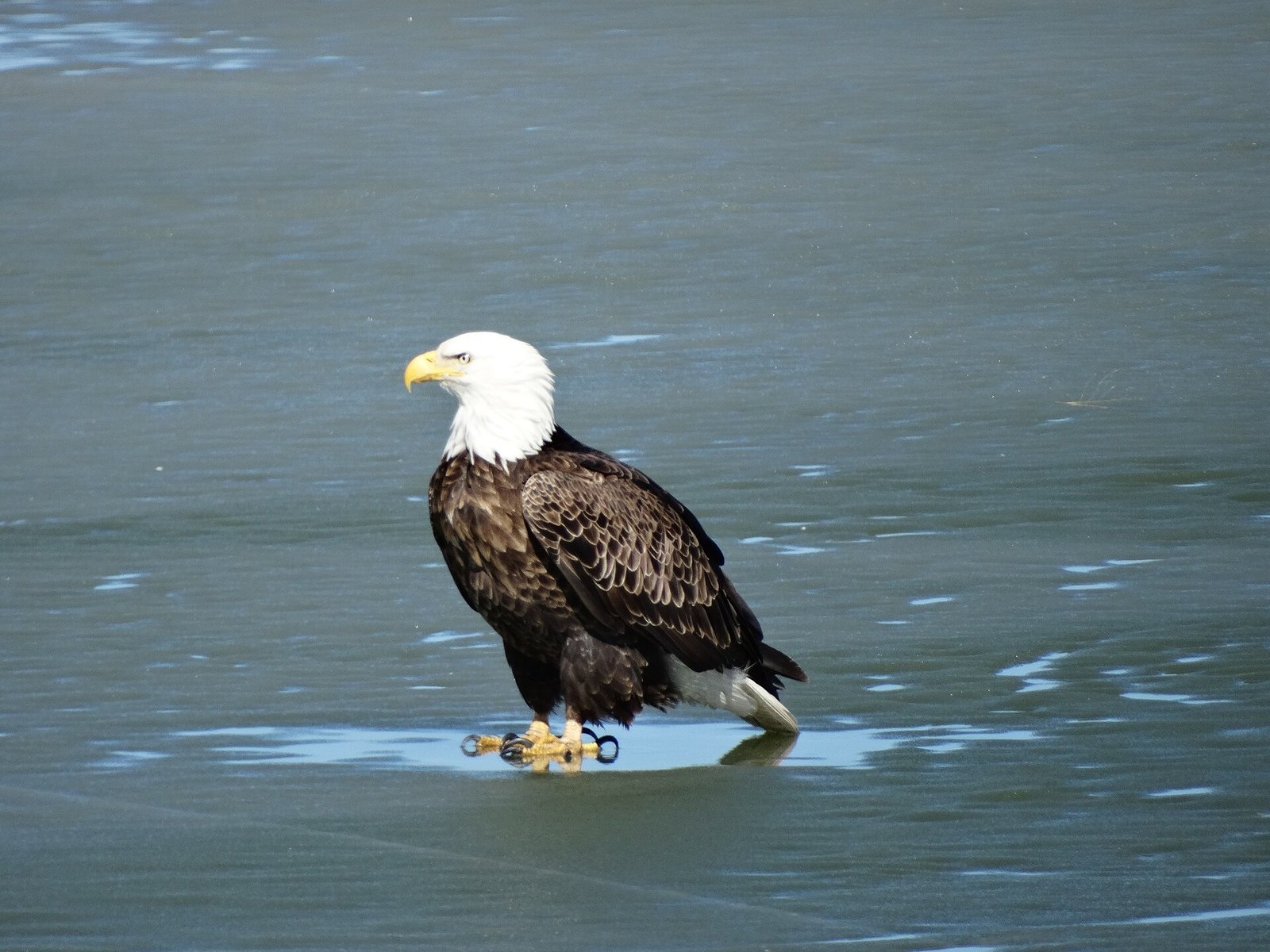
Ninety-nine percent of the injuries the center treats are caused by humans or domestic animals; about 70 percent of patients are released, its executive director said in March 20251. The 2025 published release rates — measured only among patients that survived their first 24 hours of care — give amphibians 82 percent, birds 58 percent, mammals 78 percent, reptiles 80 percent2. Lead poisoning is a recurring reason eagles arrive: one adult admitted in December 2024 had a blood lead level of 49; another, treated for a shoulder fracture and lead toxicity together, was announced for release at Banshee Reeks Nature Preserve on March 29, 2025. The center attributes the exposure to ammunition fragments in gut piles and unrecovered deer and radiographs donated venison year-round3.

Education is carried by non-releasable animals kept as ambassadors, among them a wood turtle named Jesse who could not be returned to the wild because of an eye problem and because nobody knew where she had been found. Programs run in schools within an hour's drive under names including Wild Virginia, Wildlife in Winter, Turtle Takeover, and World at Night1. The center describes itself as one of two wildlife veterinary teaching hospitals in Virginia, hosts one veterinary intern a year alongside a rehabilitation fellowship and paid summer internships with housing, and launched its first year-long veterinary, rehabilitation, and education fellowships in 20252. Its research is filed as a One Health program, with contributions on avian influenza, COVID-19 in wild animals, and tick-borne illness; a 2025 study of eastern cottontails as hosts for disease-carrying ticks was published in the Journal of Medical Entomology3.

The center's reach is regional. Clarke County did not appear among the five counties that generated the most hotline calls in 2025 — the organization's own report names Loudoun, Frederick, Fairfax, Fauquier, and Warren, in that order1. It sits in Clarke and serves the region. The IRS classifies the organization under Philanthropy, Voluntarism and Grantmaking Foundations, a category that does not describe a wildlife hospital2. The classification is a filing artifact rather than a description of the work.

Sixteen claims across twenty-five years. The center that opened as a hotline in 2000 is now the largest single-entity presence in the modern-Clarke record on this site, and its own reporting is dense enough to sustain the count that fills the 2020s bar on the /clarke-in/ dashboard.

Evidence

See the source and its limits
✓ Supported by a sourceAn account exists

The organization describes its early work in two ways: its About page and a 2025 feature call the start a wildlife assistance hotline, and the introduction to its own 2025 annual report calls it a small education effort.

What the source supports

The two descriptions of the early work that the organization itself publishes.

Uncertainty

Neither is checked against a record, and the two are not in conflict: answering calls about wildlife and teaching people about wildlife are the kind of work a small organization does at once, and nothing read here says whether these describe one activity or two. Recorded because both are published, not because either is disputed.

Source

Document

Evidence role: supports. The 2000 date, the hotline account and the facility size, in the organization's words.

Blue Ridge Wildlife Center, About Us

Blue Ridge Wildlife Center

Locator: About Us, the opening paragraph

Relevant passage
Established in 2000, the center has evolved from a wildlife assistance hotline to an advanced 8,700 sqft. facility located on the Burwell-van Lennep Foundation's conservation easement.

Checked: Page text reviewed. Original image not independently inspected.

Open source

Source family: self_published_by_the_subject. Multiple passages from one source are not independent witnesses.

Reporting

Evidence role: complicates. The annual report's description of the early work, alongside the hotline account.

Blue Ridge Wildlife Center Acknowledges a Quarter of a Century of Work in Wildlife Preservation, Human Education

Roger Bianchini, Royal Examiner · 2026-04-06 (publication)

Locator: Body, quoting the annual report's introductory message

Relevant passage
What began as a small education effort has grown into a regional center for wildlife medicine, research, education, and professional training, grounded in the understanding that the health of wildlife, people, and the environment are deeply interconnected

Checked: Page text reviewed. Original image not independently inspected.

Open source

Source family: royal-examiner-brwc. Multiple passages from one source are not independent witnesses.

AI-assisted source check · 2026-09-11. How this project checks its sources

See the source and its limits
✓ DocumentedThat it was so

Blue Ridge Wildlife Center is recognized by the IRS as a 501(c)(3) organization, EIN 54-1996991, with tax exemption issued February 2001 and a Boyce, Virginia locality on the register.

What the source supports

The organization's federal identity and the month its exemption was issued.

Uncertainty

Read from ProPublica's Nonprofit Explorer, which is an interface onto IRS data rather than an independent observer; an error in the IRS record would appear there unchanged. An exemption date is not a founding date, and the locality on a federal register is a mailing locality, not a finding about where the work is done.

Source

Document

Evidence role: supports. Federal identity, exemption month and register locality.

Blue Ridge Wildlife Center - Nonprofit Explorer

ProPublica

Locator: Organization header

Relevant passage
Blue Ridge Wildlife Center ... Boyce, VA ... Tax exemption issued: Feb. 2001 ... EIN: 54-1996991

Checked: Page text reviewed. Original image not independently inspected.

Open source

Source family: irs-derived-aggregator. Multiple passages from one source are not independent witnesses.

AI-assisted source check · 2026-09-11. How this project checks its sources

See the source and its limits
✓ Supported by a sourceThat it was so

The organization says it was established in 2000 and has grown from a wildlife assistance hotline into an 8,700 square foot facility; a Clarke Monthly feature in March 2025 described it the same way, as founded 25 years earlier and grown from a hotline into a wildlife hospital.

What the source supports

That the organization dates itself to 2000 and describes its beginning as a hotline, and that a local publication reported the same account.

Uncertainty

Both statements trace to the organization. The feature attributes its framing to the center and cites no record, so it corroborates the telling rather than the founding. No incorporation record, charter or dated document was consulted, and the date the hotline became a hospital is not established by anything read here.

Source

Document

Evidence role: supports. The 2000 date, the hotline account and the facility size, in the organization's words.

Blue Ridge Wildlife Center, About Us

Blue Ridge Wildlife Center

Locator: About Us, the opening paragraph

Relevant passage
Established in 2000, the center has evolved from a wildlife assistance hotline to an advanced 8,700 sqft. facility located on the Burwell-van Lennep Foundation's conservation easement.

Checked: Page text reviewed. Original image not independently inspected.

Open source

Source family: self_published_by_the_subject. Multiple passages from one source are not independent witnesses.

Reporting

Evidence role: supports. Local reporting giving the same founding framing the organization gives.

Blue Ridge Wildlife Center Has Impact Close to Home and Far Beyond

David Lillard, Clarke Monthly · 2025-03-05 (publication)

Locator: Body, the paragraph beginning 'Since its founding'

Relevant passage
Since its founding 25 years ago, BRWC has grown from a wildlife assistance hotline to the region's premier wildlife animal hospital and rehabilitation center.

Checked: Page text reviewed. Original image not independently inspected.

Open source

Source family: clarke-monthly-brwc. Multiple passages from one source are not independent witnesses.

AI-assisted source check · 2026-09-11. How this project checks its sources

See the source and its limits
✓ Supported by a sourceAn account exists

Blue Ridge Wildlife Center describes its work as: BRWC provides veterinary services, educational programs, professional training, and actively contributes to scientific research on local wildlife diseases and environmental threats. Operating without government funding, the Center relies entirely on donations.

What the source supports

What the organization says it does, quoted from its own site on 2026-09-11.

Uncertainty

Self-published and unverified. This is the organization's account of its own work; nothing here checks it against a program record, a filing or an independent report.

Source

Document

Evidence role: supports. The organization's own summary of what it does and how it is funded.

Blue Ridge Wildlife Center, About Us

Blue Ridge Wildlife Center

Locator: About Us, the opening paragraph

Relevant passage
BRWC provides veterinary services, educational programs, professional training, and actively contributes to scientific research on local wildlife diseases and environmental threats. Operating without government funding, the Center relies entirely on donations.

Checked: Page text reviewed. Original image not independently inspected.

Open source

Source family: self_published_by_the_subject. Multiple passages from one source are not independent witnesses.

AI-assisted source check · 2026-09-11. How this project checks its sources

See the source and its limits
✓ Supported by a sourceThat it was so

The center operates at 106 Island Farm Lane in Boyce, Clarke County, on land held under a Burwell-van Lennep Foundation conservation easement; the organization states the foundation provides the land at no cost.

What the source supports

Where the center operates and how it describes its tenure there.

Uncertainty

The land arrangement is the organization's characterization, not a record of title or tenure: no deed, lease or parcel record was inspected, and nothing here establishes who owns the land, who owns the building, or what instrument governs the use. Nor is the lessor's legal identity established; a shared surname is not evidence that two parties are one.

Source

Reporting

Evidence role: supports. The street address and county the organization publishes.

Blue Ridge Wildlife Center Acknowledges a Quarter of a Century of Work in Wildlife Preservation, Human Education

Roger Bianchini, Royal Examiner · 2026-04-06 (publication)

Locator: Contact Info

Relevant passage
The Blue Ridge Wildlife Center is located at 106 Island Farm Lane, Boyce, Virginia in Clarke County.

Checked: Page text reviewed. Original image not independently inspected.

Open source

Source family: royal-examiner-brwc. Multiple passages from one source are not independent witnesses.

Reporting

Evidence role: supports. The organization's description of the land arrangement.

Blue Ridge Wildlife Center Acknowledges a Quarter of a Century of Work in Wildlife Preservation, Human Education

Roger Bianchini, Royal Examiner · 2026-04-06 (publication)

Locator: Contact Info

Relevant passage
The BRWC is located on the Burwell-Van Lennup Foundation (BVLF) property in Boyce, Clarke County. “The mission of the BVLF includes preserving the diverse ecology of this land, protecting wildlife, and environmental education. BVLF generously provides the land to BRWC at no cost,” they report.

Checked: Page text reviewed. Original image not independently inspected.

Open source

Source family: royal-examiner-brwc. Multiple passages from one source are not independent witnesses.

AI-assisted source check · 2026-09-11. How this project checks its sources

See the source and its limits
✓ Supported by a sourceThat it was so

Clarke Monthly reported in March 2025 that none of the center's money comes from state or federal funds, that it is not allowed to charge for its services, and that everything from diagnostics to surgery to rehabilitation is free. The organization's own About page says it operates without government funding and relies entirely on donations.

What the source supports

What the article and the organization say about how the work is paid for.

Uncertainty

The statement that the center may not charge is the reporter's sentence, not a citation of any rule, and no Virginia regulation was consulted here; it is carried as reported rather than as an established legal position. The funding statement appears both in the organization's own material and in reporting that draws on it.

Source

Reporting

Evidence role: supports. That care is free and the funding is not governmental.

Blue Ridge Wildlife Center Has Impact Close to Home and Far Beyond

David Lillard, Clarke Monthly · 2025-03-05 (publication)

Locator: The breadth of impact

Relevant passage
None of the money comes from state or federal funds. Nor is BRWC allowed to charge for its services. All services are free, from diagnostics to surgery to rehab.

Checked: Page text reviewed. Original image not independently inspected.

Open source

Source family: clarke-monthly-brwc. Multiple passages from one source are not independent witnesses.

Document

Evidence role: supports. The organization's own summary of what it does and how it is funded.

Blue Ridge Wildlife Center, About Us

Blue Ridge Wildlife Center

Locator: About Us, the opening paragraph

Relevant passage
BRWC provides veterinary services, educational programs, professional training, and actively contributes to scientific research on local wildlife diseases and environmental threats. Operating without government funding, the Center relies entirely on donations.

Checked: Page text reviewed. Original image not independently inspected.

Open source

Source family: self_published_by_the_subject. Multiple passages from one source are not independent witnesses.

AI-assisted source check · 2026-09-11. How this project checks its sources

See the source and its limits
✓ Supported by a sourceThat it was so

Clarke Monthly reported in March 2025 that the center had served patients from 40 counties across four states and the District of Columbia in 2024, and that 172 species were patients that year. In the same account, without attaching a year, it gave a staff of 16 with 50 volunteers and a budget of about $1.5 million.

What the source supports

What the article reports, and which of its figures it ties to 2024.

Uncertainty

The article attributes these figures to the executive director rather than to any record the reporter examined, and no filing was consulted. The year label matters: the article ties the counties, the states and the species count to 2024 and states the staff, volunteer and budget figures without a year, so they are carried here as reported in March 2025 rather than assigned to 2024.

Source

Reporting

Evidence role: supports. The 2024 service area, as the feature reports it.

Blue Ridge Wildlife Center Has Impact Close to Home and Far Beyond

David Lillard, Clarke Monthly · 2025-03-05 (publication)

Locator: Body, the paragraph beginning 'Since its founding'

Relevant passage
In 2024, the wildlife center served patients from 40 counties across four states and the District of Columbia at its home on the Burwell-van Lennep Foundation's conservation easement

Checked: Page text reviewed. Original image not independently inspected.

Open source

Source family: clarke-monthly-brwc. Multiple passages from one source are not independent witnesses.

Reporting

Evidence role: supports. The species count and the cause-of-injury proportion, attributed in the article to the executive director.

Blue Ridge Wildlife Center Has Impact Close to Home and Far Beyond

David Lillard, Clarke Monthly · 2025-03-05 (publication)

Locator: Body, the paragraph beginning 'Like nearly all'

Relevant passage
There are raptors and reptiles, Rodentia and amphibians, bunnies and bats - 172 species were patients in 2024. Ninety-nine percent of their injuries are caused by humans or domestic animals, said Bradfield. They are injured by cars, lawnmowers, weeders, and cats or dogs.

Checked: Page text reviewed. Original image not independently inspected.

Open source

Source family: clarke-monthly-brwc. Multiple passages from one source are not independent witnesses.

Reporting

Evidence role: supports. Staff, volunteers and budget, as the March 2025 article states them without a year.

Blue Ridge Wildlife Center Has Impact Close to Home and Far Beyond

David Lillard, Clarke Monthly · 2025-03-05 (publication)

Locator: The breadth of impact

Relevant passage
It takes a staff of 16 and 50 volunteers, and a budget of about $1.5 million to treat, rehabilitate, and release the animals, and to provide veterinary and rehabilitation training and education programs.

Checked: Page text reviewed. Original image not independently inspected.

Open source

Source family: clarke-monthly-brwc. Multiple passages from one source are not independent witnesses.

AI-assisted source check · 2026-09-11. How this project checks its sources

See the source and its limits
✓ Supported by a sourceThat it was so

The organization's 2025 annual report, as Royal Examiner reported it in April 2026, records 4,005 patients of 166 species, 49,686 hotline calls, ten research studies, 13 summer rehabilitation interns contributing more than 7,000 hours, and 78 programs and events reaching over 5,000 people.

What the source supports

What the organization's 2025 annual report says about its year.

Uncertainty

Every figure originates with the organization; the reporting establishes what the report says, not that anyone checked it. The annual report itself was not obtained. The organization's year-end message three months earlier gave a narrower measure for the same year, 62 educational programs reaching more than 3,500 people, against the annual report's 78 programs and events reaching over 5,000. Both are reported here with their own wording and date; the difference in what each counts is not resolved, and neither figure corrects the other.

Source

Reporting

Evidence role: supports. Patients and species for 2025, from the annual report.

Blue Ridge Wildlife Center Acknowledges a Quarter of a Century of Work in Wildlife Preservation, Human Education

Roger Bianchini, Royal Examiner · 2026-04-06 (publication)

Locator: Body, the five annual-report categories

Relevant passage
Wildlife Medicine - “Why animals arrive, We treated 4,005 patients of 166 species in 2025”

Checked: Page text reviewed. Original image not independently inspected.

Open source

Source family: royal-examiner-brwc. Multiple passages from one source are not independent witnesses.

Reporting

Evidence role: supports. The hotline call total for 2025.

Blue Ridge Wildlife Center Acknowledges a Quarter of a Century of Work in Wildlife Preservation, Human Education

Roger Bianchini, Royal Examiner · 2026-04-06 (publication)

Locator: Body, the hotline paragraph

Relevant passage
The BRWC's Annual Report notes that it received nearly 50,000, 49,686 to be precise, Hotline Calls in 2025.

Checked: Page text reviewed. Original image not independently inspected.

Open source

Source family: royal-examiner-brwc. Multiple passages from one source are not independent witnesses.

Reporting

Evidence role: supports. Ten studies in 2025 and the one that reached a journal.

Blue Ridge Wildlife Center Acknowledges a Quarter of a Century of Work in Wildlife Preservation, Human Education

Roger Bianchini, Royal Examiner · 2026-04-06 (publication)

Locator: Body, the five annual-report categories

Relevant passage
in 2025 BRWC was involved in 10 Research Studies, one of which, ‘Eastern Cottontails as hosts for ticks infected with various diseases that can be transmitted to other animals and humans’, was published in the Journal of Medical Entomology

Checked: Page text reviewed. Original image not independently inspected.

Open source

Source family: royal-examiner-brwc. Multiple passages from one source are not independent witnesses.

Reporting

Evidence role: supports. Summer interns and the hours they contributed.

Blue Ridge Wildlife Center Acknowledges a Quarter of a Century of Work in Wildlife Preservation, Human Education

Roger Bianchini, Royal Examiner · 2026-04-06 (publication)

Locator: Body, the five annual-report categories

Relevant passage
We also welcomed 13 Summer Rehabilitation Interns.” It is reported those interns provided over 7,000 hours to the BRWC's workforce.

Checked: Page text reviewed. Original image not independently inspected.

Open source

Source family: royal-examiner-brwc. Multiple passages from one source are not independent witnesses.

Reporting

Evidence role: supports. Programs, events and reach for 2025, from the annual report.

Blue Ridge Wildlife Center Acknowledges a Quarter of a Century of Work in Wildlife Preservation, Human Education

Roger Bianchini, Royal Examiner · 2026-04-06 (publication)

Locator: Body, the five annual-report categories

Relevant passage
Public Education - “How we prevent future harm: “In 2025 we presented 78 programs and events reaching over 5,000 people.

Checked: Page text reviewed. Original image not independently inspected.

Open source

Source family: royal-examiner-brwc. Multiple passages from one source are not independent witnesses.

Document

Evidence role: complicates. The narrower education measure the organization published for 2025 in January.

Blue Ridge Wildlife Center Thanks the Community for an Amazing 2025

Blue Ridge Wildlife Center, published by Royal Examiner · 2026-01-05 (publication)

Locator: Body, the 2025 list

Relevant passage
Presented 62 educational programs reaching more than 3,500 community members... using real patient stories to inspire stewardship, reduce preventable wildlife injuries, and deepen understanding of how people and wildlife coexist.

Checked: Page text reviewed. Original image not independently inspected.

Open source

Source family: self_published_by_the_subject. Multiple passages from one source are not independent witnesses.

AI-assisted source check · 2026-09-11. How this project checks its sources

See the source and its limits
✓ Supported by a sourceThat it was so

Ninety-nine percent of the injuries the center treats are caused by humans or domestic animals, and about 70 percent of its patients are released, according to its executive director as quoted in March 2025.

What the source supports

The proportions the organization states for the cause of injury and for release.

Uncertainty

Both figures are quoted from the executive director in a feature article. Neither is traced to the underlying patient records, and nothing here tests the definition behind either number - what counts as released, or over what period.

Source

Reporting

Evidence role: supports. The species count and the cause-of-injury proportion, attributed in the article to the executive director.

Blue Ridge Wildlife Center Has Impact Close to Home and Far Beyond

David Lillard, Clarke Monthly · 2025-03-05 (publication)

Locator: Body, the paragraph beginning 'Like nearly all'

Relevant passage
There are raptors and reptiles, Rodentia and amphibians, bunnies and bats - 172 species were patients in 2024. Ninety-nine percent of their injuries are caused by humans or domestic animals, said Bradfield. They are injured by cars, lawnmowers, weeders, and cats or dogs.

Checked: Page text reviewed. Original image not independently inspected.

Open source

Source family: clarke-monthly-brwc. Multiple passages from one source are not independent witnesses.

Reporting

Evidence role: supports. The release proportion, attributed to the executive director.

Blue Ridge Wildlife Center Has Impact Close to Home and Far Beyond

David Lillard, Clarke Monthly · 2025-03-05 (publication)

Locator: Body, the paragraph beginning 'Most of the animals'

Relevant passage
Most of the animals who come to the center - 70 percent according to BRWC executive director Annie Bradfield - are able to be released back to their original ranges after surgery and rehabilitation.

Checked: Page text reviewed. Original image not independently inspected.

Open source

Source family: clarke-monthly-brwc. Multiple passages from one source are not independent witnesses.

AI-assisted source check · 2026-09-11. How this project checks its sources

See the source and its limits
✓ Supported by a sourceThat it was so

For 2025 the organization published release rates measured only among patients that survived their first 24 hours of care: amphibians 82 percent, birds 58 percent, mammals 78 percent, reptiles 80 percent.

What the source supports

The release rates the organization published for 2025 and the population they are measured against.

Uncertainty

These rates exclude any animal that died in the first day, which the organization states plainly and which is why they cannot be compared with a release rate measured on all admissions. Reported figures; the underlying records were not examined.

Source

Reporting

Evidence role: supports. The 2025 release rates and the survivor denominator they are measured against.

Blue Ridge Wildlife Center Acknowledges a Quarter of a Century of Work in Wildlife Preservation, Human Education

Roger Bianchini, Royal Examiner · 2026-04-06 (publication)

Locator: Body, the five annual-report categories

Relevant passage
Wildlife Rehabilitation - “How we return animals to the wild: Release Rates (for patients surviving the first 24 hours of care): Amphibians 82%; Birds 58%; Mammals 78%; Reptiles 80%.”

Checked: Page text reviewed. Original image not independently inspected.

Open source

Source family: royal-examiner-brwc. Multiple passages from one source are not independent witnesses.

AI-assisted source check · 2026-09-11. How this project checks its sources

See the source and its limits
✓ Supported by a sourceThat it was so

Lead poisoning is a recurring reason eagles arrive: one adult admitted in December 2024 had a blood lead level of 49, and another, treated for a shoulder fracture and lead toxicity together, was announced for release at Banshee Reeks Nature Preserve on March 29, 2025. The center attributes the exposure to ammunition fragments in gut piles and unrecovered deer, and radiographs donated venison year-round.

What the source supports

That lead poisoning appears repeatedly in the published case record, and what the organization says causes it.

Uncertainty

Two cases are two cases, not a rate: nothing here establishes how much of the caseload lead accounts for. The clinical detail in both reports comes from the organization, in one case quoted from its own social media post. The mechanism it describes is its own account and was not checked against a study. The Banshee Reeks release was announced ahead of the date; nothing read here reports that it took place.

Source

Reporting

Evidence role: supports. A measured blood lead level and what the organization says lead does.

Bald eagle brought into Blue Ridge Wildlife Center

Jacquelynn Dobrin, Rocktown Now · 2024-12-17 (publication)

Locator: Body, quoting the center's social media post

Relevant passage
The underlying culprit? A blood lead level of 49. There is no “safe” level of lead to have in the body, and lead poisoning wreaks havoc internally, causing neurologic issues, seizures, delayed reaction time, organ failure, gastrointestinal issues, and even death.

Checked: Page text reviewed. Original image not independently inspected.

Open source

Source family: rocktown-now. Multiple passages from one source are not independent witnesses.

Reporting

Evidence role: supports. The quantity the organization says is enough to kill an eagle.

Bald eagle brought into Blue Ridge Wildlife Center

Jacquelynn Dobrin, Rocktown Now · 2024-12-17 (publication)

Locator: Body, quoting the center's social media post

Relevant passage
It only takes a lead fragment the size of a grain of rice to poison and kill an eagle.

Checked: Page text reviewed. Original image not independently inspected.

Open source

Source family: rocktown-now. Multiple passages from one source are not independent witnesses.

Reporting

Evidence role: supports. One eagle's injuries and its month of treatment.

Blue Ridge Wildlife Center to Release Rehabilitated Bald Eagle at Banshee Reeks Nature Preserve

Middleburg Life · 2025-04-01 (publication)

Locator: Body

Relevant passage
The eagle was found by Officer Acosta of Loudoun County Animal Services after sustaining a right coracoid fracture (part of the shoulder) and suffering from lead toxicity. After a month of treatment, the fractured bone is well healed and the eagle is flying again.

Checked: Page text reviewed. Original image not independently inspected.

Open source

Source family: middleburg-life. Multiple passages from one source are not independent witnesses.

Reporting

Evidence role: supports. The exposure route the organization gives for lead.

Blue Ridge Wildlife Center to Release Rehabilitated Bald Eagle at Banshee Reeks Nature Preserve

Middleburg Life · 2025-04-01 (publication)

Locator: Body

Relevant passage
The exposure comes primarily from wildlife eating fragments of ammunition in gut piles or dead deer that were previously shot but survived long enough to escape the hunter, or that the hunter left behind.

Checked: Page text reviewed. Original image not independently inspected.

Open source

Source family: middleburg-life. Multiple passages from one source are not independent witnesses.

Reporting

Evidence role: supports. That donated venison is radiographed, and what has been found in it.

Bald eagle brought into Blue Ridge Wildlife Center

Jacquelynn Dobrin, Rocktown Now · 2024-12-17 (publication)

Locator: Body, quoting the center's social media post

Relevant passage
The center receives donations of venison from hunters year-round and radiograph all of it and have found that some deer shot with non-lead ammo or arrows can still have old lead shot from previous hunting attempts.

Checked: Page text reviewed. Original image not independently inspected.

Open source

Source family: rocktown-now. Multiple passages from one source are not independent witnesses.

AI-assisted source check · 2026-09-11. How this project checks its sources

See the source and its limits
✓ Supported by a sourceThat it was so

Education is carried by non-releasable animals kept as ambassadors, among them a wood turtle named Jesse who could not be returned to the wild because of an eye problem and because nobody knew where she had been found. Programs run in schools within an hour's drive under names including Wild Virginia, Wildlife in Winter, Turtle Takeover and World at Night.

What the source supports

How the education work is staffed and what it is called.

Uncertainty

From one feature article whose author visited the center. The reason given for Jesse's non-release is the organization's, and no veterinary record was seen. The article's figure of nearly 12,000 people reached carries no year and is a third measure alongside the two the organization published for 2025; the three count different things, and no source read here sets out what each includes.

Source

Reporting

Evidence role: supports. Why one wood turtle stayed, and what she does now.

Blue Ridge Wildlife Center Has Impact Close to Home and Far Beyond

David Lillard, Clarke Monthly · 2025-03-05 (publication)

Locator: Body, the paragraph beginning 'Despite the heroic efforts'

Relevant passage
So Jesse is now an ambassador and member of the education team, living the good life as a teaching animal in a safe space replicating her natural habitat at the center. She accompanies BRWC staff to schools and events, where people of all ages can see animals up close

Checked: Page text reviewed. Original image not independently inspected.

Open source

Source family: clarke-monthly-brwc. Multiple passages from one source are not independent witnesses.

Reporting

Evidence role: supports. Named programs, the school radius, and the reach figure the article gives.

Blue Ridge Wildlife Center Has Impact Close to Home and Far Beyond

David Lillard, Clarke Monthly · 2025-03-05 (publication)

Locator: Public awareness and education

Relevant passage
BRWC and their ambassadors present curriculum in schools within an hour's drive, reaching nearly 12,000 people through on and offsite programs. Popular programs include Wild Virginia, Wildlife in Winter, Turtle Takeover, and World at Night.

Checked: Page text reviewed. Original image not independently inspected.

Open source

Source family: clarke-monthly-brwc. Multiple passages from one source are not independent witnesses.

AI-assisted source check · 2026-09-11. How this project checks its sources

See the source and its limits
✓ Supported by a sourceThat it was so

The center is one of two wildlife veterinary teaching hospitals in Virginia, hosts one veterinary intern a year alongside a rehabilitation fellowship and paid summer internships with housing, and launched its first year-long veterinary, rehabilitation and education fellowships in 2025.

What the source supports

The shape of the professional training program and the organization's claim about its rarity in the state.

Uncertainty

The count of two teaching hospitals is the executive director's statement, repeated by the reporter; no register of Virginia teaching hospitals was consulted. The fellowship launch is from the organization's own year-end message.

Source

Reporting

Evidence role: supports. The claim of two teaching hospitals in the state, and that training is part of the mission.

Blue Ridge Wildlife Center Has Impact Close to Home and Far Beyond

David Lillard, Clarke Monthly · 2025-03-05 (publication)

Locator: Body, the paragraph beginning 'BRWC is one of only two'

Relevant passage
BRWC is one of only two wildlife veterinarian teaching hospitals in Virginia. Training future wildlife vets and rehabilitators is an integral part of the center's mission, said Bradfield.

Checked: Page text reviewed. Original image not independently inspected.

Open source

Source family: clarke-monthly-brwc. Multiple passages from one source are not independent witnesses.

Reporting

Evidence role: supports. The veterinary internship and how it is placed.

Blue Ridge Wildlife Center Has Impact Close to Home and Far Beyond

David Lillard, Clarke Monthly · 2025-03-05 (publication)

Locator: Training

Relevant passage
The wildlife center hosts one veterinary intern each year. The program is designed for veterinary graduates placed by their universities to complete an annual rotation at a hospital.

Checked: Page text reviewed. Original image not independently inspected.

Open source

Source family: clarke-monthly-brwc. Multiple passages from one source are not independent witnesses.

Reporting

Evidence role: supports. The fellowship and internship structure, and that the posts are paid and donor-funded.

Blue Ridge Wildlife Center Has Impact Close to Home and Far Beyond

David Lillard, Clarke Monthly · 2025-03-05 (publication)

Locator: Training

Relevant passage
BRWC also hosts an annual wildlife rehabilitation fellowship offering advanced training for experienced rehabilitators, summer rehabilitation internships, and other professional training programs. These are competitive, paid positions with housing provided - funded entirely by donations.

Checked: Page text reviewed. Original image not independently inspected.

Open source

Source family: clarke-monthly-brwc. Multiple passages from one source are not independent witnesses.

Document

Evidence role: supports. The first year-long fellowships, announced by the organization.

Blue Ridge Wildlife Center Thanks the Community for an Amazing 2025

Blue Ridge Wildlife Center, published by Royal Examiner · 2026-01-05 (publication)

Locator: Body, the 2025 list

Relevant passage
Launched our first-ever year-long veterinary, rehabilitation, and education fellowships... creating sustainable, paid training pathways that strengthen patient care today while building the next generation of wildlife professionals.

Checked: Page text reviewed. Original image not independently inspected.

Open source

Source family: self_published_by_the_subject. Multiple passages from one source are not independent witnesses.

AI-assisted source check · 2026-09-11. How this project checks its sources

See the source and its limits
✓ Supported by a sourceThat it was so

The center describes its research as a One Health program, contributing data on avian influenza, COVID-19 in wild animals and tick-borne illness; a 2025 study of eastern cottontails as hosts for disease-carrying ticks was published in the Journal of Medical Entomology.

What the source supports

What the research program covers and that one study reached a peer-reviewed journal.

Uncertainty

The journal article was not retrieved or read, and its authorship, date and the organization's role in it are not established here - only that the annual report names it. The remaining research topics are the organization's description of its own work.

Source

Reporting

Evidence role: supports. The research topics, in the executive director's words.

Blue Ridge Wildlife Center Has Impact Close to Home and Far Beyond

David Lillard, Clarke Monthly · 2025-03-05 (publication)

Locator: Research

Relevant passage
“Every patient contributes data to research,” said Bradfield. Data on avian flu, Covid 19 in wild animals, tick-borne illnesses, and more - including the Allegheny woodrat

Checked: Page text reviewed. Original image not independently inspected.

Open source

Source family: clarke-monthly-brwc. Multiple passages from one source are not independent witnesses.

Reporting

Evidence role: supports. Ten studies in 2025 and the one that reached a journal.

Blue Ridge Wildlife Center Acknowledges a Quarter of a Century of Work in Wildlife Preservation, Human Education

Roger Bianchini, Royal Examiner · 2026-04-06 (publication)

Locator: Body, the five annual-report categories

Relevant passage
in 2025 BRWC was involved in 10 Research Studies, one of which, ‘Eastern Cottontails as hosts for ticks infected with various diseases that can be transmitted to other animals and humans’, was published in the Journal of Medical Entomology

Checked: Page text reviewed. Original image not independently inspected.

Open source

Source family: royal-examiner-brwc. Multiple passages from one source are not independent witnesses.

AI-assisted source check · 2026-09-11. How this project checks its sources

See the source and its limits
✓ Supported by a sourceThat it was so

Clarke County did not appear among the five counties that generated the most hotline calls in 2025; the organization's report names Loudoun, Frederick, Fairfax, Fauquier and Warren, in that order.

What the source supports

The ranking of counties by hotline calls that the organization published for 2025.

Uncertainty

This is a count of telephone calls, and it establishes nothing about where patients come from: no source read here reports patient origin by county, for Clarke or anywhere else. The separate patient measure in evidence is the 2024 figure of 40 counties across four states and the District of Columbia, which carries no county ranking. The five named counts also total a small fraction of the year's reported call volume, so the ranking and the total are not the same measure, and the source explains neither.

Source

Reporting

Evidence role: supports. The five counties generating the most hotline calls, and that Clarke was not among them.

Blue Ridge Wildlife Center Acknowledges a Quarter of a Century of Work in Wildlife Preservation, Human Education

Roger Bianchini, Royal Examiner · 2026-04-06 (publication)

Locator: Body, the hotline paragraph

Relevant passage
The Center's home base of Clarke County didn't make that top five regional county calls list, the Center noted. Those top five county Hotline calls included Loudoun (843), Frederick (697), Fairfax (422), Fauquier (361), and Warren (318).

Checked: Page text reviewed. Original image not independently inspected.

Open source

Source family: royal-examiner-brwc. Multiple passages from one source are not independent witnesses.

AI-assisted source check · 2026-09-11. How this project checks its sources

See the source and its limits
✓ Supported by a sourceThat it was so

The IRS register files the organization under Philanthropy, Voluntarism and Grantmaking Foundations, a category that does not describe a wildlife hospital.

What the source supports

The activity category the federal register carries for this organization.

Uncertainty

An NTEE code is assigned in the federal register and is not the organization's description of itself. Why this one sits where it does was not determined: it may date from recognition, or be a keying error, or reflect something else. This is recorded as a property of the register entry and implies nothing about the organization's conduct or status.

Source

Document

Evidence role: supports. The activity category the federal register carries.

Blue Ridge Wildlife Center - Nonprofit Explorer

ProPublica

Locator: Organization summary, the Category field

Checked: Page text reviewed. Original image not independently inspected.

Open source

Source family: irs-derived-aggregator. Multiple passages from one source are not independent witnesses.

Document

Evidence role: complicates. The organization's own summary of what it does and how it is funded.

Blue Ridge Wildlife Center, About Us

Blue Ridge Wildlife Center

Locator: About Us, the opening paragraph

Relevant passage
BRWC provides veterinary services, educational programs, professional training, and actively contributes to scientific research on local wildlife diseases and environmental threats. Operating without government funding, the Center relies entirely on donations.

Checked: Page text reviewed. Original image not independently inspected.

Open source

Source family: self_published_by_the_subject. Multiple passages from one source are not independent witnesses.

AI-assisted source check · 2026-09-11. How this project checks its sources

What the sources support

Blue Ridge Wildlife Center is recognized by the IRS as a 501(c)(3) organization, EIN 54-1996991, with tax exemption issued February 2001 and a Boyce, Virginia locality on the register.

✓ Documented
See the source and its limits
✓ DocumentedThat it was so

Blue Ridge Wildlife Center is recognized by the IRS as a 501(c)(3) organization, EIN 54-1996991, with tax exemption issued February 2001 and a Boyce, Virginia locality on the register.

What the source supports

The organization's federal identity and the month its exemption was issued.

Uncertainty

Read from ProPublica's Nonprofit Explorer, which is an interface onto IRS data rather than an independent observer; an error in the IRS record would appear there unchanged. An exemption date is not a founding date, and the locality on a federal register is a mailing locality, not a finding about where the work is done.

Source

Document

Evidence role: supports. Federal identity, exemption month and register locality.

Blue Ridge Wildlife Center - Nonprofit Explorer

ProPublica

Locator: Organization header

Relevant passage
Blue Ridge Wildlife Center ... Boyce, VA ... Tax exemption issued: Feb. 2001 ... EIN: 54-1996991

Checked: Page text reviewed. Original image not independently inspected.

Open source

Source family: irs-derived-aggregator. Multiple passages from one source are not independent witnesses.

AI-assisted source check · 2026-09-11. How this project checks its sources

Blue Ridge Wildlife Center describes its work as: BRWC provides veterinary services, educational programs, professional training, and actively contributes to scientific research on local wildlife diseases and environmental threats. Operating without government funding, the Center relies entirely on donations.

✓ Supported by a source
See the source and its limits
✓ Supported by a sourceAn account exists

Blue Ridge Wildlife Center describes its work as: BRWC provides veterinary services, educational programs, professional training, and actively contributes to scientific research on local wildlife diseases and environmental threats. Operating without government funding, the Center relies entirely on donations.

What the source supports

What the organization says it does, quoted from its own site on 2026-09-11.

Uncertainty

Self-published and unverified. This is the organization's account of its own work; nothing here checks it against a program record, a filing or an independent report.

Source

Document

Evidence role: supports. The organization's own summary of what it does and how it is funded.

Blue Ridge Wildlife Center, About Us

Blue Ridge Wildlife Center

Locator: About Us, the opening paragraph

Relevant passage
BRWC provides veterinary services, educational programs, professional training, and actively contributes to scientific research on local wildlife diseases and environmental threats. Operating without government funding, the Center relies entirely on donations.

Checked: Page text reviewed. Original image not independently inspected.

Open source

Source family: self_published_by_the_subject. Multiple passages from one source are not independent witnesses.

AI-assisted source check · 2026-09-11. How this project checks its sources

The organization says it was established in 2000 and has grown from a wildlife assistance hotline into an 8,700 square foot facility; a Clarke Monthly feature in March 2025 described it the same way, as founded 25 years earlier and grown from a hotline into a wildlife hospital.

✓ Supported by a source
See the source and its limits
✓ Supported by a sourceThat it was so

The organization says it was established in 2000 and has grown from a wildlife assistance hotline into an 8,700 square foot facility; a Clarke Monthly feature in March 2025 described it the same way, as founded 25 years earlier and grown from a hotline into a wildlife hospital.

What the source supports

That the organization dates itself to 2000 and describes its beginning as a hotline, and that a local publication reported the same account.

Uncertainty

Both statements trace to the organization. The feature attributes its framing to the center and cites no record, so it corroborates the telling rather than the founding. No incorporation record, charter or dated document was consulted, and the date the hotline became a hospital is not established by anything read here.

Source

Document

Evidence role: supports. The 2000 date, the hotline account and the facility size, in the organization's words.

Blue Ridge Wildlife Center, About Us

Blue Ridge Wildlife Center

Locator: About Us, the opening paragraph

Relevant passage
Established in 2000, the center has evolved from a wildlife assistance hotline to an advanced 8,700 sqft. facility located on the Burwell-van Lennep Foundation's conservation easement.

Checked: Page text reviewed. Original image not independently inspected.

Open source

Source family: self_published_by_the_subject. Multiple passages from one source are not independent witnesses.

Reporting

Evidence role: supports. Local reporting giving the same founding framing the organization gives.

Blue Ridge Wildlife Center Has Impact Close to Home and Far Beyond

David Lillard, Clarke Monthly · 2025-03-05 (publication)

Locator: Body, the paragraph beginning 'Since its founding'

Relevant passage
Since its founding 25 years ago, BRWC has grown from a wildlife assistance hotline to the region's premier wildlife animal hospital and rehabilitation center.

Checked: Page text reviewed. Original image not independently inspected.

Open source

Source family: clarke-monthly-brwc. Multiple passages from one source are not independent witnesses.

AI-assisted source check · 2026-09-11. How this project checks its sources

The organization describes its early work in two ways: its About page and a 2025 feature call the start a wildlife assistance hotline, and the introduction to its own 2025 annual report calls it a small education effort.

✓ Supported by a source
See the source and its limits
✓ Supported by a sourceAn account exists

The organization describes its early work in two ways: its About page and a 2025 feature call the start a wildlife assistance hotline, and the introduction to its own 2025 annual report calls it a small education effort.

What the source supports

The two descriptions of the early work that the organization itself publishes.

Uncertainty

Neither is checked against a record, and the two are not in conflict: answering calls about wildlife and teaching people about wildlife are the kind of work a small organization does at once, and nothing read here says whether these describe one activity or two. Recorded because both are published, not because either is disputed.

Source

Document

Evidence role: supports. The 2000 date, the hotline account and the facility size, in the organization's words.

Blue Ridge Wildlife Center, About Us

Blue Ridge Wildlife Center

Locator: About Us, the opening paragraph

Relevant passage
Established in 2000, the center has evolved from a wildlife assistance hotline to an advanced 8,700 sqft. facility located on the Burwell-van Lennep Foundation's conservation easement.

Checked: Page text reviewed. Original image not independently inspected.

Open source

Source family: self_published_by_the_subject. Multiple passages from one source are not independent witnesses.

Reporting

Evidence role: complicates. The annual report's description of the early work, alongside the hotline account.

Blue Ridge Wildlife Center Acknowledges a Quarter of a Century of Work in Wildlife Preservation, Human Education

Roger Bianchini, Royal Examiner · 2026-04-06 (publication)

Locator: Body, quoting the annual report's introductory message

Relevant passage
What began as a small education effort has grown into a regional center for wildlife medicine, research, education, and professional training, grounded in the understanding that the health of wildlife, people, and the environment are deeply interconnected

Checked: Page text reviewed. Original image not independently inspected.

Open source

Source family: royal-examiner-brwc. Multiple passages from one source are not independent witnesses.

AI-assisted source check · 2026-09-11. How this project checks its sources

Clarke Monthly reported in March 2025 that the center had served patients from 40 counties across four states and the District of Columbia in 2024, and that 172 species were patients that year. In the same account, without attaching a year, it gave a staff of 16 with 50 volunteers and a budget of about $1.5 million.

✓ Supported by a source
See the source and its limits
✓ Supported by a sourceThat it was so

Clarke Monthly reported in March 2025 that the center had served patients from 40 counties across four states and the District of Columbia in 2024, and that 172 species were patients that year. In the same account, without attaching a year, it gave a staff of 16 with 50 volunteers and a budget of about $1.5 million.

What the source supports

What the article reports, and which of its figures it ties to 2024.

Uncertainty

The article attributes these figures to the executive director rather than to any record the reporter examined, and no filing was consulted. The year label matters: the article ties the counties, the states and the species count to 2024 and states the staff, volunteer and budget figures without a year, so they are carried here as reported in March 2025 rather than assigned to 2024.

Source

Reporting

Evidence role: supports. The 2024 service area, as the feature reports it.

Blue Ridge Wildlife Center Has Impact Close to Home and Far Beyond

David Lillard, Clarke Monthly · 2025-03-05 (publication)

Locator: Body, the paragraph beginning 'Since its founding'

Relevant passage
In 2024, the wildlife center served patients from 40 counties across four states and the District of Columbia at its home on the Burwell-van Lennep Foundation's conservation easement

Checked: Page text reviewed. Original image not independently inspected.

Open source

Source family: clarke-monthly-brwc. Multiple passages from one source are not independent witnesses.

Reporting

Evidence role: supports. The species count and the cause-of-injury proportion, attributed in the article to the executive director.

Blue Ridge Wildlife Center Has Impact Close to Home and Far Beyond

David Lillard, Clarke Monthly · 2025-03-05 (publication)

Locator: Body, the paragraph beginning 'Like nearly all'

Relevant passage
There are raptors and reptiles, Rodentia and amphibians, bunnies and bats - 172 species were patients in 2024. Ninety-nine percent of their injuries are caused by humans or domestic animals, said Bradfield. They are injured by cars, lawnmowers, weeders, and cats or dogs.

Checked: Page text reviewed. Original image not independently inspected.

Open source

Source family: clarke-monthly-brwc. Multiple passages from one source are not independent witnesses.

Reporting

Evidence role: supports. Staff, volunteers and budget, as the March 2025 article states them without a year.

Blue Ridge Wildlife Center Has Impact Close to Home and Far Beyond

David Lillard, Clarke Monthly · 2025-03-05 (publication)

Locator: The breadth of impact

Relevant passage
It takes a staff of 16 and 50 volunteers, and a budget of about $1.5 million to treat, rehabilitate, and release the animals, and to provide veterinary and rehabilitation training and education programs.

Checked: Page text reviewed. Original image not independently inspected.

Open source

Source family: clarke-monthly-brwc. Multiple passages from one source are not independent witnesses.

AI-assisted source check · 2026-09-11. How this project checks its sources

The organization's 2025 annual report, as Royal Examiner reported it in April 2026, records 4,005 patients of 166 species, 49,686 hotline calls, ten research studies, 13 summer rehabilitation interns contributing more than 7,000 hours, and 78 programs and events reaching over 5,000 people.

✓ Supported by a source
See the source and its limits
✓ Supported by a sourceThat it was so

The organization's 2025 annual report, as Royal Examiner reported it in April 2026, records 4,005 patients of 166 species, 49,686 hotline calls, ten research studies, 13 summer rehabilitation interns contributing more than 7,000 hours, and 78 programs and events reaching over 5,000 people.

What the source supports

What the organization's 2025 annual report says about its year.

Uncertainty

Every figure originates with the organization; the reporting establishes what the report says, not that anyone checked it. The annual report itself was not obtained. The organization's year-end message three months earlier gave a narrower measure for the same year, 62 educational programs reaching more than 3,500 people, against the annual report's 78 programs and events reaching over 5,000. Both are reported here with their own wording and date; the difference in what each counts is not resolved, and neither figure corrects the other.

Source

Reporting

Evidence role: supports. Patients and species for 2025, from the annual report.

Blue Ridge Wildlife Center Acknowledges a Quarter of a Century of Work in Wildlife Preservation, Human Education

Roger Bianchini, Royal Examiner · 2026-04-06 (publication)

Locator: Body, the five annual-report categories

Relevant passage
Wildlife Medicine - “Why animals arrive, We treated 4,005 patients of 166 species in 2025”

Checked: Page text reviewed. Original image not independently inspected.

Open source

Source family: royal-examiner-brwc. Multiple passages from one source are not independent witnesses.

Reporting

Evidence role: supports. The hotline call total for 2025.

Blue Ridge Wildlife Center Acknowledges a Quarter of a Century of Work in Wildlife Preservation, Human Education

Roger Bianchini, Royal Examiner · 2026-04-06 (publication)

Locator: Body, the hotline paragraph

Relevant passage
The BRWC's Annual Report notes that it received nearly 50,000, 49,686 to be precise, Hotline Calls in 2025.

Checked: Page text reviewed. Original image not independently inspected.

Open source

Source family: royal-examiner-brwc. Multiple passages from one source are not independent witnesses.

Reporting

Evidence role: supports. Ten studies in 2025 and the one that reached a journal.

Blue Ridge Wildlife Center Acknowledges a Quarter of a Century of Work in Wildlife Preservation, Human Education

Roger Bianchini, Royal Examiner · 2026-04-06 (publication)

Locator: Body, the five annual-report categories

Relevant passage
in 2025 BRWC was involved in 10 Research Studies, one of which, ‘Eastern Cottontails as hosts for ticks infected with various diseases that can be transmitted to other animals and humans’, was published in the Journal of Medical Entomology

Checked: Page text reviewed. Original image not independently inspected.

Open source

Source family: royal-examiner-brwc. Multiple passages from one source are not independent witnesses.

Reporting

Evidence role: supports. Summer interns and the hours they contributed.

Blue Ridge Wildlife Center Acknowledges a Quarter of a Century of Work in Wildlife Preservation, Human Education

Roger Bianchini, Royal Examiner · 2026-04-06 (publication)

Locator: Body, the five annual-report categories

Relevant passage
We also welcomed 13 Summer Rehabilitation Interns.” It is reported those interns provided over 7,000 hours to the BRWC's workforce.

Checked: Page text reviewed. Original image not independently inspected.

Open source

Source family: royal-examiner-brwc. Multiple passages from one source are not independent witnesses.

Reporting

Evidence role: supports. Programs, events and reach for 2025, from the annual report.

Blue Ridge Wildlife Center Acknowledges a Quarter of a Century of Work in Wildlife Preservation, Human Education

Roger Bianchini, Royal Examiner · 2026-04-06 (publication)

Locator: Body, the five annual-report categories

Relevant passage
Public Education - “How we prevent future harm: “In 2025 we presented 78 programs and events reaching over 5,000 people.

Checked: Page text reviewed. Original image not independently inspected.

Open source

Source family: royal-examiner-brwc. Multiple passages from one source are not independent witnesses.

Document

Evidence role: complicates. The narrower education measure the organization published for 2025 in January.

Blue Ridge Wildlife Center Thanks the Community for an Amazing 2025

Blue Ridge Wildlife Center, published by Royal Examiner · 2026-01-05 (publication)

Locator: Body, the 2025 list

Relevant passage
Presented 62 educational programs reaching more than 3,500 community members... using real patient stories to inspire stewardship, reduce preventable wildlife injuries, and deepen understanding of how people and wildlife coexist.

Checked: Page text reviewed. Original image not independently inspected.

Open source

Source family: self_published_by_the_subject. Multiple passages from one source are not independent witnesses.

AI-assisted source check · 2026-09-11. How this project checks its sources

Ninety-nine percent of the injuries the center treats are caused by humans or domestic animals, and about 70 percent of its patients are released, according to its executive director as quoted in March 2025.

✓ Supported by a source
See the source and its limits
✓ Supported by a sourceThat it was so

Ninety-nine percent of the injuries the center treats are caused by humans or domestic animals, and about 70 percent of its patients are released, according to its executive director as quoted in March 2025.

What the source supports

The proportions the organization states for the cause of injury and for release.

Uncertainty

Both figures are quoted from the executive director in a feature article. Neither is traced to the underlying patient records, and nothing here tests the definition behind either number - what counts as released, or over what period.

Source

Reporting

Evidence role: supports. The species count and the cause-of-injury proportion, attributed in the article to the executive director.

Blue Ridge Wildlife Center Has Impact Close to Home and Far Beyond

David Lillard, Clarke Monthly · 2025-03-05 (publication)

Locator: Body, the paragraph beginning 'Like nearly all'

Relevant passage
There are raptors and reptiles, Rodentia and amphibians, bunnies and bats - 172 species were patients in 2024. Ninety-nine percent of their injuries are caused by humans or domestic animals, said Bradfield. They are injured by cars, lawnmowers, weeders, and cats or dogs.

Checked: Page text reviewed. Original image not independently inspected.

Open source

Source family: clarke-monthly-brwc. Multiple passages from one source are not independent witnesses.

Reporting

Evidence role: supports. The release proportion, attributed to the executive director.

Blue Ridge Wildlife Center Has Impact Close to Home and Far Beyond

David Lillard, Clarke Monthly · 2025-03-05 (publication)

Locator: Body, the paragraph beginning 'Most of the animals'

Relevant passage
Most of the animals who come to the center - 70 percent according to BRWC executive director Annie Bradfield - are able to be released back to their original ranges after surgery and rehabilitation.

Checked: Page text reviewed. Original image not independently inspected.

Open source

Source family: clarke-monthly-brwc. Multiple passages from one source are not independent witnesses.

AI-assisted source check · 2026-09-11. How this project checks its sources

For 2025 the organization published release rates measured only among patients that survived their first 24 hours of care: amphibians 82 percent, birds 58 percent, mammals 78 percent, reptiles 80 percent.

✓ Supported by a source
See the source and its limits
✓ Supported by a sourceThat it was so

For 2025 the organization published release rates measured only among patients that survived their first 24 hours of care: amphibians 82 percent, birds 58 percent, mammals 78 percent, reptiles 80 percent.

What the source supports

The release rates the organization published for 2025 and the population they are measured against.

Uncertainty

These rates exclude any animal that died in the first day, which the organization states plainly and which is why they cannot be compared with a release rate measured on all admissions. Reported figures; the underlying records were not examined.

Source

Reporting

Evidence role: supports. The 2025 release rates and the survivor denominator they are measured against.

Blue Ridge Wildlife Center Acknowledges a Quarter of a Century of Work in Wildlife Preservation, Human Education

Roger Bianchini, Royal Examiner · 2026-04-06 (publication)

Locator: Body, the five annual-report categories

Relevant passage
Wildlife Rehabilitation - “How we return animals to the wild: Release Rates (for patients surviving the first 24 hours of care): Amphibians 82%; Birds 58%; Mammals 78%; Reptiles 80%.”

Checked: Page text reviewed. Original image not independently inspected.

Open source

Source family: royal-examiner-brwc. Multiple passages from one source are not independent witnesses.

AI-assisted source check · 2026-09-11. How this project checks its sources

Clarke Monthly reported in March 2025 that none of the center's money comes from state or federal funds, that it is not allowed to charge for its services, and that everything from diagnostics to surgery to rehabilitation is free. The organization's own About page says it operates without government funding and relies entirely on donations.

✓ Supported by a source
See the source and its limits
✓ Supported by a sourceThat it was so

Clarke Monthly reported in March 2025 that none of the center's money comes from state or federal funds, that it is not allowed to charge for its services, and that everything from diagnostics to surgery to rehabilitation is free. The organization's own About page says it operates without government funding and relies entirely on donations.

What the source supports

What the article and the organization say about how the work is paid for.

Uncertainty

The statement that the center may not charge is the reporter's sentence, not a citation of any rule, and no Virginia regulation was consulted here; it is carried as reported rather than as an established legal position. The funding statement appears both in the organization's own material and in reporting that draws on it.

Source

Reporting

Evidence role: supports. That care is free and the funding is not governmental.

Blue Ridge Wildlife Center Has Impact Close to Home and Far Beyond

David Lillard, Clarke Monthly · 2025-03-05 (publication)

Locator: The breadth of impact

Relevant passage
None of the money comes from state or federal funds. Nor is BRWC allowed to charge for its services. All services are free, from diagnostics to surgery to rehab.

Checked: Page text reviewed. Original image not independently inspected.

Open source

Source family: clarke-monthly-brwc. Multiple passages from one source are not independent witnesses.

Document

Evidence role: supports. The organization's own summary of what it does and how it is funded.

Blue Ridge Wildlife Center, About Us

Blue Ridge Wildlife Center

Locator: About Us, the opening paragraph

Relevant passage
BRWC provides veterinary services, educational programs, professional training, and actively contributes to scientific research on local wildlife diseases and environmental threats. Operating without government funding, the Center relies entirely on donations.

Checked: Page text reviewed. Original image not independently inspected.

Open source

Source family: self_published_by_the_subject. Multiple passages from one source are not independent witnesses.

AI-assisted source check · 2026-09-11. How this project checks its sources

Lead poisoning is a recurring reason eagles arrive: one adult admitted in December 2024 had a blood lead level of 49, and another, treated for a shoulder fracture and lead toxicity together, was announced for release at Banshee Reeks Nature Preserve on March 29, 2025. The center attributes the exposure to ammunition fragments in gut piles and unrecovered deer, and radiographs donated venison year-round.

✓ Supported by a source
See the source and its limits
✓ Supported by a sourceThat it was so

Lead poisoning is a recurring reason eagles arrive: one adult admitted in December 2024 had a blood lead level of 49, and another, treated for a shoulder fracture and lead toxicity together, was announced for release at Banshee Reeks Nature Preserve on March 29, 2025. The center attributes the exposure to ammunition fragments in gut piles and unrecovered deer, and radiographs donated venison year-round.

What the source supports

That lead poisoning appears repeatedly in the published case record, and what the organization says causes it.

Uncertainty

Two cases are two cases, not a rate: nothing here establishes how much of the caseload lead accounts for. The clinical detail in both reports comes from the organization, in one case quoted from its own social media post. The mechanism it describes is its own account and was not checked against a study. The Banshee Reeks release was announced ahead of the date; nothing read here reports that it took place.

Source

Reporting

Evidence role: supports. A measured blood lead level and what the organization says lead does.

Bald eagle brought into Blue Ridge Wildlife Center

Jacquelynn Dobrin, Rocktown Now · 2024-12-17 (publication)

Locator: Body, quoting the center's social media post

Relevant passage
The underlying culprit? A blood lead level of 49. There is no “safe” level of lead to have in the body, and lead poisoning wreaks havoc internally, causing neurologic issues, seizures, delayed reaction time, organ failure, gastrointestinal issues, and even death.

Checked: Page text reviewed. Original image not independently inspected.

Open source

Source family: rocktown-now. Multiple passages from one source are not independent witnesses.

Reporting

Evidence role: supports. The quantity the organization says is enough to kill an eagle.

Bald eagle brought into Blue Ridge Wildlife Center

Jacquelynn Dobrin, Rocktown Now · 2024-12-17 (publication)

Locator: Body, quoting the center's social media post

Relevant passage
It only takes a lead fragment the size of a grain of rice to poison and kill an eagle.

Checked: Page text reviewed. Original image not independently inspected.

Open source

Source family: rocktown-now. Multiple passages from one source are not independent witnesses.

Reporting

Evidence role: supports. One eagle's injuries and its month of treatment.

Blue Ridge Wildlife Center to Release Rehabilitated Bald Eagle at Banshee Reeks Nature Preserve

Middleburg Life · 2025-04-01 (publication)

Locator: Body

Relevant passage
The eagle was found by Officer Acosta of Loudoun County Animal Services after sustaining a right coracoid fracture (part of the shoulder) and suffering from lead toxicity. After a month of treatment, the fractured bone is well healed and the eagle is flying again.

Checked: Page text reviewed. Original image not independently inspected.

Open source

Source family: middleburg-life. Multiple passages from one source are not independent witnesses.

Reporting

Evidence role: supports. The exposure route the organization gives for lead.

Blue Ridge Wildlife Center to Release Rehabilitated Bald Eagle at Banshee Reeks Nature Preserve

Middleburg Life · 2025-04-01 (publication)

Locator: Body

Relevant passage
The exposure comes primarily from wildlife eating fragments of ammunition in gut piles or dead deer that were previously shot but survived long enough to escape the hunter, or that the hunter left behind.

Checked: Page text reviewed. Original image not independently inspected.

Open source

Source family: middleburg-life. Multiple passages from one source are not independent witnesses.

Reporting

Evidence role: supports. That donated venison is radiographed, and what has been found in it.

Bald eagle brought into Blue Ridge Wildlife Center

Jacquelynn Dobrin, Rocktown Now · 2024-12-17 (publication)

Locator: Body, quoting the center's social media post

Relevant passage
The center receives donations of venison from hunters year-round and radiograph all of it and have found that some deer shot with non-lead ammo or arrows can still have old lead shot from previous hunting attempts.

Checked: Page text reviewed. Original image not independently inspected.

Open source

Source family: rocktown-now. Multiple passages from one source are not independent witnesses.

AI-assisted source check · 2026-09-11. How this project checks its sources

Education is carried by non-releasable animals kept as ambassadors, among them a wood turtle named Jesse who could not be returned to the wild because of an eye problem and because nobody knew where she had been found. Programs run in schools within an hour's drive under names including Wild Virginia, Wildlife in Winter, Turtle Takeover and World at Night.

✓ Supported by a source
See the source and its limits
✓ Supported by a sourceThat it was so

Education is carried by non-releasable animals kept as ambassadors, among them a wood turtle named Jesse who could not be returned to the wild because of an eye problem and because nobody knew where she had been found. Programs run in schools within an hour's drive under names including Wild Virginia, Wildlife in Winter, Turtle Takeover and World at Night.

What the source supports

How the education work is staffed and what it is called.

Uncertainty

From one feature article whose author visited the center. The reason given for Jesse's non-release is the organization's, and no veterinary record was seen. The article's figure of nearly 12,000 people reached carries no year and is a third measure alongside the two the organization published for 2025; the three count different things, and no source read here sets out what each includes.

Source

Reporting

Evidence role: supports. Why one wood turtle stayed, and what she does now.

Blue Ridge Wildlife Center Has Impact Close to Home and Far Beyond

David Lillard, Clarke Monthly · 2025-03-05 (publication)

Locator: Body, the paragraph beginning 'Despite the heroic efforts'

Relevant passage
So Jesse is now an ambassador and member of the education team, living the good life as a teaching animal in a safe space replicating her natural habitat at the center. She accompanies BRWC staff to schools and events, where people of all ages can see animals up close

Checked: Page text reviewed. Original image not independently inspected.

Open source

Source family: clarke-monthly-brwc. Multiple passages from one source are not independent witnesses.

Reporting

Evidence role: supports. Named programs, the school radius, and the reach figure the article gives.

Blue Ridge Wildlife Center Has Impact Close to Home and Far Beyond

David Lillard, Clarke Monthly · 2025-03-05 (publication)

Locator: Public awareness and education

Relevant passage
BRWC and their ambassadors present curriculum in schools within an hour's drive, reaching nearly 12,000 people through on and offsite programs. Popular programs include Wild Virginia, Wildlife in Winter, Turtle Takeover, and World at Night.

Checked: Page text reviewed. Original image not independently inspected.

Open source

Source family: clarke-monthly-brwc. Multiple passages from one source are not independent witnesses.

AI-assisted source check · 2026-09-11. How this project checks its sources

The center is one of two wildlife veterinary teaching hospitals in Virginia, hosts one veterinary intern a year alongside a rehabilitation fellowship and paid summer internships with housing, and launched its first year-long veterinary, rehabilitation and education fellowships in 2025.

✓ Supported by a source
See the source and its limits
✓ Supported by a sourceThat it was so

The center is one of two wildlife veterinary teaching hospitals in Virginia, hosts one veterinary intern a year alongside a rehabilitation fellowship and paid summer internships with housing, and launched its first year-long veterinary, rehabilitation and education fellowships in 2025.

What the source supports

The shape of the professional training program and the organization's claim about its rarity in the state.

Uncertainty

The count of two teaching hospitals is the executive director's statement, repeated by the reporter; no register of Virginia teaching hospitals was consulted. The fellowship launch is from the organization's own year-end message.

Source

Reporting

Evidence role: supports. The claim of two teaching hospitals in the state, and that training is part of the mission.

Blue Ridge Wildlife Center Has Impact Close to Home and Far Beyond

David Lillard, Clarke Monthly · 2025-03-05 (publication)

Locator: Body, the paragraph beginning 'BRWC is one of only two'

Relevant passage
BRWC is one of only two wildlife veterinarian teaching hospitals in Virginia. Training future wildlife vets and rehabilitators is an integral part of the center's mission, said Bradfield.

Checked: Page text reviewed. Original image not independently inspected.

Open source

Source family: clarke-monthly-brwc. Multiple passages from one source are not independent witnesses.

Reporting

Evidence role: supports. The veterinary internship and how it is placed.

Blue Ridge Wildlife Center Has Impact Close to Home and Far Beyond

David Lillard, Clarke Monthly · 2025-03-05 (publication)

Locator: Training

Relevant passage
The wildlife center hosts one veterinary intern each year. The program is designed for veterinary graduates placed by their universities to complete an annual rotation at a hospital.

Checked: Page text reviewed. Original image not independently inspected.

Open source

Source family: clarke-monthly-brwc. Multiple passages from one source are not independent witnesses.

Reporting

Evidence role: supports. The fellowship and internship structure, and that the posts are paid and donor-funded.

Blue Ridge Wildlife Center Has Impact Close to Home and Far Beyond

David Lillard, Clarke Monthly · 2025-03-05 (publication)

Locator: Training

Relevant passage
BRWC also hosts an annual wildlife rehabilitation fellowship offering advanced training for experienced rehabilitators, summer rehabilitation internships, and other professional training programs. These are competitive, paid positions with housing provided - funded entirely by donations.

Checked: Page text reviewed. Original image not independently inspected.

Open source

Source family: clarke-monthly-brwc. Multiple passages from one source are not independent witnesses.

Document

Evidence role: supports. The first year-long fellowships, announced by the organization.

Blue Ridge Wildlife Center Thanks the Community for an Amazing 2025

Blue Ridge Wildlife Center, published by Royal Examiner · 2026-01-05 (publication)

Locator: Body, the 2025 list

Relevant passage
Launched our first-ever year-long veterinary, rehabilitation, and education fellowships... creating sustainable, paid training pathways that strengthen patient care today while building the next generation of wildlife professionals.

Checked: Page text reviewed. Original image not independently inspected.

Open source

Source family: self_published_by_the_subject. Multiple passages from one source are not independent witnesses.

AI-assisted source check · 2026-09-11. How this project checks its sources

The center describes its research as a One Health program, contributing data on avian influenza, COVID-19 in wild animals and tick-borne illness; a 2025 study of eastern cottontails as hosts for disease-carrying ticks was published in the Journal of Medical Entomology.

✓ Supported by a source
See the source and its limits
✓ Supported by a sourceThat it was so

The center describes its research as a One Health program, contributing data on avian influenza, COVID-19 in wild animals and tick-borne illness; a 2025 study of eastern cottontails as hosts for disease-carrying ticks was published in the Journal of Medical Entomology.

What the source supports

What the research program covers and that one study reached a peer-reviewed journal.

Uncertainty

The journal article was not retrieved or read, and its authorship, date and the organization's role in it are not established here - only that the annual report names it. The remaining research topics are the organization's description of its own work.

Source

Reporting

Evidence role: supports. The research topics, in the executive director's words.

Blue Ridge Wildlife Center Has Impact Close to Home and Far Beyond

David Lillard, Clarke Monthly · 2025-03-05 (publication)

Locator: Research

Relevant passage
“Every patient contributes data to research,” said Bradfield. Data on avian flu, Covid 19 in wild animals, tick-borne illnesses, and more - including the Allegheny woodrat

Checked: Page text reviewed. Original image not independently inspected.

Open source

Source family: clarke-monthly-brwc. Multiple passages from one source are not independent witnesses.

Reporting

Evidence role: supports. Ten studies in 2025 and the one that reached a journal.

Blue Ridge Wildlife Center Acknowledges a Quarter of a Century of Work in Wildlife Preservation, Human Education

Roger Bianchini, Royal Examiner · 2026-04-06 (publication)

Locator: Body, the five annual-report categories

Relevant passage
in 2025 BRWC was involved in 10 Research Studies, one of which, ‘Eastern Cottontails as hosts for ticks infected with various diseases that can be transmitted to other animals and humans’, was published in the Journal of Medical Entomology

Checked: Page text reviewed. Original image not independently inspected.

Open source

Source family: royal-examiner-brwc. Multiple passages from one source are not independent witnesses.

AI-assisted source check · 2026-09-11. How this project checks its sources

The center operates at 106 Island Farm Lane in Boyce, Clarke County, on land held under a Burwell-van Lennep Foundation conservation easement; the organization states the foundation provides the land at no cost.

✓ Supported by a source
See the source and its limits
✓ Supported by a sourceThat it was so

The center operates at 106 Island Farm Lane in Boyce, Clarke County, on land held under a Burwell-van Lennep Foundation conservation easement; the organization states the foundation provides the land at no cost.

What the source supports

Where the center operates and how it describes its tenure there.

Uncertainty

The land arrangement is the organization's characterization, not a record of title or tenure: no deed, lease or parcel record was inspected, and nothing here establishes who owns the land, who owns the building, or what instrument governs the use. Nor is the lessor's legal identity established; a shared surname is not evidence that two parties are one.

Source

Reporting

Evidence role: supports. The street address and county the organization publishes.

Blue Ridge Wildlife Center Acknowledges a Quarter of a Century of Work in Wildlife Preservation, Human Education

Roger Bianchini, Royal Examiner · 2026-04-06 (publication)

Locator: Contact Info

Relevant passage
The Blue Ridge Wildlife Center is located at 106 Island Farm Lane, Boyce, Virginia in Clarke County.

Checked: Page text reviewed. Original image not independently inspected.

Open source

Source family: royal-examiner-brwc. Multiple passages from one source are not independent witnesses.

Reporting

Evidence role: supports. The organization's description of the land arrangement.

Blue Ridge Wildlife Center Acknowledges a Quarter of a Century of Work in Wildlife Preservation, Human Education

Roger Bianchini, Royal Examiner · 2026-04-06 (publication)

Locator: Contact Info

Relevant passage
The BRWC is located on the Burwell-Van Lennup Foundation (BVLF) property in Boyce, Clarke County. “The mission of the BVLF includes preserving the diverse ecology of this land, protecting wildlife, and environmental education. BVLF generously provides the land to BRWC at no cost,” they report.

Checked: Page text reviewed. Original image not independently inspected.

Open source

Source family: royal-examiner-brwc. Multiple passages from one source are not independent witnesses.

AI-assisted source check · 2026-09-11. How this project checks its sources

Clarke County did not appear among the five counties that generated the most hotline calls in 2025; the organization's report names Loudoun, Frederick, Fairfax, Fauquier and Warren, in that order.

✓ Supported by a source
See the source and its limits
✓ Supported by a sourceThat it was so

Clarke County did not appear among the five counties that generated the most hotline calls in 2025; the organization's report names Loudoun, Frederick, Fairfax, Fauquier and Warren, in that order.

What the source supports

The ranking of counties by hotline calls that the organization published for 2025.

Uncertainty

This is a count of telephone calls, and it establishes nothing about where patients come from: no source read here reports patient origin by county, for Clarke or anywhere else. The separate patient measure in evidence is the 2024 figure of 40 counties across four states and the District of Columbia, which carries no county ranking. The five named counts also total a small fraction of the year's reported call volume, so the ranking and the total are not the same measure, and the source explains neither.

Source

Reporting

Evidence role: supports. The five counties generating the most hotline calls, and that Clarke was not among them.

Blue Ridge Wildlife Center Acknowledges a Quarter of a Century of Work in Wildlife Preservation, Human Education

Roger Bianchini, Royal Examiner · 2026-04-06 (publication)

Locator: Body, the hotline paragraph

Relevant passage
The Center's home base of Clarke County didn't make that top five regional county calls list, the Center noted. Those top five county Hotline calls included Loudoun (843), Frederick (697), Fairfax (422), Fauquier (361), and Warren (318).

Checked: Page text reviewed. Original image not independently inspected.

Open source

Source family: royal-examiner-brwc. Multiple passages from one source are not independent witnesses.

AI-assisted source check · 2026-09-11. How this project checks its sources

The IRS register files the organization under Philanthropy, Voluntarism and Grantmaking Foundations, a category that does not describe a wildlife hospital.

✓ Supported by a source
See the source and its limits
✓ Supported by a sourceThat it was so

The IRS register files the organization under Philanthropy, Voluntarism and Grantmaking Foundations, a category that does not describe a wildlife hospital.

What the source supports

The activity category the federal register carries for this organization.

Uncertainty

An NTEE code is assigned in the federal register and is not the organization's description of itself. Why this one sits where it does was not determined: it may date from recognition, or be a keying error, or reflect something else. This is recorded as a property of the register entry and implies nothing about the organization's conduct or status.

Source

Document

Evidence role: supports. The activity category the federal register carries.

Blue Ridge Wildlife Center - Nonprofit Explorer

ProPublica

Locator: Organization summary, the Category field

Checked: Page text reviewed. Original image not independently inspected.

Open source

Source family: irs-derived-aggregator. Multiple passages from one source are not independent witnesses.

Document

Evidence role: complicates. The organization's own summary of what it does and how it is funded.

Blue Ridge Wildlife Center, About Us

Blue Ridge Wildlife Center

Locator: About Us, the opening paragraph

Relevant passage
BRWC provides veterinary services, educational programs, professional training, and actively contributes to scientific research on local wildlife diseases and environmental threats. Operating without government funding, the Center relies entirely on donations.

Checked: Page text reviewed. Original image not independently inspected.

Open source

Source family: self_published_by_the_subject. Multiple passages from one source are not independent witnesses.

AI-assisted source check · 2026-09-11. How this project checks its sources

In the chronology

Also indexed as: BLUE RIDGE WILDLIFE CENTER; BRWC.

Know something about this place or record? Help fill a gap. It stays private until it is reviewed.

Keep exploring

Related stories

Civic life & gathering✓ Supported

Inside Blue Ridge Wildlife Center

Blue Ridge Wildlife Center treats about four thousand wild animals a year, free, on an easement outside Boyce. By its own account almost all of them were hurt by people.

What the evidence says Scale, care, education and location from six published articles and pages, with almost every figure originating from the organization itself.

  • 5 min read
  • 7 sources

Search

Searches the released collection only.