Clarke County, Virginia

Every place has a story.
Discover ours.

Explore the people, places, photographs, films, and evidence that shaped Clarke County, Virginia.

Line drawing of Clarke County at Berryville: farm fields and the town on the valley floor, the Shenandoah River, and the Blue Ridge.

Find a person or place needs JavaScript. Explore people and places or browse records instead.

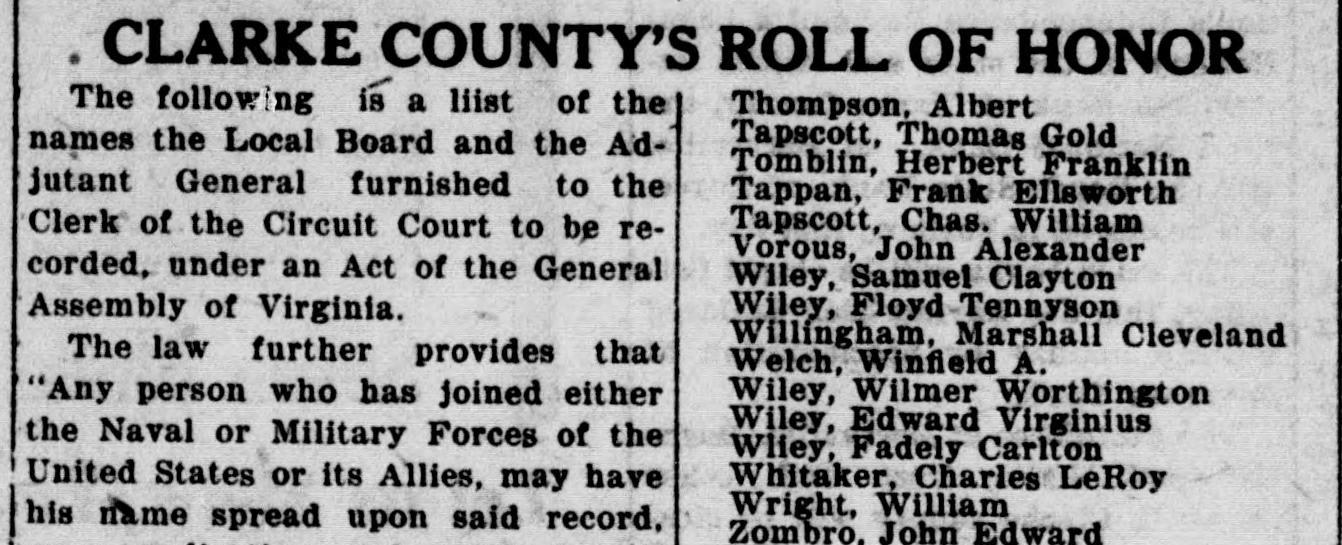
The top of a newspaper page headed "Clarke County's Roll of Honor": an opening paragraph about the list recorded with the Clerk of the Circuit Court, beside a column of names from Thompson, Albert to Zombro, John Edward.
The top of "Clarke County's Roll of Honor" in the Clarke Courier, July 3, 1919. Clarke Courier (Berryville, Va.), July 3, 1919, page 1. Library of Congress, Chronicling America.
Veterans of Clarke County

2,312 names on the roll, and counting.

The veterans page

A roll of Clarke County veterans who have died, built from Confederate rolls, cemetery registers, memorial books and this site's own research, with more added war by war. Search it for a name, read the soldiers whose records support a full page, or tell us about someone who is missing. Living veterans appear only at their own request.

Visit the veterans page Search the roll Add a veteran

Stories

A few stories to begin with.

View all 55 stories
Working Clarke✓ Supported

Bellview and the Sprints

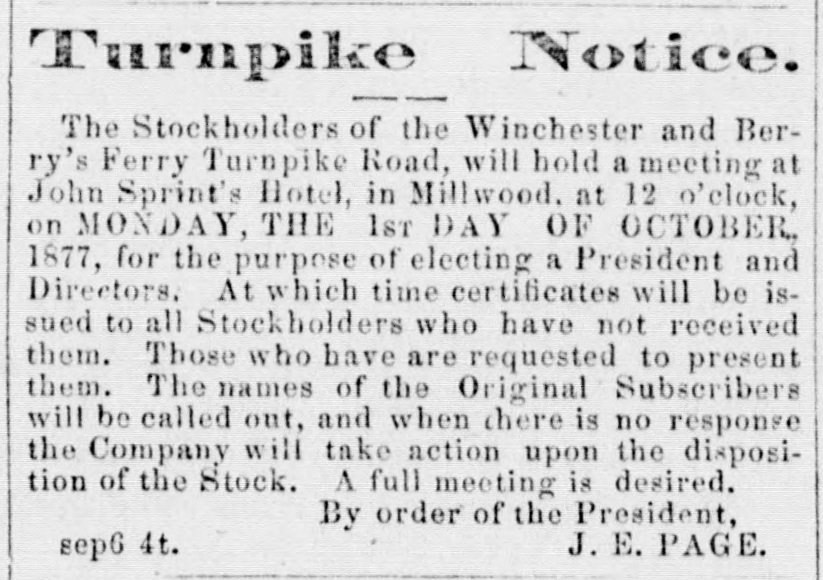
In 1877 a turnpike company called its stockholders to meet at John Sprint's Hotel in Millwood, and by 1882 J. W. Sprint & Son was advertising phosphates at Boyce. A will B. F. Humston signed in 1902 provided the Bellview farm to his daughter, Mamie R. Sprint, for life; it was admitted to record in 1904. Her son J. Ashby Sprint acquired orchard property, exported apples and leased land under a packing house at White Post. The records trace Mamie's family and Ashby's trade, while leaving the hotel's John Sprint and the firm's partners incompletely identified.

What the evidence says Humston's recorded will gives Mamie R. Sprint the Bellview farm for life. Courier notices place a Sprint packing house at Boyce and a leased packing-house site at White Post, but none names who ran the Boyce house, and the 1936 sale was advertised, not shown to be completed.

  • 5 min read
  • 21 sources
Land, work & community✓ Supported

Mary F. Lewis’s Civil War property claim

In 1864, according to her later claim, Union forces took horses, livestock and grain from Mary F. Lewis's farm near Boyce. The record follows her claim to a court valuation and an 1899 appropriation. Whether the money was paid has not been found.

What the evidence says Three federal records for the claim, the valuation and the appropriation; a family essay for the rest. No payment record.

  • 3 min read
  • 5 sources
Working Clarke✓ Supported

Tomatoes under glass on Route 7.

In 1942 a six-year-old sold watermelons from a wagon at Route 7 and Chilly Hollow Road. He ran the stand that grew out of it for more than forty-five years, and told the story himself in 2013.

What the evidence says Wagon, stand and greenhouses documented from one attributed interview. Land history not established.

  • 2 min read
  • 2 sources
Before Clarke was Clarke

The valley belonged to Indigenous peoples for at least twelve thousand years.

The full page

Two Clovis points at site 44CK26 place human presence in what is now Clarke County at least 12,000 years ago. When English settlers first wrote about this region in the 1600s, the northern Shenandoah Valley was a populated, cultivated, and used landscape connected to the Potomac, Piedmont, and Susquehanna nations. Living Native nations remain, with their own governments, and this page names them.

Read Indigenous Clarke

How this works

You can check any of it.

Every story shows what we know, what remains uncertain, and where you can explore the original sources.

Everything on this site comes from somewhere, and we say where. Open the drawer under any statement and you get the source, what it supports, and — the part most local history leaves out — what it does not establish.

Some of what you will read is documented. Some of it is what people remember, or what they have always said about a place. Both belong here, as long as we are clear which is which.

What we know

  • ✓ DocumentedA named source records this directly.
  • ✓ Supported by a sourceA named source supports this account. That an account exists is not the same as the events in it being established.

What people remember

  • ◇ Local traditionPeople have told this story. The source records the telling, not the event.

What remains uncertain

  • ? UnconfirmedNobody has established this. It is kept because dropping it would hide a real part of the record.

53 stories · 690 people and places · 764 sources · 82 chronology records, 81 of them dated. Sources and methods.

Search

Searches the released collection only.