
Built by a barkeeper
Siz Daingerfield, a Black barkeeper, put up a two-story hall on East Main Street and named it for the singer Jenny Winston. Both accounts agree on that much — the Legion's telling, and the bank's, which calls him "a black man named Siz Dangerfield". The Legion says 1881. The bank says 1884, built as a theater with a stage and dressing rooms, opened in 1885 with a performance by Winston herself. Neither cites a record, and both dates are kept.
Source note: Early Meeting Hall (Post 41 Berryville, and one more
A history page maintained for American Legion Post 41 states that Winston Hall stood on East Main Street where the Bank of Clarke County driveway is now, that it was built in 1881 by Siz Daingerfield, whom it describes as a Black barkeeper, and that it was named for the singer Jenny Winston.
What the source supports
The Legion's account of the builder, the date and the name, and its description of the site.
Uncertainty
An uncited retrospective. The bank's history gives 1884 as the building date, an 1885 opening, and spells the builder's name Dangerfield; the two accounts are not reconciled here. "Where the driveway is now" is the source's locator, not a parcel.
Source
Evidence role: supports. The Legion page's opening sentences.
Early Meeting Hall (Post 41 Berryville, Virginia, American Legion Centennial Celebration site)
American Legion Post 41, Berryville (post-submitted history)
Locator: First paragraph
Relevant passageWinston Hall was on East Main Street where the Bank of Clarke County driveway is now located. Built in 1881 by Siz Daingerfield, a black barkeep, it was named for singer, Jenny Winston.
Checked: Page text reviewed. Original image not independently inspected.
Open sourceSource family: legion-post-41-centennial. Multiple passages from one source are not independent witnesses.
Evidence role: complicates. The bank history's different date and spelling.
Bank of Clarke County history, page 102
Bank of Clarke County
Locator: Page 102, on the building's origin
Relevant passageIt was originally built in 1884 by a black man named Siz Dangerfield who operated a saloon for whites across the street. It was known as Winston Hall (named after Jennie Winston who gave a performance there the night the hall was opened in 1885)
Checked: Page text reviewed. Original image not independently inspected.
Open sourceSource family: bank-of-clarke-history. Multiple passages from one source are not independent witnesses.
AI-assisted source check (Claude Fable 5.1) · 2026-09-10. How this project checks its sources
Source note: Bank of Clarke County
The bank's history says the hall was built as a theater with a stage and dressing rooms, opened in 1885 with a performance by Jennie Winston, and was where cotillions were danced, the Legion held bazaars and the county National Guard unit was housed.
What the source supports
The bank's own description of what the hall was for and what happened in it.
Uncertainty
A retelling with no citation, written for a bank anniversary. Its 1884 building date and 1885 opening differ from the Legion's 1881.
Source
Evidence role: supports. The bank on the builder, the name and the 1885 opening.
Bank of Clarke County history, page 102
Bank of Clarke County
Locator: Page 102, on the building's origin
Relevant passageIt was originally built in 1884 by a black man named Siz Dangerfield who operated a saloon for whites across the street. It was known as Winston Hall (named after Jennie Winston who gave a performance there the night the hall was opened in 1885)
Checked: Page text reviewed. Original image not independently inspected.
Open sourceSource family: bank-of-clarke-history. Multiple passages from one source are not independent witnesses.
Evidence role: supports. The bank on the theater and its uses.
Bank of Clarke County history, page 102
Bank of Clarke County
Locator: Page 102, on the hall's use and end
Relevant passageWinston Hall was built as a theater, complete with stage and dressing rooms. ... Winston Hall would be demolished in 1962 and made into a parking lot.
Checked: Page text reviewed. Original image not independently inspected.
Open sourceSource family: bank-of-clarke-history. Multiple passages from one source are not independent witnesses.
AI-assisted source check (Claude Fable 5.1) · 2026-09-10. How this project checks its sources
Upstairs and downstairs
Upstairs, the Legion's page says, was the largest meeting hall in town, used for entertainments and school graduations; the bank remembers cotillions and Legion bazaars there. Downstairs was commerce: a saloon by the Legion's account, later Griffin Taylor's clothing store while he ran the hall, and later still the farm machinery and cigars of the owners James W. Gaver and Fred Morris. Post 41 itself met upstairs from 1920 until 1938.
Source note: Early Meeting Hall (Post 41 Berryville, and one more
The Legion account describes the upstairs as the largest meeting hall in town, used for entertainments and school graduations, with a saloon downstairs, and says Post 41 met there from 1920 until 1938.
What the source supports
The hall's uses as the Legion remembers them, and the span of its own meetings there.
Uncertainty
The bank's history places Daingerfield's saloon across the street rather than downstairs. The Legion's meeting dates are its own institutional memory.
Source
Evidence role: supports. The Legion page on the hall's uses and its meetings.
Early Meeting Hall (Post 41 Berryville, Virginia, American Legion Centennial Celebration site)
American Legion Post 41, Berryville (post-submitted history)
Locator: First paragraph, continued
Relevant passageUpstairs was the largest meeting hall in the town and was used for entertainments and even school graduations; down stairs was the saloon. From 1920 until 1938, American Legion Post 41 used Winston Hall for its meetings.
Checked: Page text reviewed. Original image not independently inspected.
Open sourceSource family: legion-post-41-centennial. Multiple passages from one source are not independent witnesses.
Evidence role: complicates. The bank history on the saloon's location.
Bank of Clarke County history, page 102
Bank of Clarke County
Locator: Page 102, on the building's origin
Relevant passageIt was originally built in 1884 by a black man named Siz Dangerfield who operated a saloon for whites across the street. It was known as Winston Hall (named after Jennie Winston who gave a performance there the night the hall was opened in 1885)
Checked: Page text reviewed. Original image not independently inspected.
Open sourceSource family: bank-of-clarke-history. Multiple passages from one source are not independent witnesses.
AI-assisted source check (Claude Fable 5.1) · 2026-09-10. How this project checks its sources
Source note: Early Meeting Hall (Post 41 Berryville
The Legion account names Griffin Taylor as the hall's operator for years, with a clothing store below, and later owners James W. Gaver and Fred Morris, who sold farm machinery and cigars.
What the source supports
Named people who ran or owned the building, and what was sold there.
Uncertainty
Operator and owner are the source's words; no deed or licence was inspected. Dates for these tenancies are not given. The bank later bought "the Morris building" from the heirs of F. H. Morris, which is consistent but not the same name.
Source
Evidence role: supports. The Legion page's second paragraph.
Early Meeting Hall (Post 41 Berryville, Virginia, American Legion Centennial Celebration site)
American Legion Post 41, Berryville (post-submitted history)
Locator: Second paragraph
Relevant passageGriffin Taylor operated Winston Hall for years with a clothing store below. Later, owners James W. Gaver and Fred Morris sold farm machinery and cigars.
Checked: Page text reviewed. Original image not independently inspected.
Open sourceSource family: legion-post-41-centennial. Multiple passages from one source are not independent witnesses.
AI-assisted source check (Claude Fable 5.1) · 2026-09-10. How this project checks its sources
It was originally built in 1884 by a black man named Siz Dangerfield who operated a saloon for whites across the street. It was known as Winston Hall (named after Jennie Winston who gave a performance there the night the hall was opened in 1885)
Guardsmen, then bankers
From 1922 to 1939 the Virginia National Guard rented the upper floor as the armory of Headquarters Company, 91st Infantry Brigade. In February 1957 the Bank of Clarke County, next door to the west, bought "the Morris building" from F. H. Morris's heirs for $25,000, wanting a drive-through. In 1962 the hall came down for the bank's expansion and parking, which is where the sources say to look for it now.
Source note: Early Meeting Hall (Post 41 Berryville
The Legion account states that the Virginia National Guard rented the upstairs from 1922 to 1939 as the armory of Headquarters Company, 91st Infantry Brigade.
What the source supports
The armory use and its span, as the Legion reports them.
Uncertainty
The bank's history also says the county Guard unit was housed there but gives no dates.
Source
Evidence role: supports. The Legion page on the armory rental.
Early Meeting Hall (Post 41 Berryville, Virginia, American Legion Centennial Celebration site)
American Legion Post 41, Berryville (post-submitted history)
Locator: Second paragraph, on the armory
Relevant passageFrom 1922 to 1939, the upstairs portion of the building was rented by the Virginia National Guard and served as the armory for Headquarters Company of the 91st Infantry Brigade.
Checked: Page text reviewed. Original image not independently inspected.
Open sourceSource family: legion-post-41-centennial. Multiple passages from one source are not independent witnesses.
AI-assisted source check (Claude Fable 5.1) · 2026-09-10. How this project checks its sources
Source note: Early Meeting Hall (Post 41 Berryville, and one more
Two accounts agree that the Bank of Clarke County bought the building in 1957 and demolished it in 1962 for bank expansion and parking; the bank's own history dates the purchase to February 1957, at $25,000, from the heirs of F. H. Morris.
What the source supports
The end of the building: purchase and demolition, with the bank recording its own transaction.
Uncertainty
No deed or demolition permit was inspected. The Legion gives the purpose as expanding the bank building and parking lot; the bank says a drive-through and a parking lot.
Source
Evidence role: supports. The Legion page on the 1957 purchase and 1962 demolition.
Early Meeting Hall (Post 41 Berryville, Virginia, American Legion Centennial Celebration site)
American Legion Post 41, Berryville (post-submitted history)
Locator: Second paragraph, last sentence
Relevant passageIn 1957, the building was purchased by the Bank of Clarke County and demolished in 1962 to expand the bank building and parking lot.
Checked: Page text reviewed. Original image not independently inspected.
Open sourceSource family: legion-post-41-centennial. Multiple passages from one source are not independent witnesses.
Evidence role: supports. The bank's record of its February 1957 purchase.
Bank of Clarke County history, page 102
Bank of Clarke County
Locator: Page 102, entry for 1957
Relevant passageIn February of 1957, Bank of Clarke County purchased the Morris building that adjoined the Bank on the east for $25,000 from the heirs of the late F. H. Morris for future bank expansion, primarily to give the bank a drive-through option.
Checked: Page text reviewed. Original image not independently inspected.
Open sourceSource family: bank-of-clarke-history. Multiple passages from one source are not independent witnesses.
Evidence role: supports. The bank on the 1962 demolition.
Bank of Clarke County history, page 102
Bank of Clarke County
Locator: Page 102, on the hall's use and end
Relevant passageWinston Hall was built as a theater, complete with stage and dressing rooms. ... Winston Hall would be demolished in 1962 and made into a parking lot.
Checked: Page text reviewed. Original image not independently inspected.
Open sourceSource family: bank-of-clarke-history. Multiple passages from one source are not independent witnesses.
AI-assisted source check (Claude Fable 5.1) · 2026-09-10. How this project checks its sources
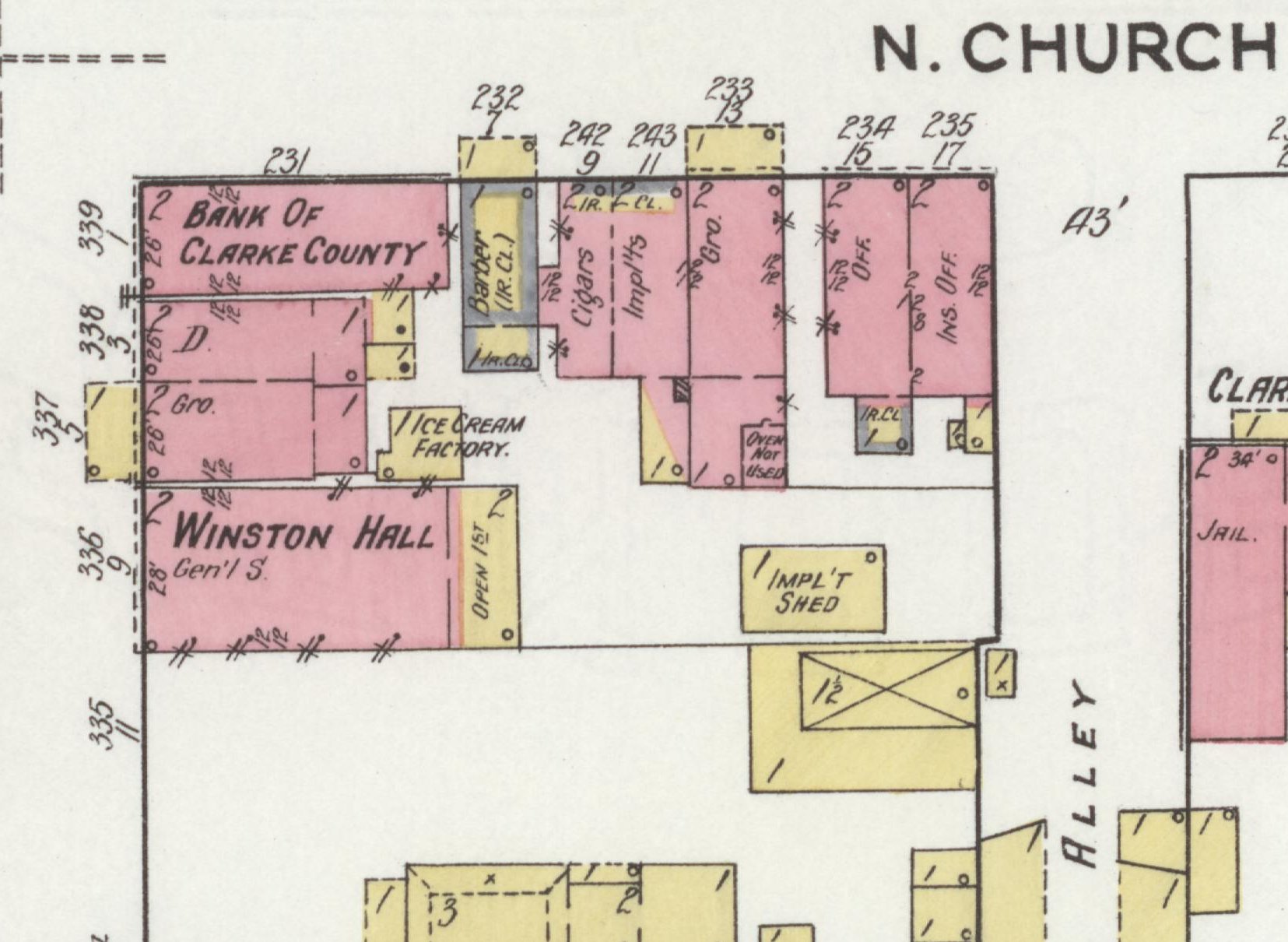
Winston Hall footprint labeled on Sanborn Fire Insurance sheet, Berryville, March 1921. Marked Gen'l S. in this survey.
What this image does and does not showThis shows only the fire-insurance surveyor's 1921 record of building footprint, construction, and recorded use. It is not a photograph, and it does not show what the building looked like or what took place in the hall.
Sanborn Map Company, Sanborn Fire Insurance Map from Berryville, Clark County, Virginia, March 1921, sheet 2. Library of Congress, Geography and Map Division, Sanborn Maps Collection. Rights Changes: A detail cut from the Library of Congress scan of the whole sheet, which is 6,450 by 7,650 pixels: the rectangle from x 2,205 to 3,860 and y 4,176 to 5,386, kept at those 1,655 by 1,210 pixels, not scaled, and re-encoded as JPEG. Nothing retouched, recolored or added.
Source: Sanborn Fire Insurance Map from Berryville, Clark County, Virginia, Mar. 1921, sheet 2 of 5 (Library of Congress item) Open the full image
Two accounts, two dates
The Legion's page and the bank's history were each written to remember an institution, not to document a building. They agree on the builder, the name, the uses and the ending, and differ on the year it was built and on which side of the street the saloon stood. No deed, license or newspaper has been inspected for this story. The differences are left standing.
About the accountsWhat the evidence says
Builder, uses and ending documented by two accounts. Building year disputed.
Two institutional histories, the Legion post's and the bank's, independently describe Winston Hall, its builder Siz Daingerfield, its meeting hall and theater, the Legion and National Guard uses, and the bank's purchase in 1957 and demolition in 1962. They give different building years, 1881 and 1884, and place the saloon differently. Both are attributed; neither is corrected.
- An account exists✓ Supported by a source
A history page maintained for American Legion Post 41 states that Winston Hall stood on East Main Street where the Bank of Clarke County driveway is now, that it was built in 1881 by Siz Daingerfield, whom it describes as a Black barkeeper, and that it was named for the singer Jenny Winston.
See the evidence
✓ Supported by a sourceAn account existsA history page maintained for American Legion Post 41 states that Winston Hall stood on East Main Street where the Bank of Clarke County driveway is now, that it was built in 1881 by Siz Daingerfield, whom it describes as a Black barkeeper, and that it was named for the singer Jenny Winston.
What the source supports
The Legion's account of the builder, the date and the name, and its description of the site.
Uncertainty
An uncited retrospective. The bank's history gives 1884 as the building date, an 1885 opening, and spells the builder's name Dangerfield; the two accounts are not reconciled here. "Where the driveway is now" is the source's locator, not a parcel.
Source
Later historical account Evidence role: supports. The Legion page's opening sentences.
Early Meeting Hall (Post 41 Berryville, Virginia, American Legion Centennial Celebration site)
American Legion Post 41, Berryville (post-submitted history)
Locator: First paragraph
Relevant passageWinston Hall was on East Main Street where the Bank of Clarke County driveway is now located. Built in 1881 by Siz Daingerfield, a black barkeep, it was named for singer, Jenny Winston.
Checked: Page text reviewed. Original image not independently inspected.
Open sourceSource family: legion-post-41-centennial. Multiple passages from one source are not independent witnesses.
Later historical account Evidence role: complicates. The bank history's different date and spelling.
Bank of Clarke County history, page 102
Bank of Clarke County
Locator: Page 102, on the building's origin
Relevant passageIt was originally built in 1884 by a black man named Siz Dangerfield who operated a saloon for whites across the street. It was known as Winston Hall (named after Jennie Winston who gave a performance there the night the hall was opened in 1885)
Checked: Page text reviewed. Original image not independently inspected.
Open sourceSource family: bank-of-clarke-history. Multiple passages from one source are not independent witnesses.
AI-assisted source check (Claude Fable 5.1) · 2026-09-10. How this project checks its sources
- That it happened✓ Documented
Two accounts agree that the Bank of Clarke County bought the building in 1957 and demolished it in 1962 for bank expansion and parking; the bank's own history dates the purchase to February 1957, at $25,000, from the heirs of F. H. Morris.
See the evidence
✓ DocumentedThat it happenedTwo accounts agree that the Bank of Clarke County bought the building in 1957 and demolished it in 1962 for bank expansion and parking; the bank's own history dates the purchase to February 1957, at $25,000, from the heirs of F. H. Morris.
What the source supports
The end of the building: purchase and demolition, with the bank recording its own transaction.
Uncertainty
No deed or demolition permit was inspected. The Legion gives the purpose as expanding the bank building and parking lot; the bank says a drive-through and a parking lot.
Source
Later historical account Evidence role: supports. The Legion page on the 1957 purchase and 1962 demolition.
Early Meeting Hall (Post 41 Berryville, Virginia, American Legion Centennial Celebration site)
American Legion Post 41, Berryville (post-submitted history)
Locator: Second paragraph, last sentence
Relevant passageIn 1957, the building was purchased by the Bank of Clarke County and demolished in 1962 to expand the bank building and parking lot.
Checked: Page text reviewed. Original image not independently inspected.
Open sourceSource family: legion-post-41-centennial. Multiple passages from one source are not independent witnesses.
Later historical account Evidence role: supports. The bank's record of its February 1957 purchase.
Bank of Clarke County history, page 102
Bank of Clarke County
Locator: Page 102, entry for 1957
Relevant passageIn February of 1957, Bank of Clarke County purchased the Morris building that adjoined the Bank on the east for $25,000 from the heirs of the late F. H. Morris for future bank expansion, primarily to give the bank a drive-through option.
Checked: Page text reviewed. Original image not independently inspected.
Open sourceSource family: bank-of-clarke-history. Multiple passages from one source are not independent witnesses.
Later historical account Evidence role: supports. The bank on the 1962 demolition.
Bank of Clarke County history, page 102
Bank of Clarke County
Locator: Page 102, on the hall's use and end
Relevant passageWinston Hall was built as a theater, complete with stage and dressing rooms. ... Winston Hall would be demolished in 1962 and made into a parking lot.
Checked: Page text reviewed. Original image not independently inspected.
Open sourceSource family: bank-of-clarke-history. Multiple passages from one source are not independent witnesses.
AI-assisted source check (Claude Fable 5.1) · 2026-09-10. How this project checks its sources
- An account exists✓ Supported by a source
The bank's history says the hall was built as a theater with a stage and dressing rooms, opened in 1885 with a performance by Jennie Winston, and was where cotillions were danced, the Legion held bazaars and the county National Guard unit was housed.
See the evidence
✓ Supported by a sourceAn account existsThe bank's history says the hall was built as a theater with a stage and dressing rooms, opened in 1885 with a performance by Jennie Winston, and was where cotillions were danced, the Legion held bazaars and the county National Guard unit was housed.
What the source supports
The bank's own description of what the hall was for and what happened in it.
Uncertainty
A retelling with no citation, written for a bank anniversary. Its 1884 building date and 1885 opening differ from the Legion's 1881.
Source
Later historical account Evidence role: supports. The bank on the builder, the name and the 1885 opening.
Bank of Clarke County history, page 102
Bank of Clarke County
Locator: Page 102, on the building's origin
Relevant passageIt was originally built in 1884 by a black man named Siz Dangerfield who operated a saloon for whites across the street. It was known as Winston Hall (named after Jennie Winston who gave a performance there the night the hall was opened in 1885)
Checked: Page text reviewed. Original image not independently inspected.
Open sourceSource family: bank-of-clarke-history. Multiple passages from one source are not independent witnesses.
Later historical account Evidence role: supports. The bank on the theater and its uses.
Bank of Clarke County history, page 102
Bank of Clarke County
Locator: Page 102, on the hall's use and end
Relevant passageWinston Hall was built as a theater, complete with stage and dressing rooms. ... Winston Hall would be demolished in 1962 and made into a parking lot.
Checked: Page text reviewed. Original image not independently inspected.
Open sourceSource family: bank-of-clarke-history. Multiple passages from one source are not independent witnesses.
AI-assisted source check (Claude Fable 5.1) · 2026-09-10. How this project checks its sources
Each statement above is assessed on its own evidence. Nothing here is averaged, scored or voted on, and a well-attributed account can be documented while what it describes stays unconfirmed.
Which year is right, 1881 or 1884, and what did the deed and the town license say about who owned and ran the hall?
Know more about this story, or see something to correct? Help fill a gap. It stays private until it is reviewed.
Remember this place or someone in this story? Share a memory, even if you do not know the date. It stays private until it is reviewed.
Go deeper: every source under this story Follow another threadThree restaurants at 9 East Main Street
The same street, a century later, where the record is thinner and the lesson is the same: say what the source says.