
James Frank Moore
A letter to the editor in the Clarke Courier of June 29, 1922 tells of James Frank Moore, known as "Jim," an old Confederate soldier. The letter says he came into the courthouse from his home in the Blue Ridge and said he had not had money enough to go to the veterans' reunion at Richmond. Its headline, which calls for a Carnegie medal, says he risked his life to save his brother after the brother fell from a horse and broke a leg in the Shenandoah River.
Civil War as the cited records state it
Also written: "Jim" Moore. Each name is shown as a source gives it.
- 1 record cited
- 2 statements
- 2 images shown
Is this the same man?
IDENTITY Confirmed The page rests on one Courier item that names him; no other record is matched to him here.
Clarke connection: Qualified: the Courier letter of June 29, 1922 says he came into the courthouse from his home in the Blue Ridge (C879). The passage does not name the county, and no residence record has been read.
This page rests on one record.
Evidence depth: Recorded
Service summary
Only the fields a record supplies, in the record's own words. The full statement is under What the records say.
| Field | As the record prints it | Source | RECORD | IDENTITY |
|---|---|---|---|---|
| War | Civil War | Clarke Courier, Berryville, Va., June 29, 1922 The statement | RECORD Likely | IDENTITY Confirmed |
What the records say
Each line is a statement from a cited source, in the source's own terms, with the three questions asked of it. Same man as the one on this page?
| When | What the record shows | RECORD | IDENTITY | Source |
|---|---|---|---|---|
| Date not established | The Clarke Courier of June 29, 1922 prints a letter to the editor, headed as a call for a Carnegie hero medal, about James Frank Moore, known as "Jim," an old Confederate soldier who came into the courthouse from his home in the Blue Ridge, said he had not had money enough to go to the veterans' reunion at Richmond, and who, the headline says, risked his life to save his brother after the brother fell from a horse and broke a leg in the Shenandoah River. | RECORD Likely | IDENTITY ConfirmedThis is the item the entity was created from. | See the source and its limits✓ LikelyAn account exists
The Clarke Courier of June 29, 1922 prints a letter to the editor, headed as a call for a Carnegie hero medal, about James Frank Moore, known as "Jim," an old Confederate soldier who came into the courthouse from his home in the Blue Ridge, said he had not had money enough to go to the veterans' reunion at Richmond, and who, the headline says, risked his life to save his brother after the brother fell from a horse and broke a leg in the Shenandoah River. What the source supportsThat James Frank Moore, a Confederate veteran of the Blue Ridge, was the subject of a 1922 letter praising a river rescue. UncertaintyRead from uncorrected OCR, not from the page image. The rescue is told in the headline and in the writer's account; the passage breaks off before his own telling. The letter writer is not named in the passage. His brother is not named. SourceEvidence role: supports. The June 29, 1922 letter to the editor. Clarke Courier, Berryville, Va., June 29, 1922Clarke Courier · 1922-06-29 (publication) Locator: Page 4, letter "Here's Clarke Man Who Deserves a Carnegie Hero Medal" Relevant passageJames Frank Moore, [OCR unclear] Old Confederate Warrior' Risks Life to Save Brother, Who Fell from Horse and Broke Leg in Souks [South] Shenandoah River. ... It was none other than Mr. James Frank Moore, known to his friends as “Jim" Moore. Checked: Existing OCR reviewed. Original image not independently inspected. Open sourceSource family: clarke-courier. Multiple passages from one source are not independent witnesses. Evidence role: supports. The rescue account in the letter, read from the page image and shown in the clipping above. Clarke Courier, Berryville, Va., June 29, 1922Clarke Courier · 1922-06-29 (publication) Locator: Clarke Courier, Berryville, Va., June 29, 1922, page 4 of the issue, per the Library of Congress record (printed page not recorded: the page prints no number), letter "Here's Clarke Man Who Deserves a Carnegie Hero Medal", middle part, the passage beginning ""You know my brother Alf. we..." Relevant passage"You know my brother Alf., we call him 'Coon; well, mour'n a ear [sic] ago, mour'n two year I reckin; early in April we was crossing the river (Shenandoah) with a four-horse team. We had a right wild leader and he wouldn't take the water, the river had gone up over night. So I sez 'Coon, I'll mount the leader and you stay on the saddle horse. Well, after getting started, I thought we was allright and I kept looking ahead for the ford. Finallly [sic], I tuck a look back and Coon was gone. Checked: This passage was read on a digital reproduction of the page; no original has been handled. The source's other readings: existing OCR reviewed, original image not independently inspected. Open sourceSource family: clarke-courier. Multiple passages from one source are not independent witnesses. |
| Date not established | The letter in the Clarke Courier of June 29, 1922 that calls for a Carnegie hero medal for James Frank Moore is signed with the initials "W. A. B.", and closes with the line "Here lies one who loved his fellowman." | RECORD Likely | IDENTITY UnconfirmedNo identity statement has been recorded for this statement. | See the source and its limits✓ LikelyAn account exists
The letter in the Clarke Courier of June 29, 1922 that calls for a Carnegie hero medal for James Frank Moore is signed with the initials "W. A. B.", and closes with the line "Here lies one who loved his fellowman." What the source supportsWho signed the letter about Moore, as far as the paper prints it: initials only. UncertaintyThe paper prints only the initials; the writer is not named anywhere in the letter or the issue. The closing lines are set at the foot of another column and do not name Moore; the letter they end is the one C879 describes. Read on the page image of the Library of Congress digital reproduction. No human historian has reviewed this claim. SourceEvidence role: supports. Clarke Courier, Berryville, Va., June 29, 1922, page 4 of the issue, per the Library of Congress record (printed page not recorded: the page prints no number), letter "Here's Clarke Man Who Deserves a Carnegie Hero Medal", last lines. Clarke Courier, Berryville, Va., June 29, 1922Clarke Courier · 1922-06-29 (publication) Locator: Clarke Courier, Berryville, Va., June 29, 1922, page 4 of the issue, per the Library of Congress record (printed page not recorded: the page prints no number), letter "Here's Clarke Man Who Deserves a Carnegie Hero Medal", last lines Relevant passagewrote of Ben Adhem: "Here lies one who loved his fellowman." W. A. B. Checked: This passage was read on a digital reproduction of the page; no original has been handled. The source's other readings: existing OCR reviewed, original image not independently inspected. Open sourceSource family: clarke-courier. Multiple passages from one source are not independent witnesses. |
Evidence gallery
Each image is the document itself, cropped from a saved original, and is shown only after a check by a reader who did not choose it found that it supports the passage it is cited for. Open one to read it closely.

The middle of the letter headed Here's Clarke Man Who Deserves a Carnegie Hero Medal in the Clarke Courier of June 29, 1922: a first-person account of crossing the Shenandoah with a four-horse team and bringing a brother out of the river, and the writer's comment on the deed.
What this image does and does not showA crop of part of one newspaper page; the rest of the page is not shown. The column begins and ends mid-sentence. This part of the letter does not print Mr. Moore's name; the opening of the letter, which does, is in another crop of the page.
Clarke Courier (Berryville, Va.), June 29, 1922, page 4 (as numbered by the Library of Congress). Library of Congress, Chronicling America. Rights Changes: Cut from the Library of Congress page image at full resolution (the region lies at box 1178,1471 332x2224 pixels of the saved half-size copy of the page) and shown at its own 665 by 4448 pixels; not scaled, retouched, enhanced, highlighted or re-encoded.
Source: Clarke Courier, Berryville, Va., June 29, 1922 Open the full image
What this image is evidence for
Passage it reproduces: Clarke Courier, Berryville, Va., June 29, 1922, page 4 of the issue, per the Library of Congress record (printed page not recorded: the page prints no number), letter "Here's Clarke Man Who Deserves a Carnegie Hero Medal", middle part, the passage beginning ""You know my brother Alf. we..."
Statements on this site that rest on it:
- The Clarke Courier of June 29, 1922 prints a letter to the editor, headed as a call for a Carnegie hero medal, about James Frank Moore, known as "Jim," an old Confederate soldier who came into the courthouse from his home in the Blue Ridge, said he had not had money enough to go to the veterans' reunion at Richmond, and who, the headline says, risked his life to save his brother after the brother fell from a horse and broke a leg in the Shenandoah River.
People namedJames Frank Moore
Clarke Courier, Berryville, Va., June 29, 1922, page 4 (numbered by the Library of Congress; the page prints no number).
Typed transcription
"You know my brother Alf., we call him 'Coon; well, mour'n a ear [sic] ago, mour'n two year I reckin; early in April we was crossing the river (Shenandoah) with a four-horse team. We had a right wild leader and he wouldn't take the water, the river had gone up over night. So I sez 'Coon, I'll mount the leader and you stay on the saddle horse. Well, after getting started, I thought we was allright and I kept looking ahead for the ford. Finallly [sic], I tuck a look back and Coon was gone. The saddle horse had blundered and throwed him over his head and tht [sic] wheel had run over and badly broken his leg. I swept the river with my eye and seen his hat floating in the water some distance below me. I slid down offen the leader and with the water right up to my neck I beat my way back to where I thought he must be and sho 'nough his body come up not far from me and went down, and when it come up the second time I grabbed him and floundered back to the wagon and managed to get him in. If I had not been customed to the water I could not have drargged [sic] him back or even saved myself. But we got across, got help and soon got a doctor." What a simple recital of a splendid deed. When this drama was enacted, no drums were beating, no flags were flying, no grandstand was shouting its applause. No human eye beheld this noble if not knightly act. None saw it save the blue sky above, the billowy waters as they went rolling by, the tall sycamores standing like silent sentinels along the river's brim and the Omnipotent One who we are told suffers not a sparrow to fall unnoticed. But if seen perchance by none of these the glory of that deed will not be thereby diminished. In the Great Book of Life it is written and will there forever remain. Therre [sic] is something pathetic in the contemplation of the life of this stalwart old son of the mountains -- Tall and impressive in his youth, the weight of life more than three score years and ten has left its impress on his snow white locks and his shrunken form. Serving Virginia loyally in her hour of need, he looks back today on a life of hard knocks of heroic service of duty done. Choosing a life of celibacy, he and "Coon" have lived alone in their modest little cottage high up on the hills of the Blue Ridge. But the shelter of their humble roof and the warmth of their hospitality have not been withheld from those who possibly may have had collateral claim on their bounty. Soon, too soon, this fine old fellow will fall into his last long sleep. No splendid ceremonial will invest his burial. His body will be laid away by friendly hands; with simple rites, in the little mountain grave, sequestered, remote, obscure; in the shadow of the tall pines among whose waving branches the winds of summer murmers [sic] and complain. No hero's medal will decorate his breast; no distinguished service cross will be worn upon his shoulder. Perhaps a wooden headboard will mark the spot where his body lies, or at best a simple slab will tell his name and the date of his birth and death. That is all; and the world will at once forget him. But were fitting tribute paid his memory there would rise above his lifeless form a noble memorial on which the graven words would be: what the angle [sic]
- Source
- Clarke Courier, Berryville, Va., June 29, 1922, Clarke Courier
- Date as printed
- 1922-06-29 (published)
- Passage
- Clarke Courier, Berryville, Va., June 29, 1922, page 4 of the issue, per the Library of Congress record (printed page not recorded: the page prints no number), letter "Here's Clarke Man Who Deserves a Carnegie Hero Medal", middle part, the passage beginning ""You know my brother Alf. we..."
- What it supports
- The Clarke Courier of June 29, 1922 prints a letter to the editor, headed as a call for a Carnegie hero medal, about James Frank Moore, known as "Jim," an old Confederate soldier who came into the courthouse from his home in the Blue Ridge, said he had not had money enough to go to the veterans' reunion at Richmond, and who, the headline says, risked his life to save his brother after the brother fell from a horse and broke a leg in the Shenandoah River.
- Treatment
- Cropped to the document only; no retouch, no highlight.
RECORD Likely IDENTITY Confirmed
This is the item the entity was created from.
See the original Read the full newspaper page at the Library of Congress
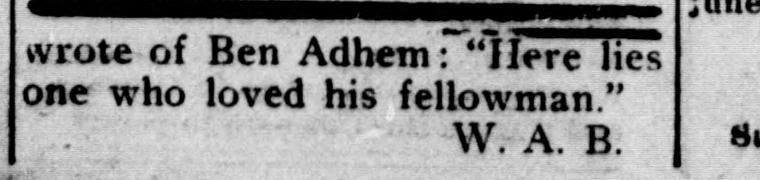
The last lines of the letter headed Here's Clarke Man Who Deserves a Carnegie Hero Medal in the Clarke Courier of June 29, 1922, set at the foot of another column and signed W. A. B.
What this image does and does not showA crop of part of one newspaper page; the rest of the page is not shown. The lines are set at the foot of a column, apart from the rest of the letter, and do not print Mr. Moore's name; the opening of the letter, which does, is in another crop of the page.
Clarke Courier (Berryville, Va.), June 29, 1922, page 4 (as numbered by the Library of Congress). Library of Congress, Chronicling America. Rights Changes: Cut from the Library of Congress page image at full resolution (the region lies at box 1498,3573 380x90 pixels of the saved half-size copy of the page) and shown at its own 760 by 180 pixels; not scaled, retouched, enhanced, highlighted or re-encoded.
Source: Clarke Courier, Berryville, Va., June 29, 1922 Open the full image
What this image is evidence for
Passage it reproduces: Clarke Courier, Berryville, Va., June 29, 1922, page 4 of the issue, per the Library of Congress record (printed page not recorded: the page prints no number), letter "Here's Clarke Man Who Deserves a Carnegie Hero Medal", last lines
Statements on this site that rest on it:
- The letter in the Clarke Courier of June 29, 1922 that calls for a Carnegie hero medal for James Frank Moore is signed with the initials "W. A. B.", and closes with the line "Here lies one who loved his fellowman."
People namedJames Frank Moore
Clarke Courier, Berryville, Va., June 29, 1922, page 4 (numbered by the Library of Congress; the page prints no number).
Typed transcription
wrote of Ben Adhem: "Here lies one who loved his fellowman." W. A. B.
- Source
- Clarke Courier, Berryville, Va., June 29, 1922, Clarke Courier
- Date as printed
- 1922-06-29 (published)
- Passage
- Clarke Courier, Berryville, Va., June 29, 1922, page 4 of the issue, per the Library of Congress record (printed page not recorded: the page prints no number), letter "Here's Clarke Man Who Deserves a Carnegie Hero Medal", last lines
- What it supports
- The letter in the Clarke Courier of June 29, 1922 that calls for a Carnegie hero medal for James Frank Moore is signed with the initials "W. A. B.", and closes with the line "Here lies one who loved his fellowman."
- Treatment
- Cropped to the document only; no retouch, no highlight.
RECORD Likely IDENTITY Confirmed
The page rests on one Courier item that names him; no other record is matched to him here.
See the original Read the full newspaper page at the Library of Congress
Cited, with no image here
- Clarke Courier, Berryville, Va., June 29, 1922, Page 4, letter "Here's Clarke Man Who Deserves a Carnegie Hero Medal". The text was read from a transcription or machine reading, not from a saved page image.
How we check the sources on this page.
Help fill in the gaps
Everything you send goes to a private queue that a person reads. Nothing is published without review.
- No photograph of James Frank Moore is known to this site. Tell us about one
- Where is he buried? Tell us
- Did the Carnegie Hero Fund ever act on the 1922 letter about James Frank Moore saving his brother in the Shenandoah River? Tell us
- Know more? Add or correct (submit a veteran; a person reviews it)
- Correct or ask for something to be removed
- Share a memory
- Tell us about a photo or document (describe it; the form takes words, not files)