
A road, an hour, four people
The Clarke Courier of October 6, 1869 gave it one word of heading: HOMICIDE. About eleven o'clock on the previous Wednesday night, the paper reported, Alec Cary was killed on the turnpike between Millwood and Berryville by Pinkey Blakely. The issue is itself dated a Wednesday, which puts the night at 29 September. Four people were walking together, Cary and Blakely in company with another man and a girl. The paper names two of the four.
Source note: Clarke Courier, Berryville, Va., 1869
The Clarke Courier of October 6, 1869 reported, under the heading "HOMICIDE", that about 11 o'clock on the previous Wednesday night Alec Cary was killed on the turnpike between Millwood and Berryville by Pinkey Blakely.
What the source supports
That the killing was reported, with a named road, a stated hour and both men named.
Uncertainty
The paper's own account. Both men are described only as "colored"; nothing else about either is in the item.
Source
Evidence role: supports. The opening sentence, naming both men, the road and the hour.
Clarke Courier, Berryville, Va., 6 October 1869, page 3: "HOMICIDE"
Clarke Courier, Berryville, Va. · 1869-10-06 (publication)
Locator: Page 3, item headed "HOMICIDE", opening
Relevant passageHOMICIDE—About 11 o'clock last Wednesday night Alec Cary, (colored) was killed on the Millwood and Berryville Turnpike by Pinkey Blakely (colored). The circumstances, as elicited at the inquest, were substantially as follows: Alec, and Pinkey, in company with another negro man and a girl, were walking together, when an altercation sprung up between the two resulting in a scuffle, in which Alec, the deceased, got somewhat the better of Pinkey,
Checked: Original inspected. A digital reproduction was inspected; no original has been handled.
Open sourceSource family: clarke-courier-1869-10-06-homicide. Multiple passages from one source are not independent witnesses.
AI-assisted source check (Claude Opus 5) · 2026-09-23. How this project checks its sources
Source note: Clarke Courier, Berryville, Va., 1869
The issue carrying the item is dated Wednesday October 6, 1869, so its phrase "last Wednesday night" places the killing on the night of September 29, 1869.
What the source supports
A date for the killing, derived from the issue date.
Uncertainty
An inference from the weekday of the issue, not a date printed in the item. The item gives only "last Wednesday night".
Source
Evidence role: contextualizes. The item's only date expression, read against the issue date.
Clarke Courier, Berryville, Va., 6 October 1869, page 3: "HOMICIDE"
Clarke Courier, Berryville, Va. · 1869-10-06 (publication)
Locator: Page 3, item headed "HOMICIDE", opening
Relevant passageHOMICIDE—About 11 o'clock last Wednesday night Alec Cary, (colored) was killed on the Millwood and Berryville Turnpike by Pinkey Blakely (colored). The circumstances, as elicited at the inquest, were substantially as follows: Alec, and Pinkey, in company with another negro man and a girl, were walking together, when an altercation sprung up between the two resulting in a scuffle, in which Alec, the deceased, got somewhat the better of Pinkey,
Checked: Original inspected. A digital reproduction was inspected; no original has been handled.
Open sourceSource family: clarke-courier-1869-10-06-homicide. Multiple passages from one source are not independent witnesses.
AI-assisted source check (Claude Opus 5) · 2026-09-23. How this project checks its sources
What the inquest heard
The Courier set out the circumstances "as elicited at the inquest". An altercation sprang up between the two men and became a scuffle, in which Cary, it reported, "got somewhat the better of Pinkey". Blakely then drew a knife, cut Cary on the arm and stabbed him in the chest. "The wound proved fatal in a few moments." An inquest asks how a person died; it tries nobody, and the paper was reporting what it heard there rather than a finding of any court.
Source note: Clarke Courier, Berryville, Va., 1869
The same item reports that four people were walking together, Cary and Blakely in company with another man and a girl, and it names only Cary and Blakely.
What the source supports
That two of the four people present go unnamed in the account.
Uncertainty
The item gives no name, age or connection for the other man or the girl.
Source
Evidence role: supports. The account of who was walking together.
Clarke Courier, Berryville, Va., 6 October 1869, page 3: "HOMICIDE"
Clarke Courier, Berryville, Va. · 1869-10-06 (publication)
Locator: Page 3, item headed "HOMICIDE", opening
Relevant passageHOMICIDE—About 11 o'clock last Wednesday night Alec Cary, (colored) was killed on the Millwood and Berryville Turnpike by Pinkey Blakely (colored). The circumstances, as elicited at the inquest, were substantially as follows: Alec, and Pinkey, in company with another negro man and a girl, were walking together, when an altercation sprung up between the two resulting in a scuffle, in which Alec, the deceased, got somewhat the better of Pinkey,
Checked: Original inspected. A digital reproduction was inspected; no original has been handled.
Open sourceSource family: clarke-courier-1869-10-06-homicide. Multiple passages from one source are not independent witnesses.
AI-assisted source check (Claude Opus 5) · 2026-09-23. How this project checks its sources
Source note: Clarke Courier, Berryville, Va., 1869
The item summarises what it says was elicited at the inquest: an altercation between the two became a scuffle in which Cary got somewhat the better of Blakely, whereupon Blakely drew a knife, cut Cary on the arm and stabbed him in the chest, and the wound proved fatal in a few moments.
What the source supports
The sequence of events as the newspaper reported the inquest account.
Uncertainty
This is a newspaper summary of an inquest, not a transcript and not a court finding. No inquest record has been inspected.
Source
Evidence role: supports. The altercation and the scuffle.
Clarke Courier, Berryville, Va., 6 October 1869, page 3: "HOMICIDE"
Clarke Courier, Berryville, Va. · 1869-10-06 (publication)
Locator: Page 3, item headed "HOMICIDE", opening
Relevant passageHOMICIDE—About 11 o'clock last Wednesday night Alec Cary, (colored) was killed on the Millwood and Berryville Turnpike by Pinkey Blakely (colored). The circumstances, as elicited at the inquest, were substantially as follows: Alec, and Pinkey, in company with another negro man and a girl, were walking together, when an altercation sprung up between the two resulting in a scuffle, in which Alec, the deceased, got somewhat the better of Pinkey,
Checked: Original inspected. A digital reproduction was inspected; no original has been handled.
Open sourceSource family: clarke-courier-1869-10-06-homicide. Multiple passages from one source are not independent witnesses.
Evidence role: supports. The knife, the wounds and the death.
Clarke Courier, Berryville, Va., 6 October 1869, page 3: "HOMICIDE"
Clarke Courier, Berryville, Va. · 1869-10-06 (publication)
Locator: Page 3, item headed "HOMICIDE", close
Relevant passagewhereupon Pinkey drew a knife and cut Alec on the arm, and then stabbed him in the chest. The wound proved fatal in a few moments. Pinkey escaped. The difficulty is thought to have been connected with the girl.
Checked: Original inspected. A digital reproduction was inspected; no original has been handled.
Open sourceSource family: clarke-courier-1869-10-06-homicide. Multiple passages from one source are not independent witnesses.
AI-assisted source check (Claude Opus 5) · 2026-09-23. How this project checks its sources
Blakely escaped
The paper states simply: "Pinkey escaped." It also offers one explanation for the quarrel, and offers it at arm's length. The difficulty, it says, "is thought to have been connected with the girl". It does not say who thought so, and it does not name her. What the item leaves in print is a road, an hour and four people, two of them named.
Source note: Clarke Courier, Berryville, Va., 1869
The item states that Blakely escaped, and it records no arrest, charge, trial or outcome.
What the source supports
That the account ends without anyone in custody.
Uncertainty
This is what this issue prints. The issue of October 27, 1869 reports a true bill and an unsuccessful attempt to arrest him (C1026, C1027). A search of the held Courier text through 1880 found no report of an arrest, trial or outcome. That is a statement about the issues searched, not evidence that none occurred.
Source
Evidence role: supports. The sentence "Pinkey escaped."
Clarke Courier, Berryville, Va., 6 October 1869, page 3: "HOMICIDE"
Clarke Courier, Berryville, Va. · 1869-10-06 (publication)
Locator: Page 3, item headed "HOMICIDE", close
Relevant passagewhereupon Pinkey drew a knife and cut Alec on the arm, and then stabbed him in the chest. The wound proved fatal in a few moments. Pinkey escaped. The difficulty is thought to have been connected with the girl.
Checked: Original inspected. A digital reproduction was inspected; no original has been handled.
Open sourceSource family: clarke-courier-1869-10-06-homicide. Multiple passages from one source are not independent witnesses.
AI-assisted source check (Claude Opus 5) · 2026-09-23. How this project checks its sources
Source note: Clarke Courier, Berryville, Va., 1869
The item attributes the quarrel to the girl as something thought rather than established, saying the difficulty "is thought to have been connected with the girl", without saying who thought so.
What the source supports
That the motive in the account is the newspaper's own speculation.
Uncertainty
The paper offers no source for the supposition and does not name the girl.
Source
Evidence role: supports. The closing sentence on the supposed cause.
Clarke Courier, Berryville, Va., 6 October 1869, page 3: "HOMICIDE"
Clarke Courier, Berryville, Va. · 1869-10-06 (publication)
Locator: Page 3, item headed "HOMICIDE", close
Relevant passagewhereupon Pinkey drew a knife and cut Alec on the arm, and then stabbed him in the chest. The wound proved fatal in a few moments. Pinkey escaped. The difficulty is thought to have been connected with the girl.
Checked: Original inspected. A digital reproduction was inspected; no original has been handled.
Open sourceSource family: clarke-courier-1869-10-06-homicide. Multiple passages from one source are not independent witnesses.
AI-assisted source check (Claude Opus 5) · 2026-09-23. How this project checks its sources
whereupon Pinkey drew a knife and cut Alec on the arm, and then stabbed him in the chest. The wound proved fatal in a few moments. Pinkey escaped. The difficulty is thought to have been connected with the girl.
A true bill
The Courier came back to the case on October 27, 1869, three weeks after its first report, with two short items on its third page. The first was a report of the circuit court, which had adjourned on the Saturday before after a session of two weeks. Among its business, the paper said, the grand jury had found a true bill against Pinkey for killing "Elliott Cary". A true bill is an indictment: a grand jury's finding that there is enough to put a person on trial. It is not an arrest, a trial or a verdict, and the report describes none of those.
Source note: Clarke Courier, Berryville, Va., 1869
The Clarke Courier of October 27, 1869 reported that the circuit court had adjourned on Saturday the 23d after a session of two weeks, and that its grand jury had found a true bill against Pinkey for killing Elliott Cary.
What the source supports
That an indictment was reported, three weeks after the paper's first report of the killing.
Uncertainty
A true bill is an indictment. It is not an arrest, a trial or a verdict, and the item reports none of those. The item gives Pinkey no surname and calls the dead man Elliott; it is read as this case because of the names, the act and the NO ARREST item beside it. It dates the court's adjournment, not the grand jury's finding, and the month of the adjournment is read from the issue date.
Source
Evidence role: supports. The adjournment and the true bill.
Clarke Courier, Berryville, Va., 27 October 1869, page 3: "CIRCUIT COURT" and "NO ARREST"
Clarke Courier, Berryville, Va. · 1869-10-27 (publication)
Locator: Page 3, Local Items, item headed "CIRCUIT COURT"
Relevant passagewas adjourned on Satu[r]day, 23d, after a session of two weeks. A large amount of business was disposed of.— The Grand Jury found a true bill again[st] Pinkey (colored), for killing Elliott Cary (co[l]ored).
Checked: Original inspected. A digital reproduction was inspected; no original has been handled.
Open sourceSource family: clarke-courier-1869-10-27-local-items. Multiple passages from one source are not independent witnesses.
AI-assisted source check (Claude Opus 5.5) · 2026-09-24. How this project checks its sources
No arrest
The second item ran under the heading NO ARREST. Constable Fryer, it said, had gone "a few days ago" to Madison County, Pinkey's former home, to arrest him, "a report having reached here that he was there; but it turned out to be a false report." People in his old neighborhood, the paper added, had heard of the killing only a few days before the constable arrived. The item does not say where Pinkey was, or whether anyone went on looking. It is the last item on the case found in the Courier text searched for this follow-up, covering the issues held from October 13, 1869 through the end of 1880.
Source note: Clarke Courier, Berryville, Va., 1869
The same issue reported that Constable Fryer had gone a few days earlier to Madison county, Pinkey's former residence, to arrest him on a report that he was there; that the report proved false; and that people in his old neighborhood had heard of the killing only a few days before the constable arrived.
What the source supports
That an attempt to arrest him was reported, and that it failed.
Uncertainty
The item names the constable by title and surname only, and this project does not identify him further. It dates the trip only as "a few days ago", names no state for Madison county, and says nothing of where Pinkey was or of any further search.
Source
Evidence role: supports. The whole NO ARREST item.
Clarke Courier, Berryville, Va., 27 October 1869, page 3: "CIRCUIT COURT" and "NO ARREST"
Clarke Courier, Berryville, Va. · 1869-10-27 (publication)
Locator: Page 3, Local Items, item headed "NO ARREST"
Relevant passageNO ARREST.—Constable Fryer went a few days ago to Madison county, the former residence of the negro Pinkey, who killed Alec, (or Elliott) Cary, for the purpose of arresting Pinkey, a report having reached here that he was there; but it turned out to be a false report; the people of his old neighborhood had only heard a few days before Mr. Fryer's arrival, of the killing.
Checked: Original inspected. A digital reproduction was inspected; no original has been handled.
Open sourceSource family: clarke-courier-1869-10-27-local-items. Multiple passages from one source are not independent witnesses.
AI-assisted source check (Claude Opus 5.5) · 2026-09-24. How this project checks its sources
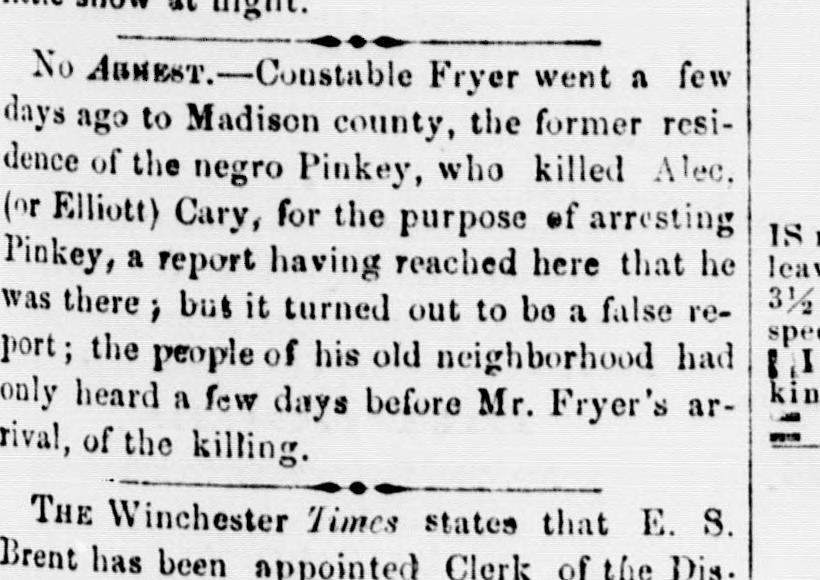
The Courier's "No Arrest" item reported an unsuccessful attempt to find Pinkey and printed the dead man's name as "Alec, (or Elliott) Cary." Clarke Courier, October 27, 1869, p. 3.
What this image does and does not showThe complete "No Arrest" item within a crop of the newspaper page; fragments of neighboring items remain. The newspaper's original wording, including period racial language, is retained. This is reporting, not a court record or verdict; it does not establish what happened afterward.
Clarke Courier (Berryville, Va.), October 27, 1869, page 3. Library of Congress, Chronicling America. Rights Changes: Retrieved unchanged from the accepted historical Git blob (research/publication-prep/cary-followup-2026-09-24/captures/cc-1869-10-27-p3-no-arrest.jpg at commit 544c61f9, integrated by PR #589), itself the Library of Congress page-image region x=100, y=5220, width=820, height=580 of a 5268 by 7640 pixel scan: not scaled, not re-cropped, retouched, enhanced, OCR'd, recolored, censored or reconstructed. Re-encoded as JPEG only for the web derivative.
Source: Clarke Courier, Berryville, Va., 27 October 1869, page 3: "CIRCUIT COURT" and "NO ARREST" Open the full image
Alec, or Elliott
Neither of the later items gives Pinkey a surname. The second ties him to this killing in its own words, as the man "who killed Alec, (or Elliott) Cary". That parenthesis is the paper's. Its first report called the dead man Alec, its court report called him Elliott, and the next item printed both and did not choose. This page keeps the name Alec, from the account of the night itself, and records Elliott as the other name the same paper gave him. These three items do not settle which name he went by.
Source note: Clarke Courier, Berryville, Va., 1869
The Courier printed the dead man's given name three ways: "Alec" in its report of October 6, 1869, "Elliott" in its court report of October 27, and "Alec, (or Elliott)" in the NO ARREST item of the same day.
What the source supports
That the newspaper itself did not settle his given name.
Uncertainty
Three printings by one newspaper. None is a record made by his family, a court or a registrar, and none says which name he went by.
Source
Evidence role: supports. "Alec Cary" in the October 6 item.
Clarke Courier, Berryville, Va., 6 October 1869, page 3: "HOMICIDE"
Clarke Courier, Berryville, Va. · 1869-10-06 (publication)
Locator: Page 3, item headed "HOMICIDE", opening
Relevant passageHOMICIDE—About 11 o'clock last Wednesday night Alec Cary, (colored) was killed on the Millwood and Berryville Turnpike by Pinkey Blakely (colored). The circumstances, as elicited at the inquest, were substantially as follows: Alec, and Pinkey, in company with another negro man and a girl, were walking together, when an altercation sprung up between the two resulting in a scuffle, in which Alec, the deceased, got somewhat the better of Pinkey,
Checked: Original inspected. A digital reproduction was inspected; no original has been handled.
Open sourceSource family: clarke-courier-1869-10-06-homicide. Multiple passages from one source are not independent witnesses.
Evidence role: supports. "Elliott Cary" in the court report.
Clarke Courier, Berryville, Va., 27 October 1869, page 3: "CIRCUIT COURT" and "NO ARREST"
Clarke Courier, Berryville, Va. · 1869-10-27 (publication)
Locator: Page 3, Local Items, item headed "CIRCUIT COURT"
Relevant passagewas adjourned on Satu[r]day, 23d, after a session of two weeks. A large amount of business was disposed of.— The Grand Jury found a true bill again[st] Pinkey (colored), for killing Elliott Cary (co[l]ored).
Checked: Original inspected. A digital reproduction was inspected; no original has been handled.
Open sourceSource family: clarke-courier-1869-10-27-local-items. Multiple passages from one source are not independent witnesses.
Evidence role: supports. "Alec, (or Elliott) Cary" in the NO ARREST item.
Clarke Courier, Berryville, Va., 27 October 1869, page 3: "CIRCUIT COURT" and "NO ARREST"
Clarke Courier, Berryville, Va. · 1869-10-27 (publication)
Locator: Page 3, Local Items, item headed "NO ARREST"
Relevant passageNO ARREST.—Constable Fryer went a few days ago to Madison county, the former residence of the negro Pinkey, who killed Alec, (or Elliott) Cary, for the purpose of arresting Pinkey, a report having reached here that he was there; but it turned out to be a false report; the people of his old neighborhood had only heard a few days before Mr. Fryer's arrival, of the killing.
Checked: Original inspected. A digital reproduction was inspected; no original has been handled.
Open sourceSource family: clarke-courier-1869-10-27-local-items. Multiple passages from one source are not independent witnesses.
AI-assisted source check (Claude Opus 5.5) · 2026-09-24. How this project checks its sources
About the accountsWhat the evidence says
Three inspected newspaper items in two issues. A killing reported, an indictment reported, an arrest attempt that failed, two people never named, and no trial or outcome in any of them.
The killing itself rests on a single item in the Clarke Courier of October 6, 1869, page 3, read from the page image because the OCR of it is badly degraded. The item reports what an inquest heard, about a week after the night it describes. It names Alec Cary and Pinkey Blakely and leaves the other two walkers unnamed. Its one suggestion of a motive is expressly something "thought", with no source given. It ends with Blakely at liberty. Two items in the issue of October 27, 1869, page 3, also read from the page image, report a grand jury's true bill against "Pinkey" for killing "Elliott Cary", and a constable's unsuccessful trip to arrest him in Madison County. Neither gives Pinkey a surname, and the second calls the dead man "Alec, (or Elliott) Cary". No court record has been inspected. A search of the text of the Courier issues the project holds, through 1880, found nothing further on the case.
- An account exists✓ Supported by a source
The Clarke Courier of October 6, 1869 reported, under the heading "HOMICIDE", that about 11 o'clock on the previous Wednesday night Alec Cary was killed on the turnpike between Millwood and Berryville by Pinkey Blakely.
See the evidence
✓ Supported by a sourceAn account existsThe Clarke Courier of October 6, 1869 reported, under the heading "HOMICIDE", that about 11 o'clock on the previous Wednesday night Alec Cary was killed on the turnpike between Millwood and Berryville by Pinkey Blakely.
What the source supports
That the killing was reported, with a named road, a stated hour and both men named.
Uncertainty
The paper's own account. Both men are described only as "colored"; nothing else about either is in the item.
Source
Reporting Evidence role: supports. The opening sentence, naming both men, the road and the hour.
Clarke Courier, Berryville, Va., 6 October 1869, page 3: "HOMICIDE"
Clarke Courier, Berryville, Va. · 1869-10-06 (publication)
Locator: Page 3, item headed "HOMICIDE", opening
Relevant passageHOMICIDE—About 11 o'clock last Wednesday night Alec Cary, (colored) was killed on the Millwood and Berryville Turnpike by Pinkey Blakely (colored). The circumstances, as elicited at the inquest, were substantially as follows: Alec, and Pinkey, in company with another negro man and a girl, were walking together, when an altercation sprung up between the two resulting in a scuffle, in which Alec, the deceased, got somewhat the better of Pinkey,
Checked: Original inspected. A digital reproduction was inspected; no original has been handled.
Open sourceSource family: clarke-courier-1869-10-06-homicide. Multiple passages from one source are not independent witnesses.
AI-assisted source check (Claude Opus 5) · 2026-09-23. How this project checks its sources
- An account exists✓ Supported by a source
The item summarises what it says was elicited at the inquest: an altercation between the two became a scuffle in which Cary got somewhat the better of Blakely, whereupon Blakely drew a knife, cut Cary on the arm and stabbed him in the chest, and the wound proved fatal in a few moments.
See the evidence
✓ Supported by a sourceAn account existsThe item summarises what it says was elicited at the inquest: an altercation between the two became a scuffle in which Cary got somewhat the better of Blakely, whereupon Blakely drew a knife, cut Cary on the arm and stabbed him in the chest, and the wound proved fatal in a few moments.
What the source supports
The sequence of events as the newspaper reported the inquest account.
Uncertainty
This is a newspaper summary of an inquest, not a transcript and not a court finding. No inquest record has been inspected.
Source
Reporting Evidence role: supports. The altercation and the scuffle.
Clarke Courier, Berryville, Va., 6 October 1869, page 3: "HOMICIDE"
Clarke Courier, Berryville, Va. · 1869-10-06 (publication)
Locator: Page 3, item headed "HOMICIDE", opening
Relevant passageHOMICIDE—About 11 o'clock last Wednesday night Alec Cary, (colored) was killed on the Millwood and Berryville Turnpike by Pinkey Blakely (colored). The circumstances, as elicited at the inquest, were substantially as follows: Alec, and Pinkey, in company with another negro man and a girl, were walking together, when an altercation sprung up between the two resulting in a scuffle, in which Alec, the deceased, got somewhat the better of Pinkey,
Checked: Original inspected. A digital reproduction was inspected; no original has been handled.
Open sourceSource family: clarke-courier-1869-10-06-homicide. Multiple passages from one source are not independent witnesses.
Reporting Evidence role: supports. The knife, the wounds and the death.
Clarke Courier, Berryville, Va., 6 October 1869, page 3: "HOMICIDE"
Clarke Courier, Berryville, Va. · 1869-10-06 (publication)
Locator: Page 3, item headed "HOMICIDE", close
Relevant passagewhereupon Pinkey drew a knife and cut Alec on the arm, and then stabbed him in the chest. The wound proved fatal in a few moments. Pinkey escaped. The difficulty is thought to have been connected with the girl.
Checked: Original inspected. A digital reproduction was inspected; no original has been handled.
Open sourceSource family: clarke-courier-1869-10-06-homicide. Multiple passages from one source are not independent witnesses.
AI-assisted source check (Claude Opus 5) · 2026-09-23. How this project checks its sources
- An account exists✓ Supported by a source
The item states that Blakely escaped, and it records no arrest, charge, trial or outcome.
See the evidence
✓ Supported by a sourceAn account existsThe item states that Blakely escaped, and it records no arrest, charge, trial or outcome.
What the source supports
That the account ends without anyone in custody.
Uncertainty
This is what this issue prints. The issue of October 27, 1869 reports a true bill and an unsuccessful attempt to arrest him (C1026, C1027). A search of the held Courier text through 1880 found no report of an arrest, trial or outcome. That is a statement about the issues searched, not evidence that none occurred.
Source
Reporting Evidence role: supports. The sentence "Pinkey escaped."
Clarke Courier, Berryville, Va., 6 October 1869, page 3: "HOMICIDE"
Clarke Courier, Berryville, Va. · 1869-10-06 (publication)
Locator: Page 3, item headed "HOMICIDE", close
Relevant passagewhereupon Pinkey drew a knife and cut Alec on the arm, and then stabbed him in the chest. The wound proved fatal in a few moments. Pinkey escaped. The difficulty is thought to have been connected with the girl.
Checked: Original inspected. A digital reproduction was inspected; no original has been handled.
Open sourceSource family: clarke-courier-1869-10-06-homicide. Multiple passages from one source are not independent witnesses.
AI-assisted source check (Claude Opus 5) · 2026-09-23. How this project checks its sources
- An account exists✓ Supported by a source
The Clarke Courier of October 27, 1869 reported that the circuit court had adjourned on Saturday the 23d after a session of two weeks, and that its grand jury had found a true bill against Pinkey for killing Elliott Cary.
See the evidence
✓ Supported by a sourceAn account existsThe Clarke Courier of October 27, 1869 reported that the circuit court had adjourned on Saturday the 23d after a session of two weeks, and that its grand jury had found a true bill against Pinkey for killing Elliott Cary.
What the source supports
That an indictment was reported, three weeks after the paper's first report of the killing.
Uncertainty
A true bill is an indictment. It is not an arrest, a trial or a verdict, and the item reports none of those. The item gives Pinkey no surname and calls the dead man Elliott; it is read as this case because of the names, the act and the NO ARREST item beside it. It dates the court's adjournment, not the grand jury's finding, and the month of the adjournment is read from the issue date.
Source
Reporting Evidence role: supports. The adjournment and the true bill.
Clarke Courier, Berryville, Va., 27 October 1869, page 3: "CIRCUIT COURT" and "NO ARREST"
Clarke Courier, Berryville, Va. · 1869-10-27 (publication)
Locator: Page 3, Local Items, item headed "CIRCUIT COURT"
Relevant passagewas adjourned on Satu[r]day, 23d, after a session of two weeks. A large amount of business was disposed of.— The Grand Jury found a true bill again[st] Pinkey (colored), for killing Elliott Cary (co[l]ored).
Checked: Original inspected. A digital reproduction was inspected; no original has been handled.
Open sourceSource family: clarke-courier-1869-10-27-local-items. Multiple passages from one source are not independent witnesses.
AI-assisted source check (Claude Opus 5.5) · 2026-09-24. How this project checks its sources
Each statement above is assessed on its own evidence. Nothing here is averaged, scored or voted on, and a well-attributed account can be documented while what it describes stays unconfirmed.
What this story does not say
It does not name the other man or the girl; no account the project has found gives either name. It does not offer the supposed cause as a fact, because the paper did not. It does not treat the true bill as a verdict: an indictment says a case should be tried, and no report found says that it was. It identifies Constable Fryer only by the title and surname the item gives him. And it does not claim that nothing happened after October 1869. The project searched the text of every Courier issue it holds from October 13, 1869 through the end of 1880 and, through 1873, the passages it holds from other newspapers that mention Clarke. It found nothing more on the case. That search ran over machine-read text, which can garble a short item. A few weekly issues in those years are not held, and no court record has been consulted.
Was Pinkey Blakely ever taken, and was the indictment against him ever tried?
Know more about this story, or see something to correct? Help fill a gap. It stays private until it is reviewed.
Remember this place or someone in this story? Share a memory, even if you do not know the date. It stays private until it is reviewed.
Go deeper: every source under this story Follow another threadEveryday life in Josephine City
Another account of Black life in Clarke in the decades after emancipation, built from what the record happens to preserve.