
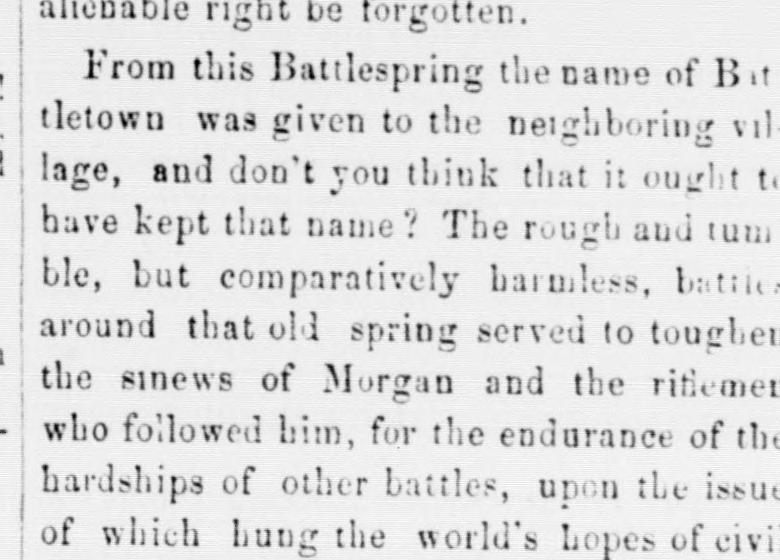
An 1883 printed explanation of the name, not a contemporary witness to the town's eighteenth-century origin and not a depiction of Daniel Morgan or the spring itself. Writing under the pen name "Tramp" for the Leesburg Mirror, reprinted here, the correspondent gives Battle Spring's rough-and-tumble reputation as his reason the neighboring village was called Battletown, and says he wished the name had been kept.
Clarke Courier (Berryville, Va.), March 22, 1883, page 1. Library of Congress, Chronicling America. Open the full image
Saturday evenings at the spring
On Saturday evenings, the men of the neighborhood walked out to a spring to talk, to drink, to trade, and to fight. They indulged so much in the last of those amusements, wrote a correspondent signing himself "Tramp," that the spring took its name from them: Battle Spring. And from the spring, he said, the village nearby took its own. He was writing in March 1883, in a travel letter to the Leesburg Mirror that the Clarke Courier reprinted across its front page, and he could not forgive the town for changing it. Berryville "has no special meaning whatever that I have ever heard of." Battletown was historic. Battletown should be taken back.
Source note: Clarke Courier, 1883
A correspondent signing himself "Tramp", in a letter reprinted by the Clarke Courier on 22 March 1883, wrote that in colonial times the men of the neighborhood met at a spring near the town on Saturday evenings to talk, drink, trade and fight, that the spring was named Battle Spring from the fighting, and that the village took its name from the spring.
What the source supports
That this explanation of the name was in circulation and in print by 1883, and what it said.
Uncertainty
A travel letter, not a record: a writer in 1883 describing colonial times. It is evidence that the account was told and printed, not evidence of what happened at the spring. The correspondent is identified only by a pen name. The Courier reprinting a Leesburg Mirror letter shows circulation, not endorsement.
Source
Evidence role: supports. The spring passage itself, image-verified.
Clarke Courier, Berryville, Va., 22 March 1883, page 1: "'TRAMP' IN CLARKE COUNTY. BERRYVILLE AND ITS OUTLOOK", reprinted from the Leesburg Mirror
An unidentified correspondent signing himself "Tramp"; originally printed in the Leesburg Mirror, Leesburg, Va. · 1883-03-22 (publication)
Locator: Page 1, the spring passage
Relevant passageThere is a spring near the town known as Battlespring. In the old colonial times the men of that neighborhood met at the spring on Saturday evenings to talk, and drink, and trade and fight, and they indulged so much in this latter amusement that the spring was named Battle Spring. In these fisticuffs Daniel Morgan was particularly prominent, and was always victorious.
Checked: Original inspected. A digital reproduction was inspected; no original has been handled.
Open sourceSource family: leesburg-mirror-tramp-1883. Multiple passages from one source are not independent witnesses.
Evidence role: supports. The sentence deriving the village's name from the spring.
Clarke Courier, Berryville, Va., 22 March 1883, page 1: "'TRAMP' IN CLARKE COUNTY. BERRYVILLE AND ITS OUTLOOK", reprinted from the Leesburg Mirror
An unidentified correspondent signing himself "Tramp"; originally printed in the Leesburg Mirror, Leesburg, Va. · 1883-03-22 (publication)
Locator: Page 1, the naming sentence
Relevant passageFrom this Battlespring the name of Battletown was given to the neighboring village, and don't you think that it ought to have kept that name? The rough and tumble, but comparatively harmless, battles around that old spring served to toughen the sinews of Morgan and the riflemen who followed him…
Checked: Original inspected. A digital reproduction was inspected; no original has been handled.
Open sourceSource family: leesburg-mirror-tramp-1883. Multiple passages from one source are not independent witnesses.
AI-assisted source check (Claude Opus 5) · 2026-09-23. How this project checks its sources
The man in every version
One figure stands out in his account of the spring: "In these fisticuffs Daniel Morgan was particularly prominent, and was always victorious." Morgan is in nearly every telling of this story. Before he was the general who broke Tarleton at Cowpens, he was a young wagoner in eastern Frederick County with a reputation for settling things with his hands. His minister, William Hill, kept notes of what Morgan told him in his last years, and from those notes his biographer drew a scene: Saturday afternoons at a tavern kept by Benjamin Berry, boxing and wrestling by daylight, drinking and gaming after dark.
Source note: Clarke Courier, 1883
The same 1883 letter names Daniel Morgan in its account of the spring, saying that in these fisticuffs he "was particularly prominent, and was always victorious", and that the fighting there toughened "the sinews of Morgan and the riflemen who followed him".
What the source supports
That the spring account is itself a Morgan account, rather than an explanation that leaves him out.
Uncertainty
Establishes what the letter says, not that Morgan fought at any spring. Written eighty years after the events it describes and more than eighty after Morgan's youth.
Source
Evidence role: supports. Morgan named in the spring passage.
Clarke Courier, Berryville, Va., 22 March 1883, page 1: "'TRAMP' IN CLARKE COUNTY. BERRYVILLE AND ITS OUTLOOK", reprinted from the Leesburg Mirror
An unidentified correspondent signing himself "Tramp"; originally printed in the Leesburg Mirror, Leesburg, Va. · 1883-03-22 (publication)
Locator: Page 1, the spring passage
Relevant passageThere is a spring near the town known as Battlespring. In the old colonial times the men of that neighborhood met at the spring on Saturday evenings to talk, and drink, and trade and fight, and they indulged so much in this latter amusement that the spring was named Battle Spring. In these fisticuffs Daniel Morgan was particularly prominent, and was always victorious.
Checked: Original inspected. A digital reproduction was inspected; no original has been handled.
Open sourceSource family: leesburg-mirror-tramp-1883. Multiple passages from one source are not independent witnesses.
Evidence role: supports. Morgan and his riflemen in the naming sentence.
Clarke Courier, Berryville, Va., 22 March 1883, page 1: "'TRAMP' IN CLARKE COUNTY. BERRYVILLE AND ITS OUTLOOK", reprinted from the Leesburg Mirror
An unidentified correspondent signing himself "Tramp"; originally printed in the Leesburg Mirror, Leesburg, Va. · 1883-03-22 (publication)
Locator: Page 1, the naming sentence
Relevant passageFrom this Battlespring the name of Battletown was given to the neighboring village, and don't you think that it ought to have kept that name? The rough and tumble, but comparatively harmless, battles around that old spring served to toughen the sinews of Morgan and the riflemen who followed him…
Checked: Original inspected. A digital reproduction was inspected; no original has been handled.
Open sourceSource family: leesburg-mirror-tramp-1883. Multiple passages from one source are not independent witnesses.
AI-assisted source check (Claude Opus 5) · 2026-09-23. How this project checks its sources
Source note: James Graham, 1856
Graham's 1856 life of Daniel Morgan, drawing on the manuscripts of the Rev. William Hill, describes young men of the country between Winchester and the Shenandoah gathering every Saturday afternoon at a tavern kept by Benjamin Berry, boxing and wrestling by daylight and drinking and gaming at night.
What the source supports
The tavern version of the gathering, and that the tavern keeper was Benjamin Berry.
Uncertainty
Published in 1856, more than fifty years after Morgan's death, and footnoted to manuscripts by Morgan's minister that have not been inspected here. A recollection twice removed.
Source
Evidence role: supports. Graham's account of the Saturday gatherings at Berry's tavern.
James Graham, The Life of General Daniel Morgan, of the Virginia Line of the Army of the United States (New York: Derby & Jackson, 1856)
James Graham · 1856 (publication)
Locator: Printed pp. 35-36, the Saturday gatherings
Relevant passageIt was the custom at this time for all the athletic young men who resided in the country, between Winchester and the Shenandoah river, to assemble every Saturday afternoon, at a tavern, about midway between the river and the town, kept by a man named Benjamin Berry. Here they boxed, wrestled, and practised other athletic exercises during the daylight, while drinking and gaming generally occupied the night.
Checked: Existing OCR reviewed. Original image not independently inspected.
Open sourceSource family: graham-morgan-1856. Multiple passages from one source are not independent witnesses.
AI-assisted source check (Claude Opus 5) · 2026-09-23. How this project checks its sources
The detail that outlasts the rest
Hill also recorded something smaller. Helping the dying man from his bed, he noticed a toe lying flat across the top of his foot and asked about it. Morgan said he had got it years before, kicking Bill Davis, at Battletown. The fighting runs through these accounts. What the fighting did is harder.
Source note: James Graham, 1856
Graham reports, from Hill's manuscripts, that Morgan in his last illness was asked about a crooked toe and answered that he got it "in a fight I had with Bill Davis, and in kicking him, at Battletown".
What the source supports
That the name Battletown is attributed to Morgan's own mouth in an account traceable to the minister who attended him.
Uncertainty
Not a contemporary record. Morgan died in 1802; Hill's manuscripts are undated here and uninspected; Graham published in 1856. It establishes what Graham reports Hill recorded Morgan as saying.
Source
Evidence role: supports. The deathbed exchange as Graham prints it.
James Graham, The Life of General Daniel Morgan, of the Virginia Line of the Army of the United States (New York: Derby & Jackson, 1856)
James Graham · 1856 (publication)
Locator: Printed p. 37, the deathbed exchange
Relevant passage"General, what is the matter with this toe of yours?" I inquired. "I got that many years ago," he replied, "in a fight I had with Bill Davis, and in kicking him, at Battletown. I broke that toe, then, and I never could get it to lie in its right place since."
Checked: Existing OCR reviewed. Original image not independently inspected.
Open sourceSource family: graham-morgan-1856. Multiple passages from one source are not independent witnesses.
AI-assisted source check (Claude Opus 5) · 2026-09-23. How this project checks its sources
From this Battlespring the name of Battletown was given to the neighboring village, and don't you think that it ought to have kept that name? The rough and tumble, but comparatively harmless, battles around that old spring served to toughen the sinews of Morgan and the riflemen who followed him…
The name may not have started with the fighting
The Berryville Historic District nomination places an eight-hundred-acre estate called Battletown belonging to Charles Smith, its house built between 1755 and 1765 and standing still at 106 East Main Street, known now as the Nook. On that account the crossroads settlement took its name from the land it sat on. The two accounts are not really rivals, and the man who joins them is Benjamin Berry. He kept the tavern where the fighting is remembered, and when Smith's estate was divided among his children it was Smith's son John who sold Berry the ground on which Berry then laid out a town — and gave it his own name.
Source note: Berryville Historic District, 1987
The 1987 Berryville Historic District nomination states that the crossroads settlement was known before 1798 as Battletown, and that earlier in the eighteenth century the area was an 800-acre estate of the same name owned by Charles Smith, whose house, built between 1755 and 1765, survives at 106 East Main Street as the Nook.
What the source supports
That an estate account of the name exists in a state register nomination, with a date range for the house.
Uncertainty
An architectural survey written in 1987. Its footnote markers point to a references section that has not been read, so whether it rests on deeds consulted independently or repeats a published county history is unresolved. A nomination repeating an earlier account is not independent evidence of the deeds behind it.
Source
Evidence role: supports. The nomination's estate paragraph.
Berryville Historic District, National Register of Historic Places nomination, DHR 168-0012 (1987)
Virginia Division of Historic Landmarks (nomination preparers not individually named in the pages read) · 1987 (creation)
Locator: PDF page 3, Background: the estate
Relevant passageEarlier in the 18th century the area was the site of an 800-acre estate of the same name owned by Charles Smith. The Battletown estate's main residence, known today as the Nook, was built between 1755 and 1765 and still survives at 106 E. Main Street.
Checked: Page text reviewed. Original image not independently inspected.
Open sourceSource family: dhr-berryville. Multiple passages from one source are not independent witnesses.
AI-assisted source check (Claude Opus 5) · 2026-09-23. How this project checks its sources
Source note: Berryville Historic District, 1987
The same nomination states that when Charles Smith died the estate passed to his wife and was divided among their four children, and that his son John sold a portion of his land to Benjamin Berry, the founder of Berryville.
What the source supports
A named path from the estate to the ground the town was laid out on.
Uncertainty
As above: a 1987 survey whose own authority has not been read. No deed has been inspected here, and no deed chain has been traced.
Source
Evidence role: supports. The nomination on the division of the estate and the sale to Berry.
Berryville Historic District, National Register of Historic Places nomination, DHR 168-0012 (1987)
Virginia Division of Historic Landmarks (nomination preparers not individually named in the pages read) · 1987 (creation)
Locator: PDF page 3, Background: the division of the estate
Relevant passageWhen Charles Smith died, he left the parcel to his wife, and eventually it was divided among their four children, Charles, John, Elizabeth Morton, and Sarah Easten. John sold a portion of his land to Benjamin Berry, the town of Berryville's founder.
Checked: Page text reviewed. Original image not independently inspected.
Open sourceSource family: dhr-berryville. Multiple passages from one source are not independent witnesses.
AI-assisted source check (Claude Opus 5) · 2026-09-23. How this project checks its sources
Source note: James Graham, 1856
Graham's 1856 life of Daniel Morgan, drawing on the manuscripts of the Rev. William Hill, describes young men of the country between Winchester and the Shenandoah gathering every Saturday afternoon at a tavern kept by Benjamin Berry, boxing and wrestling by daylight and drinking and gaming at night.
What the source supports
The tavern version of the gathering, and that the tavern keeper was Benjamin Berry.
Uncertainty
Published in 1856, more than fifty years after Morgan's death, and footnoted to manuscripts by Morgan's minister that have not been inspected here. A recollection twice removed.
Source
Evidence role: supports. Graham's account of the Saturday gatherings at Berry's tavern.
James Graham, The Life of General Daniel Morgan, of the Virginia Line of the Army of the United States (New York: Derby & Jackson, 1856)
James Graham · 1856 (publication)
Locator: Printed pp. 35-36, the Saturday gatherings
Relevant passageIt was the custom at this time for all the athletic young men who resided in the country, between Winchester and the Shenandoah river, to assemble every Saturday afternoon, at a tavern, about midway between the river and the town, kept by a man named Benjamin Berry. Here they boxed, wrestled, and practised other athletic exercises during the daylight, while drinking and gaming generally occupied the night.
Checked: Existing OCR reviewed. Original image not independently inspected.
Open sourceSource family: graham-morgan-1856. Multiple passages from one source are not independent witnesses.
AI-assisted source check (Claude Opus 5) · 2026-09-23. How this project checks its sources
The same ten years
Which leaves an obvious question, and nobody has answered it. Smith's house went up between 1755 and 1765. Morgan's brawling belongs to the same stretch of his life. The estate and the fighting sit inside the same ten years. Whether the fighting gave its name to the land, or the land gave its name to the fighting, or the two simply grew up together and nobody at the time thought to keep them apart, is not settled — and the sources we have are not the kind that will settle it.
Source note: Berryville Historic District, 1987
The 1987 Berryville Historic District nomination states that the crossroads settlement was known before 1798 as Battletown, and that earlier in the eighteenth century the area was an 800-acre estate of the same name owned by Charles Smith, whose house, built between 1755 and 1765, survives at 106 East Main Street as the Nook.
What the source supports
That an estate account of the name exists in a state register nomination, with a date range for the house.
Uncertainty
An architectural survey written in 1987. Its footnote markers point to a references section that has not been read, so whether it rests on deeds consulted independently or repeats a published county history is unresolved. A nomination repeating an earlier account is not independent evidence of the deeds behind it.
Source
Evidence role: supports. The nomination's estate paragraph.
Berryville Historic District, National Register of Historic Places nomination, DHR 168-0012 (1987)
Virginia Division of Historic Landmarks (nomination preparers not individually named in the pages read) · 1987 (creation)
Locator: PDF page 3, Background: the estate
Relevant passageEarlier in the 18th century the area was the site of an 800-acre estate of the same name owned by Charles Smith. The Battletown estate's main residence, known today as the Nook, was built between 1755 and 1765 and still survives at 106 E. Main Street.
Checked: Page text reviewed. Original image not independently inspected.
Open sourceSource family: dhr-berryville. Multiple passages from one source are not independent witnesses.
AI-assisted source check (Claude Opus 5) · 2026-09-23. How this project checks its sources
Source note: James Graham, 1856
Graham reports, from Hill's manuscripts, that Morgan in his last illness was asked about a crooked toe and answered that he got it "in a fight I had with Bill Davis, and in kicking him, at Battletown".
What the source supports
That the name Battletown is attributed to Morgan's own mouth in an account traceable to the minister who attended him.
Uncertainty
Not a contemporary record. Morgan died in 1802; Hill's manuscripts are undated here and uninspected; Graham published in 1856. It establishes what Graham reports Hill recorded Morgan as saying.
Source
Evidence role: supports. The deathbed exchange as Graham prints it.
James Graham, The Life of General Daniel Morgan, of the Virginia Line of the Army of the United States (New York: Derby & Jackson, 1856)
James Graham · 1856 (publication)
Locator: Printed p. 37, the deathbed exchange
Relevant passage"General, what is the matter with this toe of yours?" I inquired. "I got that many years ago," he replied, "in a fight I had with Bill Davis, and in kicking him, at Battletown. I broke that toe, then, and I never could get it to lie in its right place since."
Checked: Existing OCR reviewed. Original image not independently inspected.
Open sourceSource family: graham-morgan-1856. Multiple passages from one source are not independent witnesses.
AI-assisted source check (Claude Opus 5) · 2026-09-23. How this project checks its sources
The old name outlived its replacement
The town has been Berryville since 1798. The old name remained in circulation. Writing in 1856, Morgan's biographer put it plainly: the place was "called Battletown by everybody in that part of the country, excepting the inhabitants of the village themselves." There was a Battletown District and a Battletown academy, where the first Clarke County court sat in 1836 while it waited for a courthouse. And in 1883 a man calling himself Tramp, standing in a town that had grown respectable, wanted it all back.
Source note: James Graham, 1856
Writing in 1856, Graham said the place was "called Battletown by everybody in that part of the country, excepting the inhabitants of the village themselves".
What the source supports
That the old name remained in ordinary use nearly sixty years after the town was chartered under another one.
Uncertainty
Graham's own observation of usage in his day, offered in passing. He gives no count and no source for it.
Source
Evidence role: supports. Graham on which name was actually used.
James Graham, The Life of General Daniel Morgan, of the Virginia Line of the Army of the United States (New York: Derby & Jackson, 1856)
James Graham · 1856 (publication)
Locator: Printed pp. 37-38, on which name was actually used
Relevant passageIt is, nevertheless, called Battletown by everybody in that part of the country, excepting the inhabitants of the village themselves.
Checked: Existing OCR reviewed. Original image not independently inspected.
Open sourceSource family: graham-morgan-1856. Multiple passages from one source are not independent witnesses.
AI-assisted source check (Claude Opus 5) · 2026-09-23. How this project checks its sources
Source note: Clarke County government
The county history dates Berryville's incorporation to 1798.
What the source supports
A dated anchor in the county's historical summary.
Uncertainty
The original charter has not been inspected in this prototype.
Source
Evidence role: supports. Supports the claim at the stated source level; see limits.
A Brief County History
Clarke County government
Locator: Berryville paragraph, beginning "Clarke County's seat"
Relevant passageSettled in 1775 and incorporated in 1798, it was originally called Battletown.
Checked: Page text reviewed. Original image not independently inspected.
Open sourceSource family: county-history. Multiple passages from one source are not independent witnesses.
AI-assisted source check · 2026-09-08. How this project checks its sources
About the accountsFact or Fable?
Name documented. Origin unconfirmed.
Three separate things are often told as one. That Berryville was known as Battletown is documented. That later accounts explain the name by fighting — at a tavern, at a spring, or in the pages of a 1914 county history — is also documented; those accounts plainly exist. Whether any of the fighting actually caused the name is a different question, and this collection cannot answer it. The evidence for a place name is not the evidence for the story that explains it.
- That it was so✓ Documented
Berryville was known as Battletown.
See the evidence
✓ DocumentedThat it was soBerryville was known as Battletown.
What the source supports
DHR recognizes Battletown as the earlier settlement name.
Uncertainty
This does not, by itself, explain why that name arose.
Source
Later historical account Evidence role: supports. Supports the claim at the stated source level; see limits.
Berryville Historic District, 168-0012
Virginia Department of Historic Resources · 2024-09-16 (last update)
Locator: First historical paragraph
Relevant passageBerryville began as a colonial crossroads settlement known as Battletown.
Checked: Page text reviewed. Original image not independently inspected.
Open sourceSource family: dhr-berryville. Multiple passages from one source are not independent witnesses.
AI-assisted source check · 2026-09-08. How this project checks its sources
- An account exists✓ Supported by a source
Gold's 1914 history links the Battletown name to tavern fighting and Daniel Morgan.
See the evidence
✓ Supported by a sourceAn account existsGold's 1914 history links the Battletown name to tavern fighting and Daniel Morgan.
What the source supports
The explanation is present in a later published account.
Uncertainty
Existing OCR was read; page images were not inspected. This is not contemporary proof of the eighteenth-century events.
Source
Later historical account Evidence role: supports. Supports the claim at the stated source level; see limits.
History of Clarke County, Virginia and its connection with the war between the states
Thomas D. Gold · 1914 (publication)
Locator: Printed p. 16, paragraph beginning "Among the men"
Relevant passagewhere he had many fisticuffs and no doubt helped to give the town its name.
Checked: Existing OCR reviewed. Original image not independently inspected.
Open sourceSource family: gold-1914. Multiple passages from one source are not independent witnesses.
Later historical account Evidence role: supports. Supports the claim at the stated source level; see limits.
History of Clarke County, Virginia and its connection with the war between the states
Thomas D. Gold · 1914 (publication)
Locator: Printed p. 30, Chapter IV: Battletown or Berryville
Checked: Existing OCR reviewed. Original image not independently inspected.
Open sourceSource family: gold-1914. Multiple passages from one source are not independent witnesses.
AI-assisted source check · 2026-09-08. How this project checks its sources
- That it happened◇ Local tradition
Daniel Morgan's fighting caused the name Battletown.
See the evidence
? UnconfirmedThat it happenedDaniel Morgan's fighting caused the name Battletown.
What the source supports
Gold supplies a later explanation of the name.
Uncertainty
The causal claim is not independently established in this pilot. It stays unconfirmed even though the retelling itself is documented.
Source
Later historical account Evidence role: contextualizes. Documents a later telling only; it does not establish the proposed cause.
History of Clarke County, Virginia and its connection with the war between the states
Thomas D. Gold · 1914 (publication)
Locator: Printed p. 16, paragraph beginning "Among the men"
Relevant passagewhere he had many fisticuffs and no doubt helped to give the town its name.
Checked: Existing OCR reviewed. Original image not independently inspected.
Open sourceSource family: gold-1914. Multiple passages from one source are not independent witnesses.
Later historical account Evidence role: contextualizes. Documents a later telling only; it does not establish the proposed cause.
History of Clarke County, Virginia and its connection with the war between the states
Thomas D. Gold · 1914 (publication)
Locator: Printed p. 30, Chapter IV: Battletown or Berryville
Checked: Existing OCR reviewed. Original image not independently inspected.
Open sourceSource family: gold-1914. Multiple passages from one source are not independent witnesses.
AI-assisted source check · 2026-09-08. How this project checks its sources
Each statement above is assessed on its own evidence. Nothing here is averaged, scored or voted on, and a well-attributed account can be documented while what it describes stays unconfirmed.
What the sources will and will not carry
None of these tellings agree on why the name arose, and this account does not settle it. Thomas D. Gold's 1914 county history carries the version most often repeated since, connecting the name with tavern quarrels and Morgan; that the explanation was published is documented, and that Morgan's fighting caused the name is not. The 1883 letter is an attributed explanation, not proof of origin. The estate account comes from a 1987 survey whose own authority has not been read. What is clear is the name's long persistence and the fighting traditions attached to it.
Source note: Thomas D. Gold, 1914
Gold's 1914 history links the Battletown name to tavern fighting and Daniel Morgan.
What the source supports
The explanation is present in a later published account.
Uncertainty
Existing OCR was read; page images were not inspected. This is not contemporary proof of the eighteenth-century events.
Source
Evidence role: supports. Supports the claim at the stated source level; see limits.
History of Clarke County, Virginia and its connection with the war between the states
Thomas D. Gold · 1914 (publication)
Locator: Printed p. 16, paragraph beginning "Among the men"
Relevant passagewhere he had many fisticuffs and no doubt helped to give the town its name.
Checked: Existing OCR reviewed. Original image not independently inspected.
Open sourceSource family: gold-1914. Multiple passages from one source are not independent witnesses.
Evidence role: supports. Supports the claim at the stated source level; see limits.
History of Clarke County, Virginia and its connection with the war between the states
Thomas D. Gold · 1914 (publication)
Locator: Printed p. 30, Chapter IV: Battletown or Berryville
Checked: Existing OCR reviewed. Original image not independently inspected.
Open sourceSource family: gold-1914. Multiple passages from one source are not independent witnesses.
AI-assisted source check · 2026-09-08. How this project checks its sources
Source note: Thomas D. Gold, 1914
Daniel Morgan's fighting caused the name Battletown.
What the source supports
Gold supplies a later explanation of the name.
Uncertainty
The causal claim is not independently established in this pilot. It stays unconfirmed even though the retelling itself is documented.
Source
Evidence role: contextualizes. Documents a later telling only; it does not establish the proposed cause.
History of Clarke County, Virginia and its connection with the war between the states
Thomas D. Gold · 1914 (publication)
Locator: Printed p. 16, paragraph beginning "Among the men"
Relevant passagewhere he had many fisticuffs and no doubt helped to give the town its name.
Checked: Existing OCR reviewed. Original image not independently inspected.
Open sourceSource family: gold-1914. Multiple passages from one source are not independent witnesses.
Evidence role: contextualizes. Documents a later telling only; it does not establish the proposed cause.
History of Clarke County, Virginia and its connection with the war between the states
Thomas D. Gold · 1914 (publication)
Locator: Printed p. 30, Chapter IV: Battletown or Berryville
Checked: Existing OCR reviewed. Original image not independently inspected.
Open sourceSource family: gold-1914. Multiple passages from one source are not independent witnesses.
AI-assisted source check · 2026-09-08. How this project checks its sources
Source note: Thomas D. Gold, 1914
Gold's preface frames the 1914 work as a Confederate-veteran remembrance project.
What the source supports
The author's stated purpose provides context for reading the volume.
Uncertainty
A source's perspective requires interpretation; it does not automatically prove or disprove every individual claim.
Source
Evidence role: supports. Supports the claim at the stated source level; see limits.
History of Clarke County, Virginia and its connection with the war between the states
Thomas D. Gold · 1914 (publication)
Locator: Preface, purpose of the history and veteran-camp connection
Checked: Existing OCR reviewed. Original image not independently inspected.
Open sourceSource family: gold-1914. Multiple passages from one source are not independent witnesses.
AI-assisted source check · 2026-09-08. How this project checks its sources
Source note: Berryville Historic District, 1987
The 1987 Berryville Historic District nomination states that the crossroads settlement was known before 1798 as Battletown, and that earlier in the eighteenth century the area was an 800-acre estate of the same name owned by Charles Smith, whose house, built between 1755 and 1765, survives at 106 East Main Street as the Nook.
What the source supports
That an estate account of the name exists in a state register nomination, with a date range for the house.
Uncertainty
An architectural survey written in 1987. Its footnote markers point to a references section that has not been read, so whether it rests on deeds consulted independently or repeats a published county history is unresolved. A nomination repeating an earlier account is not independent evidence of the deeds behind it.
Source
Evidence role: supports. The nomination's estate paragraph.
Berryville Historic District, National Register of Historic Places nomination, DHR 168-0012 (1987)
Virginia Division of Historic Landmarks (nomination preparers not individually named in the pages read) · 1987 (creation)
Locator: PDF page 3, Background: the estate
Relevant passageEarlier in the 18th century the area was the site of an 800-acre estate of the same name owned by Charles Smith. The Battletown estate's main residence, known today as the Nook, was built between 1755 and 1765 and still survives at 106 E. Main Street.
Checked: Page text reviewed. Original image not independently inspected.
Open sourceSource family: dhr-berryville. Multiple passages from one source are not independent witnesses.
AI-assisted source check (Claude Opus 5) · 2026-09-23. How this project checks its sources
Does the 1987 nomination's estate account rest on deeds consulted independently, or does it repeat an earlier published history?
Know more about this story, or see something to correct? Help fill a gap. It stays private until it is reviewed.
Remember this place or someone in this story? Share a memory, even if you do not know the date. It stays private until it is reviewed.
Go deeper: every source under this story Follow another threadJosephine City: building a community after emancipation
Another way into this town starts with land records and the community of Josephine City, a few blocks away. The connection is the town, not a claim that the people in these stories knew each other.
Source note: Virginia Department of Historic Resources, 2024
DHR places Josephine City within Berryville.
What the source supports
A geographic relationship supported by the district account.
Uncertainty
This prototype does not map the district boundary or imply routes between properties.
Source
Evidence role: supports. Supports the claim at the stated source level; see limits.
Josephine City Historic District, 168-5029
Virginia Department of Historic Resources · 2024-02-17 (last update)
Locator: Opening historical paragraph: location within Berryville
Checked: Page text reviewed. Original image not independently inspected.
Open sourceSource family: dhr-josephine. Multiple passages from one source are not independent witnesses.
AI-assisted source check · 2026-09-08. How this project checks its sources