
One in forty
In November 1835, the count of the proposed new county found 160 free Black people. The federal census of 1840 counted 161 free people of color, 73 male and 88 female, in a county of 6,353: about one person in forty. Most Black people in Clarke were enslaved.
The county taxed its free Black people apart. Joy MacDonald read Clarke's personal property tax lists for 1836 to 1862 on microfilm and indexed every free Black person they name. "Besides usually a separate list of free negroes," she writes, the master list often counted free Black people by number on a white taxpayer's line. Her index holds 704 entries from 26 yearly lists, with 302 names; there is no list for 1842. Another 91 people are counted without names, on the lines of 77 white taxpayers.
MacDonald opens her book with Robert Carter III, who held land in the part of Frederick that became Clarke and who, she writes, "manumitted over six hundred slaves over the course of many years." The tax lists themselves never say how a person became free.
Source note: Library of Virginia, 1835
A census of the proposed county ordered by the legislature in 1835 and finished on November 30, 1835 counted 3,125 white people, 3,508 enslaved people and 160 free Black people, 6,793 in all. Its takers, Richard M. Sydnor and Wilford G. Settle, refused to count enslaved people hired out to masters outside the district.
What the source supports
The population of the proposed county on the eve of its creation, and that more of its people were enslaved than free.
Uncertainty
The figures are Robert Page's sum in the margin of the return and Settle's corrected total; the return itself gives the white count as 3126 and its own total as 6783, and Settle had first reported 6569. Read on the Library of Virginia's scan of the microfilm, a digital reproduction. No human historian has reviewed this claim.
Source
Evidence role: supports. Library of Virginia, file 045_083_053, Scan page 1, the census return, its opening.
Library of Virginia, Legislative Petitions, Frederick County, December 30, 1835 (file 045_083_053): Richard M. Sydnor and Wilford G. Settle's census of the north-eastern part of Frederick County
Settle, Wilford G. & Sydnor, Richard M.: Correspondence (catalogued by the Library of Virginia) · 1835-12-30 (filing)
Locator: Scan page 1, the census return, its opening
Relevant passageWe Richard M Sydnor and Wilford G. Settle, State, that in pursuance of an act of assembly passed February 28th 1835 we have taken the census of the North east part of Frederick County
Checked: Original inspected. A digital reproduction was inspected; no original has been handled.
Open sourceSource family: lva-legislative-petitions-frederick-1831-1836. Multiple passages from one source are not independent witnesses.
Evidence role: supports. Library of Virginia, file 045_083_053, Scan page 1, Robert Page's sum in the margin.
Library of Virginia, Legislative Petitions, Frederick County, December 30, 1835 (file 045_083_053): Richard M. Sydnor and Wilford G. Settle's census of the north-eastern part of Frederick County
Settle, Wilford G. & Sydnor, Richard M.: Correspondence (catalogued by the Library of Virginia) · 1835-12-30 (filing)
Locator: Scan page 1, Robert Page's sum in the margin
Relevant passage3125 white persons 3508 Slaves 160 Free Negroes 6793 the whole number according to the above
Checked: Original inspected. A digital reproduction was inspected; no original has been handled.
Open sourceSource family: lva-legislative-petitions-frederick-1831-1836. Multiple passages from one source are not independent witnesses.
Evidence role: supports. Library of Virginia, file 045_083_053, Scan page 1, the census return.
Library of Virginia, Legislative Petitions, Frederick County, December 30, 1835 (file 045_083_053): Richard M. Sydnor and Wilford G. Settle's census of the north-eastern part of Frederick County
Settle, Wilford G. & Sydnor, Richard M.: Correspondence (catalogued by the Library of Virginia) · 1835-12-30 (filing)
Locator: Scan page 1, the census return
Relevant passageconceiving that such slaves were not inhabitants of the district at the time of taking the census We refused to place them on the list.
Checked: Original inspected. A digital reproduction was inspected; no original has been handled.
Open sourceSource family: lva-legislative-petitions-frederick-1831-1836. Multiple passages from one source are not independent witnesses.
Evidence role: supports. Library of Virginia, file 045_083_049, Scan page 36, Wilford G. Settle to Robert Page, Winchester, November 30, 1835.
Library of Virginia, Legislative Petitions, Frederick County, December 9, 1835 (file 045_083_049): printed petition for a new county out of north-eastern Frederick, with signatures and Wilford G. Settle's letter on the census
Citizens: Petition (catalogued by the Library of Virginia) · 1835-12-09 (filing)
Locator: Scan page 36, Wilford G. Settle to Robert Page, Winchester, November 30, 1835
Relevant passagethe true amount of population is 6793
Checked: Original inspected. A digital reproduction was inspected; no original has been handled.
Open sourceSource family: lva-legislative-petitions-frederick-1831-1836. Multiple passages from one source are not independent witnesses.
AI-assisted source check (Claude Opus 5.5) · 2026-10-17. How this project checks its sources
Source note: United States Department of State, 1841
The Compendium of the Sixth Census, printed in 1841, gives Clarke County 6,353 people, and its twelve slave columns for the county add to 3,325: 1,771 male and 1,554 female. One enslaved woman is counted at 100 years or more.
What the source supports
How many people were enslaved in Clarke County in 1840, by the federal government's own published count, and what share of the county they were.
Uncertainty
The volume prints the slave columns by sex and age but no slave total; 3,325 and the totals by sex are the sums of its printed cells. This project's count of the schedules gives the same twelve figures. No human historian has reviewed this claim.
Source
Evidence role: supports. United States Department of State, Page 38, Virginia, Western District, slaves and total, row Clarke.
Compendium of the Enumeration of the Inhabitants and Statistics of the United States, as Obtained at the Department of State, from the Returns of the Sixth Census (Washington: Thomas Allen, 1841)
United States Department of State · 1841 (publication)
Locator: Page 38, Virginia, Western District, slaves and total, row Clarke
Relevant passageClarke ... 576 | 503 | 328 | 269 | 95 | .... | 552 | 426 | 260 | 210 | 105 | 1 | 6,353
Checked: Original inspected. A digital reproduction was inspected; no original has been handled.
Open sourceSource family: us-census. Multiple passages from one source are not independent witnesses.
AI-assisted source check (Claude Opus 5.5) · 2026-10-21. How this project checks its sources
Source note: United States Department of State, 1841
The Compendium of the Sixth Census gives Clarke County free colored persons in twelve columns that add to 161: 73 male and 88 female.
What the source supports
How many free people of color the 1840 census counted in Clarke County.
Uncertainty
The volume prints no free colored total; 161 is the sum of its cells, and this project's count of the schedules gives the same twelve figures. The census term is the census's. No human historian has reviewed this claim.
Source
Evidence role: supports. United States Department of State, Page 37, Virginia, Western District, free colored persons, row Clarke.
Compendium of the Enumeration of the Inhabitants and Statistics of the United States, as Obtained at the Department of State, from the Returns of the Sixth Census (Washington: Thomas Allen, 1841)
United States Department of State · 1841 (publication)
Locator: Page 37, Virginia, Western District, free colored persons, row Clarke
Relevant passageClarke ... 30 | 16 | 8 | 13 | 5 | 1 | 28 | 21 | 17 | 14 | 8 | ..
Checked: Original inspected. A digital reproduction was inspected; no original has been handled.
Open sourceSource family: us-census. Multiple passages from one source are not independent witnesses.
AI-assisted source check (Claude Opus 5.5) · 2026-10-21. How this project checks its sources
Source note: Joy MacDonald, 2013
Joy MacDonald indexed every free Black person named on Clarke County's personal property tax lists from 1836 to 1862: 704 entries from 26 yearly lists, with 302 names as printed; there is no list for 1842. Most years had a separate list of free negroes. Another 91 free Black people are counted without names on the lines of 77 white taxpayers.
What the source supports
How many free Black people the county's tax lists name, 1836 to 1862, and how the lists recorded them.
Uncertainty
The counts are this project's count of MacDonald's entries. A name is not a person: one name in two years may be two people, and two spellings may be one. The lists name adults who owed tax and, in a few years, their children; they are not a census. MacDonald notes that some names were illegible. No human historian has reviewed this claim.
Source
Evidence role: supports. Joy MacDonald, Page v, Introduction, second paragraph.
Joy MacDonald, comp., Free Blacks on the Personal Property Tax Lists of Clarke County, Virginia, 1836-1862 (New Papyrus Publishing, 2013)
Joy MacDonald · 2013 (publication)
Locator: Page v, Introduction, second paragraph
Relevant passageBesides usually a separate list of free negroes, frequently there was a column for free blacks/negroes in the master list with a number on the line of a white tithable.
Checked: Original inspected. A digital reproduction was inspected; no original has been handled.
Open sourceSource family: macdonald-clarke-free-blacks. Multiple passages from one source are not independent witnesses.
AI-assisted source check (Claude Opus 5.5) · 2026-10-26. How this project checks its sources
Source note: Joy MacDonald, 2013
MacDonald opens her index with Robert Carter III, a landowner in the part of Frederick County that became Clarke, who she writes manumitted more than six hundred slaves over many years, and whose freed people she says played an important part in the growth of the community.
What the source supports
Why the compiler of the tax-list index thought the county's free Black community began where it did.
Uncertainty
This is the compiler's summary, not a reading of Carter's deed of manumission, which was not inspected. The tax lists do not say how any person on them became free, so no one on them is connected to Carter here. No human historian has reviewed this claim.
Source
Evidence role: supports. Joy MacDonald, Page v, Introduction, first paragraph.
Joy MacDonald, comp., Free Blacks on the Personal Property Tax Lists of Clarke County, Virginia, 1836-1862 (New Papyrus Publishing, 2013)
Joy MacDonald · 2013 (publication)
Locator: Page v, Introduction, first paragraph
Relevant passageHe manumitted over six hundred slaves over the course of many years.
Checked: Original inspected. A digital reproduction was inspected; no original has been handled.
Open sourceSource family: macdonald-clarke-free-blacks. Multiple passages from one source are not independent witnesses.
AI-assisted source check (Claude Opus 5.5) · 2026-10-26. How this project checks its sources
Households of their own
The census of 1840 names only the head of each household. On 14 of its lines every person was a free person of color: 81 people in all. The largest was James Murray's, 13 people, among them four boys and three girls under ten. Sylva Hall and Frank Irwin each headed a household of 10, Thos Gray one of 8, John Clifton and Hannah Robinson 6 each. Frank Irwin's household had five girls under ten.
The tax list of the same year names the heads of eight of these households. James Murray was taxed on 2 horses, Silva Hall on 2 tithables and 2 horses, Hannah Robinson on a horse and John Williams on 2 horses; Frank Irvin, John Clifton, John Diggs and Bristo Smith are listed with no property. The spellings move a little between the two records, as names did from one clerk to the next. A matching name in two records of the same year is a strong lead, not proof.
Source note: Jos. M. Nicklin, assistant marshal, 1840
On the 1840 schedule for Clarke County, the line of Fairfax Taylor lists 3 free colored persons and 5 slaves, 8 in all, and the line of Jacob Vanmeter 1 free colored person and 1 slave, 2 in all, with no white person on either; the line of James Murray lists 13 free colored persons and no one else.
What the source supports
That free people of color headed households in Clarke County in 1840, and that two such lines also list enslaved people.
Uncertainty
The census does not say how the people on a line were related, or who among them was the head. Whether anyone else was on these lines rests on the line total as written. No human historian has reviewed this claim.
Source
Evidence role: supports. Jos. M. Nicklin, assistant marshal, Page 1, line 21, free colored and slaves (images 3:1:33SQ-GYYJ-9KF7 and 3:1:33SQ-GYYJ-9KJ7).
Sixth Census of the United States, 1840: population schedule for Clarke County, Virginia (National Archives microfilm M704, roll 555)
Jos. M. Nicklin, assistant marshal · 1840 (creation)
Locator: Page 1, line 21, free colored and slaves (images 3:1:33SQ-GYYJ-9KF7 and 3:1:33SQ-GYYJ-9KJ7)
Relevant passageFairfax Taylor ... free colored 1 | . | . | 1 | . | . | . | . | 1 | . | . | . ... slaves . | . | 1 | 2 | . | . | 1 | . | . | . | 1 | . ... 8
Checked: Original inspected. A digital reproduction was inspected; no original has been handled.
Open sourceSource family: us-census. Multiple passages from one source are not independent witnesses.
Evidence role: supports. Jos. M. Nicklin, assistant marshal, Page 12, line 10, free colored and slaves (images 3:1:33S7-9YYJ-92G1 and 3:1:33S7-9YYJ-92RL).
Sixth Census of the United States, 1840: population schedule for Clarke County, Virginia (National Archives microfilm M704, roll 555)
Jos. M. Nicklin, assistant marshal · 1840 (creation)
Locator: Page 12, line 10, free colored and slaves (images 3:1:33S7-9YYJ-92G1 and 3:1:33S7-9YYJ-92RL)
Relevant passageJacob Vanmeter ... free colored . | 1 | . | . | . | . | . | . | . | . | . | . ... slaves . | . | 1 | . | . | . | . | . | . | . | . | . ... 2
Checked: Original inspected. A digital reproduction was inspected; no original has been handled.
Open sourceSource family: us-census. Multiple passages from one source are not independent witnesses.
Evidence role: supports. Jos. M. Nicklin, assistant marshal, Page 4, line 11, free colored (images 3:1:33SQ-GYYJ-9KC6 and 3:1:33SQ-GYYJ-9KWG).
Sixth Census of the United States, 1840: population schedule for Clarke County, Virginia (National Archives microfilm M704, roll 555)
Jos. M. Nicklin, assistant marshal · 1840 (creation)
Locator: Page 4, line 11, free colored (images 3:1:33SQ-GYYJ-9KC6 and 3:1:33SQ-GYYJ-9KWG)
Relevant passageJames Murray ... free colored 4 | 1 | 1 | . | . | . | 3 | 1 | 1 | 1 | 1 | . ... 13
Checked: Original inspected. A digital reproduction was inspected; no original has been handled.
Open sourceSource family: us-census. Multiple passages from one source are not independent witnesses.
AI-assisted source check (Claude Opus 5.5) · 2026-10-21. How this project checks its sources
Source note: Jos. M. Nicklin, assistant marshal, 1840
On the 1840 census for Clarke County, the households of Sylva Hall and Frank Irwin each list 10 free colored persons and no one else, Thos Gray's 8, John Clifton's and Hannah Robinson's 6 each, John Williams's 4, John Diggs's 3 and Bristo Smith's 2. Frank Irwin's household includes five girls under ten.
What the source supports
That free people of color headed whole households in Clarke in 1840, who some of them were, and how large the households were.
Uncertainty
The census names only the head; everyone else is a tally by sex and age, and the census does not say how they were related. Whether anyone else was on a line rests on its written total. The hand can be read Irwin or Irvin. No human historian has reviewed this claim.
Source
Evidence role: supports. Jos. M. Nicklin, assistant marshal, Page 9, line 17, free colored (images 3:1:33SQ-GYYJ-9KH3 and 3:1:33S7-9YYJ-92DX); the given name read again on the image on 26 Oct 2026.
Sixth Census of the United States, 1840: population schedule for Clarke County, Virginia (National Archives microfilm M704, roll 555)
Jos. M. Nicklin, assistant marshal · 1840 (creation)
Locator: Page 9, line 17, free colored (images 3:1:33SQ-GYYJ-9KH3 and 3:1:33S7-9YYJ-92DX); the given name read again on the image on 26 Oct 2026
Relevant passageSylva Hall ... free colored 2 | 2 | . | . | 1 | . | 1 | 2 | 1 | 1 | . | . ... 10
Checked: Original inspected. A digital reproduction was inspected; no original has been handled.
Open sourceSource family: us-census. Multiple passages from one source are not independent witnesses.
Evidence role: supports. Jos. M. Nicklin, assistant marshal, Page 15, line 22, free colored (images 3:1:33SQ-GYYJ-9KHC and 3:1:33SQ-GYYJ-9KWB).
Sixth Census of the United States, 1840: population schedule for Clarke County, Virginia (National Archives microfilm M704, roll 555)
Jos. M. Nicklin, assistant marshal · 1840 (creation)
Locator: Page 15, line 22, free colored (images 3:1:33SQ-GYYJ-9KHC and 3:1:33SQ-GYYJ-9KWB)
Relevant passageFrank Irwin ... free colored 1 | . | . | 1 | . | . | 5 | 1 | 1 | 1 | . | . ... 10
Checked: Original inspected. A digital reproduction was inspected; no original has been handled.
Open sourceSource family: us-census. Multiple passages from one source are not independent witnesses.
Evidence role: supports. Jos. M. Nicklin, assistant marshal, Page 15, line 17, free colored (images 3:1:33SQ-GYYJ-9KHC and 3:1:33SQ-GYYJ-9KWB).
Sixth Census of the United States, 1840: population schedule for Clarke County, Virginia (National Archives microfilm M704, roll 555)
Jos. M. Nicklin, assistant marshal · 1840 (creation)
Locator: Page 15, line 17, free colored (images 3:1:33SQ-GYYJ-9KHC and 3:1:33SQ-GYYJ-9KWB)
Relevant passageThos Gray ... free colored 1 | . | . | 1 | . | . | 4 | . | 1 | 1 | . | . ... 8
Checked: Original inspected. A digital reproduction was inspected; no original has been handled.
Open sourceSource family: us-census. Multiple passages from one source are not independent witnesses.
Evidence role: supports. Jos. M. Nicklin, assistant marshal, Page 5, line 9, free colored (images 3:1:33SQ-GYYJ-9KFS and 3:1:33SQ-GYYJ-9KF3).
Sixth Census of the United States, 1840: population schedule for Clarke County, Virginia (National Archives microfilm M704, roll 555)
Jos. M. Nicklin, assistant marshal · 1840 (creation)
Locator: Page 5, line 9, free colored (images 3:1:33SQ-GYYJ-9KFS and 3:1:33SQ-GYYJ-9KF3)
Relevant passageJohn Clifton ... free colored 2 | . | . | 1 | . | . | . | 2 | . | 1 | . | . ... 6
Checked: Original inspected. A digital reproduction was inspected; no original has been handled.
Open sourceSource family: us-census. Multiple passages from one source are not independent witnesses.
Evidence role: supports. Jos. M. Nicklin, assistant marshal, Page 9, line 25, free colored (images 3:1:33SQ-GYYJ-9KH3 and 3:1:33S7-9YYJ-92DX).
Sixth Census of the United States, 1840: population schedule for Clarke County, Virginia (National Archives microfilm M704, roll 555)
Jos. M. Nicklin, assistant marshal · 1840 (creation)
Locator: Page 9, line 25, free colored (images 3:1:33SQ-GYYJ-9KH3 and 3:1:33S7-9YYJ-92DX)
Relevant passageHannah Robinson ... free colored . | 1 | 1 | . | . | . | 1 | 1 | 1 | . | 1 | . ... 6
Checked: Original inspected. A digital reproduction was inspected; no original has been handled.
Open sourceSource family: us-census. Multiple passages from one source are not independent witnesses.
Evidence role: supports. Jos. M. Nicklin, assistant marshal, Page 1, line 19, free colored (images 3:1:33SQ-GYYJ-9KF7 and 3:1:33SQ-GYYJ-9KJ7).
Sixth Census of the United States, 1840: population schedule for Clarke County, Virginia (National Archives microfilm M704, roll 555)
Jos. M. Nicklin, assistant marshal · 1840 (creation)
Locator: Page 1, line 19, free colored (images 3:1:33SQ-GYYJ-9KF7 and 3:1:33SQ-GYYJ-9KJ7)
Relevant passageJohn Diggs ... free colored 1 | . | . | 1 | . | . | . | . | . | 1 | . | . ... 3
Checked: Original inspected. A digital reproduction was inspected; no original has been handled.
Open sourceSource family: us-census. Multiple passages from one source are not independent witnesses.
Evidence role: supports. Jos. M. Nicklin, assistant marshal, Page 7, line 23, free colored (images 3:1:33S7-9YYJ-925X and 3:1:33SQ-GYYJ-9K6Z).
Sixth Census of the United States, 1840: population schedule for Clarke County, Virginia (National Archives microfilm M704, roll 555)
Jos. M. Nicklin, assistant marshal · 1840 (creation)
Locator: Page 7, line 23, free colored (images 3:1:33S7-9YYJ-925X and 3:1:33SQ-GYYJ-9K6Z)
Relevant passageBristo Smith ... free colored . | . | . | 1 | . | . | . | . | 1 | . | . | . ... 2
Checked: Original inspected. A digital reproduction was inspected; no original has been handled.
Open sourceSource family: us-census. Multiple passages from one source are not independent witnesses.
Evidence role: supports. Jos. M. Nicklin, assistant marshal, Page 16, line 13, free colored (images 3:1:33S7-9YYJ-92JM and 3:1:33SQ-GYYJ-9KZV).
Sixth Census of the United States, 1840: population schedule for Clarke County, Virginia (National Archives microfilm M704, roll 555)
Jos. M. Nicklin, assistant marshal · 1840 (creation)
Locator: Page 16, line 13, free colored (images 3:1:33S7-9YYJ-92JM and 3:1:33SQ-GYYJ-9KZV)
Relevant passageJohn Williams ... free colored . | 1 | . | 1 | . | . | . | 1 | . | 1 | . | . ... 4
Checked: Original inspected. A digital reproduction was inspected; no original has been handled.
Open sourceSource family: us-census. Multiple passages from one source are not independent witnesses.
AI-assisted source check (Claude Opus 5.5) · 2026-10-26. How this project checks its sources
Source note: Joy MacDonald, 2013
The tax list of 1840 names James Murray, taxed on 2 horses; Frank Irvin; Silva Hall, with 2 tithables and 2 horses; Hannah Robinson, with 1 horse; John Clifton; John Diggs; Bristo Smith; and John Williams, with 2 horses.
What the source supports
That the heads of eight free colored households on the 1840 census are named, by the same or a close spelling, on the free Black tax list of the same year.
Uncertainty
A matching name in two records of the same year is a strong lead that they mean the same person, not proof. The spellings differ: Irvin on the list and Irwin or Irvin on the census, Silva on the list and Sylva on the census. No human historian has reviewed this claim.
Source
Evidence role: supports. Joy MacDonald, Page 4, row 13, tax year 1840.
Joy MacDonald, comp., Free Blacks on the Personal Property Tax Lists of Clarke County, Virginia, 1836-1862 (New Papyrus Publishing, 2013)
Joy MacDonald · 2013 (publication)
Locator: Page 4, row 13, tax year 1840
Relevant passageMurray | James | 1840 | | | 2 horses, tax .16
Checked: Original inspected. A digital reproduction was inspected; no original has been handled.
Open sourceSource family: macdonald-clarke-free-blacks. Multiple passages from one source are not independent witnesses.
Evidence role: supports. Joy MacDonald, Page 4, row 9, tax year 1840.
Joy MacDonald, comp., Free Blacks on the Personal Property Tax Lists of Clarke County, Virginia, 1836-1862 (New Papyrus Publishing, 2013)
Joy MacDonald · 2013 (publication)
Locator: Page 4, row 9, tax year 1840
Relevant passageIrvin | Frank | 1840
Checked: Original inspected. A digital reproduction was inspected; no original has been handled.
Open sourceSource family: macdonald-clarke-free-blacks. Multiple passages from one source are not independent witnesses.
Evidence role: supports. Joy MacDonald, Page 4, row 7, tax year 1840.
Joy MacDonald, comp., Free Blacks on the Personal Property Tax Lists of Clarke County, Virginia, 1836-1862 (New Papyrus Publishing, 2013)
Joy MacDonald · 2013 (publication)
Locator: Page 4, row 7, tax year 1840
Relevant passageHall | Silva | 1840 | | | 2 tithables, 2 horses, tax .16
Checked: Original inspected. A digital reproduction was inspected; no original has been handled.
Open sourceSource family: macdonald-clarke-free-blacks. Multiple passages from one source are not independent witnesses.
Evidence role: supports. Joy MacDonald, Page 4, row 15, tax year 1840.
Joy MacDonald, comp., Free Blacks on the Personal Property Tax Lists of Clarke County, Virginia, 1836-1862 (New Papyrus Publishing, 2013)
Joy MacDonald · 2013 (publication)
Locator: Page 4, row 15, tax year 1840
Relevant passageRobinson | Hannah | 1840 | | | 1 horse, tax .08
Checked: Original inspected. A digital reproduction was inspected; no original has been handled.
Open sourceSource family: macdonald-clarke-free-blacks. Multiple passages from one source are not independent witnesses.
Evidence role: supports. Joy MacDonald, Page 3, row 36, tax year 1840.
Joy MacDonald, comp., Free Blacks on the Personal Property Tax Lists of Clarke County, Virginia, 1836-1862 (New Papyrus Publishing, 2013)
Joy MacDonald · 2013 (publication)
Locator: Page 3, row 36, tax year 1840
Relevant passageClifton | John | 1840
Checked: Original inspected. A digital reproduction was inspected; no original has been handled.
Open sourceSource family: macdonald-clarke-free-blacks. Multiple passages from one source are not independent witnesses.
Evidence role: supports. Joy MacDonald, Page 4, row 3, tax year 1840.
Joy MacDonald, comp., Free Blacks on the Personal Property Tax Lists of Clarke County, Virginia, 1836-1862 (New Papyrus Publishing, 2013)
Joy MacDonald · 2013 (publication)
Locator: Page 4, row 3, tax year 1840
Relevant passageDiggs | John | 1840
Checked: Original inspected. A digital reproduction was inspected; no original has been handled.
Open sourceSource family: macdonald-clarke-free-blacks. Multiple passages from one source are not independent witnesses.
Evidence role: supports. Joy MacDonald, Page 4, row 16, tax year 1840.
Joy MacDonald, comp., Free Blacks on the Personal Property Tax Lists of Clarke County, Virginia, 1836-1862 (New Papyrus Publishing, 2013)
Joy MacDonald · 2013 (publication)
Locator: Page 4, row 16, tax year 1840
Relevant passageSmith | Bristo | 1840
Checked: Original inspected. A digital reproduction was inspected; no original has been handled.
Open sourceSource family: macdonald-clarke-free-blacks. Multiple passages from one source are not independent witnesses.
Evidence role: supports. Joy MacDonald, Page 4, row 20, tax year 1840.
Joy MacDonald, comp., Free Blacks on the Personal Property Tax Lists of Clarke County, Virginia, 1836-1862 (New Papyrus Publishing, 2013)
Joy MacDonald · 2013 (publication)
Locator: Page 4, row 20, tax year 1840
Relevant passageWilliams | John | 1840 | | | 2 horses, tax .16
Checked: Original inspected. A digital reproduction was inspected; no original has been handled.
Open sourceSource family: macdonald-clarke-free-blacks. Multiple passages from one source are not independent witnesses.
AI-assisted source check (Claude Opus 5.5) · 2026-10-26. How this project checks its sources
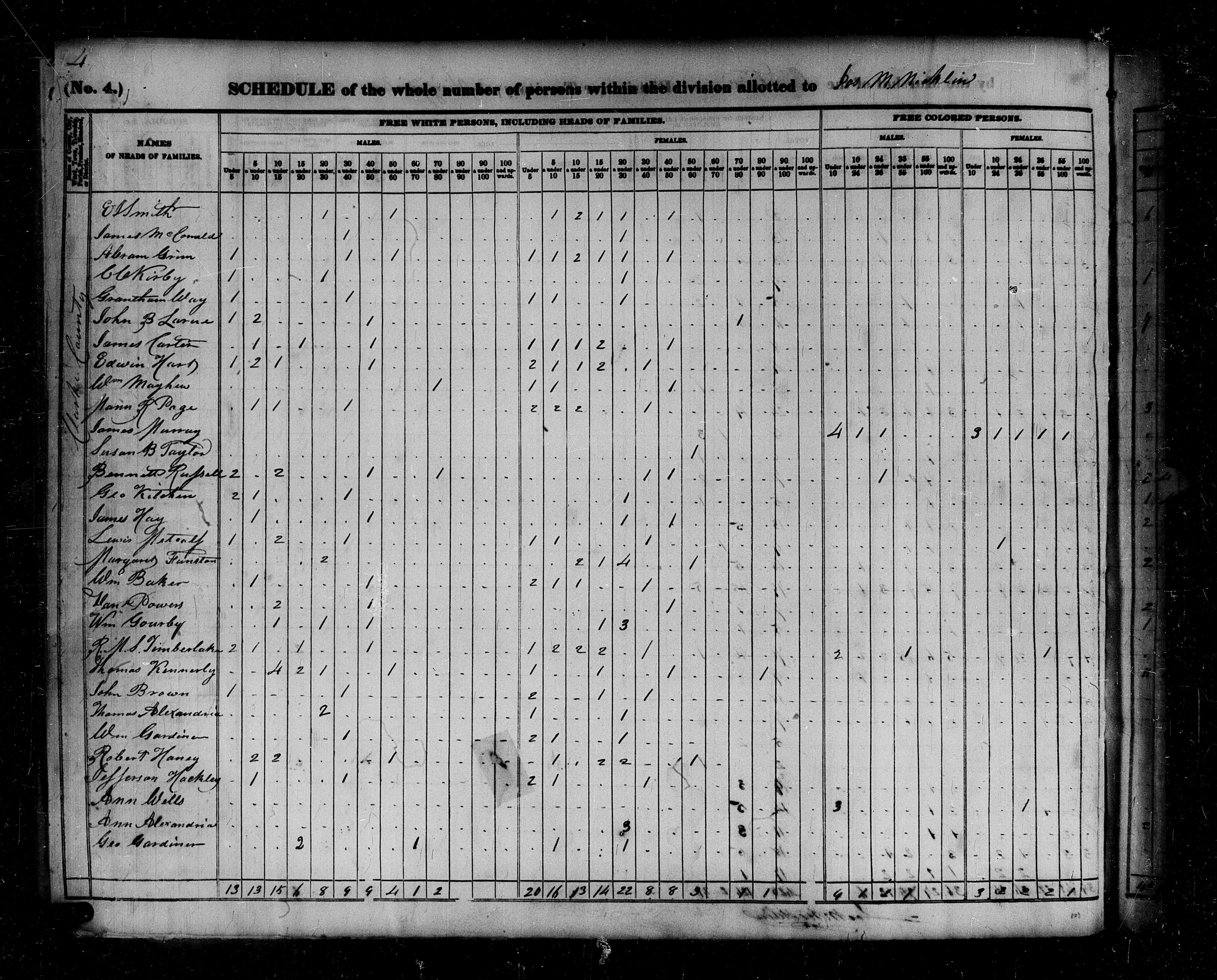
Page 4 of the schedule. James Murray is line 11: his household's 13 people are all in the free colored columns at the right. R M S Timberlake, line 21, has four free colored persons in a white household.
What this image does and does not showThe whole page as FamilySearch's image shows it. The facing page, with the household's enslaved people and totals, is not shown.
United States census of 1840, Clarke County, Virginia, page 4. FamilySearch, film 005154913, image 14. Rights Changes: FamilySearch's whole page image as downloaded, not cropped or scaled and not re-encoded. Nothing retouched or added.
Source: Sixth Census of the United States, 1840: population schedule for Clarke County, Virginia (National Archives microfilm M704, roll 555) Open the full image
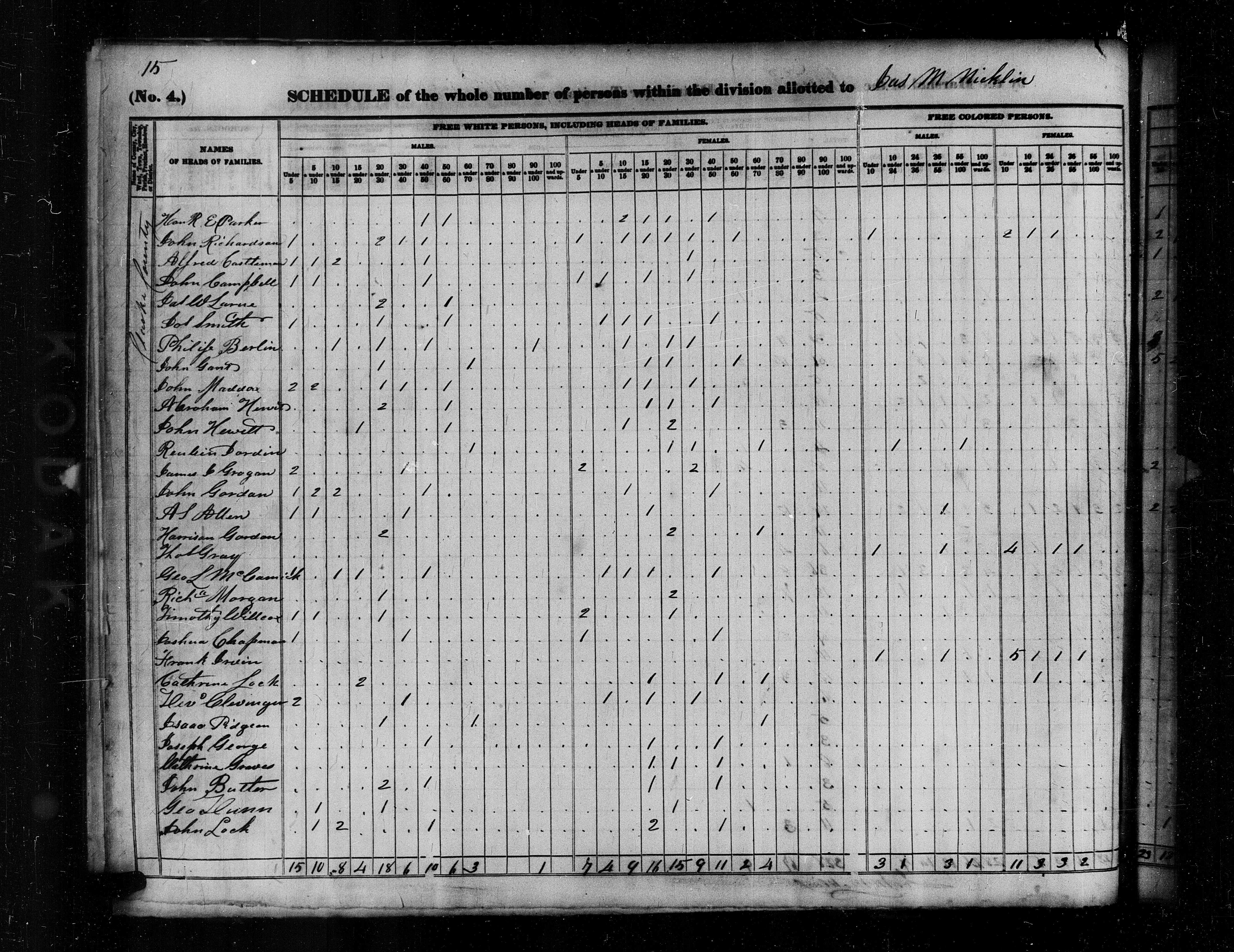
Page 15 holds more free people of color than any other page of the schedule. Thos Gray, line 17, and Frank Irwin, line 22, head households counted only in the free colored columns; A S Allen, line 15, has one free colored man.
What this image does and does not showThe whole page as FamilySearch's image shows it. The facing page is not shown.
United States census of 1840, Clarke County, Virginia, page 15. FamilySearch, film 005154913, image 38. Rights Changes: FamilySearch's whole page image as downloaded, not cropped or scaled and not re-encoded. Nothing retouched or added.
Source: Sixth Census of the United States, 1840: population schedule for Clarke County, Virginia (National Archives microfilm M704, roll 555) Open the full image
In other households
Not every free person of color lived in a household of their own. The census lists 76 of them on 41 lines that also list white people, most of which list enslaved people too. The two records of 1840 agree on five of these households. The tax list counts one free Black person, unnamed, on each of the lines of Algernon S Allen, Isaac Irving Hite, John Jolliffe, Richard MS Timberlake and John Wood, and the census lists free people of color in the same five households. Neither record says who they were, what work they did there, or whether they were paid.
Later lists add a little. In 1843 a person named only Nanny is entered "at BVille", most likely Berryville. In 1851 Nancy Robinson, 65, is entered "with Mrs S R Page". In 1850 four people, among them Washington Newman, are entered as bound out.
Source note: United States Department of State, 1841
The Compendium of the Sixth Census gives Clarke County free colored persons in twelve columns that add to 161: 73 male and 88 female.
What the source supports
How many free people of color the 1840 census counted in Clarke County.
Uncertainty
The volume prints no free colored total; 161 is the sum of its cells, and this project's count of the schedules gives the same twelve figures. The census term is the census's. No human historian has reviewed this claim.
Source
Evidence role: supports. United States Department of State, Page 37, Virginia, Western District, free colored persons, row Clarke.
Compendium of the Enumeration of the Inhabitants and Statistics of the United States, as Obtained at the Department of State, from the Returns of the Sixth Census (Washington: Thomas Allen, 1841)
United States Department of State · 1841 (publication)
Locator: Page 37, Virginia, Western District, free colored persons, row Clarke
Relevant passageClarke ... 30 | 16 | 8 | 13 | 5 | 1 | 28 | 21 | 17 | 14 | 8 | ..
Checked: Original inspected. A digital reproduction was inspected; no original has been handled.
Open sourceSource family: us-census. Multiple passages from one source are not independent witnesses.
AI-assisted source check (Claude Opus 5.5) · 2026-10-21. How this project checks its sources
Source note: Joy MacDonald, 2013, and one more
The tax list of 1840 counts one free Black person, without a name, on each of the lines of Algernon S Allen, Isaac Irving Hite, John Jolliffe, Richard MS Timberlake and John Wood, and the census of 1840 lists free colored persons in the households of A S Allen, Isaac I Hite, John Jolliffe, R M S Timberlake and John Wood: one each, and four in Timberlake's.
What the source supports
That the two records of 1840 agree in placing free Black people in the same five white households.
Uncertainty
Neither record names these people or says what they did in the household, whether they were paid, or how they were related to anyone there. The tax list counts only people of taxable age, which is why it can count fewer than the census. No human historian has reviewed this claim.
Source
Evidence role: supports. Joy MacDonald, Page 4, row 21, tax year 1840.
Joy MacDonald, comp., Free Blacks on the Personal Property Tax Lists of Clarke County, Virginia, 1836-1862 (New Papyrus Publishing, 2013)
Joy MacDonald · 2013 (publication)
Locator: Page 4, row 21, tax year 1840
Relevant passagex | | 1840 | | | | 1 free black no name listed with Algernon S Allen
Checked: Original inspected. A digital reproduction was inspected; no original has been handled.
Open sourceSource family: macdonald-clarke-free-blacks. Multiple passages from one source are not independent witnesses.
Evidence role: supports. Joy MacDonald, Page 4, row 23, tax year 1840.
Joy MacDonald, comp., Free Blacks on the Personal Property Tax Lists of Clarke County, Virginia, 1836-1862 (New Papyrus Publishing, 2013)
Joy MacDonald · 2013 (publication)
Locator: Page 4, row 23, tax year 1840
Relevant passagex | | 1840 | | | | 1 free black no name listed with Isaac Irving Hite
Checked: Original inspected. A digital reproduction was inspected; no original has been handled.
Open sourceSource family: macdonald-clarke-free-blacks. Multiple passages from one source are not independent witnesses.
Evidence role: supports. Joy MacDonald, Page 4, row 24, tax year 1840.
Joy MacDonald, comp., Free Blacks on the Personal Property Tax Lists of Clarke County, Virginia, 1836-1862 (New Papyrus Publishing, 2013)
Joy MacDonald · 2013 (publication)
Locator: Page 4, row 24, tax year 1840
Relevant passagex | | 1840 | | | | 1 free black no name listed with John Jolliffe
Checked: Original inspected. A digital reproduction was inspected; no original has been handled.
Open sourceSource family: macdonald-clarke-free-blacks. Multiple passages from one source are not independent witnesses.
Evidence role: supports. Joy MacDonald, Page 4, row 25, tax year 1840.
Joy MacDonald, comp., Free Blacks on the Personal Property Tax Lists of Clarke County, Virginia, 1836-1862 (New Papyrus Publishing, 2013)
Joy MacDonald · 2013 (publication)
Locator: Page 4, row 25, tax year 1840
Relevant passagex | | 1840 | | | | 1 free black no name listed with Richard MS Timberlake
Checked: Original inspected. A digital reproduction was inspected; no original has been handled.
Open sourceSource family: macdonald-clarke-free-blacks. Multiple passages from one source are not independent witnesses.
Evidence role: supports. Joy MacDonald, Page 4, row 26, tax year 1840.
Joy MacDonald, comp., Free Blacks on the Personal Property Tax Lists of Clarke County, Virginia, 1836-1862 (New Papyrus Publishing, 2013)
Joy MacDonald · 2013 (publication)
Locator: Page 4, row 26, tax year 1840
Relevant passagex | | 1840 | | | | 1 free black no name listed with John Wood
Checked: Original inspected. A digital reproduction was inspected; no original has been handled.
Open sourceSource family: macdonald-clarke-free-blacks. Multiple passages from one source are not independent witnesses.
Evidence role: supports. Jos. M. Nicklin, assistant marshal, Page 15, line 15, free colored (images 3:1:33SQ-GYYJ-9KHC and 3:1:33SQ-GYYJ-9KWB).
Sixth Census of the United States, 1840: population schedule for Clarke County, Virginia (National Archives microfilm M704, roll 555)
Jos. M. Nicklin, assistant marshal · 1840 (creation)
Locator: Page 15, line 15, free colored (images 3:1:33SQ-GYYJ-9KHC and 3:1:33SQ-GYYJ-9KWB)
Relevant passageA S Allen ... free colored . | . | . | 1 | . | . | . | . | . | . | . | .
Checked: Original inspected. A digital reproduction was inspected; no original has been handled.
Open sourceSource family: us-census. Multiple passages from one source are not independent witnesses.
Evidence role: supports. Jos. M. Nicklin, assistant marshal, Page 5, line 19, free colored (images 3:1:33SQ-GYYJ-9KFS and 3:1:33SQ-GYYJ-9KF3).
Sixth Census of the United States, 1840: population schedule for Clarke County, Virginia (National Archives microfilm M704, roll 555)
Jos. M. Nicklin, assistant marshal · 1840 (creation)
Locator: Page 5, line 19, free colored (images 3:1:33SQ-GYYJ-9KFS and 3:1:33SQ-GYYJ-9KF3)
Relevant passageIsaac I Hite ... free colored . | . | 1 | . | . | . | . | . | . | . | . | .
Checked: Original inspected. A digital reproduction was inspected; no original has been handled.
Open sourceSource family: us-census. Multiple passages from one source are not independent witnesses.
Evidence role: supports. Jos. M. Nicklin, assistant marshal, Page 3, line 15, free colored (images 3:1:33SQ-GYYJ-9K2Y and 3:1:33S7-9YYJ-9LDQ).
Sixth Census of the United States, 1840: population schedule for Clarke County, Virginia (National Archives microfilm M704, roll 555)
Jos. M. Nicklin, assistant marshal · 1840 (creation)
Locator: Page 3, line 15, free colored (images 3:1:33SQ-GYYJ-9K2Y and 3:1:33S7-9YYJ-9LDQ)
Relevant passageJohn Jolliffe ... free colored . | . | . | 1 | . | . | . | . | . | . | . | .
Checked: Original inspected. A digital reproduction was inspected; no original has been handled.
Open sourceSource family: us-census. Multiple passages from one source are not independent witnesses.
Evidence role: supports. Jos. M. Nicklin, assistant marshal, Page 4, line 21, free colored (images 3:1:33SQ-GYYJ-9KC6 and 3:1:33SQ-GYYJ-9KWG).
Sixth Census of the United States, 1840: population schedule for Clarke County, Virginia (National Archives microfilm M704, roll 555)
Jos. M. Nicklin, assistant marshal · 1840 (creation)
Locator: Page 4, line 21, free colored (images 3:1:33SQ-GYYJ-9KC6 and 3:1:33SQ-GYYJ-9KWG)
Relevant passageR M S Timberlake ... free colored 2 | . | . | 1 | . | . | . | . | . | 1 | . | .
Checked: Original inspected. A digital reproduction was inspected; no original has been handled.
Open sourceSource family: us-census. Multiple passages from one source are not independent witnesses.
Evidence role: supports. Jos. M. Nicklin, assistant marshal, Page 6, line 20, free colored (images 3:1:33SQ-GYYJ-9K4N and 3:1:33S7-9YYJ-92TZ).
Sixth Census of the United States, 1840: population schedule for Clarke County, Virginia (National Archives microfilm M704, roll 555)
Jos. M. Nicklin, assistant marshal · 1840 (creation)
Locator: Page 6, line 20, free colored (images 3:1:33SQ-GYYJ-9K4N and 3:1:33S7-9YYJ-92TZ)
Relevant passageJohn Wood ... free colored . | . | 1 | . | . | . | . | . | . | . | . | .
Checked: Original inspected. A digital reproduction was inspected; no original has been handled.
Open sourceSource family: us-census. Multiple passages from one source are not independent witnesses.
AI-assisted source check (Claude Opus 5.5) · 2026-10-26. How this project checks its sources
Source note: Joy MacDonald, 2013
A few tax-list entries say where a person was: in 1843 a person named only Nanny is entered "at BVille"; in 1851 Nancy Robinson, 65, is entered "with Mrs S R Page"; and in 1850 Washington Newman is one of four people entered "bound out".
What the source supports
What the tax lists say about where some free Black people lived, and that some were bound out.
Uncertainty
BVille is most likely Berryville, but the entry does not spell it out. "Bound out" is the list's own phrase; the list does not say to whom, for how long, or why. No human historian has reviewed this claim.
Source
Evidence role: supports. Joy MacDonald, Page 6, row 33, tax year 1843.
Joy MacDonald, comp., Free Blacks on the Personal Property Tax Lists of Clarke County, Virginia, 1836-1862 (New Papyrus Publishing, 2013)
Joy MacDonald · 2013 (publication)
Locator: Page 6, row 33, tax year 1843
Relevant passage| Nanny | 1843 | | | | at BVille
Checked: Original inspected. A digital reproduction was inspected; no original has been handled.
Open sourceSource family: macdonald-clarke-free-blacks. Multiple passages from one source are not independent witnesses.
Evidence role: supports. Joy MacDonald, Page 10, row 30, tax year 1850.
Joy MacDonald, comp., Free Blacks on the Personal Property Tax Lists of Clarke County, Virginia, 1836-1862 (New Papyrus Publishing, 2013)
Joy MacDonald · 2013 (publication)
Locator: Page 10, row 30, tax year 1850
Relevant passageNewman | Washington | 1850 | | | | bound out
Checked: Original inspected. A digital reproduction was inspected; no original has been handled.
Open sourceSource family: macdonald-clarke-free-blacks. Multiple passages from one source are not independent witnesses.
Evidence role: supports. Joy MacDonald, Page 12, row 23, tax year 1851.
Joy MacDonald, comp., Free Blacks on the Personal Property Tax Lists of Clarke County, Virginia, 1836-1862 (New Papyrus Publishing, 2013)
Joy MacDonald · 2013 (publication)
Locator: Page 12, row 23, tax year 1851
Relevant passageRobinson | Nancy | 1851 | 65 | | | with Mrs S R Page
Checked: Original inspected. A digital reproduction was inspected; no original has been handled.
Open sourceSource family: macdonald-clarke-free-blacks. Multiple passages from one source are not independent witnesses.
AI-assisted source check (Claude Opus 5.5) · 2026-10-26. How this project checks its sources
Work and property
Most lists give only an age band, such as over 16. The lists of 1851, 1860 and 1861 give 103 ages in years and 79 trades. Seventy of the trades are laborer. The rest are blacksmith, carpenter, barber, cooper, shoemaker and stone mason. Walter Howard, 60 in 1861, was a blacksmith. Robert Diggs, 22 in 1851, was a shoemaker, and the list notes "John Kable to pay": someone else was to pay his tax, as the lists say of 20 entries in 1843 and 1851.
The property taxed was mostly horses, with cattle, hogs, clocks and household furniture in later years. A few people had more. In 1836 Daniel Wilkerson was taxed on a carryall valued at $50, and in 1840 Kitty Wilkinson on a horse and a barouche valued at $20.
Source note: Joy MacDonald, 2013
The tax lists of 1851, 1860 and 1861 give 103 ages in years and 79 trades. Seventy of the trades are labourer; the others are blacksmith, carpenter and barber (two each), cooper, shoe maker and stone mason. Walter Howard, 60, is a blacksmith in 1861, and Robert Diggs, 22, a shoe maker in 1851, with the memo "John Kable to pay".
What the source supports
What work free Black people in Clarke did, as three of the tax lists record it.
Uncertainty
Most lists give only an age band, so the trades come from three years. A trade on a tax list is what the commissioner wrote down, not a full account of a person's work. Twenty entries of 1843 and 1851 name someone else to pay the tax; the lists do not say why. No human historian has reviewed this claim.
Source
Evidence role: supports. Joy MacDonald, Page 20, row 11, tax year 1861.
Joy MacDonald, comp., Free Blacks on the Personal Property Tax Lists of Clarke County, Virginia, 1836-1862 (New Papyrus Publishing, 2013)
Joy MacDonald · 2013 (publication)
Locator: Page 20, row 11, tax year 1861
Relevant passageHoward | Walter | 1861 | 60 | blacksmith
Checked: Original inspected. A digital reproduction was inspected; no original has been handled.
Open sourceSource family: macdonald-clarke-free-blacks. Multiple passages from one source are not independent witnesses.
Evidence role: supports. Joy MacDonald, Page 11, row 19, tax year 1851.
Joy MacDonald, comp., Free Blacks on the Personal Property Tax Lists of Clarke County, Virginia, 1836-1862 (New Papyrus Publishing, 2013)
Joy MacDonald · 2013 (publication)
Locator: Page 11, row 19, tax year 1851
Relevant passageDiggs | Robert | 1851 | 22 | shoe maker | tax 1.00 | John Kable to pay
Checked: Original inspected. A digital reproduction was inspected; no original has been handled.
Open sourceSource family: macdonald-clarke-free-blacks. Multiple passages from one source are not independent witnesses.
AI-assisted source check (Claude Opus 5.5) · 2026-10-26. How this project checks its sources
Source note: Joy MacDonald, 2013
In 1840 Kitty Wilkinson was taxed on 1 horse and a barouche valued at $20, and in 1836 Daniel Wilkerson on a carryall valued at $50 and 1 horse.
What the source supports
That some free Black taxpayers in Clarke owned horses and carriages.
Uncertainty
The lists record only taxable property; land was taxed on separate books, which were not read. No human historian has reviewed this claim.
Source
Evidence role: supports. Joy MacDonald, Page 4, row 19, tax year 1840.
Joy MacDonald, comp., Free Blacks on the Personal Property Tax Lists of Clarke County, Virginia, 1836-1862 (New Papyrus Publishing, 2013)
Joy MacDonald · 2013 (publication)
Locator: Page 4, row 19, tax year 1840
Relevant passageWilkinson | Kitty | 1840 | | | 1 horse, 1 barouche val 20, tax 2.08
Checked: Original inspected. A digital reproduction was inspected; no original has been handled.
Open sourceSource family: macdonald-clarke-free-blacks. Multiple passages from one source are not independent witnesses.
Evidence role: supports. Joy MacDonald, Page 1, row 16, tax year 1836.
Joy MacDonald, comp., Free Blacks on the Personal Property Tax Lists of Clarke County, Virginia, 1836-1862 (New Papyrus Publishing, 2013)
Joy MacDonald · 2013 (publication)
Locator: Page 1, row 16, tax year 1836
Relevant passageWilkerson | Daniel | 1836 | >16 | | 1 carryall val 50, 1 horse, tax 1.06
Checked: Original inspected. A digital reproduction was inspected; no original has been handled.
Open sourceSource family: macdonald-clarke-free-blacks. Multiple passages from one source are not independent witnesses.
AI-assisted source check (Claude Opus 5.5) · 2026-10-26. How this project checks its sources
Mowen Harris
One name runs through almost the whole record. Mowen Harris is on 21 of the 26 lists from 1836 to 1862, and once more as Mowan in 1848. In 1851 he was 41 and a stone mason. By 1861 he was taxed on a horse, 2 cattle, 4 hogs, a clock and household and kitchen furniture valued at $50.
In most years from 1844 to 1851 he was also taxed on a slave, and in 1851 on three over 16. His is one of nine names on the free Black lists taxed on slaves between 1836 and 1851. The first was Thomas Whiting, entered in 1836 with "2 tithables, 4 slaves >12, 1 horse". Virginia law limited whom a free Black person could acquire: no slave "other than the husband, wife, parent or descendant of such free negro," except by inheritance. Under that rule, a free Black person who bought a slave could buy only a member of the family. The tax lists give only numbers, and cannot show whom Mowen Harris or Thomas Whiting held.
Source note: Joy MacDonald, 2013
Mowen Harris is on 21 of the 26 tax lists from 1836 to 1862 under that spelling, and as Mowan in 1848. In 1851 he is 41, a stone mason, taxed on 3 slaves over 16; in 1861 he is taxed on a horse, 2 cattle, 4 hogs, a clock and household and kitchen furniture valued at $50.
What the source supports
That one free Black man of Clarke can be followed through nearly the whole run of the tax lists, with his trade and property.
Uncertainty
The same name over 27 years is very probably one man but is not proved by the lists. His printed ages do not quite agree: 41 in 1851, 50 in 1860 and 55 in 1861. In 1861 the name appears twice, once with property and once with an age and trade. The lists do not say whom he was taxed on. No human historian has reviewed this claim.
Source
Evidence role: supports. Joy MacDonald, Page 1, row 9, tax year 1836.
Joy MacDonald, comp., Free Blacks on the Personal Property Tax Lists of Clarke County, Virginia, 1836-1862 (New Papyrus Publishing, 2013)
Joy MacDonald · 2013 (publication)
Locator: Page 1, row 9, tax year 1836
Relevant passageHarris | Mowen | 1836 | >16
Checked: Original inspected. A digital reproduction was inspected; no original has been handled.
Open sourceSource family: macdonald-clarke-free-blacks. Multiple passages from one source are not independent witnesses.
Evidence role: supports. Joy MacDonald, Page 11, row 28, tax year 1851.
Joy MacDonald, comp., Free Blacks on the Personal Property Tax Lists of Clarke County, Virginia, 1836-1862 (New Papyrus Publishing, 2013)
Joy MacDonald · 2013 (publication)
Locator: Page 11, row 28, tax year 1851
Relevant passageHarris | Mowen | 1851 | 41 | stone mason | 3 slaves >16, tax 2.14
Checked: Original inspected. A digital reproduction was inspected; no original has been handled.
Open sourceSource family: macdonald-clarke-free-blacks. Multiple passages from one source are not independent witnesses.
Evidence role: supports. Joy MacDonald, Page 20, row 9, tax year 1861.
Joy MacDonald, comp., Free Blacks on the Personal Property Tax Lists of Clarke County, Virginia, 1836-1862 (New Papyrus Publishing, 2013)
Joy MacDonald · 2013 (publication)
Locator: Page 20, row 9, tax year 1861
Relevant passageHarris | Mowen | 1861 | | | 1 horse val 30, 2 cattle val 30, 4 hogs val 10, 1 clock val 5, household & kitchen furniture val 50, tax 1.30
Checked: Original inspected. A digital reproduction was inspected; no original has been handled.
Open sourceSource family: macdonald-clarke-free-blacks. Multiple passages from one source are not independent witnesses.
AI-assisted source check (Claude Opus 5.5) · 2026-10-26. How this project checks its sources
Source note: Joy MacDonald, 2013, and one more
Nine names on Clarke's free Black tax lists were taxed on slaves between 1836 and 1851, among them Thomas Whiting, entered in 1836 with "2 tithables, 4 slaves >12, 1 horse", and Mowen Harris. The Code of Virginia of 1849, restating an act of the 1831-32 session cited in its margin, allowed a free negro to acquire a slave, except by inheritance, only if the slave was his husband, wife, parent or descendant.
What the source supports
That some free Black people in Clarke held slaves in law, and the limit the law put on whom they could acquire.
Uncertainty
The lists give numbers, not names, so they cannot show whether these were family members held in law, as the statute's rule suggests some were. No deed or register was read for any of them. No human historian has reviewed this claim.
Source
Evidence role: supports. Joy MacDonald, Page 1, row 15, tax year 1836.
Joy MacDonald, comp., Free Blacks on the Personal Property Tax Lists of Clarke County, Virginia, 1836-1862 (New Papyrus Publishing, 2013)
Joy MacDonald · 2013 (publication)
Locator: Page 1, row 15, tax year 1836
Relevant passageWhiting | Thomas | 1836 | >16 | | 2 tithables, 4 slaves >12, 1 horse, tax 1.06
Checked: Original inspected. A digital reproduction was inspected; no original has been handled.
Open sourceSource family: macdonald-clarke-free-blacks. Multiple passages from one source are not independent witnesses.
Evidence role: supports. Joy MacDonald, Page 11, row 28, tax year 1851.
Joy MacDonald, comp., Free Blacks on the Personal Property Tax Lists of Clarke County, Virginia, 1836-1862 (New Papyrus Publishing, 2013)
Joy MacDonald · 2013 (publication)
Locator: Page 11, row 28, tax year 1851
Relevant passageHarris | Mowen | 1851 | 41 | stone mason | 3 slaves >16, tax 2.14
Checked: Original inspected. A digital reproduction was inspected; no original has been handled.
Open sourceSource family: macdonald-clarke-free-blacks. Multiple passages from one source are not independent witnesses.
Evidence role: supports. General Assembly of Virginia, Page 458, chapter 103, section 4 (page scan 496).
The Code of Virginia (Richmond: William F. Ritchie, 1849), Title 30, Slaves and Free Negroes, chapters 103 and 107
General Assembly of Virginia · 1849 (publication)
Locator: Page 458, chapter 103, section 4 (page scan 496)
Relevant passageNo free negro shall be capable of acquiring (except by descent) any slave other than the husband, wife, parent or descendant of such free negro.
Checked: Original inspected. A digital reproduction was inspected; no original has been handled.
Open sourceSource family: code-of-virginia-1849. Multiple passages from one source are not independent witnesses.
AI-assisted source check (Claude Opus 5.5) · 2026-10-26. How this project checks its sources
Freed by will
Virginia let an owner free people "by last will in writing, or by deed, recorded in the court of his county or corporation." Clarke's will books, as Patricia B. Duncan abstracted them, show it happening throughout these years.
Thomas T. Byrd's will of February 16, 1840 "frees man Gabriel". It gave Ann Preston's children, Thomas Whiting called Tinko and Maria Louisa, to his niece's family in Baltimore, to be freed at 25. That September his estate's inventory listed Gabriel, Thomas Preston, about 10, and Anne Preston and her infant Maria as to be emancipated. But when the estate was settled, the executor reported that the Wymans of Baltimore had taken Thomas Whiting and Maria Louisa, Mrs. Ellen Buchanan had taken Ann Preston early in 1843, and "rest of slaves were taken by Mrs. Maria C. NICHOLAS at the end of 1843." The abstracts do not say whether any of them was later freed. A man entered only as Gabriel, taxed on a horse, is on the free Black list of 1841. Nothing shows he is the same Gabriel.
Other wills free people by name: James (Dr. Henry W. Snyder, 1840); John and Robin Lovet (Catharine Milton, 1841); John (Samuel Bryarly, 1844); Aaron (John Richardson, 1848); Easter, Strother and Sarepta Jane (Mary Howard, 1850); Nancy (Elizabeth N. Carter, 1854); and Fannda, who was also given 21 acres and a house on the road leading north to the Snickers Gap Turnpike (Liney Littleton, 1857). Elizabeth Crampton's will of 1845 frees all her slaves at her son's death. A will was a promise, not a release. Four years after Mary Howard's will, the inventory of her estate still listed Strother, Jane and two children, and Easter.
Some wills tied freedom to leaving. Ann R. Page's of 1838 has "Jack and Billy to be sent to Liberia". Frederick Clopton's of 1845 "frees Negroes and wants them moved to PA or some other free state". Susan R. Page added in 1858 that her servants be hired out to raise money to send them to Liberia, and stay with her children if they did not wish to go.
Source note: General Assembly of Virginia, 1849, and one more
Thomas T. Byrd's will of February 16, 1840 frees Gabriel, and gives Ann Preston's children, Thomas Whiting called Tinko and Maria Louisa, to Samuel Wyman Jr. and his wife of Baltimore, to be freed at 25. The inventory of his estate that September lists Gabriel, Thomas Preston, about 10, and Anne Preston and her infant Maria as to be emancipated. The settlement recorded in 1845 says the Wymans took Thomas Whiting and Maria Louisa, Mrs. Ellen Buchanan took Ann Preston early in 1843, and Mrs. Maria C. Nicholas took the rest of the slaves at the end of 1843.
What the source supports
What one Clarke will promised the people it named, and what the settlement of the estate says happened to them.
Uncertainty
These are Duncan's abstracts, not the will books. The will gives Ann Preston to Mrs. Buchanan while the inventory lists her to be emancipated; the abstracts do not explain the difference, or say whether anyone was freed later. Tinko was a child in 1840 and is not the Thomas Whiting of the tax lists. No human historian has reviewed this claim.
Source
Evidence role: supports. General Assembly of Virginia, Page 458, chapter 103, section 9 (page scan 496).
The Code of Virginia (Richmond: William F. Ritchie, 1849), Title 30, Slaves and Free Negroes, chapters 103 and 107
General Assembly of Virginia · 1849 (publication)
Locator: Page 458, chapter 103, section 9 (page scan 496)
Relevant passageAny person may emancipate any of his slaves by last will in writing, or by deed, recorded in the court of his county or corporation.
Checked: Original inspected. A digital reproduction was inspected; no original has been handled.
Open sourceSource family: code-of-virginia-1849. Multiple passages from one source are not independent witnesses.
Evidence role: supports. Patricia B. Duncan, Printed page 46, [A:142], will of Thomas T. Byrd, 16 Feb 1840.
Patricia B. Duncan, Clarke County, Virginia Will Book Abstracts, Books A-I (1836-1904) and 1A-3C (1841-1913) (Heritage Books, 2016)
Patricia B. Duncan · 2016 (publication)
Locator: Printed page 46, [A:142], will of Thomas T. Byrd, 16 Feb 1840
Relevant passageWill of 16 Feb 1840: frees man Gabriel, Sam. WYMAN Jr. & wife (his niece) Mary of Baltimore (given children of Ann Preston (Thomas Whiting called Tinko & Maria Louisa) who are freed at age 25y)
Checked: This passage was read on a digital reproduction of the page; no original has been handled. The source's other readings: existing OCR reviewed, original image not independently inspected.
Open sourceSource family: duncan-clarke-wills. Multiple passages from one source are not independent witnesses.
Evidence role: supports. Patricia B. Duncan, Printed page 47, [A:369], appraisal and inventory of the estate of Thomas T. Byrd, 30 Sep 1840.
Patricia B. Duncan, Clarke County, Virginia Will Book Abstracts, Books A-I (1836-1904) and 1A-3C (1841-1913) (Heritage Books, 2016)
Patricia B. Duncan · 2016 (publication)
Locator: Printed page 47, [A:369], appraisal and inventory of the estate of Thomas T. Byrd, 30 Sep 1840
Relevant passageNegroes Gabriel to be emancipated, Thomas alias Thomas Cooper, Thomas alias Thomas Laws, Thomas alias Thomas Preston abt 10y old to be emancipated, very old Solomon, Anne alias Anne Preston & her infant child Maria to be emancipated
Checked: This passage was read on a digital reproduction of the page; no original has been handled. The source's other readings: existing OCR reviewed, original image not independently inspected.
Open sourceSource family: duncan-clarke-wills. Multiple passages from one source are not independent witnesses.
Evidence role: supports. Patricia B. Duncan, Printed page 47, [B:016], settlement of the estate of Thomas T. Byrd, recorded 24 Mar 1845.
Patricia B. Duncan, Clarke County, Virginia Will Book Abstracts, Books A-I (1836-1904) and 1A-3C (1841-1913) (Heritage Books, 2016)
Patricia B. Duncan · 2016 (publication)
Locator: Printed page 47, [B:016], settlement of the estate of Thomas T. Byrd, recorded 24 Mar 1845
Relevant passageDistribution of slaves to: Samuel WYMAN Jr. & wife (took Thomas Whiting & Maria Louisa the children of Ann Preston), Mrs. Ellen BUCHANAN (took Ann Preston early in 1843), rest of slaves were taken by Mrs. Maria C. NICHOLAS at the end of 1843.
Checked: This passage was read on a digital reproduction of the page; no original has been handled. The source's other readings: existing OCR reviewed, original image not independently inspected.
Open sourceSource family: duncan-clarke-wills. Multiple passages from one source are not independent witnesses.
AI-assisted source check (Claude Opus 5.5) · 2026-10-26. How this project checks its sources
Source note: Joy MacDonald, 2013
A man entered only as Gabriel, over 16, is on the tax list of 1841, taxed on 1 horse.
What the source supports
That a free man named Gabriel was in Clarke the year after Thomas T. Byrd's will freed a man of that name.
Uncertainty
A single given name is a lead, not an identification; nothing in the list connects him to Byrd's estate. No human historian has reviewed this claim.
Source
Evidence role: supports. Joy MacDonald, Page 5, row 27, tax year 1841.
Joy MacDonald, comp., Free Blacks on the Personal Property Tax Lists of Clarke County, Virginia, 1836-1862 (New Papyrus Publishing, 2013)
Joy MacDonald · 2013 (publication)
Locator: Page 5, row 27, tax year 1841
Relevant passage| Gabriel | 1841 | >16 | | 1 horse, tax .125
Checked: Original inspected. A digital reproduction was inspected; no original has been handled.
Open sourceSource family: macdonald-clarke-free-blacks. Multiple passages from one source are not independent witnesses.
AI-assisted source check (Claude Opus 5.5) · 2026-10-26. How this project checks its sources
Source note: Patricia B. Duncan, 2016
Other Clarke wills free people by name: Dr. Henry W. Snyder's of 1840 frees a man named James; Catharine Milton's of 1841, John and Robin Lovet; Samuel Bryarly's of 1844, a man named John; Elizabeth Crampton's of 1845, all her slaves at her son's death; John Richardson's of 1848, Aaron; Mary Howard's of 1850, Easter, Strother and Sarepta Jane; Elizabeth N. Carter's of 1854, a girl named Nancy; and Liney Littleton's of 1857, Fannda, with 21 acres and a house. The inventory of Mary Howard's estate in 1854 still lists Strother, Jane and two children, and Easter.
What the source supports
That freeing people by will happened in Clarke through the whole period, and that a will's promise was not always kept at once.
Uncertainty
These are Duncan's abstracts of the will books, which carry what she chose to carry. A will names whom it meant to free; it does not show that the person was freed, stayed in Virginia, or had leave to. Several were recorded years after they were written. No human historian has reviewed this claim.
Source
Evidence role: supports. Patricia B. Duncan, Printed page 48, [A:159], will of Dr. Henry W. Snyder, 21 Nov 1840.
Patricia B. Duncan, Clarke County, Virginia Will Book Abstracts, Books A-I (1836-1904) and 1A-3C (1841-1913) (Heritage Books, 2016)
Patricia B. Duncan · 2016 (publication)
Locator: Printed page 48, [A:159], will of Dr. Henry W. Snyder, 21 Nov 1840
Relevant passageWill of 21 Nov 1840: frees man James
Checked: This passage was read on a digital reproduction of the page; no original has been handled. The source's other readings: existing OCR reviewed, original image not independently inspected.
Open sourceSource family: duncan-clarke-wills. Multiple passages from one source are not independent witnesses.
Evidence role: supports. Patricia B. Duncan, Printed page 62, [B:049], will of Mrs. Catharine Milton, 12 Jan 1841.
Patricia B. Duncan, Clarke County, Virginia Will Book Abstracts, Books A-I (1836-1904) and 1A-3C (1841-1913) (Heritage Books, 2016)
Patricia B. Duncan · 2016 (publication)
Locator: Printed page 62, [B:049], will of Mrs. Catharine Milton, 12 Jan 1841
Relevant passageservants including John & Robin Lovet both who are to be freed
Checked: This passage was read on a digital reproduction of the page; no original has been handled. The source's other readings: existing OCR reviewed, original image not independently inspected.
Open sourceSource family: duncan-clarke-wills. Multiple passages from one source are not independent witnesses.
Evidence role: supports. Patricia B. Duncan, Printed page 78, [B:401], will of Samuel Bryarly, 1 Feb 1844.
Patricia B. Duncan, Clarke County, Virginia Will Book Abstracts, Books A-I (1836-1904) and 1A-3C (1841-1913) (Heritage Books, 2016)
Patricia B. Duncan · 2016 (publication)
Locator: Printed page 78, [B:401], will of Samuel Bryarly, 1 Feb 1844
Relevant passagefrees Negro man John
Checked: This passage was read on a digital reproduction of the page; no original has been handled. The source's other readings: existing OCR reviewed, original image not independently inspected.
Open sourceSource family: duncan-clarke-wills. Multiple passages from one source are not independent witnesses.
Evidence role: supports. Patricia B. Duncan, Printed page 66, [B:188], will of Mrs. Elizabeth Crampton, 6 Mar 1845.
Patricia B. Duncan, Clarke County, Virginia Will Book Abstracts, Books A-I (1836-1904) and 1A-3C (1841-1913) (Heritage Books, 2016)
Patricia B. Duncan · 2016 (publication)
Locator: Printed page 66, [B:188], will of Mrs. Elizabeth Crampton, 6 Mar 1845
Relevant passagefrees all Negroes at death of her son, free Negro woman Catharine & any children
Checked: This passage was read on a digital reproduction of the page; no original has been handled. The source's other readings: existing OCR reviewed, original image not independently inspected.
Open sourceSource family: duncan-clarke-wills. Multiple passages from one source are not independent witnesses.
Evidence role: supports. Patricia B. Duncan, Printed page 74, [B:320], will of John Richardson, 4 Aug 1848.
Patricia B. Duncan, Clarke County, Virginia Will Book Abstracts, Books A-I (1836-1904) and 1A-3C (1841-1913) (Heritage Books, 2016)
Patricia B. Duncan · 2016 (publication)
Locator: Printed page 74, [B:320], will of John Richardson, 4 Aug 1848
Relevant passageslave Aaron freed
Checked: This passage was read on a digital reproduction of the page; no original has been handled. The source's other readings: existing OCR reviewed, original image not independently inspected.
Open sourceSource family: duncan-clarke-wills. Multiple passages from one source are not independent witnesses.
Evidence role: supports. Patricia B. Duncan, Printed page 89, [C:232], will of Mary Howard, 9 May 1850.
Patricia B. Duncan, Clarke County, Virginia Will Book Abstracts, Books A-I (1836-1904) and 1A-3C (1841-1913) (Heritage Books, 2016)
Patricia B. Duncan · 2016 (publication)
Locator: Printed page 89, [C:232], will of Mary Howard, 9 May 1850
Relevant passagefrees servants Easter, Strother & Sarepta Jane and all other slaves if financially possible
Checked: This passage was read on a digital reproduction of the page; no original has been handled. The source's other readings: existing OCR reviewed, original image not independently inspected.
Open sourceSource family: duncan-clarke-wills. Multiple passages from one source are not independent witnesses.
Evidence role: supports. Patricia B. Duncan, Printed page 90, [C:273], appraisal and inventory of the estate of Mary Howard, ordered 27 Mar 1854.
Patricia B. Duncan, Clarke County, Virginia Will Book Abstracts, Books A-I (1836-1904) and 1A-3C (1841-1913) (Heritage Books, 2016)
Patricia B. Duncan · 2016 (publication)
Locator: Printed page 90, [C:273], appraisal and inventory of the estate of Mary Howard, ordered 27 Mar 1854
Relevant passageservants Strother, Jane & 2 children & Easter of no value
Checked: This passage was read on a digital reproduction of the page; no original has been handled. The source's other readings: existing OCR reviewed, original image not independently inspected.
Open sourceSource family: duncan-clarke-wills. Multiple passages from one source are not independent witnesses.
Evidence role: supports. Patricia B. Duncan, Printed page 116, [E:294], will of Elizabeth N. Carter, 28 Apr 1854.
Patricia B. Duncan, Clarke County, Virginia Will Book Abstracts, Books A-I (1836-1904) and 1A-3C (1841-1913) (Heritage Books, 2016)
Patricia B. Duncan · 2016 (publication)
Locator: Printed page 116, [E:294], will of Elizabeth N. Carter, 28 Apr 1854
Relevant passagefrees Negro girl Nancy
Checked: This passage was read on a digital reproduction of the page; no original has been handled. The source's other readings: existing OCR reviewed, original image not independently inspected.
Open sourceSource family: duncan-clarke-wills. Multiple passages from one source are not independent witnesses.
Evidence role: supports. Patricia B. Duncan, Printed page 98, [D:092], will of Liney Littleton, 21 Jan 1857.
Patricia B. Duncan, Clarke County, Virginia Will Book Abstracts, Books A-I (1836-1904) and 1A-3C (1841-1913) (Heritage Books, 2016)
Patricia B. Duncan · 2016 (publication)
Locator: Printed page 98, [D:092], will of Liney Littleton, 21 Jan 1857
Relevant passageservant woman Fannda emancipated and given 21 acres and house on road leading north to Snickers Gap Turnpike
Checked: This passage was read on a digital reproduction of the page; no original has been handled. The source's other readings: existing OCR reviewed, original image not independently inspected.
Open sourceSource family: duncan-clarke-wills. Multiple passages from one source are not independent witnesses.
AI-assisted source check (Claude Opus 5.5) · 2026-10-26. How this project checks its sources
Source note: Patricia B. Duncan, 2016
Some Clarke wills tie freedom to leaving: Ann R. Page's of 1838 has Jack and Billy sent to Liberia; Frederick Clopton's of 1845 frees his slaves and wants them moved to Pennsylvania or another free state; Anna Mercer Harrison's of 1846 says they can be sent to Liberia; and Susan R. Page's codicil of 1858 has her servants hired out to raise money to send them to Liberia, or to stay with her children if they do not wish to go.
What the source supports
That some Clarke owners who freed people expected or required them to leave Virginia.
Uncertainty
These are Duncan's abstracts. Whether anyone named went to Liberia or Pennsylvania is not recorded in them. No human historian has reviewed this claim.
Source
Evidence role: supports. Patricia B. Duncan, Printed page 38, [A:027], will of Ann R. Page, 9 Feb 1838.
Patricia B. Duncan, Clarke County, Virginia Will Book Abstracts, Books A-I (1836-1904) and 1A-3C (1841-1913) (Heritage Books, 2016)
Patricia B. Duncan · 2016 (publication)
Locator: Printed page 38, [A:027], will of Ann R. Page, 9 Feb 1838
Relevant passageJack and Billy to be sent to Liberia
Checked: This passage was read on a digital reproduction of the page; no original has been handled. The source's other readings: existing OCR reviewed, original image not independently inspected.
Open sourceSource family: duncan-clarke-wills. Multiple passages from one source are not independent witnesses.
Evidence role: supports. Patricia B. Duncan, Printed page 91, [C:334], will of Frederick Clopton, 1845.
Patricia B. Duncan, Clarke County, Virginia Will Book Abstracts, Books A-I (1836-1904) and 1A-3C (1841-1913) (Heritage Books, 2016)
Patricia B. Duncan · 2016 (publication)
Locator: Printed page 91, [C:334], will of Frederick Clopton, 1845
Relevant passagefrees Negroes and wants them moved to PA or some other free state
Checked: This passage was read on a digital reproduction of the page; no original has been handled. The source's other readings: existing OCR reviewed, original image not independently inspected.
Open sourceSource family: duncan-clarke-wills. Multiple passages from one source are not independent witnesses.
Evidence role: supports. Patricia B. Duncan, Printed page 65, [B:133], nuncupative will of Miss Anna Mercer Harrison, 28 Jul 1846.
Patricia B. Duncan, Clarke County, Virginia Will Book Abstracts, Books A-I (1836-1904) and 1A-3C (1841-1913) (Heritage Books, 2016)
Patricia B. Duncan · 2016 (publication)
Locator: Printed page 65, [B:133], nuncupative will of Miss Anna Mercer Harrison, 28 Jul 1846
Relevant passageNegroes can be sent to Liberia
Checked: This passage was read on a digital reproduction of the page; no original has been handled. The source's other readings: existing OCR reviewed, original image not independently inspected.
Open sourceSource family: duncan-clarke-wills. Multiple passages from one source are not independent witnesses.
Evidence role: supports. Patricia B. Duncan, Printed page 103, [D:269], codicil of 8 May 1858 to the will of Susan R. Page.
Patricia B. Duncan, Clarke County, Virginia Will Book Abstracts, Books A-I (1836-1904) and 1A-3C (1841-1913) (Heritage Books, 2016)
Patricia B. Duncan · 2016 (publication)
Locator: Printed page 103, [D:269], codicil of 8 May 1858 to the will of Susan R. Page
Relevant passagehire servants out to raise money to send them to Liberia, they to remain with her children if they do not wish to go
Checked: This passage was read on a digital reproduction of the page; no original has been handled. The source's other readings: existing OCR reviewed, original image not independently inspected.
Open sourceSource family: duncan-clarke-wills. Multiple passages from one source are not independent witnesses.
AI-assisted source check (Claude Opus 5.5) · 2026-10-26. How this project checks its sources
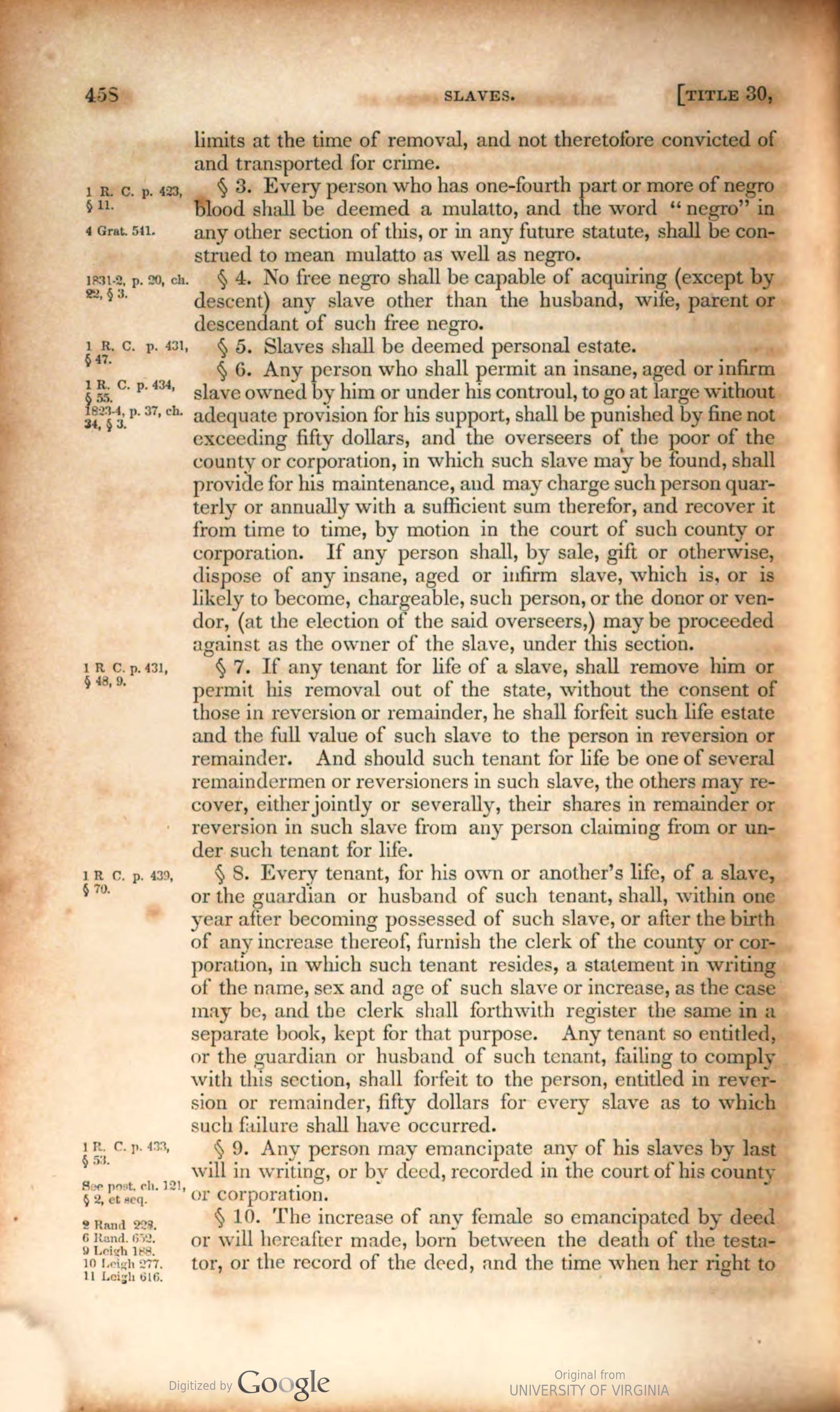
Section 4 limits whom a free negro could acquire as a slave; section 9 lets an owner free people by will or by deed.
What this image does and does not showThe whole printed page, with the marginal citations of the earlier acts.
The Code of Virginia (Richmond, 1849), page 458. HathiTrust Digital Library, from the University of Virginia. Rights Changes: HathiTrust's whole page image as downloaded at 300 dpi, not cropped or scaled and not re-encoded. Nothing retouched or added.
Source: The Code of Virginia (Richmond: William F. Ritchie, 1849), Title 30, Slaves and Free Negroes, chapters 103 and 107 Open the full image
What the law required
The separate tax lists were the law at work. The Code of Virginia of 1849 told every commissioner of the revenue to return each year "a complete list of all free negroes in his district, who are over twelve years of age, specifying their names, sexes, ages (as nearly as he can,) and trades or occupations", and the clerk to post a copy at the courthouse door.
Freedom came with a condition. Under an act of 1806, a slave freed afterward who stayed in Virginia more than twelve months "should forfeit such right and might be sold for the benefit of the poor of the county or corporation." The Code of 1849 kept the rule: no one freed since 1806 might, after 21, "remain in this state more than one year without lawful permission." A county court could give leave to stay, and to live in that county only, after notice at the courthouse door and proof that the person was "of good character, sober, peaceable, orderly and industrious."
Every free Black person was to be registered with the county clerk every five years, by name, age, color, stature and any scar, and to carry a copy of the register. One found without it could be jailed. A second time, the Code said, "he shall be punished with stripes."
This is what the law required. How Clarke's court applied it, and who had its leave to stay, are in the court's own books, which this site has not yet read.
Source note: General Assembly of Virginia, 1849
Under the act of January 25, 1806, as the Code of 1849 summarizes it, a slave freed afterward who stayed in Virginia more than twelve months forfeited the freedom and might be sold for the benefit of the county's poor. The Code of 1849 kept the rule: no one freed since May 1, 1806 could, after 21, stay in the state more than a year without permission, which a county court could grant only on proof of good character, to live in that county only.
What the source supports
What Virginia law required of people freed after 1806, the condition under which Clarke's free Black people of this period lived.
Uncertainty
The statute says what the law required. How the Clarke County court applied it, and who in Clarke had leave to remain, would be in the court's order books, which were not read. No human historian has reviewed this claim.
Source
Evidence role: supports. General Assembly of Virginia, Page 465, chapter 107, note to the heading (page scan 503).
The Code of Virginia (Richmond: William F. Ritchie, 1849), Title 30, Slaves and Free Negroes, chapters 103 and 107
General Assembly of Virginia · 1849 (publication)
Locator: Page 465, chapter 107, note to the heading (page scan 503)
Relevant passageThe act of January 25, 1806, (Sess. Acts, 1805-6, p. 36, ch. 63, § 10,) enacted that if any slave thereafter emancipated should remain within this state more than twelve months after his right to freedom accrued, he should forfeit such right and might be sold for the benefit of the poor of the county or corporation.
Checked: Original inspected. A digital reproduction was inspected; no original has been handled.
Open sourceSource family: code-of-virginia-1849. Multiple passages from one source are not independent witnesses.
Evidence role: supports. General Assembly of Virginia, Page 466, chapter 107, section 1 (page scan 504).
The Code of Virginia (Richmond: William F. Ritchie, 1849), Title 30, Slaves and Free Negroes, chapters 103 and 107
General Assembly of Virginia · 1849 (publication)
Locator: Page 466, chapter 107, section 1 (page scan 504)
Relevant passageNo negro, emancipated since the first day of May eighteen hundred and six, or hereafter, or claiming his right to freedom under a negro so emancipated, shall, after being twenty-one years of age, remain in this state more than one year without lawful permission.
Checked: Original inspected. A digital reproduction was inspected; no original has been handled.
Open sourceSource family: code-of-virginia-1849. Multiple passages from one source are not independent witnesses.
Evidence role: supports. General Assembly of Virginia, Page 466, chapter 107, section 2 (page scan 504).
The Code of Virginia (Richmond: William F. Ritchie, 1849), Title 30, Slaves and Free Negroes, chapters 103 and 107
General Assembly of Virginia · 1849 (publication)
Locator: Page 466, chapter 107, section 2 (page scan 504)
Relevant passageAny such negro may be permitted by the court of any county or corporation to remain in this state, and reside in such county or corporation only ... that the applicant produced satisfactory proof of his being of good character, sober, peaceable, orderly and industrious.
Checked: Original inspected. A digital reproduction was inspected; no original has been handled.
Open sourceSource family: code-of-virginia-1849. Multiple passages from one source are not independent witnesses.
AI-assisted source check (Claude Opus 5.5) · 2026-10-26. How this project checks its sources
Source note: General Assembly of Virginia, 1849
The Code of 1849 required every commissioner of the revenue to return each year, with his book of personal property, a list of all free negroes in his district over twelve, with their names, sexes, ages and trades, and the clerk to post a copy at the courthouse door.
What the source supports
Why free Black people appear on lists of their own in the county's tax books.
Uncertainty
The section restates an act of the 1830-31 session cited in its margin. Most of the Clarke lists give an age band rather than an age, and no trade, except in 1851, 1860 and 1861. No human historian has reviewed this claim.
Source
Evidence role: supports. General Assembly of Virginia, Page 466, chapter 107, section 5 (page scan 504).
The Code of Virginia (Richmond: William F. Ritchie, 1849), Title 30, Slaves and Free Negroes, chapters 103 and 107
General Assembly of Virginia · 1849 (publication)
Locator: Page 466, chapter 107, section 5 (page scan 504)
Relevant passageEvery commissioner of the revenue, annually, with his book of personal property, shall return also a complete list of all free negroes in his district, who are over twelve years of age, specifying their names, sexes, ages (as nearly as he can,) and trades or occupations; of which list the clerk shall fix up a copy at the courthouse door
Checked: Original inspected. A digital reproduction was inspected; no original has been handled.
Open sourceSource family: code-of-virginia-1849. Multiple passages from one source are not independent witnesses.
AI-assisted source check (Claude Opus 5.5) · 2026-10-26. How this project checks its sources
Source note: General Assembly of Virginia, 1849
The Code of 1849 required every free negro to be registered by the county clerk every five years, with name, age, colour, stature and any mark or scar, and to carry an attested copy; one over twelve found without it could be jailed, and if arrested a second time, punished with stripes.
What the source supports
The registration that the law required of every free Black person in Virginia.
Uncertainty
Clarke's register of free negroes was not read for this story, and may not survive. The statute does not say how often the rule was enforced. No human historian has reviewed this claim.
Source
Evidence role: supports. General Assembly of Virginia, Page 466, chapter 107, section 6 (page scan 504).
The Code of Virginia (Richmond: William F. Ritchie, 1849), Title 30, Slaves and Free Negroes, chapters 103 and 107
General Assembly of Virginia · 1849 (publication)
Locator: Page 466, chapter 107, section 6 (page scan 504)
Relevant passageEvery free negro shall, every five years, be registered and numbered in a book to be kept by the clerk of the court of the county or corporation where such free negro resides; which register shall specify his name, age, colour and stature, with any apparent mark or scar on his face, head or hands
Checked: Original inspected. A digital reproduction was inspected; no original has been handled.
Open sourceSource family: code-of-virginia-1849. Multiple passages from one source are not independent witnesses.
Evidence role: supports. General Assembly of Virginia, Page 467, chapter 107, section 10 (page scan 505).
The Code of Virginia (Richmond: William F. Ritchie, 1849), Title 30, Slaves and Free Negroes, chapters 103 and 107
General Assembly of Virginia · 1849 (publication)
Locator: Page 467, chapter 107, section 10 (page scan 505)
Relevant passageAny free negro above twelve years of age, residing in this state, not having such attested copy, (of a register of him, made as before directed,) may be committed to jail by a justice ... But if he be so arrested a second time ... he shall be punished with stripes.
Checked: Original inspected. A digital reproduction was inspected; no original has been handled.
Open sourceSource family: code-of-virginia-1849. Multiple passages from one source are not independent witnesses.
AI-assisted source check (Claude Opus 5.5) · 2026-10-26. How this project checks its sources
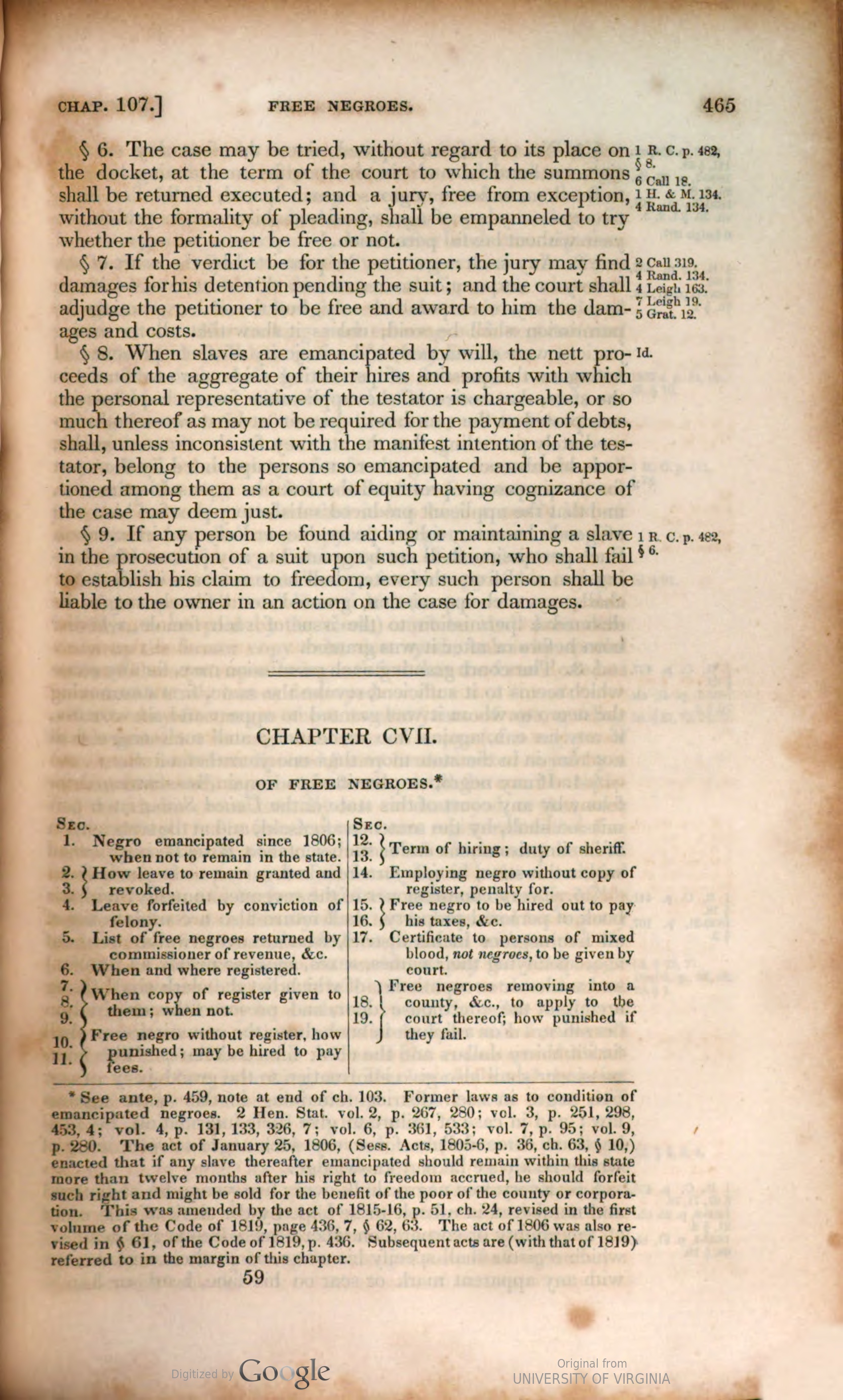
Chapter 107 begins halfway down the page. Its footnote summarizes the act of 1806 under which a freed slave who stayed in Virginia more than twelve months forfeited the freedom.
What this image does and does not showThe whole printed page; its upper half ends chapter 106, on suits for freedom.
The Code of Virginia (Richmond, 1849), page 465. HathiTrust Digital Library, from the University of Virginia. Rights Changes: HathiTrust's whole page image as downloaded at 300 dpi, not cropped or scaled and not re-encoded. Nothing retouched or added.
Source: The Code of Virginia (Richmond: William F. Ritchie, 1849), Title 30, Slaves and Free Negroes, chapters 103 and 107 Open the full image
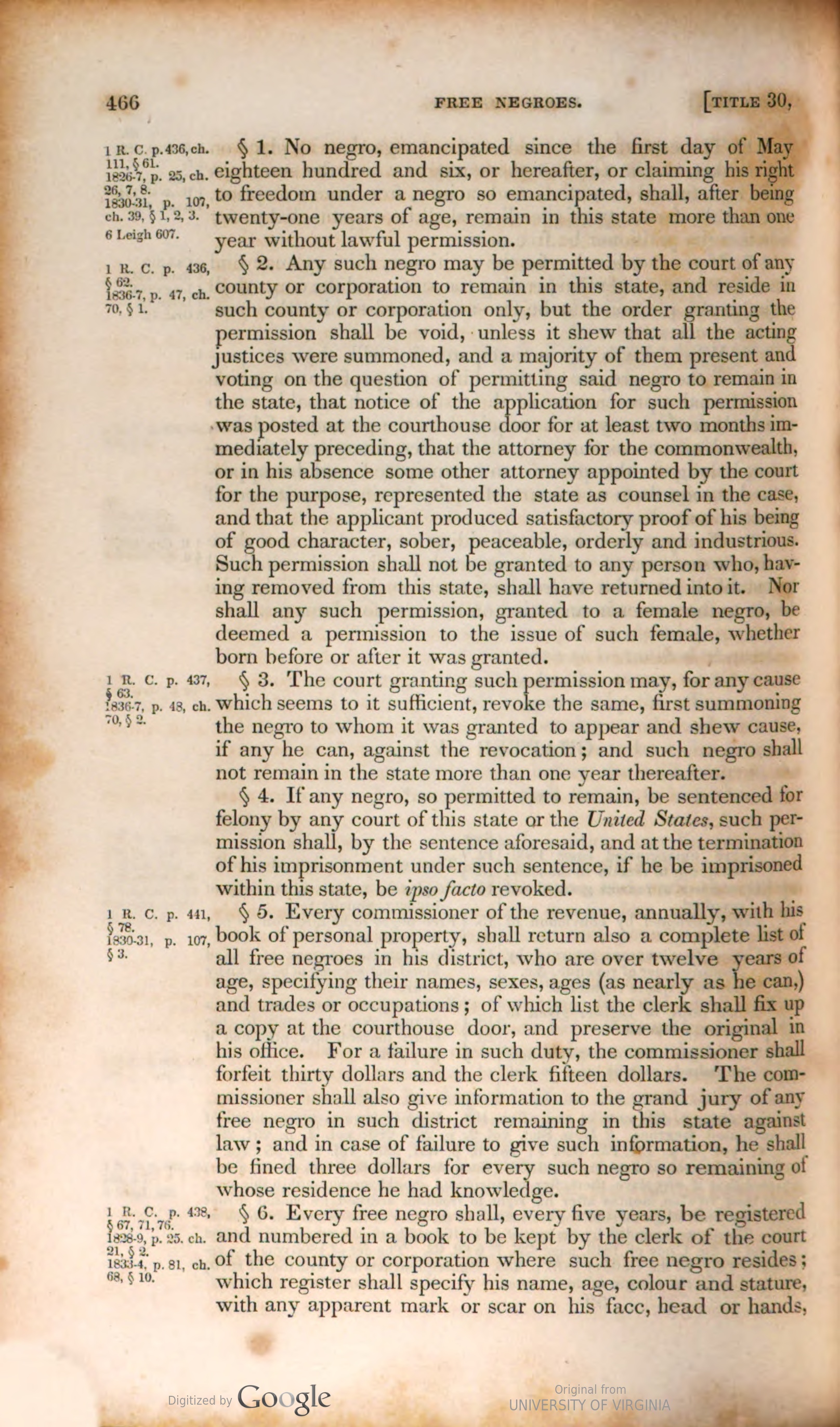
Leave to remain in the state (sections 1 to 4), the commissioner's yearly list of free negroes (section 5), and the register every five years (section 6).
What this image does and does not showThe whole printed page, with the marginal citations of the earlier acts.
The Code of Virginia (Richmond, 1849), page 466. HathiTrust Digital Library, from the University of Virginia. Rights Changes: HathiTrust's whole page image as downloaded at 300 dpi, not cropped or scaled and not re-encoded. Nothing retouched or added.
Source: The Code of Virginia (Richmond: William F. Ritchie, 1849), Title 30, Slaves and Free Negroes, chapters 103 and 107 Open the full image
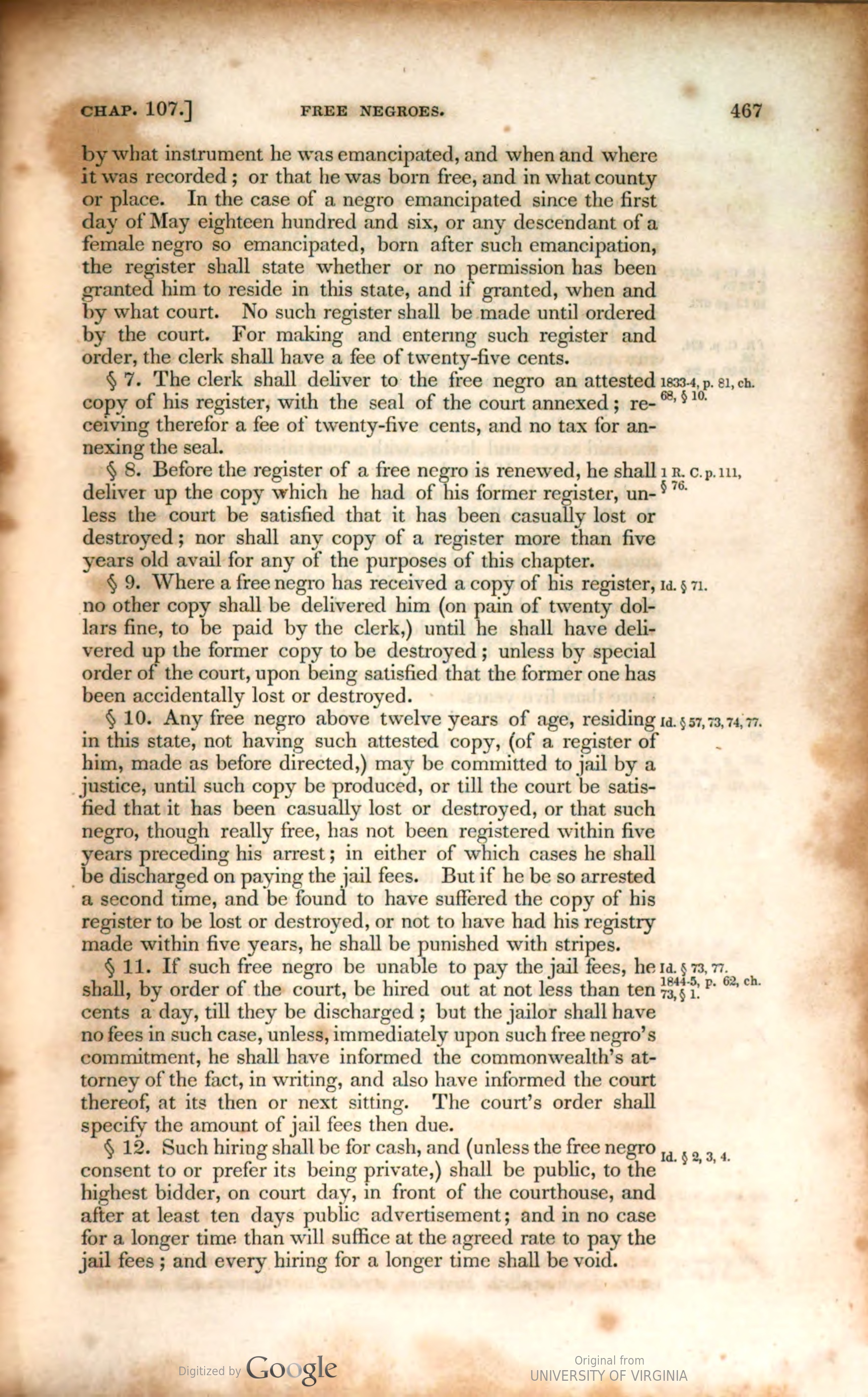
What the register recorded, and what happened to a free negro found without a copy of it (section 10).
What this image does and does not showThe whole printed page, with the marginal citations of the earlier acts.
The Code of Virginia (Richmond, 1849), page 467. HathiTrust Digital Library, from the University of Virginia. Rights Changes: HathiTrust's whole page image as downloaded at 300 dpi, not cropped or scaled and not re-encoded. Nothing retouched or added.
Source: The Code of Virginia (Richmond: William F. Ritchie, 1849), Title 30, Slaves and Free Negroes, chapters 103 and 107 Open the full image
About the sourcesWhat the evidence says
The county's free Black taxpayers from MacDonald's index of the personal property tax lists, their households from the census of 1840, the freedoms promised in Clarke wills from Duncan's abstracts, and the law from the Code of Virginia of 1849.
The tax lists and the census name people but rarely say how they were related or how they became free, and a will shows what an owner intended, not what happened.
- An account exists✓ Supported by a source
Joy MacDonald indexed every free Black person named on Clarke County's personal property tax lists from 1836 to 1862: 704 entries from 26 yearly lists, with 302 names as printed; there is no list for 1842. Most years had a separate list of free negroes. Another 91 free Black people are counted without names on the lines of 77 white taxpayers.
See the evidence
✓ Supported by a sourceAn account existsJoy MacDonald indexed every free Black person named on Clarke County's personal property tax lists from 1836 to 1862: 704 entries from 26 yearly lists, with 302 names as printed; there is no list for 1842. Most years had a separate list of free negroes. Another 91 free Black people are counted without names on the lines of 77 white taxpayers.
What the source supports
How many free Black people the county's tax lists name, 1836 to 1862, and how the lists recorded them.
Uncertainty
The counts are this project's count of MacDonald's entries. A name is not a person: one name in two years may be two people, and two spellings may be one. The lists name adults who owed tax and, in a few years, their children; they are not a census. MacDonald notes that some names were illegible. No human historian has reviewed this claim.
Source
Reference work Evidence role: supports. Joy MacDonald, Page v, Introduction, second paragraph.
Joy MacDonald, comp., Free Blacks on the Personal Property Tax Lists of Clarke County, Virginia, 1836-1862 (New Papyrus Publishing, 2013)
Joy MacDonald · 2013 (publication)
Locator: Page v, Introduction, second paragraph
Relevant passageBesides usually a separate list of free negroes, frequently there was a column for free blacks/negroes in the master list with a number on the line of a white tithable.
Checked: Original inspected. A digital reproduction was inspected; no original has been handled.
Open sourceSource family: macdonald-clarke-free-blacks. Multiple passages from one source are not independent witnesses.
AI-assisted source check (Claude Opus 5.5) · 2026-10-26. How this project checks its sources
- An account exists✓ Supported by a source
On the 1840 census for Clarke County, the households of Sylva Hall and Frank Irwin each list 10 free colored persons and no one else, Thos Gray's 8, John Clifton's and Hannah Robinson's 6 each, John Williams's 4, John Diggs's 3 and Bristo Smith's 2. Frank Irwin's household includes five girls under ten.
See the evidence
✓ Supported by a sourceAn account existsOn the 1840 census for Clarke County, the households of Sylva Hall and Frank Irwin each list 10 free colored persons and no one else, Thos Gray's 8, John Clifton's and Hannah Robinson's 6 each, John Williams's 4, John Diggs's 3 and Bristo Smith's 2. Frank Irwin's household includes five girls under ten.
What the source supports
That free people of color headed whole households in Clarke in 1840, who some of them were, and how large the households were.
Uncertainty
The census names only the head; everyone else is a tally by sex and age, and the census does not say how they were related. Whether anyone else was on a line rests on its written total. The hand can be read Irwin or Irvin. No human historian has reviewed this claim.
Source
Document Evidence role: supports. Jos. M. Nicklin, assistant marshal, Page 9, line 17, free colored (images 3:1:33SQ-GYYJ-9KH3 and 3:1:33S7-9YYJ-92DX); the given name read again on the image on 26 Oct 2026.
Sixth Census of the United States, 1840: population schedule for Clarke County, Virginia (National Archives microfilm M704, roll 555)
Jos. M. Nicklin, assistant marshal · 1840 (creation)
Locator: Page 9, line 17, free colored (images 3:1:33SQ-GYYJ-9KH3 and 3:1:33S7-9YYJ-92DX); the given name read again on the image on 26 Oct 2026
Relevant passageSylva Hall ... free colored 2 | 2 | . | . | 1 | . | 1 | 2 | 1 | 1 | . | . ... 10
Checked: Original inspected. A digital reproduction was inspected; no original has been handled.
Open sourceSource family: us-census. Multiple passages from one source are not independent witnesses.
Document Evidence role: supports. Jos. M. Nicklin, assistant marshal, Page 15, line 22, free colored (images 3:1:33SQ-GYYJ-9KHC and 3:1:33SQ-GYYJ-9KWB).
Sixth Census of the United States, 1840: population schedule for Clarke County, Virginia (National Archives microfilm M704, roll 555)
Jos. M. Nicklin, assistant marshal · 1840 (creation)
Locator: Page 15, line 22, free colored (images 3:1:33SQ-GYYJ-9KHC and 3:1:33SQ-GYYJ-9KWB)
Relevant passageFrank Irwin ... free colored 1 | . | . | 1 | . | . | 5 | 1 | 1 | 1 | . | . ... 10
Checked: Original inspected. A digital reproduction was inspected; no original has been handled.
Open sourceSource family: us-census. Multiple passages from one source are not independent witnesses.
Document Evidence role: supports. Jos. M. Nicklin, assistant marshal, Page 15, line 17, free colored (images 3:1:33SQ-GYYJ-9KHC and 3:1:33SQ-GYYJ-9KWB).
Sixth Census of the United States, 1840: population schedule for Clarke County, Virginia (National Archives microfilm M704, roll 555)
Jos. M. Nicklin, assistant marshal · 1840 (creation)
Locator: Page 15, line 17, free colored (images 3:1:33SQ-GYYJ-9KHC and 3:1:33SQ-GYYJ-9KWB)
Relevant passageThos Gray ... free colored 1 | . | . | 1 | . | . | 4 | . | 1 | 1 | . | . ... 8
Checked: Original inspected. A digital reproduction was inspected; no original has been handled.
Open sourceSource family: us-census. Multiple passages from one source are not independent witnesses.
Document Evidence role: supports. Jos. M. Nicklin, assistant marshal, Page 5, line 9, free colored (images 3:1:33SQ-GYYJ-9KFS and 3:1:33SQ-GYYJ-9KF3).
Sixth Census of the United States, 1840: population schedule for Clarke County, Virginia (National Archives microfilm M704, roll 555)
Jos. M. Nicklin, assistant marshal · 1840 (creation)
Locator: Page 5, line 9, free colored (images 3:1:33SQ-GYYJ-9KFS and 3:1:33SQ-GYYJ-9KF3)
Relevant passageJohn Clifton ... free colored 2 | . | . | 1 | . | . | . | 2 | . | 1 | . | . ... 6
Checked: Original inspected. A digital reproduction was inspected; no original has been handled.
Open sourceSource family: us-census. Multiple passages from one source are not independent witnesses.
Document Evidence role: supports. Jos. M. Nicklin, assistant marshal, Page 9, line 25, free colored (images 3:1:33SQ-GYYJ-9KH3 and 3:1:33S7-9YYJ-92DX).
Sixth Census of the United States, 1840: population schedule for Clarke County, Virginia (National Archives microfilm M704, roll 555)
Jos. M. Nicklin, assistant marshal · 1840 (creation)
Locator: Page 9, line 25, free colored (images 3:1:33SQ-GYYJ-9KH3 and 3:1:33S7-9YYJ-92DX)
Relevant passageHannah Robinson ... free colored . | 1 | 1 | . | . | . | 1 | 1 | 1 | . | 1 | . ... 6
Checked: Original inspected. A digital reproduction was inspected; no original has been handled.
Open sourceSource family: us-census. Multiple passages from one source are not independent witnesses.
Document Evidence role: supports. Jos. M. Nicklin, assistant marshal, Page 1, line 19, free colored (images 3:1:33SQ-GYYJ-9KF7 and 3:1:33SQ-GYYJ-9KJ7).
Sixth Census of the United States, 1840: population schedule for Clarke County, Virginia (National Archives microfilm M704, roll 555)
Jos. M. Nicklin, assistant marshal · 1840 (creation)
Locator: Page 1, line 19, free colored (images 3:1:33SQ-GYYJ-9KF7 and 3:1:33SQ-GYYJ-9KJ7)
Relevant passageJohn Diggs ... free colored 1 | . | . | 1 | . | . | . | . | . | 1 | . | . ... 3
Checked: Original inspected. A digital reproduction was inspected; no original has been handled.
Open sourceSource family: us-census. Multiple passages from one source are not independent witnesses.
Document Evidence role: supports. Jos. M. Nicklin, assistant marshal, Page 7, line 23, free colored (images 3:1:33S7-9YYJ-925X and 3:1:33SQ-GYYJ-9K6Z).
Sixth Census of the United States, 1840: population schedule for Clarke County, Virginia (National Archives microfilm M704, roll 555)
Jos. M. Nicklin, assistant marshal · 1840 (creation)
Locator: Page 7, line 23, free colored (images 3:1:33S7-9YYJ-925X and 3:1:33SQ-GYYJ-9K6Z)
Relevant passageBristo Smith ... free colored . | . | . | 1 | . | . | . | . | 1 | . | . | . ... 2
Checked: Original inspected. A digital reproduction was inspected; no original has been handled.
Open sourceSource family: us-census. Multiple passages from one source are not independent witnesses.
Document Evidence role: supports. Jos. M. Nicklin, assistant marshal, Page 16, line 13, free colored (images 3:1:33S7-9YYJ-92JM and 3:1:33SQ-GYYJ-9KZV).
Sixth Census of the United States, 1840: population schedule for Clarke County, Virginia (National Archives microfilm M704, roll 555)
Jos. M. Nicklin, assistant marshal · 1840 (creation)
Locator: Page 16, line 13, free colored (images 3:1:33S7-9YYJ-92JM and 3:1:33SQ-GYYJ-9KZV)
Relevant passageJohn Williams ... free colored . | 1 | . | 1 | . | . | . | 1 | . | 1 | . | . ... 4
Checked: Original inspected. A digital reproduction was inspected; no original has been handled.
Open sourceSource family: us-census. Multiple passages from one source are not independent witnesses.
AI-assisted source check (Claude Opus 5.5) · 2026-10-26. How this project checks its sources
- An account exists✓ Supported by a source
Thomas T. Byrd's will of February 16, 1840 frees Gabriel, and gives Ann Preston's children, Thomas Whiting called Tinko and Maria Louisa, to Samuel Wyman Jr. and his wife of Baltimore, to be freed at 25. The inventory of his estate that September lists Gabriel, Thomas Preston, about 10, and Anne Preston and her infant Maria as to be emancipated. The settlement recorded in 1845 says the Wymans took Thomas Whiting and Maria Louisa, Mrs. Ellen Buchanan took Ann Preston early in 1843, and Mrs. Maria C. Nicholas took the rest of the slaves at the end of 1843.
See the evidence
✓ Supported by a sourceAn account existsThomas T. Byrd's will of February 16, 1840 frees Gabriel, and gives Ann Preston's children, Thomas Whiting called Tinko and Maria Louisa, to Samuel Wyman Jr. and his wife of Baltimore, to be freed at 25. The inventory of his estate that September lists Gabriel, Thomas Preston, about 10, and Anne Preston and her infant Maria as to be emancipated. The settlement recorded in 1845 says the Wymans took Thomas Whiting and Maria Louisa, Mrs. Ellen Buchanan took Ann Preston early in 1843, and Mrs. Maria C. Nicholas took the rest of the slaves at the end of 1843.
What the source supports
What one Clarke will promised the people it named, and what the settlement of the estate says happened to them.
Uncertainty
These are Duncan's abstracts, not the will books. The will gives Ann Preston to Mrs. Buchanan while the inventory lists her to be emancipated; the abstracts do not explain the difference, or say whether anyone was freed later. Tinko was a child in 1840 and is not the Thomas Whiting of the tax lists. No human historian has reviewed this claim.
Source
Document Evidence role: supports. General Assembly of Virginia, Page 458, chapter 103, section 9 (page scan 496).
The Code of Virginia (Richmond: William F. Ritchie, 1849), Title 30, Slaves and Free Negroes, chapters 103 and 107
General Assembly of Virginia · 1849 (publication)
Locator: Page 458, chapter 103, section 9 (page scan 496)
Relevant passageAny person may emancipate any of his slaves by last will in writing, or by deed, recorded in the court of his county or corporation.
Checked: Original inspected. A digital reproduction was inspected; no original has been handled.
Open sourceSource family: code-of-virginia-1849. Multiple passages from one source are not independent witnesses.
Reference work Evidence role: supports. Patricia B. Duncan, Printed page 46, [A:142], will of Thomas T. Byrd, 16 Feb 1840.
Patricia B. Duncan, Clarke County, Virginia Will Book Abstracts, Books A-I (1836-1904) and 1A-3C (1841-1913) (Heritage Books, 2016)
Patricia B. Duncan · 2016 (publication)
Locator: Printed page 46, [A:142], will of Thomas T. Byrd, 16 Feb 1840
Relevant passageWill of 16 Feb 1840: frees man Gabriel, Sam. WYMAN Jr. & wife (his niece) Mary of Baltimore (given children of Ann Preston (Thomas Whiting called Tinko & Maria Louisa) who are freed at age 25y)
Checked: This passage was read on a digital reproduction of the page; no original has been handled. The source's other readings: existing OCR reviewed, original image not independently inspected.
Open sourceSource family: duncan-clarke-wills. Multiple passages from one source are not independent witnesses.
Reference work Evidence role: supports. Patricia B. Duncan, Printed page 47, [A:369], appraisal and inventory of the estate of Thomas T. Byrd, 30 Sep 1840.
Patricia B. Duncan, Clarke County, Virginia Will Book Abstracts, Books A-I (1836-1904) and 1A-3C (1841-1913) (Heritage Books, 2016)
Patricia B. Duncan · 2016 (publication)
Locator: Printed page 47, [A:369], appraisal and inventory of the estate of Thomas T. Byrd, 30 Sep 1840
Relevant passageNegroes Gabriel to be emancipated, Thomas alias Thomas Cooper, Thomas alias Thomas Laws, Thomas alias Thomas Preston abt 10y old to be emancipated, very old Solomon, Anne alias Anne Preston & her infant child Maria to be emancipated
Checked: This passage was read on a digital reproduction of the page; no original has been handled. The source's other readings: existing OCR reviewed, original image not independently inspected.
Open sourceSource family: duncan-clarke-wills. Multiple passages from one source are not independent witnesses.
Reference work Evidence role: supports. Patricia B. Duncan, Printed page 47, [B:016], settlement of the estate of Thomas T. Byrd, recorded 24 Mar 1845.
Patricia B. Duncan, Clarke County, Virginia Will Book Abstracts, Books A-I (1836-1904) and 1A-3C (1841-1913) (Heritage Books, 2016)
Patricia B. Duncan · 2016 (publication)
Locator: Printed page 47, [B:016], settlement of the estate of Thomas T. Byrd, recorded 24 Mar 1845
Relevant passageDistribution of slaves to: Samuel WYMAN Jr. & wife (took Thomas Whiting & Maria Louisa the children of Ann Preston), Mrs. Ellen BUCHANAN (took Ann Preston early in 1843), rest of slaves were taken by Mrs. Maria C. NICHOLAS at the end of 1843.
Checked: This passage was read on a digital reproduction of the page; no original has been handled. The source's other readings: existing OCR reviewed, original image not independently inspected.
Open sourceSource family: duncan-clarke-wills. Multiple passages from one source are not independent witnesses.
AI-assisted source check (Claude Opus 5.5) · 2026-10-26. How this project checks its sources
- An account exists✓ Supported by a source
Under the act of January 25, 1806, as the Code of 1849 summarizes it, a slave freed afterward who stayed in Virginia more than twelve months forfeited the freedom and might be sold for the benefit of the county's poor. The Code of 1849 kept the rule: no one freed since May 1, 1806 could, after 21, stay in the state more than a year without permission, which a county court could grant only on proof of good character, to live in that county only.
See the evidence
✓ Supported by a sourceAn account existsUnder the act of January 25, 1806, as the Code of 1849 summarizes it, a slave freed afterward who stayed in Virginia more than twelve months forfeited the freedom and might be sold for the benefit of the county's poor. The Code of 1849 kept the rule: no one freed since May 1, 1806 could, after 21, stay in the state more than a year without permission, which a county court could grant only on proof of good character, to live in that county only.
What the source supports
What Virginia law required of people freed after 1806, the condition under which Clarke's free Black people of this period lived.
Uncertainty
The statute says what the law required. How the Clarke County court applied it, and who in Clarke had leave to remain, would be in the court's order books, which were not read. No human historian has reviewed this claim.
Source
Document Evidence role: supports. General Assembly of Virginia, Page 465, chapter 107, note to the heading (page scan 503).
The Code of Virginia (Richmond: William F. Ritchie, 1849), Title 30, Slaves and Free Negroes, chapters 103 and 107
General Assembly of Virginia · 1849 (publication)
Locator: Page 465, chapter 107, note to the heading (page scan 503)
Relevant passageThe act of January 25, 1806, (Sess. Acts, 1805-6, p. 36, ch. 63, § 10,) enacted that if any slave thereafter emancipated should remain within this state more than twelve months after his right to freedom accrued, he should forfeit such right and might be sold for the benefit of the poor of the county or corporation.
Checked: Original inspected. A digital reproduction was inspected; no original has been handled.
Open sourceSource family: code-of-virginia-1849. Multiple passages from one source are not independent witnesses.
Document Evidence role: supports. General Assembly of Virginia, Page 466, chapter 107, section 1 (page scan 504).
The Code of Virginia (Richmond: William F. Ritchie, 1849), Title 30, Slaves and Free Negroes, chapters 103 and 107
General Assembly of Virginia · 1849 (publication)
Locator: Page 466, chapter 107, section 1 (page scan 504)
Relevant passageNo negro, emancipated since the first day of May eighteen hundred and six, or hereafter, or claiming his right to freedom under a negro so emancipated, shall, after being twenty-one years of age, remain in this state more than one year without lawful permission.
Checked: Original inspected. A digital reproduction was inspected; no original has been handled.
Open sourceSource family: code-of-virginia-1849. Multiple passages from one source are not independent witnesses.
Document Evidence role: supports. General Assembly of Virginia, Page 466, chapter 107, section 2 (page scan 504).
The Code of Virginia (Richmond: William F. Ritchie, 1849), Title 30, Slaves and Free Negroes, chapters 103 and 107
General Assembly of Virginia · 1849 (publication)
Locator: Page 466, chapter 107, section 2 (page scan 504)
Relevant passageAny such negro may be permitted by the court of any county or corporation to remain in this state, and reside in such county or corporation only ... that the applicant produced satisfactory proof of his being of good character, sober, peaceable, orderly and industrious.
Checked: Original inspected. A digital reproduction was inspected; no original has been handled.
Open sourceSource family: code-of-virginia-1849. Multiple passages from one source are not independent witnesses.
AI-assisted source check (Claude Opus 5.5) · 2026-10-26. How this project checks its sources
Each statement above is assessed on its own evidence. Nothing here is averaged, scored or voted on, and a well-attributed account can be documented while what it describes stays unconfirmed.
How this was counted
The tax-list figures are this site's count of the entries in Joy MacDonald's index (2013), read on the page images of a scan of the book and checked across its three printings. The index is MacDonald's reading of the microfilm, and she notes that some names were illegible; some years' lists are short, and 1842 has none. A name is not proof of a person: the same name in two years may be two people, and two spellings may be one. Census figures are this site's line-by-line reading of the 1840 schedule, which matches the published county totals. The wills are quoted from Patricia B. Duncan's abstracts, which condense the will books. The law is quoted from the Code of Virginia of 1849.
Know more about this story, or see something to correct? Help fill a gap. It stays private until it is reviewed.
Remember this place or someone in this story? Share a memory, even if you do not know the date. It stays private until it is reviewed.
Go deeper: every source under this story Follow another threadMore than half enslaved: Clarke County in the census of 1840
The same census of 1840, read for the 3,325 people it counted as enslaved.