Place

Clarke County

The Virginia county these census figures are tabulated for. The Census Bureau counted 7,165 residents on January 1, 1920 and 7,167 on April 1, 1930. Virginia's independent cities are tabulated separately from counties and Clarke contains none, so the county total is the whole tabulated population.

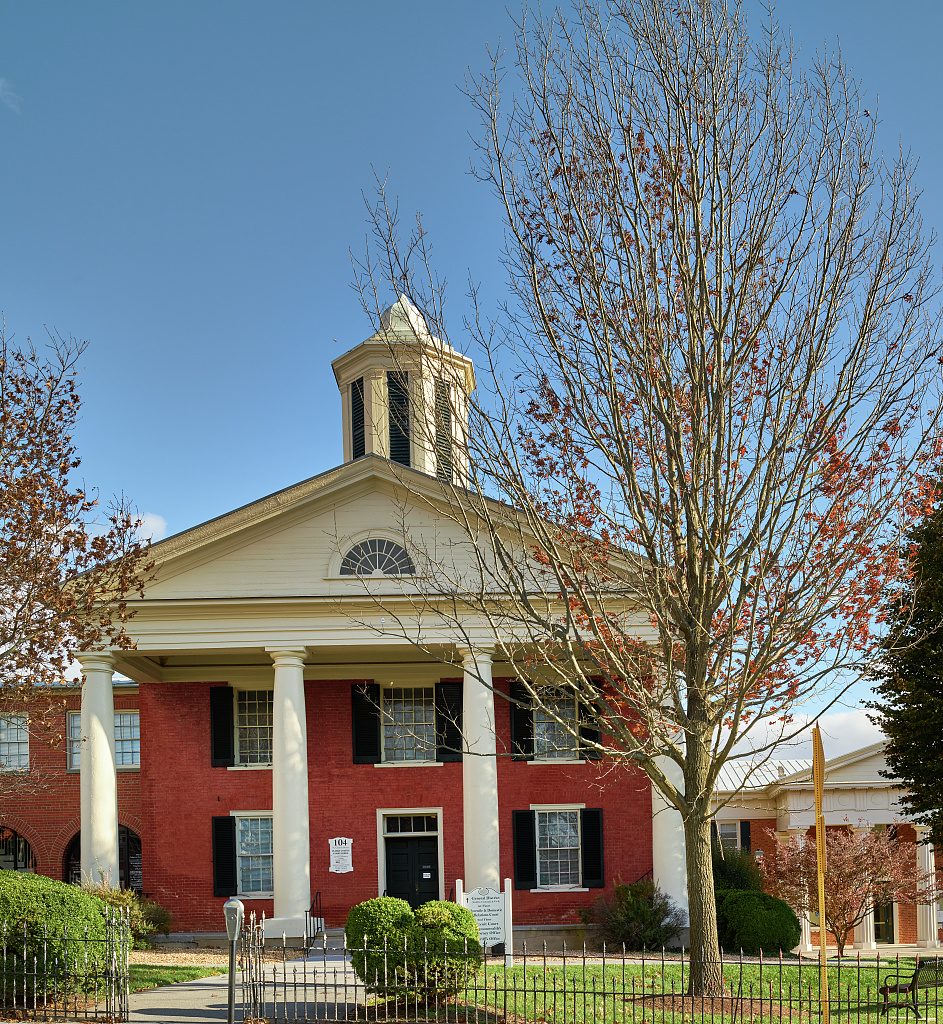
A red brick courthouse of two stories under a clear blue sky, fronted by a white portico of four tall columns that carries a pediment with a half-round fanlight. An octagonal white cupola with louvered openings rises from the roof. The windows have black shutters, a small white plaque hangs beside the central door, and a white sign stands on the lawn. A black iron fence and rounded boxwood shrubs line the front, a bare tree holding a few red leaves stands at right, and a lower building with white trim adjoins at the far right.

The Clarke County courthouse in Berryville, photographed by Carol M. Highsmith in November 2019.

What this image does and does not showA photograph of the courthouse as it stood in 2019. The Library of Congress title for it gives a construction date that comes from the photographer and has not been checked here, so no date is given. It is not evidence for any figure on this page.

Photograph by Carol M. Highsmith, November 12, 2019. Library of Congress, Prints and Photographs Division, Carol M. Highsmith Archive, LC-DIG-highsm-60959. Rights Changes: Shown at the 943 by 1,024 pixels of the Library of Congress reference image, not scaled, and re-encoded as JPEG, with the embedded metadata dropped. Nothing cropped, retouched or added.

Source: Clarke County courthouse, Berryville, Virginia, LC-DIG-highsm-60959 Open the full image

No coordinates or district boundaries have been assigned, so this place is not placed on a map.
The county in the 1920s, as the federal census counted it

Clarke County

The Virginia county these census figures are tabulated for. The Census Bureau counted 7,165 residents in 1920 and 7,167 in 1930 — a decade that changed the county by two people, on the federal record. Underneath the flat headline count, the tables show real change in schooling, literacy, and the foreign-born population.

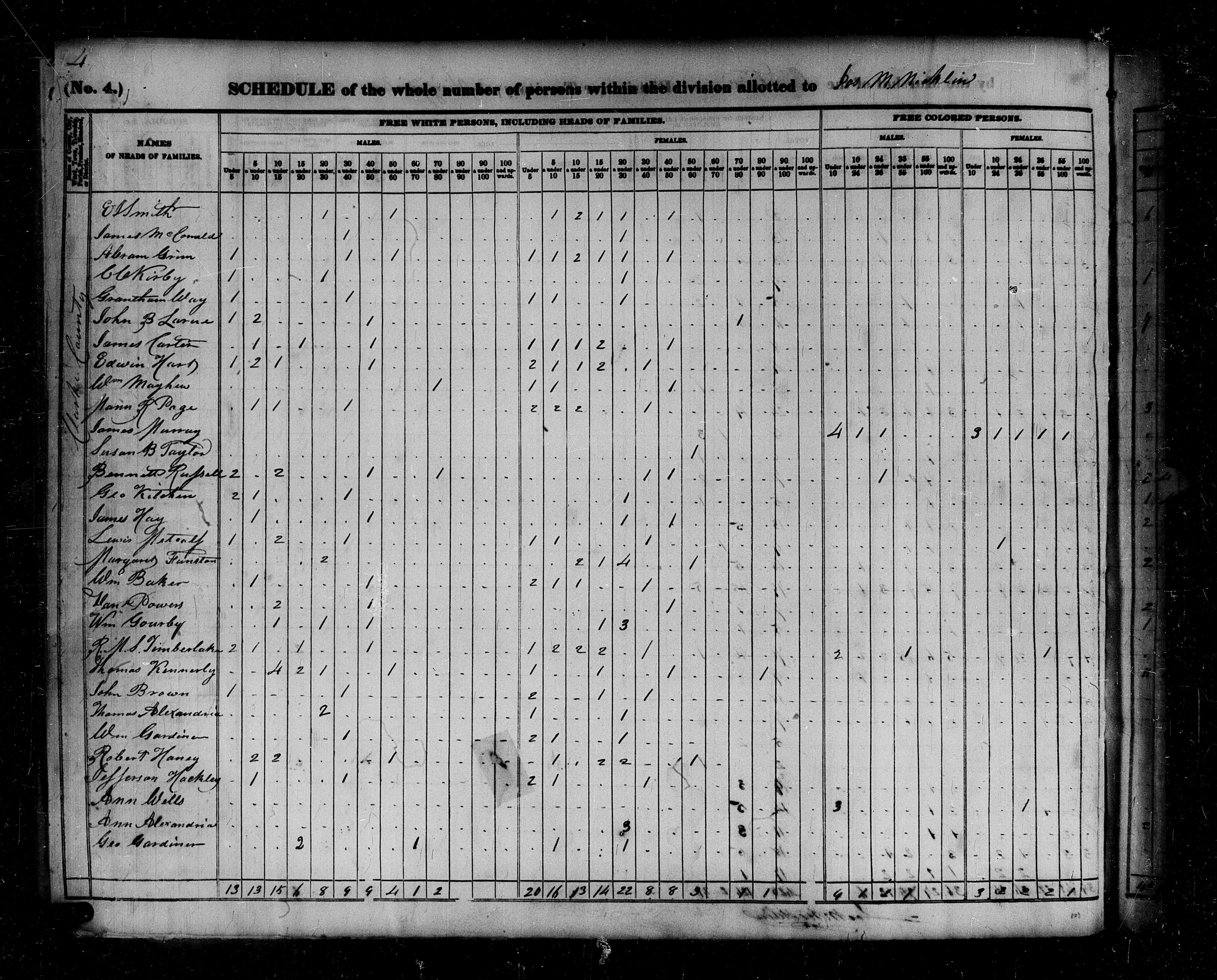
The federal census counted 7,167 people in Clarke County, Virginia, on April 1, 1930, and 7,165 on January 1, 1920. The difference is 2 persons, 0.03 per cent of the 1920 count1. As county population change goes it is a rounding artefact: Clarke stayed the same size across the decade to within a couple of households. The county the 1930 census met was the county the 1920 census had met.

That does not mean the county the census met was unchanged inside. Of the 1,147 children aged 7 to 13 in Clarke County in 1930, 1,019 were returned as attending school — 88.8 per cent, the figure the census itself printed. Among 16- and 17-year-olds the figure was 52.4 per cent1. Elementary attendance was near-universal for that age band by 1930; adolescent attendance was a coin toss. That gap between age bands says something about how far into the teens most Clarke families expected school to go.

Literacy over 10 fell by roughly half across the decade. The census returned 269 of Clarke County's 5,661 residents aged 10 and over as illiterate in 1930 — 4.8 per cent. The same table gives the county's 1920 rate as 9.7 per cent1. A halving in ten years is a substantial change; the tables do not attribute cause, but a decade of near-universal elementary attendance is the obvious background to it.

The foreign-born population was small in both years — 27 foreign-born white residents in 1930 and 40 in 1920, out of county populations of about seven thousand and one hundred1. Clarke was, on the census's own count, an overwhelmingly native-born county whose small foreign-born presence was also declining.

Four claims establish the county's flat headline population, its two-band school-attendance figures, its halved literacy rate, and its very small and declining foreign-born population across the 1920s. Missing from the corpus so far: the Black and white breakdowns for every one of these tables, the household-level manuscript census schedules (available at FamilySearch), and the same measures for adjacent counties for comparison. All are locatable next research targets.

Evidence

See the source and its limits
✓ DocumentedThat it was so

The Census Bureau counted 7,167 people in Clarke County, Virginia, on April 1, 1930, and 7,165 on January 1, 1920 -- a difference of 2 persons, which is 0.03 per cent of the 1920 count (7,167 - 7,165 = 2; 2 / 7,165 x 100 = 0.0279 per cent). The county's population was nearly unchanged between the two enumerations.

What the source supports

That the two decennial counts for the county are 7,167 and 7,165, and that the population was nearly unchanged between them.

Uncertainty

The two counts are the census's; the subtraction and the percentage are this packet's arithmetic, shown so a reader can check them. This packet supplies no estimate of enumeration error, so it cannot say how a difference of 2 compares with the accuracy of either count. The enumerations are 10 years and 3 months apart -- January 1, 1920 and April 1, 1930 -- and no annual rate is derived from them. A nearly level total is consistent with a great deal of movement in and out, and says nothing on its own about who stayed.

Source

Document

Evidence role: supports. The two total-population rows in the Clarke County column.

Fifteenth Decennial Census: 1930. Population, Volume III: Reports by States, Showing the Composition and Characteristics of the Population for Counties, Cities, and Townships or Other Minor Civil Divisions. Part 2: Montana-Wyoming

United States Department of Commerce, Bureau of the Census · 1932 (publication)

Locator: Table 13, Composition of the Population, by Counties and Independent Cities: 1930; Virginia section, printed page 1162; Clarke County column; SEX, COLOR, ETC. block, rows 'Total population' and '1920: Total population'

Relevant passage
Total population ... 7,167 | 1920: Total population ... 7,165

Checked: Original inspected. A digital reproduction was inspected; no original has been handled.

Open source

Source family: us-census. Multiple passages from one source are not independent witnesses.

Document

Evidence role: contextualizes. The enumeration dates from Table 1's column headings, which is what makes the interval 10 years 3 months.

Fifteenth Decennial Census: 1930. Population, Volume III: Reports by States, Showing the Composition and Characteristics of the Population for Counties, Cities, and Townships or Other Minor Civil Divisions. Part 2: Montana-Wyoming

United States Department of Commerce, Bureau of the Census · 1932 (publication)

Locator: Table 13, Virginia section, printed page 1162, Clarke County column, rows 'Foreign-born white' and its 1920 counterpart; and Table 1, Population of the State, Urban and Rural: 1890 to 1930, printed page 1141, column headings

Relevant passage
Foreign-born white ... 27 | 1920: ... Foreign-born white ... 40 | [printed page 1141, Table 1 column headings:] 1930 (April 1) ... 1920 (January 1)

Checked: Original inspected. A digital reproduction was inspected; no original has been handled.

Open source

Source family: us-census. Multiple passages from one source are not independent witnesses.

AI-assisted source check (Claude Opus 5) · 2026-09-12. How this project checks its sources

See the source and its limits
✓ DocumentedThat it was so

Of the 1,147 children aged 7 to 13 in Clarke County in 1930, 1,019 were returned as attending school -- 88.8 per cent, the figure the census itself printed. Among 16- and 17-year-olds the figure was 52.4 per cent, 172 of 328.

What the source supports

County-level school attendance in 1930 at two ages, with both the counts and the census's own percentages.

Uncertainty

The volume's introduction states that the school-attendance tabulation rests on the enumerator's inquiry as to whether the person had attended school or college of any kind since September 1, 1929. It is therefore a record of any attendance across that span, not enrollment from a school register and not days attended, and it should not be read as either. No comparable 1920 attendance figure was collected, so this packet carries no attendance trend.

Source

Document

Evidence role: supports. School attendance block, both age groups, counts and published percentages.

Fifteenth Decennial Census: 1930. Population, Volume III: Reports by States, Showing the Composition and Characteristics of the Population for Counties, Cities, and Townships or Other Minor Civil Divisions. Part 2: Montana-Wyoming

United States Department of Commerce, Bureau of the Census · 1932 (publication)

Locator: Table 13, Virginia section, printed page 1162, Clarke County column, SCHOOL ATTENDANCE block

Relevant passage
Total 7 to 13 years, inclusive ... 1,147 | Number attending school ... 1,019 | Per cent attending school ... 88.8 | Total 16 and 17 years ... 328 | Number attending school ... 172 | Per cent attending school ... 52.4

Checked: Original inspected. A digital reproduction was inspected; no original has been handled.

Open source

Source family: us-census. Multiple passages from one source are not independent witnesses.

Document

Evidence role: contextualizes. The volume's own definition of what the school-attendance tabulation counted.

Fifteenth Decennial Census: 1930. Population, Volume III: Reports by States, Showing the Composition and Characteristics of the Population for Counties, Cities, and Townships or Other Minor Civil Divisions. Part 2: Montana-Wyoming

United States Department of Commerce, Bureau of the Census · 1932 (publication)

Locator: Part 2 introduction, printed page 3, sections headed 'School attendance.' and 'Illiteracy.' (companion chapter file 10612982v3p2ch01.pdf, one-based PDF page 3)

Relevant passage
School attendance.-The school-attendance tabulation is based on the replies to the enumerator's inquiry as to whether the person had attended school or college of any kind since September 1, 1929. Illiteracy.-A person 10 years old and over is classified as illiterate if unable to read or write in any language. In some cases the enumerator's own judgment necessarily entered into the classification, and no test was applied except in a few doubtful cases where the interpreter was uncertain.

Checked: Original inspected. A digital reproduction was inspected; no original has been handled.

Open source

Source family: us-census. Multiple passages from one source are not independent witnesses.

AI-assisted source check (Claude Opus 5) · 2026-09-12. How this project checks its sources

See the source and its limits
✓ DocumentedThat it was so

The census returned 269 of Clarke County's 5,661 residents aged 10 and over as illiterate in 1930, a rate of 4.8 per cent. The same table gives the county's 1920 rate as 9.7 per cent.

What the source supports

That county illiteracy as the census measured it was 4.8 per cent in 1930 and 9.7 per cent in 1920.

Uncertainty

Both percentages are the census's own; the 1920 one is printed WITHOUT its numerator or base, so the number of illiterate people in 1920 is unknown from this source and is not reconstructed here. The volume's introduction defines an illiterate person as anyone 10 years of age or over unable to read and write, classified from the enumerator's question 'Whether able to read and write', with no specific test prescribed -- so this measures what was answered to an enumerator, not reading ability tested. Attributing the fall between the two rates to schooling, to migration or to who was counted would need evidence this packet does not hold.

Source

Document

Evidence role: supports. Illiteracy block, including the 1920 rate printed without a base.

Fifteenth Decennial Census: 1930. Population, Volume III: Reports by States, Showing the Composition and Characteristics of the Population for Counties, Cities, and Townships or Other Minor Civil Divisions. Part 2: Montana-Wyoming

United States Department of Commerce, Bureau of the Census · 1932 (publication)

Locator: Table 13, Virginia section, printed page 1162, Clarke County column, ILLITERACY block

Relevant passage
Total 10 years old and over ... 5,661 | Number illiterate ... 269 | Per cent illiterate ... 4.8 | Per cent illiterate in 1920 ... 9.7

Checked: Original inspected. A digital reproduction was inspected; no original has been handled.

Open source

Source family: us-census. Multiple passages from one source are not independent witnesses.

Document

Evidence role: contextualizes. The volume's own definition of an illiterate person and how the classification was made.

Fifteenth Decennial Census: 1930. Population, Volume III: Reports by States, Showing the Composition and Characteristics of the Population for Counties, Cities, and Townships or Other Minor Civil Divisions. Part 2: Montana-Wyoming

United States Department of Commerce, Bureau of the Census · 1932 (publication)

Locator: Part 2 introduction, printed page 3, sections headed 'School attendance.' and 'Illiteracy.' (companion chapter file 10612982v3p2ch01.pdf, one-based PDF page 3)

Relevant passage
School attendance.-The school-attendance tabulation is based on the replies to the enumerator's inquiry as to whether the person had attended school or college of any kind since September 1, 1929. Illiteracy.-A person 10 years old and over is classified as illiterate if unable to read or write in any language. In some cases the enumerator's own judgment necessarily entered into the classification, and no test was applied except in a few doubtful cases where the interpreter was uncertain.

Checked: Original inspected. A digital reproduction was inspected; no original has been handled.

Open source

Source family: us-census. Multiple passages from one source are not independent witnesses.

AI-assisted source check (Claude Opus 5) · 2026-09-12. How this project checks its sources

See the source and its limits
✓ DocumentedThat it was so

Clarke County returned 27 foreign-born white residents in 1930 and 40 in 1920, out of county populations of 7,167 and 7,165.

What the source supports

That the foreign-born white population of the county was very small in both years and slightly smaller in 1930.

Uncertainty

This is the census's 'Foreign-born white' row: it counts white persons born outside the United States and its territories and possessions. It is not a count of everyone born abroad, and the census tabulated nativity for the nonwhite population differently. On numbers this small a difference of 13 persons carries no weight beyond itself.

Source

Document

Evidence role: supports. Foreign-born white rows for both years.

Fifteenth Decennial Census: 1930. Population, Volume III: Reports by States, Showing the Composition and Characteristics of the Population for Counties, Cities, and Townships or Other Minor Civil Divisions. Part 2: Montana-Wyoming

United States Department of Commerce, Bureau of the Census · 1932 (publication)

Locator: Table 13, Virginia section, printed page 1162, Clarke County column, rows 'Foreign-born white' and its 1920 counterpart; and Table 1, Population of the State, Urban and Rural: 1890 to 1930, printed page 1141, column headings

Relevant passage
Foreign-born white ... 27 | 1920: ... Foreign-born white ... 40 | [printed page 1141, Table 1 column headings:] 1930 (April 1) ... 1920 (January 1)

Checked: Original inspected. A digital reproduction was inspected; no original has been handled.

Open source

Source family: us-census. Multiple passages from one source are not independent witnesses.

AI-assisted source check (Claude Opus 5) · 2026-09-12. How this project checks its sources

What the sources support

The Census Bureau counted 7,167 people in Clarke County, Virginia, on April 1, 1930, and 7,165 on January 1, 1920 -- a difference of 2 persons, which is 0.03 per cent of the 1920 count (7,167 - 7,165 = 2; 2 / 7,165 x 100 = 0.0279 per cent). The county's population was nearly unchanged between the two enumerations.

✓ Documented
See the source and its limits
✓ DocumentedThat it was so

The Census Bureau counted 7,167 people in Clarke County, Virginia, on April 1, 1930, and 7,165 on January 1, 1920 -- a difference of 2 persons, which is 0.03 per cent of the 1920 count (7,167 - 7,165 = 2; 2 / 7,165 x 100 = 0.0279 per cent). The county's population was nearly unchanged between the two enumerations.

What the source supports

That the two decennial counts for the county are 7,167 and 7,165, and that the population was nearly unchanged between them.

Uncertainty

The two counts are the census's; the subtraction and the percentage are this packet's arithmetic, shown so a reader can check them. This packet supplies no estimate of enumeration error, so it cannot say how a difference of 2 compares with the accuracy of either count. The enumerations are 10 years and 3 months apart -- January 1, 1920 and April 1, 1930 -- and no annual rate is derived from them. A nearly level total is consistent with a great deal of movement in and out, and says nothing on its own about who stayed.

Source

Document

Evidence role: supports. The two total-population rows in the Clarke County column.

Fifteenth Decennial Census: 1930. Population, Volume III: Reports by States, Showing the Composition and Characteristics of the Population for Counties, Cities, and Townships or Other Minor Civil Divisions. Part 2: Montana-Wyoming

United States Department of Commerce, Bureau of the Census · 1932 (publication)

Locator: Table 13, Composition of the Population, by Counties and Independent Cities: 1930; Virginia section, printed page 1162; Clarke County column; SEX, COLOR, ETC. block, rows 'Total population' and '1920: Total population'

Relevant passage
Total population ... 7,167 | 1920: Total population ... 7,165

Checked: Original inspected. A digital reproduction was inspected; no original has been handled.

Open source

Source family: us-census. Multiple passages from one source are not independent witnesses.

Document

Evidence role: contextualizes. The enumeration dates from Table 1's column headings, which is what makes the interval 10 years 3 months.

Fifteenth Decennial Census: 1930. Population, Volume III: Reports by States, Showing the Composition and Characteristics of the Population for Counties, Cities, and Townships or Other Minor Civil Divisions. Part 2: Montana-Wyoming

United States Department of Commerce, Bureau of the Census · 1932 (publication)

Locator: Table 13, Virginia section, printed page 1162, Clarke County column, rows 'Foreign-born white' and its 1920 counterpart; and Table 1, Population of the State, Urban and Rural: 1890 to 1930, printed page 1141, column headings

Relevant passage
Foreign-born white ... 27 | 1920: ... Foreign-born white ... 40 | [printed page 1141, Table 1 column headings:] 1930 (April 1) ... 1920 (January 1)

Checked: Original inspected. A digital reproduction was inspected; no original has been handled.

Open source

Source family: us-census. Multiple passages from one source are not independent witnesses.

AI-assisted source check (Claude Opus 5) · 2026-09-12. How this project checks its sources

Of the 1,147 children aged 7 to 13 in Clarke County in 1930, 1,019 were returned as attending school -- 88.8 per cent, the figure the census itself printed. Among 16- and 17-year-olds the figure was 52.4 per cent, 172 of 328.

✓ Documented
See the source and its limits
✓ DocumentedThat it was so

Of the 1,147 children aged 7 to 13 in Clarke County in 1930, 1,019 were returned as attending school -- 88.8 per cent, the figure the census itself printed. Among 16- and 17-year-olds the figure was 52.4 per cent, 172 of 328.

What the source supports

County-level school attendance in 1930 at two ages, with both the counts and the census's own percentages.

Uncertainty

The volume's introduction states that the school-attendance tabulation rests on the enumerator's inquiry as to whether the person had attended school or college of any kind since September 1, 1929. It is therefore a record of any attendance across that span, not enrollment from a school register and not days attended, and it should not be read as either. No comparable 1920 attendance figure was collected, so this packet carries no attendance trend.

Source

Document

Evidence role: supports. School attendance block, both age groups, counts and published percentages.

Fifteenth Decennial Census: 1930. Population, Volume III: Reports by States, Showing the Composition and Characteristics of the Population for Counties, Cities, and Townships or Other Minor Civil Divisions. Part 2: Montana-Wyoming

United States Department of Commerce, Bureau of the Census · 1932 (publication)

Locator: Table 13, Virginia section, printed page 1162, Clarke County column, SCHOOL ATTENDANCE block

Relevant passage
Total 7 to 13 years, inclusive ... 1,147 | Number attending school ... 1,019 | Per cent attending school ... 88.8 | Total 16 and 17 years ... 328 | Number attending school ... 172 | Per cent attending school ... 52.4

Checked: Original inspected. A digital reproduction was inspected; no original has been handled.

Open source

Source family: us-census. Multiple passages from one source are not independent witnesses.

Document

Evidence role: contextualizes. The volume's own definition of what the school-attendance tabulation counted.

Fifteenth Decennial Census: 1930. Population, Volume III: Reports by States, Showing the Composition and Characteristics of the Population for Counties, Cities, and Townships or Other Minor Civil Divisions. Part 2: Montana-Wyoming

United States Department of Commerce, Bureau of the Census · 1932 (publication)

Locator: Part 2 introduction, printed page 3, sections headed 'School attendance.' and 'Illiteracy.' (companion chapter file 10612982v3p2ch01.pdf, one-based PDF page 3)

Relevant passage
School attendance.-The school-attendance tabulation is based on the replies to the enumerator's inquiry as to whether the person had attended school or college of any kind since September 1, 1929. Illiteracy.-A person 10 years old and over is classified as illiterate if unable to read or write in any language. In some cases the enumerator's own judgment necessarily entered into the classification, and no test was applied except in a few doubtful cases where the interpreter was uncertain.

Checked: Original inspected. A digital reproduction was inspected; no original has been handled.

Open source

Source family: us-census. Multiple passages from one source are not independent witnesses.

AI-assisted source check (Claude Opus 5) · 2026-09-12. How this project checks its sources

The census returned 269 of Clarke County's 5,661 residents aged 10 and over as illiterate in 1930, a rate of 4.8 per cent. The same table gives the county's 1920 rate as 9.7 per cent.

✓ Documented
See the source and its limits
✓ DocumentedThat it was so

The census returned 269 of Clarke County's 5,661 residents aged 10 and over as illiterate in 1930, a rate of 4.8 per cent. The same table gives the county's 1920 rate as 9.7 per cent.

What the source supports

That county illiteracy as the census measured it was 4.8 per cent in 1930 and 9.7 per cent in 1920.

Uncertainty

Both percentages are the census's own; the 1920 one is printed WITHOUT its numerator or base, so the number of illiterate people in 1920 is unknown from this source and is not reconstructed here. The volume's introduction defines an illiterate person as anyone 10 years of age or over unable to read and write, classified from the enumerator's question 'Whether able to read and write', with no specific test prescribed -- so this measures what was answered to an enumerator, not reading ability tested. Attributing the fall between the two rates to schooling, to migration or to who was counted would need evidence this packet does not hold.

Source

Document

Evidence role: supports. Illiteracy block, including the 1920 rate printed without a base.

Fifteenth Decennial Census: 1930. Population, Volume III: Reports by States, Showing the Composition and Characteristics of the Population for Counties, Cities, and Townships or Other Minor Civil Divisions. Part 2: Montana-Wyoming

United States Department of Commerce, Bureau of the Census · 1932 (publication)

Locator: Table 13, Virginia section, printed page 1162, Clarke County column, ILLITERACY block

Relevant passage
Total 10 years old and over ... 5,661 | Number illiterate ... 269 | Per cent illiterate ... 4.8 | Per cent illiterate in 1920 ... 9.7

Checked: Original inspected. A digital reproduction was inspected; no original has been handled.

Open source

Source family: us-census. Multiple passages from one source are not independent witnesses.

Document

Evidence role: contextualizes. The volume's own definition of an illiterate person and how the classification was made.

Fifteenth Decennial Census: 1930. Population, Volume III: Reports by States, Showing the Composition and Characteristics of the Population for Counties, Cities, and Townships or Other Minor Civil Divisions. Part 2: Montana-Wyoming

United States Department of Commerce, Bureau of the Census · 1932 (publication)

Locator: Part 2 introduction, printed page 3, sections headed 'School attendance.' and 'Illiteracy.' (companion chapter file 10612982v3p2ch01.pdf, one-based PDF page 3)

Relevant passage
School attendance.-The school-attendance tabulation is based on the replies to the enumerator's inquiry as to whether the person had attended school or college of any kind since September 1, 1929. Illiteracy.-A person 10 years old and over is classified as illiterate if unable to read or write in any language. In some cases the enumerator's own judgment necessarily entered into the classification, and no test was applied except in a few doubtful cases where the interpreter was uncertain.

Checked: Original inspected. A digital reproduction was inspected; no original has been handled.

Open source

Source family: us-census. Multiple passages from one source are not independent witnesses.

AI-assisted source check (Claude Opus 5) · 2026-09-12. How this project checks its sources

Clarke County returned 27 foreign-born white residents in 1930 and 40 in 1920, out of county populations of 7,167 and 7,165.

✓ Documented
See the source and its limits
✓ DocumentedThat it was so

Clarke County returned 27 foreign-born white residents in 1930 and 40 in 1920, out of county populations of 7,167 and 7,165.

What the source supports

That the foreign-born white population of the county was very small in both years and slightly smaller in 1930.

Uncertainty

This is the census's 'Foreign-born white' row: it counts white persons born outside the United States and its territories and possessions. It is not a count of everyone born abroad, and the census tabulated nativity for the nonwhite population differently. On numbers this small a difference of 13 persons carries no weight beyond itself.

Source

Document

Evidence role: supports. Foreign-born white rows for both years.

Fifteenth Decennial Census: 1930. Population, Volume III: Reports by States, Showing the Composition and Characteristics of the Population for Counties, Cities, and Townships or Other Minor Civil Divisions. Part 2: Montana-Wyoming

United States Department of Commerce, Bureau of the Census · 1932 (publication)

Locator: Table 13, Virginia section, printed page 1162, Clarke County column, rows 'Foreign-born white' and its 1920 counterpart; and Table 1, Population of the State, Urban and Rural: 1890 to 1930, printed page 1141, column headings

Relevant passage
Foreign-born white ... 27 | 1920: ... Foreign-born white ... 40 | [printed page 1141, Table 1 column headings:] 1930 (April 1) ... 1920 (January 1)

Checked: Original inspected. A digital reproduction was inspected; no original has been handled.

Open source

Source family: us-census. Multiple passages from one source are not independent witnesses.

AI-assisted source check (Claude Opus 5) · 2026-09-12. How this project checks its sources

Know something about this place or record? Help fill a gap. It stays private until it is reviewed.

Keep exploring

Related stories

Land, work & community✓ Supported

Mary F. Lewis’s Civil War property claim

In 1864, according to her later claim, Union forces took horses, livestock and grain from Mary F. Lewis's farm near Boyce. The record follows her claim to a court valuation and an 1899 appropriation. Whether the money was paid has not been found.

What the evidence says Three federal records for the claim, the valuation and the appropriation; a family essay for the rest. No payment record.

  • 3 min read
  • 5 sources
Civic life & gathering? Unconfirmed

The Little brothers' 1873 killing and trials

In early July 1873, according to the Clarke Courier, two of the six Little brothers locked the dining-room door at their father's house and one of them shot a third. The record that follows is a newspaper record: two trials, an appeal, a witness who changed his account, and a pardon refused.

What the evidence says Nine newspaper issues: eight of the Clarke Courier across four years, and one Alexandria Daily State Journal carrying a Baltimore Sun special. Four were read on the page image. One court opinion was also read in full text, though not on a page image, and no other court record was examined.

  • 3 min read
  • 10 sources
Land, work & community✓ Supported

The reported 1854 drowning near Parker's Landing

On a Sunday night in September 1854, six men drowned trying to cross the Shenandoah in a small boat. Two Richmond papers carried the news. Each listed the people the men were said to belong to or to have been hired from, and the lists do not agree. Neither gives the name of any of the six.

What the evidence says Two inspected newspaper items, printed in Richmond a day apart. Six deaths reported, the place given in one account only, two conflicting lists of owners and hirers, and no name for any of the six.

  • 3 min read
  • 2 sources
Civic life & gathering? Unconfirmed

Clarke County Training School: a dollar a year

In 1930 Black families in Clarke County dug the foundation of a new building for the Clarke County Training School and pledged $500 a year toward it. Through the 1930s the Clarke Courier followed the school as its League raised money for a bus, its judging teams won honors, and its pageants, games and commencements drew the community in. In 1939 the League was still asking each subscriber for a dollar a year.

What the evidence says Clarke Courier reports of 1930 document the contract, the patrons' digging and the cornerstone, and the Courier of 1936 to 1940 records the League's bus, the judging teams, announced pageants and games, and three commencements. A Rosenwald Fund card and a Slater Fund list add outside records of the building and the school.

  • 7 min read
  • 27 sources
Civic life & gathering? Unconfirmed

Clarke County Training School: opening day and the debt that followed

In September 1930 Black families in Clarke County dedicated the new brick Clarke County Training School in Josephine City, with state and Rosenwald speakers, a rock pile still uncrushed and $680 owed for chairs. Through the 1930s their League paid toward the building with pageants, festivals and a $500 yearly pledge. By 1941 the school bore the name of Dr. W. T. B. Williams, and its principal, E. T. Johnson, bade farewell to the pageants in 1944 and died in 1945.

What the evidence says Clarke Courier notices and reports from August 1930 to December 1945, each read on a Library of Congress page image, document the dedication and its program, the patrons' costs and debts, the school's first year, the League's pledge and payments through 1939, the school's renaming, the principal's last pageant, his obituary and a letter in his memory. None of them reports the League's bond paid off.

  • 9 min read
  • 25 sources
Civic life & gathering✓ Supported

Dear Dan: Clarke's home front, 1943–1945

For more than three years the Clarke Courier wrote a weekly "Dear Dan" letter to a man overseas. Its pages from 1943 to 1945 show volunteers stretched thin at the aircraft spotter posts, a harvest brought in by boys, school children, traveling crews, convicts and prisoners of war, the Pope family's long wait for a son held by Japan, and a town that celebrated victory twice.

What the evidence says Clarke Courier columns, editorials, reports and notices from 1943 to 1945, each read on a Library of Congress page image, document the spotter posts' shortage of volunteers, the 1944 harvest labor as the county agent reported it, the Pope family's news of a son held by Japan, and the town's two victory celebrations.

  • 10 min read
  • 32 sources
Service & war✓ Supported

Mosby's last negotiations at Millwood

In April 1865 Union Major-General Winfield S. Hancock sought Colonel John S. Mosby’s surrender on the terms given Lee. Two Confederate memoirs, published decades apart, describe negotiations at Millwood that ended without it.

What the evidence says Two retrospective memoirs, decades apart, telling a closely similar story.

  • 4 min read
  • 3 sources
Civic life & gathering✓ Supported

Who the Old Chapel remembers

Charles Randolph Hughes’s 1906 compilation "Old Chapel," Clarke County, Virginia records who was buried in the chapel’s cemetery, by its own admission incompletely. This story reads what it says, and does not say, about the people it names only briefly.

What the evidence says One 1906 compiled record, read for what it names and what it leaves out.

  • 5 min read
  • 1 source
Civic life & gathering✓ Supported

Before the Training School

A single 2000 National Register nomination, the Millwood Colored School form, is the source for nearly everything here: a Black teacher named in an 1868 report, a free school at Millwood in 1869, a teacher appointed in 1873 and the Courier's own comment on it, county school counts for 1871 to 1888, and an 1888 school lot. Each reaches us through the nomination, not the papers, reports and deed it describes.

What the evidence says One 2000 nomination, read for what it quotes and paraphrases from sources this account has not seen.

  • 3 min read
  • 1 source
Service & war✓ Supported

Bells and flowers: Armistice and Memorial Day in Clarke, 1903 to 1946

For more than forty years Clarke kept two days for its soldiers.The Clarke Courier reported Decoration Day at Old Chapel and Green Hill from 1903, a false armistice in 1918, a welcome home for 5,000 in 1919, and Armistice Days of bells, parades and silence under the Legion post. In wartime the days turned to rain, walking and blood drives.

What the evidence says Twenty-seven Clarke Courier reports, notices and editorials from 1903 to 1946, each read on a Library of Congress page image, show Decoration and Memorial Day services at Green Hill and Old Chapel, the false and the real armistice of 1918, the July 4, 1919 welcome home, and the Legion post's Armistice Days.

  • 7 min read
  • 26 sources
Civic life & gathering? Unconfirmed

The Clarke Rifles: Berryville's company, 1859 to 1920

Berryville sent one infantry company to the Stonewall Brigade. Its story survives less in records than in remembrance: a local historian's column, and the Clarke Courier's notices and comrades' letters as the men died, from "Jim" O'Bannon and "Kate" Shepherd in 1905 to John R. Shipe and "Uncle Bill" Kelly in 1920.

What the evidence says A comrade's letter of 1905, a tribute and a death notice of 1920 and a reprinted notice of 1905, all from the Clarke Courier and read on the Library of Congress page images, with a 1948 local history reprinted by the Clarke County Historical Association, describe the Clarke Rifles from 1859 to 1920.

  • 6 min read
  • 5 sources
Service & war✓ Supported

Stars on the flags: Clarke's churches in the World War

In 1918 Clarke's churches hung service flags with a star for each of their men. Grace Church in Berryville sent its rector to France as a chaplain and mourned Capt. Lloyd W. Williams, the first Clarke man to die in the war; Christ Church at Millwood received an altar from a mother whose two sons came home. The Clarke Courier reported it week by week, and in 1927 the Virginia War History Commission printed the churches' own lists of their men.

What the evidence says Ten Clarke Courier items of 1918 to 1921, read on the Library of Congress page images, and the Virginia War History Commission's 1927 history of the county, read on the HathiTrust page images, describe the churches of Berryville and Millwood in the First World War.

  • 7 min read
  • 11 sources
Service & war✓ Supported

The last roll call: the Clarke Cavalry, 1884 to 1918

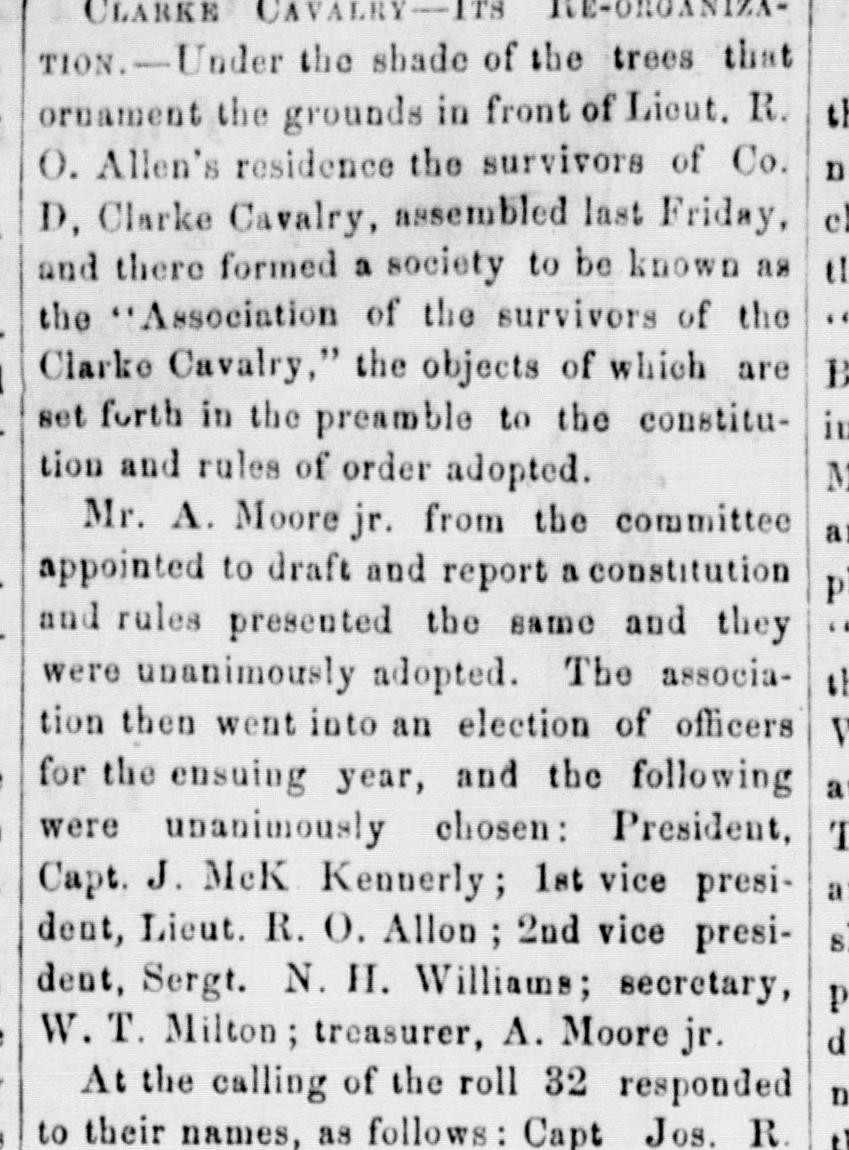
In 1884 the survivors of the Clarke Cavalry formed an association under the trees in front of R. O. Allen's house, and 32 answered the roll. For thirty-four years they met each summer. They led the county's effort for a monument to its Confederate dead, brought a comrade's remains home from Luray, and called the roll of the living and the dead, as the Clarke Courier reported each year, until four answered in 1918.

What the evidence says Twelve Clarke Courier items of 1884 to 1918, read on the Library of Congress page images, report the founding, the monument effort, the reburial of F. P. Topper and the reunions of the survivors of the Clarke Cavalry.

  • 6 min read
  • 12 sources
Service & war✓ Supported

Held in the North: Clarke men in Union prisons

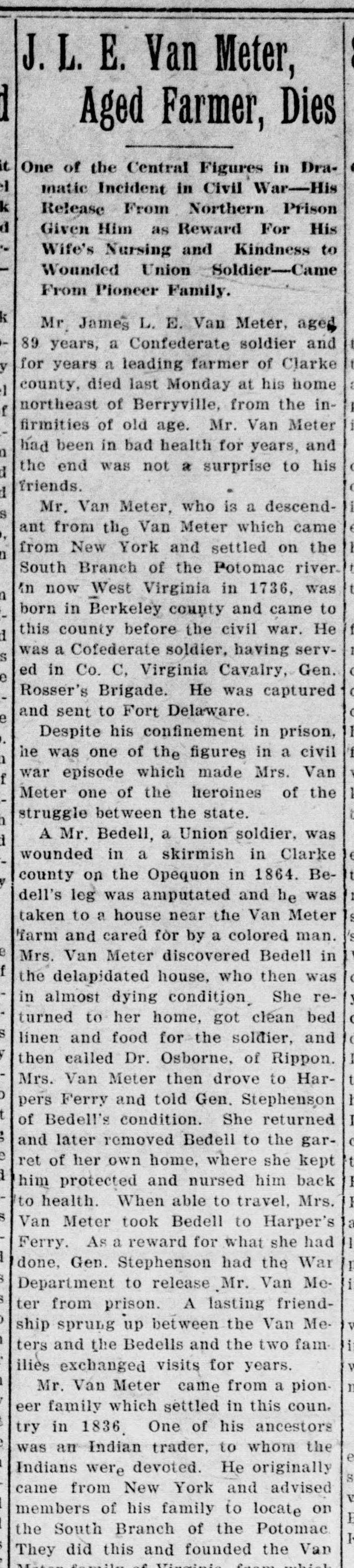
Many Clarke men spent part of the war in Northern prison camps. Their death notices in the Clarke Courier, written decades later, kept their stories: a fifteen-year-old cavalryman held five months at Fort Delaware, a color-bearer who traded his whiskey ration for bread at Elmira and swam a river to get home, and a farmer released because his wife had nursed a wounded Union soldier back to health in her garret.

What the evidence says Eight Clarke Courier notices and letters of 1900 to 1923, read on the Library of Congress page images, tell what the county remembered of its Confederate soldiers held in Northern prisons.

  • 6 min read
  • 8 sources
Service & war✓ Supported

Five sons in France: the Lloyd brothers of Clarke

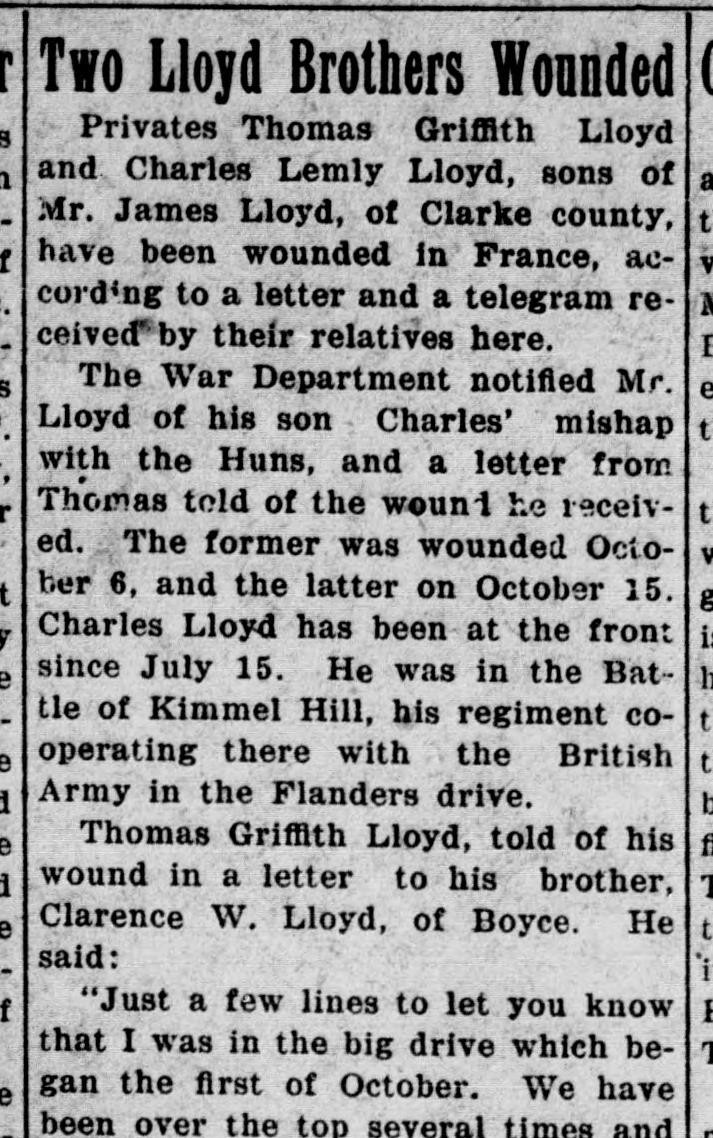
J. W. Lloyd of near Berry's Ferry had five sons in the First World War, and all five went to France. The Clarke Courier followed them: two wounded in October 1918, a false report of a death, Howard's words on a Berryville street, and Charles, gassed in the Argonne, the last to come home. In 1922 the youngest, Linton, drowned near his father's house.

What the evidence says Six Clarke Courier items of 1918 to 1922, read on the Library of Congress page images, and the Virginia War History Commission's 1927 county history follow the five Lloyd brothers through the First World War.

  • 6 min read
  • 8 sources
Service & war✓ Supported

Boys in the ranks: Clarke men who went to war young

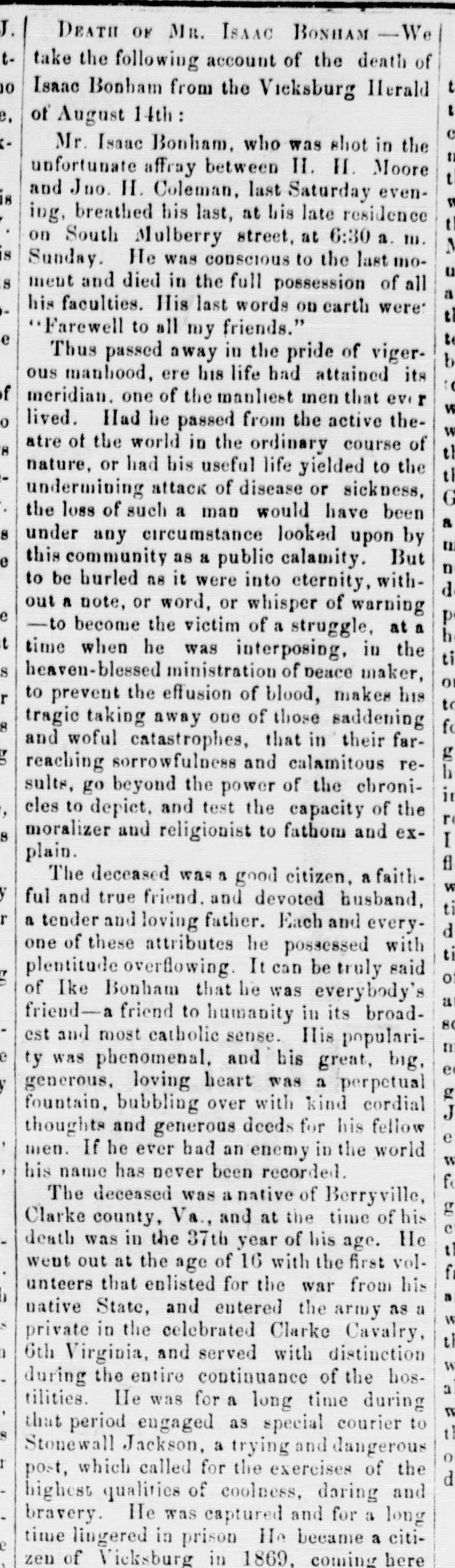
When five Clarke Confederates died between 1883 and 1924, the Clarke Courier remembered them as boys when they went to war: Isaac Bonham at 16 with the first volunteers, Burwell McGuire "in his 'teens," Charles T. Jones at 17, W. W. Bowles at 16, and William E. Reed "scarcely more than a boy." The ages are the papers' own, written years later.

What the evidence says Five Clarke Courier death notices of 1883 to 1924, read on the Library of Congress page images, each say the man went to war young.

  • 5 min read
  • 5 sources
Service & war✓ Supported

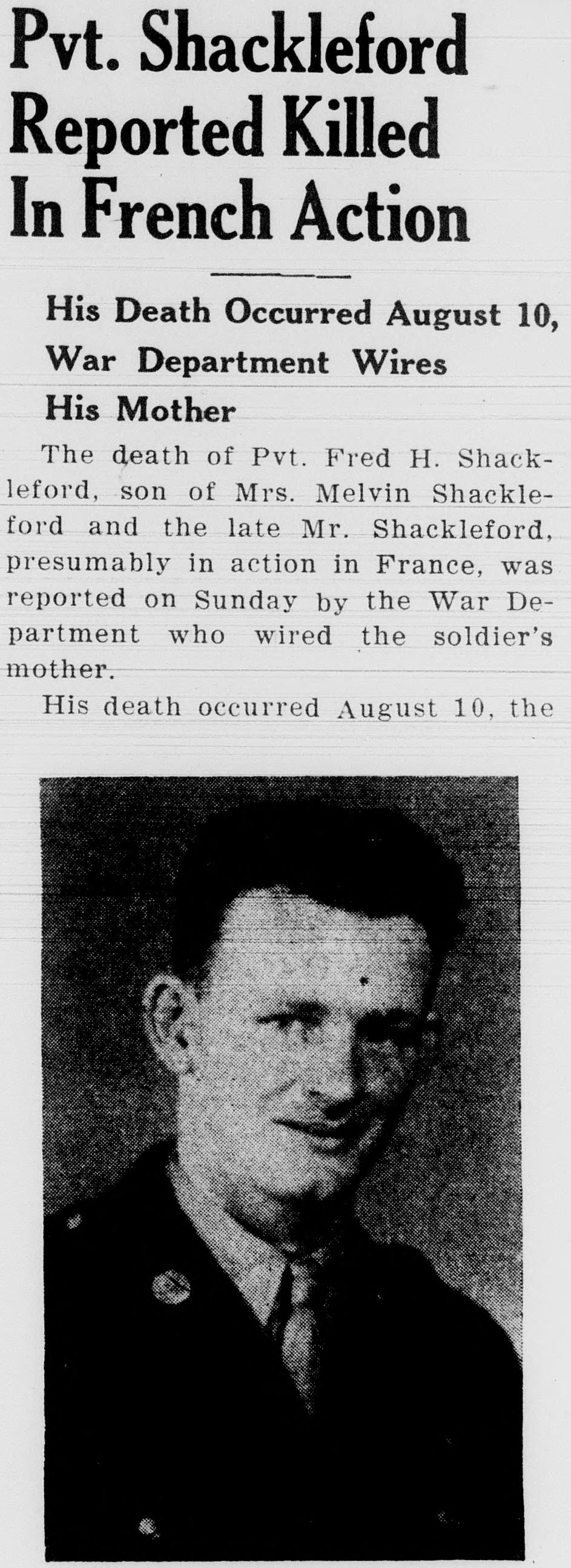
Pvt. Fred H. Shackleford, 1944: in action, or by accident

Pvt. Fred H. Shackleford of Berryville died in France on August 10, 1944. The Clarke Courier first reported him killed, presumably in action, then accidentally shot by a captured German sub-machine gun held by a companion. Its later columns said both, and the War Department's 1946 list counts him under "Died (Non-battle)."

What the evidence says Clarke Courier items of 1942 to 1948, read on the Library of Congress page images: the reports of his death, the paper's look-back columns, the War Department's 1946 list as the paper printed it, and the report of his return in 1948.

  • 5 min read
  • 12 sources
Service & war? Unconfirmed

The Civil War: the county's soldiers, 1861 to 1865

The roll of veterans on this site lists 943 people who served in the Civil War. Berryville's company served four years in the Stonewall Brigade, and the Clarke Cavalry rode in the 6th Virginia. The Clarke Courier printed what the survivors told of battle and of Northern prisons, and followed them to the monument of 1900 and their reunions into 1918.

What the evidence says Clarke Courier items of 1883 to 1923, Gold's 1914 history, Meade's 1948 column and a compiled service record, already published on this site, and the roll of veterans.

  • 3 min read
  • 13 sources
Service & war✓ Supported

World War II: the county's soldiers, 1941 to 1946

The roll of veterans on this site lists 603 people who served in World War II. The Clarke Courier followed them from the county's first aircraft-warning posts in 1941 to the War Department's list of the dead in 1946, with the four Pope brothers of near Berryville, a soldier's death in France reported first as in action and then as an accident, and the night the war ended.

What the evidence says Clarke Courier items of 1941 to 1946, already published on this site and read on the Library of Congress page images, and the roll of veterans.

  • 3 min read
  • 14 sources
Land, work & community✓ Supported

Consumption, croup and cholera infantum: how Clarke died, 1853 to 1896

Clarke County's death register records 2,322 deaths from 1853 to 1896. Before the war the childhood epidemics and consumption led among white deaths, and nearly half the deaths of enslaved people have no cause. From 1880 consumption and lung disease led for white and Black residents alike, about a quarter of the dead were babies, and white people were far more often old.

What the evidence says Patricia B. Duncan's 2008 abstract of the Clarke County death register, counted from the entries on this site's deaths collection, with five entries quoted from her printed pages.

  • 4 min read
  • 1 source
How this place came to be✓ Supported

How Clarke left Frederick: the petitions and the newspapers, 1833 to 1836

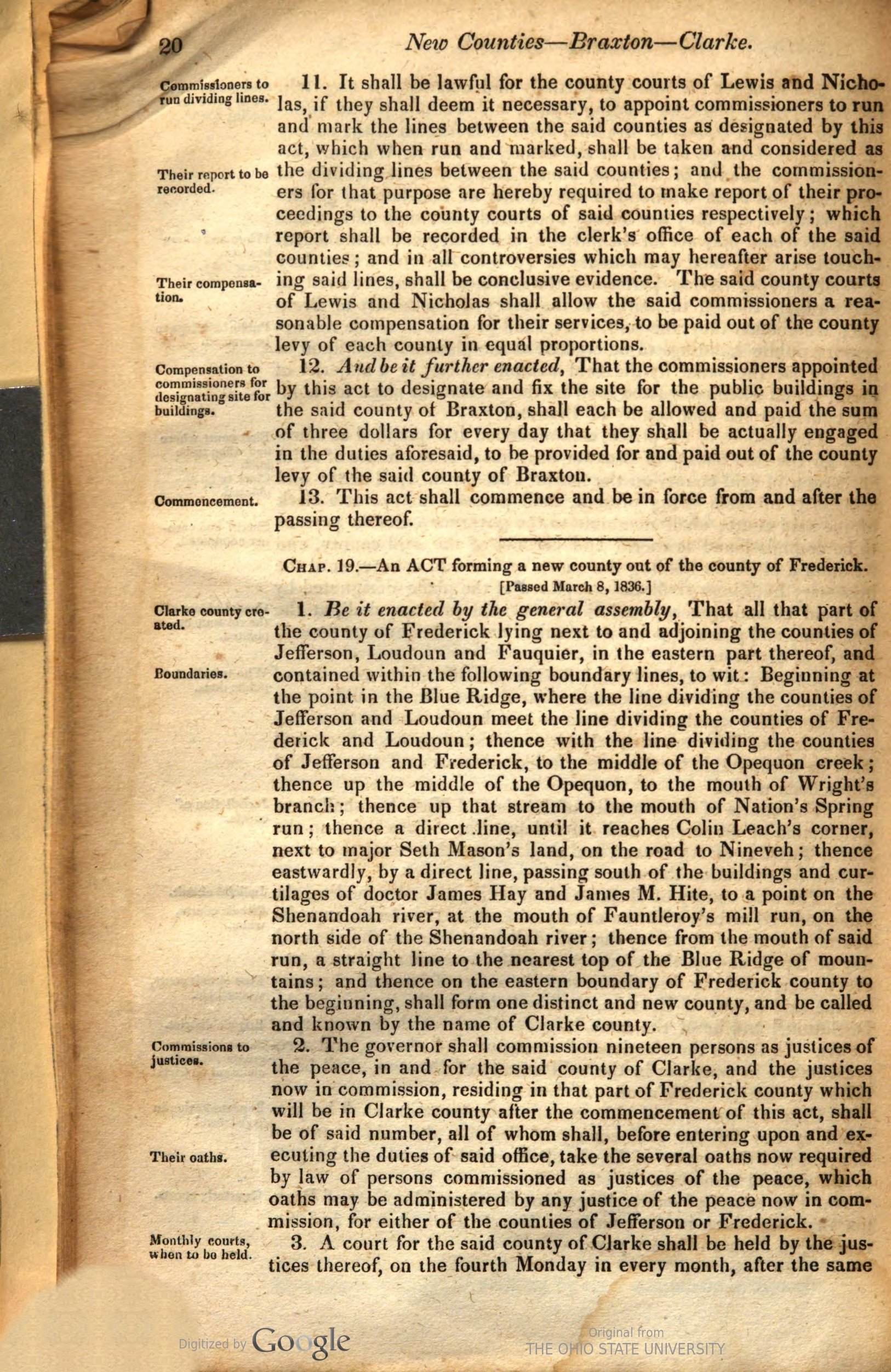
In September 1833 a meeting at Berryville asked for the eastern end of Frederick County to become a county of its own. The House of Delegates turned the petition down in 1834 and postponed a bill in 1835. A third petition carried in March 1836, after a tied vote that the Speaker broke, and the new county was named Clarke. Its justices first sat at Berryville on March 28, 1836.

What the evidence says Seventy-eight newspaper articles of 1833 to 1837 found on Virginia Chronicle, and the thirty Library of Virginia files of petitions and papers on the division, with the passages quoted here read on the images.

  • 5 min read
  • 24 sources
How this place came to be✓ Supported

Why Clarke? The county's name and the man it honors

The House of Delegates named the new county Clarke in March 1836, "in honor of Gen. George R. Clarke," the Revolutionary War general usually written George Rogers Clark. The act itself, in the session laws, reads "Clarke county," with the e, though one report that week spelled it Clark. The House journal says only that a blank in the bill "was filled." Clark was born near Charlottesville, grew up in Caroline County and died in Kentucky in 1818.

What the evidence says Newspaper reports of March 1836 read on the page images, the act and the House journal of the session read on HathiTrust's scans, the county government's history and Encyclopedia Virginia's entry on Clark.

  • 3 min read
  • 8 sources
How this place came to be✓ Supported

More than half enslaved: Clarke County in the census of 1840

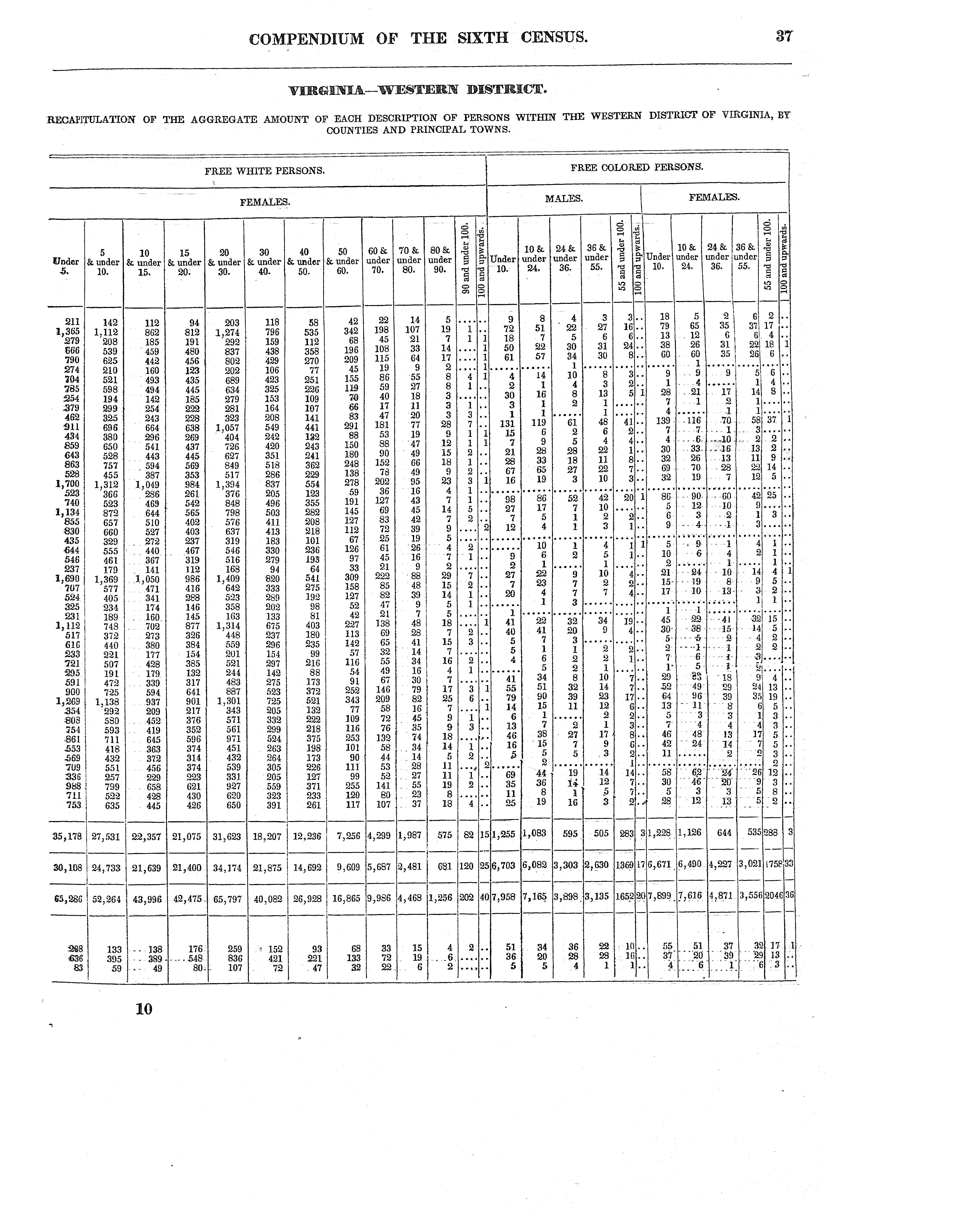
The census of 1840 counted 3,325 enslaved people in Clarke County, 52.3 percent of its 6,353 people, and 161 free people of color. They were listed on 310 of the census's 538 household lines, but unevenly: the 46 largest lines held nearly half. Households headed by a Burwell held 276 people, by a Page 235.

What the evidence says The county's totals from the Compendium of the Sixth Census (1841), and the largest lines and the free colored households quoted from the census schedule as read on its page images.

  • 5 min read
  • 4 sources
How this place came to be✓ Supported

Free in a slave county: Clarke's free Black people, 1836 to 1862

The census of 1840 counted 161 free people of color in Clarke County, about one in forty. The county's tax lists of 1836 to 1862 name 302 of them, with their horses, their trades and, for a few, where they lived. Clarke wills promised freedom to others, and the law let people freed after 1806 stay in Virginia only with a court's leave.

What the evidence says The county's free Black taxpayers from MacDonald's index of the personal property tax lists, their households from the census of 1840, the freedoms promised in Clarke wills from Duncan's abstracts, and the law from the Code of Virginia of 1849.

  • 7 min read
  • 7 sources

Search

Searches the released collection only.