
Local boy now in France
On July 4, 1917, the Clarke Courier printed a photograph of a young Marine officer on its front page under the headline "Local Boy Now in France." Capt. Lloyd William Williams of the United States Marine Corps, "formerly of Berryville," had "gone with the first contingent U. S. Marines for service overseas." He was a son of Mr. and Mrs. Goodwin H. Williams, born June 5, 1887, the paper said, in Berryville. He had been appointed a second lieutenant in the Marine Corps in January 1910, and was commissioned first lieutenant and then captain in 1916.
A year later, on June 27, 1918, the Courier reported that he had been promoted to major, and called him "the first Clarke boy, so far as is now known, to be rewarded for distinguished bravery and heroism in action."
Source note: Clarke Courier, Berryville, Va., 1917
The Clarke Courier of July 4, 1917, under the headline "Local Boy Now in France," printed a photograph of Capt. Lloyd W. Williams from the Marine Corps Publicity Bureau and reported that Captain Lloyd William Williams, United States Marine Corps, "formerly of Berryville," had "gone with the first contingent U. S. Marines for service overseas." It said he was a son of Mr. and Mrs. Goodwin H. Williams, born June 5, 1887, in Berryville, appointed a second lieutenant in the Marine Corps on January 8, 1910, and commissioned first lieutenant on June 12, 1916 and captain on August 29, 1916.
What the source supports
That the Courier reported him gone overseas with the first contingent of Marines, and the career it gave him.
Uncertainty
His career is as the paper gave it; it is not checked here against Marine Corps records. Read on the page image of the Library of Congress digital reproduction. No human historian has reviewed this claim.
Source
Evidence role: supports. Page 1, "Local Boy Now in France," the photograph and its caption.
Clarke Courier, Berryville, Va., July 4, 1917, page 1: "Local Boy Now in France"
Clarke Courier, Berryville, Va. · 1917-07-04 (publication)
Locator: Page 1, "Local Boy Now in France," the photograph and its caption
Relevant passageLocal Boy Now in France [...] CAPT. LLOYD W. WILLIAMS Photo from Marine Corps Publicity Bureau
Checked: Original inspected. A digital reproduction was inspected; no original has been handled.
Open sourceSource family: clarke-courier. Multiple passages from one source are not independent witnesses.
Evidence role: supports. Page 1, "Local Boy Now in France".
Clarke Courier, Berryville, Va., July 4, 1917, page 1: "Local Boy Now in France"
Clarke Courier, Berryville, Va. · 1917-07-04 (publication)
Locator: Page 1, "Local Boy Now in France"
Relevant passageCaptain Lloyd William Williams, United States Marine Corps, formerly of Berryville, has gone with the first contingent U. S. Marines for service overseas.
Checked: Original inspected. A digital reproduction was inspected; no original has been handled.
Open sourceSource family: clarke-courier. Multiple passages from one source are not independent witnesses.
Evidence role: supports. Page 1, "Local Boy Now in France".
Clarke Courier, Berryville, Va., July 4, 1917, page 1: "Local Boy Now in France"
Clarke Courier, Berryville, Va. · 1917-07-04 (publication)
Locator: Page 1, "Local Boy Now in France"
Relevant passageCaptain Williams is a son of Mr. and Mrs. Goodwin H. Williams, and was born June 5, 1887, in Berryville. He accepted appointment as a second lieutenant in the Marine Corps January 8, 1910
Checked: Original inspected. A digital reproduction was inspected; no original has been handled.
Open sourceSource family: clarke-courier. Multiple passages from one source are not independent witnesses.
Evidence role: supports. Page 1, "Local Boy Now in France".
Clarke Courier, Berryville, Va., July 4, 1917, page 1: "Local Boy Now in France"
Clarke Courier, Berryville, Va. · 1917-07-04 (publication)
Locator: Page 1, "Local Boy Now in France"
Relevant passageHe was commissioned first lieutenant June 12, 1916, and was assigned to expeditionary duty, serving on board the Vermont and in Cuba. He was commissioned Captain August 29, 1916.
Checked: Original inspected. A digital reproduction was inspected; no original has been handled.
Open sourceSource family: clarke-courier. Multiple passages from one source are not independent witnesses.
AI-assisted source check (Claude Opus 5.5) · 2026-10-14. How this project checks its sources
Source note: Clarke Courier, Berryville, Va., 1918
The Clarke Courier of June 27, 1918 reported that Lloyd William Williams of Berryville, a son of Mr. and Mrs. Goodwin H. Williams, had been promoted from captain to major in the United States Marine Corps, and called him "the first Clarke boy, so far as is now known, to be rewarded for distinguished bravery and heroism in action."
What the source supports
That the Courier reported his promotion to major.
Uncertainty
The promotion is as the paper reported it; its report of July 4, 1918 says only that he had been recommended for promotion to major. Read on the page image of the Library of Congress digital reproduction. No human historian has reviewed this claim.
Source
Evidence role: supports. Page 1, "Lloyd Williams Made a Major".
Clarke Courier, Berryville, Va., June 27, 1918, page 1: "Lloyd Williams Made a Major"
Clarke Courier, Berryville, Va. · 1918-06-27 (publication)
Locator: Page 1, "Lloyd Williams Made a Major"
Relevant passageLloyd William Williams, of Berryville, a son of Mr. and Mrs. Goodwin H. Williams, and one of the first Clarke boys to cross the Atlantic to fight the Huns, has been promoted from the rank of Captain to Major in the United States Marine Corps
Checked: Original inspected. A digital reproduction was inspected; no original has been handled.
Open sourceSource family: clarke-courier. Multiple passages from one source are not independent witnesses.
Evidence role: supports. Page 1, "Lloyd Williams Made a Major".
Clarke Courier, Berryville, Va., June 27, 1918, page 1: "Lloyd Williams Made a Major"
Clarke Courier, Berryville, Va. · 1918-06-27 (publication)
Locator: Page 1, "Lloyd Williams Made a Major"
Relevant passageMaj. Williams is the first Clarke boy, so far as is now known, to be rewarded for distinguished bravery and heroism in action.
Checked: Original inspected. A digital reproduction was inspected; no original has been handled.
Open sourceSource family: clarke-courier. Multiple passages from one source are not independent witnesses.
AI-assisted source check (Claude Opus 5.5) · 2026-10-14. How this project checks its sources
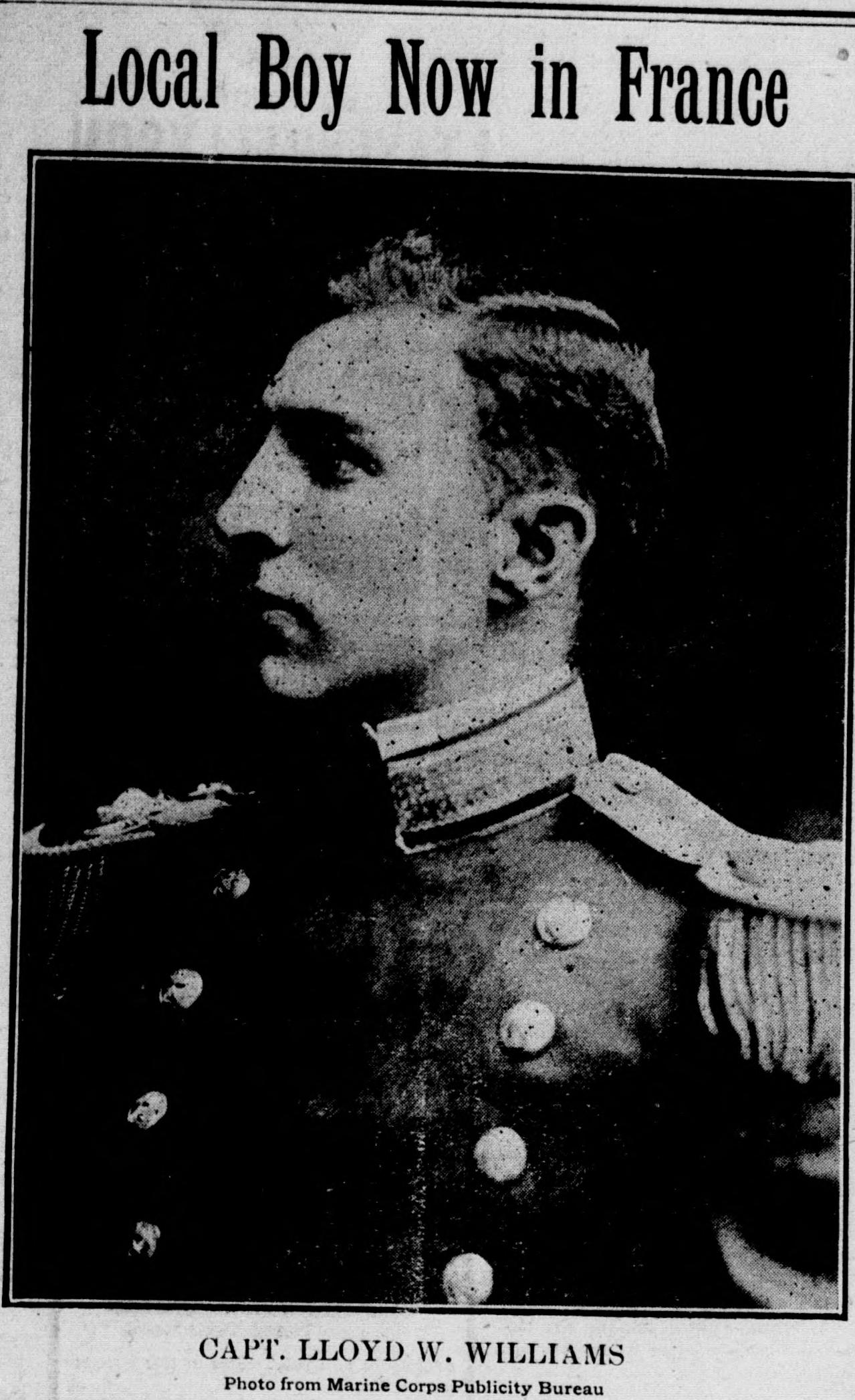
July 1917: the Courier's photograph of Capt. Lloyd W. Williams, gone overseas with the first contingent of Marines.
What this image does and does not showA photograph printed in the newspaper; the paper credits it to the Marine Corps Publicity Bureau and does not say when it was taken.
Clarke Courier (Berryville, Va.), July 4, 1917, page 1. Library of Congress, Chronicling America. Rights Changes: Cropped from the Library of Congress page image to the headline, photograph and caption of this item: 1279 by 2095 pixels, shown at its own 1279 by 2095 pixels; re-encoded as JPEG. Nothing retouched or added.
Source: Clarke Courier, Berryville, Va., July 4, 1917, page 1: "Local Boy Now in France" Open the full image
What this image is evidence for
Passage it reproduces: Page 1, "Local Boy Now in France," the photograph and its caption
Statements on this site that rest on it:
- The Clarke Courier of July 4, 1917, under the headline "Local Boy Now in France," printed a photograph of Capt. Lloyd W. Williams from the Marine Corps Publicity Bureau and reported that Captain Lloyd William Williams, United States Marine Corps, "formerly of Berryville," had "gone with the first contingent U. S. Marines for service overseas." It said he was a son of Mr. and Mrs. Goodwin H. Williams, born June 5, 1887, in Berryville, appointed a second lieutenant in the Marine Corps on January 8, 1910, and commissioned first lieutenant on June 12, 1916 and captain on August 29, 1916.
Three dates
A week later the news was of his death. His wife, Mrs. Selina Williams, and his parents received a telegram from the War Department that he "had died from wounds received in action on June 11." The Courier of July 4, 1918 said that so far as available records showed, he was "the first son of Clarke to be killed in France." The same report says he was born at "Nottingham," in Clarke County; the paper's earlier items said Berryville.
The dates do not agree. The notice of his memorial service, two weeks later, says he "died of wounds received in France on June 17." The inscription the Courier printed in 1919 for the tablet his family gave Grace Church says he was killed June 11. A press account the Courier reprinted in July 1919 says June 12.
Source note: Clarke Courier, Berryville, Va., 1918
The Clarke Courier of July 4, 1918 reported that his wife, Mrs. Selina Williams, and his parents, Mr. and Mrs. Goodwin H. Williams, had received a telegram from the War Department that Capt. Lloyd W. Williams of the Marine Corps "had died from wounds received in action on June 11." It said he was born at "Nottingham," in Clarke County, on June 5, 1887, and that "So far as available records show, Capt. Williams is the first son of Clarke to be killed in France."
What the source supports
That the Courier reported his death from wounds received in action on June 11, 1918, and called him the first son of Clarke killed in France.
Uncertainty
The date is the telegram's as the paper reported it; other Courier items give June 12 and June 17. The paper's own earlier items say he was born in Berryville. Read on the page image of the Library of Congress digital reproduction. No human historian has reviewed this claim.
Source
Evidence role: supports. Page 1, "Gallant Lloyd Williams Killed in France".
Clarke Courier, Berryville, Va., July 4, 1918, page 1: "Gallant Lloyd Williams Killed in France"
Clarke Courier, Berryville, Va. · 1918-07-04 (publication)
Locator: Page 1, "Gallant Lloyd Williams Killed in France"
Relevant passageMrs. Selina Williams, his wife, and Mr. and Mrs. Goodwin H. Williams, his father and mother, received a telegram from the War Department at Washington announcing that Capt. Lloyd W. Williams, of the United States Marine Corps, had died from wounds received in action on June 11.
Checked: Original inspected. A digital reproduction was inspected; no original has been handled.
Open sourceSource family: clarke-courier. Multiple passages from one source are not independent witnesses.
Evidence role: supports. Page 1, "Gallant Lloyd Williams Killed in France".
Clarke Courier, Berryville, Va., July 4, 1918, page 1: "Gallant Lloyd Williams Killed in France"
Clarke Courier, Berryville, Va. · 1918-07-04 (publication)
Locator: Page 1, "Gallant Lloyd Williams Killed in France"
Relevant passageCaptain Williams was born at "Nottingham," in Clarke county, on June 5, 1887. He passed his boyhood days in Berryville
Checked: Original inspected. A digital reproduction was inspected; no original has been handled.
Open sourceSource family: clarke-courier. Multiple passages from one source are not independent witnesses.
Evidence role: supports. Page 1, "Gallant Lloyd Williams Killed in France".
Clarke Courier, Berryville, Va., July 4, 1918, page 1: "Gallant Lloyd Williams Killed in France"
Clarke Courier, Berryville, Va. · 1918-07-04 (publication)
Locator: Page 1, "Gallant Lloyd Williams Killed in France"
Relevant passageSo far as available records show, Capt. Williams is the first son of Clarke to be killed in France.
Checked: Original inspected. A digital reproduction was inspected; no original has been handled.
Open sourceSource family: clarke-courier. Multiple passages from one source are not independent witnesses.
AI-assisted source check (Claude Opus 5.5) · 2026-10-14. How this project checks its sources
Source note: Clarke Courier, Berryville, Va., 1918
The Clarke Courier of July 18, 1918 announced memorial services at Grace Episcopal Church on Sunday, July 21, for Capt. Lloyd Williams, U. S. M. C., "who died of wounds received in France on June 17."
What the source supports
That this notice gives June 17 as the date of his wounds.
Uncertainty
A short notice; the paper's report of two weeks before gives June 11. Read on the page image of the Library of Congress digital reproduction. No human historian has reviewed this claim.
Source
Evidence role: supports. Page 1, "Memorial Services at Grace Church".
Clarke Courier, Berryville, Va., July 18, 1918, page 1: "Memorial Services at Grace Church"
Clarke Courier, Berryville, Va. · 1918-07-18 (publication)
Locator: Page 1, "Memorial Services at Grace Church"
Relevant passageMemorial services to Capt. Lloyd Williams, U. S. M. C., who died of wounds received in France on June 17, will be held at Grace Episcopl [sic] Church, on Sunday, July 21, at 4 p. m.
Checked: Original inspected. A digital reproduction was inspected; no original has been handled.
Open sourceSource family: clarke-courier. Multiple passages from one source are not independent witnesses.
AI-assisted source check (Claude Opus 5.5) · 2026-10-14. How this project checks its sources
Source note: Clarke Courier, Berryville, Va., 1919, and one more
In April 1919 the Courier reported that a memorial tablet to Maj. Lloyd W. Williams, given by his family, would be placed in Grace Episcopal Church, and printed its inscription: born June 5, 1887 at Nottingham, Clarke County, and killed June 11, 1918 at Belleau Wood. The Commission's 1927 history says Grace Church held a memorial service when the tablet was unveiled.
What the source supports
The tablet in Grace Church and what it says.
Uncertainty
The inscription is as the paper printed it before the unveiling; the tablet was not seen for this story.
Source
Evidence role: supports. The tablet and its place.
Clarke Courier, Berryville, Va., April 17, 1919, page 1: "Beautiful Memorial to Maj. Lloyd W. Williams Will be Placed in Grace Episcopal Church"
Clarke Courier, Berryville, Va. · 1919-04-17 (publication)
Locator: Page 1, "Beautiful Memorial to Maj. Lloyd W. Williams"
Relevant passageA beautiful memorial tablet to the late Major Lloyd Wm. Williams, U. S. M. C., who fell in the Battle of Belleau Woods when the American Marines blocked the Hun's drive to Paris, will be placed on the interior walls of Grace Episcopal Church, where this heroic Clarke boy worshipped and of which he was a communicant.
Checked: Original inspected. A digital reproduction was inspected; no original has been handled.
Open sourceSource family: clarke-courier. Multiple passages from one source are not independent witnesses.
Evidence role: supports. The inscription's dates.
Clarke Courier, Berryville, Va., April 17, 1919, page 1: "Beautiful Memorial to Maj. Lloyd W. Williams Will be Placed in Grace Episcopal Church"
Clarke Courier, Berryville, Va. · 1919-04-17 (publication)
Locator: Page 1, "Beautiful Memorial to Maj. Lloyd W. Williams," the inscription as printed
Relevant passage"Born June 5th, 1887, at Nottingham, Clarke county, Va.; Killed June 11, 1918, in the Battle of Belleau Wood, France.
Checked: Original inspected. A digital reproduction was inspected; no original has been handled.
Open sourceSource family: clarke-courier. Multiple passages from one source are not independent witnesses.
Evidence role: supports. Erected by his family.
Clarke Courier, Berryville, Va., April 17, 1919, page 1: "Beautiful Memorial to Maj. Lloyd W. Williams Will be Placed in Grace Episcopal Church"
Clarke Courier, Berryville, Va. · 1919-04-17 (publication)
Locator: Page 1, "Beautiful Memorial to Maj. Lloyd W. Williams," the inscription as printed
Relevant passage"Erected by his Adoring Father and Mother, Sisters and Brothers."
Checked: Original inspected. A digital reproduction was inspected; no original has been handled.
Open sourceSource family: clarke-courier. Multiple passages from one source are not independent witnesses.
Evidence role: supports. The unveiling service.
Virginia War History Commission, "Clarke County in War Time: A Community History," in Virginia Communities in War Time, Second Series (Publications of the Virginia War History Commission, Source Volume VII, ed. Arthur Kyle Davis, Richmond, 1927), pp. 27-28, "Churches in War Time"
Virginia War History Commission; Arthur Kyle Davis, editor · 1927 (publication)
Locator: Page 27, "Churches in War Time," on Grace Church
Relevant passageGrace Church, in Berryville, held such a memorial service in commemoration of Major Lloyd Williams when a tablet was unveiled to his memory.
Checked: Original inspected. A digital reproduction was inspected; no original has been handled.
Open sourceSource family: virginia-war-history-commission. Multiple passages from one source are not independent witnesses.
AI-assisted source check (Claude Opus 5.5) · 2026-10-12. How this project checks its sources
Source note: Clarke Courier, Berryville, Va., 1919
The Clarke Courier of July 10, 1919 reprinted a United Press account that traced the reply "Retreat, Hell No!", attributed for months to Gen. Omar Bundy, to Capt. Lloyd Williams of the 51st Company, 5th Marines: a French major told him to follow a withdrawal, and "'Retreat?' the American asked. 'Hell, no!'" It quotes his message as "French major ordered me to withdraw with him. Told him to go to hell," says he was killed six days later, on June 12, 1918, and says a Distinguished Service Cross was sent later to his home at Berryville.
What the source supports
What the press account the Courier reprinted in 1919 said of the reply, the date of his death and a Distinguished Service Cross.
Uncertainty
A press account reprinted by the paper, which prints his name once as "Lloyd M. Williams"; the date of death and the medal differ from other Courier items. Read on the page image of the Library of Congress digital reproduction. No human historian has reviewed this claim.
Source
Evidence role: supports. Page 1, "Major Lloyd Williams Uttered Historic Sentence Which Became American Battle-Cry in France".
Clarke Courier, Berryville, Va., July 10, 1919, page 1: "5,000 Pay Homage to Clarke Heroes"
Clarke Courier, Berryville, Va. · 1919-07-10 (publication)
Locator: Page 1, "Major Lloyd Williams Uttered Historic Sentence Which Became American Battle-Cry in France"
Relevant passageA French major, moving with his battalion along the dark road and believing a general withdrawal had been ordered, told Williams to follow. "Retreat?" the American asked. "Hell, no!"
Checked: Original inspected. A digital reproduction was inspected; no original has been handled.
Open sourceSource family: clarke-courier. Multiple passages from one source are not independent witnesses.
Evidence role: supports. Page 1, "Major Lloyd Williams Uttered Historic Sentence Which Became American Battle-Cry in France".
Clarke Courier, Berryville, Va., July 10, 1919, page 1: "5,000 Pay Homage to Clarke Heroes"
Clarke Courier, Berryville, Va. · 1919-07-10 (publication)
Locator: Page 1, "Major Lloyd Williams Uttered Historic Sentence Which Became American Battle-Cry in France"
Relevant passage"French drawing back through us. French major ordered me to withdraw with him. Told him to go to hell." "WILLIAMS, C. O."
Checked: Original inspected. A digital reproduction was inspected; no original has been handled.
Open sourceSource family: clarke-courier. Multiple passages from one source are not independent witnesses.
Evidence role: supports. Page 1, "Major Lloyd Williams Uttered Historic Sentence Which Became American Battle-Cry in France".
Clarke Courier, Berryville, Va., July 10, 1919, page 1: "5,000 Pay Homage to Clarke Heroes"
Clarke Courier, Berryville, Va. · 1919-07-10 (publication)
Locator: Page 1, "Major Lloyd Williams Uttered Historic Sentence Which Became American Battle-Cry in France"
Relevant passageCaptain Williams was killed six days later—June 12, 1918. [...] A distinguished service cross for extraordinary heroism was sent later to his home at Berryville, Va.
Checked: Original inspected. A digital reproduction was inspected; no original has been handled.
Open sourceSource family: clarke-courier. Multiple passages from one source are not independent witnesses.
AI-assisted source check (Claude Opus 5.5) · 2026-10-14. How this project checks its sources
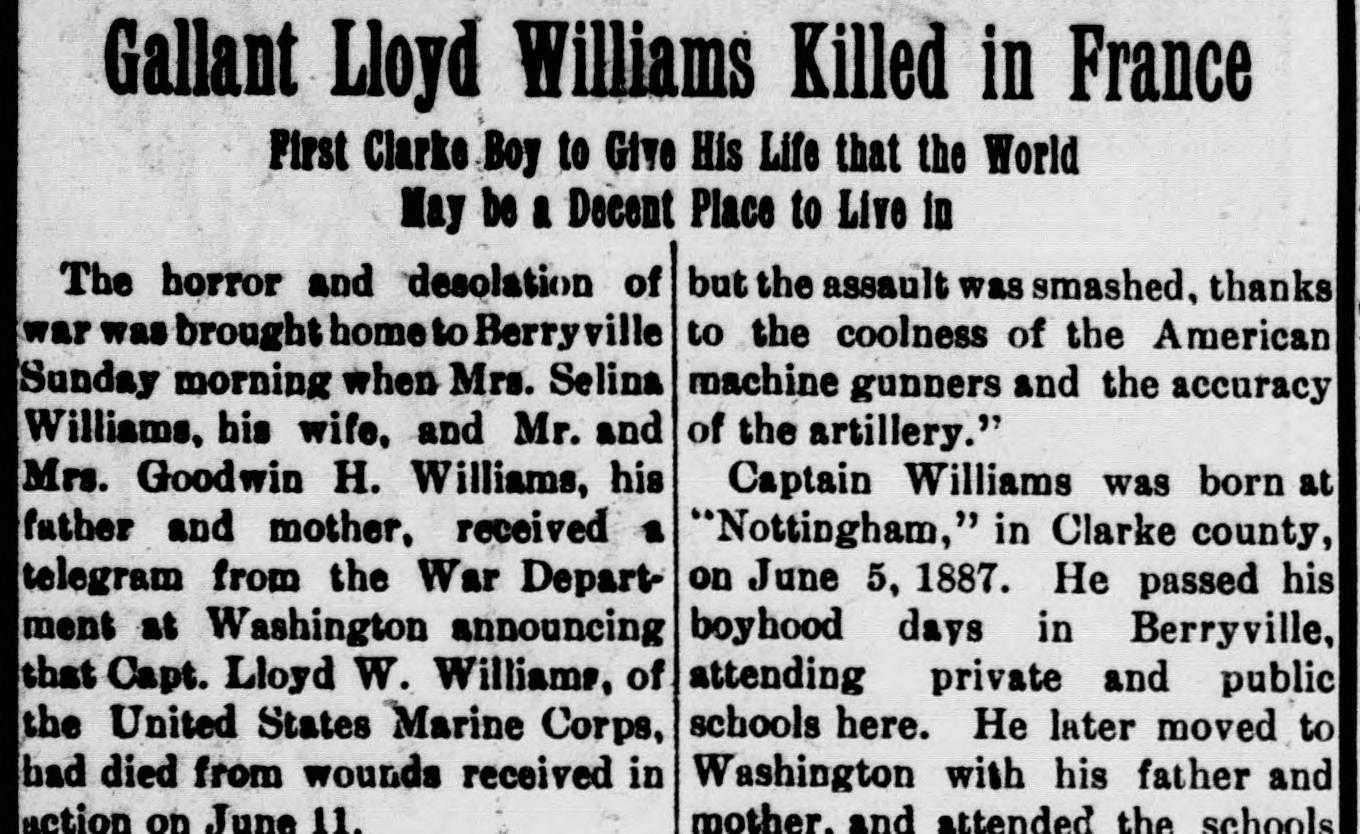
July 1918: the War Department's telegram, "died from wounds received in action on June 11."
What this image does and does not showA crop of part of one page; the rest of the page is not shown.
Clarke Courier (Berryville, Va.), July 4, 1918, page 1. Library of Congress, Chronicling America. Rights Changes: Cropped from the Library of Congress page image to the headline and the opening of this item: 1360 by 834 pixels, shown at its own 1360 by 834 pixels; re-encoded as JPEG. Nothing retouched or added.
Source: Clarke Courier, Berryville, Va., July 4, 1918, page 1: "Gallant Lloyd Williams Killed in France" Open the full image
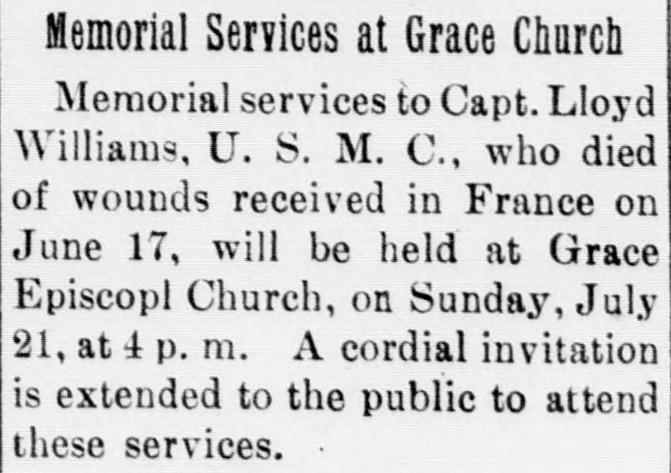
Two weeks later the notice of his memorial service gives another date: "wounds received in France on June 17."
What this image does and does not showA crop of part of one page; the rest of the page is not shown.
Clarke Courier (Berryville, Va.), July 18, 1918, page 1. Library of Congress, Chronicling America. Rights Changes: Cropped from the Library of Congress page image to this notice: 671 by 473 pixels, shown at its own 671 by 473 pixels; re-encoded as JPEG. Nothing retouched or added.
Source: Clarke Courier, Berryville, Va., July 18, 1918, page 1: "Memorial Services at Grace Church" Open the full image
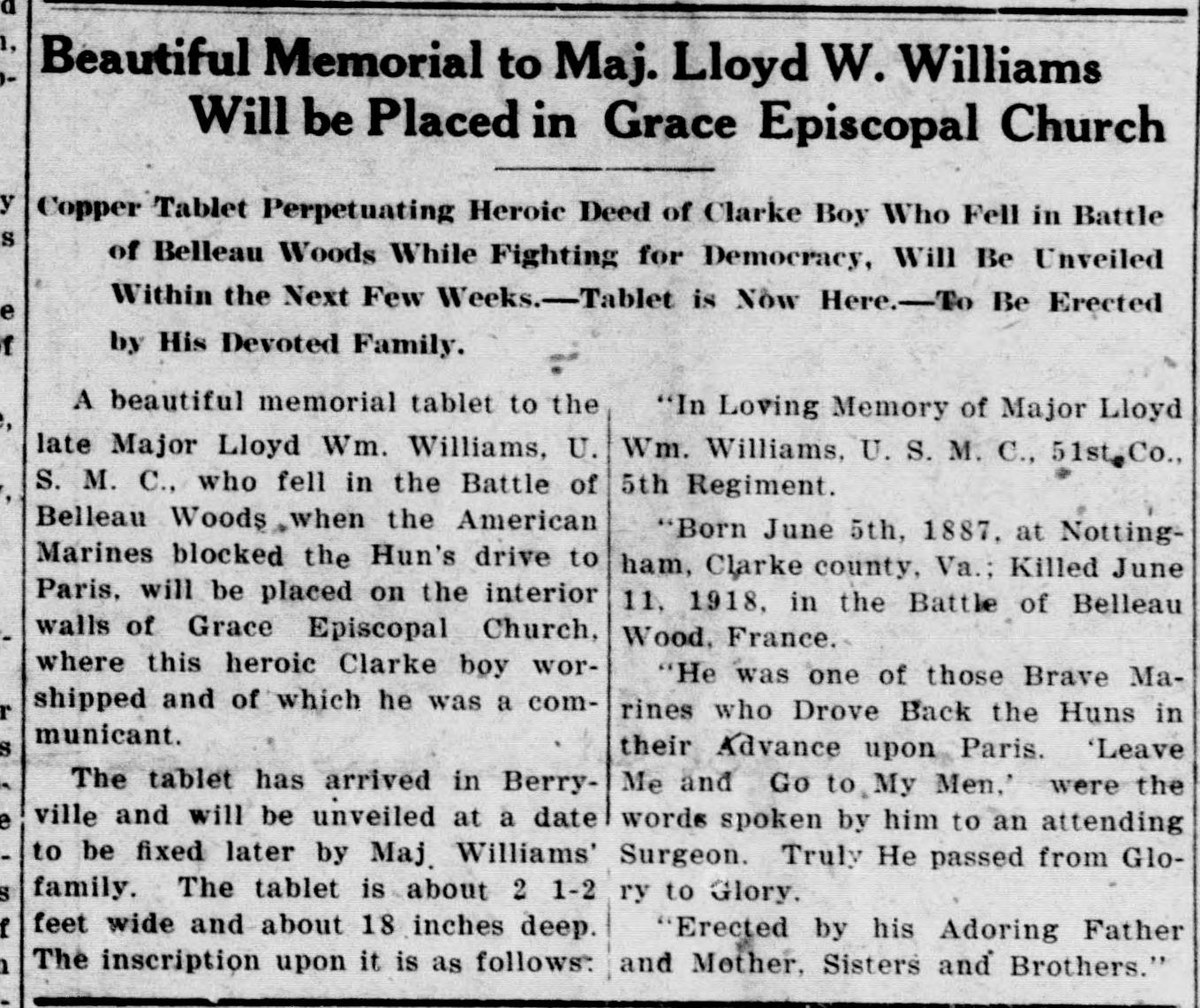
"Beautiful Memorial to Maj. Lloyd W. Williams Will be Placed in Grace Episcopal Church," with the inscription as the paper printed it.
What this image does and does not showA crop of part of one page; the rest of the page is not shown.
Clarke Courier (Berryville, Va.), April 17, 1919, page 1. Library of Congress, Chronicling America. Rights Changes: Cropped from the Library of Congress page image to the region of this item: 1359 by 1142 pixels, scaled to 1200 by 1008; re-encoded as JPEG. Nothing retouched or added.
Source: Clarke Courier, Berryville, Va., April 17, 1919, page 1: "Beautiful Memorial to Maj. Lloyd W. Williams Will be Placed in Grace Episcopal Church" Open the full image
How he died
Nor do the accounts of how he died. At his memorial service at Grace Church in July 1918, where he had been baptized, the rector said he had been slightly wounded on June 9 and taken to a hospital at Lucy, behind the lines, and that a shell falling in his room "exploded and killed him instantly."
In November 1918 the Courier retold the account of a lieutenant of his company. On June 6, it said, Williams went alone into a wheat field to carry first aid to his wounded, and was awarded the croix de guerre for it. On June 11, wounded in the left arm and shoulder, he was carried to the dressing station at Lucy, where a shell exploded and mortally wounded him. A Red Cross letter the paper quoted says he was "fatally rewounded while being carried to or actually in the dressing station," and "buried at La Ferte by Chaplain Father Brady."
In August 1919 Father John J. Brady, a Navy chaplain, wrote to the widow: "I did not have the honor of burying Captain Williams as he died in one of the hospitals in the rear." If he remembered rightly, Brady wrote, Williams had been wounded again by the fragments of a bursting shell "while being carried on a stretcher to the rear."
Source note: Clarke Courier, Berryville, Va., 1918
On a Sunday in July 1918 more than four hundred people gathered in Grace Episcopal Church in memory of Capt. Lloyd W. Williams, U.S. Marine Corps, "the first son of Clarke county to make the supreme sacrifice," the Courier reported; he had been baptized in Grace Church, and the rector read a poem written for him by Rev. J. Herbert Bean, the Methodist pastor.
What the source supports
The memorial service at Grace Church and what bound Williams to it.
Uncertainty
The paper's count of the crowd.
Source
Evidence role: supports. The gathering.
Clarke Courier, Berryville, Va., July 25, 1918, page 1: "Pay Tribute to Capt. Williams"
Clarke Courier, Berryville, Va. · 1918-07-25 (publication)
Locator: Page 1, "Pay Tribute to Capt. Williams"
Relevant passageMore than four hundred men and women of Berryville and vicinity gathered in Grace Episcopal Church Sunday afternoon at 4 o'clock to lay a wreath of love and respect upon the memory of Capt. Lloyd W. Williams, United States Marine Corps, who was the first son of Clarke county to make the supreme sacrifice
Checked: Original inspected. A digital reproduction was inspected; no original has been handled.
Open sourceSource family: clarke-courier. Multiple passages from one source are not independent witnesses.
Evidence role: supports. Baptized in Grace Church.
Clarke Courier, Berryville, Va., July 25, 1918, page 1: "Pay Tribute to Capt. Williams"
Clarke Courier, Berryville, Va. · 1918-07-25 (publication)
Locator: Page 1, "Pay Tribute to Capt. Williams"
Relevant passageCaptain Williams was baptized in Grace Church. He attended its Sunday School when a boy of Berryville.
Checked: Original inspected. A digital reproduction was inspected; no original has been handled.
Open sourceSource family: clarke-courier. Multiple passages from one source are not independent witnesses.
Evidence role: supports. Bean's poem.
Clarke Courier, Berryville, Va., July 25, 1918, page 1: "Pay Tribute to Capt. Williams"
Clarke Courier, Berryville, Va. · 1918-07-25 (publication)
Locator: Page 1, "Pay Tribute to Capt. Williams"
Relevant passageMr. Taylor read a poem, written by Rev. J. Herbert Bean paster of the Methodist Church, in honor of the memory of this young man.
Checked: Original inspected. A digital reproduction was inspected; no original has been handled.
Open sourceSource family: clarke-courier. Multiple passages from one source are not independent witnesses.
AI-assisted source check (Claude Opus 5.5) · 2026-10-12. How this project checks its sources
Source note: Clarke Courier, Berryville, Va., 1918
At the memorial service at Grace Church in July 1918, the Clarke Courier of July 25, 1918 reported, the rector, Rev. Malcolm S. Taylor, said that Capt. Lloyd W. Williams had been slightly wounded on June 9 and taken to a hospital at Lucy, behind the lines, and that a shell falling in the room where he lay "exploded and killed him instantly."
What the source supports
What the rector said in July 1918 of how Williams died.
Uncertainty
The rector's account, as the paper reported his address; the date and the manner of death differ from the paper's other accounts. Read on the page image of the Library of Congress digital reproduction. No human historian has reviewed this claim.
Source
Evidence role: supports. Page 1, "Pay Tribute to Capt. Williams".
Clarke Courier, Berryville, Va., July 25, 1918, page 1: "Pay Tribute to Capt. Williams"
Clarke Courier, Berryville, Va. · 1918-07-25 (publication)
Locator: Page 1, "Pay Tribute to Capt. Williams"
Relevant passageHe said that on June 9th he was slightly wounded and was taken to a hospital in a small town (Lucy) back of the battle lines. [...] the shell falling in the room where Captian [sic] Williams was confined. It exploded and killed him instantly.
Checked: Original inspected. A digital reproduction was inspected; no original has been handled.
Open sourceSource family: clarke-courier. Multiple passages from one source are not independent witnesses.
AI-assisted source check (Claude Opus 5.5) · 2026-10-14. How this project checks its sources
Source note: Clarke Courier, Berryville, Va., 1918
The Clarke Courier of November 28, 1918, retelling the account of a lieutenant of his company, reported that on June 6 Capt. Lloyd W. Williams went alone into a wheat field to carry first aid to his wounded and was awarded the croix de guerre, and that on June 11, wounded in the left arm and shoulder, he was carried to the dressing station at Lucy, where a shell exploded and mortally wounded him. A Red Cross letter it quoted says he was "fatally rewounded while being carried to or actually in the dressing station" and "buried at La Ferte by Chaplain Father Brady."
What the source supports
What the paper reported in November 1918 of how Williams died, and the Red Cross letter it quoted.
Uncertainty
A lieutenant's account as the paper retold it, and a letter as the paper quoted it; the chaplain the letter names wrote in 1919 that he did not bury Williams. Read on the page image of the Library of Congress digital reproduction. No human historian has reviewed this claim.
Source
Evidence role: supports. Page 1, "Details of Capt. Williams' Death".
Clarke Courier, Berryville, Va., November 28, 1918, page 1: "Details of Capt. Williams' Death" and the report of the death of Robert E. Russell
Clarke Courier, Berryville, Va. · 1918-11-28 (publication)
Locator: Page 1, "Details of Capt. Williams' Death"
Relevant passageOn June 6th, Capt. Williams went alone into one of these wheat fields, to carry first aid to some of his wounded who were lying there. [...] In recognition of his gallantry, he was awarded the croix de guerre
Checked: Original inspected. A digital reproduction was inspected; no original has been handled.
Open sourceSource family: clarke-courier. Multiple passages from one source are not independent witnesses.
Evidence role: supports. Page 1, "Details of Capt. Williams' Death".
Clarke Courier, Berryville, Va., November 28, 1918, page 1: "Details of Capt. Williams' Death" and the report of the death of Robert E. Russell
Clarke Courier, Berryville, Va. · 1918-11-28 (publication)
Locator: Page 1, "Details of Capt. Williams' Death"
Relevant passageCapt. Williams was wounded in the left arm and in the shoulder and had to be carried to the dressing station, at Lucy, a little town about two miles back of the line. Here, while his wounds were being dressed a shell exploded in the station and mortally wounded him.
Checked: Original inspected. A digital reproduction was inspected; no original has been handled.
Open sourceSource family: clarke-courier. Multiple passages from one source are not independent witnesses.
Evidence role: supports. Page 1, "Details of Capt. Williams' Death," the Red Cross letter.
Clarke Courier, Berryville, Va., November 28, 1918, page 1: "Details of Capt. Williams' Death" and the report of the death of Robert E. Russell
Clarke Courier, Berryville, Va. · 1918-11-28 (publication)
Locator: Page 1, "Details of Capt. Williams' Death," the Red Cross letter
Relevant passageHe was wounded twice at Belleau Woods and fatally rewounded while being carried to or actually in the dressing station in the presence of the attending physician, a Dr. Petty. He was buried at La Ferte by Chaplain Father Brady.
Checked: Original inspected. A digital reproduction was inspected; no original has been handled.
Open sourceSource family: clarke-courier. Multiple passages from one source are not independent witnesses.
AI-assisted source check (Claude Opus 5.5) · 2026-10-14. How this project checks its sources
Source note: Clarke Courier, Berryville, Va., 1919
The Clarke Courier of September 18, 1919 printed a letter of August 14, 1919 from Father John J. Brady, a Navy chaplain, to Mrs. Lloyd W. Williams, which says: "I did not have the honor of burying Captain Williams as he died in one of the hospitals in the rear," and "If I remember rightly he was wounded again by the flying fragments of a bursting shell while being carried on a stretcher to the rear."
What the source supports
What the chaplain wrote to the widow in 1919.
Uncertainty
The chaplain's memory, fourteen months after the death, as the paper printed his letter. Read on the page image of the Library of Congress digital reproduction. No human historian has reviewed this claim.
Source
Evidence role: supports. Page 1, "Army Chaplain Tells of Capt. Williams' Heroism".
Clarke Courier, Berryville, Va., September 18, 1919, page 1: "Army Chaplain Tells of Capt. Williams' Heroism"
Clarke Courier, Berryville, Va. · 1919-09-18 (publication)
Locator: Page 1, "Army Chaplain Tells of Capt. Williams' Heroism"
Relevant passageDear Mrs. Williams:—I did not have the honor of burying Captain Williams as he died in one of the hospitals in the rear.
Checked: Original inspected. A digital reproduction was inspected; no original has been handled.
Open sourceSource family: clarke-courier. Multiple passages from one source are not independent witnesses.
Evidence role: supports. Page 1, "Army Chaplain Tells of Capt. Williams' Heroism".
Clarke Courier, Berryville, Va., September 18, 1919, page 1: "Army Chaplain Tells of Capt. Williams' Heroism"
Clarke Courier, Berryville, Va. · 1919-09-18 (publication)
Locator: Page 1, "Army Chaplain Tells of Capt. Williams' Heroism"
Relevant passageIf I remember rightly he was wounded again by the flying fragments of a bursting shell while being carried on a stretcher to the rear. This is what really brought about his death.
Checked: Original inspected. A digital reproduction was inspected; no original has been handled.
Open sourceSource family: clarke-courier. Multiple passages from one source are not independent witnesses.
AI-assisted source check (Claude Opus 5.5) · 2026-10-14. How this project checks its sources
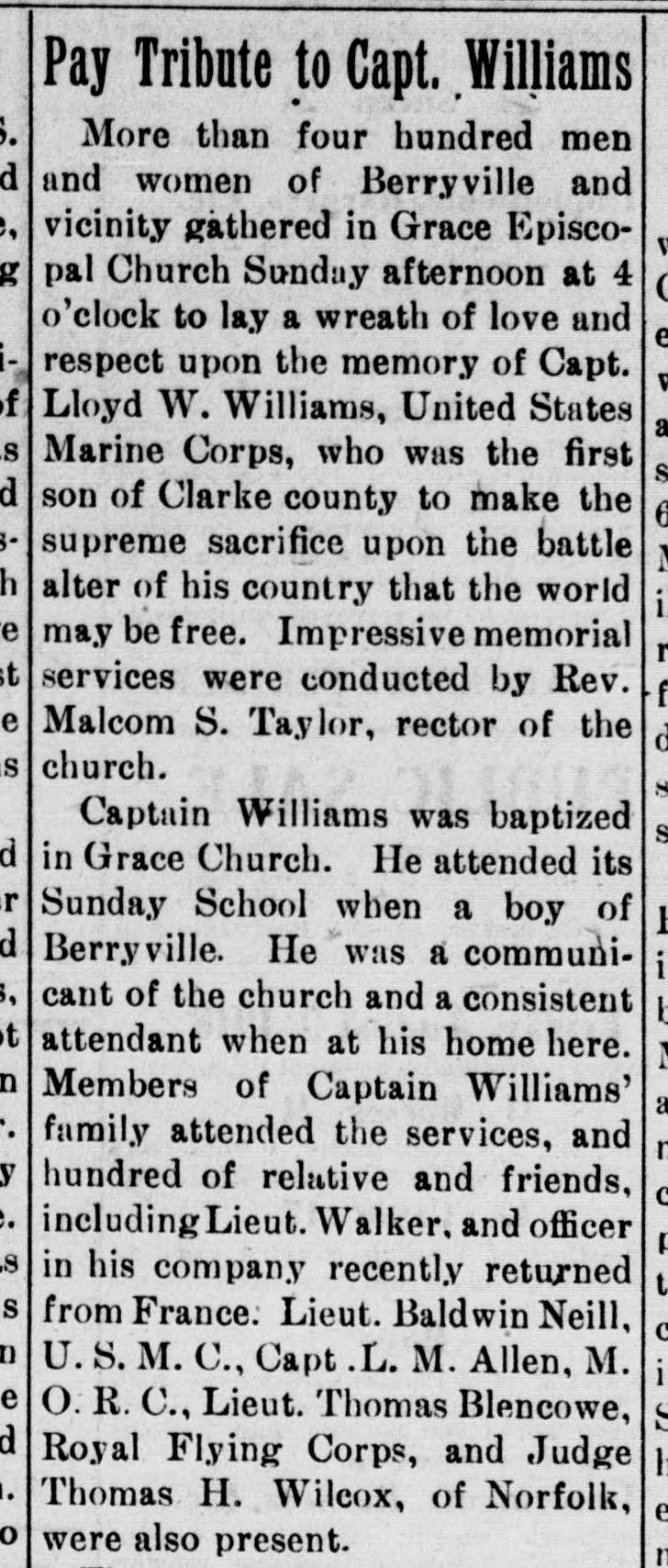
"Pay Tribute to Capt. Williams": more than four hundred people in Grace Church for "the first son of Clarke county" to die in the war.
What this image does and does not showA crop of part of one page; the rest of the page is not shown.
Clarke Courier (Berryville, Va.), July 25, 1918, page 1. Library of Congress, Chronicling America. Rights Changes: Cropped from the Library of Congress page image to the region of this item, then cropped again to the opening of the report: 728 by 1708 pixels, shown at its own 728 by 1708 pixels; re-encoded as JPEG. Nothing retouched or added.
Source: Clarke Courier, Berryville, Va., July 25, 1918, page 1: "Pay Tribute to Capt. Williams" Open the full image
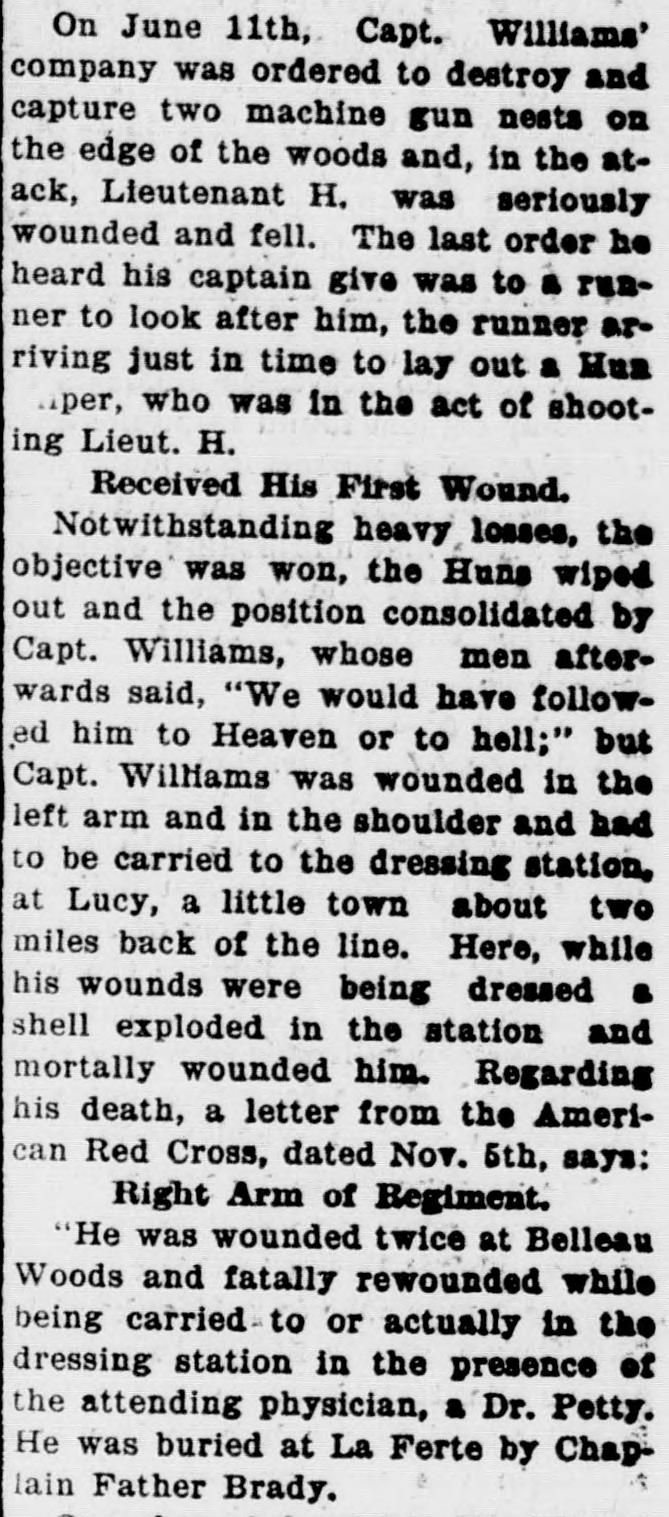
November 1918: wounded on June 11 and mortally wounded by a shell in the dressing station at Lucy, and a Red Cross letter that has him buried at La Ferte by Chaplain Father Brady.
What this image does and does not showA crop of part of one page; the rest of the page is not shown.
Clarke Courier (Berryville, Va.), November 28, 1918, page 1. Library of Congress, Chronicling America. Rights Changes: Cropped from the Library of Congress page image to two paragraphs of this item, from "On June 11th" to the end of the Red Cross letter's first sentences: 669 by 1517 pixels, shown at its own 669 by 1517 pixels; re-encoded as JPEG. Nothing retouched or added.
Source: Clarke Courier, Berryville, Va., November 28, 1918, page 1: "Details of Capt. Williams' Death" and the report of the death of Robert E. Russell Open the full image
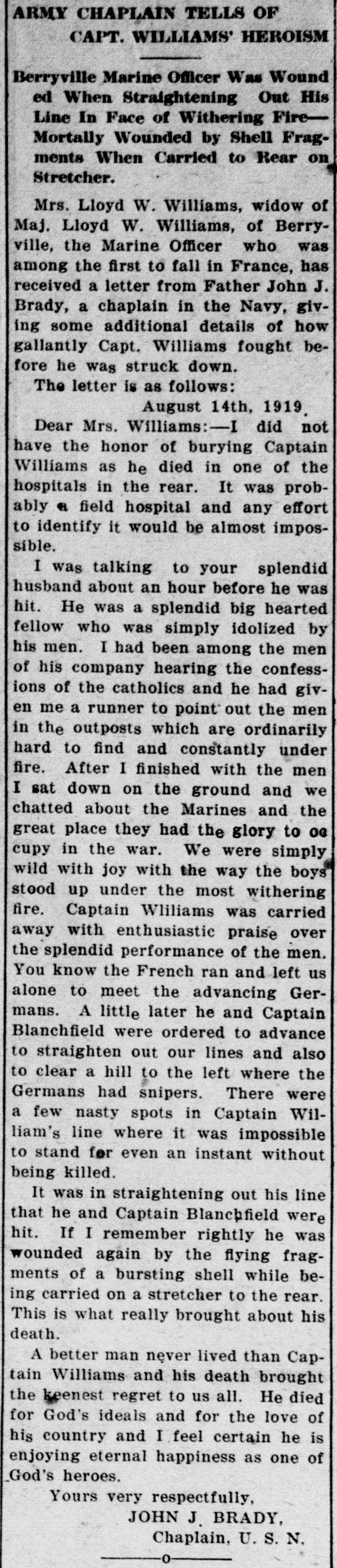
September 1919: Father John J. Brady writes to the widow that he did not bury Captain Williams.
What this image does and does not showA crop of part of one page; the rest of the page is not shown.
Clarke Courier (Berryville, Va.), September 18, 1919, page 1. Library of Congress, Chronicling America. Rights Changes: Cropped from the Library of Congress page image to this item: 687 by 3192 pixels, shown at its own 687 by 3192 pixels; re-encoded as JPEG. Nothing retouched or added.
Source: Clarke Courier, Berryville, Va., September 18, 1919, page 1: "Army Chaplain Tells of Capt. Williams' Heroism" Open the full image
Retreat? Hell, no!
In July 1919 the Courier reprinted a United Press account that traced a famous American reply, credited for months to Gen. Omar Bundy, to Williams. A French major falling back along a dark road told him to follow: "'Retreat?' the American asked. 'Hell, no!'" His message to his battalion commander, the account says, read: "French major ordered me to withdraw with him. Told him to go to hell."
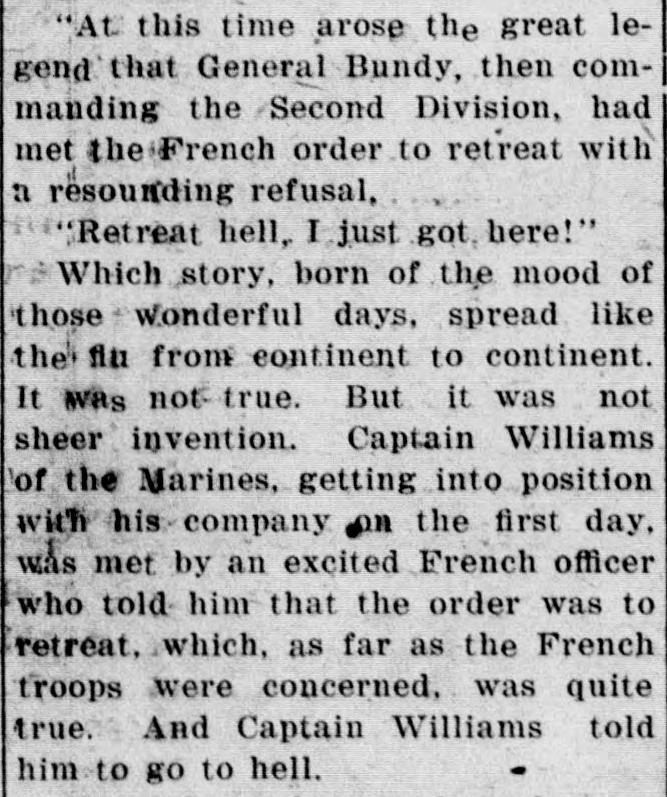
In November 1919 the paper printed another version, from an article by Alexander Woollcott (the paper prints "Woolcott"). The story that General Bundy had answered "Retreat hell, I just got here!" "was not true. But it was not sheer invention." An excited French officer told Captain Williams the order was to retreat, "And Captain Williams told him to go to hell." Woollcott has him killed later by a random shell on the operating table in the dressing station.
When the Courier reported his funeral in 1921, it gave the reply a third way: "Fall back hell, We are going to advance."
Source note: Clarke Courier, Berryville, Va., 1919
The Clarke Courier of July 10, 1919 reprinted a United Press account that traced the reply "Retreat, Hell No!", attributed for months to Gen. Omar Bundy, to Capt. Lloyd Williams of the 51st Company, 5th Marines: a French major told him to follow a withdrawal, and "'Retreat?' the American asked. 'Hell, no!'" It quotes his message as "French major ordered me to withdraw with him. Told him to go to hell," says he was killed six days later, on June 12, 1918, and says a Distinguished Service Cross was sent later to his home at Berryville.
What the source supports
What the press account the Courier reprinted in 1919 said of the reply, the date of his death and a Distinguished Service Cross.
Uncertainty
A press account reprinted by the paper, which prints his name once as "Lloyd M. Williams"; the date of death and the medal differ from other Courier items. Read on the page image of the Library of Congress digital reproduction. No human historian has reviewed this claim.
Source
Evidence role: supports. Page 1, "Major Lloyd Williams Uttered Historic Sentence Which Became American Battle-Cry in France".
Clarke Courier, Berryville, Va., July 10, 1919, page 1: "5,000 Pay Homage to Clarke Heroes"
Clarke Courier, Berryville, Va. · 1919-07-10 (publication)
Locator: Page 1, "Major Lloyd Williams Uttered Historic Sentence Which Became American Battle-Cry in France"
Relevant passageA French major, moving with his battalion along the dark road and believing a general withdrawal had been ordered, told Williams to follow. "Retreat?" the American asked. "Hell, no!"
Checked: Original inspected. A digital reproduction was inspected; no original has been handled.
Open sourceSource family: clarke-courier. Multiple passages from one source are not independent witnesses.
Evidence role: supports. Page 1, "Major Lloyd Williams Uttered Historic Sentence Which Became American Battle-Cry in France".
Clarke Courier, Berryville, Va., July 10, 1919, page 1: "5,000 Pay Homage to Clarke Heroes"
Clarke Courier, Berryville, Va. · 1919-07-10 (publication)
Locator: Page 1, "Major Lloyd Williams Uttered Historic Sentence Which Became American Battle-Cry in France"
Relevant passage"French drawing back through us. French major ordered me to withdraw with him. Told him to go to hell." "WILLIAMS, C. O."
Checked: Original inspected. A digital reproduction was inspected; no original has been handled.
Open sourceSource family: clarke-courier. Multiple passages from one source are not independent witnesses.
Evidence role: supports. Page 1, "Major Lloyd Williams Uttered Historic Sentence Which Became American Battle-Cry in France".
Clarke Courier, Berryville, Va., July 10, 1919, page 1: "5,000 Pay Homage to Clarke Heroes"
Clarke Courier, Berryville, Va. · 1919-07-10 (publication)
Locator: Page 1, "Major Lloyd Williams Uttered Historic Sentence Which Became American Battle-Cry in France"
Relevant passageCaptain Williams was killed six days later—June 12, 1918. [...] A distinguished service cross for extraordinary heroism was sent later to his home at Berryville, Va.
Checked: Original inspected. A digital reproduction was inspected; no original has been handled.
Open sourceSource family: clarke-courier. Multiple passages from one source are not independent witnesses.
AI-assisted source check (Claude Opus 5.5) · 2026-10-14. How this project checks its sources
Source note: Clarke Courier, Berryville, Va., 1919
The Clarke Courier of November 6, 1919, quoting an article by Alexander Woollcott (the paper prints "Woolcott") in the Home Sector, says the story that General Bundy had answered a French order to retreat with "Retreat hell, I just got here!" "was not true. But it was not sheer invention": Captain Williams of the Marines, met by an excited French officer who said the order was to retreat, "told him to go to hell." It says Williams was later killed by a random shell while on the operating table in the dressing station.
What the source supports
What the article the Courier quoted in November 1919 said of the reply and of his death.
Uncertainty
A magazine writer's account as the paper quoted it. Read on the page image of the Library of Congress digital reproduction. No human historian has reviewed this claim.
Source
Evidence role: supports. Page 3, "Another Version of Maj. Williams' Famous Saying".
Clarke Courier, Berryville, Va., November 6, 1919, page 3: "ARMISTICE DAY MEETING"
Clarke Courier, Berryville, Va. · 1919-11-06 (publication)
Locator: Page 3, "Another Version of Maj. Williams' Famous Saying"
Relevant passage"Retreat hell, I just got here!" Which story, born of the mood of those wonderful days, spread like the flu from continent to continent. It was not true. But it was not sheer invention.
Checked: Original inspected. A digital reproduction was inspected; no original has been handled.
Open sourceSource family: clarke-courier. Multiple passages from one source are not independent witnesses.
Evidence role: supports. Page 3, "Another Version of Maj. Williams' Famous Saying".
Clarke Courier, Berryville, Va., November 6, 1919, page 3: "ARMISTICE DAY MEETING"
Clarke Courier, Berryville, Va. · 1919-11-06 (publication)
Locator: Page 3, "Another Version of Maj. Williams' Famous Saying"
Relevant passageCaptain Williams of the Marines, getting into position with his company on the first day, was met by an excited French officer who told him that the order was to retreat, which, as far as the French troops were concerned, was quite true. And Captain Williams told him to go to hell.
Checked: Original inspected. A digital reproduction was inspected; no original has been handled.
Open sourceSource family: clarke-courier. Multiple passages from one source are not independent witnesses.
Evidence role: supports. Page 3, "Another Version of Maj. Williams' Famous Saying".
Clarke Courier, Berryville, Va., November 6, 1919, page 3: "ARMISTICE DAY MEETING"
Clarke Courier, Berryville, Va. · 1919-11-06 (publication)
Locator: Page 3, "Another Version of Maj. Williams' Famous Saying"
Relevant passageCaptain Williams was wounded later, and when he was on the operating table in the dressing station he was killed by a random shell.
Checked: Original inspected. A digital reproduction was inspected; no original has been handled.
Open sourceSource family: clarke-courier. Multiple passages from one source are not independent witnesses.
AI-assisted source check (Claude Opus 5.5) · 2026-10-14. How this project checks its sources
Source note: Clarke Courier, Berryville, Va., 1921, and one more
The Clarke Courier of July 14, 1921 reported that the body of Maj. Lloyd W. Williams, which had reached New York from France after three years, would arrive at Berryville that Thursday morning, with funeral services at Grace Church and burial in the Williams lot in Green Hill Cemetery. Its issue of July 21, 1921 reported that "On Thursday last" he was laid to rest "on a beautiful slope of Green Hill Cemetery," and quoted his reply to the French officers as "Fall back hell, We are going to advance."
What the source supports
That his body was brought home from France and buried at Green Hill Cemetery in July 1921.
Uncertainty
Newspaper reports of the funeral; the 1921 report quotes his reply in a third wording. Read on the page image of the Library of Congress digital reproduction. No human historian has reviewed this claim.
Source
Evidence role: supports. Page 1, "Maj. William's Body Reaches Here Today".
Clarke Courier, Berryville, Va., July 14, 1921, page 1: "Maj. William's Body Reaches Here Today"
Clarke Courier, Berryville, Va. · 1921-07-14 (publication)
Locator: Page 1, "Maj. William's Body Reaches Here Today"
Relevant passageThe body of Maj. Lloyd W. Williams, U. S. M. C., which reached New York last week from France, where it had been interred for three years, will arrive at Berryville this (Thursday) morning at 9 o'clock for final religious services and burial.
Checked: Original inspected. A digital reproduction was inspected; no original has been handled.
Open sourceSource family: clarke-courier. Multiple passages from one source are not independent witnesses.
Evidence role: supports. Page 1, "Maj. William's Body Reaches Here Today".
Clarke Courier, Berryville, Va., July 14, 1921, page 1: "Maj. William's Body Reaches Here Today"
Clarke Courier, Berryville, Va. · 1921-07-14 (publication)
Locator: Page 1, "Maj. William's Body Reaches Here Today"
Relevant passageThe funeral services will be held at 6 o'clock p.m. in Grace Church, after which the burial will be in the Williams' lot in Green Hill Cemetary [sic].
Checked: Original inspected. A digital reproduction was inspected; no original has been handled.
Open sourceSource family: clarke-courier. Multiple passages from one source are not independent witnesses.
Evidence role: supports. Page 1, "1000 Home People Honor Maj. Williams".
Clarke Courier, Berryville, Va., July 21, 1921
Clarke Courier · 1921-07-21 (publication)
Locator: Page 1, "1000 Home People Honor Maj. Williams"
Relevant passageOn Thursday last, just as the sun went down behind the rugged heights of the Alleghenies, all that is mortal of that gallant soldier and son of Clarke, Major Lloyd W. Williams, United States Marine Corps, who was killed in France in the world war, was laid in its last resting place on a beautiful slope of Green Hill Cemetery
Checked: This passage was read on a digital reproduction of the page; no original has been handled. The source's other readings: existing OCR reviewed, original image not independently inspected.
Open sourceSource family: clarke-courier. Multiple passages from one source are not independent witnesses.
Evidence role: supports. Page 1, "1000 Home People Honor Maj. Williams".
Clarke Courier, Berryville, Va., July 21, 1921
Clarke Courier · 1921-07-21 (publication)
Locator: Page 1, "1000 Home People Honor Maj. Williams"
Relevant passagehe had replied to the French staff officers information that the French were falling back and that he should do the same, "Fall back hell, We are going to advance,"
Checked: This passage was read on a digital reproduction of the page; no original has been handled. The source's other readings: existing OCR reviewed, original image not independently inspected.
Open sourceSource family: clarke-courier. Multiple passages from one source are not independent witnesses.
AI-assisted source check (Claude Opus 5.5) · 2026-10-14. How this project checks its sources
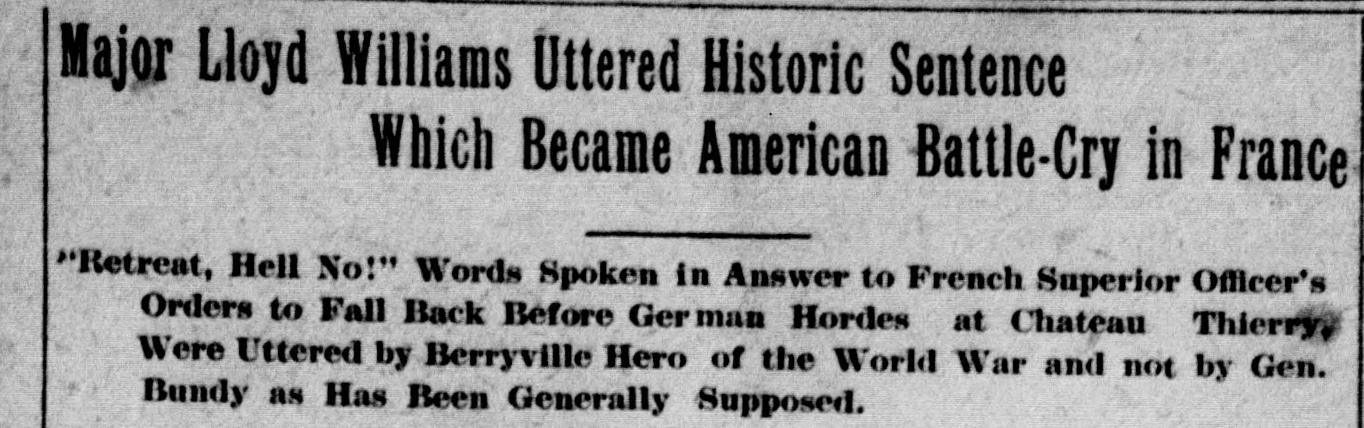
July 1919: "Retreat, Hell No!" credited to the Berryville officer, "and not by Gen. Bundy as Has Been Generally Supposed."
What this image does and does not showA crop of part of one page; the rest of the page is not shown.
Clarke Courier (Berryville, Va.), July 10, 1919, page 1. Library of Congress, Chronicling America. Rights Changes: Cropped from the Library of Congress page image to the headline and deck of this item: 1364 by 428 pixels, shown at its own 1364 by 428 pixels; re-encoded as JPEG. Nothing retouched or added.
Source: Clarke Courier, Berryville, Va., July 10, 1919, page 1: "5,000 Pay Homage to Clarke Heroes" Open the full image
November 1919: the Bundy story "was not true. But it was not sheer invention."
What this image does and does not showA crop of part of one page; the rest of the page is not shown.
Clarke Courier (Berryville, Va.), November 6, 1919, page 3. Library of Congress, Chronicling America. Rights Changes: Cropped from the Library of Congress page image to one paragraph of this item, quoting Alexander Woollcott: 667 by 797 pixels, shown at its own 667 by 797 pixels; re-encoded as JPEG. Nothing retouched or added.
Source: Clarke Courier, Berryville, Va., November 6, 1919, page 3: "ARMISTICE DAY MEETING" Open the full image
The medals
The papers name different honors, too. The November 1918 report says he was awarded the croix de guerre; the July 1919 account says a Distinguished Service Cross was sent to his home at Berryville. The list of Clarke's war honors the Courier printed in April 1923, compiled from the first volume of the Virginia War History, gives him the French croix de guerre with palms and a silver star citation at Chateau Thierry, June 3, 1918. It quotes a citation for June 6, 1918: he "continued fighting until he was severely wounded by machine gun fire, and later killed by shell fire." It names no Distinguished Service Cross for him.
The same list gives John R. Castleman of Berryville, an air service pilot, a distinguished service cross at Romagne, France, on October 5, 1918. In May 1921 the Courier had reported that Lieut. John R. Castleman, Jr., was awarded a Distinguished Service Medal. Which medal each man received is not settled here.
Source note: Clarke Courier, Berryville, Va., 1918
The Clarke Courier of November 28, 1918, retelling the account of a lieutenant of his company, reported that on June 6 Capt. Lloyd W. Williams went alone into a wheat field to carry first aid to his wounded and was awarded the croix de guerre, and that on June 11, wounded in the left arm and shoulder, he was carried to the dressing station at Lucy, where a shell exploded and mortally wounded him. A Red Cross letter it quoted says he was "fatally rewounded while being carried to or actually in the dressing station" and "buried at La Ferte by Chaplain Father Brady."
What the source supports
What the paper reported in November 1918 of how Williams died, and the Red Cross letter it quoted.
Uncertainty
A lieutenant's account as the paper retold it, and a letter as the paper quoted it; the chaplain the letter names wrote in 1919 that he did not bury Williams. Read on the page image of the Library of Congress digital reproduction. No human historian has reviewed this claim.
Source
Evidence role: supports. Page 1, "Details of Capt. Williams' Death".
Clarke Courier, Berryville, Va., November 28, 1918, page 1: "Details of Capt. Williams' Death" and the report of the death of Robert E. Russell
Clarke Courier, Berryville, Va. · 1918-11-28 (publication)
Locator: Page 1, "Details of Capt. Williams' Death"
Relevant passageOn June 6th, Capt. Williams went alone into one of these wheat fields, to carry first aid to some of his wounded who were lying there. [...] In recognition of his gallantry, he was awarded the croix de guerre
Checked: Original inspected. A digital reproduction was inspected; no original has been handled.
Open sourceSource family: clarke-courier. Multiple passages from one source are not independent witnesses.
Evidence role: supports. Page 1, "Details of Capt. Williams' Death".
Clarke Courier, Berryville, Va., November 28, 1918, page 1: "Details of Capt. Williams' Death" and the report of the death of Robert E. Russell
Clarke Courier, Berryville, Va. · 1918-11-28 (publication)
Locator: Page 1, "Details of Capt. Williams' Death"
Relevant passageCapt. Williams was wounded in the left arm and in the shoulder and had to be carried to the dressing station, at Lucy, a little town about two miles back of the line. Here, while his wounds were being dressed a shell exploded in the station and mortally wounded him.
Checked: Original inspected. A digital reproduction was inspected; no original has been handled.
Open sourceSource family: clarke-courier. Multiple passages from one source are not independent witnesses.
Evidence role: supports. Page 1, "Details of Capt. Williams' Death," the Red Cross letter.
Clarke Courier, Berryville, Va., November 28, 1918, page 1: "Details of Capt. Williams' Death" and the report of the death of Robert E. Russell
Clarke Courier, Berryville, Va. · 1918-11-28 (publication)
Locator: Page 1, "Details of Capt. Williams' Death," the Red Cross letter
Relevant passageHe was wounded twice at Belleau Woods and fatally rewounded while being carried to or actually in the dressing station in the presence of the attending physician, a Dr. Petty. He was buried at La Ferte by Chaplain Father Brady.
Checked: Original inspected. A digital reproduction was inspected; no original has been handled.
Open sourceSource family: clarke-courier. Multiple passages from one source are not independent witnesses.
AI-assisted source check (Claude Opus 5.5) · 2026-10-14. How this project checks its sources
Source note: Clarke Courier, Berryville, Va., 1919
The Clarke Courier of July 10, 1919 reprinted a United Press account that traced the reply "Retreat, Hell No!", attributed for months to Gen. Omar Bundy, to Capt. Lloyd Williams of the 51st Company, 5th Marines: a French major told him to follow a withdrawal, and "'Retreat?' the American asked. 'Hell, no!'" It quotes his message as "French major ordered me to withdraw with him. Told him to go to hell," says he was killed six days later, on June 12, 1918, and says a Distinguished Service Cross was sent later to his home at Berryville.
What the source supports
What the press account the Courier reprinted in 1919 said of the reply, the date of his death and a Distinguished Service Cross.
Uncertainty
A press account reprinted by the paper, which prints his name once as "Lloyd M. Williams"; the date of death and the medal differ from other Courier items. Read on the page image of the Library of Congress digital reproduction. No human historian has reviewed this claim.
Source
Evidence role: supports. Page 1, "Major Lloyd Williams Uttered Historic Sentence Which Became American Battle-Cry in France".
Clarke Courier, Berryville, Va., July 10, 1919, page 1: "5,000 Pay Homage to Clarke Heroes"
Clarke Courier, Berryville, Va. · 1919-07-10 (publication)
Locator: Page 1, "Major Lloyd Williams Uttered Historic Sentence Which Became American Battle-Cry in France"
Relevant passageA French major, moving with his battalion along the dark road and believing a general withdrawal had been ordered, told Williams to follow. "Retreat?" the American asked. "Hell, no!"
Checked: Original inspected. A digital reproduction was inspected; no original has been handled.
Open sourceSource family: clarke-courier. Multiple passages from one source are not independent witnesses.
Evidence role: supports. Page 1, "Major Lloyd Williams Uttered Historic Sentence Which Became American Battle-Cry in France".
Clarke Courier, Berryville, Va., July 10, 1919, page 1: "5,000 Pay Homage to Clarke Heroes"
Clarke Courier, Berryville, Va. · 1919-07-10 (publication)
Locator: Page 1, "Major Lloyd Williams Uttered Historic Sentence Which Became American Battle-Cry in France"
Relevant passage"French drawing back through us. French major ordered me to withdraw with him. Told him to go to hell." "WILLIAMS, C. O."
Checked: Original inspected. A digital reproduction was inspected; no original has been handled.
Open sourceSource family: clarke-courier. Multiple passages from one source are not independent witnesses.
Evidence role: supports. Page 1, "Major Lloyd Williams Uttered Historic Sentence Which Became American Battle-Cry in France".
Clarke Courier, Berryville, Va., July 10, 1919, page 1: "5,000 Pay Homage to Clarke Heroes"
Clarke Courier, Berryville, Va. · 1919-07-10 (publication)
Locator: Page 1, "Major Lloyd Williams Uttered Historic Sentence Which Became American Battle-Cry in France"
Relevant passageCaptain Williams was killed six days later—June 12, 1918. [...] A distinguished service cross for extraordinary heroism was sent later to his home at Berryville, Va.
Checked: Original inspected. A digital reproduction was inspected; no original has been handled.
Open sourceSource family: clarke-courier. Multiple passages from one source are not independent witnesses.
AI-assisted source check (Claude Opus 5.5) · 2026-10-14. How this project checks its sources
Source note: Clarke Courier, 1923
The list of Clarke soldiers' war honors that the Clarke Courier printed on April 26, 1923, compiled from the first volume of the Virginia War History, gives Lloyd William Williams, captain of the 51st Company of Marines, the French croix de guerre with palms and a silver star citation at Chateau Thierry, June 3, 1918, and quotes a citation for June 6, 1918: he "continued fighting until he was severely wounded by machine gun fire, and later killed by shell fire." The list names no Distinguished Service Cross for him.
What the source supports
The honors the 1923 list gives him.
Uncertainty
The list as the paper printed it from the Virginia War History; it is not checked here against military records. Read on the page image of the Library of Congress digital reproduction. No human historian has reviewed this claim.
Source
Evidence role: supports. Page 1, "Ten War Honors For Clarke County," the entry for Lloyd William Williams.
Clarke Courier, Berryville, Va., April 26, 1923
Clarke Courier · 1923-04-26 (publication)
Locator: Page 1, "Ten War Honors For Clarke County," the entry for Lloyd William Williams
Relevant passageLloyd William Williams, deceased Berryville, for whom the local post of the American Legion in [sic] named, captain of the 51st company of Marines, French croix de guerre with palms. [...] Also silver star citation, Chateau Thierry, June 3, 1918
Checked: This passage was read on a digital reproduction of the page; no original has been handled. The source's other readings: existing OCR reviewed, original image not independently inspected.
Open sourceSource family: clarke-courier. Multiple passages from one source are not independent witnesses.
Evidence role: supports. Page 1, "Ten War Honors For Clarke County," the entry for Lloyd William Williams, continued.
Clarke Courier, Berryville, Va., April 26, 1923
Clarke Courier · 1923-04-26 (publication)
Locator: Page 1, "Ten War Honors For Clarke County," the entry for Lloyd William Williams, continued
Relevant passageFor his great bravery and conspicuous leadership in the Bois de Belleau on June 6, 1918, when with one officer left in his company and with more than 50 per cent casaulties [sic] among his enlisted men continued fighting until he was severely wounded by machine gun fire, and later killed by shell fire.
Checked: This passage was read on a digital reproduction of the page; no original has been handled. The source's other readings: existing OCR reviewed, original image not independently inspected.
Open sourceSource family: clarke-courier. Multiple passages from one source are not independent witnesses.
AI-assisted source check (Claude Opus 5.5) · 2026-10-14. How this project checks its sources
Source note: Clarke Courier, 1923
The list of Clarke soldiers' war honors that the Clarke Courier printed on April 26, 1923 gives John R. Castleman of Berryville, first lieutenant and air service pilot, a distinguished service cross at Romagne, France, on October 5, 1918, "for extraordinary heroism in action."
What the source supports
The honor the 1923 list gives John R. Castleman.
Uncertainty
The Courier of May 26, 1921 reported a Distinguished Service Medal for Lieut. John R. Castleman, Jr.; which is right is not settled here. Read on the page image of the Library of Congress digital reproduction. No human historian has reviewed this claim.
Source
Evidence role: supports. Page 1, "Ten War Honors For Clarke County," the entry for John R. Castleman.
Clarke Courier, Berryville, Va., April 26, 1923
Clarke Courier · 1923-04-26 (publication)
Locator: Page 1, "Ten War Honors For Clarke County," the entry for John R. Castleman
Relevant passageJohn R. Castleman, Berryville, first lieut. air service pilot, distinguished service cross, Romagne, France, Oct. 5, 1918, "for extraordinary heroism in action.
Checked: This passage was read on a digital reproduction of the page; no original has been handled. The source's other readings: existing OCR reviewed, original image not independently inspected.
Open sourceSource family: clarke-courier. Multiple passages from one source are not independent witnesses.
AI-assisted source check (Claude Opus 5.5) · 2026-10-14. How this project checks its sources
Source note: Clarke Courier, 1921
The Clarke Courier of May 26, 1921 reports that Lieut. John R. Castleman, Jr., of Clarke County, son of the late John R. Castleman of Mosby's Rangers, had made the highest average record over four years at the Virginia Polytechnic Institute and was chosen valedictorian of his class, and that he had been awarded a Distinguished Service Medal for bravery in an air battle with German aeroplanes during the World War.
What the source supports
That the Courier of May 26, 1921 reported John R. Castleman, Jr., of Clarke County as chosen valedictorian at Virginia Polytechnic Institute and as awarded a Distinguished Service Medal; a Courier list of 1923 names a different decoration (see the uncertainty note).
Uncertainty
Read from uncorrected OCR, not from the page image. The medal is as the item reports it and was not checked against military records. A Courier list of April 26, 1923 (page 1, compiled from the first volume of the Virginia War History) gives, for a John R. Castleman of Berryville, "first lieut. air service pilot," a "distinguished service cross" at Romagne, France, on October 5, 1918, with a silver star citation. The two Courier items name different decorations, and which is right is not settled here; the 1923 list is not cited as evidence in this record. His father and brothers named in the item have no records here.
Source
Evidence role: supports. The May 26, 1921 item.
Clarke Courier, Berryville, Va., May 26, 1921
Clarke Courier · 1921-05-26 (publication)
Locator: Page 2, local news items
Relevant passageLieut. John R Castleman, Jr., of Clarke county, son of that brave old Confederate soldier, tlie [the] late John R. Castleman, of Mosby's Rangcts [Rangers] fame ... has made the highest average record in his studies, covering a period of four years, at the Virginia Polytechnic Institute and has been chosen valedictorian for his class at the final exercises. "John” was awaided [awarded] a Distinguished Service Medal for bravery in an air battle with German aeroplanes during the world war.
Checked: Existing OCR reviewed. Original image not independently inspected.
Open sourceSource family: clarke-courier. Multiple passages from one source are not independent witnesses.
Evidence role: supports. The same passage, read from the page image and shown in the clipping above.
Clarke Courier, Berryville, Va., May 26, 1921
Clarke Courier · 1921-05-26 (publication)
Locator: Clarke Courier, Berryville, Va., May 26, 1921, page 2 of the issue, per the Library of Congress record (printed page not recorded: the page prints no number), column "Little Locals", Castleman item, the passage beginning "Lieut. John R. Castleman, Jr., of..."
Relevant passageLieut. John R. Castleman, Jr., of Clarke county, son of that brave old Confederate soldier, the late John R. Castleman, of Mosby's Rangers fame, has won laurels in the college class room to match those on the battle lines in France. Word from Blacksburg is to the effect that he has made the highest average record in his studies, covering a period of four years, at the Virginia Polytechnic Institute and has been chosen valedictorian for his class at the final exercises. "John" was awarded a Distinguished Service Medal for bravery in an air battle with German aeroplanes during the world war.
Checked: This passage was read on a digital reproduction of the page; no original has been handled. The source's other readings: existing OCR reviewed, original image not independently inspected.
Open sourceSource family: clarke-courier. Multiple passages from one source are not independent witnesses.
AI-assisted source check (Claude Opus 5) · 2026-09-16. How this project checks its sources
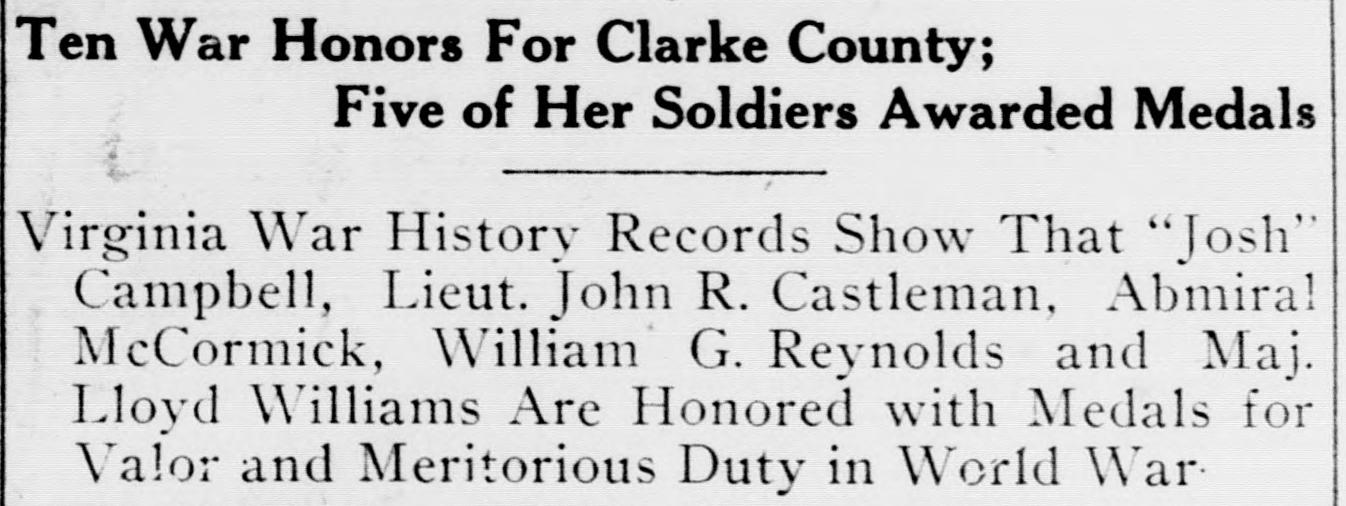
The headline and deck of the report Ten War Honors For Clarke County on the front page of the Clarke Courier of April 26, 1923, naming "Josh" Campbell, Lieut. John R. Castleman, Admiral McCormick (printed Abmiral), William G. Reynolds and Maj. Lloyd Williams.
What this image does and does not showPrint damaged in places; letters that could not be read on the page are supplied from context.
Clarke Courier (Berryville, Va.), April 26, 1923, page 1. Library of Congress, Chronicling America. Rights Changes: Cut from the Library of Congress page image at full resolution (the region lies at box 1484,1547 673x253 pixels of the saved half-size copy of the page) and shown at its own 1346 by 506 pixels; not scaled, retouched, enhanced, highlighted or re-encoded. Restored transcription: the passage is keyed as clean running text per docs/hubs-foundations.md's restored-transcription convention, not strict as-printed brackets.
Source: Clarke Courier, Berryville, Va., April 26, 1923 Open the full image
What this image is evidence for
Passage it reproduces: Clarke Courier, Berryville, Va., April 26, 1923, page 1, headline "Ten War Honors For Clarke County"
Statements on this site that rest on it:
- The Clarke Courier of April 26, 1923 prints a list, compiled from the first volume of the Virginia War History, of Clarke soldiers awarded honors in the World War, naming William Graham Reynolds of Berryville, captain in the 23rd Infantry, as awarded the Distinguished Service Cross at St. Etienne on October 4, 1918, "for extraordinary heroism in action."

The item on Lieut. John R. Castleman, Jr. in the Little Locals column of the Clarke Courier of May 26, 1921: the highest average in four years at the Virginia Polytechnic Institute, chosen valedictorian, and awarded a Distinguished Service Medal for bravery in an air battle during the World War.
What this image does and does not showA crop of part of one newspaper page; the rest of the page is not shown. Other local items in the column are not part of the passage.
Clarke Courier (Berryville, Va.), May 26, 1921, page 2 (as numbered by the Library of Congress). Library of Congress, Chronicling America. Rights Changes: Cut from the Library of Congress page image at full resolution (the region lies at box 147,165 340x2020 pixels of the saved half-size copy of the page) and shown at its own 681 by 4039 pixels; not scaled, retouched, enhanced, highlighted or re-encoded.
Source: Clarke Courier, Berryville, Va., May 26, 1921 Open the full image
What this image is evidence for
Passage it reproduces: Clarke Courier, Berryville, Va., May 26, 1921, page 2 of the issue, per the Library of Congress record (printed page not recorded: the page prints no number), column "Little Locals", Castleman item, the passage beginning "Lieut. John R. Castleman, Jr., of..."
Statements on this site that rest on it:
- The Clarke Courier of May 26, 1921 reports that Lieut. John R. Castleman, Jr., of Clarke County, son of the late John R. Castleman of Mosby's Rangers, had made the highest average record over four years at the Virginia Polytechnic Institute and was chosen valedictorian of his class, and that he had been awarded a Distinguished Service Medal for bravery in an air battle with German aeroplanes during the World War.
The second son
When Robert E. Russell was killed in France that autumn, the Courier of November 28, 1918 called him "the second son of Clarke county who has met death on the field of battle so far as official reports show. Capt. Lloyd Williams was the first." In 1921 a marble tablet to Russell was unveiled at Stone's Chapel, near Swimley. Its inscription says it was presented by the Woman's Auxiliary of the Lloyd Williams Post.
Source note: Clarke Courier, Berryville, Va., 1918
Reporting the death of Robert E. Russell, son of Mrs. Mary A. Russell and the late Jesse Russell, the Clarke Courier of November 28, 1918 called him "the second son of Clarke county who has met death on the field of battle so far as official reports show. Capt. Lloyd Williams was the first."
What the source supports
That the Courier counted Russell second and Williams first among Clarke's dead in France.
Uncertainty
The count is the paper's, "so far as official reports show." Read on the page image of the Library of Congress digital reproduction. No human historian has reviewed this claim.
Source
Evidence role: supports. Page 1, the report of the death of Robert E. Russell.
Clarke Courier, Berryville, Va., November 28, 1918, page 1: "Details of Capt. Williams' Death" and the report of the death of Robert E. Russell
Clarke Courier, Berryville, Va. · 1918-11-28 (publication)
Locator: Page 1, the report of the death of Robert E. Russell
Relevant passageHe is the second son of Clarke county who has met death on the field of battle so far as official reports show. Capt. Lloyd Williams was the first.
Checked: Original inspected. A digital reproduction was inspected; no original has been handled.
Open sourceSource family: clarke-courier. Multiple passages from one source are not independent witnesses.
AI-assisted source check (Claude Opus 5.5) · 2026-10-14. How this project checks its sources
Source note: Clarke Courier, 1921
The Clarke Courier of June 2, 1921 reported that more than 600 people went to Stone's Chapel, near Swimley, the Sunday before, for the unveiling of a marble tablet to Robert Edgar Russell, killed in the Meuse-Argonne drive, and printed its inscription, which says it was presented by the Woman's Auxiliary of the Lloyd Williams Post, American Legion.
What the source supports
That the Legion Auxiliary's tablet to Robert Edgar Russell was unveiled at Stone's Chapel in May 1921 before a crowd the Courier put at more than 600.
Uncertainty
Read from the uncorrected OCR passages already released for this issue, and shown from the released crop of the page image; the crowd is the paper's figure.
Source
Evidence role: supports. The opening of the report: more than 600 at Stone's Chapel.
Clarke Courier, Berryville, Va., June 2, 1921
Clarke Courier · 1921-06-02 (publication)
Locator: Clarke Courier, Berryville, Va., June 2, 1921, page 1, report "600 Honor Memory of Robert Edgar Russell", the passage beginning "That gratitude for the heroic sacrifice..."
Relevant passageThat gratitude for the heroic sacrifice of Robert Edgar Russell, a son of Clarke county, who was killed in the Meuse Argonne Drive, lives in the hearts of the people of this county was exemplified last Sunday when more than 600 men, women and children journeyed to historic Stone's Presbyterian Chapel, near Swimley, to take part in the ceremonies of unveiling a beautiful marble tablet to his memory.
Checked: This passage was read on a digital reproduction of the page; no original has been handled. The source's other readings: existing OCR reviewed, original image not independently inspected.
Open sourceSource family: clarke-courier. Multiple passages from one source are not independent witnesses.
Evidence role: supports. The inscription as printed, read on the page image, naming the Woman's Auxiliary of the Lloyd Williams Post.
Clarke Courier, Berryville, Va., June 2, 1921
Clarke Courier · 1921-06-02 (publication)
Locator: Page 1, "600 Honor Memory of Robert Edgar Russell," the inscription on the tablet as printed
Relevant passageIN MEMORY OF ROBERT EDGAR RUSSELL Private Co. C, 128th Inf., 32nd Div. Killed in Action Oct. 12, 1918, MEUSE-ARGONNE, FRANCE Presented by Woman’s Auxiliary Lloyd Williams Post American Legion.
Checked: This passage was read on a digital reproduction of the page; no original has been handled. The source's other readings: existing OCR reviewed, original image not independently inspected.
Open sourceSource family: clarke-courier. Multiple passages from one source are not independent witnesses.
AI-assisted source check (Claude Opus 5.5) · 2026-10-12. How this project checks its sources

The first part of the report 600 Honor Memory of Robert Edgar Russell on the front page of the Clarke Courier of June 2, 1921: more than 600 people at Stone's Chapel for the unveiling of a marble tablet to Robert Edgar Russell, who was killed in the Meuse-Argonne drive, with the wording of the inscription.
What this image does and does not showA crop of part of one newspaper page; the rest of the page is not shown.
Clarke Courier (Berryville, Va.), June 2, 1921, page 1. Library of Congress, Chronicling America. Rights Changes: Cut from the Library of Congress page image at full resolution (the region lies at box 689,472 334x2001 pixels of the saved half-size copy of the page) and shown at its own 669 by 4002 pixels; not scaled, retouched, enhanced, highlighted or re-encoded.
Source: Clarke Courier, Berryville, Va., June 2, 1921 Open the full image
What this image is evidence for
Passage it reproduces: Clarke Courier, Berryville, Va., June 2, 1921, page 1, report "600 Honor Memory of Robert Edgar Russell", the passage beginning "That gratitude for the heroic sacrifice..."
Statements on this site that rest on it:
- The Clarke Courier of May 26, 1921 announces that a memorial tablet to Robert Russell, killed in France in the World War and the gift of the Woman's Auxiliary of the Lloyd Williams Post, would be unveiled at Stone's Chapel. Its issue of June 2, 1921 reports that more than 600 people attended the unveiling, and prints the inscription: Private, Company C, 128th Infantry, 32nd Division, killed in action October 12, 1918, Meuse-Argonne, France. Its issue of September 15, 1921 reports that his body, brought home from France, was buried beside his mother's grave after services at the Presbyterian Church.
- The Clarke Courier of June 2, 1921 reported that more than 600 people went to Stone's Chapel, near Swimley, the Sunday before, for the unveiling of a marble tablet to Robert Edgar Russell, killed in the Meuse-Argonne drive, and printed its inscription, which says it was presented by the Woman's Auxiliary of the Lloyd Williams Post, American Legion.
Home to Green Hill
In September 1919 a group of World War veterans of Berryville applied for the charter of an American Legion post, and said it would be named for him. In July 1921 his body, after three years in France, reached New York and then Berryville, and was buried in the Williams lot at Green Hill Cemetery. "On Thursday last," the Courier wrote on July 21, he was laid to rest "on a beautiful slope of Green Hill Cemetery, under the everlasting shadow of the Blue Ridge."
Source note: Clarke Courier, Berryville, Va., 1919
The Clarke Courier of September 25, 1919 reported that Maj. Henry W. Carpenter, Sergeant Moses O'Brien and Corporal Robert Fuller, for about 15 veterans of Berryville and vicinity, had applied for the charter of an American Legion post at Berryville, and that the post would be named in honor of Maj. Lloyd W. Williams.
What the source supports
That the Berryville post of the American Legion was to be named for him.
Uncertainty
A report of the charter application, before the charter arrived. Read on the page image of the Library of Congress digital reproduction. No human historian has reviewed this claim.
Source
Evidence role: supports. Page 1, "Clarke Boys Will Honor Memory of Capt. Williams".
Clarke Courier, Berryville, Va., September 25, 1919, page 1: "Clarke Boys Will Honor Memory of Capt. Williams"
Clarke Courier, Berryville, Va. · 1919-09-25 (publication)
Locator: Page 1, "Clarke Boys Will Honor Memory of Capt. Williams"
Relevant passageIn their application for the charter, they stated the post will be named in honor of Maj. Lloyd W. Williams, who made the supreme sacrifice in one of the first battles in which the American troops took part.
Checked: Original inspected. A digital reproduction was inspected; no original has been handled.
Open sourceSource family: clarke-courier. Multiple passages from one source are not independent witnesses.
AI-assisted source check (Claude Opus 5.5) · 2026-10-14. How this project checks its sources
Source note: Clarke Courier, Berryville, Va., 1921, and one more
The Clarke Courier of July 14, 1921 reported that the body of Maj. Lloyd W. Williams, which had reached New York from France after three years, would arrive at Berryville that Thursday morning, with funeral services at Grace Church and burial in the Williams lot in Green Hill Cemetery. Its issue of July 21, 1921 reported that "On Thursday last" he was laid to rest "on a beautiful slope of Green Hill Cemetery," and quoted his reply to the French officers as "Fall back hell, We are going to advance."
What the source supports
That his body was brought home from France and buried at Green Hill Cemetery in July 1921.
Uncertainty
Newspaper reports of the funeral; the 1921 report quotes his reply in a third wording. Read on the page image of the Library of Congress digital reproduction. No human historian has reviewed this claim.
Source
Evidence role: supports. Page 1, "Maj. William's Body Reaches Here Today".
Clarke Courier, Berryville, Va., July 14, 1921, page 1: "Maj. William's Body Reaches Here Today"
Clarke Courier, Berryville, Va. · 1921-07-14 (publication)
Locator: Page 1, "Maj. William's Body Reaches Here Today"
Relevant passageThe body of Maj. Lloyd W. Williams, U. S. M. C., which reached New York last week from France, where it had been interred for three years, will arrive at Berryville this (Thursday) morning at 9 o'clock for final religious services and burial.
Checked: Original inspected. A digital reproduction was inspected; no original has been handled.
Open sourceSource family: clarke-courier. Multiple passages from one source are not independent witnesses.
Evidence role: supports. Page 1, "Maj. William's Body Reaches Here Today".
Clarke Courier, Berryville, Va., July 14, 1921, page 1: "Maj. William's Body Reaches Here Today"
Clarke Courier, Berryville, Va. · 1921-07-14 (publication)
Locator: Page 1, "Maj. William's Body Reaches Here Today"
Relevant passageThe funeral services will be held at 6 o'clock p.m. in Grace Church, after which the burial will be in the Williams' lot in Green Hill Cemetary [sic].
Checked: Original inspected. A digital reproduction was inspected; no original has been handled.
Open sourceSource family: clarke-courier. Multiple passages from one source are not independent witnesses.
Evidence role: supports. Page 1, "1000 Home People Honor Maj. Williams".
Clarke Courier, Berryville, Va., July 21, 1921
Clarke Courier · 1921-07-21 (publication)
Locator: Page 1, "1000 Home People Honor Maj. Williams"
Relevant passageOn Thursday last, just as the sun went down behind the rugged heights of the Alleghenies, all that is mortal of that gallant soldier and son of Clarke, Major Lloyd W. Williams, United States Marine Corps, who was killed in France in the world war, was laid in its last resting place on a beautiful slope of Green Hill Cemetery
Checked: This passage was read on a digital reproduction of the page; no original has been handled. The source's other readings: existing OCR reviewed, original image not independently inspected.
Open sourceSource family: clarke-courier. Multiple passages from one source are not independent witnesses.
Evidence role: supports. Page 1, "1000 Home People Honor Maj. Williams".
Clarke Courier, Berryville, Va., July 21, 1921
Clarke Courier · 1921-07-21 (publication)
Locator: Page 1, "1000 Home People Honor Maj. Williams"
Relevant passagehe had replied to the French staff officers information that the French were falling back and that he should do the same, "Fall back hell, We are going to advance,"
Checked: This passage was read on a digital reproduction of the page; no original has been handled. The source's other readings: existing OCR reviewed, original image not independently inspected.
Open sourceSource family: clarke-courier. Multiple passages from one source are not independent witnesses.
AI-assisted source check (Claude Opus 5.5) · 2026-10-14. How this project checks its sources
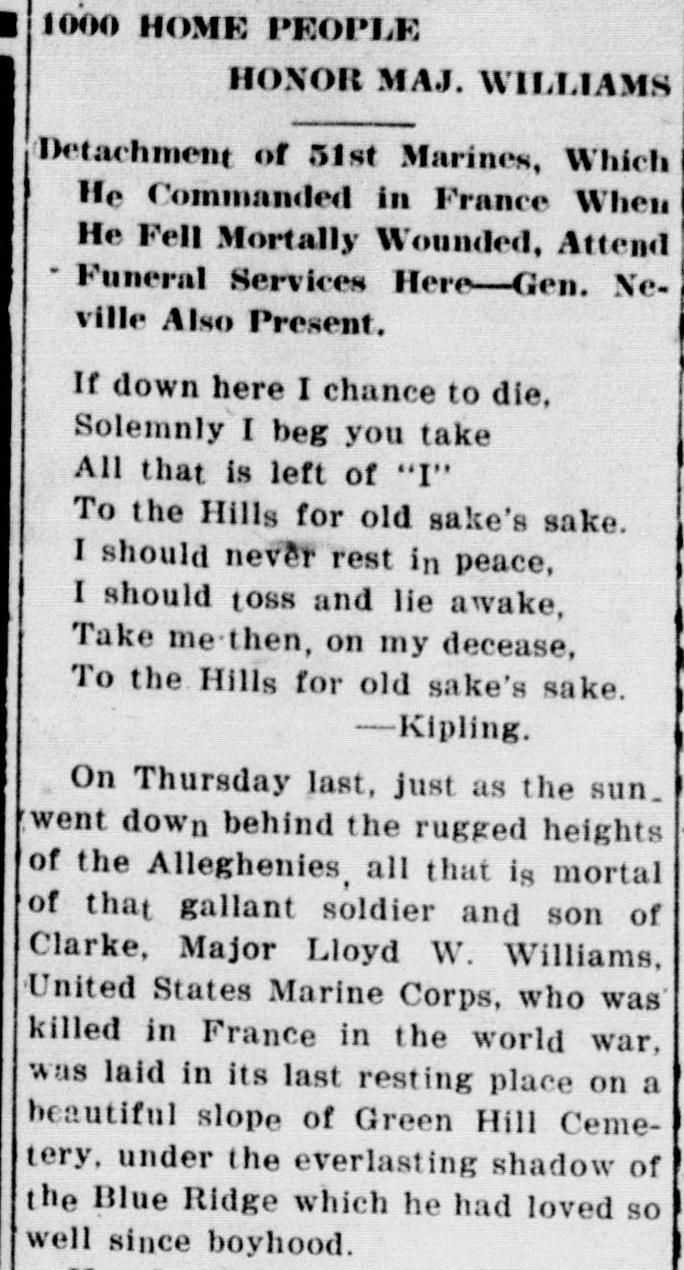
July 1921: buried "on a beautiful slope of Green Hill Cemetery, under the everlasting shadow of the Blue Ridge."
What this image does and does not showA crop of part of one page; the rest of the page is not shown.
Clarke Courier (Berryville, Va.), July 21, 1921, page 1. Library of Congress, Chronicling America. Rights Changes: Cropped from the Library of Congress page image to the headline, verse and first paragraph of this item: 684 by 1270 pixels, shown at its own 684 by 1270 pixels; re-encoded as JPEG. Nothing retouched or added.
Source: Clarke Courier, Berryville, Va., July 21, 1921 Open the full image
About the sourcesWhat the evidence says
Clarke Courier items of 1917 to 1923, read on the Library of Congress page images: reports of his going overseas, his promotion, his death, a chaplain's letter, two accounts of his famous reply, his burial and the county's war honors.
Each is a newspaper report written from telegrams, letters, a rector's address and press accounts; none is a service record. They disagree on the date and the manner of his death and on his honors, and the story sets them side by side.
- An account exists✓ Supported by a source
The Clarke Courier of July 4, 1918 reported that his wife, Mrs. Selina Williams, and his parents, Mr. and Mrs. Goodwin H. Williams, had received a telegram from the War Department that Capt. Lloyd W. Williams of the Marine Corps "had died from wounds received in action on June 11." It said he was born at "Nottingham," in Clarke County, on June 5, 1887, and that "So far as available records show, Capt. Williams is the first son of Clarke to be killed in France."
See the evidence
✓ Supported by a sourceAn account existsThe Clarke Courier of July 4, 1918 reported that his wife, Mrs. Selina Williams, and his parents, Mr. and Mrs. Goodwin H. Williams, had received a telegram from the War Department that Capt. Lloyd W. Williams of the Marine Corps "had died from wounds received in action on June 11." It said he was born at "Nottingham," in Clarke County, on June 5, 1887, and that "So far as available records show, Capt. Williams is the first son of Clarke to be killed in France."
What the source supports
That the Courier reported his death from wounds received in action on June 11, 1918, and called him the first son of Clarke killed in France.
Uncertainty
The date is the telegram's as the paper reported it; other Courier items give June 12 and June 17. The paper's own earlier items say he was born in Berryville. Read on the page image of the Library of Congress digital reproduction. No human historian has reviewed this claim.
Source
Reporting Evidence role: supports. Page 1, "Gallant Lloyd Williams Killed in France".
Clarke Courier, Berryville, Va., July 4, 1918, page 1: "Gallant Lloyd Williams Killed in France"
Clarke Courier, Berryville, Va. · 1918-07-04 (publication)
Locator: Page 1, "Gallant Lloyd Williams Killed in France"
Relevant passageMrs. Selina Williams, his wife, and Mr. and Mrs. Goodwin H. Williams, his father and mother, received a telegram from the War Department at Washington announcing that Capt. Lloyd W. Williams, of the United States Marine Corps, had died from wounds received in action on June 11.
Checked: Original inspected. A digital reproduction was inspected; no original has been handled.
Open sourceSource family: clarke-courier. Multiple passages from one source are not independent witnesses.
Reporting Evidence role: supports. Page 1, "Gallant Lloyd Williams Killed in France".
Clarke Courier, Berryville, Va., July 4, 1918, page 1: "Gallant Lloyd Williams Killed in France"
Clarke Courier, Berryville, Va. · 1918-07-04 (publication)
Locator: Page 1, "Gallant Lloyd Williams Killed in France"
Relevant passageCaptain Williams was born at "Nottingham," in Clarke county, on June 5, 1887. He passed his boyhood days in Berryville
Checked: Original inspected. A digital reproduction was inspected; no original has been handled.
Open sourceSource family: clarke-courier. Multiple passages from one source are not independent witnesses.
Reporting Evidence role: supports. Page 1, "Gallant Lloyd Williams Killed in France".
Clarke Courier, Berryville, Va., July 4, 1918, page 1: "Gallant Lloyd Williams Killed in France"
Clarke Courier, Berryville, Va. · 1918-07-04 (publication)
Locator: Page 1, "Gallant Lloyd Williams Killed in France"
Relevant passageSo far as available records show, Capt. Williams is the first son of Clarke to be killed in France.
Checked: Original inspected. A digital reproduction was inspected; no original has been handled.
Open sourceSource family: clarke-courier. Multiple passages from one source are not independent witnesses.
AI-assisted source check (Claude Opus 5.5) · 2026-10-14. How this project checks its sources
- An account exists✓ Supported by a source
The Clarke Courier of July 18, 1918 announced memorial services at Grace Episcopal Church on Sunday, July 21, for Capt. Lloyd Williams, U. S. M. C., "who died of wounds received in France on June 17."
See the evidence
✓ Supported by a sourceAn account existsThe Clarke Courier of July 18, 1918 announced memorial services at Grace Episcopal Church on Sunday, July 21, for Capt. Lloyd Williams, U. S. M. C., "who died of wounds received in France on June 17."
What the source supports
That this notice gives June 17 as the date of his wounds.
Uncertainty
A short notice; the paper's report of two weeks before gives June 11. Read on the page image of the Library of Congress digital reproduction. No human historian has reviewed this claim.
Source
Reporting Evidence role: supports. Page 1, "Memorial Services at Grace Church".
Clarke Courier, Berryville, Va., July 18, 1918, page 1: "Memorial Services at Grace Church"
Clarke Courier, Berryville, Va. · 1918-07-18 (publication)
Locator: Page 1, "Memorial Services at Grace Church"
Relevant passageMemorial services to Capt. Lloyd Williams, U. S. M. C., who died of wounds received in France on June 17, will be held at Grace Episcopl [sic] Church, on Sunday, July 21, at 4 p. m.
Checked: Original inspected. A digital reproduction was inspected; no original has been handled.
Open sourceSource family: clarke-courier. Multiple passages from one source are not independent witnesses.
AI-assisted source check (Claude Opus 5.5) · 2026-10-14. How this project checks its sources
- An account exists✓ Supported by a source
The Clarke Courier of July 10, 1919 reprinted a United Press account that traced the reply "Retreat, Hell No!", attributed for months to Gen. Omar Bundy, to Capt. Lloyd Williams of the 51st Company, 5th Marines: a French major told him to follow a withdrawal, and "'Retreat?' the American asked. 'Hell, no!'" It quotes his message as "French major ordered me to withdraw with him. Told him to go to hell," says he was killed six days later, on June 12, 1918, and says a Distinguished Service Cross was sent later to his home at Berryville.
See the evidence
✓ Supported by a sourceAn account existsThe Clarke Courier of July 10, 1919 reprinted a United Press account that traced the reply "Retreat, Hell No!", attributed for months to Gen. Omar Bundy, to Capt. Lloyd Williams of the 51st Company, 5th Marines: a French major told him to follow a withdrawal, and "'Retreat?' the American asked. 'Hell, no!'" It quotes his message as "French major ordered me to withdraw with him. Told him to go to hell," says he was killed six days later, on June 12, 1918, and says a Distinguished Service Cross was sent later to his home at Berryville.
What the source supports
What the press account the Courier reprinted in 1919 said of the reply, the date of his death and a Distinguished Service Cross.
Uncertainty
A press account reprinted by the paper, which prints his name once as "Lloyd M. Williams"; the date of death and the medal differ from other Courier items. Read on the page image of the Library of Congress digital reproduction. No human historian has reviewed this claim.
Source
Reporting Evidence role: supports. Page 1, "Major Lloyd Williams Uttered Historic Sentence Which Became American Battle-Cry in France".
Clarke Courier, Berryville, Va., July 10, 1919, page 1: "5,000 Pay Homage to Clarke Heroes"
Clarke Courier, Berryville, Va. · 1919-07-10 (publication)
Locator: Page 1, "Major Lloyd Williams Uttered Historic Sentence Which Became American Battle-Cry in France"
Relevant passageA French major, moving with his battalion along the dark road and believing a general withdrawal had been ordered, told Williams to follow. "Retreat?" the American asked. "Hell, no!"
Checked: Original inspected. A digital reproduction was inspected; no original has been handled.
Open sourceSource family: clarke-courier. Multiple passages from one source are not independent witnesses.
Reporting Evidence role: supports. Page 1, "Major Lloyd Williams Uttered Historic Sentence Which Became American Battle-Cry in France".
Clarke Courier, Berryville, Va., July 10, 1919, page 1: "5,000 Pay Homage to Clarke Heroes"
Clarke Courier, Berryville, Va. · 1919-07-10 (publication)
Locator: Page 1, "Major Lloyd Williams Uttered Historic Sentence Which Became American Battle-Cry in France"
Relevant passage"French drawing back through us. French major ordered me to withdraw with him. Told him to go to hell." "WILLIAMS, C. O."
Checked: Original inspected. A digital reproduction was inspected; no original has been handled.
Open sourceSource family: clarke-courier. Multiple passages from one source are not independent witnesses.
Reporting Evidence role: supports. Page 1, "Major Lloyd Williams Uttered Historic Sentence Which Became American Battle-Cry in France".
Clarke Courier, Berryville, Va., July 10, 1919, page 1: "5,000 Pay Homage to Clarke Heroes"
Clarke Courier, Berryville, Va. · 1919-07-10 (publication)
Locator: Page 1, "Major Lloyd Williams Uttered Historic Sentence Which Became American Battle-Cry in France"
Relevant passageCaptain Williams was killed six days later—June 12, 1918. [...] A distinguished service cross for extraordinary heroism was sent later to his home at Berryville, Va.
Checked: Original inspected. A digital reproduction was inspected; no original has been handled.
Open sourceSource family: clarke-courier. Multiple passages from one source are not independent witnesses.
AI-assisted source check (Claude Opus 5.5) · 2026-10-14. How this project checks its sources
- An account exists✓ Supported by a source
The Clarke Courier of November 28, 1918, retelling the account of a lieutenant of his company, reported that on June 6 Capt. Lloyd W. Williams went alone into a wheat field to carry first aid to his wounded and was awarded the croix de guerre, and that on June 11, wounded in the left arm and shoulder, he was carried to the dressing station at Lucy, where a shell exploded and mortally wounded him. A Red Cross letter it quoted says he was "fatally rewounded while being carried to or actually in the dressing station" and "buried at La Ferte by Chaplain Father Brady."
See the evidence
✓ Supported by a sourceAn account existsThe Clarke Courier of November 28, 1918, retelling the account of a lieutenant of his company, reported that on June 6 Capt. Lloyd W. Williams went alone into a wheat field to carry first aid to his wounded and was awarded the croix de guerre, and that on June 11, wounded in the left arm and shoulder, he was carried to the dressing station at Lucy, where a shell exploded and mortally wounded him. A Red Cross letter it quoted says he was "fatally rewounded while being carried to or actually in the dressing station" and "buried at La Ferte by Chaplain Father Brady."
What the source supports
What the paper reported in November 1918 of how Williams died, and the Red Cross letter it quoted.
Uncertainty
A lieutenant's account as the paper retold it, and a letter as the paper quoted it; the chaplain the letter names wrote in 1919 that he did not bury Williams. Read on the page image of the Library of Congress digital reproduction. No human historian has reviewed this claim.
Source
Reporting Evidence role: supports. Page 1, "Details of Capt. Williams' Death".
Clarke Courier, Berryville, Va., November 28, 1918, page 1: "Details of Capt. Williams' Death" and the report of the death of Robert E. Russell
Clarke Courier, Berryville, Va. · 1918-11-28 (publication)
Locator: Page 1, "Details of Capt. Williams' Death"
Relevant passageOn June 6th, Capt. Williams went alone into one of these wheat fields, to carry first aid to some of his wounded who were lying there. [...] In recognition of his gallantry, he was awarded the croix de guerre
Checked: Original inspected. A digital reproduction was inspected; no original has been handled.
Open sourceSource family: clarke-courier. Multiple passages from one source are not independent witnesses.
Reporting Evidence role: supports. Page 1, "Details of Capt. Williams' Death".
Clarke Courier, Berryville, Va., November 28, 1918, page 1: "Details of Capt. Williams' Death" and the report of the death of Robert E. Russell
Clarke Courier, Berryville, Va. · 1918-11-28 (publication)
Locator: Page 1, "Details of Capt. Williams' Death"
Relevant passageCapt. Williams was wounded in the left arm and in the shoulder and had to be carried to the dressing station, at Lucy, a little town about two miles back of the line. Here, while his wounds were being dressed a shell exploded in the station and mortally wounded him.
Checked: Original inspected. A digital reproduction was inspected; no original has been handled.
Open sourceSource family: clarke-courier. Multiple passages from one source are not independent witnesses.
Reporting Evidence role: supports. Page 1, "Details of Capt. Williams' Death," the Red Cross letter.
Clarke Courier, Berryville, Va., November 28, 1918, page 1: "Details of Capt. Williams' Death" and the report of the death of Robert E. Russell
Clarke Courier, Berryville, Va. · 1918-11-28 (publication)
Locator: Page 1, "Details of Capt. Williams' Death," the Red Cross letter
Relevant passageHe was wounded twice at Belleau Woods and fatally rewounded while being carried to or actually in the dressing station in the presence of the attending physician, a Dr. Petty. He was buried at La Ferte by Chaplain Father Brady.
Checked: Original inspected. A digital reproduction was inspected; no original has been handled.
Open sourceSource family: clarke-courier. Multiple passages from one source are not independent witnesses.
AI-assisted source check (Claude Opus 5.5) · 2026-10-14. How this project checks its sources
- An account exists✓ Supported by a source
The Clarke Courier of September 18, 1919 printed a letter of August 14, 1919 from Father John J. Brady, a Navy chaplain, to Mrs. Lloyd W. Williams, which says: "I did not have the honor of burying Captain Williams as he died in one of the hospitals in the rear," and "If I remember rightly he was wounded again by the flying fragments of a bursting shell while being carried on a stretcher to the rear."
See the evidence
✓ Supported by a sourceAn account existsThe Clarke Courier of September 18, 1919 printed a letter of August 14, 1919 from Father John J. Brady, a Navy chaplain, to Mrs. Lloyd W. Williams, which says: "I did not have the honor of burying Captain Williams as he died in one of the hospitals in the rear," and "If I remember rightly he was wounded again by the flying fragments of a bursting shell while being carried on a stretcher to the rear."
What the source supports
What the chaplain wrote to the widow in 1919.
Uncertainty
The chaplain's memory, fourteen months after the death, as the paper printed his letter. Read on the page image of the Library of Congress digital reproduction. No human historian has reviewed this claim.
Source
Reporting Evidence role: supports. Page 1, "Army Chaplain Tells of Capt. Williams' Heroism".
Clarke Courier, Berryville, Va., September 18, 1919, page 1: "Army Chaplain Tells of Capt. Williams' Heroism"
Clarke Courier, Berryville, Va. · 1919-09-18 (publication)
Locator: Page 1, "Army Chaplain Tells of Capt. Williams' Heroism"
Relevant passageDear Mrs. Williams:—I did not have the honor of burying Captain Williams as he died in one of the hospitals in the rear.
Checked: Original inspected. A digital reproduction was inspected; no original has been handled.
Open sourceSource family: clarke-courier. Multiple passages from one source are not independent witnesses.
Reporting Evidence role: supports. Page 1, "Army Chaplain Tells of Capt. Williams' Heroism".
Clarke Courier, Berryville, Va., September 18, 1919, page 1: "Army Chaplain Tells of Capt. Williams' Heroism"
Clarke Courier, Berryville, Va. · 1919-09-18 (publication)
Locator: Page 1, "Army Chaplain Tells of Capt. Williams' Heroism"
Relevant passageIf I remember rightly he was wounded again by the flying fragments of a bursting shell while being carried on a stretcher to the rear. This is what really brought about his death.
Checked: Original inspected. A digital reproduction was inspected; no original has been handled.
Open sourceSource family: clarke-courier. Multiple passages from one source are not independent witnesses.
AI-assisted source check (Claude Opus 5.5) · 2026-10-14. How this project checks its sources
- An account exists✓ Supported by a source
The Clarke Courier of November 6, 1919, quoting an article by Alexander Woollcott (the paper prints "Woolcott") in the Home Sector, says the story that General Bundy had answered a French order to retreat with "Retreat hell, I just got here!" "was not true. But it was not sheer invention": Captain Williams of the Marines, met by an excited French officer who said the order was to retreat, "told him to go to hell." It says Williams was later killed by a random shell while on the operating table in the dressing station.
See the evidence
✓ Supported by a sourceAn account existsThe Clarke Courier of November 6, 1919, quoting an article by Alexander Woollcott (the paper prints "Woolcott") in the Home Sector, says the story that General Bundy had answered a French order to retreat with "Retreat hell, I just got here!" "was not true. But it was not sheer invention": Captain Williams of the Marines, met by an excited French officer who said the order was to retreat, "told him to go to hell." It says Williams was later killed by a random shell while on the operating table in the dressing station.
What the source supports
What the article the Courier quoted in November 1919 said of the reply and of his death.
Uncertainty
A magazine writer's account as the paper quoted it. Read on the page image of the Library of Congress digital reproduction. No human historian has reviewed this claim.
Source
Reporting Evidence role: supports. Page 3, "Another Version of Maj. Williams' Famous Saying".
Clarke Courier, Berryville, Va., November 6, 1919, page 3: "ARMISTICE DAY MEETING"
Clarke Courier, Berryville, Va. · 1919-11-06 (publication)
Locator: Page 3, "Another Version of Maj. Williams' Famous Saying"
Relevant passage"Retreat hell, I just got here!" Which story, born of the mood of those wonderful days, spread like the flu from continent to continent. It was not true. But it was not sheer invention.
Checked: Original inspected. A digital reproduction was inspected; no original has been handled.
Open sourceSource family: clarke-courier. Multiple passages from one source are not independent witnesses.
Reporting Evidence role: supports. Page 3, "Another Version of Maj. Williams' Famous Saying".
Clarke Courier, Berryville, Va., November 6, 1919, page 3: "ARMISTICE DAY MEETING"
Clarke Courier, Berryville, Va. · 1919-11-06 (publication)
Locator: Page 3, "Another Version of Maj. Williams' Famous Saying"
Relevant passageCaptain Williams of the Marines, getting into position with his company on the first day, was met by an excited French officer who told him that the order was to retreat, which, as far as the French troops were concerned, was quite true. And Captain Williams told him to go to hell.
Checked: Original inspected. A digital reproduction was inspected; no original has been handled.
Open sourceSource family: clarke-courier. Multiple passages from one source are not independent witnesses.
Reporting Evidence role: supports. Page 3, "Another Version of Maj. Williams' Famous Saying".
Clarke Courier, Berryville, Va., November 6, 1919, page 3: "ARMISTICE DAY MEETING"
Clarke Courier, Berryville, Va. · 1919-11-06 (publication)
Locator: Page 3, "Another Version of Maj. Williams' Famous Saying"
Relevant passageCaptain Williams was wounded later, and when he was on the operating table in the dressing station he was killed by a random shell.
Checked: Original inspected. A digital reproduction was inspected; no original has been handled.
Open sourceSource family: clarke-courier. Multiple passages from one source are not independent witnesses.
AI-assisted source check (Claude Opus 5.5) · 2026-10-14. How this project checks its sources
Each statement above is assessed on its own evidence. Nothing here is averaged, scored or voted on, and a well-attributed account can be documented while what it describes stays unconfirmed.
Source note
This story rests on Clarke Courier items of 1917 to 1923, read on the Library of Congress page images. They are newspaper reports written from a telegram, letters, a rector's address and press accounts; none is a service record. They disagree on the day of his death (June 11, 12 or 17), on how he died, on the words of his reply and on his medals, and this story sets them side by side without choosing among them. The praise in them ("gallant," "hero") is the papers'; this site does not adopt it.
What do the Marine Corps records of the 51st Company, 5th Marines, give as the day and the place of his death?
Know more about this story, or see something to correct? Help fill a gap. It stays private until it is reviewed.
Remember this place or someone in this story? Share a memory, even if you do not know the date. It stays private until it is reviewed.
Go deeper: every source under this story Follow another threadStars on the flags: Clarke's churches in the World War
Grace Church's memorial service and tablet for him, and the service stars on Clarke's church flags.