
Old Robin’s water stand
On the right side of the south door, old Robin once kept a pail of cool water from the Chapel Spring and a clean gourd for anyone who had come fifteen or twenty miles to church. Capt. William N. Nelson, recalling the chapel’s early years in an 1890 address, remembered him as "the courteous old colored sexton" — one of the few people in this part of the record whose daily presence at Old Chapel the author troubled to describe at all, rather than merely to date.
Source note: Charles Randolph Hughes, 1906
Capt. William N. Nelson’s 1890 address recalls "old Robin, the courteous old colored sexton," who kept a stand by the south door of Old Chapel with a pail of cool water from the Chapel Spring and a clean gourd, for people who had come fifteen or twenty miles to church.
What the source supports
That Nelson’s 1890 address names Robin, the chapel’s sexton, and describes the water stand he kept for visitors.
Uncertainty
Nelson’s 1890 address, recalling "some now living" who remembered Robin; no date range for Robin’s service is given, and Robin appears only in this sketch, not in the cemetery record, so there is no burial entry for him here.
Source
Evidence role: supports. Supports the claim at the stated source level; see limits.
"Old Chapel," Clarke County, Virginia
Charles Randolph Hughes · 1906 (publication)
Locator: PDF pp. 13–14 (https://ourclarke.com/books-and-sources/old-chapel-1906/old-chapel-1906-clarke-county-virginia.pdf#page=13, https://ourclarke.com/books-and-sources/old-chapel-1906/old-chapel-1906-clarke-county-virginia.pdf#page=14), Nelson’s 1890 historical sketch
Relevant passageold Robin, the courteous old colored sexton, who had a little stand by the right hand side of the south door as you come in, where he kept a pail of cool water from the Chapel Spring and a nice clean gourd
Checked: Original inspected. A digital reproduction was inspected; no original has been handled.
Open sourceSource family: hughes-1906. Multiple passages from one source are not independent witnesses.
AI-assisted source check (Claude Sonnet 5) · 2026-10-01. How this project checks its sources
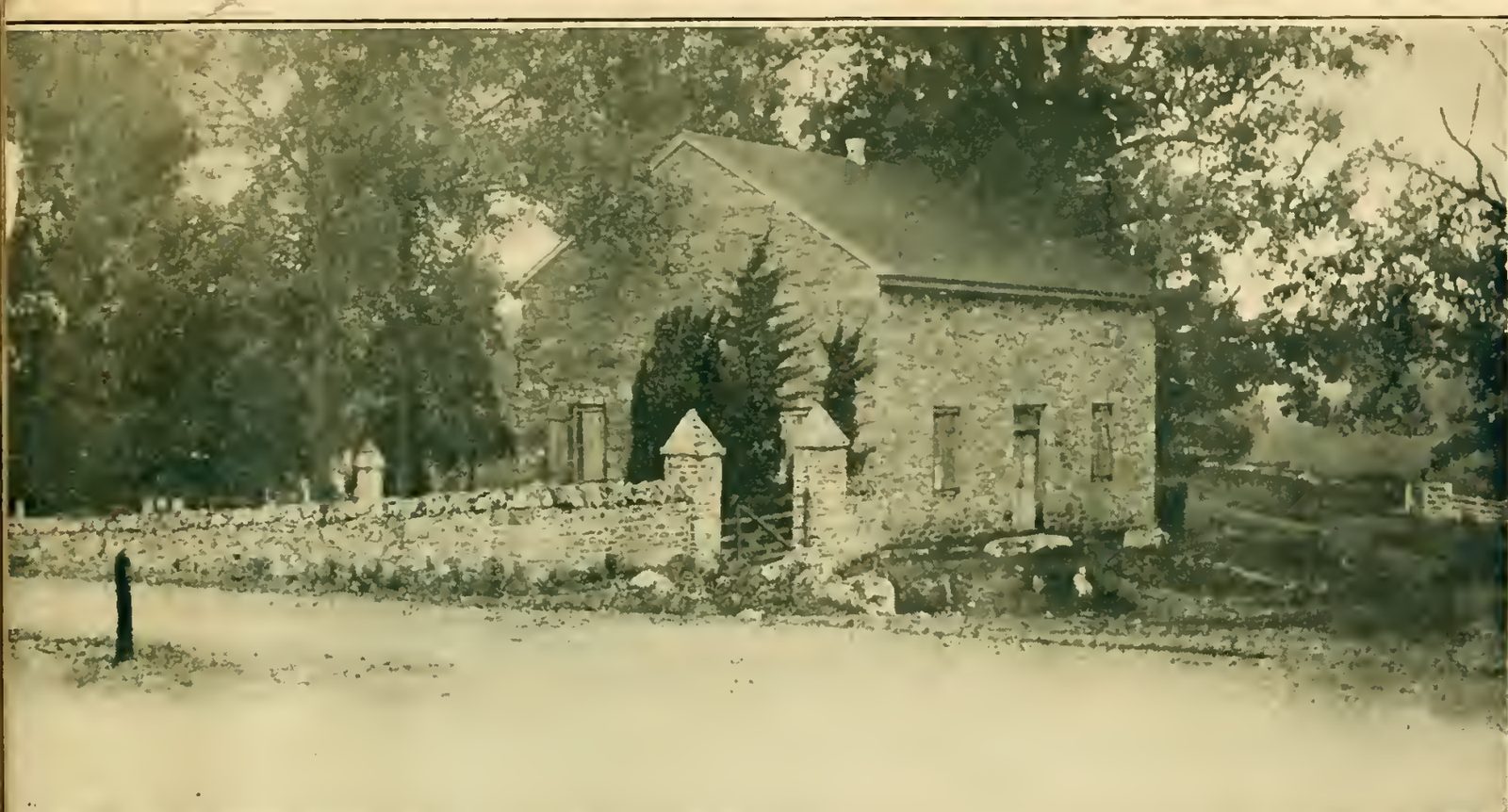
The Old Chapel, photographed in 1906 by T. W. Whitaker of Berryville.
What this image does and does not showThe book’s own frontispiece photograph, cropped to the chapel building. It shows the building as photographed in 1906, not at any earlier date discussed in this story.
T. W. Whitaker, Berryville, Va., 1906, in Charles Randolph Hughes, "Old Chapel," Clarke County, Virginia (1906), frontispiece. Rights Changes: Cropped from the book’s own frontispiece page (PDF p. 4) to the photograph alone, then scaled down to 1600 pixels wide for the web derivative; not retouched, recolored or reconstructed otherwise.
Source: "Old Chapel," Clarke County, Virginia Open the full image
A building’s date, left open
Nelson could not say exactly when the stone chapel Robin tended had gone up. He gathered what his neighbors and predecessors had written and left the question open: Bishop Meade’s history put the building in 1790; Dr. Robert C. Randolph, in an 1881 letter to the Southern Churchman, said 1798 or ’99; an engraved stone Randolph had moved into the cemetery gave 1800; and an unsigned 1869 letter to the Clarke Courier, which Nelson believed Randolph had also written, quoted a vestry resolution from 1790 ordering a "house of worship" built at the Chapel spring, on land Nathaniel Burwell had offered for that purpose. Nelson himself leaned toward 1790 — "the evidence seems to be fairly in favor of" it, he wrote — but called the question uncertain, not settled, and the record never resolves it further.
Source note: Charles Randolph Hughes, 1906
Nelson’s sketch gathers disagreeing claims for when the stone Old Chapel was built: Bishop Meade’s history put it at 1790; Dr. Robert C. Randolph’s 1881 letter to the Southern Churchman said 1798 or ’99; an engraved stone Randolph placed in the cemetery gave 1800; and an unsigned 1869 Clarke Courier letter, which Nelson believed Randolph also wrote, quoted an 1790 vestry resolution. Nelson leaned toward 1790 but called the question uncertain.
What the source supports
That the book itself presents at least three disagreeing dates for the chapel’s construction and does not resolve them.
Uncertainty
Nelson’s own 1890 retrospective weighing of sources he did not independently verify against a vestry book or other primary record; this story leaves the date unresolved rather than choosing among the four claims.
Source
Evidence role: supports. Supports the claim at the stated source level; see limits.
"Old Chapel," Clarke County, Virginia
Charles Randolph Hughes · 1906 (publication)
Locator: PDF p. 5 (https://ourclarke.com/books-and-sources/old-chapel-1906/old-chapel-1906-clarke-county-virginia.pdf#page=5), restated p. 28 (https://ourclarke.com/books-and-sources/old-chapel-1906/old-chapel-1906-clarke-county-virginia.pdf#page=28)
Relevant passageThe evidence seems to be fairly in favor of
Checked: Original inspected. A digital reproduction was inspected; no original has been handled.
Open sourceSource family: hughes-1906. Multiple passages from one source are not independent witnesses.
AI-assisted source check (Claude Sonnet 5) · 2026-10-01. How this project checks its sources
A record that admits its gaps
What is not in question is who the compiler, Charles Randolph Hughes, found buried in the chapel’s cemetery by 1906, after admitting on the record’s own first page that making the list complete had often proved impossible: "any omissions...the reader may attribute to these causes."
Source note: Charles Randolph Hughes, 1906
The cemetery record’s compiler, Charles Randolph Hughes, states on its first page that he tried to make the list as complete as possible but that information was often impossible to obtain, so "any omissions...the reader may attribute to these causes."
What the source supports
That the compiler himself describes the 1906 cemetery record as incomplete.
Uncertainty
The compiler’s own characterization of his own completeness; no independent count of unmarked or uncounted burials is made or implied.
Source
Evidence role: supports. Supports the claim at the stated source level; see limits.
"Old Chapel," Clarke County, Virginia
Charles Randolph Hughes · 1906 (publication)
Locator: PDF p. 28 (https://ourclarke.com/books-and-sources/old-chapel-1906/old-chapel-1906-clarke-county-virginia.pdf#page=28)
Relevant passageany omissions...the reader may attribute to these causes
Checked: Original inspected. A digital reproduction was inspected; no original has been handled.
Open sourceSource family: hughes-1906. Multiple passages from one source are not independent witnesses.
AI-assisted source check (Claude Sonnet 5) · 2026-10-01. How this project checks its sources
old Robin, the courteous old colored sexton, who had a little stand by the right hand side of the south door as you come in, where he kept a pail of cool water from the Chapel Spring and a nice clean gourd
People the record names briefly
Among the names that survive are people the record gives almost no other words to. Harriet Evans, "(colored), wife of Randall Evans of Winchester," died in 1848, aged thirty-eight; the book spells her husband’s name both "Randall" and "Randal" across her entry and his own. Randall, who conducted "a high-class restaurant" in Winchester, died in Baltimore in 1871. Jennie Carter, nurse for the children of Francis Otway Byrd at "Oakley," was the mother of Nat Carter, remembered as "the well-known, faithful and interesting attendant of the Old Chapel grounds for a great number of years"; the record does not date how long he held that role, only that his mother died about 1854. Patty Brook’s stone, placed by her son, recorded that she "was 13 at the siege of York and often talked of that event"; nothing else here says where she lived in the decades between. Evelyn Williams, called "Mammy Evelyn" on her own entry, was remembered as "the faithful servant and devoted nurse of all the children at ‘The Briars’"; Charles Jackson, butler to Dr. Robert C. Randolph at "New Market," is called "one of the old faithful servants"; Jacob Brooks drove Dr. Randolph’s carriage and later Mrs. George H. Burwell’s. Betsey Brooks, in a separate entry on the record’s next page, was "mammy to the children at ‘Saratoga’ for three generations"; Clara Harris was "mammy to the ‘New Market’ children." Each of those phrases is the compiler’s language, or a family’s, carried over from the stones and the memories he collected — not this account’s own description of what those years were like to live.
Source note: Charles Randolph Hughes, 1906
Harriet Evans, "(colored), wife of Randall Evans of Winchester," died November 20, 1848, aged 38.
What the source supports
That the 1906 cemetery record carries a dated entry for Harriet Evans naming her as the wife of Randall Evans of Winchester.
Uncertainty
The entry spells her husband’s name "Randall" here; his own entry (p.52) spells it "Randal" — a genuine inconsistency in the book, preserved rather than normalized.
Source
Evidence role: supports. Supports the claim at the stated source level; see limits.
"Old Chapel," Clarke County, Virginia
Charles Randolph Hughes · 1906 (publication)
Locator: PDF p. 40 (https://ourclarke.com/books-and-sources/old-chapel-1906/old-chapel-1906-clarke-county-virginia.pdf#page=40)
Relevant passageHARRIET EVANS (colored), wife of Randall Evans of Winchester. Aged 38 years. Died November 20, 1848.
Checked: Original inspected. A digital reproduction was inspected; no original has been handled.
Open sourceSource family: hughes-1906. Multiple passages from one source are not independent witnesses.
AI-assisted source check (Claude Sonnet 5) · 2026-10-01. How this project checks its sources
Source note: Charles Randolph Hughes, 1906
Randal Evans (Colored) lived in Winchester, where he conducted "a high-class restaurant," and died in Baltimore in 1871.
What the source supports
That the record gives Randal Evans’s occupation and place of death.
Uncertainty
This entry spells the surname "Randal"; Harriet’s entry (p.40) spells it "Randall." Both spellings are the book’s own, kept as an observed inconsistency.
Source
Evidence role: supports. Supports the claim at the stated source level; see limits.
"Old Chapel," Clarke County, Virginia
Charles Randolph Hughes · 1906 (publication)
Locator: PDF p. 52 (https://ourclarke.com/books-and-sources/old-chapel-1906/old-chapel-1906-clarke-county-virginia.pdf#page=52)
Relevant passageRANDAL EVANS (Colored). Lived in Winchester, where he conducted a high-class restaurant. Died in Baltimore, 1871.
Checked: Original inspected. A digital reproduction was inspected; no original has been handled.
Open sourceSource family: hughes-1906. Multiple passages from one source are not independent witnesses.
AI-assisted source check (Claude Sonnet 5) · 2026-10-01. How this project checks its sources
Source note: Charles Randolph Hughes, 1906
Jennie Carter (colored), nurse for the children of Francis Otway Byrd of "Oakley," was the mother of Nat Carter, "the well-known, faithful and interesting attendant of the Old Chapel grounds for a great number of years"; Jennie died about 1854.
What the source supports
That the record names Jennie Carter’s role and her son Nat Carter’s long attendance at the grounds, without dating when his service began or ended.
Uncertainty
The entry gives Jennie’s death as "about 1854" but does not say Nat began or continued tending the grounds after that date; no link is made here to the Carter Hall Carters.
Source
Evidence role: supports. Supports the claim at the stated source level; see limits.
"Old Chapel," Clarke County, Virginia
Charles Randolph Hughes · 1906 (publication)
Locator: PDF pp. 41–42 (https://ourclarke.com/books-and-sources/old-chapel-1906/old-chapel-1906-clarke-county-virginia.pdf#page=41, https://ourclarke.com/books-and-sources/old-chapel-1906/old-chapel-1906-clarke-county-virginia.pdf#page=42)
Relevant passagethe well-known, faithful and interesting attendant of the Old Chapel grounds for a great number of years
Checked: Original inspected. A digital reproduction was inspected; no original has been handled.
Open sourceSource family: hughes-1906. Multiple passages from one source are not independent witnesses.
AI-assisted source check (Claude Sonnet 5) · 2026-10-01. How this project checks its sources
Source note: Charles Randolph Hughes, 1906
Patty Brook’s stone, placed by her son Wm. Brook, states she "was 13 at the siege of York and often talked of that event."
What the source supports
That a stone copied into the record places Patty Brook, as a girl, at the siege of Yorktown.
Uncertainty
A stone inscription, copied as the record presents it; nothing in the entry says where she lived in the decades between.
Source
Evidence role: supports. Supports the claim at the stated source level; see limits.
"Old Chapel," Clarke County, Virginia
Charles Randolph Hughes · 1906 (publication)
Locator: PDF p. 44 (https://ourclarke.com/books-and-sources/old-chapel-1906/old-chapel-1906-clarke-county-virginia.pdf#page=44)
Relevant passageShe was 13 at the siege of York and often talked of that event
Checked: Original inspected. A digital reproduction was inspected; no original has been handled.
Open sourceSource family: hughes-1906. Multiple passages from one source are not independent witnesses.
AI-assisted source check (Claude Sonnet 5) · 2026-10-01. How this project checks its sources
Source note: Charles Randolph Hughes, 1906
Evelyn Williams (Colored), "Mammy Evelyn," is remembered in the record as "the faithful servant and devoted nurse of all the children at ‘The Briars’"; she died November 12, 1882, aged 83.
What the source supports
That the record gives Evelyn Williams this role and these dates, in the compiler’s or family’s own words.
Uncertainty
"Mammy" and "faithful servant" are quoted only as the record’s own 1906 language, not adopted as this story’s description of what her years were like to live.
Source
Evidence role: supports. Supports the claim at the stated source level; see limits.
"Old Chapel," Clarke County, Virginia
Charles Randolph Hughes · 1906 (publication)
Locator: PDF p. 58 (https://ourclarke.com/books-and-sources/old-chapel-1906/old-chapel-1906-clarke-county-virginia.pdf#page=58)
Relevant passagethe faithful servant and devoted nurse of all the children at ‘The Briars’
Checked: Original inspected. A digital reproduction was inspected; no original has been handled.
Open sourceSource family: hughes-1906. Multiple passages from one source are not independent witnesses.
AI-assisted source check (Claude Sonnet 5) · 2026-10-01. How this project checks its sources
Source note: Charles Randolph Hughes, 1906
Charles Jackson (Colored), butler for Dr. Robert C. Randolph at "New Market," is called "one of the old faithful servants" in the record; he died in April 1883.
What the source supports
That the record gives Jackson’s role, employer and date of death.
Uncertainty
"One of the old faithful servants" is quoted as the record’s own language.
Source
Evidence role: supports. Supports the claim at the stated source level; see limits.
"Old Chapel," Clarke County, Virginia
Charles Randolph Hughes · 1906 (publication)
Locator: PDF p. 58 (https://ourclarke.com/books-and-sources/old-chapel-1906/old-chapel-1906-clarke-county-virginia.pdf#page=58)
Relevant passageone of the old faithful servants
Checked: Original inspected. A digital reproduction was inspected; no original has been handled.
Open sourceSource family: hughes-1906. Multiple passages from one source are not independent witnesses.
AI-assisted source check (Claude Sonnet 5) · 2026-10-01. How this project checks its sources
Source note: Charles Randolph Hughes, 1906
Jacob Brooks (Colored) drove the carriage for Dr. Robert C. Randolph of "New Market" and later for Mrs. George H. Burwell at "Saratoga," where he died in November 1894.
What the source supports
That the record gives Jacob Brooks’s occupation, two employers and date and place of death.
Uncertainty
The record’s own entry; no stated relationship is given here between Jacob Brooks and Betsey Brooks beyond a shared surname.
Source
Evidence role: supports. Supports the claim at the stated source level; see limits.
"Old Chapel," Clarke County, Virginia
Charles Randolph Hughes · 1906 (publication)
Locator: PDF p. 67 (https://ourclarke.com/books-and-sources/old-chapel-1906/old-chapel-1906-clarke-county-virginia.pdf#page=67)
Relevant passageCoachman for Dr. Robert C. Randolph of ‘New Market,’ and afterward for Mrs. George H. Burwell at ‘Saratoga,’ where he died November, 1894.
Checked: Original inspected. A digital reproduction was inspected; no original has been handled.
Open sourceSource family: hughes-1906. Multiple passages from one source are not independent witnesses.
AI-assisted source check (Claude Sonnet 5) · 2026-10-01. How this project checks its sources
Source note: Charles Randolph Hughes, 1906
Betsey Brooks (Colored) was "mammy to the children at ‘Saratoga’ for three generations"; she died at "Saratoga" in 1896, aged 90.
What the source supports
That the record gives Betsey Brooks this role and these dates, in a separate entry from Jacob Brooks’s.
Uncertainty
Betsey Brooks’s entry (p.68) and Jacob Brooks’s entry (p.67) are separate entries; the record does not state that they were married or otherwise related, and a shared surname is not treated here as a stated relationship. "Mammy" is quoted as the record’s own language.
Source
Evidence role: supports. Supports the claim at the stated source level; see limits.
"Old Chapel," Clarke County, Virginia
Charles Randolph Hughes · 1906 (publication)
Locator: PDF p. 68 (https://ourclarke.com/books-and-sources/old-chapel-1906/old-chapel-1906-clarke-county-virginia.pdf#page=68)
Relevant passageMammy to the children at ‘Saratoga’ for three generations
Checked: Original inspected. A digital reproduction was inspected; no original has been handled.
Open sourceSource family: hughes-1906. Multiple passages from one source are not independent witnesses.
AI-assisted source check (Claude Sonnet 5) · 2026-10-01. How this project checks its sources
Source note: Charles Randolph Hughes, 1906
Clara Harris (Colored) was "mammy to the ‘New Market’ children"; she died in 1900, aged 86.
What the source supports
That the record gives Clara Harris this role and these dates.
Uncertainty
"Mammy" is quoted as the record’s own language.
Source
Evidence role: supports. Supports the claim at the stated source level; see limits.
"Old Chapel," Clarke County, Virginia
Charles Randolph Hughes · 1906 (publication)
Locator: PDF p. 71 (https://ourclarke.com/books-and-sources/old-chapel-1906/old-chapel-1906-clarke-county-virginia.pdf#page=71)
Relevant passageMammy to the ‘New Market’ children
Checked: Original inspected. A digital reproduction was inspected; no original has been handled.
Open sourceSource family: hughes-1906. Multiple passages from one source are not independent witnesses.
AI-assisted source check (Claude Sonnet 5) · 2026-10-01. How this project checks its sources
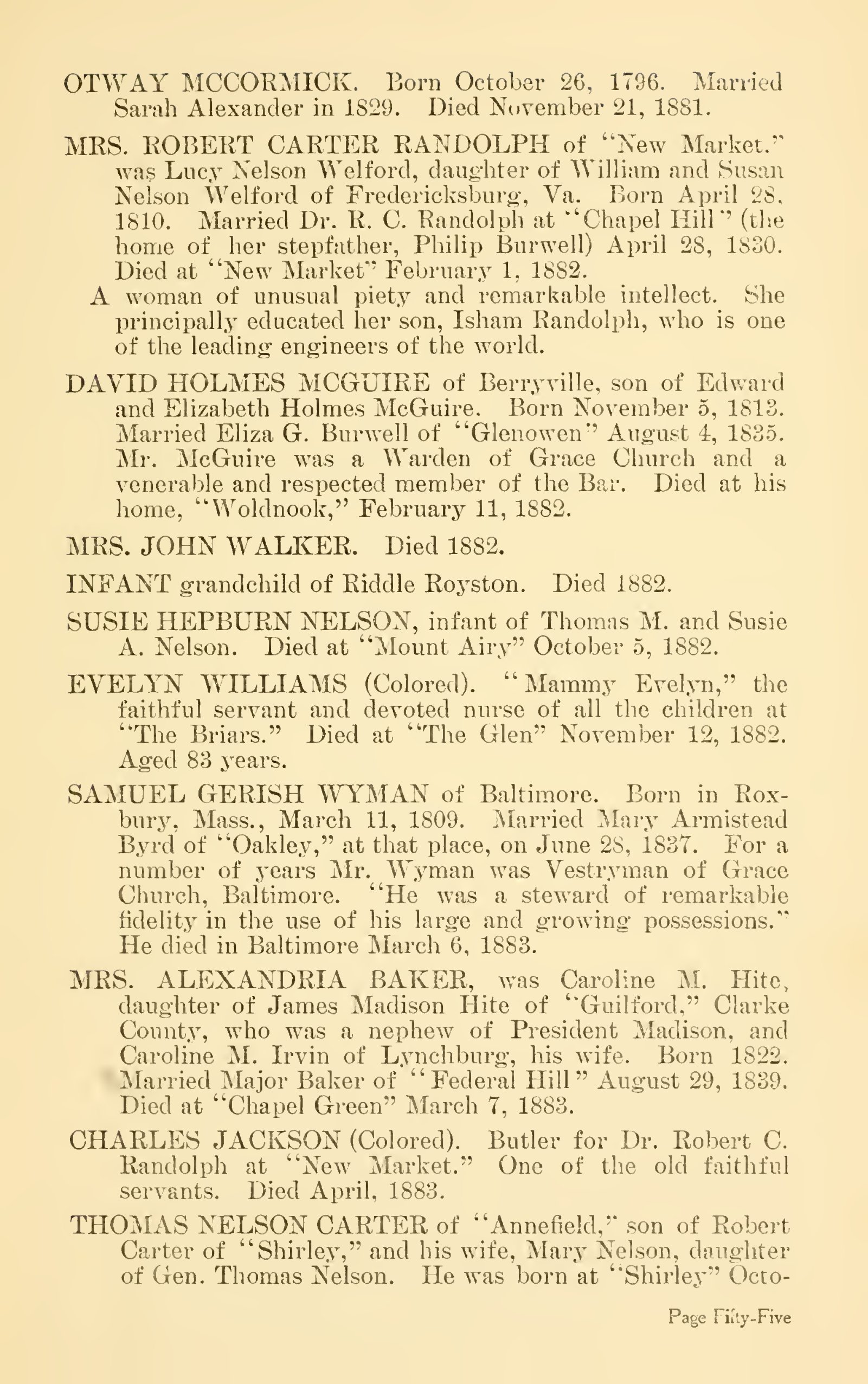
Two entries from the Old Chapel cemetery record, 1906.
What this image does and does not showThe complete printed page carrying the Evelyn Williams and Charles Jackson entries, shown whole.
Charles Randolph Hughes, "Old Chapel," Clarke County, Virginia (1906), p. 58. Rights Changes: The complete printed page: not scaled (already narrower than the web derivative’s width limit), not cropped, retouched, enhanced, OCR’d or reconstructed. Re-encoded as JPEG for the web derivative.
Source: "Old Chapel," Clarke County, Virginia Open the full image
An instructor, a substitute soldier, and the young
Oliver Bliss’s stone, copied into the record, calls him an instructor in the Millwood neighborhood, a native of Wilbraham, Massachusetts, graduated from Yale College in 1795, "separated from relatives" and consoled, it says, that his days closed "among those who knew the heart of the Stranger." John O’Connor’s entry states plainly that he served in the War of 1812, in the 4th Virginia Regiment, as a substitute for his brother Dennis — one man standing in another’s place, a transaction the record sets down without comment. And scattered across the cemetery’s fifty-odd pages are children and young people: infants of a few months, a girl of five who died when her skirts caught fire, a boy of seventeen "killed by a horse," entries that are sometimes only a name, an age and a year.
Source note: Charles Randolph Hughes, 1906
Oliver Bliss’s tombstone, copied into the record, calls him "Instructor in the Millwood neighborhood," a native of Wilbraham, Massachusetts, graduated Yale College in 1795, and died September 19, 1824.
What the source supports
That the record’s own word for Bliss’s occupation is "Instructor," not "schoolmaster."
Uncertainty
A stone inscription, copied as the record presents it.
Source
Evidence role: supports. Supports the claim at the stated source level; see limits.
"Old Chapel," Clarke County, Virginia
Charles Randolph Hughes · 1906 (publication)
Locator: PDF p. 33 (https://ourclarke.com/books-and-sources/old-chapel-1906/old-chapel-1906-clarke-county-virginia.pdf#page=33)
Relevant passageInstructor in the Millwood neighborhood
Checked: Original inspected. A digital reproduction was inspected; no original has been handled.
Open sourceSource family: hughes-1906. Multiple passages from one source are not independent witnesses.
AI-assisted source check (Claude Sonnet 5) · 2026-10-01. How this project checks its sources
Source note: Charles Randolph Hughes, 1906
John O’Connor served in the War of 1812, 4th Virginia Regiment, as a substitute for his brother Dennis O’Connor; he died at Millwood March 1, 1832.
What the source supports
That the record states O’Connor served as a substitute for his brother, without editorial comment on that arrangement.
Uncertainty
The record’s own entry; no independent military record has been checked for this story.
Source
Evidence role: supports. Supports the claim at the stated source level; see limits.
"Old Chapel," Clarke County, Virginia
Charles Randolph Hughes · 1906 (publication)
Locator: PDF p. 36 (https://ourclarke.com/books-and-sources/old-chapel-1906/old-chapel-1906-clarke-county-virginia.pdf#page=36)
Relevant passageServed in the war of 1812, 4th Virginia Regiment, as substitute for his brother Dennis O’Connor
Checked: Original inspected. A digital reproduction was inspected; no original has been handled.
Open sourceSource family: hughes-1906. Multiple passages from one source are not independent witnesses.
AI-assisted source check (Claude Sonnet 5) · 2026-10-01. How this project checks its sources
Source note: Charles Randolph Hughes, 1906
Children’s deaths recur throughout the cemetery record: among other pages, p.36 (John Randolph Page, 6; Phillippa B. Page, 5 months), p.49 (Lucia Kate Shearer, 4; Frank Holland) p.73 (S.B. Mason, infant; Lottie Hibbard, 3) and p.76 (Lillie R. Romine, 8) each carry a child’s death entry.
What the source supports
That child deaths are a recurring, not isolated, pattern across the cemetery record’s roughly fifty pages.
Uncertainty
An illustrative sample of pages, not an exhaustive count of every child entry in the record.
Source
Evidence role: supports. Supports the claim at the stated source level; see limits.
"Old Chapel," Clarke County, Virginia
Charles Randolph Hughes · 1906 (publication)
Locator: PDF pp. 36, 49, 73, 76 (https://ourclarke.com/books-and-sources/old-chapel-1906/old-chapel-1906-clarke-county-virginia.pdf#page=36, https://ourclarke.com/books-and-sources/old-chapel-1906/old-chapel-1906-clarke-county-virginia.pdf#page=49, https://ourclarke.com/books-and-sources/old-chapel-1906/old-chapel-1906-clarke-county-virginia.pdf#page=73, https://ourclarke.com/books-and-sources/old-chapel-1906/old-chapel-1906-clarke-county-virginia.pdf#page=76)
Checked: Original inspected. A digital reproduction was inspected; no original has been handled.
Open sourceSource family: hughes-1906. Multiple passages from one source are not independent witnesses.
AI-assisted source check (Claude Sonnet 5) · 2026-10-01. How this project checks its sources
Source note: Charles Randolph Hughes, 1906
Roberta W. Page, child of Dr. Matthew and Mary C. Page of "Longwood," died of burns September 25, 1835, aged 5, when her skirts caught fire while she was staying at "Prospect Hill."
What the source supports
That the record gives a specific cause of death for a child, rather than only a name, age and year.
Uncertainty
The record’s own entry.
Source
Evidence role: supports. Supports the claim at the stated source level; see limits.
"Old Chapel," Clarke County, Virginia
Charles Randolph Hughes · 1906 (publication)
Locator: PDF p. 38 (https://ourclarke.com/books-and-sources/old-chapel-1906/old-chapel-1906-clarke-county-virginia.pdf#page=38)
Relevant passageher skirts caught fire and she died of the burns
Checked: Original inspected. A digital reproduction was inspected; no original has been handled.
Open sourceSource family: hughes-1906. Multiple passages from one source are not independent witnesses.
AI-assisted source check (Claude Sonnet 5) · 2026-10-01. How this project checks its sources
Source note: Charles Randolph Hughes, 1906
Gwynn Page, son of Dr. Matthew and Mary C. Page of "Longwood," was killed by a horse May 28, 1850, aged 17.
What the source supports
That the record gives a specific cause of death for a young person, rather than only a name, age and year.
Uncertainty
The record’s own entry.
Source
Evidence role: supports. Supports the claim at the stated source level; see limits.
"Old Chapel," Clarke County, Virginia
Charles Randolph Hughes · 1906 (publication)
Locator: PDF p. 41 (https://ourclarke.com/books-and-sources/old-chapel-1906/old-chapel-1906-clarke-county-virginia.pdf#page=41)
Relevant passageKilled by a horse May 28, 1850
Checked: Original inspected. A digital reproduction was inspected; no original has been handled.
Open sourceSource family: hughes-1906. Multiple passages from one source are not independent witnesses.
AI-assisted source check (Claude Sonnet 5) · 2026-10-01. How this project checks its sources
Liberia, and an outcome the record does not give
One entry describes Mrs. Matthew Page of "Annefield," Anne Randolph Meade, whose husband Matthew Page died in 1826; the record says she then began final preparations for "liberating her slaves and sending them to Liberia," which she did, it says, in 1832, "providing them with every necessary supply for a year." That is the compiler’s entry; what became of the people she sent is not part of this record, and nothing here says.
Source note: Charles Randolph Hughes, 1906
The record’s entry for Mrs. Matthew Page of "Annefield," Anne Randolph Meade, states that after her husband Matthew Page died in 1826 she began final preparations for "liberating her slaves and sending them to Liberia," which she did in 1832, "providing them with every necessary supply for a year."
What the source supports
That the record attributes this account to Mrs. Matthew Page of "Annefield," not to Mrs. Mann Page of "Mannsfield," and that the 1826 death is her husband Matthew Page’s.
Uncertainty
This is the compiler’s entry ("the record says"), not an independently verified outcome; what became of the people she sent to Liberia is not part of this record, and nothing here states it. Colonization is not equated with freedom.
Source
Evidence role: supports. Supports the claim at the stated source level; see limits.
"Old Chapel," Clarke County, Virginia
Charles Randolph Hughes · 1906 (publication)
Locator: PDF pp. 37–38 (https://ourclarke.com/books-and-sources/old-chapel-1906/old-chapel-1906-clarke-county-virginia.pdf#page=37, https://ourclarke.com/books-and-sources/old-chapel-1906/old-chapel-1906-clarke-county-virginia.pdf#page=38)
Relevant passageliberating her slaves and sending them to Liberia, which she did in 1832, providing them with every necessary supply for a year
Checked: Original inspected. A digital reproduction was inspected; no original has been handled.
Open sourceSource family: hughes-1906. Multiple passages from one source are not independent witnesses.
AI-assisted source check (Claude Sonnet 5) · 2026-10-01. How this project checks its sources
About the recordWhat the evidence says
One 1906 compiled record, read for what it names and what it leaves out.
Every claim on this page comes from one 1906 source, "Old Chapel," Clarke County, Virginia (S427), a 76-page compilation of a 1890 historical address and a cemetery record kept by its compiler, Charles Randolph Hughes. Each page cited was read directly as a rendered page image, not from OCR or text-layer alone. The record names estate families at length and a smaller number of people it describes only briefly, often through phrases — "mammy," "faithful servant," "(colored)" — that are the compiler’s or a family’s own language, quoted here rather than adopted as this story’s description. Where the record leaves a question open, such as the chapel’s construction date or the outcome of an 1832 emigration to Liberia, this page leaves it open too.
- An account exists✓ Supported by a source
Capt. William N. Nelson’s 1890 address recalls "old Robin, the courteous old colored sexton," who kept a stand by the south door of Old Chapel with a pail of cool water from the Chapel Spring and a clean gourd, for people who had come fifteen or twenty miles to church.
See the evidence
✓ Supported by a sourceAn account existsCapt. William N. Nelson’s 1890 address recalls "old Robin, the courteous old colored sexton," who kept a stand by the south door of Old Chapel with a pail of cool water from the Chapel Spring and a clean gourd, for people who had come fifteen or twenty miles to church.
What the source supports
That Nelson’s 1890 address names Robin, the chapel’s sexton, and describes the water stand he kept for visitors.
Uncertainty
Nelson’s 1890 address, recalling "some now living" who remembered Robin; no date range for Robin’s service is given, and Robin appears only in this sketch, not in the cemetery record, so there is no burial entry for him here.
Source
Later historical account Evidence role: supports. Supports the claim at the stated source level; see limits.
"Old Chapel," Clarke County, Virginia
Charles Randolph Hughes · 1906 (publication)
Locator: PDF pp. 13–14 (https://ourclarke.com/books-and-sources/old-chapel-1906/old-chapel-1906-clarke-county-virginia.pdf#page=13, https://ourclarke.com/books-and-sources/old-chapel-1906/old-chapel-1906-clarke-county-virginia.pdf#page=14), Nelson’s 1890 historical sketch
Relevant passageold Robin, the courteous old colored sexton, who had a little stand by the right hand side of the south door as you come in, where he kept a pail of cool water from the Chapel Spring and a nice clean gourd
Checked: Original inspected. A digital reproduction was inspected; no original has been handled.
Open sourceSource family: hughes-1906. Multiple passages from one source are not independent witnesses.
AI-assisted source check (Claude Sonnet 5) · 2026-10-01. How this project checks its sources
- An account exists✓ Supported by a source
The cemetery record’s compiler, Charles Randolph Hughes, states on its first page that he tried to make the list as complete as possible but that information was often impossible to obtain, so "any omissions...the reader may attribute to these causes."
See the evidence
✓ Supported by a sourceAn account existsThe cemetery record’s compiler, Charles Randolph Hughes, states on its first page that he tried to make the list as complete as possible but that information was often impossible to obtain, so "any omissions...the reader may attribute to these causes."
What the source supports
That the compiler himself describes the 1906 cemetery record as incomplete.
Uncertainty
The compiler’s own characterization of his own completeness; no independent count of unmarked or uncounted burials is made or implied.
Source
Later historical account Evidence role: supports. Supports the claim at the stated source level; see limits.
"Old Chapel," Clarke County, Virginia
Charles Randolph Hughes · 1906 (publication)
Locator: PDF p. 28 (https://ourclarke.com/books-and-sources/old-chapel-1906/old-chapel-1906-clarke-county-virginia.pdf#page=28)
Relevant passageany omissions...the reader may attribute to these causes
Checked: Original inspected. A digital reproduction was inspected; no original has been handled.
Open sourceSource family: hughes-1906. Multiple passages from one source are not independent witnesses.
AI-assisted source check (Claude Sonnet 5) · 2026-10-01. How this project checks its sources
- An account exists✓ Supported by a source
Evelyn Williams (Colored), "Mammy Evelyn," is remembered in the record as "the faithful servant and devoted nurse of all the children at ‘The Briars’"; she died November 12, 1882, aged 83.
See the evidence
✓ Supported by a sourceAn account existsEvelyn Williams (Colored), "Mammy Evelyn," is remembered in the record as "the faithful servant and devoted nurse of all the children at ‘The Briars’"; she died November 12, 1882, aged 83.
What the source supports
That the record gives Evelyn Williams this role and these dates, in the compiler’s or family’s own words.
Uncertainty
"Mammy" and "faithful servant" are quoted only as the record’s own 1906 language, not adopted as this story’s description of what her years were like to live.
Source
Later historical account Evidence role: supports. Supports the claim at the stated source level; see limits.
"Old Chapel," Clarke County, Virginia
Charles Randolph Hughes · 1906 (publication)
Locator: PDF p. 58 (https://ourclarke.com/books-and-sources/old-chapel-1906/old-chapel-1906-clarke-county-virginia.pdf#page=58)
Relevant passagethe faithful servant and devoted nurse of all the children at ‘The Briars’
Checked: Original inspected. A digital reproduction was inspected; no original has been handled.
Open sourceSource family: hughes-1906. Multiple passages from one source are not independent witnesses.
AI-assisted source check (Claude Sonnet 5) · 2026-10-01. How this project checks its sources
- An account exists✓ Supported by a source
The record’s entry for Mrs. Matthew Page of "Annefield," Anne Randolph Meade, states that after her husband Matthew Page died in 1826 she began final preparations for "liberating her slaves and sending them to Liberia," which she did in 1832, "providing them with every necessary supply for a year."
See the evidence
✓ Supported by a sourceAn account existsThe record’s entry for Mrs. Matthew Page of "Annefield," Anne Randolph Meade, states that after her husband Matthew Page died in 1826 she began final preparations for "liberating her slaves and sending them to Liberia," which she did in 1832, "providing them with every necessary supply for a year."
What the source supports
That the record attributes this account to Mrs. Matthew Page of "Annefield," not to Mrs. Mann Page of "Mannsfield," and that the 1826 death is her husband Matthew Page’s.
Uncertainty
This is the compiler’s entry ("the record says"), not an independently verified outcome; what became of the people she sent to Liberia is not part of this record, and nothing here states it. Colonization is not equated with freedom.
Source
Later historical account Evidence role: supports. Supports the claim at the stated source level; see limits.
"Old Chapel," Clarke County, Virginia
Charles Randolph Hughes · 1906 (publication)
Locator: PDF pp. 37–38 (https://ourclarke.com/books-and-sources/old-chapel-1906/old-chapel-1906-clarke-county-virginia.pdf#page=37, https://ourclarke.com/books-and-sources/old-chapel-1906/old-chapel-1906-clarke-county-virginia.pdf#page=38)
Relevant passageliberating her slaves and sending them to Liberia, which she did in 1832, providing them with every necessary supply for a year
Checked: Original inspected. A digital reproduction was inspected; no original has been handled.
Open sourceSource family: hughes-1906. Multiple passages from one source are not independent witnesses.
AI-assisted source check (Claude Sonnet 5) · 2026-10-01. How this project checks its sources
Each statement above is assessed on its own evidence. Nothing here is averaged, scored or voted on, and a well-attributed account can be documented while what it describes stays unconfirmed.
What this book can and cannot do
That, finally, is what this book can and cannot do. It names the estate families in loving and exhaustive detail — their marriages, their service to the Confederacy. It names Robin and Nat Carter and Jennie Carter and the rest more briefly, often by nothing more than the household they served and a label, "(colored)," that the compiler used but never explained. He warned his own readers, on the record’s first page, that the list was still incomplete. That warning holds for the people this account has drawn out of it: it can tell us the words the compiler, Charles Randolph Hughes, and the families and stones he drew on chose to count them in 1906. It cannot tell us the fuller lives behind those words.
The compiler admitted the list could not be made complete. What else does the chapel’s cemetery, or other Clarke County records of the same families and households, still hold that this 1906 compilation did not capture?
Know more about this story, or see something to correct? Help fill a gap. It stays private until it is reviewed.
Remember this place or someone in this story? Share a memory, even if you do not know the date. It stays private until it is reviewed.
Go deeper: every source under this story Follow another threadMosby's last negotiations at Millwood
Another record naming people and places near Millwood, decades apart in time and sourced from a published memoir rather than a cemetery compilation.