
Before the war
Everard Kidder Meade, writing in 1948, said the Berryville company began in October 1859 as the Clarke Guards. After John Brown's raid on Harpers Ferry, he wrote, it helped guard the Charles Town prison until Brown and his men were executed, and it was later reorganized as the Clarke Rifles, which served the four years of the war in the Stonewall Brigade as Co. I, 2nd Virginia Infantry.
One Berryville man's death notice, which the Courier reprinted in 1905, put him at the raid itself. John A. Blake, born in Berryville, "was one of the party that captured John Brown," it said; he saw Brown hanged at Charles Town and was one of the few who guarded the coffin. He served in the Confederate army, but the notice does not say in which company, and this story does not place him in the Clarke Guards.
Source note: Everard Kidder Meade, 1958
The Clarke County Historical Association's Proceedings (1958), reprinting a 1948 column by Everard Kidder Meade, say the Berryville company was organized in October 1859 as the Clarke Guards, helped guard the Charles Town prison until John Brown and his men were executed, and was reorganized as the Clarke Rifles, which served the four years of the war in the Stonewall Brigade as Co. I, 2nd Virginia Infantry.
What the source supports
A local historian's account of how the Clarke Rifles began.
Uncertainty
Written in 1948 and printed in 1958; it cites no record of the Clarke Guards. Its claim that the company "prevented the escape of two of Brown's men" is not checked here.
Source
Evidence role: supports. The Clarke Guards of 1859.
Everard Kidder Meade, "Notes on the History of the Lower Shenandoah Valley," Proceedings of the Clarke County Historical Association, vol. XIV (1956-1957), pp. 70 and 72
Everard Kidder Meade; Clarke County Historical Association · 1958 (publication)
Locator: Page 70, "Berryville Company"
Relevant passageUntil the execution of John Brown and his captured associates, this company, organized in October 1859 as Clarke Guards, took part in guarding Charles Town prison and prevented the escape of two of Brown's men.
Checked: Original inspected. A digital reproduction was inspected; no original has been handled.
Open sourceSource family: ccha-proceedings. Multiple passages from one source are not independent witnesses.
Evidence role: supports. Reorganized as the Clarke Rifles, Co. I.
Everard Kidder Meade, "Notes on the History of the Lower Shenandoah Valley," Proceedings of the Clarke County Historical Association, vol. XIV (1956-1957), pp. 70 and 72
Everard Kidder Meade; Clarke County Historical Association · 1958 (publication)
Locator: Page 70, "Berryville Company"
Relevant passageReorganized later as Clarke Rifles, It went through four years of war in the Stonewall Brigade as Co. I, 2nd Va. Inf., C.S.A.
Checked: Original inspected. A digital reproduction was inspected; no original has been handled.
Open sourceSource family: ccha-proceedings. Multiple passages from one source are not independent witnesses.
AI-assisted source check (Claude Opus 5.5) · 2026-10-12. How this project checks its sources
Source note: Clarke Courier, Berryville, Va., 1905
A death notice the Clarke Courier reprinted in July 1905 from the Clarksburg News says John A. Blake, born in Berryville 63 years before, served in the Confederate army, and that before the war "he was one of the party that captured John Brown," saw Brown hanged at Charles Town and was one of the few who guarded his coffin; he was buried at Green Hill.
What the source supports
That Blake's 1905 notice tied him to the capture of John Brown.
Uncertainty
The notice does not name the company Blake served in, during the raid or the war; this site does not place him in the Clarke Guards or the Clarke Rifles.
Source
Evidence role: supports. Birth and war service.
Clarke Courier, Berryville, Va., July 19, 1905, page 1: notice of the death of John A. Blake (reprinted from the Clarksburg News)
Clarke Courier, Berryville, Va. · 1905-07-19 (publication)
Locator: Page 1, the notice of John A. Blake
Relevant passageJohn A. Blake was born in Berryville, Va., 63 years ago and was educated in the schools of that city, afterwards teaching school there. During the civil war he served in the Confederate army.
Checked: Original inspected. A digital reproduction was inspected; no original has been handled.
Open sourceSource family: clarke-courier. Multiple passages from one source are not independent witnesses.
Evidence role: supports. The capture of John Brown.
Clarke Courier, Berryville, Va., July 19, 1905, page 1: notice of the death of John A. Blake (reprinted from the Clarksburg News)
Clarke Courier, Berryville, Va. · 1905-07-19 (publication)
Locator: Page 1, the notice of John A. Blake
Relevant passageBefore the war broke out, however, he was one of the party that captured John Brown.
Checked: Original inspected. A digital reproduction was inspected; no original has been handled.
Open sourceSource family: clarke-courier. Multiple passages from one source are not independent witnesses.
Evidence role: supports. The hanging and the coffin.
Clarke Courier, Berryville, Va., July 19, 1905, page 1: notice of the death of John A. Blake (reprinted from the Clarksburg News)
Clarke Courier, Berryville, Va. · 1905-07-19 (publication)
Locator: Page 1, the notice of John A. Blake
Relevant passageHe saw Brown hanged at Charles Town and of the few who guarded the coffin containing the body of the Yankee leader.
Checked: Original inspected. A digital reproduction was inspected; no original has been handled.
Open sourceSource family: clarke-courier. Multiple passages from one source are not independent witnesses.
Evidence role: supports. Burial at Green Hill.
Clarke Courier, Berryville, Va., July 19, 1905, page 1: notice of the death of John A. Blake (reprinted from the Clarksburg News)
Clarke Courier, Berryville, Va. · 1905-07-19 (publication)
Locator: Page 1, the notice of John A. Blake
Relevant passageInterment was made in Green Hill Cemetery.
Checked: Original inspected. A digital reproduction was inspected; no original has been handled.
Open sourceSource family: clarke-courier. Multiple passages from one source are not independent witnesses.
AI-assisted source check (Claude Opus 5.5) · 2026-10-12. How this project checks its sources
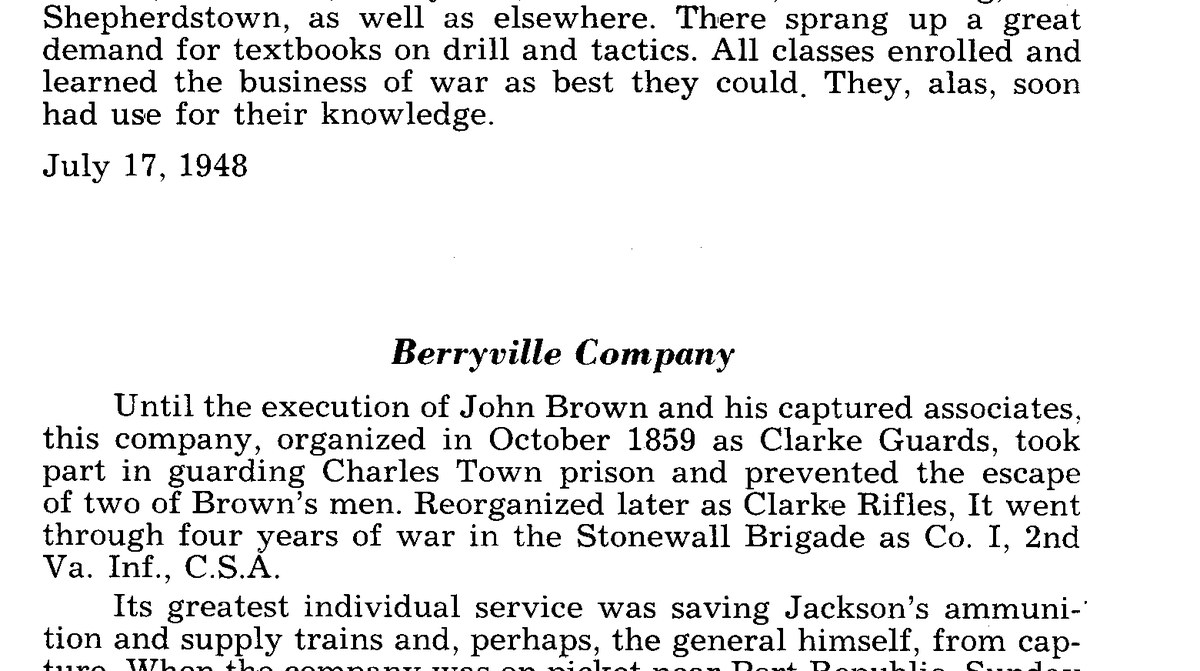
"Berryville Company": Everard Kidder Meade's 1948 column on the Clarke Guards of 1859 and the Clarke Rifles at Port Republic, as the Clarke County Historical Association reprinted it in 1958.
What this image does and does not showA crop of part of one page; the rest of the page is not shown.
Proceedings of the Clarke County Historical Association, vol. XIV (1956-1957), p. 70. Wayback Machine copy of the Association's scan. Rights Changes: Rendered from PDF page 81 of the scan at 1725 pixels wide, cropped to the article (1560 by 872 pixels) and scaled to 1200 by 671; re-encoded as JPEG. Nothing retouched or added.
Source: Everard Kidder Meade, "Notes on the History of the Lower Shenandoah Valley," Proceedings of the Clarke County Historical Association, vol. XIV (1956-1957), pp. 70 and 72 Open the full image
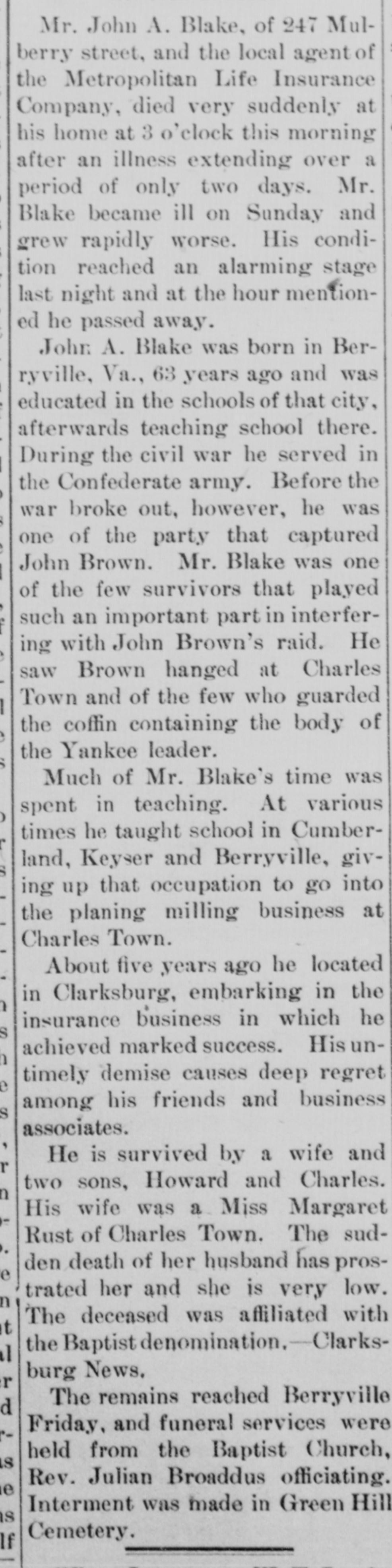
The Courier's reprint of John A. Blake's death notice, which says he was "one of the party that captured John Brown."
What this image does and does not showA crop of part of one page; the rest of the page is not shown.
Clarke Courier (Berryville, Va.), July 19, 1905, page 1. Library of Congress, Chronicling America. Rights Changes: Cropped from the Library of Congress page image to the region of this item: 986 by 3946 pixels, shown at its own 986 by 3946 pixels; re-encoded as JPEG. Nothing retouched or added.
Source: Clarke Courier, Berryville, Va., July 19, 1905, page 1: notice of the death of John A. Blake (reprinted from the Clarksburg News) Open the full image
Three captains
Meade listed the company's commanders as Capt. Bowen, who resigned; Capt. S. J. C. Moore, "twice wounded and twice promoted"; and Capt. J. H. O'Bannon. In his account the company's greatest service came on picket near Port Republic on the morning of June 8, 1862. Henry Kerfoot of the Clarke Cavalry rode up to warn Moore that Union cavalry was coming. Moore sent Kerfoot on to warn Jackson and placed the company so that it held the enemy until help came.
Source note: Everard Kidder Meade, 1958, and one more
Meade's column lists the Clarke Rifles' commanders as Capt. S. C. Bowen, who resigned, Capt. S. J. C. Moore, "twice wounded and twice promoted," and Capt. J. H. O'Bannon; a comrade's letter of 1905 gives the founder as Capt. S. H. Bowen.
What the source supports
The company's three captains in order.
Uncertainty
The column prints the first captain's initials as "S. C."; the 1905 letter prints "S. H." This site's roll has Strother H. Bowen as the company's first captain.
Source
Evidence role: supports. The column's list of commanders.
Everard Kidder Meade, "Notes on the History of the Lower Shenandoah Valley," Proceedings of the Clarke County Historical Association, vol. XIV (1956-1957), pp. 70 and 72
Everard Kidder Meade; Clarke County Historical Association · 1958 (publication)
Locator: Page 72, "Clarke Companies C.S.A."
Relevant passage3. The Clarke Rifles (The Berryville Co.). Became Co. I, 2nd Va. Inf., Stonewall Brigade. Its commanders were Capt. S. C. Bowen, who resigned; Capt. S. J. C. Moore, twice wounded and twice promoted; and Capt. J. H. O'Bannon.
Checked: Original inspected. A digital reproduction was inspected; no original has been handled.
Open sourceSource family: ccha-proceedings. Multiple passages from one source are not independent witnesses.
Evidence role: supports. The letter's founder, "Capt. S. H. Bowen."
Clarke Courier, Berryville, Va., August 23, 1905, page 1: a letter on the deaths of Jas. H. O'Bannon and Decatur J. Shepherd, signed "G." and dated August 21, 1905
Clarke Courier, Berryville, Va. · 1905-08-23 (publication)
Locator: Page 1, the letter signed "G.", on Jas. H. O'Bannon
Relevant passageJas. H. O'Bannon came to Berryville in 1859 or 1860 and was employed on the Clarke Journal. He joined the Clarke Rifles, which was organized by Capt. S. H. Bowen, and went with his company on the 17th. of April, 1861, to Harpers Ferry;
Checked: Original inspected. A digital reproduction was inspected; no original has been handled.
Open sourceSource family: clarke-courier. Multiple passages from one source are not independent witnesses.
AI-assisted source check (Claude Opus 5.5) · 2026-10-12. How this project checks its sources
Source note: Everard Kidder Meade, 1958
Meade's column says that on picket near Port Republic on Sunday morning, June 8, 1862, the company's Capt. S. J. C. Moore, warned by Henry Kerfoot of the Clarke Cavalry that Union cavalry was coming, sent Kerfoot on to warn Jackson and placed Co. I so that it held the enemy until help came.
What the source supports
The column's account of the company at Port Republic.
Uncertainty
A 1948 account; the column calls this the company's greatest service and says it may have saved Jackson himself, which is its judgment.
Source
Evidence role: supports. Kerfoot's warning.
Everard Kidder Meade, "Notes on the History of the Lower Shenandoah Valley," Proceedings of the Clarke County Historical Association, vol. XIV (1956-1957), pp. 70 and 72
Everard Kidder Meade; Clarke County Historical Association · 1958 (publication)
Locator: Page 70, "Berryville Company"
Relevant passageWhen the company was on picket near Port Republic, Sunday morning, June 8, 1862, Henry Kerfoot of the Clarke Cavalry dashed up to Capt. S. J. C. Moore with the news that Union cavalry with fieldpieces was approaching at full gallop.
Checked: Original inspected. A digital reproduction was inspected; no original has been handled.
Open sourceSource family: ccha-proceedings. Multiple passages from one source are not independent witnesses.
Evidence role: supports. Moore's orders.
Everard Kidder Meade, "Notes on the History of the Lower Shenandoah Valley," Proceedings of the Clarke County Historical Association, vol. XIV (1956-1957), pp. 70 and 72
Everard Kidder Meade; Clarke County Historical Association · 1958 (publication)
Locator: Page 70, "Berryville Company"
Relevant passageMoore, later promoted to lieutenant colonel, instantly ordered Kerfoot to warn Jackson, then disposed Co. I so advantageously that it was able to check the enemy until help came.
Checked: Original inspected. A digital reproduction was inspected; no original has been handled.
Open sourceSource family: ccha-proceedings. Multiple passages from one source are not independent witnesses.
AI-assisted source check (Claude Opus 5.5) · 2026-10-12. How this project checks its sources
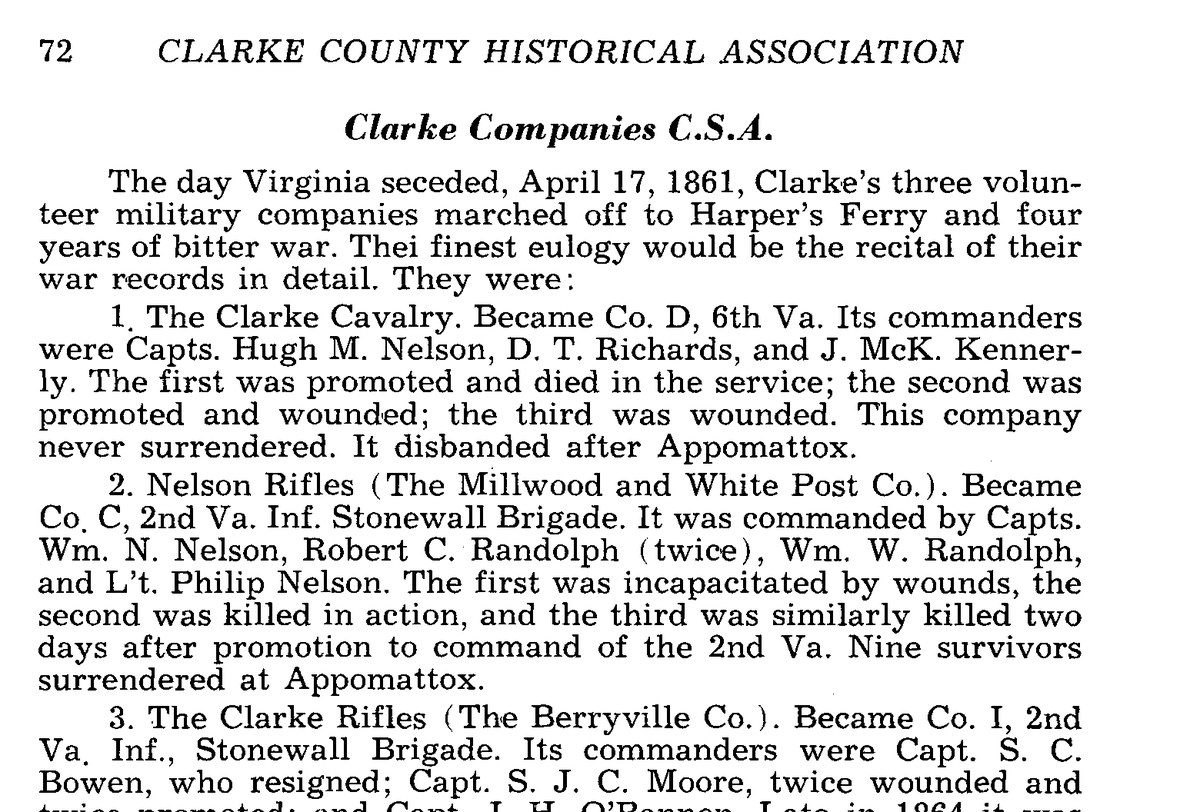
"Clarke Companies C.S.A.": the column's list of the county's three companies of 1861, ending with the Clarke Rifles and its "four survivors" at Appomattox.
What this image does and does not showA crop of part of one page; the rest of the page is not shown.
Proceedings of the Clarke County Historical Association, vol. XIV (1956-1957), p. 72. Wayback Machine copy of the Association's scan. Rights Changes: Rendered from PDF page 83 of the scan at 1725 pixels wide, cropped to the article (1560 by 1056 pixels) and scaled to 1200 by 812; re-encoded as JPEG. Nothing retouched or added.
Source: Everard Kidder Meade, "Notes on the History of the Lower Shenandoah Valley," Proceedings of the Clarke County Historical Association, vol. XIV (1956-1957), pp. 70 and 72 Open the full image
Jim and Kate
In August 1905 two of the company died "within the last few days," and a comrade who signed himself "G." wrote to the Courier. Jas. H. O'Bannon, he said, had come to Berryville in 1859 or 1860 to work on the Clarke Journal. He joined the Clarke Rifles, went with the company to Harpers Ferry on April 17, 1861, and was at Manassas and every engagement after, "never having been wounded or taken prisoner." He rose to lieutenant and then, when Moore was promoted, to captain. After the war he published the Clarke Journal with D. Holmes McGuire.
Decatur J. Shepherd had the opposite luck. He was living in Indiana when the war began and made his way "with much difficulty" through Kentucky and Tennessee to enlist in the company. He was wounded at Kernstown and permanently disabled at Cedar Run. The letter ends: "To us, 'Kate' Shepherd and 'Jim' O'Bannon can never die while memory lasts."
Source note: Clarke Courier, Berryville, Va., 1905
A comrade's letter in the Clarke Courier of August 23, 1905, signed "G.", written when two of the company had died "within the last few days," says Jas. H. O'Bannon came to Berryville in 1859 or 1860 to work on the Clarke Journal, joined the Clarke Rifles, went with the company to Harpers Ferry on April 17, 1861, and was at Manassas and every engagement after, "never having been wounded or taken prisoner."
What the source supports
O'Bannon's service as his comrade remembered it.
Uncertainty
A letter written from memory in 1905.
Source
Evidence role: supports. Two of the company dead within days.
Clarke Courier, Berryville, Va., August 23, 1905, page 1: a letter on the deaths of Jas. H. O'Bannon and Decatur J. Shepherd, signed "G." and dated August 21, 1905
Clarke Courier, Berryville, Va. · 1905-08-23 (publication)
Locator: Page 1, the opening of the letter signed "G."
Relevant passageWithin the last few days two of that gallant company, "The Clarke Rifles," Company "I" 2nd. Va. Infantry, "Stonewall Brigade," have been ordered to report for duty in a higher and better sphere.
Checked: Original inspected. A digital reproduction was inspected; no original has been handled.
Open sourceSource family: clarke-courier. Multiple passages from one source are not independent witnesses.
Evidence role: supports. Arrival in Berryville and enlistment.
Clarke Courier, Berryville, Va., August 23, 1905, page 1: a letter on the deaths of Jas. H. O'Bannon and Decatur J. Shepherd, signed "G." and dated August 21, 1905
Clarke Courier, Berryville, Va. · 1905-08-23 (publication)
Locator: Page 1, the letter signed "G.", on Jas. H. O'Bannon
Relevant passageJas. H. O'Bannon came to Berryville in 1859 or 1860 and was employed on the Clarke Journal. He joined the Clarke Rifles, which was organized by Capt. S. H. Bowen, and went with his company on the 17th. of April, 1861, to Harpers Ferry;
Checked: Original inspected. A digital reproduction was inspected; no original has been handled.
Open sourceSource family: clarke-courier. Multiple passages from one source are not independent witnesses.
Evidence role: supports. Never wounded or taken.
Clarke Courier, Berryville, Va., August 23, 1905, page 1: a letter on the deaths of Jas. H. O'Bannon and Decatur J. Shepherd, signed "G." and dated August 21, 1905
Clarke Courier, Berryville, Va. · 1905-08-23 (publication)
Locator: Page 1, the letter signed "G.", on Jas. H. O'Bannon
Relevant passagewas present with the command at Manassas July 21, 1861, and in every engagement thereafter, never having been wounded or taken prisoner.
Checked: Original inspected. A digital reproduction was inspected; no original has been handled.
Open sourceSource family: clarke-courier. Multiple passages from one source are not independent witnesses.
AI-assisted source check (Claude Opus 5.5) · 2026-10-12. How this project checks its sources
Source note: Clarke Courier, Berryville, Va., 1905
The same letter says O'Bannon was made lieutenant and, when Capt. S. J. C. Moore was promoted, captain of the company, and that after the war he published the Clarke Journal with D. Holmes McGuire.
What the source supports
O'Bannon's rank and his later work as the comrade gave them.
Uncertainty
The letter gives no dates for his promotions.
Source
Evidence role: supports. His promotions.
Clarke Courier, Berryville, Va., August 23, 1905, page 1: a letter on the deaths of Jas. H. O'Bannon and Decatur J. Shepherd, signed "G." and dated August 21, 1905
Clarke Courier, Berryville, Va. · 1905-08-23 (publication)
Locator: Page 1, the letter signed "G.", on Jas. H. O'Bannon
Relevant passageHe was soon promoted to a lieutenancy and upon the promotion of Capt. S. J. C. Moore was made Captain of the company.
Checked: Original inspected. A digital reproduction was inspected; no original has been handled.
Open sourceSource family: clarke-courier. Multiple passages from one source are not independent witnesses.
Evidence role: supports. The Clarke Journal after the war.
Clarke Courier, Berryville, Va., August 23, 1905, page 1: a letter on the deaths of Jas. H. O'Bannon and Decatur J. Shepherd, signed "G." and dated August 21, 1905
Clarke Courier, Berryville, Va. · 1905-08-23 (publication)
Locator: Page 1, the letter signed "G.", on Jas. H. O'Bannon
Relevant passageAt the close of the war, he with D. Holmes McGuire, puplished [sic] the Clarke Journal.
Checked: Original inspected. A digital reproduction was inspected; no original has been handled.
Open sourceSource family: clarke-courier. Multiple passages from one source are not independent witnesses.
AI-assisted source check (Claude Opus 5.5) · 2026-10-12. How this project checks its sources
Source note: Clarke Courier, Berryville, Va., 1905
The same letter says Decatur J. Shepherd was living in Indiana when the war opened, made his way "with much difficulty" through Kentucky and Tennessee to his native county to enlist in the Clarke Rifles, and was wounded at Kernstown and permanently disabled at Cedar Run.
What the source supports
Shepherd's road to the company and his wounds as his comrade remembered them.
Uncertainty
The letter does not date his journey.
Source
Evidence role: supports. From Indiana to the company.
Clarke Courier, Berryville, Va., August 23, 1905, page 1: a letter on the deaths of Jas. H. O'Bannon and Decatur J. Shepherd, signed "G." and dated August 21, 1905
Clarke Courier, Berryville, Va. · 1905-08-23 (publication)
Locator: Page 1, the letter signed "G.", on Decatur J. Shepherd
Relevant passageWhen the war opened he was living in the State of Indiana. He immediately made his way, with much difficulty, through Kentucky and Tennesse [sic] to his native county and enlisted in the "Clarke Rifles."
Checked: Original inspected. A digital reproduction was inspected; no original has been handled.
Open sourceSource family: clarke-courier. Multiple passages from one source are not independent witnesses.
Evidence role: supports. Kernstown and Cedar Run.
Clarke Courier, Berryville, Va., August 23, 1905, page 1: a letter on the deaths of Jas. H. O'Bannon and Decatur J. Shepherd, signed "G." and dated August 21, 1905
Clarke Courier, Berryville, Va. · 1905-08-23 (publication)
Locator: Page 1, the letter signed "G.", on Decatur J. Shepherd
Relevant passagebeing wounded at Kernstown and afterwards permanently disabled at Cedar Run.
Checked: Original inspected. A digital reproduction was inspected; no original has been handled.
Open sourceSource family: clarke-courier. Multiple passages from one source are not independent witnesses.
AI-assisted source check (Claude Opus 5.5) · 2026-10-12. How this project checks its sources
Source note: Clarke Courier, Berryville, Va., 1905
The letter, dated August 21, 1905 and signed "G.", ends: "To us, 'Kate' Shepherd and 'Jim' O'Bannon can never die while memory lasts."
What the source supports
The comrades' names for the two men.
Uncertainty
The writer is not identified beyond "G.".
Source
Evidence role: supports. The closing line.
Clarke Courier, Berryville, Va., August 23, 1905, page 1: a letter on the deaths of Jas. H. O'Bannon and Decatur J. Shepherd, signed "G." and dated August 21, 1905
Clarke Courier, Berryville, Va. · 1905-08-23 (publication)
Locator: Page 1, the close of the letter
Relevant passageTo us, "Kate" Shepherd and "Jim" O'Bannon can never die while memory lasts.
Checked: Original inspected. A digital reproduction was inspected; no original has been handled.
Open sourceSource family: clarke-courier. Multiple passages from one source are not independent witnesses.
AI-assisted source check (Claude Opus 5.5) · 2026-10-12. How this project checks its sources

A comrade's letter, signed "G.," on two men of the Clarke Rifles who died within days of each other in 1905: "Jim" O'Bannon and "Kate" Shepherd.
What this image does and does not showA crop of part of one page; the rest of the page is not shown.
Clarke Courier (Berryville, Va.), August 23, 1905, page 1. Library of Congress, Chronicling America. Rights Changes: Cropped from the Library of Congress page image to the region of this item: 994 by 5807 pixels, shown at its own 994 by 5807 pixels; re-encoded as JPEG. Nothing retouched or added.
Source: Clarke Courier, Berryville, Va., August 23, 1905, page 1: a letter on the deaths of Jas. H. O'Bannon and Decatur J. Shepherd, signed "G." and dated August 21, 1905 Open the full image
To the surrender
In February 1920 another comrade, signing himself "B." of the J. E. B. Stuart Camp, wrote a tribute to John R. Shipe, who had died on January 26. Shipe had worked as a boatman on the Shenandoah before he volunteered in Co. I. The tribute follows him to the Bloody Angle, where he and John Grubbs got away when Johnston's Division was captured, and to Gordon's last charge at Petersburg. "He and Abner Jones," it says, "were the only ones of Co. I" at Lee's surrender.
Meade's column counts differently: "Four survivors surrendered at Appomattox." The two accounts do not agree, and this story does not settle which is right. After the war, the tribute says, Shipe worked as a laborer and then as a tollgate keeper until his health gave way.
Source note: Clarke Courier, Berryville, Va., 1920
A tribute in the Clarke Courier of February 12, 1920, signed "B." of the J. E. B. Stuart Camp, says John R. Shipe, who died on January 26, 1920, had been a boatman on the Shenandoah before he volunteered in Co. I, 2nd Virginia, was at the Bloody Angle, got away with John Grubbs when Johnston's Division was captured, and was with Gordon in the last charge at Petersburg.
What the source supports
Shipe's service as his comrade remembered it.
Uncertainty
A tribute written from memory; its view of the war is the writer's.
Source
Evidence role: supports. His death.
Clarke Courier, Berryville, Va., February 12, 1920, page 4: "Old Veteran Pays Tribute to Late John R. Shipe," signed "B."
Clarke Courier, Berryville, Va. · 1920-02-12 (publication)
Locator: Page 4, the tribute to John R. Shipe
Relevant passageJohn R. Shipe, who died on January 26, 1920.
Checked: Original inspected. A digital reproduction was inspected; no original has been handled.
Open sourceSource family: clarke-courier. Multiple passages from one source are not independent witnesses.
Evidence role: supports. Boatman and volunteer.
Clarke Courier, Berryville, Va., February 12, 1920, page 4: "Old Veteran Pays Tribute to Late John R. Shipe," signed "B."
Clarke Courier, Berryville, Va. · 1920-02-12 (publication)
Locator: Page 4, the tribute to John R. Shipe
Relevant passageHe followed boating on the Shenandoah river and worked on farms until the war between the states when he volunteered in Co. I, 2nd Virginia Regiment.
Checked: Original inspected. A digital reproduction was inspected; no original has been handled.
Open sourceSource family: clarke-courier. Multiple passages from one source are not independent witnesses.
Evidence role: supports. The Bloody Angle and the escape.
Clarke Courier, Berryville, Va., February 12, 1920, page 4: "Old Veteran Pays Tribute to Late John R. Shipe," signed "B."
Clarke Courier, Berryville, Va. · 1920-02-12 (publication)
Locator: Page 4, the tribute to John R. Shipe
Relevant passageHe was at Bloody Angle and at Spottsylvania, and when Johnston's Division was captured he and John Grubbs got away.
Checked: Original inspected. A digital reproduction was inspected; no original has been handled.
Open sourceSource family: clarke-courier. Multiple passages from one source are not independent witnesses.
Evidence role: supports. The last charge at Petersburg.
Clarke Courier, Berryville, Va., February 12, 1920, page 4: "Old Veteran Pays Tribute to Late John R. Shipe," signed "B."
Clarke Courier, Berryville, Va. · 1920-02-12 (publication)
Locator: Page 4, the tribute to John R. Shipe
Relevant passageHe was one of the men with Gen. Gordon in the last charge at Petersburg.
Checked: Original inspected. A digital reproduction was inspected; no original has been handled.
Open sourceSource family: clarke-courier. Multiple passages from one source are not independent witnesses.
AI-assisted source check (Claude Opus 5.5) · 2026-10-12. How this project checks its sources
Source note: Clarke Courier, Berryville, Va., 1920, and one more
The 1920 tribute says Shipe and Abner Jones "were the only ones of Co. I" at Lee's surrender; Meade's 1948 column says "Four survivors surrendered at Appomattox."
What the source supports
That the accounts disagree on how many of the company were at Appomattox.
Uncertainty
Neither account names a record; the Appomattox parole lists were not checked for this story.
Source
Evidence role: supports. Two men, as the tribute gives it.
Clarke Courier, Berryville, Va., February 12, 1920, page 4: "Old Veteran Pays Tribute to Late John R. Shipe," signed "B."
Clarke Courier, Berryville, Va. · 1920-02-12 (publication)
Locator: Page 4, the tribute to John R. Shipe
Relevant passageHe and Abner Jones were the only ones of Co. I, Stonewall Brigade, 2nd Virginia Regiment, at Gen. Lee's surrender.
Checked: Original inspected. A digital reproduction was inspected; no original has been handled.
Open sourceSource family: clarke-courier. Multiple passages from one source are not independent witnesses.
Evidence role: complicates. Four, as the column gives it.
Everard Kidder Meade, "Notes on the History of the Lower Shenandoah Valley," Proceedings of the Clarke County Historical Association, vol. XIV (1956-1957), pp. 70 and 72
Everard Kidder Meade; Clarke County Historical Association · 1958 (publication)
Locator: Page 72, "Clarke Companies C.S.A."
Relevant passageFour survivors surrendered at Appomattox.
Checked: Original inspected. A digital reproduction was inspected; no original has been handled.
Open sourceSource family: ccha-proceedings. Multiple passages from one source are not independent witnesses.
AI-assisted source check (Claude Opus 5.5) · 2026-10-12. How this project checks its sources
Source note: Clarke Courier, Berryville, Va., 1920
The 1920 tribute says that after the war Shipe made his living as a laborer and then as a tollgate keeper until his health gave way.
What the source supports
Shipe's life after the war.
Uncertainty
The tribute does not name the tollgate.
Source
Evidence role: supports. His work after the war.
Clarke Courier, Berryville, Va., February 12, 1920, page 4: "Old Veteran Pays Tribute to Late John R. Shipe," signed "B."
Clarke Courier, Berryville, Va. · 1920-02-12 (publication)
Locator: Page 4, the tribute to John R. Shipe
Relevant passageAfter the war he returned to his county and made his living as a laborer until he got a position as tollgate keeper, which he held until his health gave way.
Checked: Original inspected. A digital reproduction was inspected; no original has been handled.
Open sourceSource family: clarke-courier. Multiple passages from one source are not independent witnesses.
AI-assisted source check (Claude Opus 5.5) · 2026-10-12. How this project checks its sources
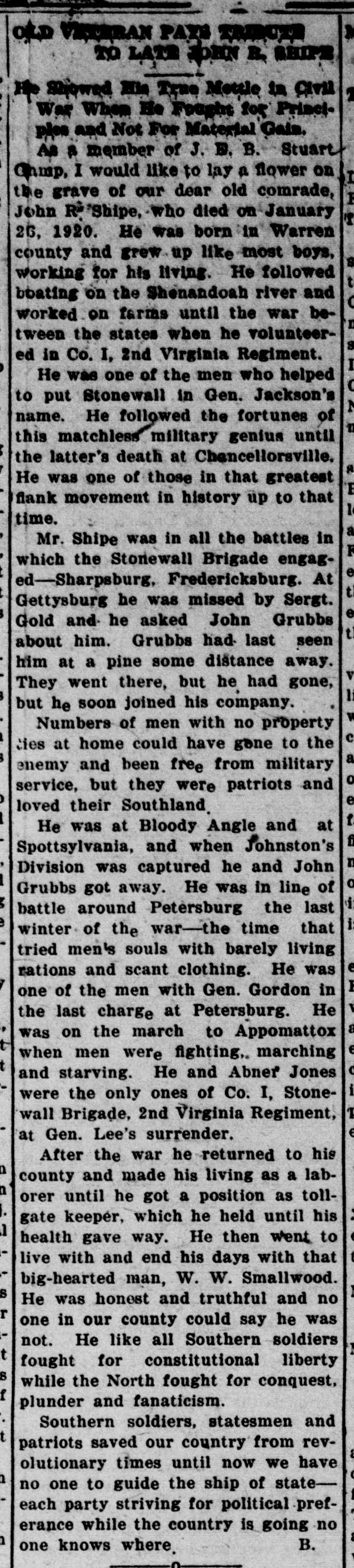
"Old Veteran Pays Tribute to Late John R. Shipe": a Stuart Camp comrade's account, signed "B.," which names Shipe and Abner Jones as the only men of Co. I at Lee's surrender.
What this image does and does not showA crop of part of one page; the rest of the page is not shown.
Clarke Courier (Berryville, Va.), February 12, 1920, page 4. Library of Congress, Chronicling America. Rights Changes: Cropped from the Library of Congress page image to the region of this item: 708 by 3138 pixels, shown at its own 708 by 3138 pixels; re-encoded as JPEG. Nothing retouched or added.
Source: Clarke Courier, Berryville, Va., February 12, 1920, page 4: "Old Veteran Pays Tribute to Late John R. Shipe," signed "B." Open the full image
The last of them
Within weeks of Shipe, G. William Kelly died. His friends called him "Uncle Bill." Born in Clarke near Paris, he had once owned land that became part of the Mt. Weather estate, and his cottage on the Bluemont pike was a familiar sight; he would come to the gate and wave to his friends. The Courier called him "the second of that famous command to pass over" in a few weeks, and recalled that Thomas D. Gold had called him a "good one."
Source note: Clarke Courier, Berryville, Va., 1920
The Clarke Courier of February 12, 1920 reported the death of G. William "Uncle Bill" Kelly, born in Clarke near Paris, once the owner of land now part of the Mt. Weather estate, who lived in a cottage on the Bluemont pike and would wave to his friends from the gate; it called him a member of Co. I, Stonewall Brigade, "the second of that famous command to pass over" in a few weeks, and said Thomas D. Gold had called him a "good one."
What the source supports
Kelly's place in the company and in the county as his notice gave it.
Uncertainty
A death notice; Gold's remark is reported, not quoted from Gold's own writing.
Source
Evidence role: supports. Co. I and the second death.
Clarke Courier, Berryville, Va., February 12, 1920, page 1: "'Uncle Bill' Kelly, One of Stonewall's Men, Dies"
Clarke Courier, Berryville, Va. · 1920-02-12 (publication)
Locator: Page 1, "'Uncle Bill' Kelly, One of Stonewall's Men, Dies"
Relevant passageMr. Kelly was a brave Confederate soldier. He was a member of Co. I, Stonewall Brigade, and is the second of that famous command to pass over to the eternal camping ground in the past few weeks.
Checked: Original inspected. A digital reproduction was inspected; no original has been handled.
Open sourceSource family: clarke-courier. Multiple passages from one source are not independent witnesses.
Evidence role: supports. Gold's remark.
Clarke Courier, Berryville, Va., February 12, 1920, page 1: "'Uncle Bill' Kelly, One of Stonewall's Men, Dies"
Clarke Courier, Berryville, Va. · 1920-02-12 (publication)
Locator: Page 1, "'Uncle Bill' Kelly, One of Stonewall's Men, Dies"
Relevant passageThe late Thomas D. Gold often spoke of Mr. Kelly as a soldier, saying he was a "good one."
Checked: Original inspected. A digital reproduction was inspected; no original has been handled.
Open sourceSource family: clarke-courier. Multiple passages from one source are not independent witnesses.
Evidence role: supports. Born near Paris; the Mt. Weather land.
Clarke Courier, Berryville, Va., February 12, 1920, page 1: "'Uncle Bill' Kelly, One of Stonewall's Men, Dies"
Clarke Courier, Berryville, Va. · 1920-02-12 (publication)
Locator: Page 1, "'Uncle Bill' Kelly, One of Stonewall's Men, Dies"
Relevant passageMr. Kelly was born in Clarke county not far from Paris. At one time he owned the land which forms a part of the Mt. Weather estate now.
Checked: Original inspected. A digital reproduction was inspected; no original has been handled.
Open sourceSource family: clarke-courier. Multiple passages from one source are not independent witnesses.
Evidence role: supports. The cottage on the Bluemont pike.
Clarke Courier, Berryville, Va., February 12, 1920, page 1: "'Uncle Bill' Kelly, One of Stonewall's Men, Dies"
Clarke Courier, Berryville, Va. · 1920-02-12 (publication)
Locator: Page 1, "'Uncle Bill' Kelly, One of Stonewall's Men, Dies"
Relevant passagehis little cottage on the Bluemont pike was a familiar sight to all who knew. Often, he would come to the gate and wave his hand at his friends.
Checked: Original inspected. A digital reproduction was inspected; no original has been handled.
Open sourceSource family: clarke-courier. Multiple passages from one source are not independent witnesses.
AI-assisted source check (Claude Opus 5.5) · 2026-10-12. How this project checks its sources
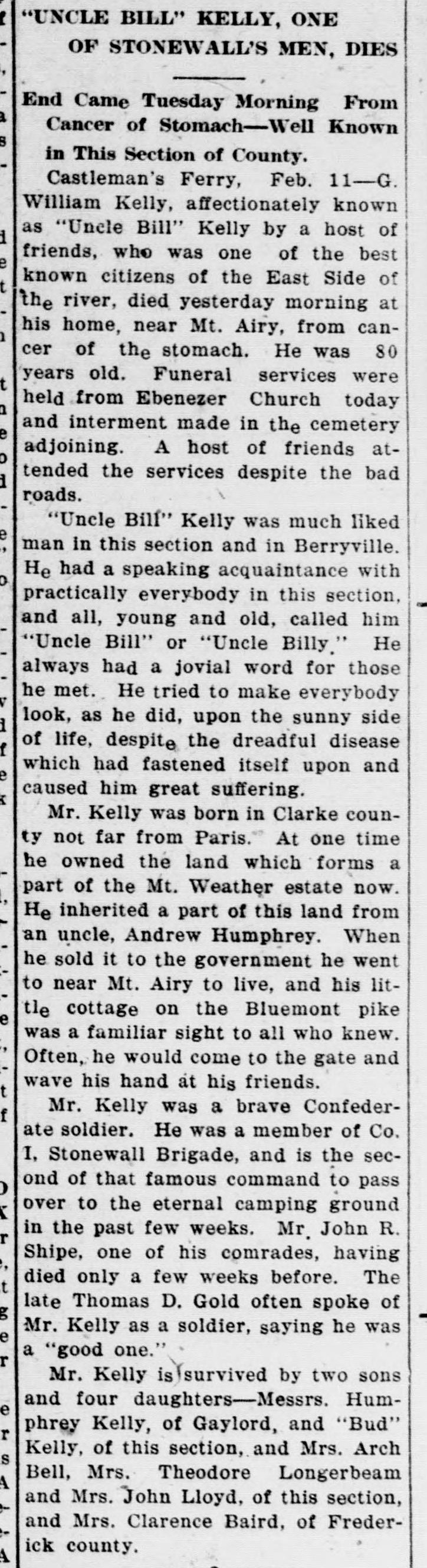
"'Uncle Bill' Kelly, One of Stonewall's Men, Dies": the Courier calls him the second man of Co. I to die within a few weeks.
What this image does and does not showA crop of part of one page; the rest of the page is not shown.
Clarke Courier (Berryville, Va.), February 12, 1920, page 1. Library of Congress, Chronicling America. Rights Changes: Cropped from the Library of Congress page image to the region of this item, then cropped again to the notice alone: 724 by 2658 pixels, shown at its own 724 by 2658 pixels; re-encoded as JPEG. Nothing retouched or added.
Source: Clarke Courier, Berryville, Va., February 12, 1920, page 1: "'Uncle Bill' Kelly, One of Stonewall's Men, Dies" Open the full image
About the accountsWhat the evidence says
A comrade's letter of 1905, a tribute and a death notice of 1920 and a reprinted notice of 1905, all from the Clarke Courier and read on the Library of Congress page images, with a 1948 local history reprinted by the Clarke County Historical Association, describe the Clarke Rifles from 1859 to 1920.
Most of the evidence is remembrance: letters and tributes written decades later and a local history that cites no sources. The accounts disagree on the number at Appomattox, and the story gives both. Blake is not placed in the company.
- An account exists✓ Supported by a source
The Clarke County Historical Association's Proceedings (1958), reprinting a 1948 column by Everard Kidder Meade, say the Berryville company was organized in October 1859 as the Clarke Guards, helped guard the Charles Town prison until John Brown and his men were executed, and was reorganized as the Clarke Rifles, which served the four years of the war in the Stonewall Brigade as Co. I, 2nd Virginia Infantry.
See the evidence
✓ Supported by a sourceAn account existsThe Clarke County Historical Association's Proceedings (1958), reprinting a 1948 column by Everard Kidder Meade, say the Berryville company was organized in October 1859 as the Clarke Guards, helped guard the Charles Town prison until John Brown and his men were executed, and was reorganized as the Clarke Rifles, which served the four years of the war in the Stonewall Brigade as Co. I, 2nd Virginia Infantry.
What the source supports
A local historian's account of how the Clarke Rifles began.
Uncertainty
Written in 1948 and printed in 1958; it cites no record of the Clarke Guards. Its claim that the company "prevented the escape of two of Brown's men" is not checked here.
Source
Later historical account Evidence role: supports. The Clarke Guards of 1859.
Everard Kidder Meade, "Notes on the History of the Lower Shenandoah Valley," Proceedings of the Clarke County Historical Association, vol. XIV (1956-1957), pp. 70 and 72
Everard Kidder Meade; Clarke County Historical Association · 1958 (publication)
Locator: Page 70, "Berryville Company"
Relevant passageUntil the execution of John Brown and his captured associates, this company, organized in October 1859 as Clarke Guards, took part in guarding Charles Town prison and prevented the escape of two of Brown's men.
Checked: Original inspected. A digital reproduction was inspected; no original has been handled.
Open sourceSource family: ccha-proceedings. Multiple passages from one source are not independent witnesses.
Later historical account Evidence role: supports. Reorganized as the Clarke Rifles, Co. I.
Everard Kidder Meade, "Notes on the History of the Lower Shenandoah Valley," Proceedings of the Clarke County Historical Association, vol. XIV (1956-1957), pp. 70 and 72
Everard Kidder Meade; Clarke County Historical Association · 1958 (publication)
Locator: Page 70, "Berryville Company"
Relevant passageReorganized later as Clarke Rifles, It went through four years of war in the Stonewall Brigade as Co. I, 2nd Va. Inf., C.S.A.
Checked: Original inspected. A digital reproduction was inspected; no original has been handled.
Open sourceSource family: ccha-proceedings. Multiple passages from one source are not independent witnesses.
AI-assisted source check (Claude Opus 5.5) · 2026-10-12. How this project checks its sources
- An account exists✓ Supported by a source
A comrade's letter in the Clarke Courier of August 23, 1905, signed "G.", written when two of the company had died "within the last few days," says Jas. H. O'Bannon came to Berryville in 1859 or 1860 to work on the Clarke Journal, joined the Clarke Rifles, went with the company to Harpers Ferry on April 17, 1861, and was at Manassas and every engagement after, "never having been wounded or taken prisoner."
See the evidence
✓ Supported by a sourceAn account existsA comrade's letter in the Clarke Courier of August 23, 1905, signed "G.", written when two of the company had died "within the last few days," says Jas. H. O'Bannon came to Berryville in 1859 or 1860 to work on the Clarke Journal, joined the Clarke Rifles, went with the company to Harpers Ferry on April 17, 1861, and was at Manassas and every engagement after, "never having been wounded or taken prisoner."
What the source supports
O'Bannon's service as his comrade remembered it.
Uncertainty
A letter written from memory in 1905.
Source
Reporting Evidence role: supports. Two of the company dead within days.
Clarke Courier, Berryville, Va., August 23, 1905, page 1: a letter on the deaths of Jas. H. O'Bannon and Decatur J. Shepherd, signed "G." and dated August 21, 1905
Clarke Courier, Berryville, Va. · 1905-08-23 (publication)
Locator: Page 1, the opening of the letter signed "G."
Relevant passageWithin the last few days two of that gallant company, "The Clarke Rifles," Company "I" 2nd. Va. Infantry, "Stonewall Brigade," have been ordered to report for duty in a higher and better sphere.
Checked: Original inspected. A digital reproduction was inspected; no original has been handled.
Open sourceSource family: clarke-courier. Multiple passages from one source are not independent witnesses.
Reporting Evidence role: supports. Arrival in Berryville and enlistment.
Clarke Courier, Berryville, Va., August 23, 1905, page 1: a letter on the deaths of Jas. H. O'Bannon and Decatur J. Shepherd, signed "G." and dated August 21, 1905
Clarke Courier, Berryville, Va. · 1905-08-23 (publication)
Locator: Page 1, the letter signed "G.", on Jas. H. O'Bannon
Relevant passageJas. H. O'Bannon came to Berryville in 1859 or 1860 and was employed on the Clarke Journal. He joined the Clarke Rifles, which was organized by Capt. S. H. Bowen, and went with his company on the 17th. of April, 1861, to Harpers Ferry;
Checked: Original inspected. A digital reproduction was inspected; no original has been handled.
Open sourceSource family: clarke-courier. Multiple passages from one source are not independent witnesses.
Reporting Evidence role: supports. Never wounded or taken.
Clarke Courier, Berryville, Va., August 23, 1905, page 1: a letter on the deaths of Jas. H. O'Bannon and Decatur J. Shepherd, signed "G." and dated August 21, 1905
Clarke Courier, Berryville, Va. · 1905-08-23 (publication)
Locator: Page 1, the letter signed "G.", on Jas. H. O'Bannon
Relevant passagewas present with the command at Manassas July 21, 1861, and in every engagement thereafter, never having been wounded or taken prisoner.
Checked: Original inspected. A digital reproduction was inspected; no original has been handled.
Open sourceSource family: clarke-courier. Multiple passages from one source are not independent witnesses.
AI-assisted source check (Claude Opus 5.5) · 2026-10-12. How this project checks its sources
- An account exists? Unconfirmed
The 1920 tribute says Shipe and Abner Jones "were the only ones of Co. I" at Lee's surrender; Meade's 1948 column says "Four survivors surrendered at Appomattox."
See the evidence
? UnconfirmedAn account existsThe 1920 tribute says Shipe and Abner Jones "were the only ones of Co. I" at Lee's surrender; Meade's 1948 column says "Four survivors surrendered at Appomattox."
What the source supports
That the accounts disagree on how many of the company were at Appomattox.
Uncertainty
Neither account names a record; the Appomattox parole lists were not checked for this story.
Source
Reporting Evidence role: supports. Two men, as the tribute gives it.
Clarke Courier, Berryville, Va., February 12, 1920, page 4: "Old Veteran Pays Tribute to Late John R. Shipe," signed "B."
Clarke Courier, Berryville, Va. · 1920-02-12 (publication)
Locator: Page 4, the tribute to John R. Shipe
Relevant passageHe and Abner Jones were the only ones of Co. I, Stonewall Brigade, 2nd Virginia Regiment, at Gen. Lee's surrender.
Checked: Original inspected. A digital reproduction was inspected; no original has been handled.
Open sourceSource family: clarke-courier. Multiple passages from one source are not independent witnesses.
Later historical account Evidence role: complicates. Four, as the column gives it.
Everard Kidder Meade, "Notes on the History of the Lower Shenandoah Valley," Proceedings of the Clarke County Historical Association, vol. XIV (1956-1957), pp. 70 and 72
Everard Kidder Meade; Clarke County Historical Association · 1958 (publication)
Locator: Page 72, "Clarke Companies C.S.A."
Relevant passageFour survivors surrendered at Appomattox.
Checked: Original inspected. A digital reproduction was inspected; no original has been handled.
Open sourceSource family: ccha-proceedings. Multiple passages from one source are not independent witnesses.
AI-assisted source check (Claude Opus 5.5) · 2026-10-12. How this project checks its sources
- An account exists✓ Supported by a source
The Clarke Courier of February 12, 1920 reported the death of G. William "Uncle Bill" Kelly, born in Clarke near Paris, once the owner of land now part of the Mt. Weather estate, who lived in a cottage on the Bluemont pike and would wave to his friends from the gate; it called him a member of Co. I, Stonewall Brigade, "the second of that famous command to pass over" in a few weeks, and said Thomas D. Gold had called him a "good one."
See the evidence
✓ Supported by a sourceAn account existsThe Clarke Courier of February 12, 1920 reported the death of G. William "Uncle Bill" Kelly, born in Clarke near Paris, once the owner of land now part of the Mt. Weather estate, who lived in a cottage on the Bluemont pike and would wave to his friends from the gate; it called him a member of Co. I, Stonewall Brigade, "the second of that famous command to pass over" in a few weeks, and said Thomas D. Gold had called him a "good one."
What the source supports
Kelly's place in the company and in the county as his notice gave it.
Uncertainty
A death notice; Gold's remark is reported, not quoted from Gold's own writing.
Source
Reporting Evidence role: supports. Co. I and the second death.
Clarke Courier, Berryville, Va., February 12, 1920, page 1: "'Uncle Bill' Kelly, One of Stonewall's Men, Dies"
Clarke Courier, Berryville, Va. · 1920-02-12 (publication)
Locator: Page 1, "'Uncle Bill' Kelly, One of Stonewall's Men, Dies"
Relevant passageMr. Kelly was a brave Confederate soldier. He was a member of Co. I, Stonewall Brigade, and is the second of that famous command to pass over to the eternal camping ground in the past few weeks.
Checked: Original inspected. A digital reproduction was inspected; no original has been handled.
Open sourceSource family: clarke-courier. Multiple passages from one source are not independent witnesses.
Reporting Evidence role: supports. Gold's remark.
Clarke Courier, Berryville, Va., February 12, 1920, page 1: "'Uncle Bill' Kelly, One of Stonewall's Men, Dies"
Clarke Courier, Berryville, Va. · 1920-02-12 (publication)
Locator: Page 1, "'Uncle Bill' Kelly, One of Stonewall's Men, Dies"
Relevant passageThe late Thomas D. Gold often spoke of Mr. Kelly as a soldier, saying he was a "good one."
Checked: Original inspected. A digital reproduction was inspected; no original has been handled.
Open sourceSource family: clarke-courier. Multiple passages from one source are not independent witnesses.
Reporting Evidence role: supports. Born near Paris; the Mt. Weather land.
Clarke Courier, Berryville, Va., February 12, 1920, page 1: "'Uncle Bill' Kelly, One of Stonewall's Men, Dies"
Clarke Courier, Berryville, Va. · 1920-02-12 (publication)
Locator: Page 1, "'Uncle Bill' Kelly, One of Stonewall's Men, Dies"
Relevant passageMr. Kelly was born in Clarke county not far from Paris. At one time he owned the land which forms a part of the Mt. Weather estate now.
Checked: Original inspected. A digital reproduction was inspected; no original has been handled.
Open sourceSource family: clarke-courier. Multiple passages from one source are not independent witnesses.
Reporting Evidence role: supports. The cottage on the Bluemont pike.
Clarke Courier, Berryville, Va., February 12, 1920, page 1: "'Uncle Bill' Kelly, One of Stonewall's Men, Dies"
Clarke Courier, Berryville, Va. · 1920-02-12 (publication)
Locator: Page 1, "'Uncle Bill' Kelly, One of Stonewall's Men, Dies"
Relevant passagehis little cottage on the Bluemont pike was a familiar sight to all who knew. Often, he would come to the gate and wave his hand at his friends.
Checked: Original inspected. A digital reproduction was inspected; no original has been handled.
Open sourceSource family: clarke-courier. Multiple passages from one source are not independent witnesses.
AI-assisted source check (Claude Opus 5.5) · 2026-10-12. How this project checks its sources
Each statement above is assessed on its own evidence. Nothing here is averaged, scored or voted on, and a well-attributed account can be documented while what it describes stays unconfirmed.
Source note
Most of this story comes from remembrance, not records. The two comrades' letters were written forty and fifty-five years after the war, and Meade's column in 1948. The 1920 tribute ends with its writer's own view of why the South fought; this story reports the facts it gives and not that view. The accounts differ on the first captain's initials ("S. C." and "S. H.") and on how many of the company surrendered at Appomattox. The company's men are on this site's roll of Clarke's veterans.
How many men of the Clarke Rifles were paroled at Appomattox: two, as the 1920 tribute says, or four, as the 1948 column says?
Know more about this story, or see something to correct? Help fill a gap. It stays private until it is reviewed.
Remember this place or someone in this story? Share a memory, even if you do not know the date. It stays private until it is reviewed.
Go deeper: every source under this story Follow another threadBells and flowers: Armistice and Memorial Day in Clarke, 1903 to 1946
How the county honored its soldiers in later years, at Green Hill and Old Chapel and on Armistice Day.