Organization

Clarke Courier

Clarke County's general-circulation weekly, published at Berryville on Thursdays in 1925. Used here as a second, independent newspaper alongside the People's Journal; the two served different readerships and named the same places and institutions differently, which is why they are kept as separate independence families. Its digitized run at the Library of Congress begins in 1869 and the catalog gives the title as running to 1997, but neither endpoint is established by anything in this corpus, so no dates are recorded.

The county's white weekly, running alongside the Black People's Journal

Clarke Courier

The general-circulation Berryville weekly used here as a second independent newspaper alongside the People's Journal. Together the two serve as cross-checks on each other for the same county, in the same years.

In April and June 1925 the Clarke Courier ran a short sequence of items about Black education in the county that are more specific than most of what the paper printed about Black institutions in the same period. On 30 April 1925 the paper announced that W. D. Gresham, supervisor of Negro education for Virginia, would speak at the Court House in Berryville on 4 May 1925, under the auspices of the Clarke County School League1. The League itself is named in the paper; the address is named; the speaker is a state official with a specific portfolio.

On 18 June 1925 the Courier reported that a County League of Negro schools had been organised on 11 July 1924, beginning with $28 to its credit1. A dated founding, a small opening balance, and a purpose the next Courier item stated in full: to raise money to establish a County Training School for Black children2. That same 18 June item reported the League's fundraising total to date — $1,265.95 as of 9 June 1925 — a figure that in 1925 dollars was a meaningful sum for a rural Black civic body operating without matching state support.

Read together, the three items give the Training School campaign a start date, a treasurer's number, a public event, and a named state ally. All three items are the Courier's own reporting; the People's Journal reading notes carry additional context about the campaign that a later narrative on the Training School itself will bring in.

Three claims establish the campaign's public shape as the Courier reported it in the spring and early summer of 1925. Missing from the corpus so far: the League's own minutes, the deed for the school site, the Training School's own opening records, and whatever the People's Journal was printing about the same campaign in the same weeks. Every one of those is a locatable next research target.

Evidence

See the source and its limits
✓ Supported by a sourceAn account exists

The Clarke Courier announced on 30 April 1925 that W. D. Gresham, supervisor of Negro education of Virginia, would speak at the Court House in Berryville on 4 May 1925 under the auspices of the Clarke County Colored school league, with division superintendent Leslie D. Kline presiding.

What the source supports

That the League could convene a meeting in the county courthouse addressed by a state education official and chaired by the white division superintendent, and that the county paper carried the announcement including the League's invitation to white attendees with reserved seating.

Uncertainty

An announcement of an intended meeting, not a report of one. Nothing in the cited records establishes that the meeting took place, who attended, or what was said. The Courier's phrasing is the League's own, attributed to 'officers of the league'.

Source

Reporting

Evidence role: supports. The announcement naming Gresham, the Court House, the date, the League and Kline as chair.

Clarke Courier, Berryville, Va., 30 April 1925

Clarke Courier · 1925-04-30 (publication)

Locator: Printed page 8, notice: W. D. GRESHAM TO SPEAK HERE

Relevant passage
Prof. W. D. Gresham, supervisor of Negro education of Virginia, will speak at the Court House, Berryville, on Monday night, May 4th, at 8 o'clock. This meeting will be held under the auspices of the Clarke County Colored school league. Every colored man with an educational pride wish for self-help or race development will be there, according to a statement given out by officers of the league. Hie [The] school officials and many white friends of the negro institution of learning are invited, special seats [be]ing reserved for them. Mr. Leslie D. Kline, division superintendent of schools, will preside, it was stated.

Checked: Existing OCR reviewed. Original image not independently inspected.

Open source

Source family: clarke-courier. Multiple passages from one source are not independent witnesses.

AI-assisted source check (Claude Opus 5) · 2026-09-08. How this project checks its sources

See the source and its limits
✓ Supported by a sourceAn account exists

The Clarke Courier reported on 18 June 1925 that a County League of Negro schools had been organised on 11 July 1924, beginning with $28 to its credit.

What the source supports

That a Clarke County newspaper printed a specific founding date and opening balance for a Black county-wide school organisation. The date is arithmetic on the paper's own phrase 'the 11th of July one year ago' in an issue dated 18 June 1925.

Uncertainty

A newspaper report published eleven months after the event it dates. It establishes what the Courier printed, not that the organisation was founded on that day. Nothing here establishes who called the founding meeting, where it was held, or who attended.

Source

Reporting

Evidence role: supports. The Courier's own sentence giving the founding date and the opening balance.

Clarke Courier, Berryville, Va., 18 June 1925

Clarke Courier · 1925-06-18 (publication)

Locator: Printed page 1, report: NEGRO SCHOOL LEAGUE MADE FINE SHOWING

Relevant passage
The County League of Negro schools was organized the 11th of July one year ago, at which time $28 was placed to its credit. The purpose of the league is to raise money with which to establish a County Training school for negro children. Through special drives, entertainments and contributions from both white and <*>lored [colored] friends the league was able to report on Tuesday night June 9th. $1265.95 toward the project in view. Before it can locate and begin to build $234.15 must be raised. A special drive has been arranged to end August 7th, at which time the league hopes to raise the required sum. The president, Rev. E. T. Johnson, wishes to thank every contributor and further solicits your good will.

Checked: Existing OCR reviewed. Original image not independently inspected.

Open source

Source family: clarke-courier. Multiple passages from one source are not independent witnesses.

AI-assisted source check (Claude Opus 5) · 2026-09-08. How this project checks its sources

See the source and its limits
✓ Supported by a sourceAn account exists

The Clarke Courier reported on 18 June 1925 that the League's purpose was to raise money to establish a County Training School for Black children, that $1,265.95 had been reported on 9 June 1925, that $234.15 remained to be raised before it could locate and build, and that its president was Rev. E. T. Johnson.

What the source supports

That the League had a stated building purpose, a named president, and a specific published financial position ten and a half months after its founding, funded by contributions the paper describes as coming from both white and Black donors.

Uncertainty

Figures as printed by the newspaper; no accounts were inspected. The report does not say where the school was to be built, and explicitly says the League had not yet located a site. It does not establish that the school was ever built. The word rendered '<*>lored' by OCR is read as 'colored'.

Source

Reporting

Evidence role: supports. The same report, for the purpose, the two money figures, the drive deadline and the president's name.

Clarke Courier, Berryville, Va., 18 June 1925

Clarke Courier · 1925-06-18 (publication)

Locator: Printed page 1, report: NEGRO SCHOOL LEAGUE MADE FINE SHOWING

Relevant passage
The County League of Negro schools was organized the 11th of July one year ago, at which time $28 was placed to its credit. The purpose of the league is to raise money with which to establish a County Training school for negro children. Through special drives, entertainments and contributions from both white and <*>lored [colored] friends the league was able to report on Tuesday night June 9th. $1265.95 toward the project in view. Before it can locate and begin to build $234.15 must be raised. A special drive has been arranged to end August 7th, at which time the league hopes to raise the required sum. The president, Rev. E. T. Johnson, wishes to thank every contributor and further solicits your good will.

Checked: Existing OCR reviewed. Original image not independently inspected.

Open source

Source family: clarke-courier. Multiple passages from one source are not independent witnesses.

AI-assisted source check (Claude Opus 5) · 2026-09-08. How this project checks its sources

What the sources support

The Clarke Courier reported on 18 June 1925 that a County League of Negro schools had been organised on 11 July 1924, beginning with $28 to its credit.

✓ Supported by a source
See the source and its limits
✓ Supported by a sourceAn account exists

The Clarke Courier reported on 18 June 1925 that a County League of Negro schools had been organised on 11 July 1924, beginning with $28 to its credit.

What the source supports

That a Clarke County newspaper printed a specific founding date and opening balance for a Black county-wide school organisation. The date is arithmetic on the paper's own phrase 'the 11th of July one year ago' in an issue dated 18 June 1925.

Uncertainty

A newspaper report published eleven months after the event it dates. It establishes what the Courier printed, not that the organisation was founded on that day. Nothing here establishes who called the founding meeting, where it was held, or who attended.

Source

Reporting

Evidence role: supports. The Courier's own sentence giving the founding date and the opening balance.

Clarke Courier, Berryville, Va., 18 June 1925

Clarke Courier · 1925-06-18 (publication)

Locator: Printed page 1, report: NEGRO SCHOOL LEAGUE MADE FINE SHOWING

Relevant passage
The County League of Negro schools was organized the 11th of July one year ago, at which time $28 was placed to its credit. The purpose of the league is to raise money with which to establish a County Training school for negro children. Through special drives, entertainments and contributions from both white and <*>lored [colored] friends the league was able to report on Tuesday night June 9th. $1265.95 toward the project in view. Before it can locate and begin to build $234.15 must be raised. A special drive has been arranged to end August 7th, at which time the league hopes to raise the required sum. The president, Rev. E. T. Johnson, wishes to thank every contributor and further solicits your good will.

Checked: Existing OCR reviewed. Original image not independently inspected.

Open source

Source family: clarke-courier. Multiple passages from one source are not independent witnesses.

AI-assisted source check (Claude Opus 5) · 2026-09-08. How this project checks its sources

The Clarke Courier reported on 18 June 1925 that the League's purpose was to raise money to establish a County Training School for Black children, that $1,265.95 had been reported on 9 June 1925, that $234.15 remained to be raised before it could locate and build, and that its president was Rev. E. T. Johnson.

✓ Supported by a source
See the source and its limits
✓ Supported by a sourceAn account exists

The Clarke Courier reported on 18 June 1925 that the League's purpose was to raise money to establish a County Training School for Black children, that $1,265.95 had been reported on 9 June 1925, that $234.15 remained to be raised before it could locate and build, and that its president was Rev. E. T. Johnson.

What the source supports

That the League had a stated building purpose, a named president, and a specific published financial position ten and a half months after its founding, funded by contributions the paper describes as coming from both white and Black donors.

Uncertainty

Figures as printed by the newspaper; no accounts were inspected. The report does not say where the school was to be built, and explicitly says the League had not yet located a site. It does not establish that the school was ever built. The word rendered '<*>lored' by OCR is read as 'colored'.

Source

Reporting

Evidence role: supports. The same report, for the purpose, the two money figures, the drive deadline and the president's name.

Clarke Courier, Berryville, Va., 18 June 1925

Clarke Courier · 1925-06-18 (publication)

Locator: Printed page 1, report: NEGRO SCHOOL LEAGUE MADE FINE SHOWING

Relevant passage
The County League of Negro schools was organized the 11th of July one year ago, at which time $28 was placed to its credit. The purpose of the league is to raise money with which to establish a County Training school for negro children. Through special drives, entertainments and contributions from both white and <*>lored [colored] friends the league was able to report on Tuesday night June 9th. $1265.95 toward the project in view. Before it can locate and begin to build $234.15 must be raised. A special drive has been arranged to end August 7th, at which time the league hopes to raise the required sum. The president, Rev. E. T. Johnson, wishes to thank every contributor and further solicits your good will.

Checked: Existing OCR reviewed. Original image not independently inspected.

Open source

Source family: clarke-courier. Multiple passages from one source are not independent witnesses.

AI-assisted source check (Claude Opus 5) · 2026-09-08. How this project checks its sources

The Clarke Courier announced on 30 April 1925 that W. D. Gresham, supervisor of Negro education of Virginia, would speak at the Court House in Berryville on 4 May 1925 under the auspices of the Clarke County Colored school league, with division superintendent Leslie D. Kline presiding.

✓ Supported by a source
See the source and its limits
✓ Supported by a sourceAn account exists

The Clarke Courier announced on 30 April 1925 that W. D. Gresham, supervisor of Negro education of Virginia, would speak at the Court House in Berryville on 4 May 1925 under the auspices of the Clarke County Colored school league, with division superintendent Leslie D. Kline presiding.

What the source supports

That the League could convene a meeting in the county courthouse addressed by a state education official and chaired by the white division superintendent, and that the county paper carried the announcement including the League's invitation to white attendees with reserved seating.

Uncertainty

An announcement of an intended meeting, not a report of one. Nothing in the cited records establishes that the meeting took place, who attended, or what was said. The Courier's phrasing is the League's own, attributed to 'officers of the league'.

Source

Reporting

Evidence role: supports. The announcement naming Gresham, the Court House, the date, the League and Kline as chair.

Clarke Courier, Berryville, Va., 30 April 1925

Clarke Courier · 1925-04-30 (publication)

Locator: Printed page 8, notice: W. D. GRESHAM TO SPEAK HERE

Relevant passage
Prof. W. D. Gresham, supervisor of Negro education of Virginia, will speak at the Court House, Berryville, on Monday night, May 4th, at 8 o'clock. This meeting will be held under the auspices of the Clarke County Colored school league. Every colored man with an educational pride wish for self-help or race development will be there, according to a statement given out by officers of the league. Hie [The] school officials and many white friends of the negro institution of learning are invited, special seats [be]ing reserved for them. Mr. Leslie D. Kline, division superintendent of schools, will preside, it was stated.

Checked: Existing OCR reviewed. Original image not independently inspected.

Open source

Source family: clarke-courier. Multiple passages from one source are not independent witnesses.

AI-assisted source check (Claude Opus 5) · 2026-09-08. How this project checks its sources

Also indexed as: The Clarke Courier.

Know something about this place or record? Help fill a gap. It stays private until it is reviewed.

Keep exploring

Related stories

Service & war? Unconfirmed

A reported reunion after Libby Prison

In March 1886 the Clarke Courier printed a small scene under the heading “An Old Acquaintance”: an old man in a hotel, a stranger off a train, and an unpaid board bill that turns out to be an escape from Libby Prison. It is a good story, and parts of it do not sit easily with the records.

What the evidence says Six sources. The 1886 Clarke Courier item that carries the whole anecdote was read on the page image. The other five bear only on whether its names and dates fit the record. No prison roster or muster record was consulted.

  • 3 min read
  • 6 sources
Land, work & community✓ Supported

The ground they kept: Milton Valley Cemetery

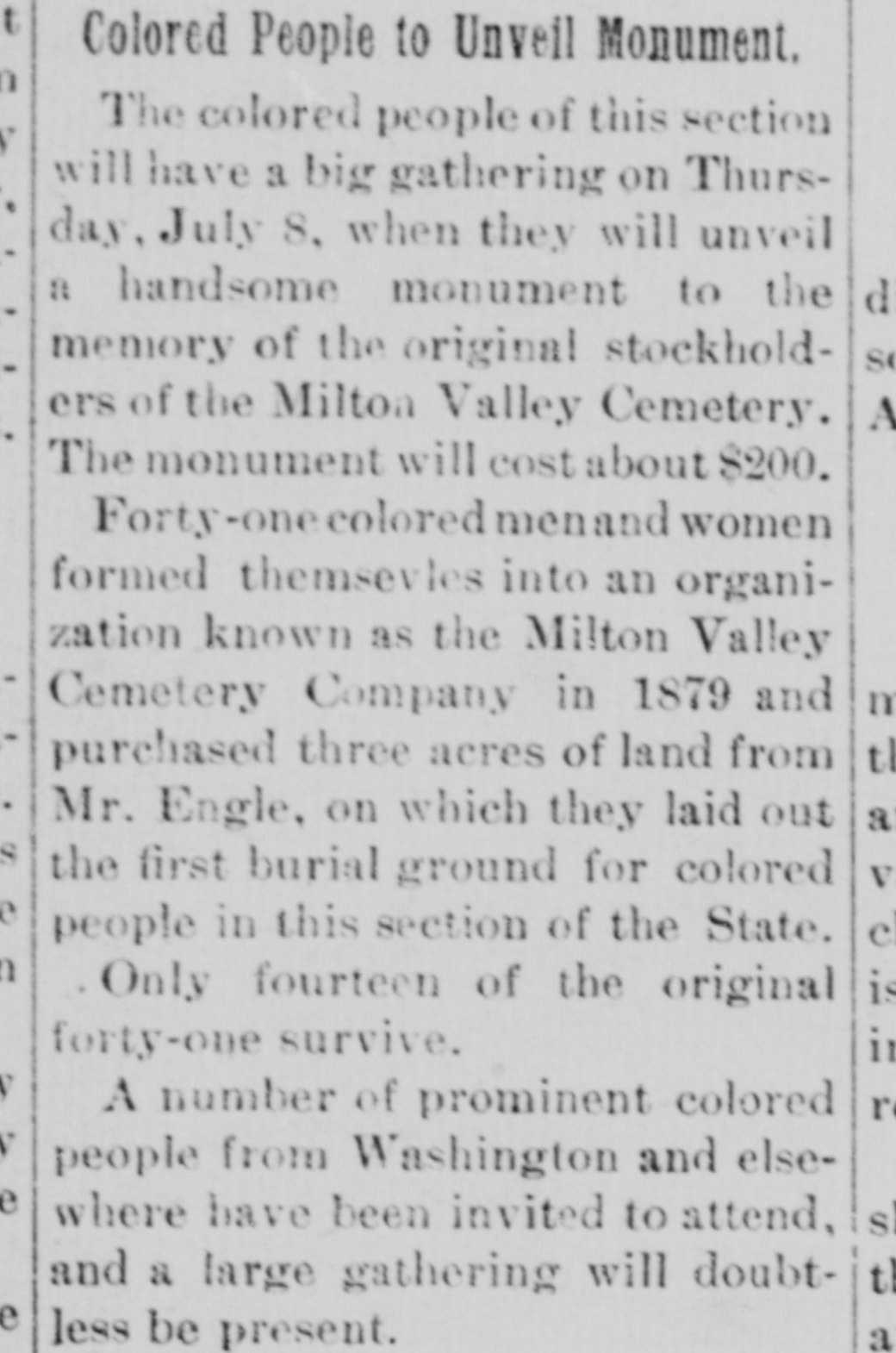
In 1909 the Clarke Courier credited forty-one Black men and women with forming the Milton Valley Cemetery Company in 1879 and buying three acres for a burial ground. A 1910 advertisement signed for the company, and a 1926 Cemetery Board notice printed under its heading, show lots offered, a monument raised and a yearly dollar asked of every lot holder, while a committee raised money for a walk in the cemetery. Funeral notices show the dead brought home from Cairo and Detroit, and by the 1930s the cemetery had its own Memorial Day exercises.

What the evidence says The 1909 Courier's account of forty-one founders in 1879, the company's 1910 advertisement and the 1926 board notice, read on the page images, show a Black-run cemetery company with stockholders, a monument and a yearly $1.00 charge on lot holders. Courier notices from 1897 to 1945 record burials there, including people brought home from Illinois and Detroit.

  • 7 min read
  • 17 sources
Civic life & gathering✓ Supported

Clarke's home front: watching the sky and making do

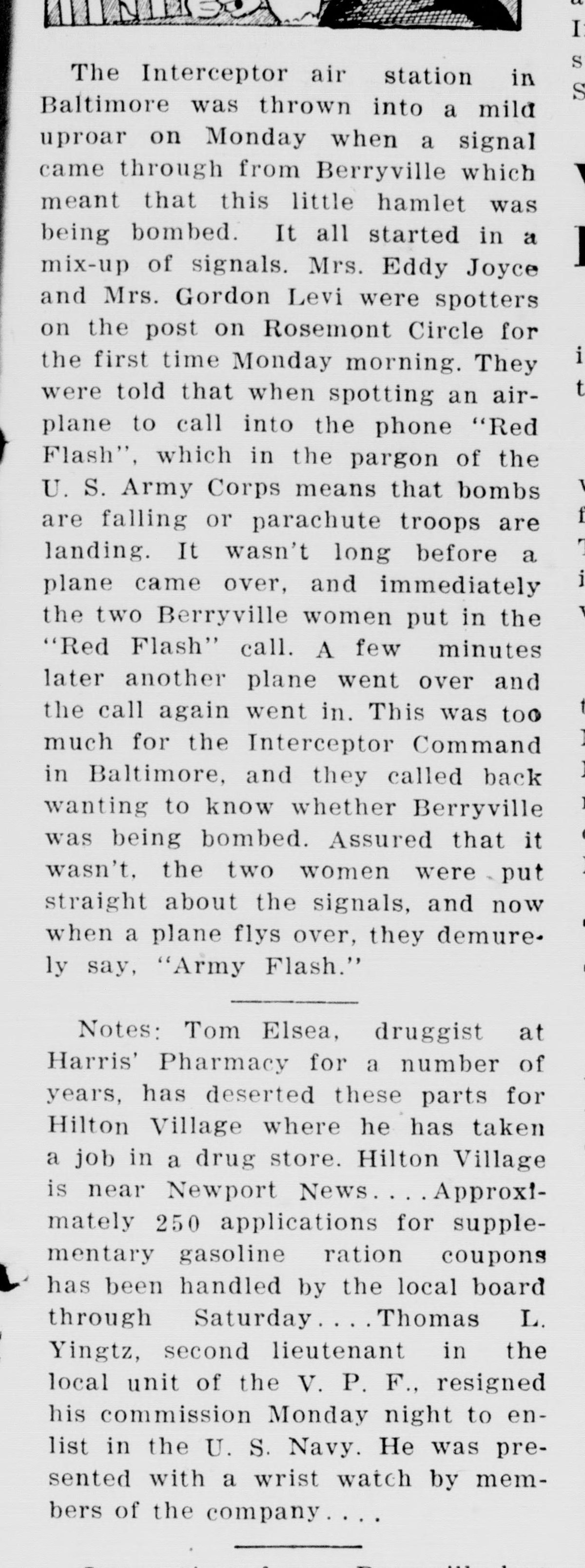
In June 1941, six months before Pearl Harbor, the Clarke Courier reported volunteers organizing aircraft observation posts across the county. Over the next two years it recorded tire and gasoline rationing reshaping that watch, schoolhouses serving as registration offices for sugar and gasoline, neighbors building and dedicating posts of their own, and the posts' closing by War Department order in July 1943.

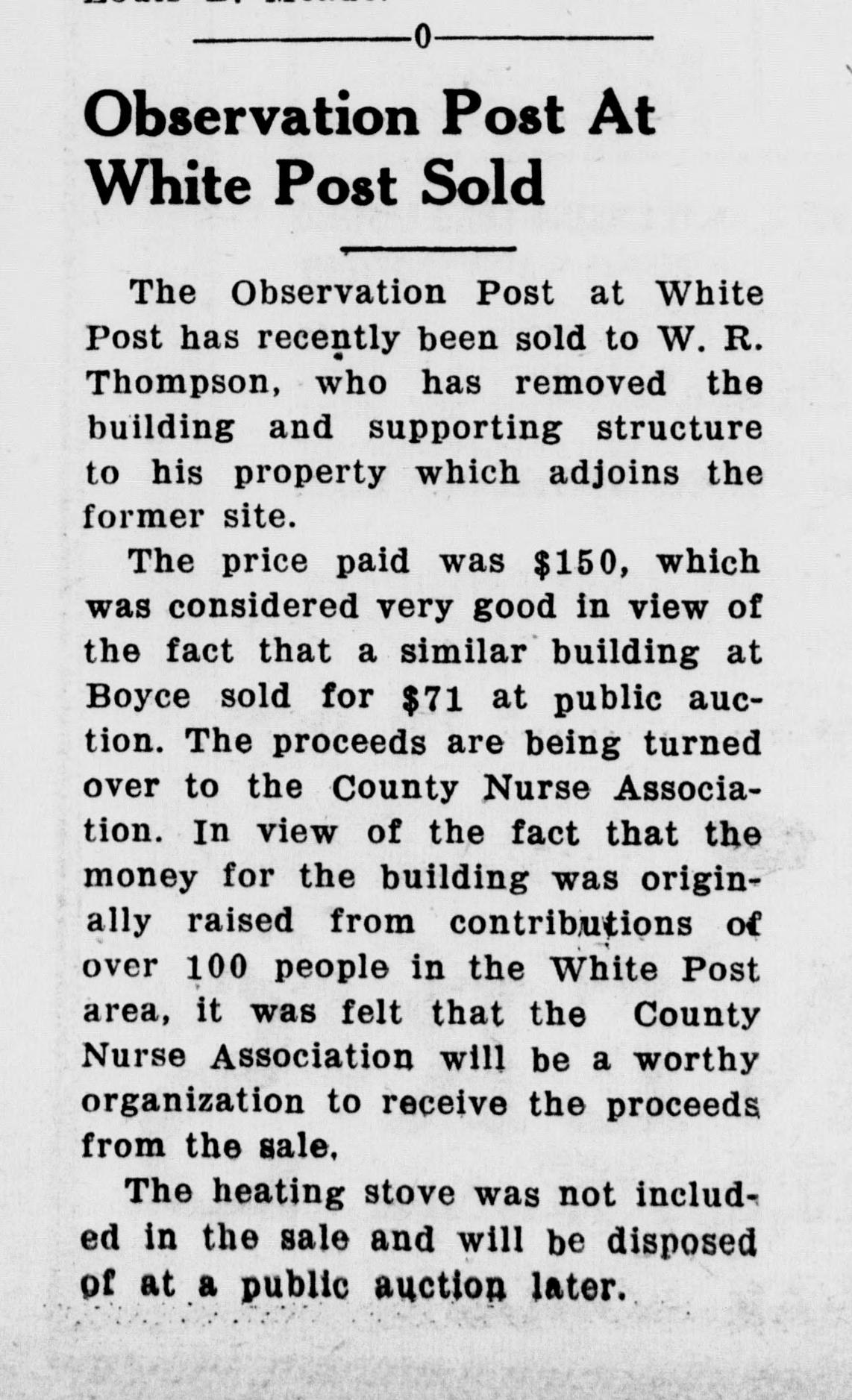
What the evidence says Courier reports and notices from June 1941 to August 1945, each read on a Library of Congress page image, document the county's aircraft warning posts, the tire board, the sugar and gasoline registrations, the posts' closing and the Boyce station's sale. They do not corroborate the column's "Red Flash" story, give a final sugar count or show who bought the Boyce station.

  • 7 min read
  • 18 sources
Civic life & gathering✓ Supported

Dear Dan: Clarke's home front, 1943–1945

For more than three years the Clarke Courier wrote a weekly "Dear Dan" letter to a man overseas. Its pages from 1943 to 1945 show volunteers stretched thin at the aircraft spotter posts, a harvest brought in by boys, school children, traveling crews, convicts and prisoners of war, the Pope family's long wait for a son held by Japan, and a town that celebrated victory twice.

What the evidence says Clarke Courier columns, editorials, reports and notices from 1943 to 1945, each read on a Library of Congress page image, document the spotter posts' shortage of volunteers, the 1944 harvest labor as the county agent reported it, the Pope family's news of a son held by Japan, and the town's two victory celebrations.

  • 10 min read
  • 32 sources
Service & war✓ Supported

Bells and flowers: Armistice and Memorial Day in Clarke, 1903 to 1946

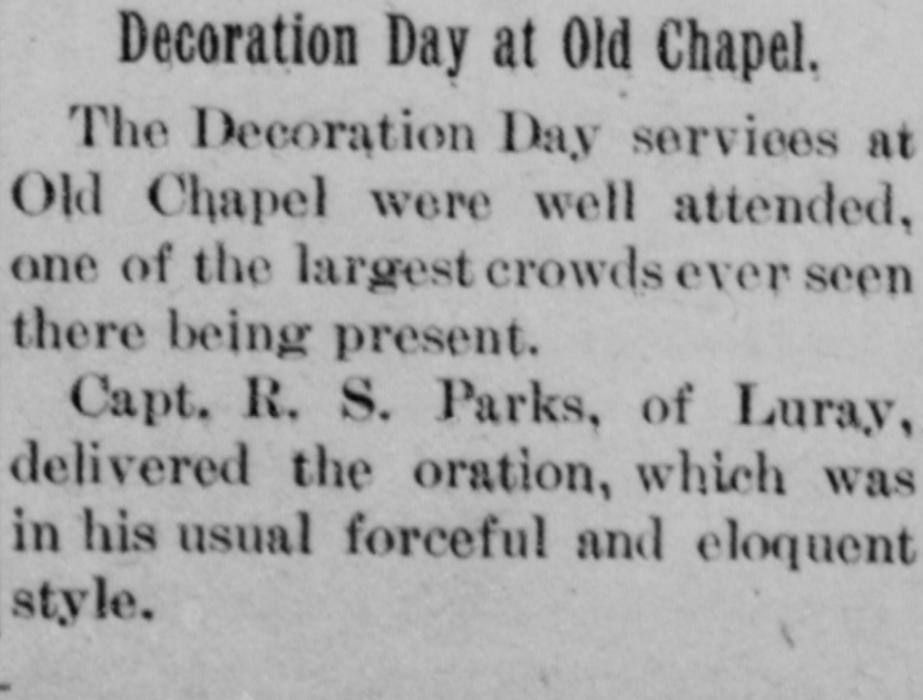
For more than forty years Clarke kept two days for its soldiers.The Clarke Courier reported Decoration Day at Old Chapel and Green Hill from 1903, a false armistice in 1918, a welcome home for 5,000 in 1919, and Armistice Days of bells, parades and silence under the Legion post. In wartime the days turned to rain, walking and blood drives.

What the evidence says Twenty-seven Clarke Courier reports, notices and editorials from 1903 to 1946, each read on a Library of Congress page image, show Decoration and Memorial Day services at Green Hill and Old Chapel, the false and the real armistice of 1918, the July 4, 1919 welcome home, and the Legion post's Armistice Days.

  • 7 min read
  • 26 sources
Civic life & gathering? Unconfirmed

The Clarke Rifles: Berryville's company, 1859 to 1920

Berryville sent one infantry company to the Stonewall Brigade. Its story survives less in records than in remembrance: a local historian's column, and the Clarke Courier's notices and comrades' letters as the men died, from "Jim" O'Bannon and "Kate" Shepherd in 1905 to John R. Shipe and "Uncle Bill" Kelly in 1920.

What the evidence says A comrade's letter of 1905, a tribute and a death notice of 1920 and a reprinted notice of 1905, all from the Clarke Courier and read on the Library of Congress page images, with a 1948 local history reprinted by the Clarke County Historical Association, describe the Clarke Rifles from 1859 to 1920.

  • 6 min read
  • 5 sources
Service & war✓ Supported

Stars on the flags: Clarke's churches in the World War

In 1918 Clarke's churches hung service flags with a star for each of their men. Grace Church in Berryville sent its rector to France as a chaplain and mourned Capt. Lloyd W. Williams, the first Clarke man to die in the war; Christ Church at Millwood received an altar from a mother whose two sons came home. The Clarke Courier reported it week by week, and in 1927 the Virginia War History Commission printed the churches' own lists of their men.

What the evidence says Ten Clarke Courier items of 1918 to 1921, read on the Library of Congress page images, and the Virginia War History Commission's 1927 history of the county, read on the HathiTrust page images, describe the churches of Berryville and Millwood in the First World War.

  • 7 min read
  • 11 sources
Service & war✓ Supported

The last roll call: the Clarke Cavalry, 1884 to 1918

In 1884 the survivors of the Clarke Cavalry formed an association under the trees in front of R. O. Allen's house, and 32 answered the roll. For thirty-four years they met each summer. They led the county's effort for a monument to its Confederate dead, brought a comrade's remains home from Luray, and called the roll of the living and the dead, as the Clarke Courier reported each year, until four answered in 1918.

What the evidence says Twelve Clarke Courier items of 1884 to 1918, read on the Library of Congress page images, report the founding, the monument effort, the reburial of F. P. Topper and the reunions of the survivors of the Clarke Cavalry.

  • 6 min read
  • 12 sources
Service & war✓ Supported

Held in the North: Clarke men in Union prisons

Many Clarke men spent part of the war in Northern prison camps. Their death notices in the Clarke Courier, written decades later, kept their stories: a fifteen-year-old cavalryman held five months at Fort Delaware, a color-bearer who traded his whiskey ration for bread at Elmira and swam a river to get home, and a farmer released because his wife had nursed a wounded Union soldier back to health in her garret.

What the evidence says Eight Clarke Courier notices and letters of 1900 to 1923, read on the Library of Congress page images, tell what the county remembered of its Confederate soldiers held in Northern prisons.

  • 6 min read
  • 8 sources
Service & war✓ Supported

Five sons in France: the Lloyd brothers of Clarke

J. W. Lloyd of near Berry's Ferry had five sons in the First World War, and all five went to France. The Clarke Courier followed them: two wounded in October 1918, a false report of a death, Howard's words on a Berryville street, and Charles, gassed in the Argonne, the last to come home. In 1922 the youngest, Linton, drowned near his father's house.

What the evidence says Six Clarke Courier items of 1918 to 1922, read on the Library of Congress page images, and the Virginia War History Commission's 1927 county history follow the five Lloyd brothers through the First World War.

  • 6 min read
  • 8 sources
Service & war✓ Supported

Boys in the ranks: Clarke men who went to war young

When five Clarke Confederates died between 1883 and 1924, the Clarke Courier remembered them as boys when they went to war: Isaac Bonham at 16 with the first volunteers, Burwell McGuire "in his 'teens," Charles T. Jones at 17, W. W. Bowles at 16, and William E. Reed "scarcely more than a boy." The ages are the papers' own, written years later.

What the evidence says Five Clarke Courier death notices of 1883 to 1924, read on the Library of Congress page images, each say the man went to war young.

  • 5 min read
  • 5 sources
Service & war✓ Supported

Wounded: five Clarke soldiers and what they carried home

Five Clarke County Confederate soldiers came home wounded, and their death notices in the Clarke Courier still remembered it decades later: a man hit at the first battle of Manassas who never fully recovered, a cavalryman crippled in the arm on the same day, and wounds from Kernstown, Brandy Station and Gettysburg.

What the evidence says Five Clarke Courier death notices of 1899 to 1914, read on the Library of Congress page images, name the battle where each man was wounded and what the wound cost him.

  • 4 min read
  • 5 sources
Service & war✓ Supported

World War I: the county's soldiers, 1917 to 1923

The roll of veterans on this site lists 428 people who served in World War I. The Clarke Courier printed the county's own Roll of Honor in July 1919, reported the first Clarke man killed in France, followed the wounded home, and in 1923 printed the honors the Virginia War History recorded for Clarke soldiers.

What the evidence says Clarke Courier items of 1918 to 1923, already published on this site and read on the Library of Congress page images, and the roll of veterans.

  • 3 min read
  • 8 sources
Service & war? Unconfirmed

The Civil War: the county's soldiers, 1861 to 1865

The roll of veterans on this site lists 943 people who served in the Civil War. Berryville's company served four years in the Stonewall Brigade, and the Clarke Cavalry rode in the 6th Virginia. The Clarke Courier printed what the survivors told of battle and of Northern prisons, and followed them to the monument of 1900 and their reunions into 1918.

What the evidence says Clarke Courier items of 1883 to 1923, Gold's 1914 history, Meade's 1948 column and a compiled service record, already published on this site, and the roll of veterans.

  • 3 min read
  • 13 sources
Service & war✓ Supported

World War II: the county's soldiers, 1941 to 1946

The roll of veterans on this site lists 603 people who served in World War II. The Clarke Courier followed them from the county's first aircraft-warning posts in 1941 to the War Department's list of the dead in 1946, with the four Pope brothers of near Berryville, a soldier's death in France reported first as in action and then as an accident, and the night the war ended.

What the evidence says Clarke Courier items of 1941 to 1946, already published on this site and read on the Library of Congress page images, and the roll of veterans.

  • 3 min read
  • 14 sources

Search

Searches the released collection only.