
Five sons
When the Virginia War History Commission wrote up Clarke County in 1927, it set down one family in a single line: "Mr. J. W. Lloyd had five sons in service—Charles, Grover, Linton, Thomas and Howard." The Clarke Courier had said it first. In January 1919 it wrote that of the seven sons of the family, "five of them joined the army, went to France and took part in the fighting." In March it called the Lloyds "one of the few in America which gave five sons to the cause of Democracy in the World War."
Source note: Virginia War History Commission, 1927, and one more
The Virginia War History Commission's 1927 history of Clarke County says "Mr. J. W. Lloyd had five sons in service": Charles, Grover, Linton, Thomas and Howard. The Courier wrote in January 1919 that five of his seven sons "joined the army, went to France and took part in the fighting," and in March that the family was "one of the few in America which gave five sons."
What the source supports
That five Lloyd brothers served, and who they were.
Uncertainty
The paper's "one of the few in America" is its own judgment.
Source
Evidence role: supports. The five, by name.
Virginia War History Commission, "Clarke County in War Time: A Community History," in Virginia Communities in War Time, Second Series (Publications of the Virginia War History Commission, Source Volume VII, ed. Arthur Kyle Davis, Richmond, 1927), pp. 27-28, "Churches in War Time"
Virginia War History Commission; Arthur Kyle Davis, editor · 1927 (publication)
Locator: Page 29, "Churches in War Time," the distinguished-service paragraph
Relevant passageMr. J. W. Lloyd had five sons in service—Charles, Grover, Linton, Thomas and Howard.
Checked: Original inspected. A digital reproduction was inspected; no original has been handled.
Open sourceSource family: virginia-war-history-commission. Multiple passages from one source are not independent witnesses.
Evidence role: supports. Five of seven, in France.
Clarke Courier, Berryville, Va., January 9, 1919 (the masthead misprints the year as 1918; the Library of Congress files the issue as January 10, 1918), page 1: "Tom Griffith Lloyd not Killed"
Clarke Courier, Berryville, Va. · 1919-01-09 (publication)
Locator: Page 1, "Tom Griffith Lloyd not Killed"
Relevant passageOf the seven sons of Mr. James S. Lloyd, five of them joined the army, went to France and took part in the fighting.
Checked: Original inspected. A digital reproduction was inspected; no original has been handled.
Open sourceSource family: clarke-courier. Multiple passages from one source are not independent witnesses.
Evidence role: supports. One of the few families.
Clarke Courier, Berryville, Va., March 13, 1919, page 1: an item on the Lloyd brothers
Clarke Courier, Berryville, Va. · 1919-03-13 (publication)
Locator: Page 1, the item on the Lloyd brothers
Relevant passagehis family being one of the few in America which gave five sons to the cause of Democracy in the World War.
Checked: Original inspected. A digital reproduction was inspected; no original has been handled.
Open sourceSource family: clarke-courier. Multiple passages from one source are not independent witnesses.
AI-assisted source check (Claude Opus 5.5) · 2026-10-12. How this project checks its sources
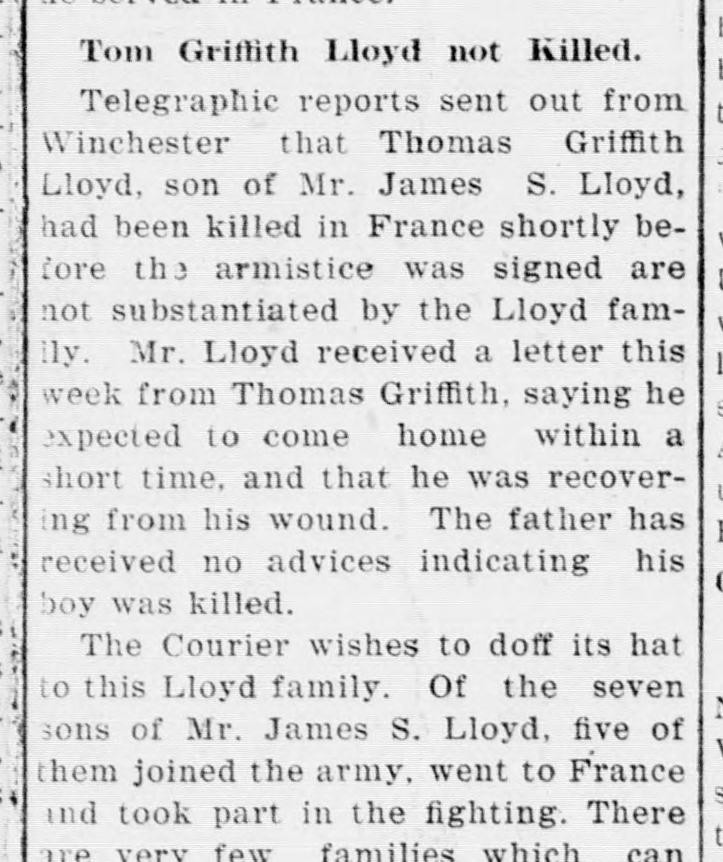
"Tom Griffith Lloyd not Killed," with the Courier's tribute to a father who sent five of his seven sons to France.
What this image does and does not showA crop of part of one page; the rest of the page is not shown.
Clarke Courier (Berryville, Va.), January 9, 1919, page 1. Library of Congress, Chronicling America. Rights Changes: Cropped from the Library of Congress page image to the region of this item: 723 by 862 pixels, shown at its own 723 by 862 pixels; re-encoded as JPEG. Nothing retouched or added.
Source: Clarke Courier, Berryville, Va., January 9, 1919 (the masthead misprints the year as 1918; the Library of Congress files the issue as January 10, 1918), page 1: "Tom Griffith Lloyd not Killed" Open the full image
Wounded in France
Just after Christmas 1918 the Courier reported that Thomas Griffith Lloyd and Charles Lemly Lloyd had both been wounded in France in October, Charles on the 6th and Thomas on the 15th. Two weeks later it had to correct a rumor. Telegraphed reports from Winchester said Thomas had been killed just before the armistice; they were "not substantiated by the Lloyd family," the paper wrote.
By August 1919 the paper could describe the wounds. Thomas had been hit in the hip by a machine-gun bullet at Verdun and then, as he was carried off the field, by shrapnel that tore through his leg, "laming him for life." Howard had a bullet through the foot and shell shock. Charles, wounded three times, had re-enlisted in the military police.
Source note: Clarke Courier, Berryville, Va., 1918, and one more
In December 1918 the Courier reported that Thomas Griffith Lloyd and Charles Lemly Lloyd had both been wounded in France in October; a few weeks later it reported that telegraphed news of Thomas's death was false.
What the source supports
Two brothers wounded, and the false report.
Uncertainty
The paper's dates come from a letter and a War Department telegram.
Source
Evidence role: supports. Both wounded.
Clarke Courier, Berryville, Va., December 26, 1918, page 1: "Two Lloyd Brothers Wounded"
Clarke Courier, Berryville, Va. · 1918-12-26 (publication)
Locator: Page 1, "Two Lloyd Brothers Wounded"
Relevant passagePrivates Thomas Griffith Lloyd and Charles Lemly Lloyd, sons of Mr. James Lloyd, of Clarke county, have been wounded in France, according to a letter and a telegram received by their relatives here.
Checked: Original inspected. A digital reproduction was inspected; no original has been handled.
Open sourceSource family: clarke-courier. Multiple passages from one source are not independent witnesses.
Evidence role: supports. The dates.
Clarke Courier, Berryville, Va., December 26, 1918, page 1: "Two Lloyd Brothers Wounded"
Clarke Courier, Berryville, Va. · 1918-12-26 (publication)
Locator: Page 1, "Two Lloyd Brothers Wounded"
Relevant passageThe War Department notified Mr. Lloyd of his son Charles' mishap with the Huns, and a letter from Thomas told of the wound he received. The former was wounded October 6, and the latter on October 15.
Checked: Original inspected. A digital reproduction was inspected; no original has been handled.
Open sourceSource family: clarke-courier. Multiple passages from one source are not independent witnesses.
Evidence role: supports. The false report.
Clarke Courier, Berryville, Va., January 9, 1919 (the masthead misprints the year as 1918; the Library of Congress files the issue as January 10, 1918), page 1: "Tom Griffith Lloyd not Killed"
Clarke Courier, Berryville, Va. · 1919-01-09 (publication)
Locator: Page 1, "Tom Griffith Lloyd not Killed"
Relevant passageTelegraphic reports sent out from Winchester that Thomas Griffith Lloyd, son of Mr. James S. Lloyd, had been killed in France shortly before the armistice was signed are not substantiated by the Lloyd family.
Checked: Original inspected. A digital reproduction was inspected; no original has been handled.
Open sourceSource family: clarke-courier. Multiple passages from one source are not independent witnesses.
AI-assisted source check (Claude Opus 5.5) · 2026-10-12. How this project checks its sources
Source note: Clarke Courier, Berryville, Va., 1919
In August 1919 the Courier described their wounds: Charles, wounded three times, had re-enlisted in the military police; Thomas Griffith, hit in the hip by a machine-gun bullet at Verdun and then by shrapnel as he was carried off, was left with a wound "laming him for life"; Howard had a bullet through the foot and shell shock.
What the source supports
The brothers' wounds.
Uncertainty
As the paper described them.
Source
Evidence role: supports. Charles.
Clarke Courier, Berryville, Va., August 14, 1919, page 1: an item on the wounds of the Lloyd brothers
Clarke Courier, Berryville, Va. · 1919-08-14 (publication)
Locator: Page 1, the item on the Lloyd brothers' wounds
Relevant passageCharles Lemly Lloyd, despite the fact he was wounded three times, re-enlisted and is now serving in the military police.
Checked: Original inspected. A digital reproduction was inspected; no original has been handled.
Open sourceSource family: clarke-courier. Multiple passages from one source are not independent witnesses.
Evidence role: supports. Thomas's two wounds.
Clarke Courier, Berryville, Va., August 14, 1919, page 1: an item on the wounds of the Lloyd brothers
Clarke Courier, Berryville, Va. · 1919-08-14 (publication)
Locator: Page 1, the item on the Lloyd brothers' wounds
Relevant passageThomas Griffith Lloyd received two wounds. When a machine gun bullet pierced his hip at Verdun when his regiment went over the top, he was wounded the second time by bursting sharpnel [sic] while being carried off the field.
Checked: Original inspected. A digital reproduction was inspected; no original has been handled.
Open sourceSource family: clarke-courier. Multiple passages from one source are not independent witnesses.
Evidence role: supports. Lamed for life.
Clarke Courier, Berryville, Va., August 14, 1919, page 1: an item on the wounds of the Lloyd brothers
Clarke Courier, Berryville, Va. · 1919-08-14 (publication)
Locator: Page 1, the item on the Lloyd brothers' wounds
Relevant passageA piece of shrapnel, as big as a boy's fist, ploughed its way through the muscles of his leg, laming him for life.
Checked: Original inspected. A digital reproduction was inspected; no original has been handled.
Open sourceSource family: clarke-courier. Multiple passages from one source are not independent witnesses.
Evidence role: supports. Howard.
Clarke Courier, Berryville, Va., August 14, 1919, page 1: an item on the wounds of the Lloyd brothers
Clarke Courier, Berryville, Va. · 1919-08-14 (publication)
Locator: Page 1, the item on the Lloyd brothers' wounds
Relevant passageHoward Lloyd was also severely wounded. A machine gun bullet not only pierced his foot but he suffered from shell shock. Accompanied by his brother Grover, he went to Washington for medical attention.
Checked: Original inspected. A digital reproduction was inspected; no original has been handled.
Open sourceSource family: clarke-courier. Multiple passages from one source are not independent witnesses.
AI-assisted source check (Claude Opus 5.5) · 2026-10-12. How this project checks its sources
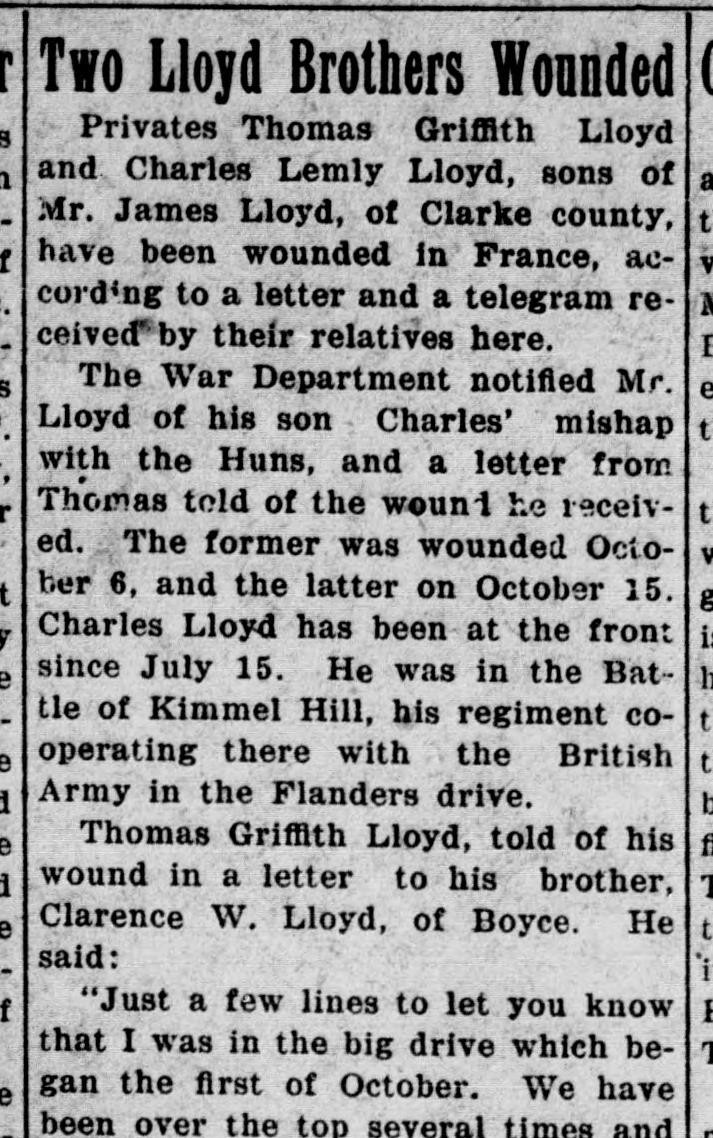
"Two Lloyd Brothers Wounded": Thomas Griffith and Charles Lemly Lloyd, both hit in France in October 1918.
What this image does and does not showA crop of part of one page; the rest of the page is not shown.
Clarke Courier (Berryville, Va.), December 26, 1918, page 1. Library of Congress, Chronicling America. Rights Changes: Cropped from the Library of Congress page image to the region of this item: 713 by 1138 pixels, shown at its own 713 by 1138 pixels; re-encoded as JPEG. Nothing retouched or added.
Source: Clarke Courier, Berryville, Va., December 26, 1918, page 1: "Two Lloyd Brothers Wounded" Open the full image
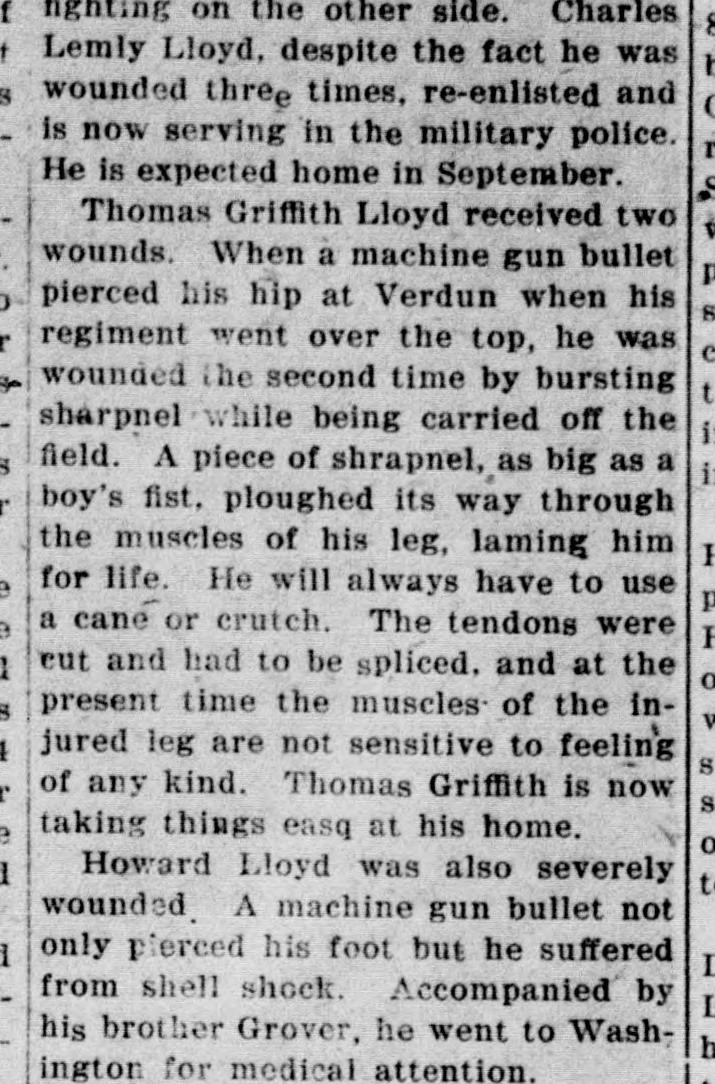
Charles wounded three times, Thomas lamed for life, Howard shot through the foot: the Courier on the brothers' wounds.
What this image does and does not showA crop of part of one page; the rest of the page is not shown.
Clarke Courier (Berryville, Va.), August 14, 1919, page 1. Library of Congress, Chronicling America. Rights Changes: Cropped from the Library of Congress page image to the region of this item: 715 by 1084 pixels, shown at its own 715 by 1084 pixels; re-encoded as JPEG. Nothing retouched or added.
Source: Clarke Courier, Berryville, Va., August 14, 1919, page 1: an item on the wounds of the Lloyd brothers Open the full image
Coming home
Howard landed in New York in March 1919 and was home in April. On the street one Tuesday night he told a group of men, "The past ten months are the worst I have ever been through." And: "If h— is as bad as what I have been through, you fellows take my advice and do better in this world—get closer to your church and your God."
Charles was "the last of the five soldier sons" to come home, in November 1919. He had been badly gassed and wounded in the Argonne with the 318th Regiment, 80th Division. When he was hit, the Courier said, he swallowed the piece of tobacco in his mouth, grew sick, and had to take off his gas mask.
Source note: Clarke Courier, Berryville, Va., 1919
Howard B. Lloyd landed in New York in March 1919 and was home in April; on a Berryville street he told a group of men that "The past ten months are the worst I have ever been through," and urged them to "get closer to your church and your God."
What the source supports
Howard's return and his words.
Uncertainty
His words as the paper printed them.
Source
Evidence role: supports. Landed in New York.
Clarke Courier, Berryville, Va., March 13, 1919, page 1: an item on the Lloyd brothers
Clarke Courier, Berryville, Va. · 1919-03-13 (publication)
Locator: Page 1, the item on the Lloyd brothers
Relevant passageAnother son, Howard B. Lloyd, has arrived safely in New York according to a telegram received by his brother, Mr. Clarence W. Lloyd, of Boyce.
Checked: Original inspected. A digital reproduction was inspected; no original has been handled.
Open sourceSource family: clarke-courier. Multiple passages from one source are not independent witnesses.
Evidence role: supports. Home.
Clarke Courier, Berryville, Va., April 17, 1919, page 1: "Beautiful Memorial to Maj. Lloyd W. Williams Will be Placed in Grace Episcopal Church"
Clarke Courier, Berryville, Va. · 1919-04-17 (publication)
Locator: Page 1, the report on Tapscott and Howard Lloyd home from France
Relevant passageCorporal Thomas Gold Tapscott and Howard Lloyd, two sons of old Clarke who were wounded in encounters with the Hun, are back at their home firesides.
Checked: Original inspected. A digital reproduction was inspected; no original has been handled.
Open sourceSource family: clarke-courier. Multiple passages from one source are not independent witnesses.
Evidence role: supports. His words.
Clarke Courier, Berryville, Va., April 17, 1919, page 1: "Beautiful Memorial to Maj. Lloyd W. Williams Will be Placed in Grace Episcopal Church"
Clarke Courier, Berryville, Va. · 1919-04-17 (publication)
Locator: Page 1, the report on Tapscott and Howard Lloyd home from France
Relevant passage"The past ten months are the worst I have ever been through," Howard said to a group of men on the street Tuesday night.
Checked: Original inspected. A digital reproduction was inspected; no original has been handled.
Open sourceSource family: clarke-courier. Multiple passages from one source are not independent witnesses.
Evidence role: supports. His advice.
Clarke Courier, Berryville, Va., April 17, 1919, page 1: "Beautiful Memorial to Maj. Lloyd W. Williams Will be Placed in Grace Episcopal Church"
Clarke Courier, Berryville, Va. · 1919-04-17 (publication)
Locator: Page 1, the report on Tapscott and Howard Lloyd home from France
Relevant passage"If h— is as bad as what I have been through, you fellows take my advice and do better in this world—get closer to your church and your God."
Checked: Original inspected. A digital reproduction was inspected; no original has been handled.
Open sourceSource family: clarke-courier. Multiple passages from one source are not independent witnesses.
AI-assisted source check (Claude Opus 5.5) · 2026-10-12. How this project checks its sources
Source note: Clarke Courier, Berryville, Va., 1919
Charles Lemly Lloyd, "the last of the five soldier sons" to come home, returned in November 1919; badly gassed and wounded in the Argonne with the 318th Regiment, 80th Division, he had swallowed his tobacco when he was hit, grown sick, and had to take off his gas mask, the Courier reported.
What the source supports
Charles's return and how he was gassed.
Uncertainty
The story of the tobacco is his, as the paper told it.
Source
Evidence role: supports. The last home.
Clarke Courier, Berryville, Va., November 27, 1919, page 4: "Lloyd Soldier Boy Returns"
Clarke Courier, Berryville, Va. · 1919-11-27 (publication)
Locator: Page 4, "Lloyd Soldier Boy Returns"
Relevant passageCharles Lemly Lloyd, the last of the five soldier sons of Mr. J. W. Lloyd, who followed the Stars and Stripes to the Battlefields of France, is home.
Checked: Original inspected. A digital reproduction was inspected; no original has been handled.
Open sourceSource family: clarke-courier. Multiple passages from one source are not independent witnesses.
Evidence role: supports. Gassed and wounded; his regiment.
Clarke Courier, Berryville, Va., November 27, 1919, page 4: "Lloyd Soldier Boy Returns"
Clarke Courier, Berryville, Va. · 1919-11-27 (publication)
Locator: Page 4, "Lloyd Soldier Boy Returns"
Relevant passageCharles Lemly was badly gassed and wounded in the Battle of Argonne Forest. He was with the 318th Regiment, 80th Division, in the fighting around Verdun.
Checked: Original inspected. A digital reproduction was inspected; no original has been handled.
Open sourceSource family: clarke-courier. Multiple passages from one source are not independent witnesses.
Evidence role: supports. The tobacco and the mask.
Clarke Courier, Berryville, Va., November 27, 1919, page 4: "Lloyd Soldier Boy Returns"
Clarke Courier, Berryville, Va. · 1919-11-27 (publication)
Locator: Page 4, "Lloyd Soldier Boy Returns"
Relevant passageAt the time he had a piece of tobacco in his mouth. When he received his wound, he swallowed the tobacco, which together with the wound made him sick, and was forced to take off his gas mask.
Checked: Original inspected. A digital reproduction was inspected; no original has been handled.
Open sourceSource family: clarke-courier. Multiple passages from one source are not independent witnesses.
AI-assisted source check (Claude Opus 5.5) · 2026-10-12. How this project checks its sources
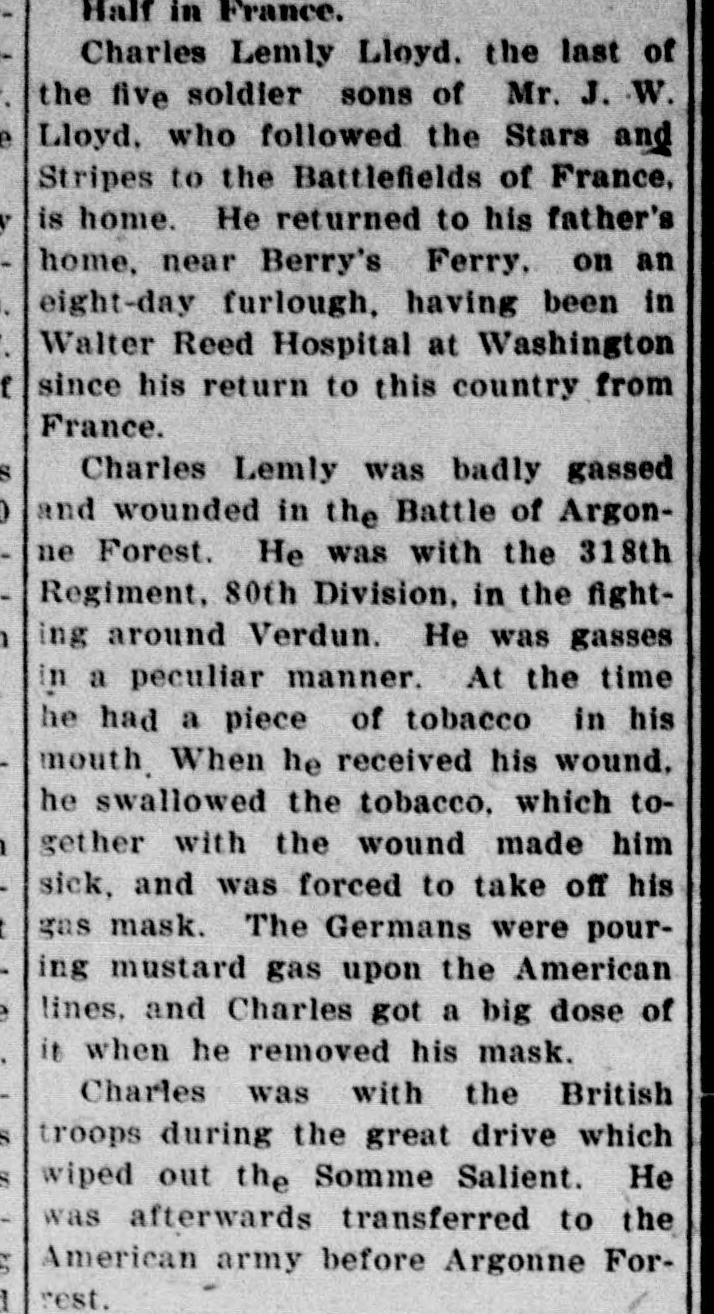
"The last of the five soldier sons" comes home: Charles Lemly Lloyd, gassed in the Argonne.
What this image does and does not showA crop of part of one page; the rest of the page is not shown.
Clarke Courier (Berryville, Va.), November 27, 1919, page 4. Library of Congress, Chronicling America. Rights Changes: Cropped from the Library of Congress page image to the region of this item: 714 by 1314 pixels, shown at its own 714 by 1314 pixels; re-encoded as JPEG. Nothing retouched or added.
Source: Clarke Courier, Berryville, Va., November 27, 1919, page 4: "Lloyd Soldier Boy Returns" Open the full image
Linton
Linton Earl Lloyd, the youngest, had served in France with Co. D, 101st Infantry, 26th Division. In February 1922, at 24, he drowned in a small reservoir not far from his father's house. All five brothers, the Courier wrote, were members of the Lloyd Williams Post of the American Legion.
Source note: Clarke Courier, 1922
Linton Earl Lloyd, the youngest, who served with Co. D, 101st Infantry, 26th Division, drowned in February 1922 at 24 in a small reservoir not far from his father's home; he and his four brothers were members of the Lloyd Williams Post, the Courier reported.
What the source supports
Linton's death and his service.
Uncertainty
A death notice; the cause of the fall is the paper's guess.
Source
Evidence role: supports. His death.
Clarke Courier, Berryville, Va., February 9, 1922
Clarke Courier · 1922-02-09 (publication)
Locator: Page 1, "World War Veteran Drowned"
Relevant passagePrivate Linton Earl Lloyd, the youngest son of Mr. and Mrs. Jas. W. Lloyd, of near Berrys Ferry, who was one of the fifive [sic] Lloyd brothers who went to France and helped lick the Kaiser, was drowned in a small reservoir not far from his father's home last Friday.
Checked: This passage was read on a digital reproduction of the page; no original has been handled. The source's other readings: existing OCR reviewed, original image not independently inspected.
Open sourceSource family: clarke-courier. Multiple passages from one source are not independent witnesses.
Evidence role: supports. His age and unit.
Clarke Courier, Berryville, Va., February 9, 1922
Clarke Courier · 1922-02-09 (publication)
Locator: Page 1, "World War Veteran Drowned"
Relevant passageMr. Lloyd was 24 years old. He served as a member of Co. D, 101st Inf., 26th Division (Yankee Division),
Checked: This passage was read on a digital reproduction of the page; no original has been handled. The source's other readings: existing OCR reviewed, original image not independently inspected.
Open sourceSource family: clarke-courier. Multiple passages from one source are not independent witnesses.
Evidence role: supports. The five in the post.
Clarke Courier, Berryville, Va., February 9, 1922
Clarke Courier · 1922-02-09 (publication)
Locator: Page 1, "World War Veteran Drowned"
Relevant passageMr. Lloyd and his four brothers, Messrs. Charles, Howard, Griffith and Grover, were members of the Lloyd Williams Post.
Checked: This passage was read on a digital reproduction of the page; no original has been handled. The source's other readings: existing OCR reviewed, original image not independently inspected.
Open sourceSource family: clarke-courier. Multiple passages from one source are not independent witnesses.
AI-assisted source check (Claude Opus 5.5) · 2026-10-12. How this project checks its sources
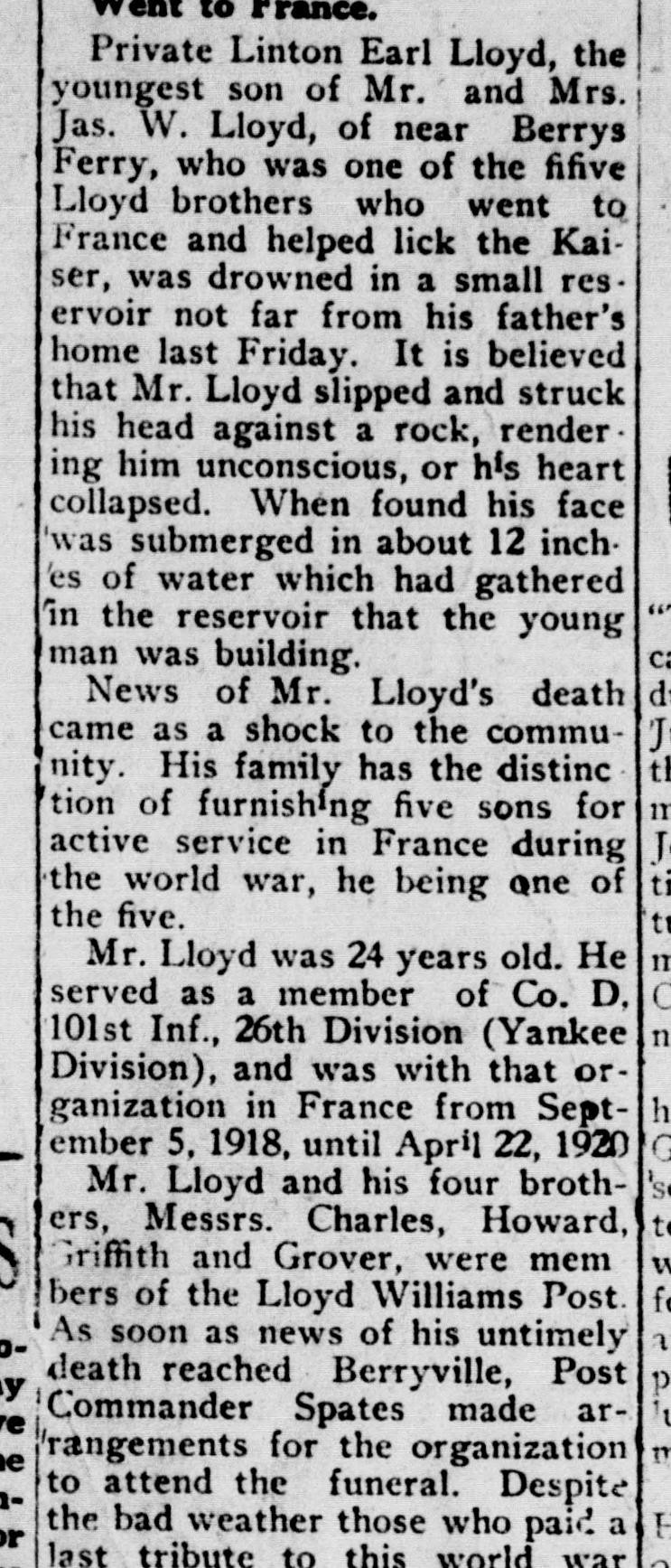
"World War Veteran Drowned": Linton Earl Lloyd, the youngest of the five brothers, in 1922.
What this image does and does not showA crop of part of one page; the rest of the page is not shown.
Clarke Courier (Berryville, Va.), February 9, 1922, page 1. Library of Congress, Chronicling America. Rights Changes: Cropped from the Library of Congress page image to the region of this item: 743 by 1735 pixels, shown at its own 743 by 1735 pixels; re-encoded as JPEG. Nothing retouched or added.
Source: Clarke Courier, Berryville, Va., February 9, 1922 Open the full image
About the reportsWhat the evidence says
Six Clarke Courier items of 1918 to 1922, read on the Library of Congress page images, and the Virginia War History Commission's 1927 county history follow the five Lloyd brothers through the First World War.
The reports were written as the news came, from letters, telegrams and the men themselves. The Commission's line agrees with the Courier on the five names.
- An account exists✓ Supported by a source
The Virginia War History Commission's 1927 history of Clarke County says "Mr. J. W. Lloyd had five sons in service": Charles, Grover, Linton, Thomas and Howard. The Courier wrote in January 1919 that five of his seven sons "joined the army, went to France and took part in the fighting," and in March that the family was "one of the few in America which gave five sons."
See the evidence
✓ Supported by a sourceAn account existsThe Virginia War History Commission's 1927 history of Clarke County says "Mr. J. W. Lloyd had five sons in service": Charles, Grover, Linton, Thomas and Howard. The Courier wrote in January 1919 that five of his seven sons "joined the army, went to France and took part in the fighting," and in March that the family was "one of the few in America which gave five sons."
What the source supports
That five Lloyd brothers served, and who they were.
Uncertainty
The paper's "one of the few in America" is its own judgment.
Source
Later historical account Evidence role: supports. The five, by name.
Virginia War History Commission, "Clarke County in War Time: A Community History," in Virginia Communities in War Time, Second Series (Publications of the Virginia War History Commission, Source Volume VII, ed. Arthur Kyle Davis, Richmond, 1927), pp. 27-28, "Churches in War Time"
Virginia War History Commission; Arthur Kyle Davis, editor · 1927 (publication)
Locator: Page 29, "Churches in War Time," the distinguished-service paragraph
Relevant passageMr. J. W. Lloyd had five sons in service—Charles, Grover, Linton, Thomas and Howard.
Checked: Original inspected. A digital reproduction was inspected; no original has been handled.
Open sourceSource family: virginia-war-history-commission. Multiple passages from one source are not independent witnesses.
Reporting Evidence role: supports. Five of seven, in France.
Clarke Courier, Berryville, Va., January 9, 1919 (the masthead misprints the year as 1918; the Library of Congress files the issue as January 10, 1918), page 1: "Tom Griffith Lloyd not Killed"
Clarke Courier, Berryville, Va. · 1919-01-09 (publication)
Locator: Page 1, "Tom Griffith Lloyd not Killed"
Relevant passageOf the seven sons of Mr. James S. Lloyd, five of them joined the army, went to France and took part in the fighting.
Checked: Original inspected. A digital reproduction was inspected; no original has been handled.
Open sourceSource family: clarke-courier. Multiple passages from one source are not independent witnesses.
Reporting Evidence role: supports. One of the few families.
Clarke Courier, Berryville, Va., March 13, 1919, page 1: an item on the Lloyd brothers
Clarke Courier, Berryville, Va. · 1919-03-13 (publication)
Locator: Page 1, the item on the Lloyd brothers
Relevant passagehis family being one of the few in America which gave five sons to the cause of Democracy in the World War.
Checked: Original inspected. A digital reproduction was inspected; no original has been handled.
Open sourceSource family: clarke-courier. Multiple passages from one source are not independent witnesses.
AI-assisted source check (Claude Opus 5.5) · 2026-10-12. How this project checks its sources
- An account exists✓ Supported by a source
In August 1919 the Courier described their wounds: Charles, wounded three times, had re-enlisted in the military police; Thomas Griffith, hit in the hip by a machine-gun bullet at Verdun and then by shrapnel as he was carried off, was left with a wound "laming him for life"; Howard had a bullet through the foot and shell shock.
See the evidence
✓ Supported by a sourceAn account existsIn August 1919 the Courier described their wounds: Charles, wounded three times, had re-enlisted in the military police; Thomas Griffith, hit in the hip by a machine-gun bullet at Verdun and then by shrapnel as he was carried off, was left with a wound "laming him for life"; Howard had a bullet through the foot and shell shock.
What the source supports
The brothers' wounds.
Uncertainty
As the paper described them.
Source
Reporting Evidence role: supports. Charles.
Clarke Courier, Berryville, Va., August 14, 1919, page 1: an item on the wounds of the Lloyd brothers
Clarke Courier, Berryville, Va. · 1919-08-14 (publication)
Locator: Page 1, the item on the Lloyd brothers' wounds
Relevant passageCharles Lemly Lloyd, despite the fact he was wounded three times, re-enlisted and is now serving in the military police.
Checked: Original inspected. A digital reproduction was inspected; no original has been handled.
Open sourceSource family: clarke-courier. Multiple passages from one source are not independent witnesses.
Reporting Evidence role: supports. Thomas's two wounds.
Clarke Courier, Berryville, Va., August 14, 1919, page 1: an item on the wounds of the Lloyd brothers
Clarke Courier, Berryville, Va. · 1919-08-14 (publication)
Locator: Page 1, the item on the Lloyd brothers' wounds
Relevant passageThomas Griffith Lloyd received two wounds. When a machine gun bullet pierced his hip at Verdun when his regiment went over the top, he was wounded the second time by bursting sharpnel [sic] while being carried off the field.
Checked: Original inspected. A digital reproduction was inspected; no original has been handled.
Open sourceSource family: clarke-courier. Multiple passages from one source are not independent witnesses.
Reporting Evidence role: supports. Lamed for life.
Clarke Courier, Berryville, Va., August 14, 1919, page 1: an item on the wounds of the Lloyd brothers
Clarke Courier, Berryville, Va. · 1919-08-14 (publication)
Locator: Page 1, the item on the Lloyd brothers' wounds
Relevant passageA piece of shrapnel, as big as a boy's fist, ploughed its way through the muscles of his leg, laming him for life.
Checked: Original inspected. A digital reproduction was inspected; no original has been handled.
Open sourceSource family: clarke-courier. Multiple passages from one source are not independent witnesses.
Reporting Evidence role: supports. Howard.
Clarke Courier, Berryville, Va., August 14, 1919, page 1: an item on the wounds of the Lloyd brothers
Clarke Courier, Berryville, Va. · 1919-08-14 (publication)
Locator: Page 1, the item on the Lloyd brothers' wounds
Relevant passageHoward Lloyd was also severely wounded. A machine gun bullet not only pierced his foot but he suffered from shell shock. Accompanied by his brother Grover, he went to Washington for medical attention.
Checked: Original inspected. A digital reproduction was inspected; no original has been handled.
Open sourceSource family: clarke-courier. Multiple passages from one source are not independent witnesses.
AI-assisted source check (Claude Opus 5.5) · 2026-10-12. How this project checks its sources
- An account exists✓ Supported by a source
Charles Lemly Lloyd, "the last of the five soldier sons" to come home, returned in November 1919; badly gassed and wounded in the Argonne with the 318th Regiment, 80th Division, he had swallowed his tobacco when he was hit, grown sick, and had to take off his gas mask, the Courier reported.
See the evidence
✓ Supported by a sourceAn account existsCharles Lemly Lloyd, "the last of the five soldier sons" to come home, returned in November 1919; badly gassed and wounded in the Argonne with the 318th Regiment, 80th Division, he had swallowed his tobacco when he was hit, grown sick, and had to take off his gas mask, the Courier reported.
What the source supports
Charles's return and how he was gassed.
Uncertainty
The story of the tobacco is his, as the paper told it.
Source
Reporting Evidence role: supports. The last home.
Clarke Courier, Berryville, Va., November 27, 1919, page 4: "Lloyd Soldier Boy Returns"
Clarke Courier, Berryville, Va. · 1919-11-27 (publication)
Locator: Page 4, "Lloyd Soldier Boy Returns"
Relevant passageCharles Lemly Lloyd, the last of the five soldier sons of Mr. J. W. Lloyd, who followed the Stars and Stripes to the Battlefields of France, is home.
Checked: Original inspected. A digital reproduction was inspected; no original has been handled.
Open sourceSource family: clarke-courier. Multiple passages from one source are not independent witnesses.
Reporting Evidence role: supports. Gassed and wounded; his regiment.
Clarke Courier, Berryville, Va., November 27, 1919, page 4: "Lloyd Soldier Boy Returns"
Clarke Courier, Berryville, Va. · 1919-11-27 (publication)
Locator: Page 4, "Lloyd Soldier Boy Returns"
Relevant passageCharles Lemly was badly gassed and wounded in the Battle of Argonne Forest. He was with the 318th Regiment, 80th Division, in the fighting around Verdun.
Checked: Original inspected. A digital reproduction was inspected; no original has been handled.
Open sourceSource family: clarke-courier. Multiple passages from one source are not independent witnesses.
Reporting Evidence role: supports. The tobacco and the mask.
Clarke Courier, Berryville, Va., November 27, 1919, page 4: "Lloyd Soldier Boy Returns"
Clarke Courier, Berryville, Va. · 1919-11-27 (publication)
Locator: Page 4, "Lloyd Soldier Boy Returns"
Relevant passageAt the time he had a piece of tobacco in his mouth. When he received his wound, he swallowed the tobacco, which together with the wound made him sick, and was forced to take off his gas mask.
Checked: Original inspected. A digital reproduction was inspected; no original has been handled.
Open sourceSource family: clarke-courier. Multiple passages from one source are not independent witnesses.
AI-assisted source check (Claude Opus 5.5) · 2026-10-12. How this project checks its sources
- An account exists✓ Supported by a source
Linton Earl Lloyd, the youngest, who served with Co. D, 101st Infantry, 26th Division, drowned in February 1922 at 24 in a small reservoir not far from his father's home; he and his four brothers were members of the Lloyd Williams Post, the Courier reported.
See the evidence
✓ Supported by a sourceAn account existsLinton Earl Lloyd, the youngest, who served with Co. D, 101st Infantry, 26th Division, drowned in February 1922 at 24 in a small reservoir not far from his father's home; he and his four brothers were members of the Lloyd Williams Post, the Courier reported.
What the source supports
Linton's death and his service.
Uncertainty
A death notice; the cause of the fall is the paper's guess.
Source
Reporting Evidence role: supports. His death.
Clarke Courier, Berryville, Va., February 9, 1922
Clarke Courier · 1922-02-09 (publication)
Locator: Page 1, "World War Veteran Drowned"
Relevant passagePrivate Linton Earl Lloyd, the youngest son of Mr. and Mrs. Jas. W. Lloyd, of near Berrys Ferry, who was one of the fifive [sic] Lloyd brothers who went to France and helped lick the Kaiser, was drowned in a small reservoir not far from his father's home last Friday.
Checked: This passage was read on a digital reproduction of the page; no original has been handled. The source's other readings: existing OCR reviewed, original image not independently inspected.
Open sourceSource family: clarke-courier. Multiple passages from one source are not independent witnesses.
Reporting Evidence role: supports. His age and unit.
Clarke Courier, Berryville, Va., February 9, 1922
Clarke Courier · 1922-02-09 (publication)
Locator: Page 1, "World War Veteran Drowned"
Relevant passageMr. Lloyd was 24 years old. He served as a member of Co. D, 101st Inf., 26th Division (Yankee Division),
Checked: This passage was read on a digital reproduction of the page; no original has been handled. The source's other readings: existing OCR reviewed, original image not independently inspected.
Open sourceSource family: clarke-courier. Multiple passages from one source are not independent witnesses.
Reporting Evidence role: supports. The five in the post.
Clarke Courier, Berryville, Va., February 9, 1922
Clarke Courier · 1922-02-09 (publication)
Locator: Page 1, "World War Veteran Drowned"
Relevant passageMr. Lloyd and his four brothers, Messrs. Charles, Howard, Griffith and Grover, were members of the Lloyd Williams Post.
Checked: This passage was read on a digital reproduction of the page; no original has been handled. The source's other readings: existing OCR reviewed, original image not independently inspected.
Open sourceSource family: clarke-courier. Multiple passages from one source are not independent witnesses.
AI-assisted source check (Claude Opus 5.5) · 2026-10-12. How this project checks its sources
Each statement above is assessed on its own evidence. Nothing here is averaged, scored or voted on, and a well-attributed account can be documented while what it describes stays unconfirmed.
Source note
This story rests on Clarke Courier items of 1918 to 1922, read on the Library of Congress page images, and on the Commission's 1927 county history, read on the HathiTrust page images. The papers print the father's name four ways (J. W., James, James S. and Jas. W. Lloyd). The January 1919 issue is misdated "1918" on its masthead. The wartime words reported here ("the Huns," "lick the Kaiser") are the paper's and the soldiers'; this site does not adopt them. The brothers are on this site's roll of Clarke's veterans.
Where did Grover and Linton Lloyd serve before they reached France, and what became of the brothers who came home?
Know more about this story, or see something to correct? Help fill a gap. It stays private until it is reviewed.
Remember this place or someone in this story? Share a memory, even if you do not know the date. It stays private until it is reviewed.
Go deeper: every source under this story Follow another threadStars on the flags: Clarke's churches in the World War
How Clarke's churches marked the same war, from the service flags to the tablet for the Legion post's namesake.