What the sources support
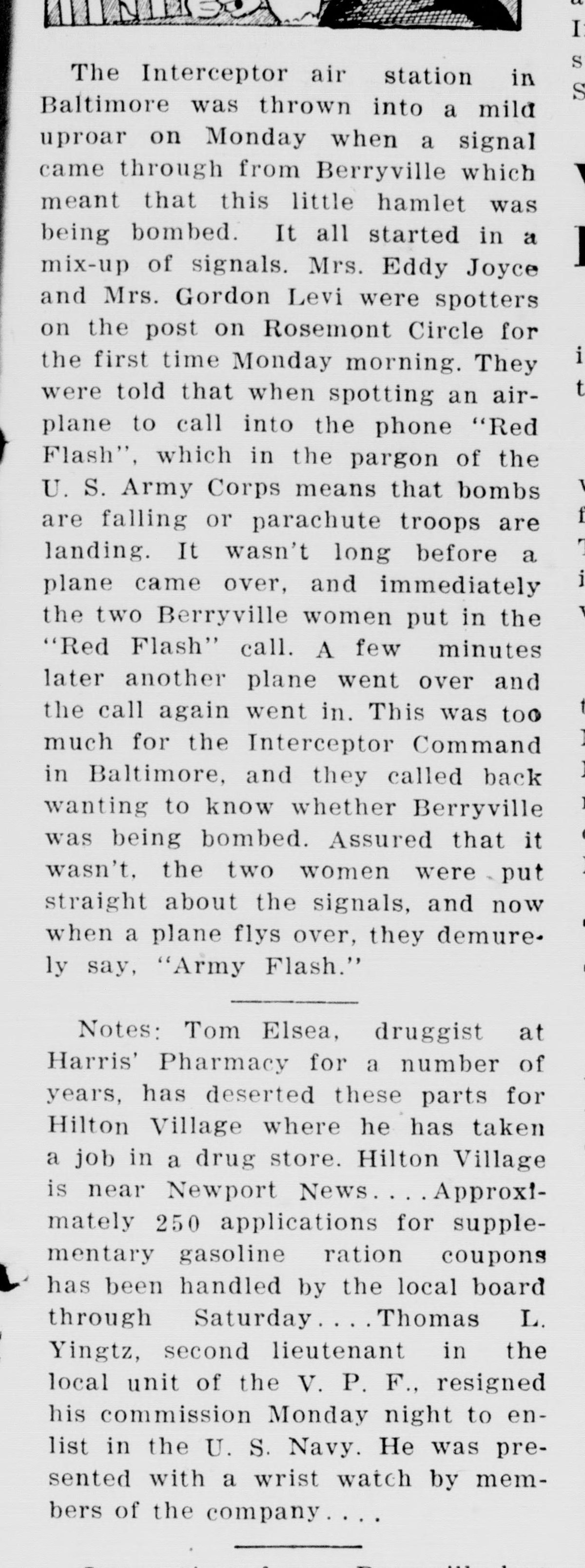
The "Courier Chatter" column of the Clarke Courier of August 6, 1942 reported that Mrs. Eddy Joyce and Mrs. Gordon Levi, spotting for the first time at the post on Rosemont Circle on the Monday morning, had been told to call "Red Flash" into the telephone on sighting an airplane, a signal that in the Army's usage meant bombs were falling or parachute troops were landing; that they called it in for one plane and again for another a few minutes later; that the Interceptor Command in Baltimore called back to ask whether Berryville was being bombed; and that, put straight about the signals, the two women now said "Army Flash."
The Clarke Courier of June 12, 1941 reported that the formation of a Clarke county station of the Virginia Aircraft Warning Service was being carried out by H. B. Harris, commander of the Lloyd Williams Post, American Legion, and Townsend Burwell, and that Commander Harris asked for volunteers as chief observers and observers for the eight posts to be established in the county.
The same report outlines the plan: a state-wide system of unpaid volunteers to watch for enemy aircraft; for each local post, a chief observer living within the area who would name about 15 observers, also living within the post's territory; and local posts reporting enemy planes to either Roanoke or Richmond, where the report would be analyzed and sent on to Norfolk for action.
The Clarke Courier of July 22, 1943 said the Aircraft Warning Service in Clarke county had first been inaugurated with about nine posts set at strategic points in the county about two years before, and that the year before the posts had been closed and three new ones set up.
The Clarke Courier of April 30, 1942 reported that eliminating all air warning posts in the county and centralizing them at three points was discussed on the Monday night in Berryville at a meeting called by H. B. Harris, who had established the posts the year before; that the purpose was the tire and gasoline rationing and to have the posts manned 24 hours a day; that preliminary plans would locate them in Berryville, Boyce and White Post; and that the Rev. E. D. Vaughan, pastor of the Berryville Presbyterian Church, had been appointed chief observer in Berryville, W. D. Burtner had been appointed at Boyce, and A. Mackay Smith had been suggested for White Post.
The Clarke Courier of September 24, 1942 reported that the Berryville Aircraft Warning Post planned to change from four-hour to three-hour watches beginning October 1, which would require 28 more observers for the added shifts, besides 21 more spotters for hours vacant then or when school began, approximately 50 in all; that the new shifts would begin at 8 a.m. and run around the clock, the daylight shifts manned by the ladies and the night hours given to the men, with an assistant chief observer in charge of each day's group and two observers on duty at the same period; that those willing to give three hours a week were asked to call the chief observer, E. D. Vaughan, or the assistant chief observer for the day they wished to serve; and that identification cards would be issued to all observers and arm bands to those with 25 hours of service.
The Clarke Courier of September 3, 1942 reported that the erection of a spotters' post in White Post was voted on the Thursday night of the previous week at a meeting called by A. Mackay Smith, chief observer; that the spotters voted to copy the post at Brucetown, an elevated building about 16 feet in the air, with a post on top 8 feet, enclosed by glass, and a walkway around it; that Smith hoped to raise $140 to pay for the materials and furnish it; and that it would be erected on donated land, with the labor donated.
The Clarke Courier of December 3, 1942 reported that the spotter post at Boyce was dedicated on the Sunday by George H. Burwell in the Parish House as "the material expression of a watchful public spirited community," and that John Zombro, chief air spotter of the post, who presided, thanked those present for their contributions and said he was sure they considered their work just beginning.
The Clarke Courier of July 22, 1943 reported that the three observation posts in Clarke county had been closed at midnight the night before on an order from the War Department, which announced that in its opinion "the danger of a large scale sustained attack from the air in this section has passed"; that the posts were to maintain their organizations and be ready to spring back into action on short notice; that their chief observers had been A. Mackay Smith at White Post, John E. Zombro at Boyce and the Rev. Henry G. Lane at Berryville; and that observers were asked to report the hours they had served so that the War Department could present souvenirs.
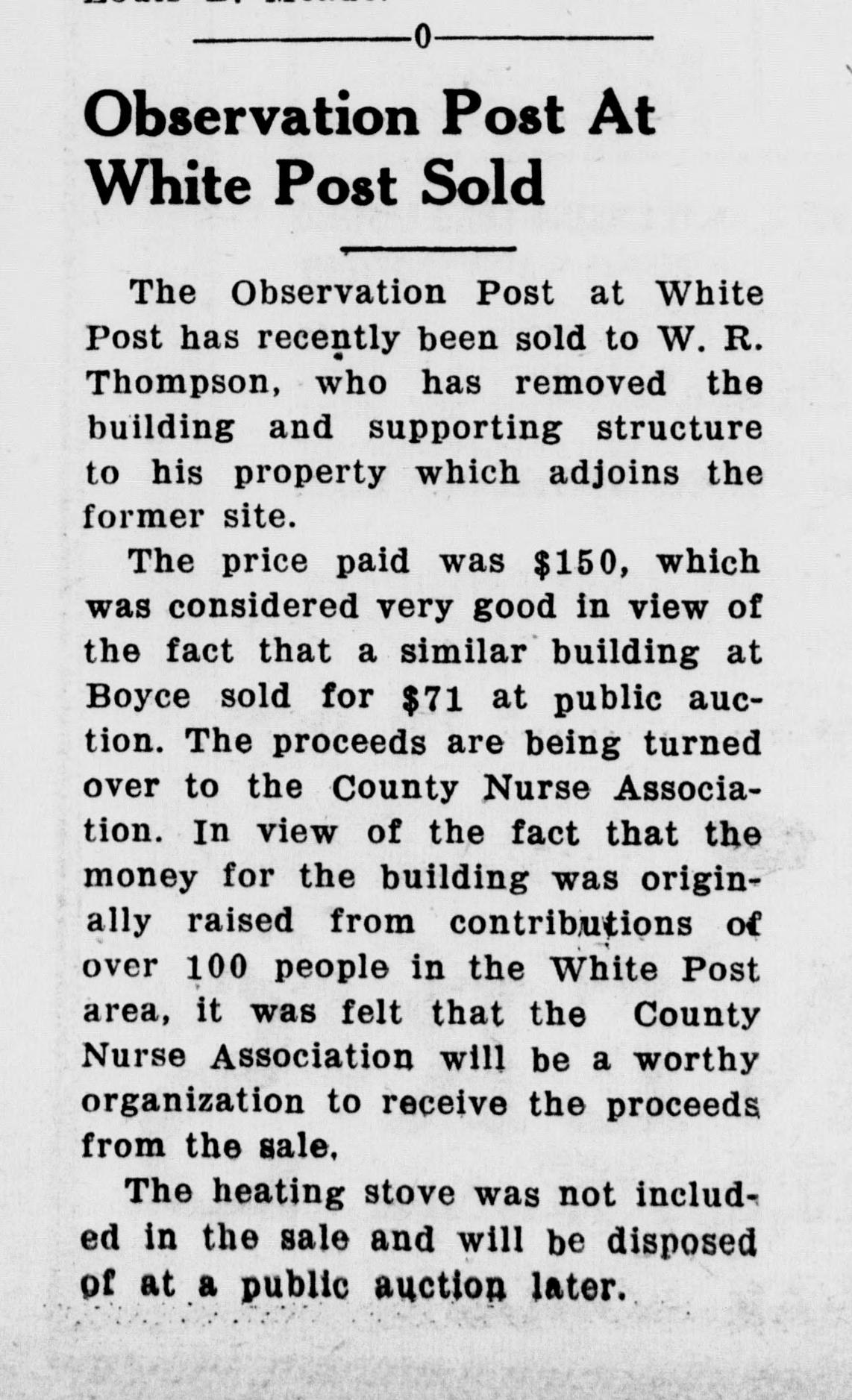
A notice in the Clarke Courier of November 9, 1944 offered for sale the air spotter station at Boyce on Friday, November 10, 1944, at 4 p.m.: a building about 12 by 12 feet, containing much good timber and window sash, with an automatic oil heating stove that had proved an excellent heater in all kinds of weather. It invited all observers to state how they wished the proceeds of the sale used, gave the terms as cash, and was signed by John E. Zombro, chief observer, with an auctioneer and a clerk.
Also indexed as: Clarke county station of the Virginia Aircraft Warning Service; Aircraft Warning Service in Clarke county.
Know something about this place or record? Help fill a gap. It stays private until it is reviewed.