
Dear Dan
For more than three years, the Clarke Courier wrote a letter every week to Dan Morrison, who was serving overseas. His tour took him to England, Scotland, North Africa, Italy, France and Corsica. The column began "Dear Dan" and carried the town's small news: who had the flu, who had written from away, who was buying war bonds, and, by the end, what was back on the shelves.
One April night in 1943 the letter was written in spurts, on duty at the Berryville air spotter post. No planes were overhead, seen or heard. The writer had forgotten his book, so he had the post's old magazines. The fire had gone out. The shabby lamp shade had been replaced with a better one, a gift, he thought, from Mrs. Ernest Locke. A red pair of dice sat on the table, evidence that the post had seen livelier nights.
Source note: Clarke Courier, Berryville, Va., 1945
An editor's note in the Clarke Courier of August 23, 1945 said that the letter column would for the time being be written to a different serviceman each week, and that Dan Morrison, to whom the paper had written the letter every seven days for over three years, was back home on furlough after a tour of duty in England, Scotland, North Africa, Italy, France and Corsica (printed "Corisca") of about 36 months, and would return to camp afterward, hoping to be discharged.
What the source supports
The end of the paper's weekly letter to Dan Morrison, and his return on furlough, as the paper reported it.
Uncertainty
The paper's note; Dan Morrison's service is not documented here beyond it. "Corisca" is as printed. Dan Morrison is not joined to any other person record.
Source
Evidence role: supports. The editor's note.
Clarke Courier, Berryville, Va., August 23, 1945, page 16: editor's note and "Dear Ralph Pope" letter column
Clarke Courier, Berryville, Va. · 1945-08-23 (publication)
Locator: Page 16, the editor's note at the head of the letter column, on Dan Morrison's furlough
Checked: Original inspected. A digital reproduction was inspected; no original has been handled.
Open sourceSource family: clarke-courier. Multiple passages from one source are not independent witnesses.
AI-assisted source check (Claude Opus 5.5) · 2026-09-26. How this project checks its sources
Source note: Clarke Courier, Berryville, Va., 1945
The letter column in the Clarke Courier of August 23, 1945, addressed "Dear Ralph Pope," told him the county had not forgotten him and hoped he was on his way home from prison; it said that canned fruits and vegetables no longer required ration points, that Governor Darden had lifted the wartime speed limit of 35 miles an hour and drivers could now go 50, and that cigarettes were beginning to come back to the shelves.
What the source supports
That the column was turned to Ralph Pope that week, and the home-front changes it reported.
Uncertainty
A first-person letter column; its news of rationing and the speed limit is the columnist's report, not an official notice. Only the part of the letter in the crop is used.
Source
Evidence role: supports. The letter, as far as the crop runs.
Clarke Courier, Berryville, Va., August 23, 1945, page 16: editor's note and "Dear Ralph Pope" letter column
Clarke Courier, Berryville, Va. · 1945-08-23 (publication)
Locator: Page 16, the letter headed "Dear Ralph Pope," on the prisoner, ration points, the speed limit and cigarettes
Relevant passageDear Ralph Pope
Checked: Original inspected. A digital reproduction was inspected; no original has been handled.
Open sourceSource family: clarke-courier. Multiple passages from one source are not independent witnesses.
AI-assisted source check (Claude Opus 5.5) · 2026-09-26. How this project checks its sources
Source note: Clarke Courier, Berryville, Va., 1943
The "Dear Dan" column in the Clarke Courier of October 14, 1943 said: "Many of the county's citizenry are sporting wings on their lapels these days," having received these emblems through the mails, signifying that they were observers in the Air Warning Service.
What the source supports
That by October 1943 observers around the county had received wing emblems by mail marking their service.
Uncertainty
A columnist's passing note; how many observers received wings is not given, and the item does not say who sent them. The report of July 22, 1943 that the posts had closed asked observers to report their hours for War Department souvenirs; this item does not say the wings were that souvenir, and that link is not made.
Source
Evidence role: supports. The note on the wings.
Clarke Courier, Berryville, Va., October 14, 1943, page 16: "Dear Dan" column, local notes including observers' wings
Clarke Courier, Berryville, Va. · 1943-10-14 (publication)
Locator: Page 16, "Dear Dan" column, closing notes, the observers' wings
Relevant passageMany of the county's citizenry are sporting wings on their lapels these days
Checked: Original inspected. A digital reproduction was inspected; no original has been handled.
Open sourceSource family: clarke-courier. Multiple passages from one source are not independent witnesses.
Evidence role: contextualizes. The July 1943 closing report's request that observers report their hours; not evidence that the wings were the souvenir.
Clarke Courier, Berryville, Va., July 22, 1943, page 1: "3 Aircraft Posts Closed By War Department"
Clarke Courier, Berryville, Va. · 1943-07-22 (publication)
Locator: Page 1, same report, the three chief observers, the service's beginning and the request for hours served
Checked: Original inspected. A digital reproduction was inspected; no original has been handled.
Open sourceSource family: clarke-courier. Multiple passages from one source are not independent witnesses.
AI-assisted source check (Claude Opus 5.5) · 2026-09-26. How this project checks its sources
Source note: Clarke Courier, Berryville, Va., 1943
Among its local notes, the "Dear Dan" column in the Clarke Courier of October 14, 1943 said that someone had just about recuperated from a touch of the flu, that the writer had had a card from Rev. Ed Vaughan, now in Richmond, sending regards, and that the War Bond Committee of the State had written that a woman working at the Berryville Basket Company was putting at least 40 per cent of her salary into War Bonds.
What the source supports
The kind of small local news the "Dear Dan" letters carried.
Uncertainty
Used only as an example of the column's contents; the people it names are not followed further or joined to any other record. Rev. Ed Vaughan is not joined to the Rev. E. D. Vaughan named in other items.
Source
Evidence role: supports. The notes on the flu, the card and the war-bond letter.
Clarke Courier, Berryville, Va., October 14, 1943, page 16: "Dear Dan" column, local notes including observers' wings
Clarke Courier, Berryville, Va. · 1943-10-14 (publication)
Locator: Page 16, "Dear Dan" column, closing notes, the flu, a card from Rev. Ed Vaughan and a war-bond letter
Checked: Original inspected. A digital reproduction was inspected; no original has been handled.
Open sourceSource family: clarke-courier. Multiple passages from one source are not independent witnesses.
AI-assisted source check (Claude Opus 5.5) · 2026-09-26. How this project checks its sources
Source note: Clarke Courier, Berryville, Va., 1943
The "Dear Dan" column in the Clarke Courier of April 8, 1943 was, its writer said, written in spurts "to pound out a portion of this letter while on duty at the air spotter post." There were no planes overhead, seen or heard; the writer had come on duty late and forgotten a good book he was reading, and the post was kept supplied with magazines, usually out of date. Since his last letter from there the place had been painted, and the old lamp shade replaced with a better one, a gift, he thought, from Mrs. Ernest Locke. Someone had let the fire go out, and a red pair of dice on the table was, he wrote, testimony that the place had seen a livelier time.
What the source supports
What a night on duty at the Berryville air spotter post was like, as the "Dear Dan" columnist described it in spring 1943.
Uncertainty
The columnist's own account, written as a letter; no other record of the night was seen. The column names the place only as "the air spotter post"; that it is the Berryville post follows from the column being written from Berryville, not from the item. The night is not dated. Mrs. Ernest Locke is named as printed, with the writer's own hedge ("I think"), and is not joined to any other person record, including the Ernest Locke named as the post's treasurer in March 1943.
Source
Evidence role: supports. The column's opening paragraphs.
Clarke Courier, Berryville, Va., April 8, 1943, page 16: "Dear Dan" column, a letter written at the air spotter post
Clarke Courier, Berryville, Va. · 1943-04-08 (publication)
Locator: Page 16, "Dear Dan" column, opening paragraphs, the night on duty at the air spotter post
Relevant passageto pound out a portion of this letter while on duty at the air spotter post
Checked: Original inspected. A digital reproduction was inspected; no original has been handled.
Open sourceSource family: clarke-courier. Multiple passages from one source are not independent witnesses.
AI-assisted source check (Claude Opus 5.5) · 2026-09-26. How this project checks its sources
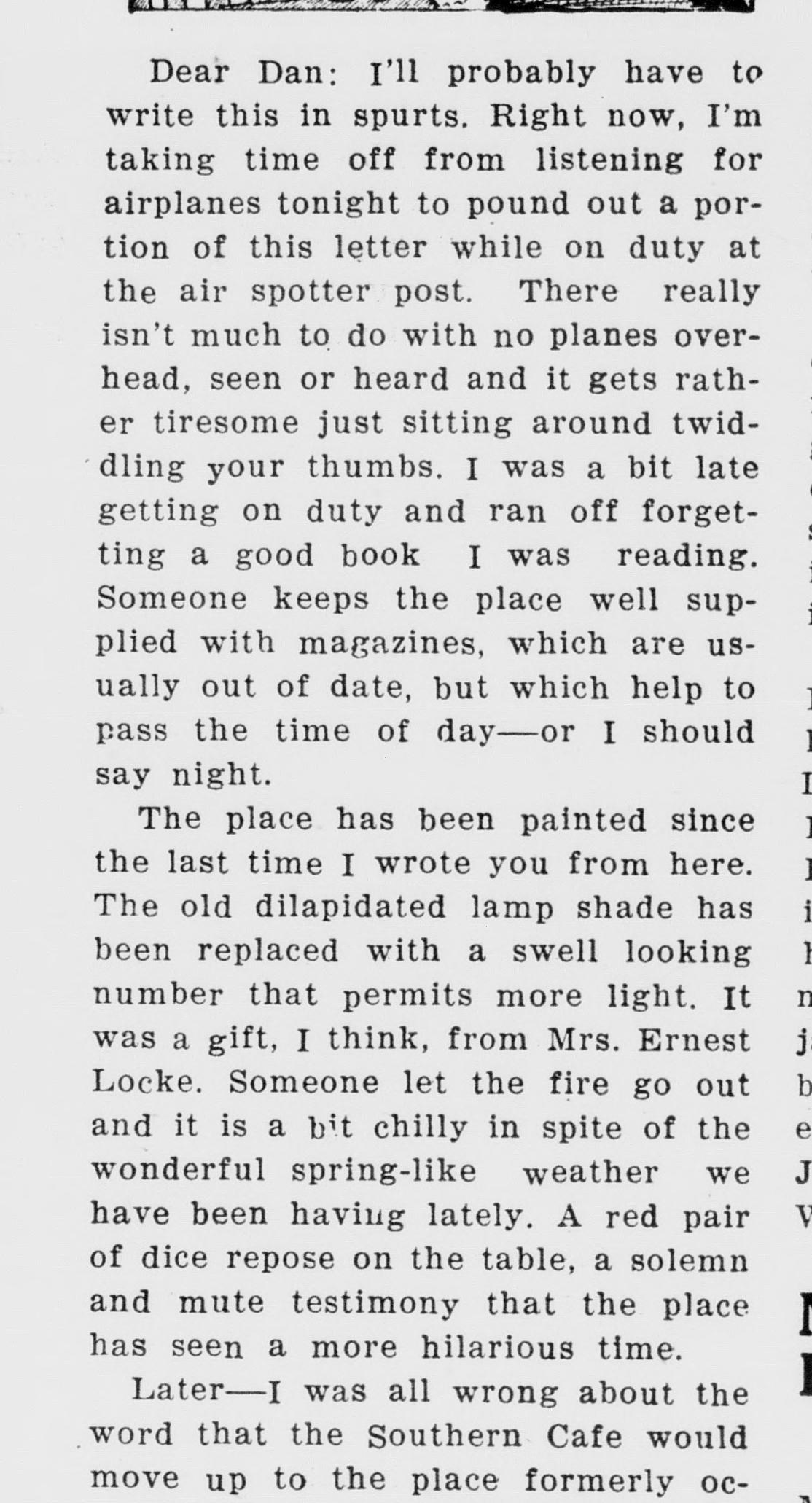
The "Dear Dan" columnist writes from a quiet night on duty at the air spotter post: no planes, old magazines, a new lamp shade and a red pair of dice.
Clarke Courier (Berryville, Va.), April 8, 1943, page 16. Library of Congress, Chronicling America. Rights Changes: The retained file itself, shown at its own 1114 by 2062 pixels: not scaled, not re-encoded. Nothing retouched or added.
Source: Clarke Courier, Berryville, Va., April 8, 1943, page 16: "Dear Dan" column, a letter written at the air spotter post Open the full image
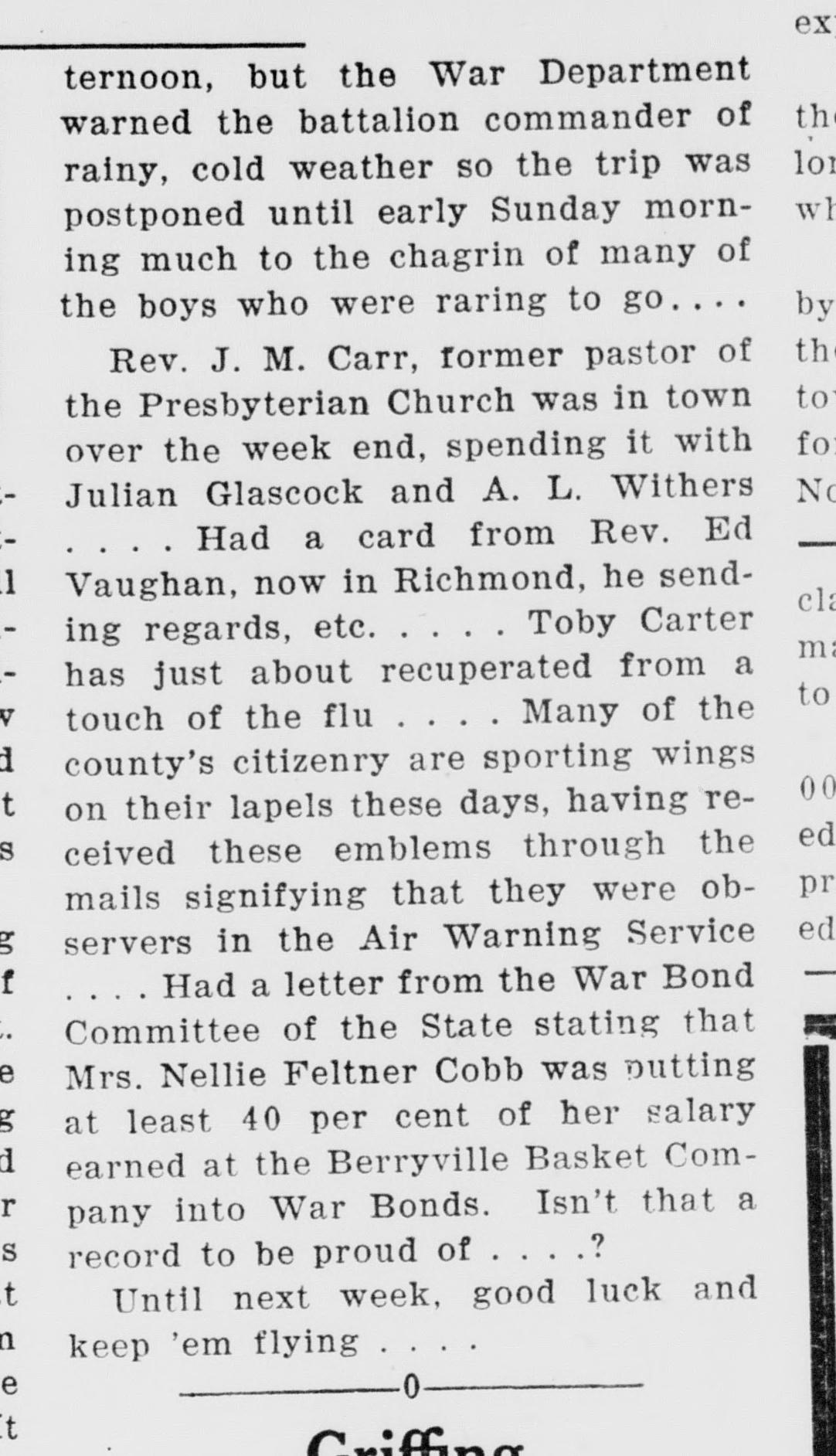
The "Dear Dan" letter notes that many people around the county are wearing observers' wings received by mail, among news of the flu, a card from away and war bonds.
Clarke Courier (Berryville, Va.), October 14, 1943, page 16. Library of Congress, Chronicling America. Rights Changes: The retained file itself, shown at its own 1082 by 1884 pixels: not scaled, not re-encoded. Nothing retouched or added.
Source: Clarke Courier, Berryville, Va., October 14, 1943, page 16: "Dear Dan" column, local notes including observers' wings Open the full image
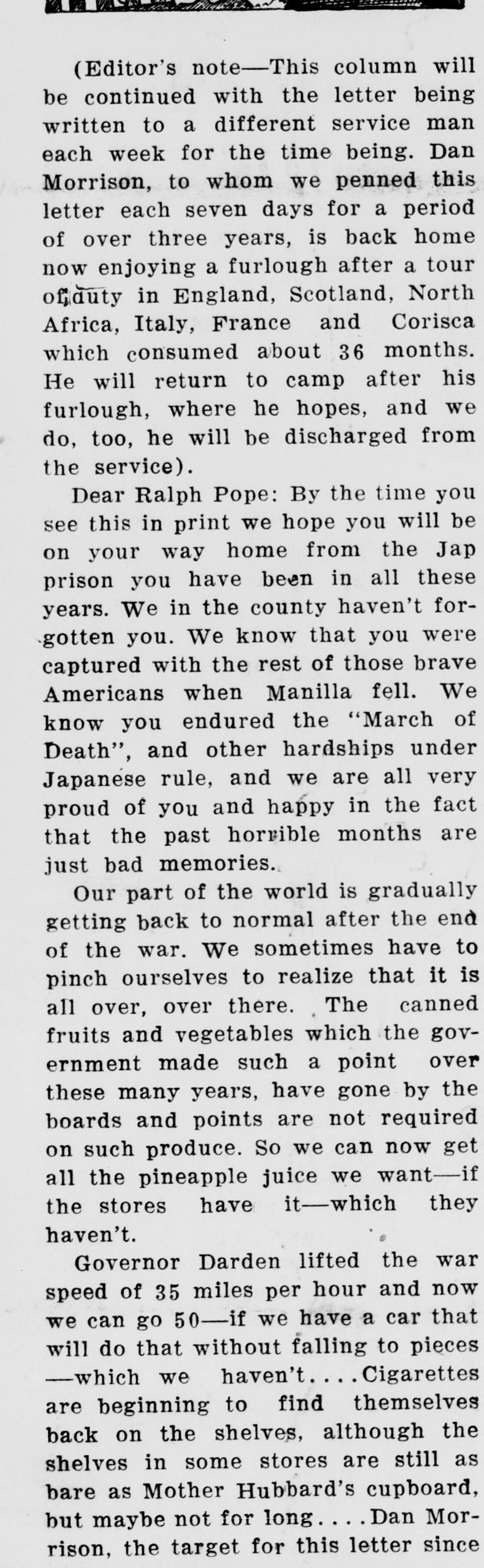
An editor's note says Dan Morrison is home on furlough; that week's letter is addressed to Ralph Pope.
Clarke Courier (Berryville, Va.), August 23, 1945, page 16. Library of Congress, Chronicling America. Rights Changes: A detail of the retained region crop of the Library of Congress page image (1107 by 3420 pixels): the rectangle from x 0 to 1015 and y 0 to 3285, which leaves out the unrelated items around it, not scaled, and re-encoded as JPEG. The whole page is at the source link. Nothing retouched or added.
Source: Clarke Courier, Berryville, Va., August 23, 1945, page 16: editor's note and "Dear Ralph Pope" letter column Open the full image
Short of spotters
That quiet watch took more people than Berryville was finding. In January 1943 the Courier complained in an editorial that the Air Warning Service could not fill its shifts. Only sixty or seventy volunteers were needed in a town of more than 1,200 people, the paper said, and each was asked for three hours a week: "just three hours out of every 168."
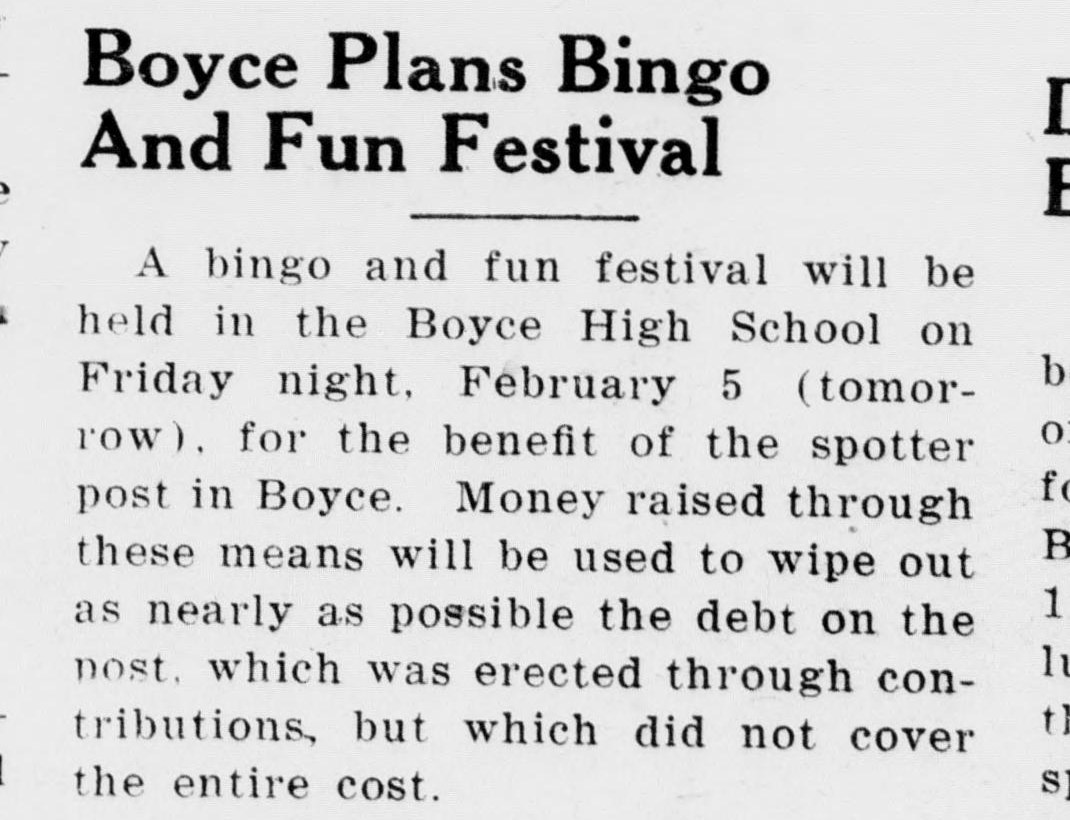
The posts were also paying for themselves. In February the Boyce post announced a bingo and fun festival at Boyce High School to clear what it still owed on its building, which contributions had not fully covered.
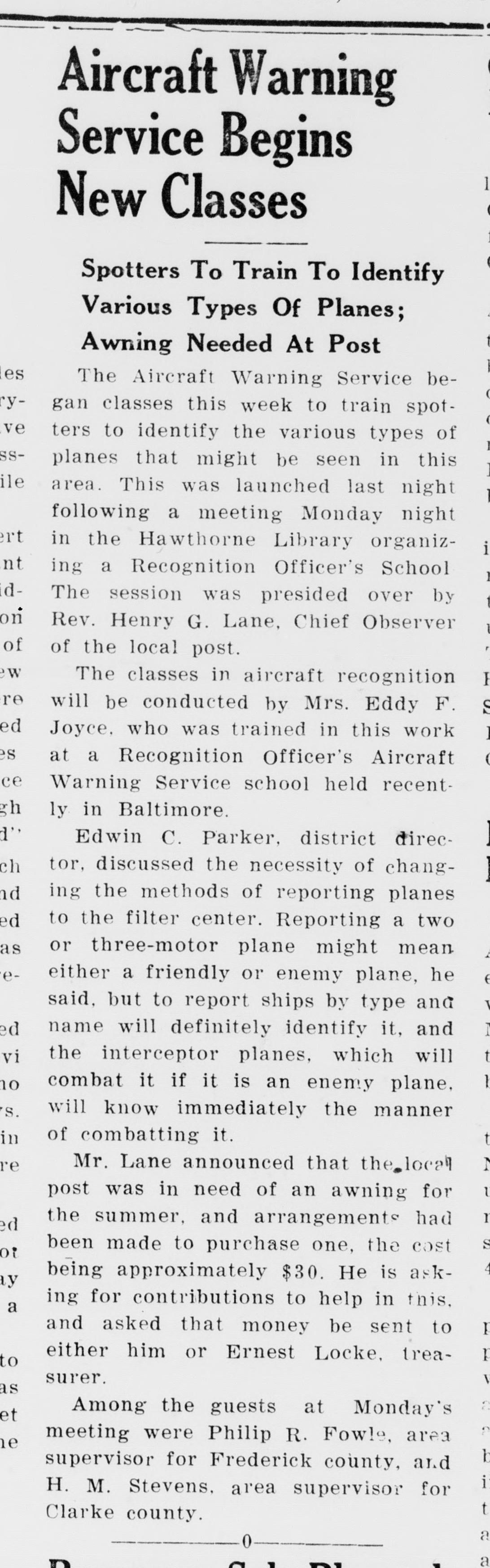
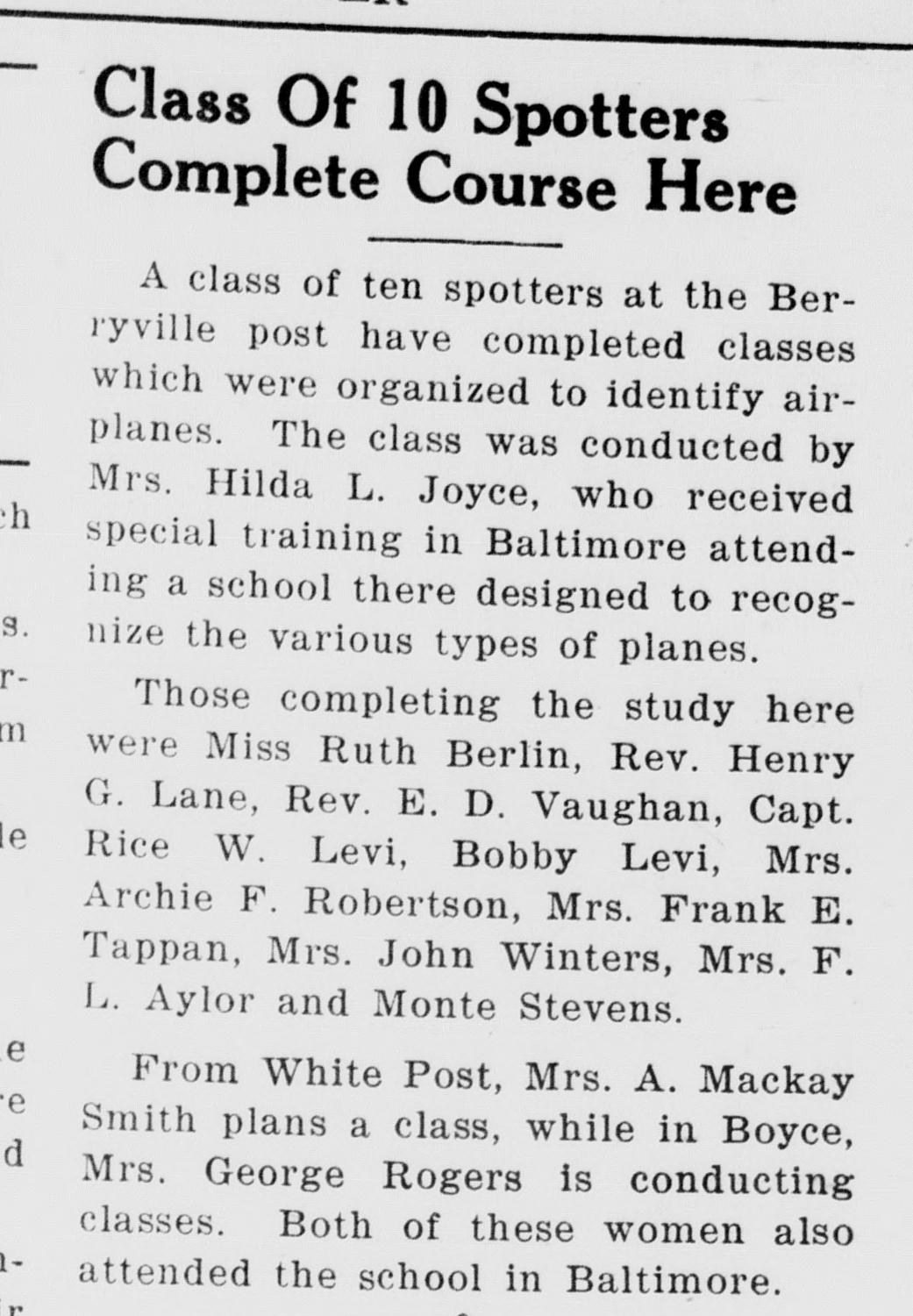
In March the work changed. Edwin C. Parker, the district director, explained that spotters would now report planes by type and name, not simply as two- or three-motor aircraft, so the fighters sent up against an enemy plane would know what they faced. At a meeting in the Hawthorne Library, the Berryville post began organizing aircraft-recognition classes, to be taught by Mrs. Eddy F. Joyce, who had trained at an Aircraft Warning Service school in Baltimore. The Courier had named a Mrs. Eddy Joyce as one of the two Berryville women in the "Red Flash" mix-up the August before; the paper does not say whether they are the same woman. By late April a class of ten had completed the course; that report named its teacher as Mrs. Hilda L. Joyce, also trained in Baltimore. At White Post, Mrs. A. Mackay Smith planned a class, and at Boyce Mrs. George Rogers was teaching one; both had attended the Baltimore school.
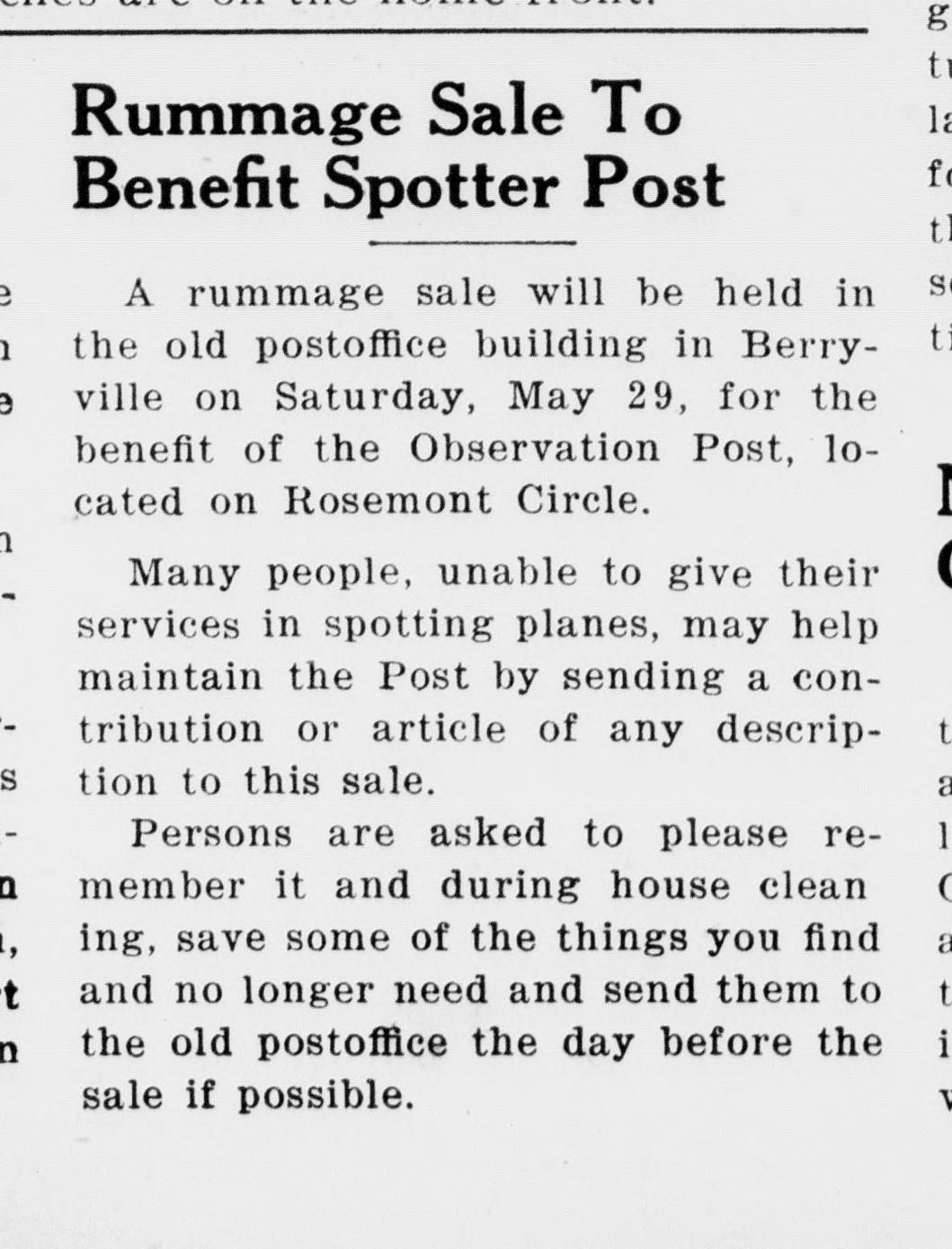
The post needed an awning for the summer, at about $30, and in May it held a rummage sale in the old post office building. People who could not spot planes were asked to send whatever they could spare from their spring cleaning. The sale made a profit of more than $75, and with other gifts the post collected nearly $100. Mrs. Ralph N. Dorsey and Mrs. Harry Warden ran it.
Money was easier to find than hours. In June the Courier wrote that it was "a crying shame" that fewer than 56 of Berryville's 1,200 people would give three hours a week to the post. The Red Cross room was in the same state: never more than three, four or five women came to roll bandages.
The War Department closed the county's three posts in July 1943. That October the "Dear Dan" letter reported that many people around the county were wearing wings on their lapels. The emblems had come through the mail as a sign that their wearers had served as observers. When the posts closed, the War Department had promised the observers a souvenir for their hours.
Source note: Clarke Courier, Berryville, Va., 1943
In an unsigned editorial headed "Spotting Airplanes," the Clarke Courier of January 21, 1943 said that, in a population of over 1,200 people, the Air Warning Service was having trouble finding volunteers to take over certain shifts at the air spotter post at Berryville, when only sixty or seventy people were needed. It asked people to volunteer three hours a week: "just three hours out of every 168."
What the source supports
That in January 1943 the Courier publicly complained that the Berryville post could not fill its shifts, and the scale of the need as the paper put it.
Uncertainty
An editorial: the paper's opinion and appeal, not a record of the post's schedule. The figures are the editorial's own, and the service is named as printed ("Air Warning Service"). The editorial's further appeal to keep promised hours or find a substitute is not used. The remainder figure it gives (read on the image as 1,130) is not used.
Source
Evidence role: supports. The editorial's opening and the three-hour request.
Clarke Courier, Berryville, Va., January 21, 1943, page 8: editorial "Spotting Airplanes"
Clarke Courier, Berryville, Va. · 1943-01-21 (publication)
Locator: Page 8, editorial "Spotting Airplanes," the shortage of volunteers at the Berryville post and the three-hour request
Relevant passagejust three hours out of every 168
Checked: Original inspected. A digital reproduction was inspected; no original has been handled.
Open sourceSource family: clarke-courier. Multiple passages from one source are not independent witnesses.
AI-assisted source check (Claude Opus 5.5) · 2026-09-26. How this project checks its sources
Source note: Clarke Courier, Berryville, Va., 1943
The Clarke Courier of February 4, 1943 announced a bingo and fun festival at the Boyce High School on Friday night, February 5, for the benefit of the spotter post in Boyce. The money raised was to be used to wipe out, as nearly as possible, the debt on the post, which had been erected through contributions that did not cover the entire cost.
What the source supports
That the Boyce spotter post was still in debt for its building in early 1943 and that a benefit was planned to clear it.
Uncertainty
An announcement of a plan; no report of the festival or its proceeds was checked, so whether it was held and what it raised are not established. The amount of the debt is not printed. A prize drawing in the Boyce post's fund drive, in the paper of January 28, 1943, was seen only as machine text and is not used.
Source
Evidence role: supports. The whole item.
Clarke Courier, Berryville, Va., February 4, 1943, page 1: "Boyce Plans Bingo And Fun Festival"
Clarke Courier, Berryville, Va. · 1943-02-04 (publication)
Locator: Page 1, "Boyce Plans Bingo And Fun Festival," the benefit for the Boyce spotter post and its debt
Checked: Original inspected. A digital reproduction was inspected; no original has been handled.
Open sourceSource family: clarke-courier. Multiple passages from one source are not independent witnesses.
AI-assisted source check (Claude Opus 5.5) · 2026-09-26. How this project checks its sources
Source note: Clarke Courier, Berryville, Va., 1943
The Clarke Courier of March 25, 1943 reported that the Aircraft Warning Service had begun classes that week to train spotters to identify the various types of planes that might be seen in the area, following a Monday-night meeting in the Hawthorne Library that organized a Recognition Officer's School, over which Rev. Henry G. Lane, Chief Observer of the local post, presided. The classes were to be conducted by Mrs. Eddy F. Joyce, trained at a Recognition Officer's Aircraft Warning Service school held recently in Baltimore. Edwin C. Parker, district director, said that reporting a two- or three-motor plane might mean either a friendly or an enemy plane, but "to report ships by type and name will definitely identify it," so that the interceptor planes would know at once how to combat it.
What the source supports
When and how aircraft-recognition training began for the county's spotters, and why reporting changed, as the Courier reported it.
Uncertainty
The paper's report. It places the organizing meeting in the Hawthorne Library; it does not say where the classes themselves met, and the Hawthorne Library is not joined to any building record. "Mrs. Eddy F. Joyce" is as printed; she is not joined to the "Mrs. Hilda L. Joyce" named as the instructor on April 22, 1943, nor to the "Mrs. Eddy Joyce" of the August 1942 "Red Flash" account. The district director's explanation is the paper's summary of what he said.
Source
Evidence role: supports. Headline, first three paragraphs.
Clarke Courier, Berryville, Va., March 25, 1943, page 1: "Aircraft Warning Service Begins New Classes"
Clarke Courier, Berryville, Va. · 1943-03-25 (publication)
Locator: Page 1, "Aircraft Warning Service Begins New Classes," the recognition classes, the instructor and the district director's explanation
Relevant passageto report ships by type and name will definitely identify it
Checked: Original inspected. A digital reproduction was inspected; no original has been handled.
Open sourceSource family: clarke-courier. Multiple passages from one source are not independent witnesses.
AI-assisted source check (Claude Opus 5.5) · 2026-09-26. How this project checks its sources
Source note: Clarke Courier, Berryville, Va., 1943
The same report of March 25, 1943 said Mr. Lane announced that the local post needed an awning for the summer and that arrangements had been made to buy one at a cost of approximately $30; he asked for contributions, to be sent to him or to Ernest Locke, treasurer.
What the source supports
That the Berryville post was raising money for its own upkeep in spring 1943.
Uncertainty
An announced purchase and appeal; whether the awning was bought is not reported in the item. Ernest Locke is named as printed and is not joined to the Mrs. Ernest Locke of the April 8, 1943 column.
Source
Evidence role: supports. The paragraph on the awning.
Clarke Courier, Berryville, Va., March 25, 1943, page 1: "Aircraft Warning Service Begins New Classes"
Clarke Courier, Berryville, Va. · 1943-03-25 (publication)
Locator: Page 1, same report, the awning needed at the post
Checked: Original inspected. A digital reproduction was inspected; no original has been handled.
Open sourceSource family: clarke-courier. Multiple passages from one source are not independent witnesses.
AI-assisted source check (Claude Opus 5.5) · 2026-09-26. How this project checks its sources
Source note: Clarke Courier, Berryville, Va., 1943
The Clarke Courier of April 22, 1943 reported that a class of ten spotters at the Berryville post had completed classes organized to identify airplanes, conducted by Mrs. Hilda L. Joyce, who had received special training in Baltimore at a school designed to recognize the various types of planes. It added that at White Post Mrs. A. Mackay Smith planned a class, and at Boyce Mrs. George Rogers was conducting classes; both women had also attended the school in Baltimore.
What the source supports
That recognition training was completed by a first class at Berryville and was spreading to the White Post and Boyce posts by April 1943.
Uncertainty
The paper's report. The ten who completed the course are named on the page; only the count is used here. "Mrs. Hilda L. Joyce" is as printed and is not joined to the "Mrs. Eddy F. Joyce" named as the instructor on March 25, 1943, though both are described as trained in Baltimore. The White Post class is a plan; no report of it was checked.
Source
Evidence role: supports. The whole item.
Clarke Courier, Berryville, Va., April 22, 1943, page 15: "Class Of 10 Spotters Complete Course Here"
Clarke Courier, Berryville, Va. · 1943-04-22 (publication)
Locator: Page 15, "Class Of 10 Spotters Complete Course Here," the class, its instructor and the classes at White Post and Boyce
Checked: Original inspected. A digital reproduction was inspected; no original has been handled.
Open sourceSource family: clarke-courier. Multiple passages from one source are not independent witnesses.
AI-assisted source check (Claude Opus 5.5) · 2026-09-26. How this project checks its sources
Source note: Clarke Courier, Berryville, Va., 1943
The Clarke Courier of May 13, 1943 announced a rummage sale in the old postoffice building in Berryville on Saturday, May 29, for the benefit of the Observation Post, located on Rosemont Circle. People unable to give their services in spotting planes could help maintain the Post by sending a contribution or article of any description, and were asked to save things they found and no longer needed during house cleaning.
What the source supports
That the Berryville post planned a rummage sale in May 1943 and asked non-spotters to contribute to it.
Uncertainty
An announcement of a plan; the result is a separate report (June 3, 1943) and is kept separate. The building is named as printed ("the old postoffice building").
Source
Evidence role: supports. The whole item.
Clarke Courier, Berryville, Va., May 13, 1943, page 8: "Rummage Sale To Benefit Spotter Post"
Clarke Courier, Berryville, Va. · 1943-05-13 (publication)
Locator: Page 8, "Rummage Sale To Benefit Spotter Post," the date, place and appeal for articles
Checked: Original inspected. A digital reproduction was inspected; no original has been handled.
Open sourceSource family: clarke-courier. Multiple passages from one source are not independent witnesses.
AI-assisted source check (Claude Opus 5.5) · 2026-09-26. How this project checks its sources
Source note: Clarke Courier, Berryville, Va., 1943
The Clarke Courier of June 3, 1943 reported, in its "Berryville" column, that the rummage sale held on Saturday for the benefit of the plane spotting post in Berryville resulted in a profit of over $75.00; together with contributions, the total collected was nearly $100. Mrs. Ralph N. Dorsey and Mrs. Harry Warden were in charge of the sale.
What the source supports
The result of the Berryville post's May 1943 rummage sale, as the paper reported it.
Uncertainty
A short local-column report; no account book was seen. The figures are as printed. Mrs. Ralph N. Dorsey is named as printed and is not joined to the "Mrs. Ralph Dorsey" named as blood donor chairman in 1945.
Source
Evidence role: supports. The paragraph on the sale.
Clarke Courier, Berryville, Va., June 3, 1943, page 3: "Berryville" local column, the spotter post's rummage sale
Clarke Courier, Berryville, Va. · 1943-06-03 (publication)
Locator: Page 3, "Berryville" column (continued from page 2), the paragraph on the rummage sale for the plane spotting post
Checked: Original inspected. A digital reproduction was inspected; no original has been handled.
Open sourceSource family: clarke-courier. Multiple passages from one source are not independent witnesses.
Evidence role: contextualizes. The announcement of the sale.
Clarke Courier, Berryville, Va., May 13, 1943, page 8: "Rummage Sale To Benefit Spotter Post"
Clarke Courier, Berryville, Va. · 1943-05-13 (publication)
Locator: Page 8, "Rummage Sale To Benefit Spotter Post," the date, place and appeal for articles
Checked: Original inspected. A digital reproduction was inspected; no original has been handled.
Open sourceSource family: clarke-courier. Multiple passages from one source are not independent witnesses.
AI-assisted source check (Claude Opus 5.5) · 2026-09-26. How this project checks its sources
Source note: Clarke Courier, Berryville, Va., 1943
In an unsigned editorial headed "Doing All You Can, Brother?", the Clarke Courier of June 10, 1943 said the air spotter post and the Red Cross room were both falling behind in their work. It called it "a crying shame" that of the 1,200 people in Berryville there were not as many as 56 who would give three hours of their time weekly watching for airplanes, and said that of all the women in Berryville there were never more than three, four or five who could spend a few hours at the Red Cross room rolling bandages.
What the source supports
That in June 1943 the Courier said the Berryville post and the Red Cross room were both short of volunteers.
Uncertainty
An editorial: the paper's opinion and appeal, not a count of volunteers. The figures (1,200 people, fewer than 56 spotters, three to five women) are the editorial's own.
Source
Evidence role: supports. The first two paragraphs.
Clarke Courier, Berryville, Va., June 10, 1943, page 8: editorial "Doing All You Can, Brother?"
Clarke Courier, Berryville, Va. · 1943-06-10 (publication)
Locator: Page 8, editorial "Doing All You Can, Brother?," the air spotter post and the Red Cross room
Relevant passagea crying shame
Checked: Original inspected. A digital reproduction was inspected; no original has been handled.
Open sourceSource family: clarke-courier. Multiple passages from one source are not independent witnesses.
AI-assisted source check (Claude Opus 5.5) · 2026-09-26. How this project checks its sources
Source note: Clarke Courier, Berryville, Va., 1943
The Clarke Courier of July 22, 1943 reported that the three observation posts in Clarke county had been closed at midnight the night before on an order from the War Department, which announced that in its opinion "the danger of a large scale sustained attack from the air in this section has passed"; that the posts were to maintain their organizations and be ready to spring back into action on short notice; that their chief observers had been A. Mackay Smith at White Post, John E. Zombro at Boyce and the Rev. Henry G. Lane at Berryville; and that observers were asked to report the hours they had served so that the War Department could present souvenirs.
What the source supports
That the county's posts were closed by War Department order in July 1943, the reason given, and who had led them.
Uncertainty
The paper's report of the order; the order itself was not seen. The Rev. Henry G. Lane is not joined to the Rev. H. G. Lane named in 1942.
Source
Evidence role: supports. The closing, the War Department's statement and the order to stay ready.
Clarke Courier, Berryville, Va., July 22, 1943, page 1: "3 Aircraft Posts Closed By War Department"
Clarke Courier, Berryville, Va. · 1943-07-22 (publication)
Locator: Page 1, report of the posts' closing, headline, subhead, the War Department's statement and the order to stay ready
Relevant passagethe danger of a large scale sustained attack from the air in this section has passed.
Checked: Original inspected. A digital reproduction was inspected; no original has been handled.
Open sourceSource family: clarke-courier. Multiple passages from one source are not independent witnesses.
Evidence role: supports. The chief observers and the request for hours served.
Clarke Courier, Berryville, Va., July 22, 1943, page 1: "3 Aircraft Posts Closed By War Department"
Clarke Courier, Berryville, Va. · 1943-07-22 (publication)
Locator: Page 1, same report, the three chief observers, the service's beginning and the request for hours served
Checked: Original inspected. A digital reproduction was inspected; no original has been handled.
Open sourceSource family: clarke-courier. Multiple passages from one source are not independent witnesses.
AI-assisted source check (Claude Opus 5.5) · 2026-09-26. How this project checks its sources
Source note: Clarke Courier, Berryville, Va., 1943
The "Dear Dan" column in the Clarke Courier of October 14, 1943 said: "Many of the county's citizenry are sporting wings on their lapels these days," having received these emblems through the mails, signifying that they were observers in the Air Warning Service.
What the source supports
That by October 1943 observers around the county had received wing emblems by mail marking their service.
Uncertainty
A columnist's passing note; how many observers received wings is not given, and the item does not say who sent them. The report of July 22, 1943 that the posts had closed asked observers to report their hours for War Department souvenirs; this item does not say the wings were that souvenir, and that link is not made.
Source
Evidence role: supports. The note on the wings.
Clarke Courier, Berryville, Va., October 14, 1943, page 16: "Dear Dan" column, local notes including observers' wings
Clarke Courier, Berryville, Va. · 1943-10-14 (publication)
Locator: Page 16, "Dear Dan" column, closing notes, the observers' wings
Relevant passageMany of the county's citizenry are sporting wings on their lapels these days
Checked: Original inspected. A digital reproduction was inspected; no original has been handled.
Open sourceSource family: clarke-courier. Multiple passages from one source are not independent witnesses.
Evidence role: contextualizes. The July 1943 closing report's request that observers report their hours; not evidence that the wings were the souvenir.
Clarke Courier, Berryville, Va., July 22, 1943, page 1: "3 Aircraft Posts Closed By War Department"
Clarke Courier, Berryville, Va. · 1943-07-22 (publication)
Locator: Page 1, same report, the three chief observers, the service's beginning and the request for hours served
Checked: Original inspected. A digital reproduction was inspected; no original has been handled.
Open sourceSource family: clarke-courier. Multiple passages from one source are not independent witnesses.
AI-assisted source check (Claude Opus 5.5) · 2026-09-26. How this project checks its sources
Source note: Clarke Courier, Berryville, Va., 1943
Among its local notes, the "Dear Dan" column in the Clarke Courier of October 14, 1943 said that someone had just about recuperated from a touch of the flu, that the writer had had a card from Rev. Ed Vaughan, now in Richmond, sending regards, and that the War Bond Committee of the State had written that a woman working at the Berryville Basket Company was putting at least 40 per cent of her salary into War Bonds.
What the source supports
The kind of small local news the "Dear Dan" letters carried.
Uncertainty
Used only as an example of the column's contents; the people it names are not followed further or joined to any other record. Rev. Ed Vaughan is not joined to the Rev. E. D. Vaughan named in other items.
Source
Evidence role: supports. The notes on the flu, the card and the war-bond letter.
Clarke Courier, Berryville, Va., October 14, 1943, page 16: "Dear Dan" column, local notes including observers' wings
Clarke Courier, Berryville, Va. · 1943-10-14 (publication)
Locator: Page 16, "Dear Dan" column, closing notes, the flu, a card from Rev. Ed Vaughan and a war-bond letter
Checked: Original inspected. A digital reproduction was inspected; no original has been handled.
Open sourceSource family: clarke-courier. Multiple passages from one source are not independent witnesses.
AI-assisted source check (Claude Opus 5.5) · 2026-09-26. How this project checks its sources
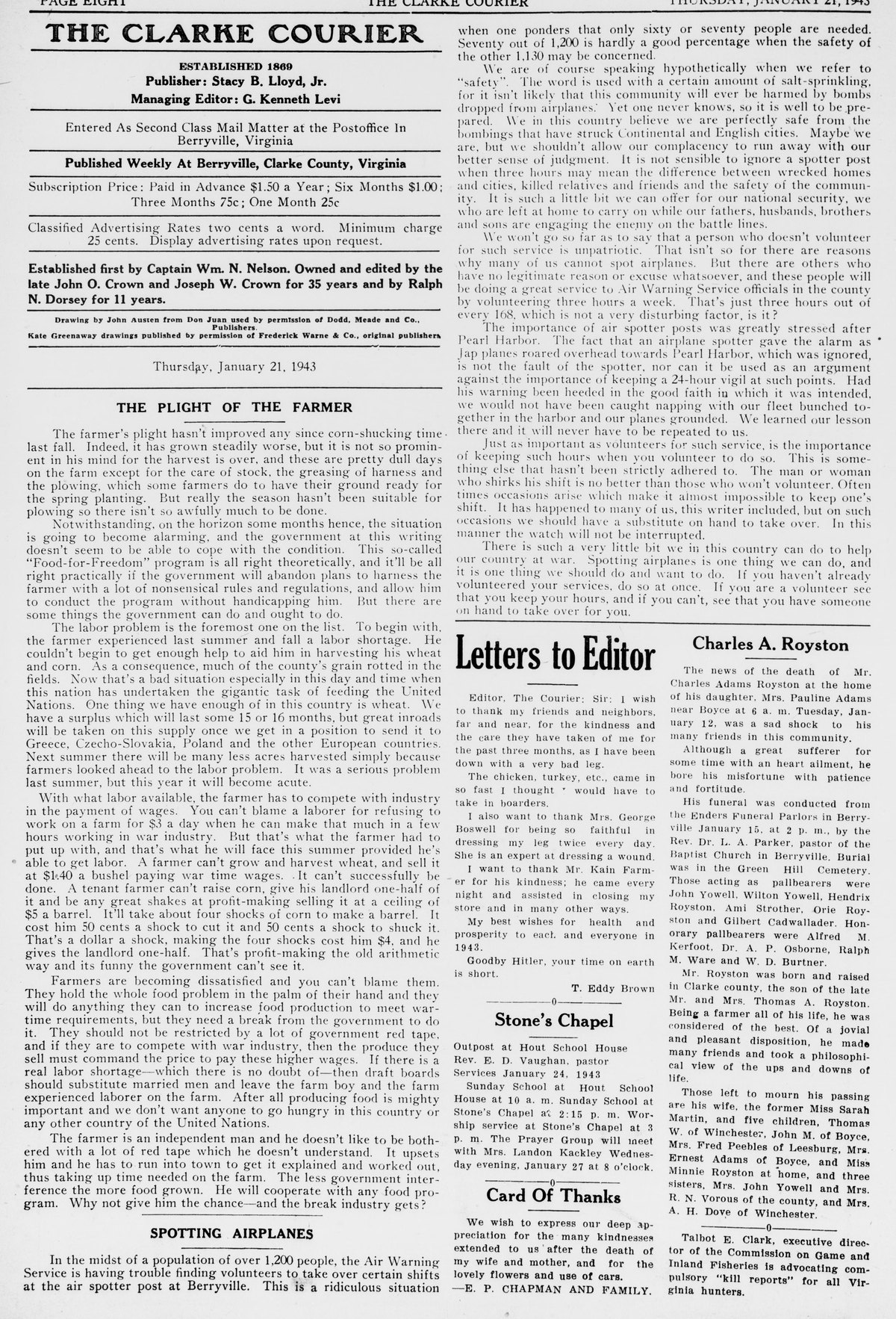
The Courier's editorial page of January 21, 1943: "Spotting Airplanes," at the foot of the first column and continuing at the head of the second, says the Berryville post cannot fill its shifts.
Clarke Courier (Berryville, Va.), January 21, 1943, page 8. Library of Congress, Chronicling America. Rights Changes: The retained JPEG image of 4010 by 5902 pixels, scaled to 1200 by 1766 and re-encoded as JPEG for the web. Nothing retouched or added.
Source: Clarke Courier, Berryville, Va., January 21, 1943, page 8: editorial "Spotting Airplanes" Open the full image
Boyce plans a bingo and fun festival at the high school to pay off what is still owed on its spotter post.
Clarke Courier (Berryville, Va.), February 4, 1943, page 1. Library of Congress, Chronicling America. Rights Changes: A detail of the retained region crop of the Library of Congress page image (1070 by 2458 pixels): the rectangle from x 0 to 1070 and y 1010 to 1830, which leaves out an American Legion item above it and a Minute Men notice below it, not scaled, and re-encoded as JPEG. The whole page is at the source link. Nothing retouched or added.
Source: Clarke Courier, Berryville, Va., February 4, 1943, page 1: "Boyce Plans Bingo And Fun Festival" Open the full image
Spotters begin training to identify planes by type; the district director explains why, and the post asks for about $30 for a summer awning.
Clarke Courier (Berryville, Va.), March 25, 1943, page 1. Library of Congress, Chronicling America. Rights Changes: The retained file itself, shown at its own 1092 by 3496 pixels: not scaled, not re-encoded. Nothing retouched or added.
Source: Clarke Courier, Berryville, Va., March 25, 1943, page 1: "Aircraft Warning Service Begins New Classes" Open the full image
Ten Berryville spotters complete the aircraft-recognition course; classes are planned or under way at White Post and Boyce.
Clarke Courier (Berryville, Va.), April 22, 1943, page 15. Library of Congress, Chronicling America. Rights Changes: A detail of the retained region crop of the Library of Congress page image (1041 by 1905 pixels): the rectangle from x 0 to 1041 and y 0 to 1500, which leaves out a war-bond slogan below it, not scaled, and re-encoded as JPEG. The whole page is at the source link. Nothing retouched or added.
Source: Clarke Courier, Berryville, Va., April 22, 1943, page 15: "Class Of 10 Spotters Complete Course Here" Open the full image
The Berryville post announces a rummage sale in the old post office building and asks those who cannot spot planes to send articles.
Clarke Courier (Berryville, Va.), May 13, 1943, page 8. Library of Congress, Chronicling America. Rights Changes: The retained file itself, shown at its own 1059 by 1389 pixels: not scaled, not re-encoded. Nothing retouched or added.
Source: Clarke Courier, Berryville, Va., May 13, 1943, page 8: "Rummage Sale To Benefit Spotter Post" Open the full image
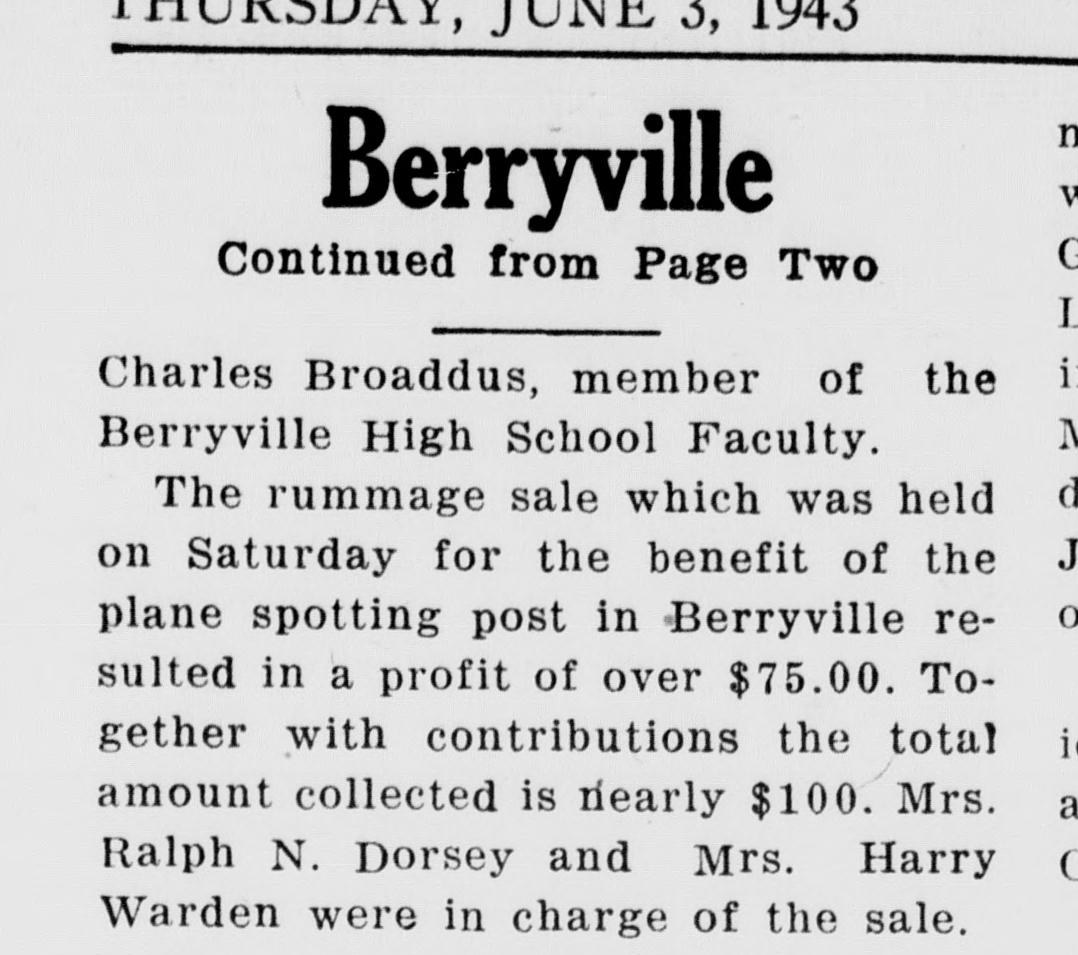
The rummage sale for the plane spotting post clears more than $75; with contributions, nearly $100.
Clarke Courier (Berryville, Va.), June 3, 1943, page 3. Library of Congress, Chronicling America. Rights Changes: A detail of the retained region crop of the Library of Congress page image (1078 by 1860 pixels): the rectangle from x 0 to 1078 and y 0 to 955, which leaves out the column's later paragraphs on other local news, not scaled, and re-encoded as JPEG. The whole page is at the source link. Nothing retouched or added.
Source: Clarke Courier, Berryville, Va., June 3, 1943, page 3: "Berryville" local column, the spotter post's rummage sale Open the full image
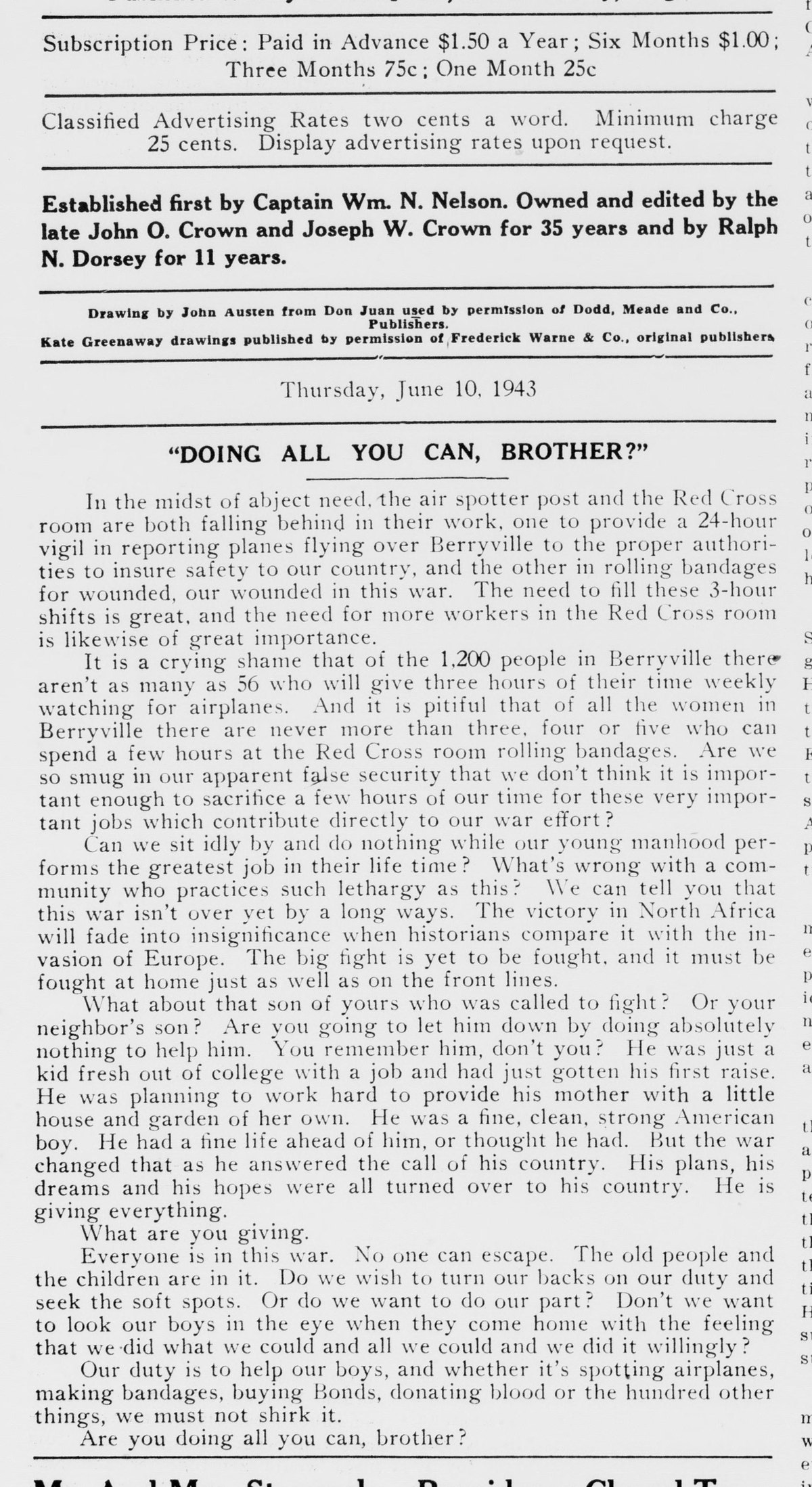
The Courier's editorial of June 10, 1943 calls it "a crying shame" that fewer than 56 of Berryville's 1,200 people will give three hours a week to the post.
Clarke Courier (Berryville, Va.), June 10, 1943, page 8. Library of Congress, Chronicling America. Rights Changes: The retained JPEG image of 2041 by 3737 pixels, scaled to 1200 by 2197 and re-encoded as JPEG for the web. Nothing retouched or added.
Source: Clarke Courier, Berryville, Va., June 10, 1943, page 8: editorial "Doing All You Can, Brother?" Open the full image
Bringing in the harvest
Clarke's orchards needed hands that the war had taken. In April 1944 the county's agriculture committee began planning for the harvest. War prisoners, it learned, would not be available to the county: they were released only for six months' work and had to have permanent housing. The committee looked instead to the Woman's Land Army, as the paper printed it, high school boys, vacationers from Washington, contract labor and convicts.
The county agent's report on 1944, printed in January 1945, shows how the season went. Orchardists set the prevailing wage at 10 cents a bushel for apple pickers, 40 cents an hour for men and 35 cents for women. Boys came from Arlington and Washington to work on farms for the summer, and most stayed the season. School children worked on the farms all summer, the report said, while their brothers were in the armed forces and their older sisters in defense work, and college girls thinned apples. Workers from the Bahamas arrived in mid-July, housed at a camp in Frederick County; fifty worked on one orchard operation and ninety on another. From late August, the report says, state road convicts cut and shocked corn, at a rate it gives as 35 cents an hour; it does not say what, if anything, the men themselves were paid. Farmers who used them, the report adds, called them the best corn cutters they had seen that year.
The apple pickers were harder to keep. A group of 103 Kentuckians moved into the Castleman Ferry camp, but they could not start picking at once and the War Food Administration made them pay for their meals. Within two weeks only 26 were left, and they were sent on to Nelson County. In their place came 118 Jamaican workers from New Hampshire. When they saw the tent camp, the report says, they threatened to stay on the buses until they could be housed in buildings. The Commonwealth's Attorney, the sheriff and a state trooper persuaded them to get off, and the next day 21 men the report called trouble makers were sent home. The rest did a fairly good job, the agent wrote. Some earned $75 or $80 a week, and the average was about $40.
Later that 1944 season, by the same report, one orchardist contracted for German war prisoners after all. They did not pick apples with much success, but 25 of them did good work in his packing shed. The agent added that these men were Russians, captured by the Germans early in the war and made to fight for Germany in France.
Finally the county's children were let out of school. Before school opened, farmers and orchardists pressed for it. The school board first agreed to work permits for ten school days; the orchardists asked for a month and got twenty days. When the board met on October 1 and found the need still great, it let the approved children stay out until October 31, with every child of school age back in school on November 1. Of more than two hundred children investigated, 169 were approved.
Source note: Clarke Courier, Berryville, Va., 1944
The Clarke Courier of April 13, 1944 reported that the Clarke County Agriculture Committee, meeting the week before with officials of the Emergency Farm Labor Committee and others, had begun a study of the county's labor problem for the coming harvest season. It was brought out at the meeting that "war prisoners would not be available for this county," since prisoners were released only for six months' work and must have permanent housing facilities. The Woman's Land Army would probably be available for summer work, and other sources named were high school boys for summer work, vacationists from Washington, contract labor and convict labor.
What the source supports
What labor the county's planners expected to be able to use for the 1944 harvest, and why war prisoners were ruled out, as of April 1944.
Uncertainty
A report of plans at a planning meeting, kept separate from the county agent's report of the 1944 season (printed January 18, 1945). Its statement that war prisoners would not be available is dated to this April 1944 meeting and is not reconciled with the later report's German war prisoners or with any 1945 report. The organization is named as printed ("Woman's Land Army"). The item continues on page 16, which was not read.
Source
Evidence role: supports. The front-page part of the item.
Clarke Courier, Berryville, Va., April 13, 1944, page 1: "County Farm Group Begins Study Of Labor Problems"
Clarke Courier, Berryville, Va. · 1944-04-13 (publication)
Locator: Page 1, "County Farm Group Begins Study Of Labor Problems," the meeting, war prisoners and the other labor sources
Relevant passagewar prisoners would not be available for this county
Checked: Original inspected. A digital reproduction was inspected; no original has been handled.
Open sourceSource family: clarke-courier. Multiple passages from one source are not independent witnesses.
AI-assisted source check (Claude Opus 5.5) · 2026-09-26. How this project checks its sources
Source note: Clarke Courier, Berryville, Va., 1945
The county agent's report for 1944, printed in the Clarke Courier of January 18, 1945, states under "Farm Labor" that at an open hearing on Emergency Farm Labor in June the orchardists set 10 cents a bushel as the prevailing wage for apple pickers, 40 cents an hour for men and 35 cents an hour for women; that of five boys from Arlington who came in the first part of June four proved satisfactory and stayed the summer, and two boys from Washington were placed on farms soon afterward; that during the summer school children, boys and girls, helped with food production while their brothers were in the armed forces and their older sisters in defense work, and some college girls helped thin apples and pick summer varieties; and that Bahaman workers, the first Emergency Farm Labor to come into the area, arrived in the middle of July, were housed in a camp in Frederick County, and worked fifty on one orchard operation and ninety on another.
What the source supports
How the county agent reported the 1944 farm-labor season's wages, local and visiting youth labor and the Bahaman workers.
Uncertainty
The county agent's own report, as the Courier printed it; its characterizations of the workers are the report's. The prevailing wages are the rates the orchardists set, not evidence of what any worker was paid; the report says the crop-raising farmers reached no agreement on other farm wages. "Bahamans" as printed. No payroll, contract or camp record was seen, and no worker is named.
Source
Evidence role: supports. The wage, youth, school-children, college-girl and Bahaman paragraphs.
Clarke Courier, Berryville, Va., January 18, 1945, page 4: the county agent's report for 1944, "Farm Labor"
Clarke Courier, Berryville, Va. · 1945-01-18 (publication)
Locator: Page 4, the county agent's report for 1944, "Farm Labor": the June hearing and prevailing wages, the Arlington and Washington boys, school children and college girls, and the Bahaman workers
Checked: Original inspected. A digital reproduction was inspected; no original has been handled.
Open sourceSource family: clarke-courier. Multiple passages from one source are not independent witnesses.
AI-assisted source check (Claude Opus 5.5) · 2026-09-26. How this project checks its sources
Source note: Clarke Courier, Berryville, Va., 1945
The county agent's report for 1944, printed in the Clarke Courier of January 18, 1945, states that the last of August State Road convicts were made available to Clarke County farmers to help harvest food and feed crops; that they cut corn for filling silos, then cut and shocked corn, and were used up to November 30 husking corn and hauling fodder; that "They worked for 35 cents per hour throughout the season"; and that farmers who used them said they were the best corn cutters they had seen that year.
What the source supports
That the county agent reported State Road convicts working on Clarke farms in the 1944 harvest, and the rate the report gives.
Uncertainty
The 35 cents an hour is the report's rate for the convicts' work. The report does not say who paid it or who received it, and nothing in it shows that any of it was paid to the convicts; it is not evidence of wages received and is kept distinct from the prevailing wages set for hired farm help. The farmers' praise is reported secondhand by the agent. The per-shock prices for cutting and shocking corn, with a foreman's wage and truck hire, are not used. "State Road convicts" as printed; no road-force or prison record was seen and no one is named.
Source
Evidence role: supports. The convict paragraph, with the report's rate quoted.
Clarke Courier, Berryville, Va., January 18, 1945, page 4: the county agent's report for 1944, "Farm Labor"
Clarke Courier, Berryville, Va. · 1945-01-18 (publication)
Locator: Page 4, the county agent's report for 1944, "Farm Labor": the State Road convicts, from the last of August to November 30
Relevant passageThey worked for 35 cents per hour throughout the season
Checked: Original inspected. A digital reproduction was inspected; no original has been handled.
Open sourceSource family: clarke-courier. Multiple passages from one source are not independent witnesses.
AI-assisted source check (Claude Opus 5.5) · 2026-09-26. How this project checks its sources
Source note: Clarke Courier, Berryville, Va., 1945
The county agent's report for 1944, printed in the Clarke Courier of January 18, 1945, states that shortly after the convicts started, 103 Kentuckians moved into the Castleman Ferry Camp; that, unable to pick at once, they became dissatisfied when the War Food Administration insisted that they pay for their meals; and that within a couple of weeks only 26 were left, who were transported to Nelson County, while 118 Jamaicans were moved in from New Hampshire. In the report's account, the Jamaican men, on seeing the tent camp, threatened to stay on the buses until they could be housed in buildings, got off after persuasion by the Commonwealth's Attorney, the sheriff and a state trooper, and the next day "21 of the trouble makers were returned to their native land"; the report says the rest did a fairly good job of picking in the majority of the orchards, some earning $75.00 to $80.00 a week and the average about $40.00.
What the source supports
How the county agent's report described the Kentucky and Jamaican apple pickers of 1944.
Uncertainty
Every characterization here, including "trouble makers," "dissatisfied" and "a fairly good job," and the account of the camp episode, is the county agent's report's language and view, attributed to it and not this site's judgment. Only the agent's account is held: the workers' own side is not recorded, and no War Food Administration, camp or payroll record was seen. The earnings are the report's figures. "Castleman Ferry Camp" as printed; no worker is named.
Source
Evidence role: supports. The Kentuckian and Jamaican paragraph, with the report's label quoted as its own.
Clarke Courier, Berryville, Va., January 18, 1945, page 4: the county agent's report for 1944, "Farm Labor"
Clarke Courier, Berryville, Va. · 1945-01-18 (publication)
Locator: Page 4, the county agent's report for 1944, "Farm Labor": the Kentuckians at the Castleman Ferry Camp and the Jamaicans from New Hampshire
Relevant passage21 of the trouble makers were returned to their native land.
Checked: Original inspected. A digital reproduction was inspected; no original has been handled.
Open sourceSource family: clarke-courier. Multiple passages from one source are not independent witnesses.
AI-assisted source check (Claude Opus 5.5) · 2026-09-26. How this project checks its sources
Source note: Clarke Courier, Berryville, Va., 1945
The county agent's report for 1944, printed in the Clarke Courier of January 18, 1945, states that German war prisoners were contracted for by one of the orchardists, who tried them at picking apples without very much success and then used 25 of them in his packing shed, where they did a very nice job; the report adds that these men were Russians captured by the Germans early in the war, made to fight for Germany in France, and captured when the U.S. Army entered Flanders.
What the source supports
That the county agent reported one orchardist's use of war prisoners in 1944.
Uncertainty
The report's account: it names neither the orchardist nor where the prisoners were housed, and gives no dates. Their origin is the agent's statement, not a military record. This report on 1944 is kept separately dated from the Courier's report of April 13, 1944 that war prisoners would not be available to the county, and from any later report about 1945; the reports are not reconciled here.
Source
Evidence role: supports. The war-prisoner paragraph.
Clarke Courier, Berryville, Va., January 18, 1945, page 4: the county agent's report for 1944, "Farm Labor"
Clarke Courier, Berryville, Va. · 1945-01-18 (publication)
Locator: Page 4, the county agent's report for 1944, "Farm Labor": the German war prisoners in an orchardist's packing shed
Checked: Original inspected. A digital reproduction was inspected; no original has been handled.
Open sourceSource family: clarke-courier. Multiple passages from one source are not independent witnesses.
AI-assisted source check (Claude Opus 5.5) · 2026-09-26. How this project checks its sources
Source note: Clarke Courier, Berryville, Va., 1945
The county agent's report for 1944, printed in the Clarke Courier of January 18, 1945, states (page 4, continued on page 11) that before school opened farmers and orchardists pressed for some school children to be kept out of school to help with harvests; that the school board agreed to a work permit for ten school days, on approval of the parent, employer, teacher, superintendent and county agent; that the orchardists asked for a month and the board agreed to only 20 days; that when the board met on the first of October and found the need still great, it let the approved children remain out until October 31, with every child of school age to be in school on November 1; and that 169 children were approved of over two hundred investigated.
What the source supports
How the county agent reported the 1944 school work permits for harvest labor.
Uncertainty
The report's account; no school board minutes or permit records were seen, and no child is named. The counts are the report's.
Source
Evidence role: supports. The request and the first ten-day permits, page 4.
Clarke Courier, Berryville, Va., January 18, 1945, page 4: the county agent's report for 1944, "Farm Labor"
Clarke Courier, Berryville, Va. · 1945-01-18 (publication)
Locator: Page 4, the county agent's report for 1944, "Farm Labor": farmers and orchardists ask for school children to be kept out of school; work permits for ten school days (continued on page 11)
Checked: Original inspected. A digital reproduction was inspected; no original has been handled.
Open sourceSource family: clarke-courier. Multiple passages from one source are not independent witnesses.
Evidence role: supports. The month requested, the 20 days, the extension to October 31 and the count, page 11.
Clarke Courier, Berryville, Va., January 18, 1945, page 11: "County Agent Report, Continued from Page Four"
Clarke Courier, Berryville, Va. · 1945-01-18 (publication)
Locator: Page 11, "County Agent Report, Continued from Page Four": the permits' approval, the orchardists' request for a month, the 20 days, the October 1 meeting, October 31 and November 1, and the count approved
Checked: Original inspected. A digital reproduction was inspected; no original has been handled.
Open sourceSource family: clarke-courier. Multiple passages from one source are not independent witnesses.
AI-assisted source check (Claude Opus 5.5) · 2026-09-26. How this project checks its sources
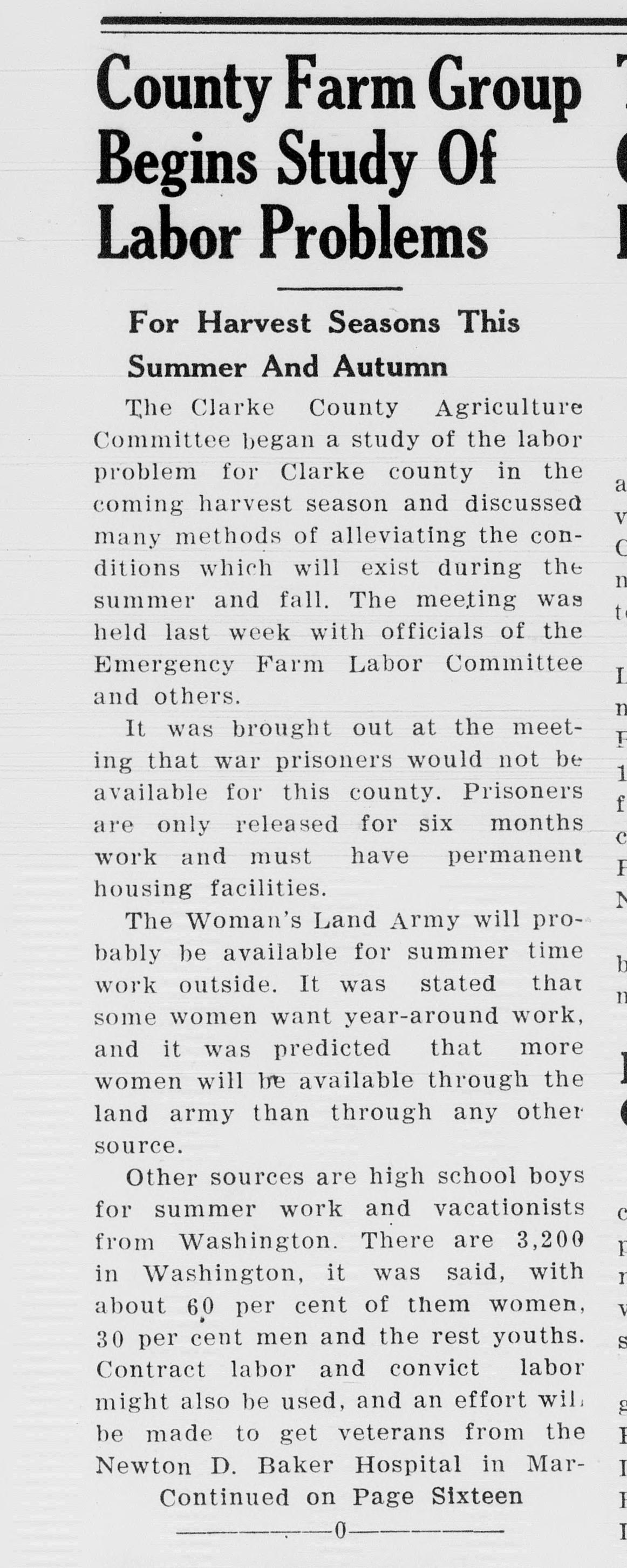
The county agriculture committee begins planning for the 1944 harvest and learns that war prisoners will not be available.
Clarke Courier (Berryville, Va.), April 13, 1944, page 1. Library of Congress, Chronicling America. Rights Changes: The retained file itself, shown at its own 1162 by 2907 pixels: not scaled, not re-encoded. Nothing retouched or added.
Source: Clarke Courier, Berryville, Va., April 13, 1944, page 1: "County Farm Group Begins Study Of Labor Problems" Open the full image
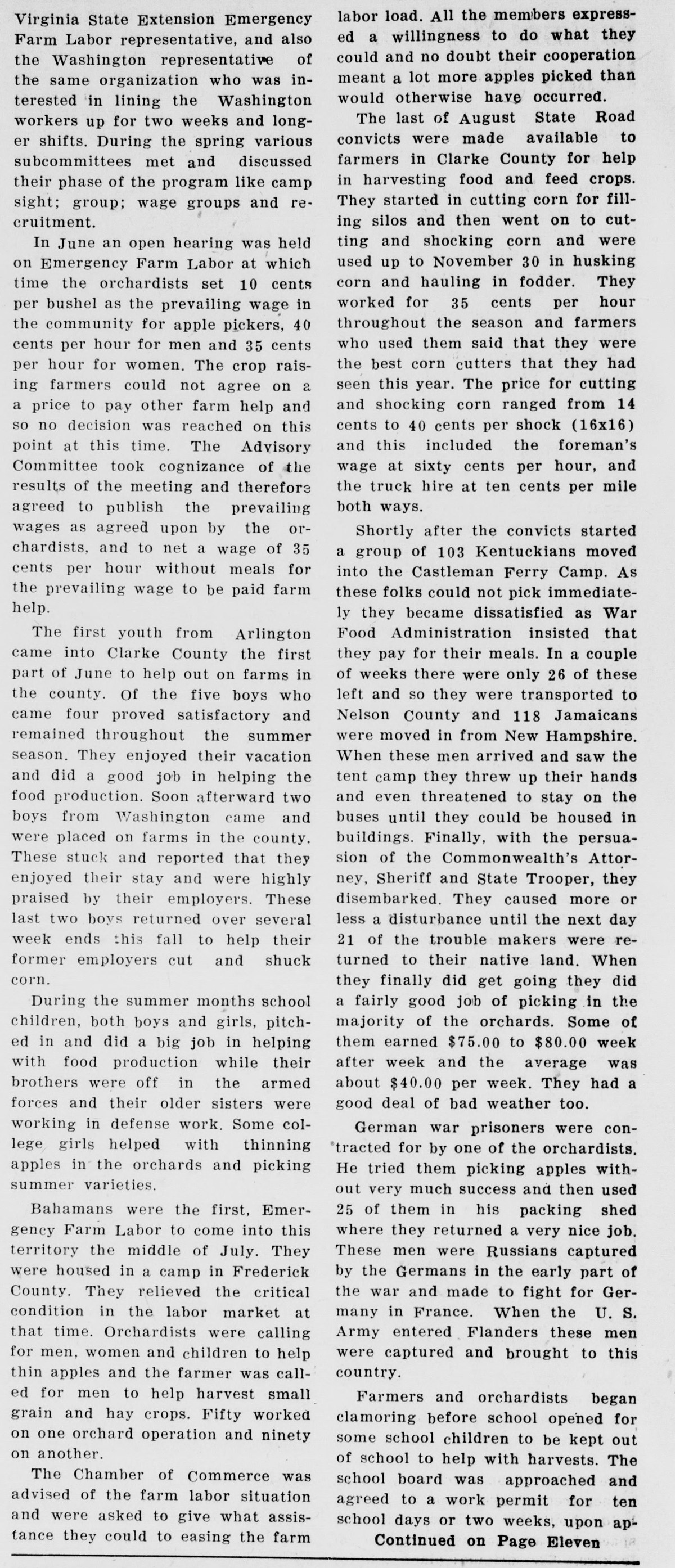
The county agent's report for 1944, as the Courier printed it: wages, boys and school children, Bahaman and Jamaican workers, State Road convicts and German war prisoners, in the report's own words.
Clarke Courier (Berryville, Va.), January 18, 1945, page 4. Library of Congress, Chronicling America. Rights Changes: A detail of the retained region crop of the Library of Congress page image (3078 by 5982 pixels): the rectangle from x 1040 to 3078 and y 60 to 4795, which leaves out the unrelated items around it, scaled to 1200 by 2788, and re-encoded as JPEG. The whole page is at the source link. Nothing retouched or added.
Source: Clarke Courier, Berryville, Va., January 18, 1945, page 4: the county agent's report for 1944, "Farm Labor" Open the full image
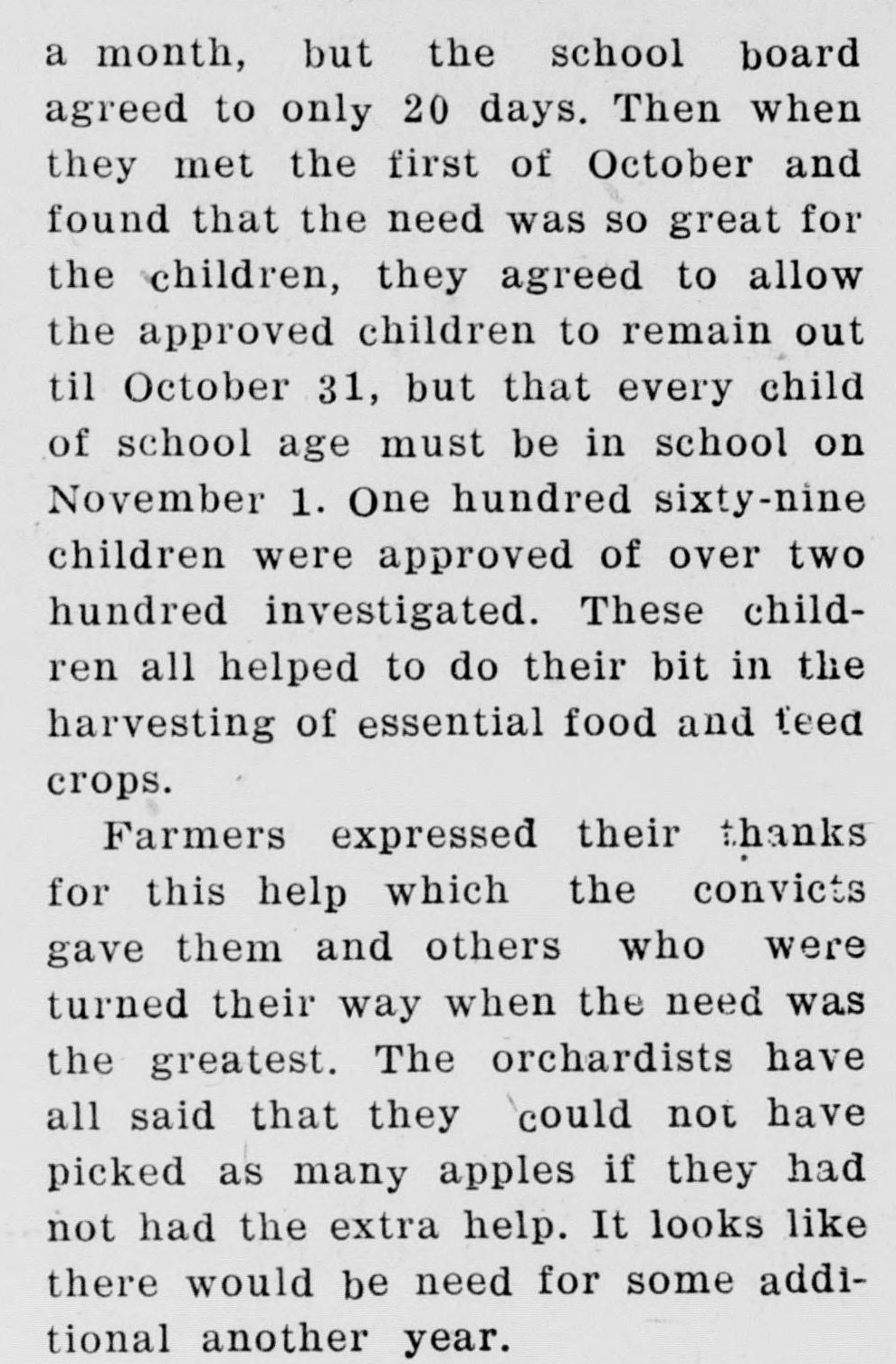
The report's continuation: the school board allowed 20 days, then let approved children stay out until October 31; 169 were approved of more than two hundred investigated.
Clarke Courier (Berryville, Va.), January 18, 1945, page 11. Library of Congress, Chronicling America. Rights Changes: A detail of the retained region crop of the Library of Congress page image (2104 by 4426 pixels): the rectangle from x 1050 to 2040 and y 56 to 1563, which leaves out the unrelated items around it, not scaled, and re-encoded as JPEG. The whole page is at the source link. Nothing retouched or added.
Source: Clarke Courier, Berryville, Va., January 18, 1945, page 11: "County Agent Report, Continued from Page Four" Open the full image
The Pope family
Some families carried the war more heavily than others. In February 1943 Mrs. Fred Pope of near Berryville told the Courier she believed her son Ralph was safe. He was 26, he had been at Manila, and he had been missing since May 7, 1942. Two more of her sons, Janey Lee and Robert Edward, were serving overseas. A fourth, Garland, was eighteen and eligible for service, and her daughter Eva Corinne, sixteen, was eager to join the WAACs.
In late May the Courier reported that the War Department had told the Popes, through the International Red Cross, that Ralph was a prisoner of the Japanese. In August they had their first card from him: he was interned, uninjured and well, and he sent his love to his brothers and sisters. At the end of October another son, Carl, seventeen, enlisted in the Navy from his job at the post office. In February 1944, despite the reports of Japanese atrocities, Mrs. Pope said she still felt her son was all right.
In November 1944 the Courier reported that the War Department had wired the family the text of an enemy propaganda broadcast it had intercepted: "Dear Mother, I am getting along fine," it began. "I am now in Japan." Six weeks later the War Department wired the Popes again. Staff Sergeant Janey Lee Pope was killed in action in Germany in December 1944, at 23. On December 13, a few days before his death, he had gone to spend several days with his brother Robert in France. So far as the paper could learn, he was the first Clarke County soldier killed in action in the war.
In May 1945, Robert Pope was discharged after 26 months overseas and six campaigns, one of the first Clarke soldiers, if not the first, to be discharged under the Army's point system.
Source note: Clarke Courier, Berryville, Va., 1943
The Clarke Courier of February 4, 1943 reported that Ralph Pope, son of Mr. and Mrs. Fred Pope of Berryville, missing since May 7, 1942, "is safe and alright according to the way his mother feels about it"; that the 26-year-old Clarke county man was at Manila when the Japanese came, and a War Department letter about Christmas had stated he was missing in action; that a second son, Staff Sergt. Janey Lee Pope, 20, was stationed somewhere in England and a third, Lieut. Robert Edward Pope, 22, was also in a foreign country; that another son, Garland Iden Pope, 18, was eligible for service; and that a daughter, Eva Corinne, 16, was eager to join the WAACs.
What the source supports
What the Courier reported of the Pope family's situation in February 1943, including the mother's belief about her missing son.
Uncertainty
The mother's belief is reported as hers and is not evidence of his condition. Names, ranks and ages as printed. This item does not state Ralph Pope's rank or branch. The parents' printed forms (Fred, Fred C., Fred H., Fred W.; "of Berryville" and "of near Berryville") and the sons' names are not joined beyond the paper's own family statements; the name "Joe" in a later item is not joined to anyone.
Source
Evidence role: supports. The whole item.
Clarke Courier, Berryville, Va., February 4, 1943, page 12: "Mother Believes Son Missing Is Safe"
Clarke Courier, Berryville, Va. · 1943-02-04 (publication)
Locator: Page 12, "Mother Believes Son Missing Is Safe," the whole item
Relevant passageis safe and alright according to the way his mother feels about it.
Checked: Original inspected. A digital reproduction was inspected; no original has been handled.
Open sourceSource family: clarke-courier. Multiple passages from one source are not independent witnesses.
AI-assisted source check (Claude Opus 5.5) · 2026-09-26. How this project checks its sources
Source note: Clarke Courier, Berryville, Va., 1943
The Clarke Courier of May 27, 1943 reported that Mr. and Mrs. Fred Pope had received word from the War Department that their son, Technical Sergt. Ralph W. Pope, first reported missing as of May 7, 1942, was "a prisoner of war of the Japanese Government," taken in the Philippine Island campaign; the War Department said the word had just been received through the International Red Cross and that a letter of information would follow.
What the source supports
That the Courier reported the War Department's notice that Ralph W. Pope was a prisoner of the Japanese.
Uncertainty
The paper's report of a War Department notice, which was not seen; the notice is not dated in the item. "Ralph W. Pope" as printed; another middle initial printed elsewhere (Ralph E.) is not joined or resolved here.
Source
Evidence role: supports. The whole item.
Clarke Courier, Berryville, Va., May 27, 1943, page 16: "Sergt. Ralph Pope Prisoner Of Japs"
Clarke Courier, Berryville, Va. · 1943-05-27 (publication)
Locator: Page 16, "Sergt. Ralph Pope Prisoner Of Japs," the whole item
Relevant passagea prisoner of war of the Japanese Government.
Checked: Original inspected. A digital reproduction was inspected; no original has been handled.
Open sourceSource family: clarke-courier. Multiple passages from one source are not independent witnesses.
AI-assisted source check (Claude Opus 5.5) · 2026-09-26. How this project checks its sources
Source note: Clarke Courier, Berryville, Va., 1943
In its "Stars, Bars and Stripes" column of August 26, 1943, the Clarke Courier reported that Mr. and Mrs. Fred Pope had received their first word direct from their son, Tech. Sergt. Ralph W. Pope, a prisoner of war of the Japanese in the Philippines: on a form card allowed by the Japanese he said he was interned at the headquarters of a war prison (printed "Camp P. I. No. 12"), that "His health is good, he is uninjured and is well," and he sent his love to his brothers and sisters.
What the source supports
That the Courier reported the first card the Popes received from their son as a prisoner.
Uncertainty
A form card the captors allowed, as the paper describes it; its wording shows what could be sent, not necessarily his condition. The card was not seen. The women he greets by first name are not used or identified. A later item (May 31, 1945) prints a different camp number; the two are not reconciled.
Source
Evidence role: supports. The second item of the column.
Clarke Courier, Berryville, Va., August 26, 1943, page 13: "Stars, Bars and Stripes" column, item on Tech. Sergt. Ralph W. Pope
Clarke Courier, Berryville, Va. · 1943-08-26 (publication)
Locator: Page 13, "Stars, Bars and Stripes," second item, on the first card from Tech. Sergt. Ralph W. Pope
Relevant passageHis health is good, he is uninjured and is well.
Checked: Original inspected. A digital reproduction was inspected; no original has been handled.
Open sourceSource family: clarke-courier. Multiple passages from one source are not independent witnesses.
AI-assisted source check (Claude Opus 5.5) · 2026-09-26. How this project checks its sources
Source note: Clarke Courier, Berryville, Va., 1943
The Clarke Courier of November 4, 1943 reported, under the heading "Fourth Pope Boy Enlists In Navy," that Carl Herbert Pope, son of Mr. and Mrs. Fred W. Pope, Berryville, enlisted in the U.S. Navy "last Saturday" and was transferred to the Navy Training Station at Bainbridge, Maryland; that three older brothers were sergeants in the Army overseas; that Carl was born in Berryville on July 30, 1926; and that at the time of his enlistment he was working in the post office.
What the source supports
That the Courier reported Carl Herbert Pope's Navy enlistment at the end of October 1943.
Uncertainty
"Last Saturday" in the issue of Thursday, November 4, 1943 is October 30, 1943. His age, seventeen, is computed from the printed birth date and is not printed. The item names the brother in England as "Joe"; earlier items give Janey Lee Pope in England; the name Joe is not used and no join is made. The other enlistees named in the item are not used. "Fred W. Pope" as printed; not joined to other printed forms beyond the paper's family statements.
Source
Evidence role: supports. The first, second and last paragraphs.
Clarke Courier, Berryville, Va., November 4, 1943, page 12: "Fourth Pope Boy Enlists In Navy"
Clarke Courier, Berryville, Va. · 1943-11-04 (publication)
Locator: Page 12, "Fourth Pope Boy Enlists In Navy," the enlistment, the brothers, the birth date and the post office
Checked: Original inspected. A digital reproduction was inspected; no original has been handled.
Open sourceSource family: clarke-courier. Multiple passages from one source are not independent witnesses.
AI-assisted source check (Claude Opus 5.5) · 2026-09-26. How this project checks its sources
Source note: Clarke Courier, Berryville, Va., 1944
The Clarke Courier of February 3, 1944 reported that Mrs. Fred H. Pope of near Berryville believed her son, Sergt. Ralph W. Pope, a prisoner of war of the Japanese, was all right, as she said on Tuesday afternoon, and that in spite of the Army-Navy report of the atrocities perpetrated by the Japanese on prisoners taken at Bataan and in the Philippines, "Mrs. Pope feels that her son is all right."
What the source supports
That the Courier reported Mrs. Pope's continued belief, in February 1944, that her son was all right.
Uncertainty
The mother's belief, reported as hers; it is not evidence of his condition. The atrocity report is referred to, not printed or examined here. "Fred H. Pope" as printed; not joined to other printed forms beyond the paper's family statements.
Source
Evidence role: supports. The first and second paragraphs.
Clarke Courier, Berryville, Va., February 3, 1944, page 1: "Believes Son, Prisoner Of Japs, All Right"
Clarke Courier, Berryville, Va. · 1944-02-03 (publication)
Locator: Page 1, "Believes Son, Prisoner Of Japs, All Right," first and second paragraphs
Relevant passageMrs. Pope feels that her son is all right.
Checked: Original inspected. A digital reproduction was inspected; no original has been handled.
Open sourceSource family: clarke-courier. Multiple passages from one source are not independent witnesses.
AI-assisted source check (Claude Opus 5.5) · 2026-09-26. How this project checks its sources
Source note: Clarke Courier, Berryville, Va., 1944
The Clarke Courier of November 16, 1944 reported that Tech. Sergt. Ralph Pope, a prisoner of the Japanese government, was now in Japan, according to a War Department telegram to his parents, Mr. and Mrs. Fred Pope of Berryville; that the War Department had intercepted a Japanese broadcast; and it printed the wire, which gave the text of "enemy propoganda broadcast from Japan" (as printed): "Dear Mother, I am getting along fine. Hope this finds all the same. Say hello to all. I am now in Japan."
What the source supports
That the Courier printed the War Department's wire quoting an intercepted broadcast message from Ralph Pope.
Uncertainty
The message is quoted from the War Department wire as the paper printed it. It came through an enemy propaganda broadcast, so neither its authorship nor its account of his condition can be verified from it. The telegram was not seen and is not dated in the item.
Source
Evidence role: supports. The whole item, with the wire's text quoted.
Clarke Courier, Berryville, Va., November 16, 1944, page 1: "Sergt. Ralph Pope Prisoner In Japan"
Clarke Courier, Berryville, Va. · 1944-11-16 (publication)
Locator: Page 1, "Sergt. Ralph Pope Prisoner In Japan," the War Department telegram and the wire's text
Relevant passageDear Mother, I am getting along fine. Hope this finds all the same. Say hello to all. I am now in Japan.
Checked: Original inspected. A digital reproduction was inspected; no original has been handled.
Open sourceSource family: clarke-courier. Multiple passages from one source are not independent witnesses.
AI-assisted source check (Claude Opus 5.5) · 2026-09-26. How this project checks its sources
Source note: Clarke Courier, Berryville, Va., 1944
The Clarke Courier of December 28, 1944 reported that Staff Sergt. Janey Lee Pope, one of four fighting sons of Mr. and Mrs. Fred Pope of near Berryville, was killed in action in Germany on December 19, as the War Department wired his parents on Tuesday; that he had turned 23 on December 9; that on December 13 he spent several days visiting his brother, Staff Sergt. Robert Edward Pope, in France; and that his death, "so far as can be learned, is the first Clarke county soldier to be killed in action in the present conflict."
What the source supports
That the Courier reported Janey Lee Pope killed in action in Germany in December 1944, and its qualified statement that he was the county's first.
Uncertainty
The paper's report of a War Department telegram, which was not seen. The death date is December 19 here and December 16 in a later Courier item (October 4, 1945, page 16, held as machine text only); the two are not reconciled, and the story gives only the month. "First Clarke county soldier" is the paper's qualified statement, not a verified count. His unit and the list of survivors are not used, and the survivors named are not joined to names in earlier items.
Source
Evidence role: supports. The first, third and last paragraphs.
Clarke Courier, Berryville, Va., December 28, 1944, page 1: "Sgt. Janey L. Pope Killed In Action In Germany"
Clarke Courier, Berryville, Va. · 1944-12-28 (publication)
Locator: Page 1, "Sgt. Janey L. Pope Killed In Action In Germany," the telegram, his age, the visit to his brother in France and the closing sentence
Relevant passageso far as can be learned, is the first Clarke county soldier to be killed in action in the present conflict.
Checked: Original inspected. A digital reproduction was inspected; no original has been handled.
Open sourceSource family: clarke-courier. Multiple passages from one source are not independent witnesses.
AI-assisted source check (Claude Opus 5.5) · 2026-09-26. How this project checks its sources
Source note: Clarke Courier, Berryville, Va., 1945
The Clarke Courier of May 31, 1945 reported that Staff Sergt. Robert Pope, son of Mr. and Mrs. Fred Pope of near Berryville, was "One of the first, if not the first," soldier from Clarke county to be discharged under the point system; that he was discharged May 21 after serving overseas for 26 months; that he took part in six campaigns, in Tunisia, Sicily, Naples-Foggia, Rome-Arno, Southern France and Germany; and that he had a total of 112 points.
What the source supports
That the Courier reported Robert Pope's discharge under the point system in May 1945 as one of the county's first.
Uncertainty
The paper's claim of primacy is qualified as printed and is not verified against discharge records, which were not seen. The brothers' news in the same item (a brother printed as "Janney"; Ralph's camp given as No. 11) is not used and not reconciled with earlier items.
Source
Evidence role: supports. The first and second paragraphs.
Clarke Courier, Berryville, Va., May 31, 1945, page 1: "Sgt. Pope First County Dischargee Under Point System"
Clarke Courier, Berryville, Va. · 1945-05-31 (publication)
Locator: Page 1, "Sgt. Pope First County Dischargee Under Point System," first and second paragraphs
Relevant passageOne of the first, if not the first, soldier from Clarke county to be discharged under the point system
Checked: Original inspected. A digital reproduction was inspected; no original has been handled.
Open sourceSource family: clarke-courier. Multiple passages from one source are not independent witnesses.
AI-assisted source check (Claude Opus 5.5) · 2026-09-26. How this project checks its sources
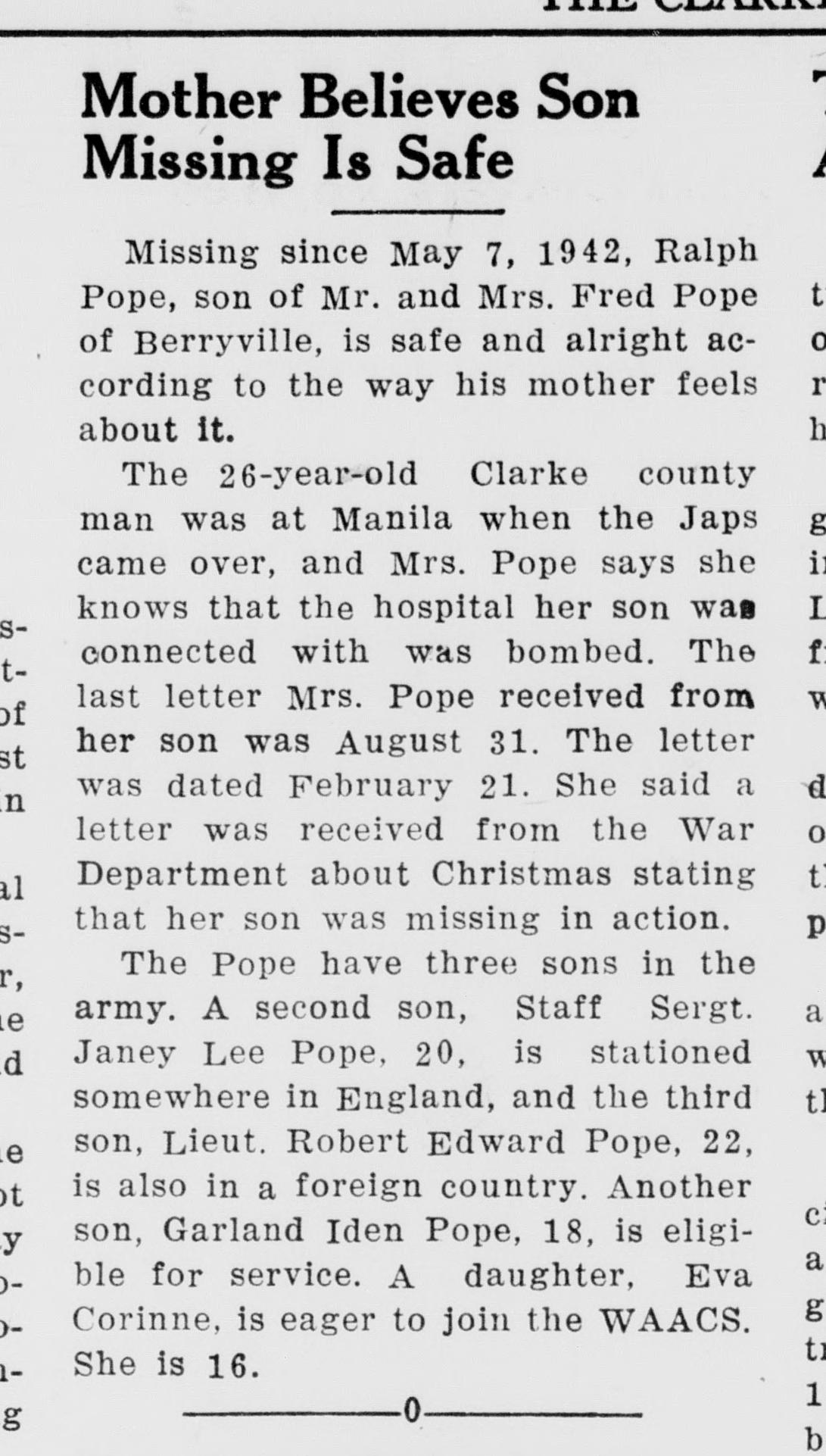
February 1943: Mrs. Pope believes her son Ralph, missing since May 7, 1942, is safe; two more sons serve overseas, a fourth is eligible and a daughter hopes to join the WAACs.
Clarke Courier (Berryville, Va.), February 4, 1943, page 12. Library of Congress, Chronicling America. Rights Changes: The retained file itself, shown at its own 1091 by 1922 pixels: not scaled, not re-encoded. Nothing retouched or added.
Source: Clarke Courier, Berryville, Va., February 4, 1943, page 12: "Mother Believes Son Missing Is Safe" Open the full image
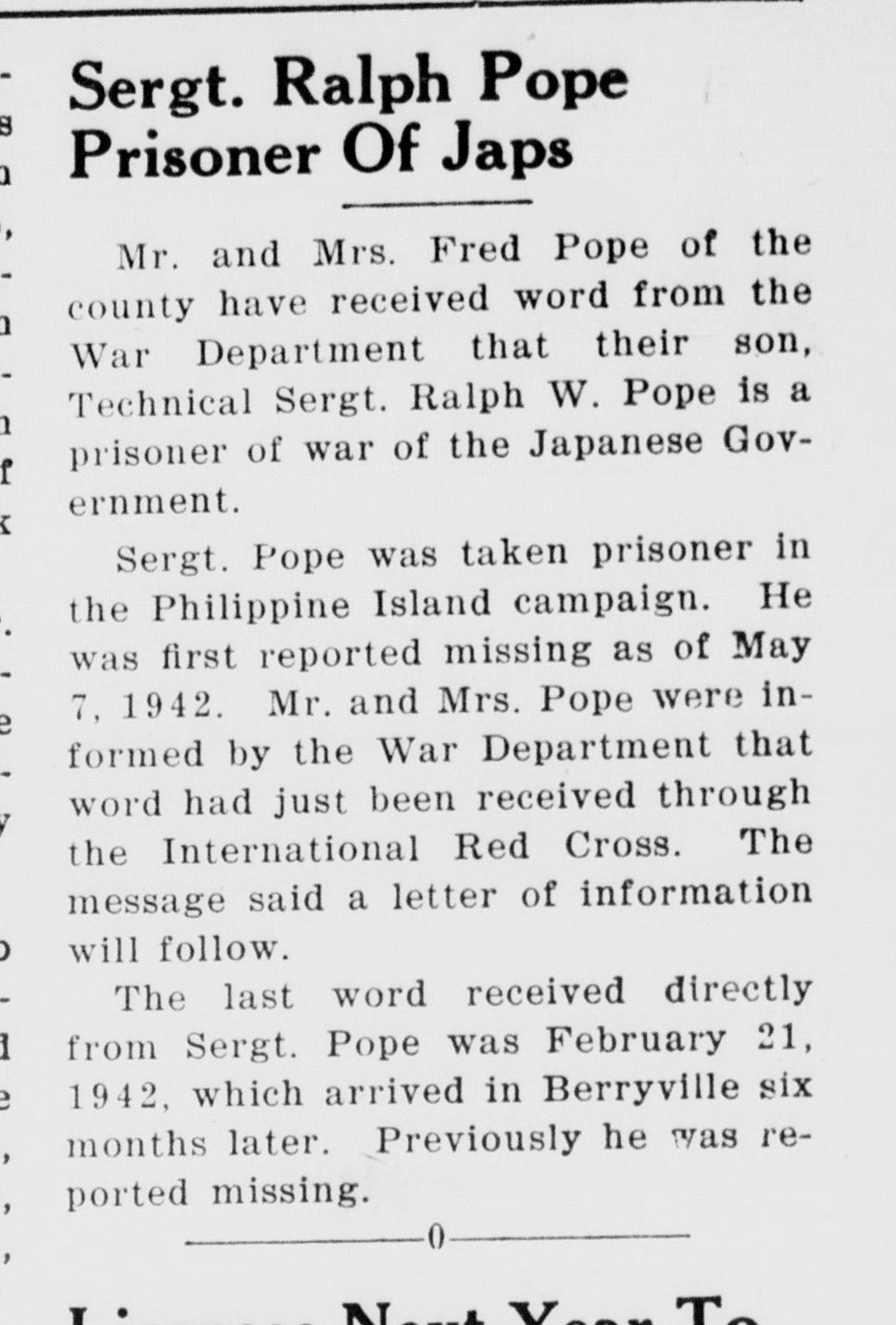
May 1943: the War Department, through the International Red Cross, reports Technical Sergeant Ralph W. Pope a prisoner of war of the Japanese.
Clarke Courier (Berryville, Va.), May 27, 1943, page 16. Library of Congress, Chronicling America. Rights Changes: The retained file itself, shown at its own 1075 by 1590 pixels: not scaled, not re-encoded. Nothing retouched or added.
Source: Clarke Courier, Berryville, Va., May 27, 1943, page 16: "Sergt. Ralph Pope Prisoner Of Japs" Open the full image
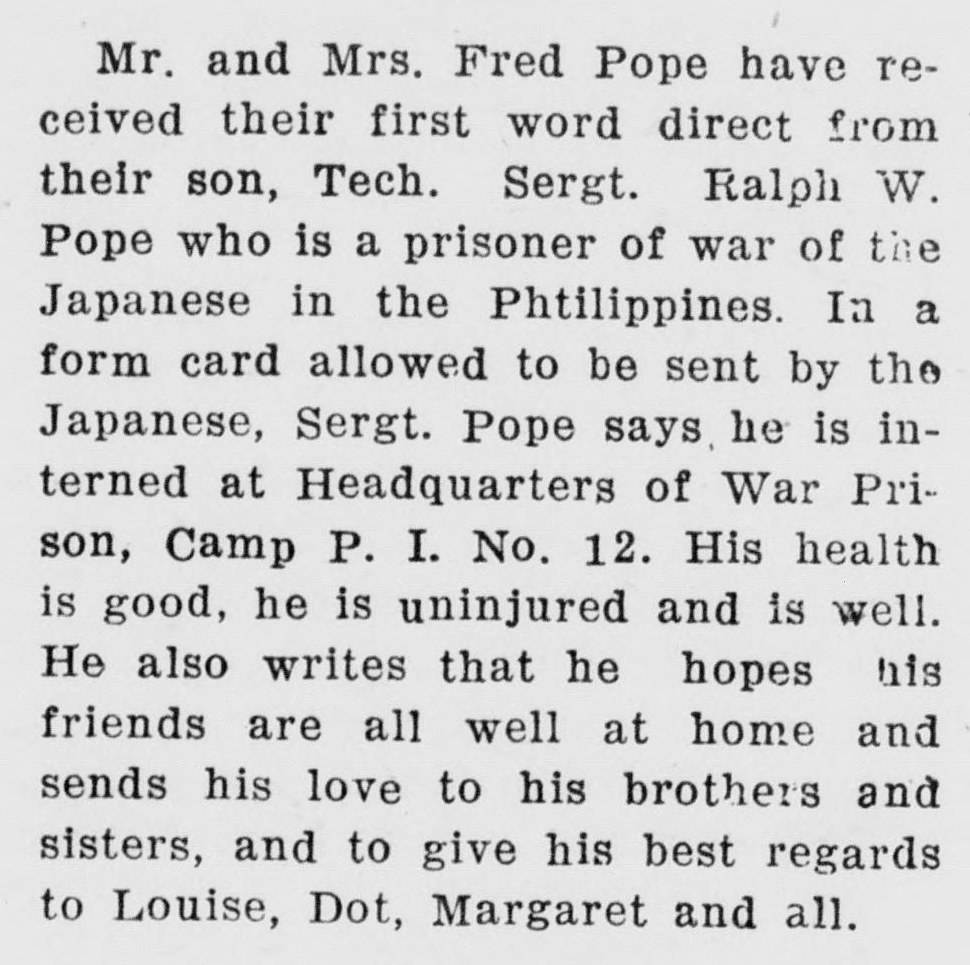
August 1943, from the paper's service-news column: the Popes' first card direct from their son, a prisoner of the Japanese in the Philippines.
Clarke Courier (Berryville, Va.), August 26, 1943, page 13. Library of Congress, Chronicling America. Rights Changes: A detail of the retained region crop of the Library of Congress page image (1126 by 4371 pixels): the rectangle from x 110 to 1080 and y 1115 to 2080, which leaves out the unrelated items around it, not scaled, and re-encoded as JPEG. The whole page is at the source link. Nothing retouched or added.
Source: Clarke Courier, Berryville, Va., August 26, 1943, page 13: "Stars, Bars and Stripes" column, item on Tech. Sergt. Ralph W. Pope Open the full image
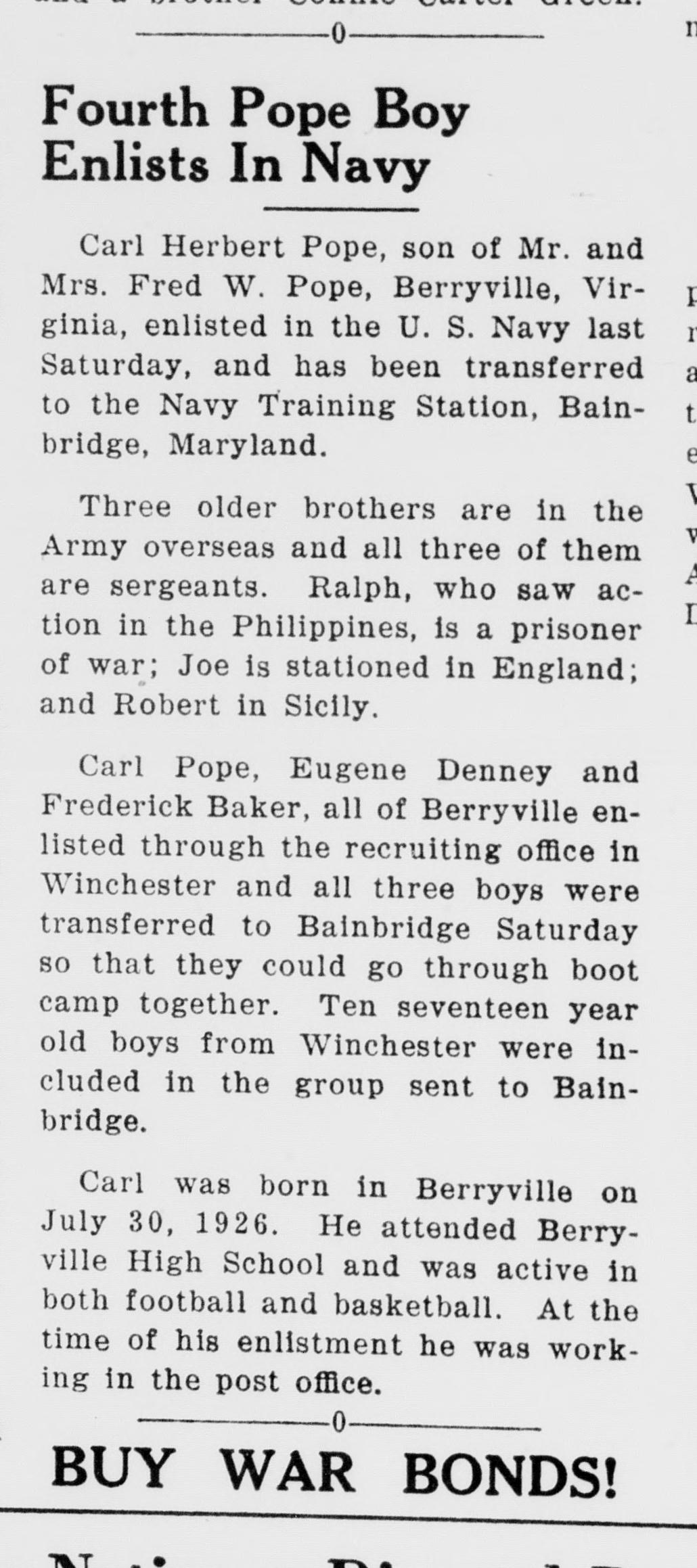
Carl Herbert Pope enlists in the Navy on the last Saturday of October 1943, the fourth Pope son in service; he had been working in the post office.
Clarke Courier (Berryville, Va.), November 4, 1943, page 12. Library of Congress, Chronicling America. Rights Changes: The retained file itself, shown at its own 1030 by 2318 pixels: not scaled, not re-encoded. Nothing retouched or added.
Source: Clarke Courier, Berryville, Va., November 4, 1943, page 12: "Fourth Pope Boy Enlists In Navy" Open the full image
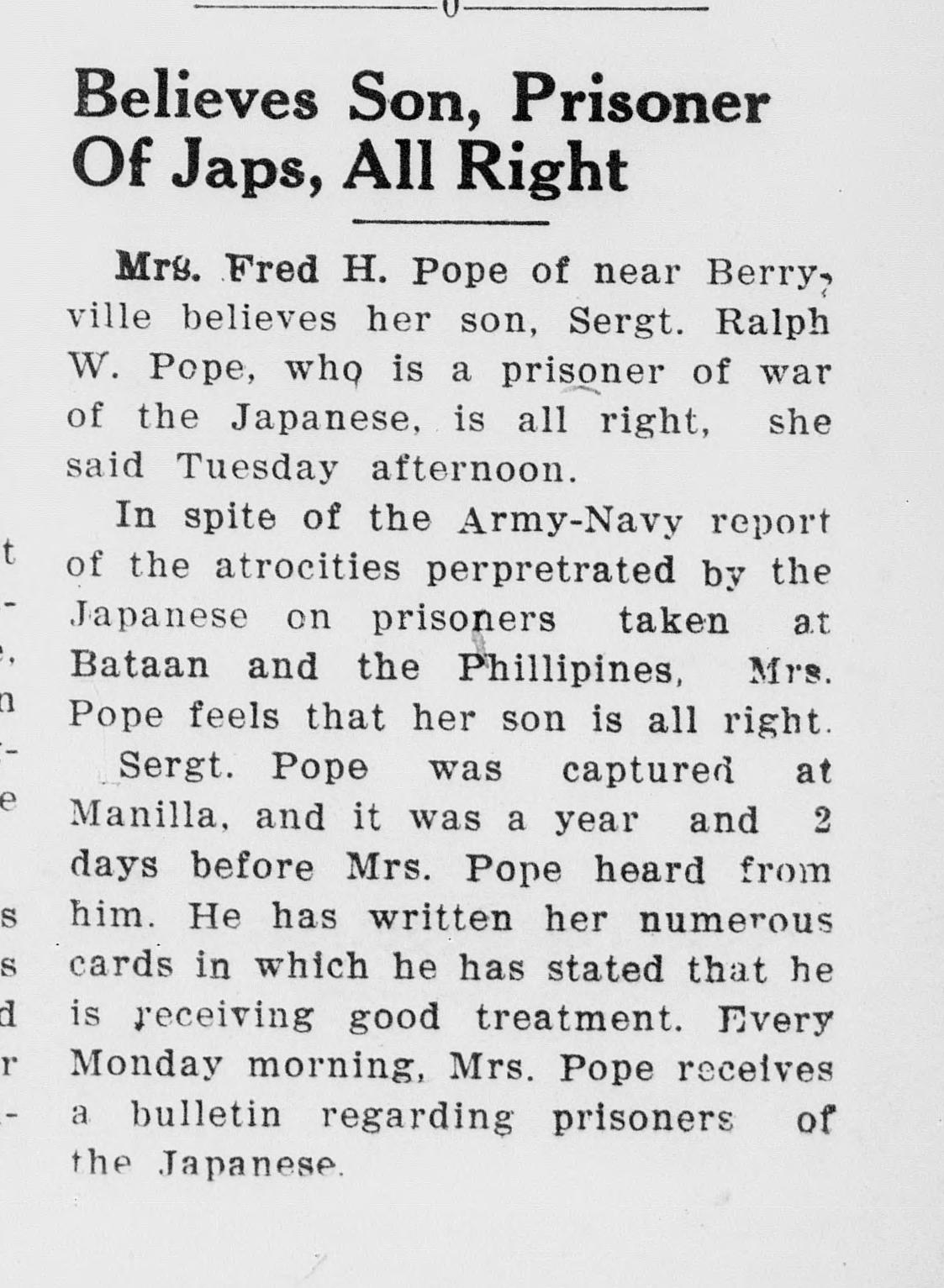
February 1944: despite the reports of atrocities against prisoners, Mrs. Fred H. Pope says she feels her son is all right.
Clarke Courier (Berryville, Va.), February 3, 1944, page 1. Library of Congress, Chronicling America. Rights Changes: The retained file itself, shown at its own 1123 by 1533 pixels: not scaled, not re-encoded. Nothing retouched or added.
Source: Clarke Courier, Berryville, Va., February 3, 1944, page 1: "Believes Son, Prisoner Of Japs, All Right" Open the full image
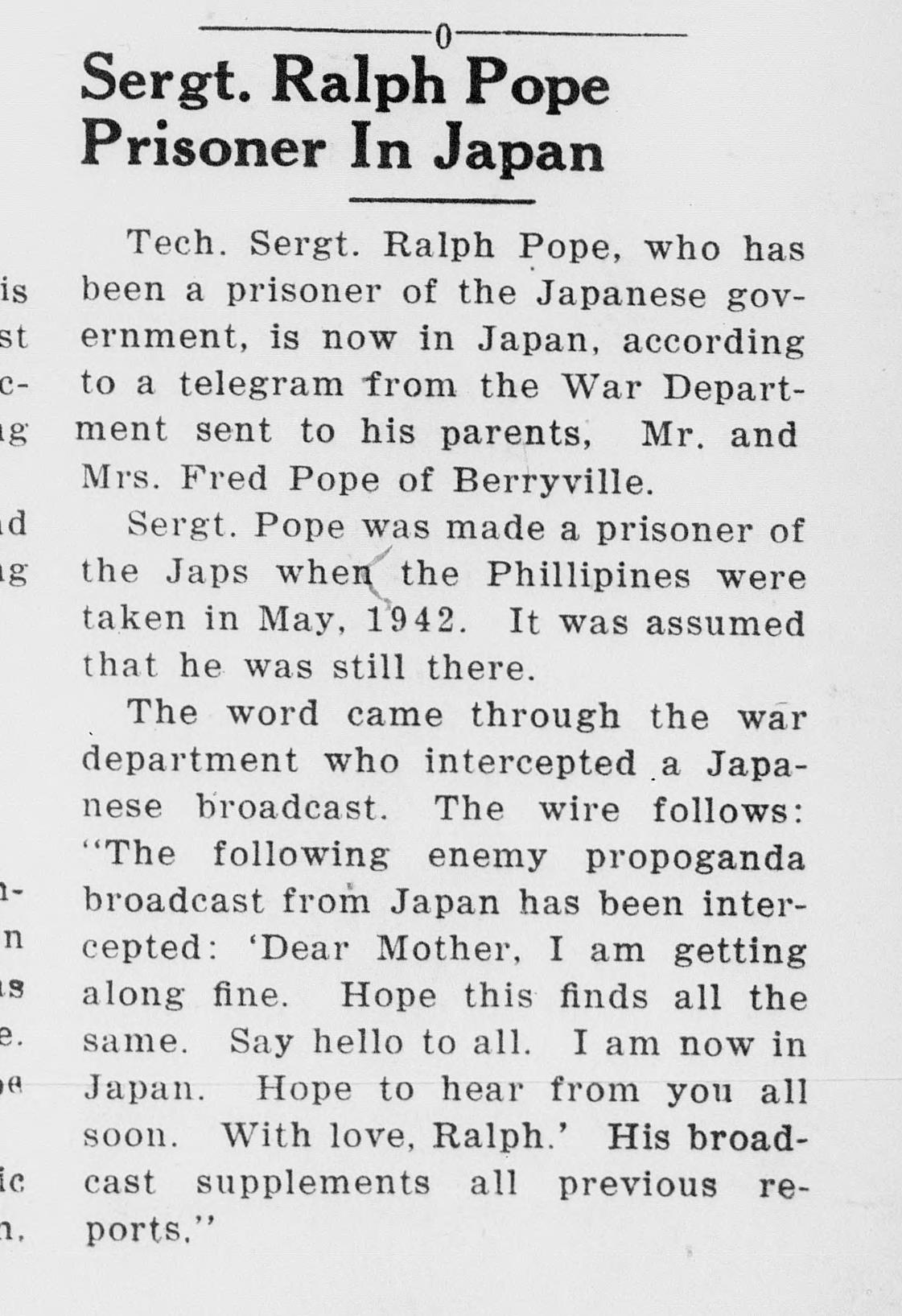
November 1944: the War Department wires the Popes the text of an intercepted Japanese propaganda broadcast from their son, now in Japan.
Clarke Courier (Berryville, Va.), November 16, 1944, page 1. Library of Congress, Chronicling America. Rights Changes: The retained file itself, shown at its own 1121 by 1635 pixels: not scaled, not re-encoded. Nothing retouched or added.
Source: Clarke Courier, Berryville, Va., November 16, 1944, page 1: "Sergt. Ralph Pope Prisoner In Japan" Open the full image
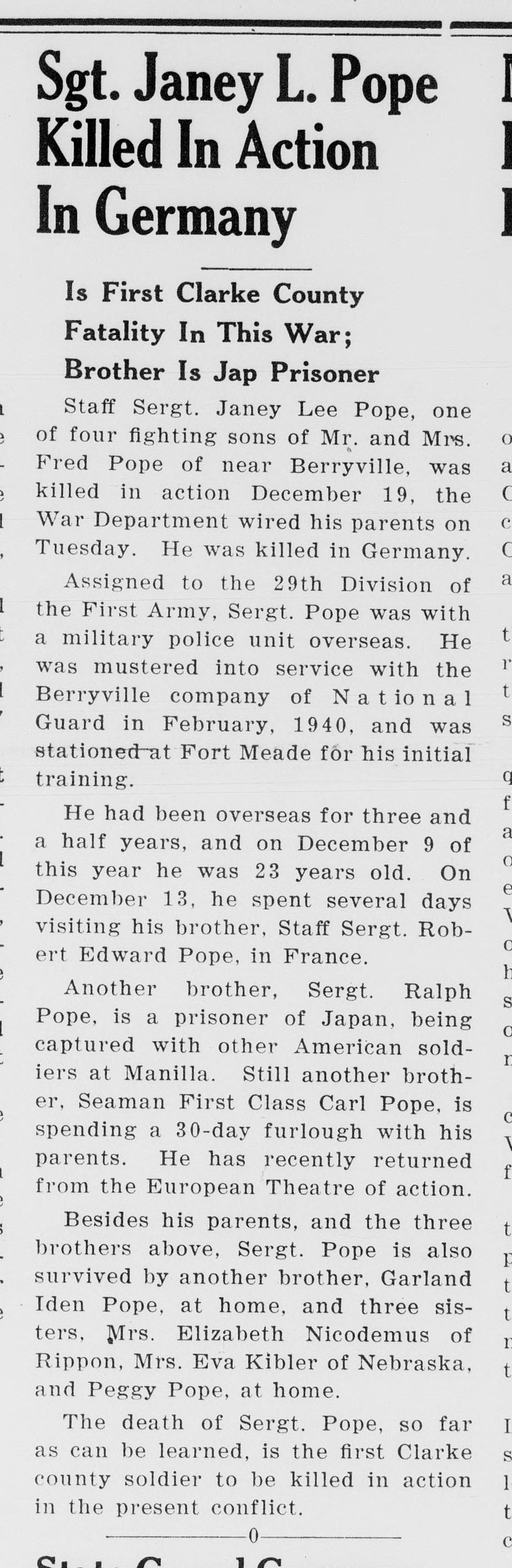
December 1944: Staff Sergeant Janey Lee Pope is killed in action in Germany; so far as the paper could learn, the first Clarke County soldier killed in the war.
Clarke Courier (Berryville, Va.), December 28, 1944, page 1. Library of Congress, Chronicling America. Rights Changes: The retained file itself, shown at its own 1058 by 3239 pixels: not scaled, not re-encoded. Nothing retouched or added.
Source: Clarke Courier, Berryville, Va., December 28, 1944, page 1: "Sgt. Janey L. Pope Killed In Action In Germany" Open the full image
What this image is evidence for
Passage it reproduces: Page 1, "Sgt. Janey L. Pope Killed In Action In Germany," the telegram, his age, the visit to his brother in France and the closing sentence
Statements on this site that rest on it:
- The Clarke Courier of December 28, 1944 reported that Staff Sergt. Janey Lee Pope, one of four fighting sons of Mr. and Mrs. Fred Pope of near Berryville, was killed in action in Germany on December 19, as the War Department wired his parents on Tuesday; that he had turned 23 on December 9; that on December 13 he spent several days visiting his brother, Staff Sergt. Robert Edward Pope, in France; and that his death, "so far as can be learned, is the first Clarke county soldier to be killed in action in the present conflict."
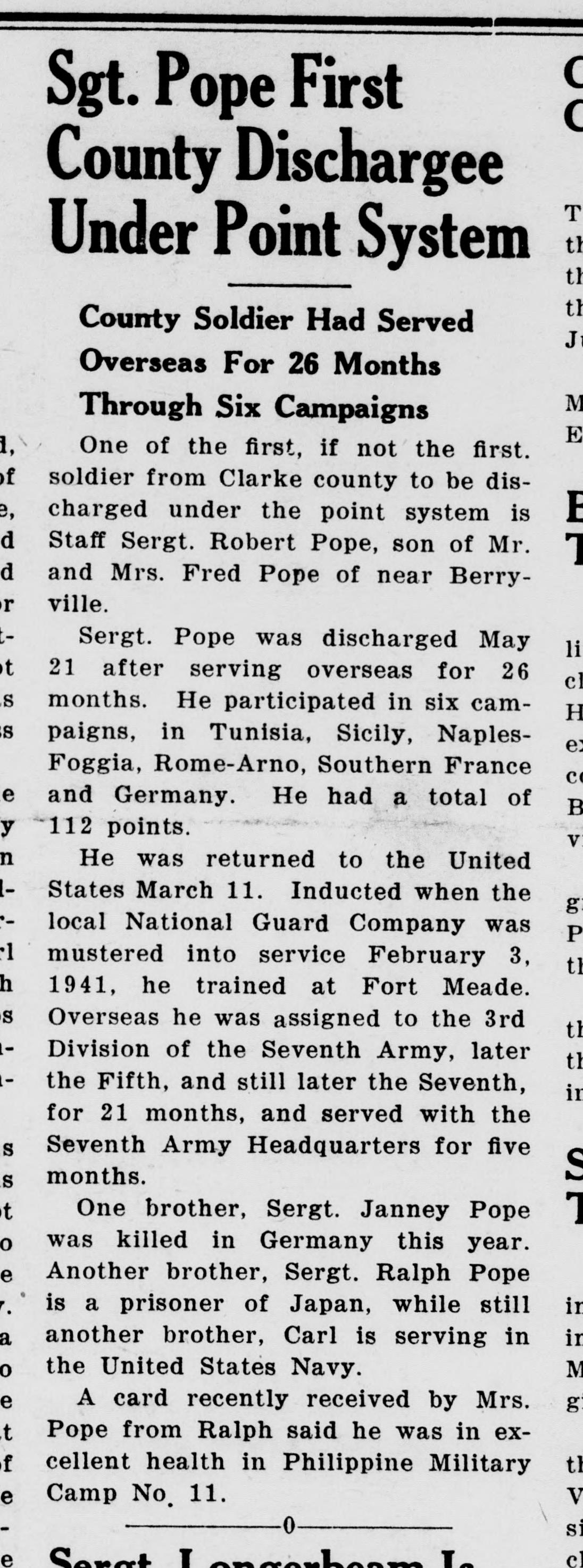
May 1945: Staff Sergeant Robert Pope, discharged after 26 months overseas and six campaigns, one of the first Clarke soldiers, if not the first, released under the point system.
Clarke Courier (Berryville, Va.), May 31, 1945, page 1. Library of Congress, Chronicling America. Rights Changes: The retained file itself, shown at its own 1096 by 2948 pixels: not scaled, not re-encoded. Nothing retouched or added.
Source: Clarke Courier, Berryville, Va., May 31, 1945, page 1: "Sgt. Pope First County Dischargee Under Point System" Open the full image
Victory, twice
Berryville celebrated the end of the war in Europe before it happened. On Saturday night, April 28, 1945, a false report of Germany's surrender went out over the radio, and for an hour or so, the paper said, the town "went wild." People blew the fire siren without stopping, rang the fire bell, and drove the fire truck up and down every street with its siren open. The committee planning the V-E Day celebration gathered and thought of holding a service where Main Street crosses Church Street, but held off for want of confirmation.
The real V-E Day was "a tame affair" by comparison, the "Dear Dan" letter admitted. The town was a little disappointed not to celebrate on May 7, when the war really ended, and had to wait until the next day. People stood around the radio to hear President Truman's proclamation, rang the church bells and the siren, closed the stores and went to church.
The news from Japan came over the radio at seven o'clock on Tuesday evening, August 14. People poured into Berryville's streets and shouted. The siren blew long and loud, church bells rang, and cars full of people drove through town with horns sounding. The churches were packed, and a community service was held at the Berryville Baptist Church. Afterward boys and girls fed bonfires at the four corners of the main block with paper, old tires and trash. On the same front page, the Courier reported that Ralph Pope would be, or already had been, freed.
The home-front work wound down in the same weeks. A telegram from Red Cross headquarters ended the county's blood collections. The mobile unit had collected 1,425 pints of blood in ten visits to the county. Dan Morrison came home on furlough after about 36 months overseas, and the column that had been his for three years was addressed that week to someone else: "Dear Ralph Pope." It told him the county had not forgotten him, that canned goods no longer took ration points, and that the wartime speed limit had gone from 35 to 50 miles an hour.
Source note: Clarke Courier, Berryville, Va., 1945
The Clarke Courier of May 3, 1945 reported that Berryville was one of several communities that celebrated a false report of Germany's unconditional surrender, reported on Saturday night by the Associated Press and carried by the radio, until it was labeled unfounded; that Berryville "went wild for an hour or so," blowing the fire siren continuously, ringing the fire bell and parading the fire truck up and down all the streets with its siren open and bell ringing; and that the committee on the V-E Day celebration gathered and contemplated holding a service in Main Street where it crosses Church Street, but withheld its plans for want of confirmation.
What the source supports
How Berryville answered the false surrender report of late April 1945, as the Courier reported it.
Uncertainty
The paper's report; it names no participants. The committee's service was only considered and was not held; it is a plan, kept separate from the actual V-E Day of May 8 (see the Dear Dan letter of May 10). "Saturday night" is April 28, 1945 by the calendar of the May 3 issue; the item does not print the date.
Source
Evidence role: supports. The whole item.
Clarke Courier, Berryville, Va., May 3, 1945, page 5: "Berryville Goes Wild For An Hour Or So Before Report Is Denied"
Clarke Courier, Berryville, Va. · 1945-05-03 (publication)
Locator: Page 5, "Berryville Goes Wild For An Hour Or So Before Report Is Denied," the false surrender report, the siren, fire bell and fire truck, and the V-E Day committee
Relevant passageBerryville went wild for an hour or so.
Checked: Original inspected. A digital reproduction was inspected; no original has been handled.
Open sourceSource family: clarke-courier. Multiple passages from one source are not independent witnesses.
AI-assisted source check (Claude Opus 5.5) · 2026-09-26. How this project checks its sources
Source note: Clarke Courier, Berryville, Va., 1945
The "Dear Dan" letter column in the Clarke Courier of May 10, 1945 said that Berryville's celebration of V-E Day was "a tame affair" compared with the one the town's boys and girls gave the false surrender report a couple of Saturdays before; that the writer was a little disappointed not to celebrate on May 7, when the war really ended, but had to wait until the next day; and that the town took it quietly: people stood around the radio, heard President Truman issue his proclamation, rang church bells and the siren, closed the stores and attended church.
What the source supports
How V-E Day passed in Berryville, in the columnist's own account.
Uncertainty
A first-person letter column by an unnamed writer, not a news report; its characterization of the day is the columnist's. It is kept separate from the May 3 report of the false surrender celebration.
Source
Evidence role: supports. The opening paragraph.
Clarke Courier, Berryville, Va., May 10, 1945, page 16: "Dear Dan" letter column
Clarke Courier, Berryville, Va. · 1945-05-10 (publication)
Locator: Page 16, "Dear Dan" column, the opening paragraph on V-E Day
Relevant passageBerryville's celebration of V-E Day was a tame affair
Checked: Original inspected. A digital reproduction was inspected; no original has been handled.
Open sourceSource family: clarke-courier. Multiple passages from one source are not independent witnesses.
AI-assisted source check (Claude Opus 5.5) · 2026-09-26. How this project checks its sources
Source note: Clarke Courier, Berryville, Va., 1945
The Clarke Courier of August 16, 1945 reported that the news of the war's end was flashed over the radio at seven p.m. Tuesday; that people came out of their homes into the streets of Berryville and shouted, the fire siren was blown long and loud, church bells rang and automobiles filled with people went through the town with horns tooting; that churches in the county were packed and a community service was held in the Berryville Baptist Church; and that afterward crowds gathered on the streets, large bonfires were lit on the four corners of the main block in Berryville, and boys and girls kept them fed with paper, old tires and other trash.
What the source supports
How the county received the news of Japan's surrender, as the Courier reported it.
Uncertainty
The paper's report; the part continued on page 9 was not read. The national wire report printed beside it is not used as county evidence. The ministers named as conducting the service are not used here.
Source
Evidence role: supports. The county report, left column.
Clarke Courier, Berryville, Va., August 16, 1945, page 1: "County Celebrates As War With Japan Ends" and "Sgt. Pope, Jap Captive, Expected To Be Freed"
Clarke Courier, Berryville, Va. · 1945-08-16 (publication)
Locator: Page 1, "County Celebrates As War With Japan Ends," the county report under the subhead "County In Hilarious and Sober Mood," to the jump to page 9
Checked: Original inspected. A digital reproduction was inspected; no original has been handled.
Open sourceSource family: clarke-courier. Multiple passages from one source are not independent witnesses.
AI-assisted source check (Claude Opus 5.5) · 2026-09-26. How this project checks its sources
Source note: Clarke Courier, Berryville, Va., 1945
The Clarke Courier of August 16, 1945 reported that Sergt. Ralph Pope, a captive of the Japanese government since the fall of the Philippines, "will be or has already been liberated, it is believed," and that he was the son of Mr. and Mrs. Fred C. Pope of Berryville and had been captured at Manila.
What the source supports
That by mid-August 1945 the paper expected Ralph Pope's release.
Uncertainty
An expectation, not a report of a liberation; his liberation is reported only in the October 4, 1945 issue. The item says he was captured at Manila; his own later account says Corregidor. The item's "Fred C. Pope" is as printed; other items give Fred Pope without an initial. Printed names are kept as printed and are not joined to other records.
Source
Evidence role: supports. The whole item.
Clarke Courier, Berryville, Va., August 16, 1945, page 1: "County Celebrates As War With Japan Ends" and "Sgt. Pope, Jap Captive, Expected To Be Freed"
Clarke Courier, Berryville, Va. · 1945-08-16 (publication)
Locator: Page 1, "Sgt. Pope, Jap Captive, Expected To Be Freed"
Relevant passagewill be or has already been liberated, it is believed.
Checked: Original inspected. A digital reproduction was inspected; no original has been handled.
Open sourceSource family: clarke-courier. Multiple passages from one source are not independent witnesses.
AI-assisted source check (Claude Opus 5.5) · 2026-09-26. How this project checks its sources
Source note: Clarke Courier, Berryville, Va., 1945
The Clarke Courier of August 23, 1945 printed a telegram from National Headquarters received the week before by Mrs. Ralph Dorsey, chairman of the Blood Donor Service of the Clarke County Chapter of the American Red Cross, saying that in view of the presidential proclamation of Japanese surrender the procurement of blood for the armed forces by the fixed center in Washington and all mobile units was to be discontinued immediately; the headline said that during ten visits the mobile unit had collected 1,425 pints of blood in the county.
What the source supports
That the Red Cross blood collections in Clarke County ended with the Japanese surrender, and the program's reported total.
Uncertainty
The telegram as the paper printed it; the telegram itself was not seen. The 1,425 pints and ten visits are the headline's figures; the article continued on page 9, which was not read, and the dates of the visits are not given here. "Mrs. Ralph Dorsey" is as printed and is not joined to the "Mrs. Ralph N. Dorsey" of the 1943 rummage sale.
Source
Evidence role: supports. The headline and the telegram.
Clarke Courier, Berryville, Va., August 23, 1945, page 1: "During Ten Visits Here, Mobile Unit Collected 1,425 Pints Of Blood"
Clarke Courier, Berryville, Va. · 1945-08-23 (publication)
Locator: Page 1, "During Ten Visits Here, Mobile Unit Collected 1,425 Pints Of Blood," the headline and the telegram to the Blood Donor Service chairman
Checked: Original inspected. A digital reproduction was inspected; no original has been handled.
Open sourceSource family: clarke-courier. Multiple passages from one source are not independent witnesses.
AI-assisted source check (Claude Opus 5.5) · 2026-09-26. How this project checks its sources
Source note: Clarke Courier, Berryville, Va., 1945
An editor's note in the Clarke Courier of August 23, 1945 said that the letter column would for the time being be written to a different serviceman each week, and that Dan Morrison, to whom the paper had written the letter every seven days for over three years, was back home on furlough after a tour of duty in England, Scotland, North Africa, Italy, France and Corsica (printed "Corisca") of about 36 months, and would return to camp afterward, hoping to be discharged.
What the source supports
The end of the paper's weekly letter to Dan Morrison, and his return on furlough, as the paper reported it.
Uncertainty
The paper's note; Dan Morrison's service is not documented here beyond it. "Corisca" is as printed. Dan Morrison is not joined to any other person record.
Source
Evidence role: supports. The editor's note.
Clarke Courier, Berryville, Va., August 23, 1945, page 16: editor's note and "Dear Ralph Pope" letter column
Clarke Courier, Berryville, Va. · 1945-08-23 (publication)
Locator: Page 16, the editor's note at the head of the letter column, on Dan Morrison's furlough
Checked: Original inspected. A digital reproduction was inspected; no original has been handled.
Open sourceSource family: clarke-courier. Multiple passages from one source are not independent witnesses.
AI-assisted source check (Claude Opus 5.5) · 2026-09-26. How this project checks its sources
Source note: Clarke Courier, Berryville, Va., 1945
The letter column in the Clarke Courier of August 23, 1945, addressed "Dear Ralph Pope," told him the county had not forgotten him and hoped he was on his way home from prison; it said that canned fruits and vegetables no longer required ration points, that Governor Darden had lifted the wartime speed limit of 35 miles an hour and drivers could now go 50, and that cigarettes were beginning to come back to the shelves.
What the source supports
That the column was turned to Ralph Pope that week, and the home-front changes it reported.
Uncertainty
A first-person letter column; its news of rationing and the speed limit is the columnist's report, not an official notice. Only the part of the letter in the crop is used.
Source
Evidence role: supports. The letter, as far as the crop runs.
Clarke Courier, Berryville, Va., August 23, 1945, page 16: editor's note and "Dear Ralph Pope" letter column
Clarke Courier, Berryville, Va. · 1945-08-23 (publication)
Locator: Page 16, the letter headed "Dear Ralph Pope," on the prisoner, ration points, the speed limit and cigarettes
Relevant passageDear Ralph Pope
Checked: Original inspected. A digital reproduction was inspected; no original has been handled.
Open sourceSource family: clarke-courier. Multiple passages from one source are not independent witnesses.
AI-assisted source check (Claude Opus 5.5) · 2026-09-26. How this project checks its sources
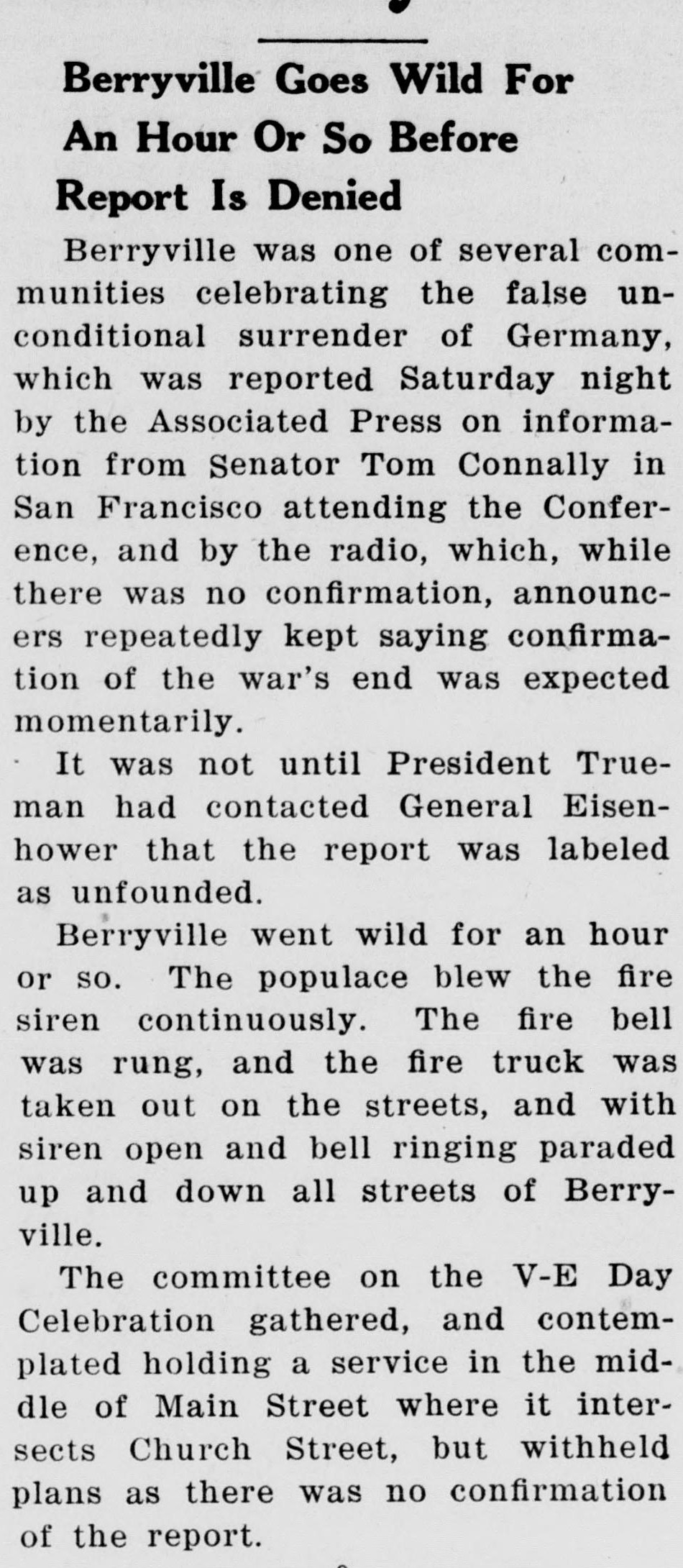
Berryville celebrates a false report of Germany's surrender for an hour or so, and the V-E Day committee holds back its plans.
Clarke Courier (Berryville, Va.), May 3, 1945, page 5. Library of Congress, Chronicling America. Rights Changes: A detail of the retained region crop of the Library of Congress page image (1095 by 2262 pixels): the rectangle from x 60 to 1010 and y 0 to 2180, which leaves out the unrelated items around it, not scaled, and re-encoded as JPEG. The whole page is at the source link. Nothing retouched or added.
Source: Clarke Courier, Berryville, Va., May 3, 1945, page 5: "Berryville Goes Wild For An Hour Or So Before Report Is Denied" Open the full image
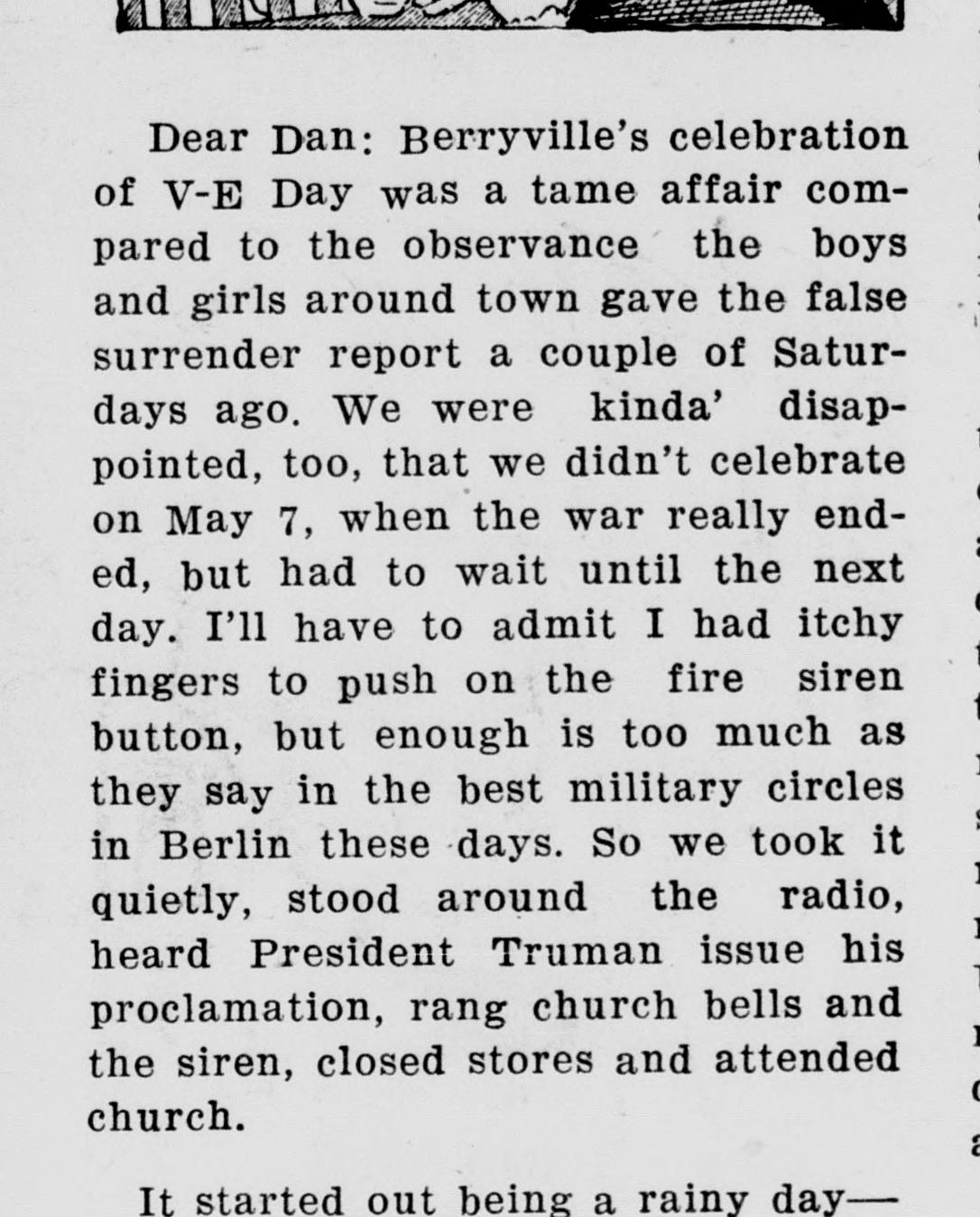
The "Dear Dan" letter calls V-E Day in Berryville a tame affair: the radio, the President's proclamation, church bells and the siren, closed stores and church.
Clarke Courier (Berryville, Va.), May 10, 1945, page 16. Library of Congress, Chronicling America. Rights Changes: The retained file itself, shown at its own 1086 by 1349 pixels: not scaled, not re-encoded. Nothing retouched or added.
Source: Clarke Courier, Berryville, Va., May 10, 1945, page 16: "Dear Dan" letter column Open the full image
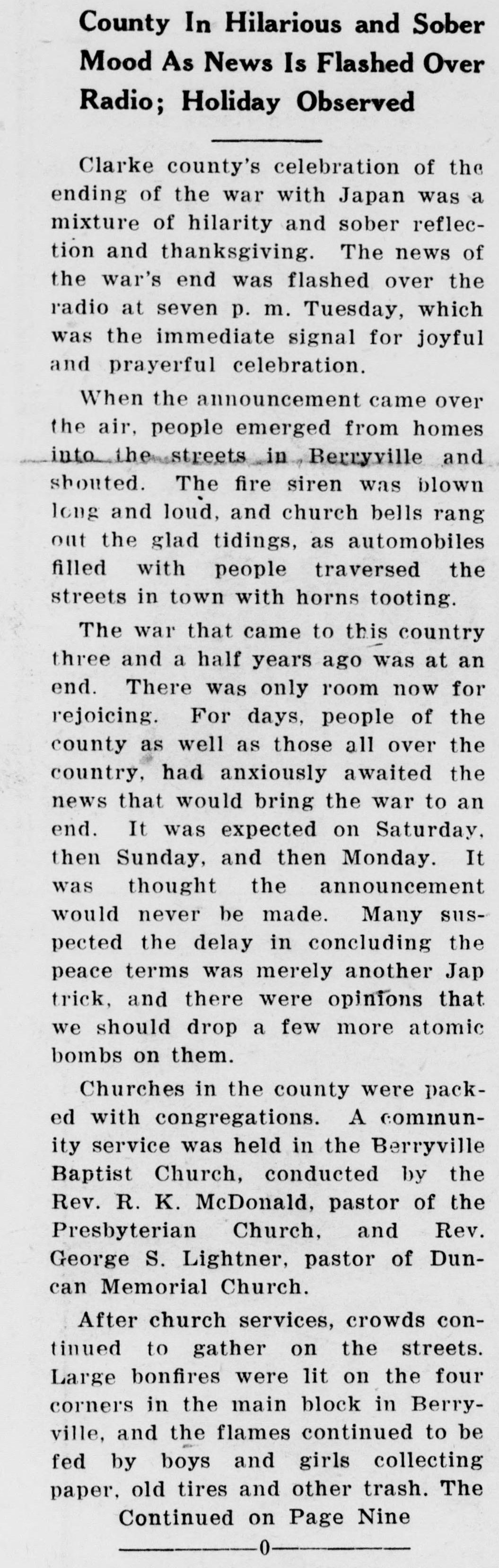
The county report of V-J night: the radio at seven o'clock, sirens, bells and horns, packed churches, a community service and bonfires at the four corners.
Clarke Courier (Berryville, Va.), August 16, 1945, page 1. Library of Congress, Chronicling America. Rights Changes: A detail of the retained region crop of the Library of Congress page image (2096 by 3824 pixels): the rectangle from x 0 to 1055 and y 510 to 3824, which leaves out the unrelated items around it, not scaled, and re-encoded as JPEG. The whole page is at the source link. Nothing retouched or added.
Source: Clarke Courier, Berryville, Va., August 16, 1945, page 1: "County Celebrates As War With Japan Ends" and "Sgt. Pope, Jap Captive, Expected To Be Freed" Open the full image
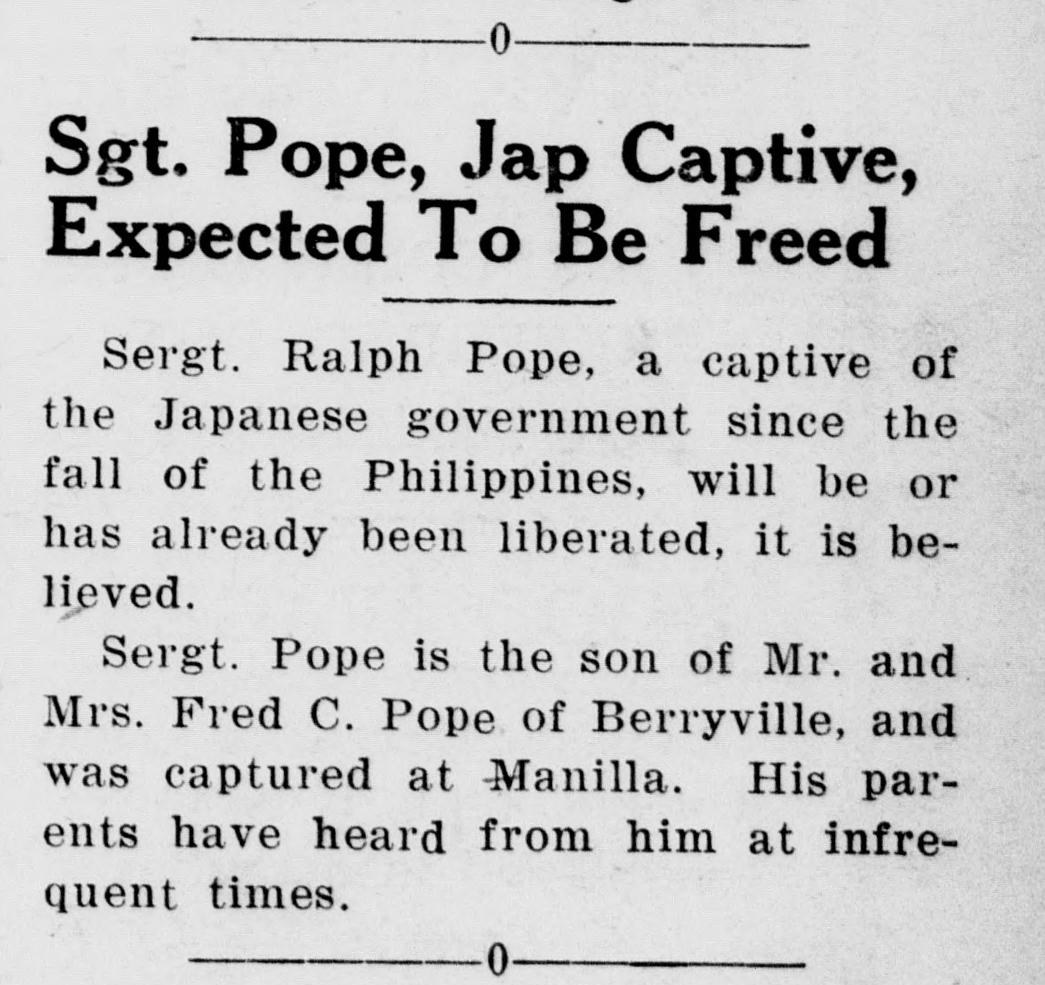
On the V-J front page: Sergt. Ralph Pope, a captive since the fall of the Philippines, will be or has already been liberated, it is believed.
Clarke Courier (Berryville, Va.), August 16, 1945, page 1. Library of Congress, Chronicling America. Rights Changes: A detail of the retained region crop of the Library of Congress page image (1125 by 1741 pixels): the rectangle from x 80 to 1125 and y 0 to 985, which leaves out the unrelated items around it, not scaled, and re-encoded as JPEG. The whole page is at the source link. Nothing retouched or added.
Source: Clarke Courier, Berryville, Va., August 16, 1945, page 1: "County Celebrates As War With Japan Ends" and "Sgt. Pope, Jap Captive, Expected To Be Freed" Open the full image
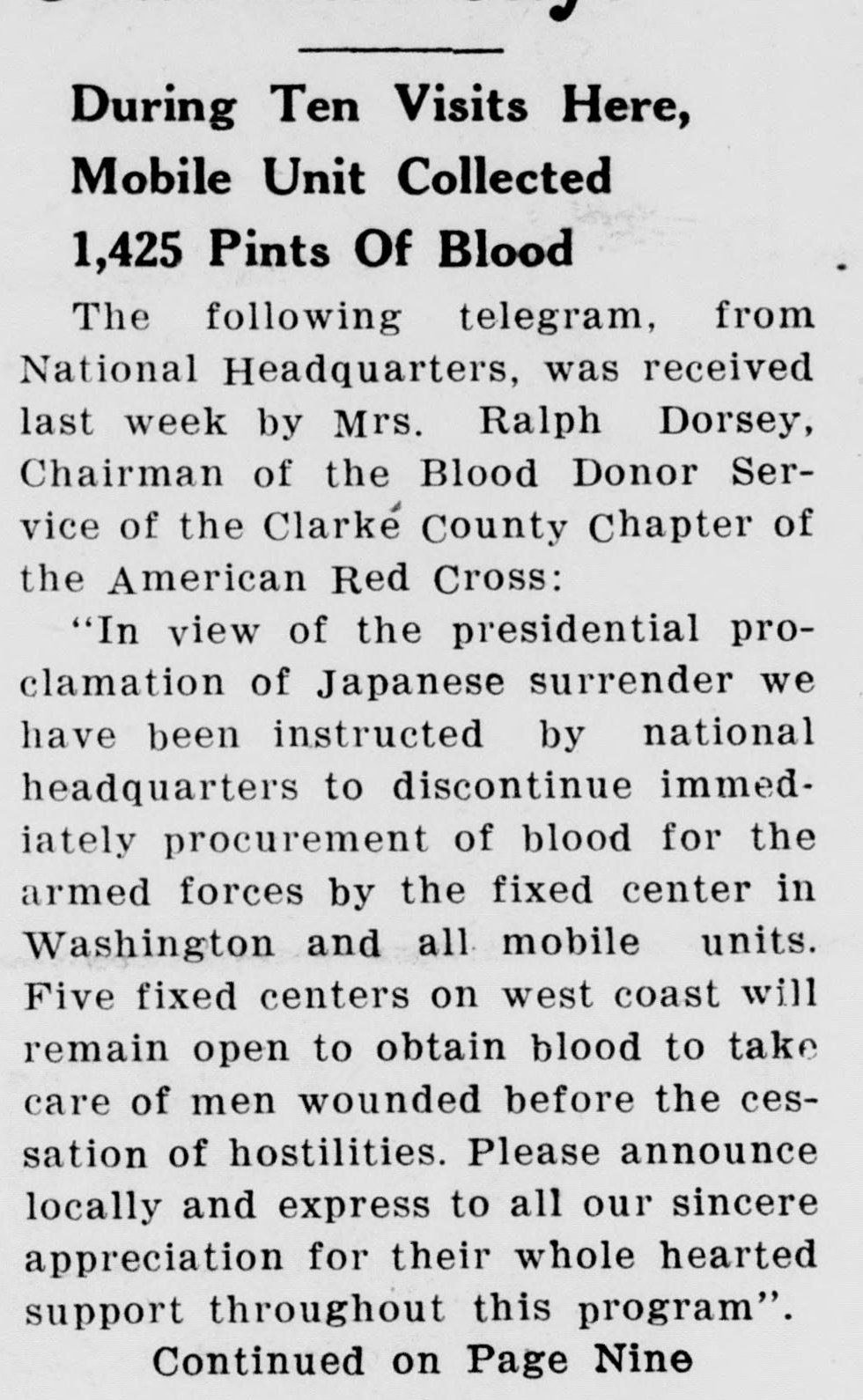
A telegram to the county's Red Cross blood donor chairman ends blood collections; the headline gives 1,425 pints in ten visits.
Clarke Courier (Berryville, Va.), August 23, 1945, page 1. Library of Congress, Chronicling America. Rights Changes: A detail of the retained region crop of the Library of Congress page image (1083 by 2887 pixels): the rectangle from x 65 to 1045 and y 0 to 1590, which leaves out the unrelated items around it, not scaled, and re-encoded as JPEG. The whole page is at the source link. Nothing retouched or added.
Source: Clarke Courier, Berryville, Va., August 23, 1945, page 1: "During Ten Visits Here, Mobile Unit Collected 1,425 Pints Of Blood" Open the full image
Coming home
In October the Popes had a cable from Manila: "I'm fine," it began. In all his time in captivity, the paper noted, the family had received only five prisoner-of-war postcards and one letter reporting his broadcast. After a stay at the Woodrow Wilson Hospital in Staunton, Ralph Pope reached Clarke on a Saturday night in mid-November.
That December he told the Courier his story, and the paper printed what government rules allowed. He had been captured at Corregidor. He had driven a bus and then trucks for his captors in the Philippines, worked on the Manila docks, and been shipped to Japan with 1,025 men in a ship's hold for twelve days. At a copper mine at Hanawa, he said, guards beat him, broke his arm and gave him no medical care. He was down to 95 pounds when he was freed. American planes began dropping food to the camp on August 25, and on September 16 the prisoners were turned over to the American occupation forces.
The paper that week also listed twenty Clarke County men discharged from service. Ralph Pope had three months of prisoner-of-war leave ahead of him, from January 7. After that, he said, he would re-enlist.
The spotter posts had one last errand. In the summer of 1945 the White Post observation post was sold for $150 to W. R. Thompson, who moved it to his land next to the old site. The Courier called the price very good, noting that a similar building at Boyce had sold for $71 at public auction. Because more than a hundred people in the White Post neighborhood had paid for the post, the money went to the County Nurse Association.
Source note: Clarke Courier, Berryville, Va., 1945
The Clarke Courier of October 4, 1945 reported that Sergt. Ralph W. Pope of Berryville, a prisoner of the Japanese since May 7, 1942, had been liberated and was in Manila awaiting transportation home, as he had cabled his parents, Mr. and Mrs. Fred Pope, in a cable that began "I'm fine."; that little was known of his rescue; and that during his entire internment his family had received a total of only five government-regulation prisoner-of-war postcards and one letter containing official news of a broadcast he had made.
What the source supports
The family's news of Ralph Pope's liberation, and how little word they had had of him, as the paper reported it.
Uncertainty
The paper's report of the cable; the cable was not seen. The other names in the cable are not used. The page 16 continuation is not used. The liberation is not dated in the item.
Source
Evidence role: supports. The item to the jump.
Clarke Courier, Berryville, Va., October 4, 1945, page 1: "Sergt. Ralph Pope Liberated From Japanese Camp"
Clarke Courier, Berryville, Va. · 1945-10-04 (publication)
Locator: Page 1, "Sergt. Ralph Pope Liberated From Japanese Camp," the cable, and the family's five postcards and one letter, to the jump to page 16
Relevant passageI'm fine.
Checked: Original inspected. A digital reproduction was inspected; no original has been handled.
Open sourceSource family: clarke-courier. Multiple passages from one source are not independent witnesses.
AI-assisted source check (Claude Opus 5.5) · 2026-09-26. How this project checks its sources
Source note: Clarke Courier, Berryville, Va., 1945
The Clarke Courier of November 22, 1945 reported that Mr. and Mrs. Fred Pope had with them their son, Sergt. Ralph Pope, a prisoner of the Japanese since 1942 who had recently arrived in this country after being released, and that since arriving in the States he had been at Woodrow Wilson Hospital in Staunton, Va., and had arrived in Clarke on Saturday night.
What the source supports
When Ralph Pope reached Clarke County after his release, as the paper reported it.
Uncertainty
A one-paragraph local item. The hospital is named as printed ("Woodrow Wilson Hospital"). "Saturday night" is November 17, 1945 by the calendar of the November 22 issue; the item does not print the date.
Source
Evidence role: supports. The whole item.
Clarke Courier, Berryville, Va., November 22, 1945, page 2: local item on Sergt. Ralph Pope
Clarke Courier, Berryville, Va. · 1945-11-22 (publication)
Locator: Page 2, local item on Sergt. Ralph Pope, from Woodrow Wilson Hospital, Staunton, to Clarke
Checked: Original inspected. A digital reproduction was inspected; no original has been handled.
Open sourceSource family: clarke-courier. Multiple passages from one source are not independent witnesses.
AI-assisted source check (Claude Opus 5.5) · 2026-09-26. How this project checks its sources
Source note: Clarke Courier, Berryville, Va., 1945
The Clarke Courier of December 20, 1945 printed the story of 40 months as a prisoner of war of the Japanese told to it the day before by Master Sergt. Ralph E. Pope (as printed), son of Mr. and Mrs. Fred Pope of Berryville, who was captured at Corregidor; the paper said he told of horrors that "cannot be printed because of government regulations."
What the source supports
That Ralph Pope's own account of his captivity was published in the county, and that the paper withheld part of it.
Uncertainty
Pope's account as the paper printed it, not an official record; the paper itself says part was not printed. The paper names him "Ralph E. Pope" here, where other items give Ralph W. Pope; the same parents and captivity are named, and no join is made beyond the paper's own statements.
Source
Evidence role: supports. The headline, subhead and opening paragraphs.
Clarke Courier, Berryville, Va., December 20, 1945, page 3: "Sgt. Pope Relates Beatings By Japs As War Prisoner"
Clarke Courier, Berryville, Va. · 1945-12-20 (publication)
Locator: Page 3, "Sgt. Pope Relates Beatings By Japs As War Prisoner," from the capture through the transport to Japan and the Hanawa mine, to the jump to page 18
Relevant passagecannot be printed because of government regulations
Checked: Original inspected. A digital reproduction was inspected; no original has been handled.
Open sourceSource family: clarke-courier. Multiple passages from one source are not independent witnesses.
AI-assisted source check (Claude Opus 5.5) · 2026-09-26. How this project checks its sources
Source note: Clarke Courier, Berryville, Va., 1945
In the account printed in the Clarke Courier of December 20, 1945, Ralph Pope said that after his capture he volunteered to drive a bus hauling Japanese troops for three months, then drove a truck hauling supplies and ammunition in Manila for eleven months, and then worked in the port area loading and unloading ships for another eleven months; that a group of 1,025 men was put on a transport bound for Moji, Japan, in the ship's hold, 60 by 80 feet, for 12 days and nights; and that he was taken to Hanawa, a big copper mine, to work.
What the source supports
The course of Ralph Pope's captivity in his own account.
Uncertainty
Pope's recollection as the paper printed it; the durations are his and the dates of each stage are not given. Place names as printed ("Honchu"; "coper mine" for copper mine).
Source
Evidence role: supports. The account through the Hanawa mine.
Clarke Courier, Berryville, Va., December 20, 1945, page 3: "Sgt. Pope Relates Beatings By Japs As War Prisoner"
Clarke Courier, Berryville, Va. · 1945-12-20 (publication)
Locator: Page 3, "Sgt. Pope Relates Beatings By Japs As War Prisoner," from the capture through the transport to Japan and the Hanawa mine, to the jump to page 18
Relevant passagecannot be printed because of government regulations
Checked: Original inspected. A digital reproduction was inspected; no original has been handled.
Open sourceSource family: clarke-courier. Multiple passages from one source are not independent witnesses.
AI-assisted source check (Claude Opus 5.5) · 2026-09-26. How this project checks its sources
Source note: Clarke Courier, Berryville, Va., 1945
The continuation of Ralph Pope's account in the Clarke Courier of December 20, 1945 said that guards once beat him for about 30 minutes because they thought his men were not working, knocked him out with a club and broke his arm, and that he never received any medical attention; that he was down to 95 pounds when liberated; and that the first American planes came over on August 25 and dropped food every other day until September 16, when the prisoners were turned over to the American Occupation Forces, after which he sailed to Manila, then to Seattle and finally to Staunton, where he was hospitalized.
What the source supports
Ralph Pope's own account of his treatment and release.
Uncertainty
Pope's account as the paper printed it; no medical or military record was seen. The figure for pounds lost is not clearly legible on the scan and is not used.
Source
Evidence role: supports. The continuation from page 3.
Clarke Courier, Berryville, Va., December 20, 1945, page 18: "Sgt. Pope" (continued from page 3) and "Twenty County Men Receive Discharges"
Clarke Courier, Berryville, Va. · 1945-12-20 (publication)
Locator: Page 18, "Sgt. Pope, Continued from Page Three," the beating, his weight, the food drops, his return and his leave
Relevant passageI never received any medical attention.
Checked: Original inspected. A digital reproduction was inspected; no original has been handled.
Open sourceSource family: clarke-courier. Multiple passages from one source are not independent witnesses.
AI-assisted source check (Claude Opus 5.5) · 2026-09-26. How this project checks its sources
Source note: Clarke Courier, Berryville, Va., 1945
The Clarke Courier of December 20, 1945 said that Ralph Pope had three months of furlough from January 7, a prisoner-of-war leave, after which, he said, he would re-enlist.
What the source supports
Ralph Pope's plans as of December 1945.
Uncertainty
A plan and an intention as the paper reported them; whether he re-enlisted is not known from the items read (1946 issues were not searched).
Source
Evidence role: supports. The last paragraph of the continuation.
Clarke Courier, Berryville, Va., December 20, 1945, page 18: "Sgt. Pope" (continued from page 3) and "Twenty County Men Receive Discharges"
Clarke Courier, Berryville, Va. · 1945-12-20 (publication)
Locator: Page 18, "Sgt. Pope, Continued from Page Three," the beating, his weight, the food drops, his return and his leave
Relevant passageI never received any medical attention.
Checked: Original inspected. A digital reproduction was inspected; no original has been handled.
Open sourceSource family: clarke-courier. Multiple passages from one source are not independent witnesses.
AI-assisted source check (Claude Opus 5.5) · 2026-09-26. How this project checks its sources
Source note: Clarke Courier, Berryville, Va., 1945
The Clarke Courier of December 20, 1945 reported that twenty Clarke County servicemen had been discharged that week, as the draft board announced.
What the source supports
The pace of discharges in the county in December 1945, by the draft board's announcement.
Uncertainty
The paper prints the twenty names; they are not listed or joined here. The count is the draft board's as reported.
Source
Evidence role: supports. The first paragraph.
Clarke Courier, Berryville, Va., December 20, 1945, page 18: "Sgt. Pope" (continued from page 3) and "Twenty County Men Receive Discharges"
Clarke Courier, Berryville, Va. · 1945-12-20 (publication)
Locator: Page 18, "Twenty County Men Receive Discharges," the announcement (names not used)
Checked: Original inspected. A digital reproduction was inspected; no original has been handled.
Open sourceSource family: clarke-courier. Multiple passages from one source are not independent witnesses.
AI-assisted source check (Claude Opus 5.5) · 2026-09-26. How this project checks its sources
Source note: Clarke Courier, Berryville, Va., 1945
The Clarke Courier of August 2, 1945 reported that the Observation Post at White Post had recently been sold for $150 to W. R. Thompson, who had moved the building and its supporting structure to his property adjoining the former site; that the price was considered very good in view of the fact that a similar building at Boyce sold for $71 at public auction; and that, since the money for the building had been raised from contributions of over 100 people in the White Post area, the proceeds were being turned over to the County Nurse Association.
What the source supports
How the White Post observation post was disposed of in 1945, as the Courier reported it.
Uncertainty
The paper's report; no deed or bill of sale was seen. W. R. Thompson is named as printed and is not joined to any other person record. The heating stove, which the item says was not included in the sale, is not followed further.
Source
Evidence role: supports. The whole item.
Clarke Courier, Berryville, Va., August 2, 1945, page 15: "Observation Post At White Post Sold"
Clarke Courier, Berryville, Va. · 1945-08-02 (publication)
Locator: Page 15, "Observation Post At White Post Sold," the sale to W. R. Thompson, the price, the Boyce comparison and the proceeds
Relevant passagea similar building at Boyce sold for $71 at public auction.
Checked: Original inspected. A digital reproduction was inspected; no original has been handled.
Open sourceSource family: clarke-courier. Multiple passages from one source are not independent witnesses.
AI-assisted source check (Claude Opus 5.5) · 2026-09-26. How this project checks its sources
Source note: Clarke Courier, Berryville, Va., 1945, and one more
In its report of the White Post sale, the Clarke Courier of August 2, 1945 stated that a similar building at Boyce "sold for $71 at public auction."
What the source supports
That the Courier reported the Boyce spotter building sold at public auction for $71.
Uncertainty
A reported outcome in an item about another post, not an inspected sale record; no report of the Boyce auction itself was found. The item does not date the auction or name the buyer, and says nothing of what became of the building. It calls it "a similar building at Boyce"; reading it as the station advertised in November 1944 follows the two reports, not a separate record.
Source
Evidence role: supports. The sentence on the Boyce building.
Clarke Courier, Berryville, Va., August 2, 1945, page 15: "Observation Post At White Post Sold"
Clarke Courier, Berryville, Va. · 1945-08-02 (publication)
Locator: Page 15, "Observation Post At White Post Sold," the sale to W. R. Thompson, the price, the Boyce comparison and the proceeds
Relevant passagea similar building at Boyce sold for $71 at public auction.
Checked: Original inspected. A digital reproduction was inspected; no original has been handled.
Open sourceSource family: clarke-courier. Multiple passages from one source are not independent witnesses.
Evidence role: contextualizes. The November 1944 notice that advertised the Boyce station for sale at auction.
Clarke Courier, Berryville, Va., November 9, 1944, page 14: "For Sale" notice of the air spotter station at Boyce
Clarke Courier, Berryville, Va. · 1944-11-09 (publication)
Locator: Page 14, "For Sale" notice of the air spotter station at Boyce
Checked: Original inspected. A digital reproduction was inspected; no original has been handled.
Open sourceSource family: clarke-courier. Multiple passages from one source are not independent witnesses.
AI-assisted source check (Claude Opus 5.5) · 2026-09-26. How this project checks its sources
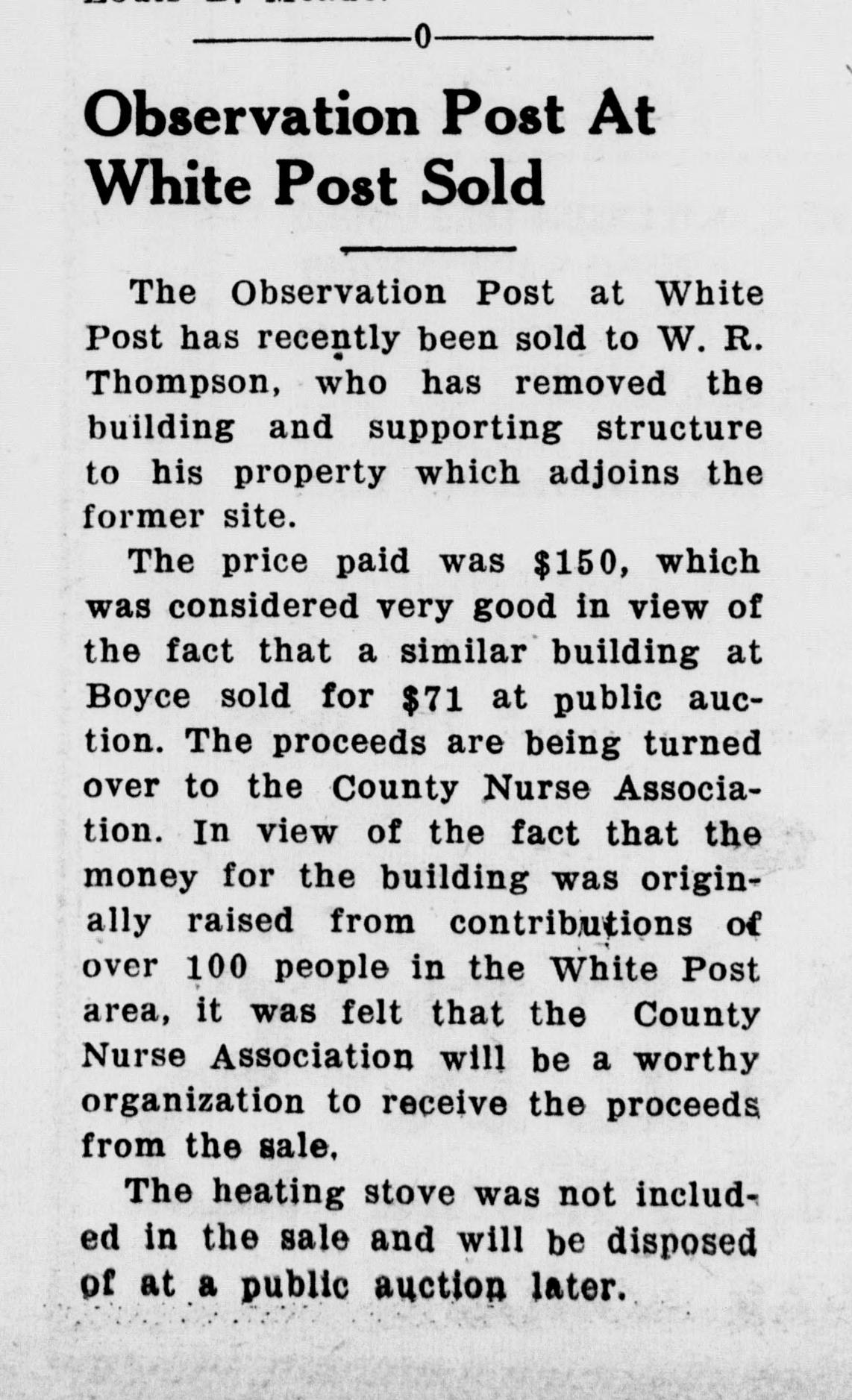
The White Post observation post is sold for $150 and moved next door; the item notes that a similar building at Boyce sold for $71 at public auction.
Clarke Courier (Berryville, Va.), August 2, 1945, page 15. Library of Congress, Chronicling America. Rights Changes: The retained file itself, shown at its own 1142 by 1877 pixels: not scaled, not re-encoded. Nothing retouched or added.
Source: Clarke Courier, Berryville, Va., August 2, 1945, page 15: "Observation Post At White Post Sold" Open the full image
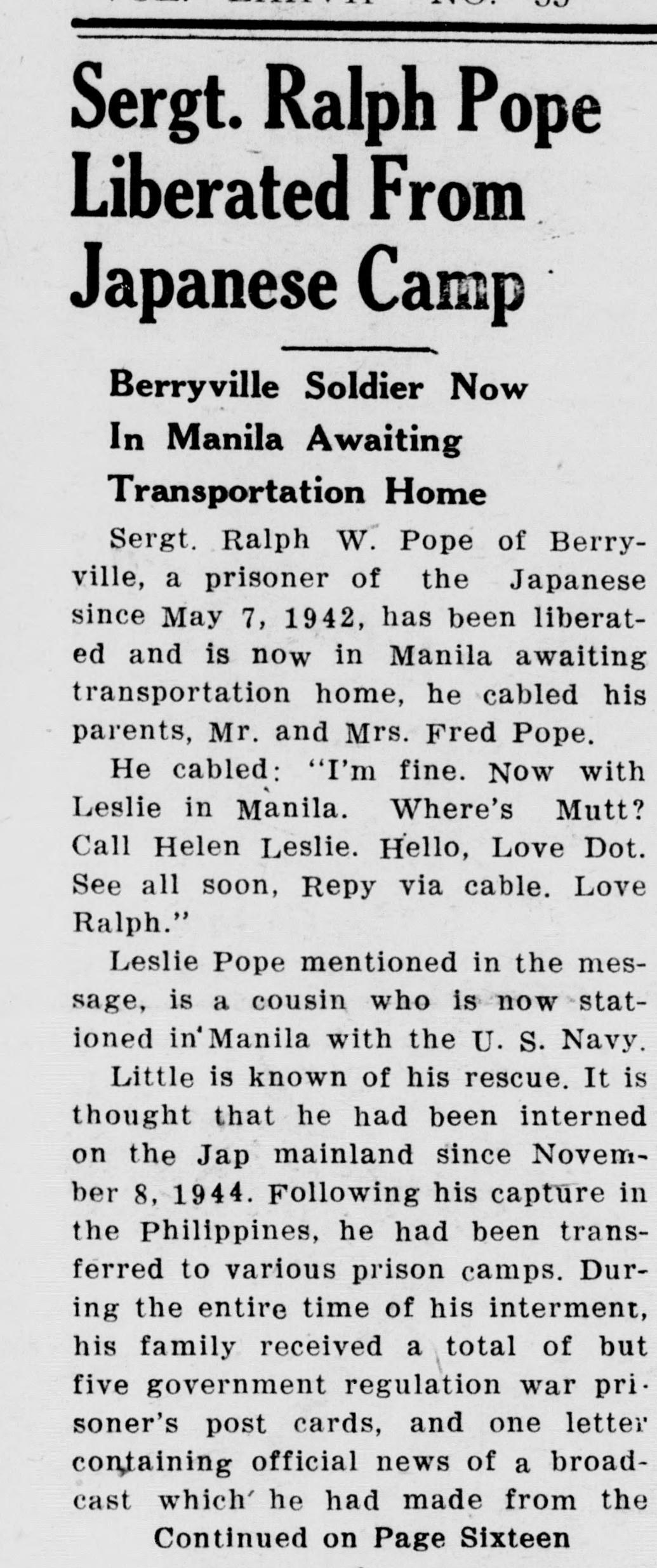
A cable from Manila tells the Popes their son has been liberated; the paper notes the family had only five prisoner-of-war postcards and one letter in all.
Clarke Courier (Berryville, Va.), October 4, 1945, page 1. Library of Congress, Chronicling America. Rights Changes: A detail of the retained region crop of the Library of Congress page image (1128 by 4136 pixels): the rectangle from x 0 to 1035 and y 0 to 2470, which leaves out the unrelated items around it, not scaled, and re-encoded as JPEG. The whole page is at the source link. Nothing retouched or added.
Source: Clarke Courier, Berryville, Va., October 4, 1945, page 1: "Sergt. Ralph Pope Liberated From Japanese Camp" Open the full image
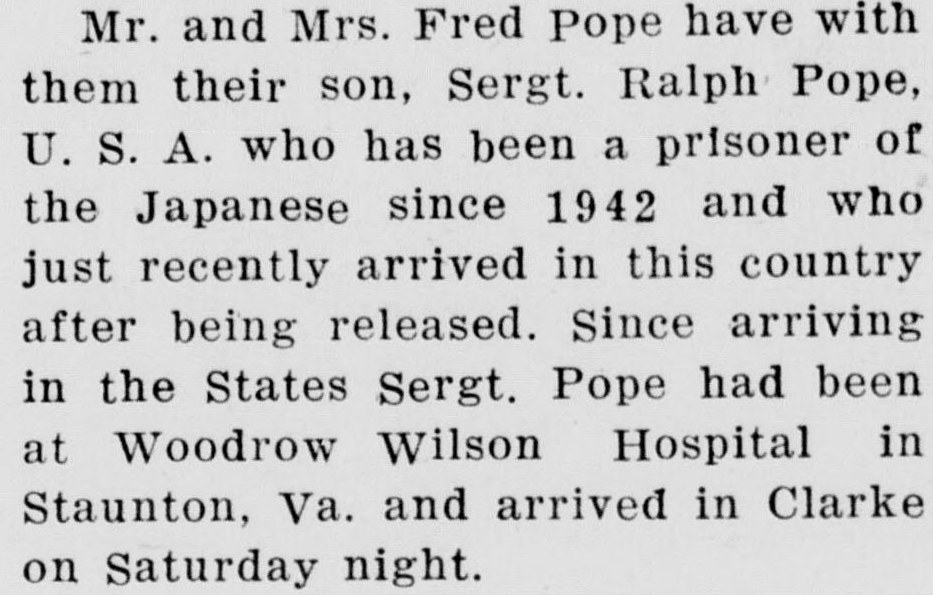
A local item: after Woodrow Wilson Hospital in Staunton, Sergt. Ralph Pope arrived in Clarke on Saturday night.
Clarke Courier (Berryville, Va.), November 22, 1945, page 2. Library of Congress, Chronicling America. Rights Changes: A detail of the retained region crop of the Library of Congress page image (1083 by 1764 pixels): the rectangle from x 70 to 1003 and y 275 to 870, which leaves out the unrelated items around it, not scaled, and re-encoded as JPEG. The whole page is at the source link. Nothing retouched or added.
Source: Clarke Courier, Berryville, Va., November 22, 1945, page 2: local item on Sergt. Ralph Pope Open the full image

Ralph Pope tells the Courier of 40 months as a prisoner; the paper notes that some of what he told could not be printed.
Clarke Courier (Berryville, Va.), December 20, 1945, page 3. Library of Congress, Chronicling America. Rights Changes: The retained file itself, shown at its own 1099 by 5938 pixels: not scaled, not re-encoded. Nothing retouched or added.
Source: Clarke Courier, Berryville, Va., December 20, 1945, page 3: "Sgt. Pope Relates Beatings By Japs As War Prisoner" Open the full image
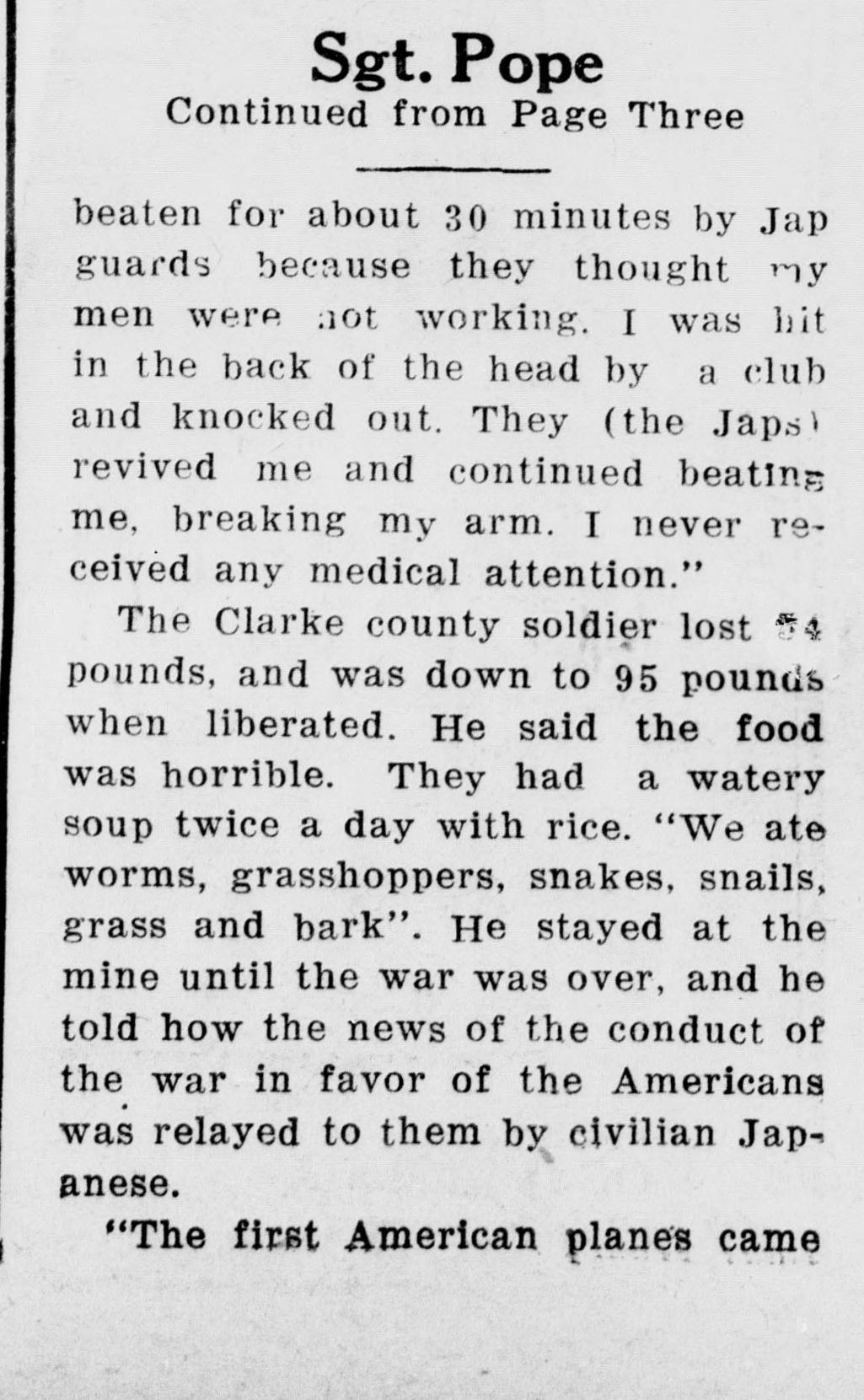
The continuation of Pope's account: the beating that broke his arm, no medical care, and his weight of 95 pounds when he was freed.
Clarke Courier (Berryville, Va.), December 20, 1945, page 18. Library of Congress, Chronicling America. Rights Changes: A detail of the retained region crop of the Library of Congress page image (2035 by 6051 pixels): the rectangle from x 0 to 1025 and y 4390 to 6051, which leaves out the unrelated items around it, not scaled, and re-encoded as JPEG. The whole page is at the source link. Nothing retouched or added.
Source: Clarke Courier, Berryville, Va., December 20, 1945, page 18: "Sgt. Pope" (continued from page 3) and "Twenty County Men Receive Discharges" Open the full image
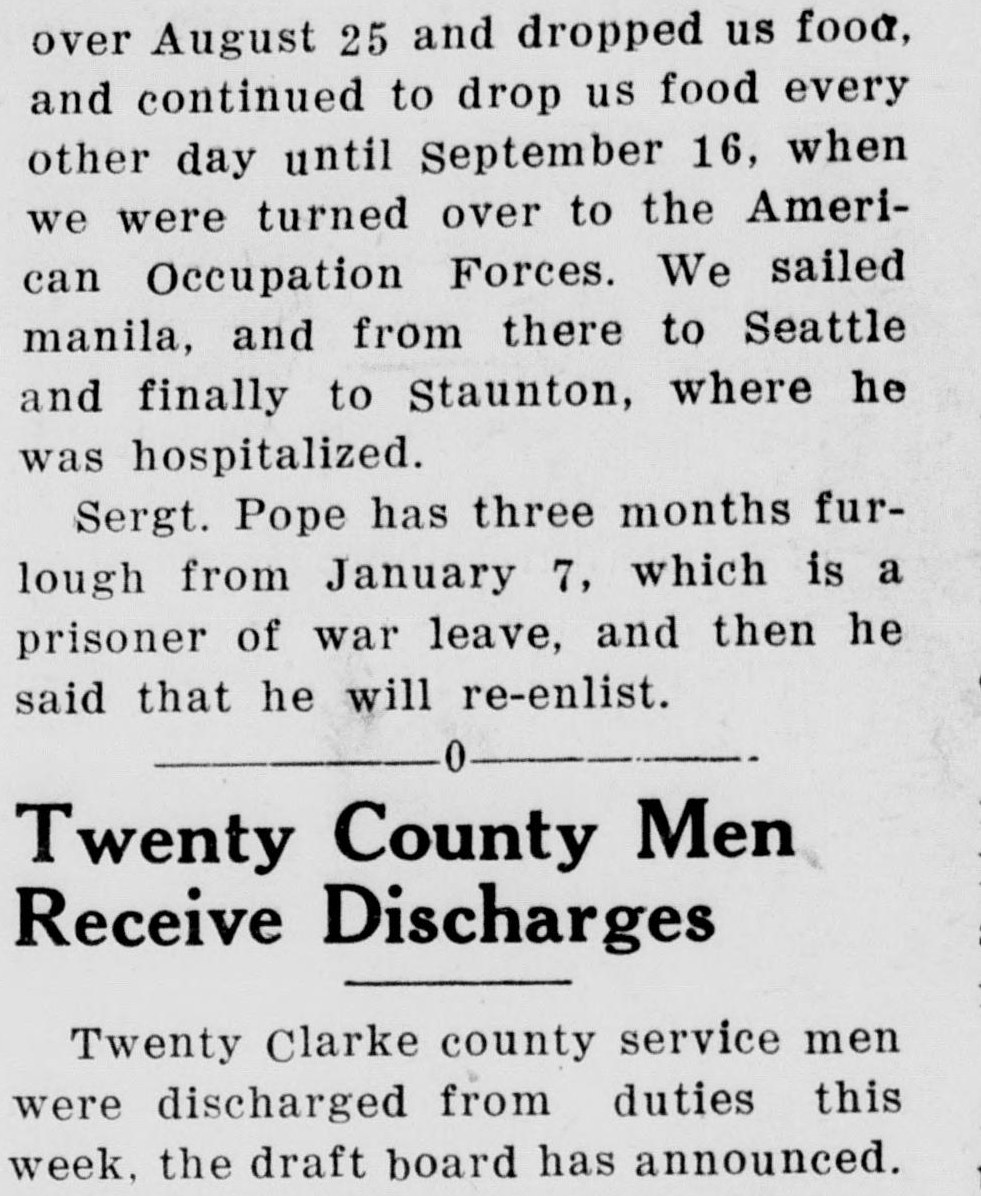
The end of Pope's account: food drops from August 25, his leave from January 7 and his plan to re-enlist; below, twenty county men are discharged.
Clarke Courier (Berryville, Va.), December 20, 1945, page 18. Library of Congress, Chronicling America. Rights Changes: A detail of the retained region crop of the Library of Congress page image (2035 by 6051 pixels): the rectangle from x 1054 to 2035 and y 109 to 1305, which leaves out the unrelated items around it, not scaled, and re-encoded as JPEG. The whole page is at the source link. Nothing retouched or added.
Source: Clarke Courier, Berryville, Va., December 20, 1945, page 18: "Sgt. Pope" (continued from page 3) and "Twenty County Men Receive Discharges" Open the full image
About the accountsWhat the evidence says
Clarke Courier columns, editorials, reports and notices from 1943 to 1945, each read on a Library of Congress page image, document the spotter posts' shortage of volunteers, the 1944 harvest labor as the county agent reported it, the Pope family's news of a son held by Japan, and the town's two victory celebrations.
The harvest account is the county agent's own report as the paper printed it, including its descriptions of the workers. Mrs. Pope's hopes, the intercepted broadcast and Ralph Pope's account are the paper's reports. The two printed Mrs. Joyces are not joined, and Janey Lee Pope's death is given only by month because two reports differ on the day.
- An account exists✓ Supported by a source
In an unsigned editorial headed "Spotting Airplanes," the Clarke Courier of January 21, 1943 said that, in a population of over 1,200 people, the Air Warning Service was having trouble finding volunteers to take over certain shifts at the air spotter post at Berryville, when only sixty or seventy people were needed. It asked people to volunteer three hours a week: "just three hours out of every 168."
See the evidence
✓ Supported by a sourceAn account existsIn an unsigned editorial headed "Spotting Airplanes," the Clarke Courier of January 21, 1943 said that, in a population of over 1,200 people, the Air Warning Service was having trouble finding volunteers to take over certain shifts at the air spotter post at Berryville, when only sixty or seventy people were needed. It asked people to volunteer three hours a week: "just three hours out of every 168."
What the source supports
That in January 1943 the Courier publicly complained that the Berryville post could not fill its shifts, and the scale of the need as the paper put it.
Uncertainty
An editorial: the paper's opinion and appeal, not a record of the post's schedule. The figures are the editorial's own, and the service is named as printed ("Air Warning Service"). The editorial's further appeal to keep promised hours or find a substitute is not used. The remainder figure it gives (read on the image as 1,130) is not used.
Source
Reporting Evidence role: supports. The editorial's opening and the three-hour request.
Clarke Courier, Berryville, Va., January 21, 1943, page 8: editorial "Spotting Airplanes"
Clarke Courier, Berryville, Va. · 1943-01-21 (publication)
Locator: Page 8, editorial "Spotting Airplanes," the shortage of volunteers at the Berryville post and the three-hour request
Relevant passagejust three hours out of every 168
Checked: Original inspected. A digital reproduction was inspected; no original has been handled.
Open sourceSource family: clarke-courier. Multiple passages from one source are not independent witnesses.
AI-assisted source check (Claude Opus 5.5) · 2026-09-26. How this project checks its sources
- An account exists✓ Supported by a source
The county agent's report for 1944, printed in the Clarke Courier of January 18, 1945, states under "Farm Labor" that at an open hearing on Emergency Farm Labor in June the orchardists set 10 cents a bushel as the prevailing wage for apple pickers, 40 cents an hour for men and 35 cents an hour for women; that of five boys from Arlington who came in the first part of June four proved satisfactory and stayed the summer, and two boys from Washington were placed on farms soon afterward; that during the summer school children, boys and girls, helped with food production while their brothers were in the armed forces and their older sisters in defense work, and some college girls helped thin apples and pick summer varieties; and that Bahaman workers, the first Emergency Farm Labor to come into the area, arrived in the middle of July, were housed in a camp in Frederick County, and worked fifty on one orchard operation and ninety on another.
See the evidence
✓ Supported by a sourceAn account existsThe county agent's report for 1944, printed in the Clarke Courier of January 18, 1945, states under "Farm Labor" that at an open hearing on Emergency Farm Labor in June the orchardists set 10 cents a bushel as the prevailing wage for apple pickers, 40 cents an hour for men and 35 cents an hour for women; that of five boys from Arlington who came in the first part of June four proved satisfactory and stayed the summer, and two boys from Washington were placed on farms soon afterward; that during the summer school children, boys and girls, helped with food production while their brothers were in the armed forces and their older sisters in defense work, and some college girls helped thin apples and pick summer varieties; and that Bahaman workers, the first Emergency Farm Labor to come into the area, arrived in the middle of July, were housed in a camp in Frederick County, and worked fifty on one orchard operation and ninety on another.
What the source supports
How the county agent reported the 1944 farm-labor season's wages, local and visiting youth labor and the Bahaman workers.
Uncertainty
The county agent's own report, as the Courier printed it; its characterizations of the workers are the report's. The prevailing wages are the rates the orchardists set, not evidence of what any worker was paid; the report says the crop-raising farmers reached no agreement on other farm wages. "Bahamans" as printed. No payroll, contract or camp record was seen, and no worker is named.
Source
Reporting Evidence role: supports. The wage, youth, school-children, college-girl and Bahaman paragraphs.
Clarke Courier, Berryville, Va., January 18, 1945, page 4: the county agent's report for 1944, "Farm Labor"
Clarke Courier, Berryville, Va. · 1945-01-18 (publication)
Locator: Page 4, the county agent's report for 1944, "Farm Labor": the June hearing and prevailing wages, the Arlington and Washington boys, school children and college girls, and the Bahaman workers
Checked: Original inspected. A digital reproduction was inspected; no original has been handled.
Open sourceSource family: clarke-courier. Multiple passages from one source are not independent witnesses.
AI-assisted source check (Claude Opus 5.5) · 2026-09-26. How this project checks its sources
- An account exists✓ Supported by a source
The Clarke Courier of May 27, 1943 reported that Mr. and Mrs. Fred Pope had received word from the War Department that their son, Technical Sergt. Ralph W. Pope, first reported missing as of May 7, 1942, was "a prisoner of war of the Japanese Government," taken in the Philippine Island campaign; the War Department said the word had just been received through the International Red Cross and that a letter of information would follow.
See the evidence
✓ Supported by a sourceAn account existsThe Clarke Courier of May 27, 1943 reported that Mr. and Mrs. Fred Pope had received word from the War Department that their son, Technical Sergt. Ralph W. Pope, first reported missing as of May 7, 1942, was "a prisoner of war of the Japanese Government," taken in the Philippine Island campaign; the War Department said the word had just been received through the International Red Cross and that a letter of information would follow.
What the source supports
That the Courier reported the War Department's notice that Ralph W. Pope was a prisoner of the Japanese.
Uncertainty
The paper's report of a War Department notice, which was not seen; the notice is not dated in the item. "Ralph W. Pope" as printed; another middle initial printed elsewhere (Ralph E.) is not joined or resolved here.
Source
Reporting Evidence role: supports. The whole item.
Clarke Courier, Berryville, Va., May 27, 1943, page 16: "Sergt. Ralph Pope Prisoner Of Japs"
Clarke Courier, Berryville, Va. · 1943-05-27 (publication)
Locator: Page 16, "Sergt. Ralph Pope Prisoner Of Japs," the whole item
Relevant passagea prisoner of war of the Japanese Government.
Checked: Original inspected. A digital reproduction was inspected; no original has been handled.
Open sourceSource family: clarke-courier. Multiple passages from one source are not independent witnesses.
AI-assisted source check (Claude Opus 5.5) · 2026-09-26. How this project checks its sources
- An account exists✓ Supported by a source
The Clarke Courier of August 16, 1945 reported that the news of the war's end was flashed over the radio at seven p.m. Tuesday; that people came out of their homes into the streets of Berryville and shouted, the fire siren was blown long and loud, church bells rang and automobiles filled with people went through the town with horns tooting; that churches in the county were packed and a community service was held in the Berryville Baptist Church; and that afterward crowds gathered on the streets, large bonfires were lit on the four corners of the main block in Berryville, and boys and girls kept them fed with paper, old tires and other trash.
See the evidence
✓ Supported by a sourceAn account existsThe Clarke Courier of August 16, 1945 reported that the news of the war's end was flashed over the radio at seven p.m. Tuesday; that people came out of their homes into the streets of Berryville and shouted, the fire siren was blown long and loud, church bells rang and automobiles filled with people went through the town with horns tooting; that churches in the county were packed and a community service was held in the Berryville Baptist Church; and that afterward crowds gathered on the streets, large bonfires were lit on the four corners of the main block in Berryville, and boys and girls kept them fed with paper, old tires and other trash.
What the source supports
How the county received the news of Japan's surrender, as the Courier reported it.
Uncertainty
The paper's report; the part continued on page 9 was not read. The national wire report printed beside it is not used as county evidence. The ministers named as conducting the service are not used here.
Source
Reporting Evidence role: supports. The county report, left column.
Clarke Courier, Berryville, Va., August 16, 1945, page 1: "County Celebrates As War With Japan Ends" and "Sgt. Pope, Jap Captive, Expected To Be Freed"
Clarke Courier, Berryville, Va. · 1945-08-16 (publication)
Locator: Page 1, "County Celebrates As War With Japan Ends," the county report under the subhead "County In Hilarious and Sober Mood," to the jump to page 9
Checked: Original inspected. A digital reproduction was inspected; no original has been handled.
Open sourceSource family: clarke-courier. Multiple passages from one source are not independent witnesses.
AI-assisted source check (Claude Opus 5.5) · 2026-09-26. How this project checks its sources
Each statement above is assessed on its own evidence. Nothing here is averaged, scored or voted on, and a well-attributed account can be documented while what it describes stays unconfirmed.
Source note
This account rests on the Clarke Courier (Berryville), 1943–1945, read on Library of Congress page images (Chronicling America), which are digital reproductions; each item is shown with its page image and a link to the original. The harvest section follows the county agent's annual report as the paper printed it, including its own descriptions of the workers. Mrs. Pope's hopes, the intercepted broadcast and Ralph Pope's account are reported as the paper printed them. Janey Lee Pope's death is dated December 19 in the first report and December 16 in a later one; this account gives only the month.
Did the 1945 harvest use the war prisoners the county agent offered that spring, and did Ralph Pope re-enlist after his leave, as he said he would?
Know more about this story, or see something to correct? Help fill a gap. It stays private until it is reviewed.
Remember this place or someone in this story? Share a memory, even if you do not know the date. It stays private until it is reviewed.
Go deeper: every source under this story Follow another threadClarke's home front: watching the sky and making do
The first two years of the same watch: how the county's aircraft posts, tire board and ration offices began.