
A call to Baltimore
The Clarke Courier told this one for laughs. According to its "Courier Chatter" column of August 6, 1942, Mrs. Eddy Joyce and Mrs. Gordon Levi took their first watch at the aircraft spotter post on Rosemont Circle in Berryville that Monday morning. They had been told to call "Red Flash" into the telephone when they saw a plane. When one passed, they called. When a second passed a few minutes later, they called again. In the Army's language, the column explained, the signal meant bombs were falling or parachute troops were landing. The interceptor command in Baltimore rang back to ask whether Berryville was being bombed. Once the signals were straightened out, the paper reported, the two women called in "Army Flash" instead. The mix-up made a good local column because the work behind it was serious and ordinary at once. For two years, Clarke residents kept telephones staffed to report the airplanes that crossed the county. Meanwhile a county board decided who could buy a tire, and teachers turned schoolhouses into registration offices for sugar and gasoline.
Source note: Clarke Courier, Berryville, Va., 1942
The "Courier Chatter" column of the Clarke Courier of August 6, 1942 reported that Mrs. Eddy Joyce and Mrs. Gordon Levi, spotting for the first time at the post on Rosemont Circle on the Monday morning, had been told to call "Red Flash" into the telephone on sighting an airplane, a signal that in the Army's usage meant bombs were falling or parachute troops were landing; that they called it in for one plane and again for another a few minutes later; that the Interceptor Command in Baltimore called back to ask whether Berryville was being bombed; and that, put straight about the signals, the two women now said "Army Flash."
What the source supports
How the Courier's column told the "Red Flash" mix-up at the Berryville post.
Uncertainty
A humorous column's account; no second source for the episode was found, and it is presented as the column's story. The two women are named as the column prints them. Rosemont Circle is the post's printed location in 1942, not a present-day address.
Source
Evidence role: supports. The "Red Flash" paragraph.
Clarke Courier, Berryville, Va., August 6, 1942, page 17: "Courier Chatter" column
Clarke Courier, Berryville, Va. · 1942-08-06 (publication)
Locator: Page 17, "Courier Chatter" column, paragraph on the "Red Flash" mix-up at the Rosemont Circle post
Checked: Original inspected. A digital reproduction was inspected; no original has been handled.
Open sourceSource family: clarke-courier. Multiple passages from one source are not independent witnesses.
AI-assisted source check (Claude Opus 5.5) · 2026-09-26. How this project checks its sources
Source note: Clarke Courier, Berryville, Va., 1941
The Clarke Courier of June 12, 1941 reported that the formation of a Clarke county station of the Virginia Aircraft Warning Service was being carried out by H. B. Harris, commander of the Lloyd Williams Post, American Legion, and Townsend Burwell, and that Commander Harris asked for volunteers as chief observers and observers for the eight posts to be established in the county.
What the source supports
That the county's aircraft warning station was being organized in June 1941, by whom, and for how many posts.
Uncertainty
An announcement of formation, not an outcome: it does not show that eight posts were set up. H. B. Harris is not joined to any other Harris, nor Townsend Burwell to any other Burwell.
Source
Evidence role: supports. The headline, subhead and opening paragraphs.
Clarke Courier, Berryville, Va., June 12, 1941, page 1: "Observation Post To Be Formed In County"
Clarke Courier, Berryville, Va. · 1941-06-12 (publication)
Locator: Page 1, report of the observation post to be formed, headline, subhead and first two paragraphs
Checked: Original inspected. A digital reproduction was inspected; no original has been handled.
Open sourceSource family: clarke-courier. Multiple passages from one source are not independent witnesses.
AI-assisted source check (Claude Opus 5.5) · 2026-09-26. How this project checks its sources
Source note: Clarke Courier, Berryville, Va., 1943
The Clarke Courier of July 22, 1943 reported that the three observation posts in Clarke county had been closed at midnight the night before on an order from the War Department, which announced that in its opinion "the danger of a large scale sustained attack from the air in this section has passed"; that the posts were to maintain their organizations and be ready to spring back into action on short notice; that their chief observers had been A. Mackay Smith at White Post, John E. Zombro at Boyce and the Rev. Henry G. Lane at Berryville; and that observers were asked to report the hours they had served so that the War Department could present souvenirs.
What the source supports
That the county's posts were closed by War Department order in July 1943, the reason given, and who had led them.
Uncertainty
The paper's report of the order; the order itself was not seen. The Rev. Henry G. Lane is not joined to the Rev. H. G. Lane named in 1942.
Source
Evidence role: supports. The closing, the War Department's statement and the order to stay ready.
Clarke Courier, Berryville, Va., July 22, 1943, page 1: "3 Aircraft Posts Closed By War Department"
Clarke Courier, Berryville, Va. · 1943-07-22 (publication)
Locator: Page 1, report of the posts' closing, headline, subhead, the War Department's statement and the order to stay ready
Relevant passagethe danger of a large scale sustained attack from the air in this section has passed.
Checked: Original inspected. A digital reproduction was inspected; no original has been handled.
Open sourceSource family: clarke-courier. Multiple passages from one source are not independent witnesses.
Evidence role: supports. The chief observers and the request for hours served.
Clarke Courier, Berryville, Va., July 22, 1943, page 1: "3 Aircraft Posts Closed By War Department"
Clarke Courier, Berryville, Va. · 1943-07-22 (publication)
Locator: Page 1, same report, the three chief observers, the service's beginning and the request for hours served
Checked: Original inspected. A digital reproduction was inspected; no original has been handled.
Open sourceSource family: clarke-courier. Multiple passages from one source are not independent witnesses.
AI-assisted source check (Claude Opus 5.5) · 2026-09-26. How this project checks its sources
Source note: Clarke Courier, Berryville, Va., 1942
The Clarke Courier of January 22, 1942 reported that at its January 19 meeting the tire rationing board granted a tire each to two mail carriers, and a tube to one of them; granted an ice and cold storage business two truck tires from an application for four; and denied one request for a tire and tube.
What the source supports
The tire rationing board's decisions at one meeting in January 1942.
Uncertainty
The paper's report; the board's records were not seen. The applicants are named in the report and summarized here by role, as an editorial choice. The headline's two tires and one tube are the grants for passenger cars.
Source
Evidence role: supports. The report of the board's decisions.
Clarke Courier, Berryville, Va., January 22, 1942, page 1: "Rationing Board Allows 2 Tires, 1 Tube"
Clarke Courier, Berryville, Va. · 1942-01-22 (publication)
Locator: Page 1, report of the tire rationing board's January 19 decisions
Checked: Original inspected. A digital reproduction was inspected; no original has been handled.
Open sourceSource family: clarke-courier. Multiple passages from one source are not independent witnesses.
AI-assisted source check (Claude Opus 5.5) · 2026-09-26. How this project checks its sources
Source note: Clarke Courier, Berryville, Va., 1942
The Clarke Courier of May 7, 1942, the day sugar registration was to end at the schools, reported that 3,726 persons in Clarke county had registered for sugar rationing books through Tuesday, according to a survey by the official in charge; that the total for Monday, the first day, was 1,428 and for Tuesday 2,308; that he expected about 6,800 or 6,900 people to register in the county; and that D. G. Cooley, principal, said registration at Berryville would be held that evening from 7:30 to 9 o'clock.
What the source supports
How many people registered for sugar ration books in the first two days, as the paper printed the figures, and where registration was held.
Uncertainty
The figures are kept as printed: the two day counts add to 3,736, ten more than the printed total of 3,726, and neither is corrected here. The final county count was not checked. The expected total is an estimate. D. G. Cooley is named as printed and not joined to any other record of that name.
Source
Evidence role: supports. The registration figures, the estimate and the Berryville session.
Clarke Courier, Berryville, Va., May 7, 1942, page 1: "Sugar Rationing Ends Today In County"
Clarke Courier, Berryville, Va. · 1942-05-07 (publication)
Locator: Page 1, report of the sugar registration, headline to the gasoline paragraph
Checked: Original inspected. A digital reproduction was inspected; no original has been handled.
Open sourceSource family: clarke-courier. Multiple passages from one source are not independent witnesses.
AI-assisted source check (Claude Opus 5.5) · 2026-09-26. How this project checks its sources
Source note: Clarke Courier, Berryville, Va., 1942
The Clarke Courier of May 14, 1942 reported that hundreds of motorists had come to the school houses that week to register for gasoline rationing cards, where they were questioned by school teachers; that the cards were being issued at Berryville High School, Boyce High School, Providence Chapel School, White Post School, Gaylord School and the Millwood Colored School; and that the X card entitled its holder to unlimited quantities of fuel.
What the source supports
That the county's schools served as gasoline registration offices, with teachers questioning motorists, and which schools did so.
Uncertainty
The schools are named as printed and are not joined to school records elsewhere in this project. The paper adds that many sought the X card but only a few were issued.
Source
Evidence role: supports. The report of the registration.
Clarke Courier, Berryville, Va., May 14, 1942, page 1: "Hundreds Issued Gas Rationing Cards Here"
Clarke Courier, Berryville, Va. · 1942-05-14 (publication)
Locator: Page 1, report of the gasoline card registration at the schools
Checked: Original inspected. A digital reproduction was inspected; no original has been handled.
Open sourceSource family: clarke-courier. Multiple passages from one source are not independent witnesses.
AI-assisted source check (Claude Opus 5.5) · 2026-09-26. How this project checks its sources
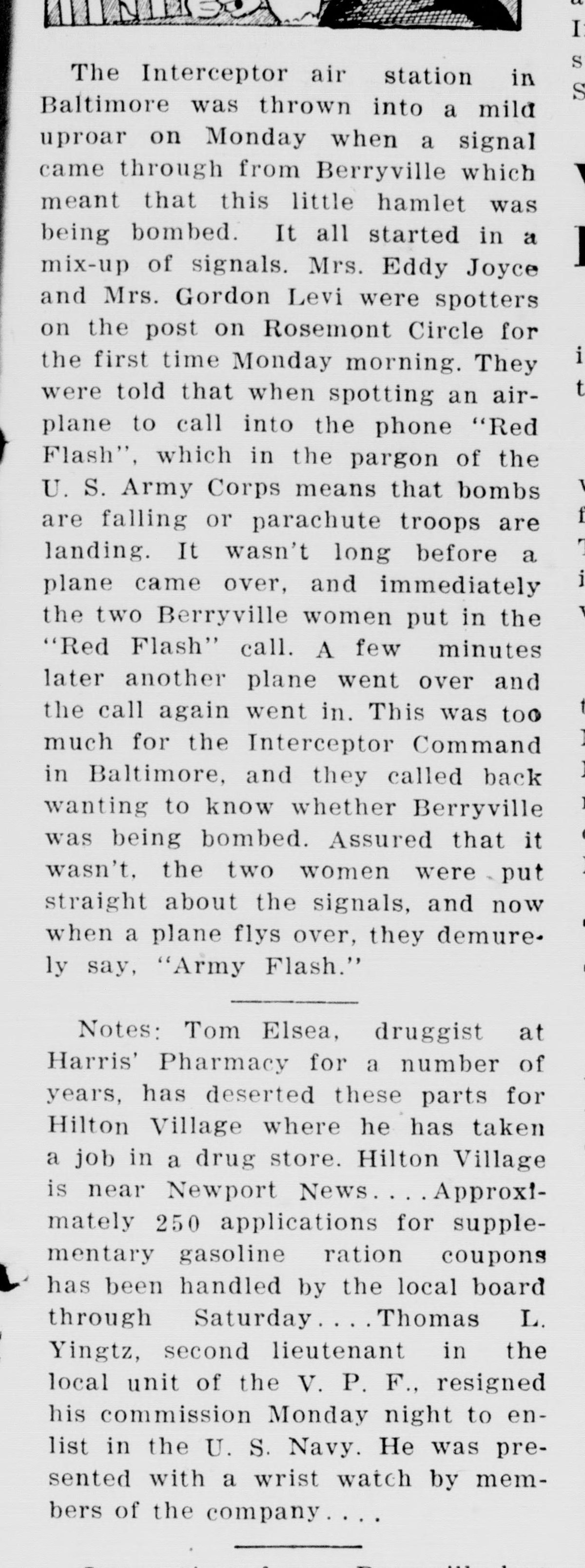
The "Courier Chatter" column tells of the "Red Flash" mix-up at the Rosemont Circle post, and reports about 250 applications for supplementary gasoline coupons.
Clarke Courier (Berryville, Va.), August 6, 1942, page 17. Library of Congress, Chronicling America. Rights Changes: The retained JPEG image of 1234 by 3306 pixels, scaled to 1200 by 3215 and re-encoded as JPEG for the web. Nothing retouched or added.
Source: Clarke Courier, Berryville, Va., August 6, 1942, page 17: "Courier Chatter" column Open the full image
Before Pearl Harbor
The watch began six months before the United States entered the war. On June 12, 1941, the Courier reported that H. B. Harris and Townsend Burwell were forming a Clarke County station of the Virginia Aircraft Warning Service. Harris was commander of the Lloyd Williams Post of the American Legion. They asked for volunteers for eight posts. The paper laid out the plan. Unpaid volunteers across Virginia would watch for hostile aircraft and report to Roanoke or Richmond, and from there the report would go on to Norfolk. Each post would have a chief observer, who would name about fifteen observers from its own neighborhood. Looking back in 1943, the paper said the service had started with about nine posts at points around the county. Other defense work drew volunteers of its own. By the last days of December 1941, about 275 people had registered at the Court House to offer 347 kinds of help. The registrar reported about 75 more not yet counted. The list printed in the Courier ran from 56 auto drivers and 26 canteen workers to 15 air raid wardens, 14 messengers, 11 typists and 3 knitters. Only four listed airplane spotting; the posts found their observers through their own chief observers.
Source note: Clarke Courier, Berryville, Va., 1941
The Clarke Courier of June 12, 1941 reported that the formation of a Clarke county station of the Virginia Aircraft Warning Service was being carried out by H. B. Harris, commander of the Lloyd Williams Post, American Legion, and Townsend Burwell, and that Commander Harris asked for volunteers as chief observers and observers for the eight posts to be established in the county.
What the source supports
That the county's aircraft warning station was being organized in June 1941, by whom, and for how many posts.
Uncertainty
An announcement of formation, not an outcome: it does not show that eight posts were set up. H. B. Harris is not joined to any other Harris, nor Townsend Burwell to any other Burwell.
Source
Evidence role: supports. The headline, subhead and opening paragraphs.
Clarke Courier, Berryville, Va., June 12, 1941, page 1: "Observation Post To Be Formed In County"
Clarke Courier, Berryville, Va. · 1941-06-12 (publication)
Locator: Page 1, report of the observation post to be formed, headline, subhead and first two paragraphs
Checked: Original inspected. A digital reproduction was inspected; no original has been handled.
Open sourceSource family: clarke-courier. Multiple passages from one source are not independent witnesses.
AI-assisted source check (Claude Opus 5.5) · 2026-09-26. How this project checks its sources
Source note: Clarke Courier, Berryville, Va., 1941
The same report outlines the plan: a state-wide system of unpaid volunteers to watch for enemy aircraft; for each local post, a chief observer living within the area who would name about 15 observers, also living within the post's territory; and local posts reporting enemy planes to either Roanoke or Richmond, where the report would be analyzed and sent on to Norfolk for action.
What the source supports
How the state plan was described to the county's readers when the posts were organized.
Uncertainty
The plan as the paper printed it; it describes the intended system, not how the county's posts actually reported. It is not a county report.
Source
Evidence role: supports. The paragraphs on the plan.
Clarke Courier, Berryville, Va., June 12, 1941, page 1: "Observation Post To Be Formed In County"
Clarke Courier, Berryville, Va. · 1941-06-12 (publication)
Locator: Page 1, same report, the plan for the state-wide system and the local posts
Checked: Original inspected. A digital reproduction was inspected; no original has been handled.
Open sourceSource family: clarke-courier. Multiple passages from one source are not independent witnesses.
AI-assisted source check (Claude Opus 5.5) · 2026-09-26. How this project checks its sources
Source note: Clarke Courier, Berryville, Va., 1943
The Clarke Courier of July 22, 1943 said the Aircraft Warning Service in Clarke county had first been inaugurated with about nine posts set at strategic points in the county about two years before, and that the year before the posts had been closed and three new ones set up.
What the source supports
The paper's own later summary of how many posts the service began with.
Uncertainty
A retrospective written about two years later. The paper's December 18, 1941 report of the first posts could not be retrieved and was not read.
Source
Evidence role: supports. The paragraph on the service's beginning.
Clarke Courier, Berryville, Va., July 22, 1943, page 1: "3 Aircraft Posts Closed By War Department"
Clarke Courier, Berryville, Va. · 1943-07-22 (publication)
Locator: Page 1, same report, the three chief observers, the service's beginning and the request for hours served
Checked: Original inspected. A digital reproduction was inspected; no original has been handled.
Open sourceSource family: clarke-courier. Multiple passages from one source are not independent witnesses.
AI-assisted source check (Claude Opus 5.5) · 2026-09-26. How this project checks its sources
Source note: Clarke Courier, Berryville, Va., 1942
The Clarke Courier of January 1, 1942 reported that a check-up on the Monday showed approximately 275 persons had registered at the Court House for defense work, for 347 various functions, and that the registrar announced about 75 more registrants not included in those figures. Its list of functions includes 56 auto drivers, 26 canteen workers, 15 air raid wardens, 14 messengers, 11 for typing, 4 airplane spotters and 3 for knitting.
What the source supports
How many people had offered themselves for defense work at the Court House by the end of 1941, and in what roles.
Uncertainty
Counts of offers to serve, not of work done. The registrar is named in the report and not in the story. The story's remark that the posts found their observers through their own chief observers is an explanation from the June 1941 plan, not a figure in this report.
Source
Evidence role: supports. The report and its list.
Clarke Courier, Berryville, Va., January 1, 1942, page 9: "347 Various Functions Are Subscribed To In Registration At Court House"
Clarke Courier, Berryville, Va. · 1942-01-01 (publication)
Locator: Page 9, report of the defense registration at the Court House, with its list of functions
Checked: Original inspected. A digital reproduction was inspected; no original has been handled.
Open sourceSource family: clarke-courier. Multiple passages from one source are not independent witnesses.
AI-assisted source check (Claude Opus 5.5) · 2026-09-26. How this project checks its sources
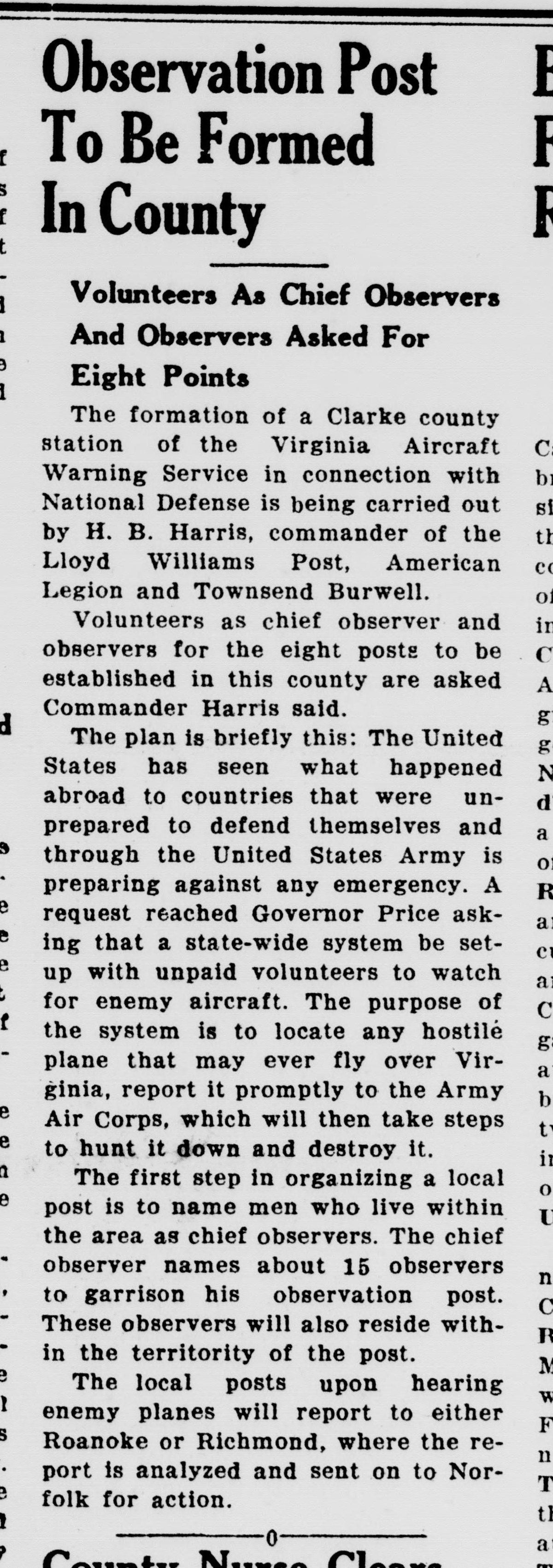
H. B. Harris and Townsend Burwell form a county station of the Virginia Aircraft Warning Service and ask for volunteers for eight posts; the paper outlines how reports would travel to Roanoke or Richmond and on to Norfolk.
Clarke Courier (Berryville, Va.), June 12, 1941, page 1. Library of Congress, Chronicling America. Rights Changes: The retained JPEG image of 1269 by 3597 pixels, scaled to 1200 by 3401 and re-encoded as JPEG for the web. Nothing retouched or added.
Source: Clarke Courier, Berryville, Va., June 12, 1941, page 1: "Observation Post To Be Formed In County" Open the full image
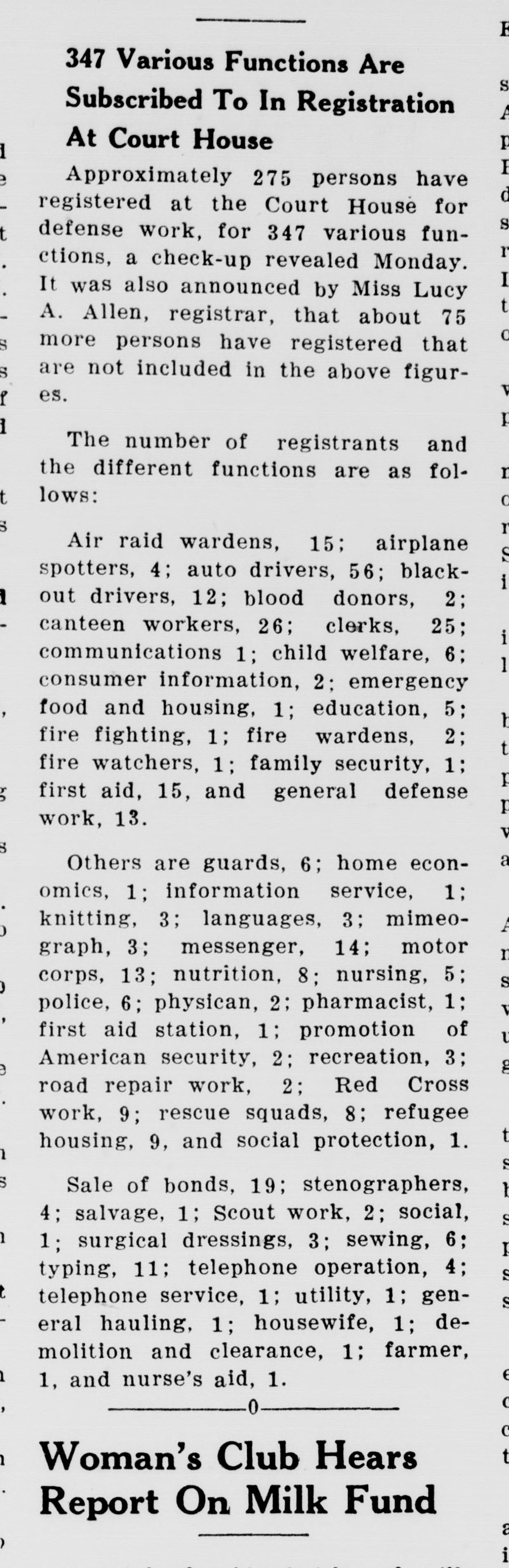
The Court House defense registration check-up: about 275 people offering 347 kinds of help, listed by category.
Clarke Courier (Berryville, Va.), January 1, 1942, page 9. Library of Congress, Chronicling America. Rights Changes: The retained JPEG image of 1233 by 3799 pixels, scaled to 1200 by 3697 and re-encoded as JPEG for the web. Nothing retouched or added.
Source: Clarke Courier, Berryville, Va., January 1, 1942, page 9: "347 Various Functions Are Subscribed To In Registration At Court House" Open the full image
A tire at a time
By January 1942 the Courier was reporting the decisions of the county's tire rationing board. Its account of the January 19 meeting reads like a ledger of scarcity. Two mail carriers got a tire each, and one of them a tube. An ice and cold-storage business got two truck tires of the four it had asked for. One request for a tire and tube was denied. Rationing soon reshaped the sky watch itself. In late April 1942, a meeting that Harris called in Berryville discussed closing all the posts and concentrating the service at three points: Berryville, Boyce and White Post. The paper gave two reasons: tire and gasoline rationing, and the need to keep the posts manned 24 hours a day. The Rev. E. D. Vaughan, pastor of the Berryville Presbyterian Church, was named chief observer in Berryville. W. D. Burtner was appointed at Boyce, and A. Mackay Smith was suggested for White Post. The paper called the plan preliminary. The shortage reached doorsteps. In September 1942 a Berryville milk dealer, M. W. Jones, Jr., ran a notice in the Courier: unable to get tires for his delivery truck, he would stop delivering milk after September 30. He thanked his customers for their loyalty over the years he had served them.
Source note: Clarke Courier, Berryville, Va., 1942
The Clarke Courier of January 22, 1942 reported that at its January 19 meeting the tire rationing board granted a tire each to two mail carriers, and a tube to one of them; granted an ice and cold storage business two truck tires from an application for four; and denied one request for a tire and tube.
What the source supports
The tire rationing board's decisions at one meeting in January 1942.
Uncertainty
The paper's report; the board's records were not seen. The applicants are named in the report and summarized here by role, as an editorial choice. The headline's two tires and one tube are the grants for passenger cars.
Source
Evidence role: supports. The report of the board's decisions.
Clarke Courier, Berryville, Va., January 22, 1942, page 1: "Rationing Board Allows 2 Tires, 1 Tube"
Clarke Courier, Berryville, Va. · 1942-01-22 (publication)
Locator: Page 1, report of the tire rationing board's January 19 decisions
Checked: Original inspected. A digital reproduction was inspected; no original has been handled.
Open sourceSource family: clarke-courier. Multiple passages from one source are not independent witnesses.
AI-assisted source check (Claude Opus 5.5) · 2026-09-26. How this project checks its sources
Source note: Clarke Courier, Berryville, Va., 1942, and one more
The Clarke Courier of April 30, 1942 reported that eliminating all air warning posts in the county and centralizing them at three points was discussed on the Monday night in Berryville at a meeting called by H. B. Harris, who had established the posts the year before; that the purpose was the tire and gasoline rationing and to have the posts manned 24 hours a day; that preliminary plans would locate them in Berryville, Boyce and White Post; and that the Rev. E. D. Vaughan, pastor of the Berryville Presbyterian Church, had been appointed chief observer in Berryville, W. D. Burtner had been appointed at Boyce, and A. Mackay Smith had been suggested for White Post.
What the source supports
Why and how the county's posts were to be concentrated at three places in 1942, and who was named to lead them.
Uncertainty
A discussion and a preliminary plan; the three-post operation is shown by the paper's July 1943 report. W. D. Burtner at Boyce in April 1942 is not joined to the auctioneer of the same printed name in 1944, and no one person is asserted to have led the Boyce post throughout.
Source
Evidence role: supports. The report of the meeting.
Clarke Courier, Berryville, Va., April 30, 1942, page 1: "Air Spotter Stations In County Are Moved"
Clarke Courier, Berryville, Va. · 1942-04-30 (publication)
Locator: Page 1, report of the meeting on moving the air spotter stations
Checked: Original inspected. A digital reproduction was inspected; no original has been handled.
Open sourceSource family: clarke-courier. Multiple passages from one source are not independent witnesses.
Evidence role: contextualizes. The 1943 report that three new posts were set up the year before.
Clarke Courier, Berryville, Va., July 22, 1943, page 1: "3 Aircraft Posts Closed By War Department"
Clarke Courier, Berryville, Va. · 1943-07-22 (publication)
Locator: Page 1, same report, the three chief observers, the service's beginning and the request for hours served
Checked: Original inspected. A digital reproduction was inspected; no original has been handled.
Open sourceSource family: clarke-courier. Multiple passages from one source are not independent witnesses.
AI-assisted source check (Claude Opus 5.5) · 2026-09-26. How this project checks its sources
Source note: Clarke Courier, Berryville, Va., 1942
A notice in the Clarke Courier of September 24, 1942, signed M. W. Jones, Jr., Berryville, said that, being unable to get tires for his truck to deliver milk, he would be compelled to discontinue deliveries after September 30, 1942, and thanked his customers for their patronage and loyalty during the years he had served them.
What the source supports
That a Berryville milk delivery was to stop for want of tires, in its dealer's own public notice.
Uncertainty
A signed notice stating an intention; it does not show when deliveries actually stopped. It gives no business name. M. W. Jones, Jr. is not joined to any other M. W. Jones.
Source
Evidence role: supports. The signed notice.
Clarke Courier, Berryville, Va., September 24, 1942, page 12: "Berryville Post Changes To 3 Hour Shifts" and a notice by M. W. Jones, Jr.
Clarke Courier, Berryville, Va. · 1942-09-24 (publication)
Locator: Page 12, classified columns, notice signed by M. W. Jones, Jr.
Checked: Original inspected. A digital reproduction was inspected; no original has been handled.
Open sourceSource family: clarke-courier. Multiple passages from one source are not independent witnesses.
AI-assisted source check (Claude Opus 5.5) · 2026-09-26. How this project checks its sources
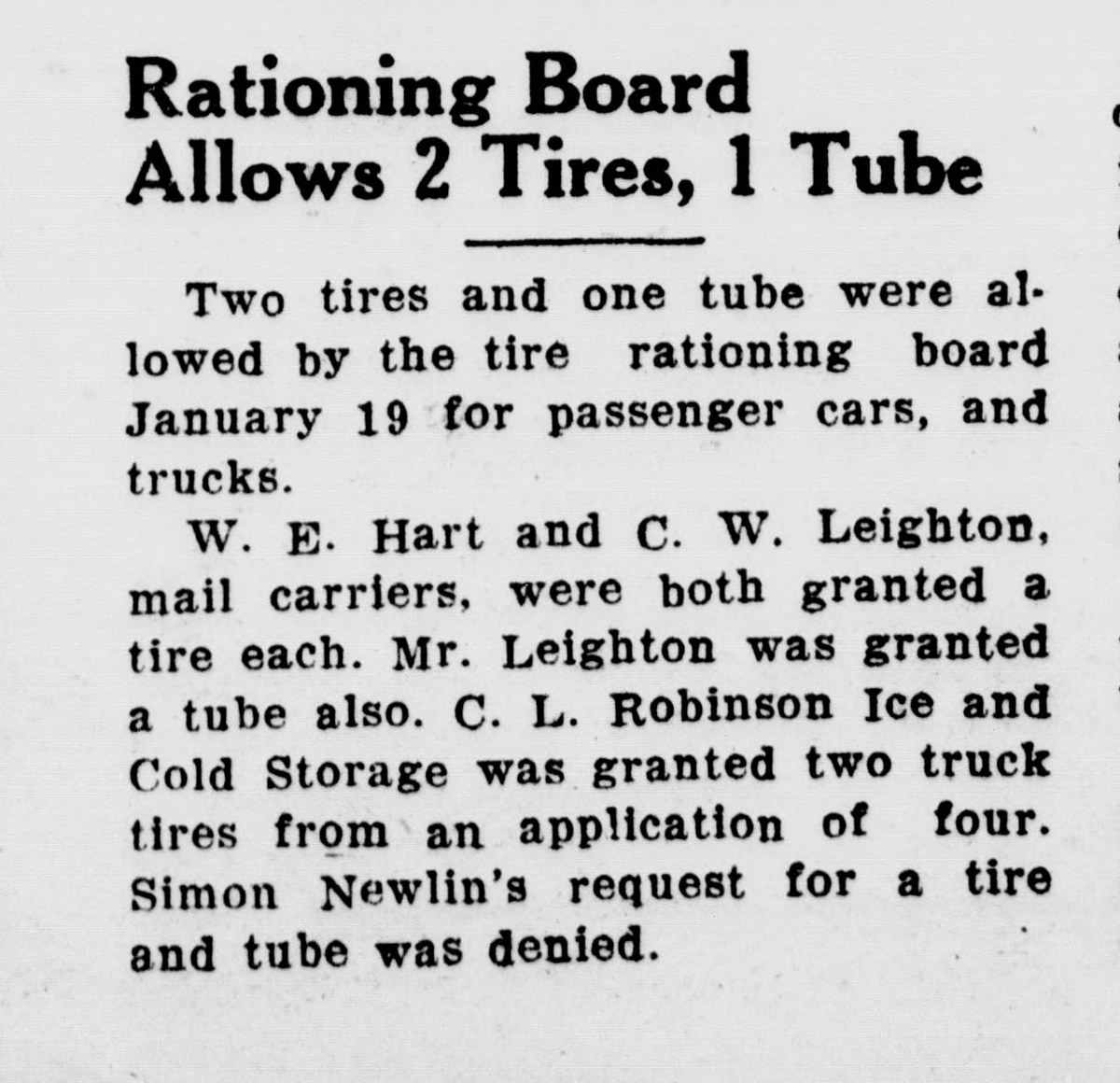
The tire rationing board's January 19 decisions: tires for two mail carriers, two truck tires of four requested, and one request denied.
Clarke Courier (Berryville, Va.), January 22, 1942, page 1. Library of Congress, Chronicling America. Rights Changes: A detail of the retained region crop of the Library of Congress page image (1265 by 2872 pixels): the rectangle from x 0 to 1265 and y 1649 to 2872, which leaves out the unrelated items around it, scaled to 1200 by 1160, and re-encoded as JPEG. The whole page is at the source link. Nothing retouched or added.
Source: Clarke Courier, Berryville, Va., January 22, 1942, page 1: "Rationing Board Allows 2 Tires, 1 Tube" Open the full image
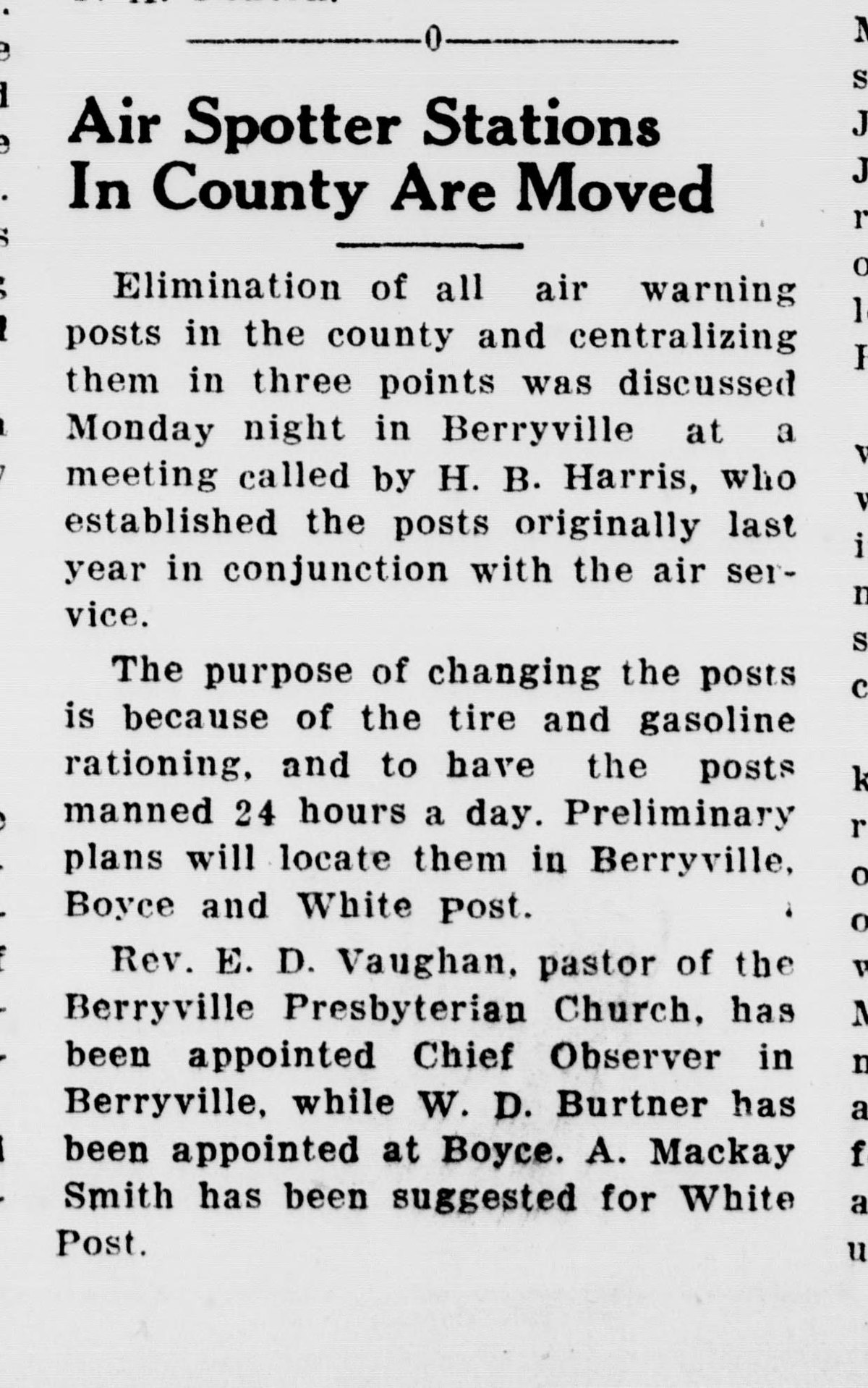
A meeting called by H. B. Harris discusses concentrating the posts at Berryville, Boyce and White Post because of tire and gasoline rationing.
Clarke Courier (Berryville, Va.), April 30, 1942, page 1. Library of Congress, Chronicling America. Rights Changes: The retained JPEG image of 1238 by 1979 pixels, scaled to 1200 by 1918 and re-encoded as JPEG for the web. Nothing retouched or added.
Source: Clarke Courier, Berryville, Va., April 30, 1942, page 1: "Air Spotter Stations In County Are Moved" Open the full image
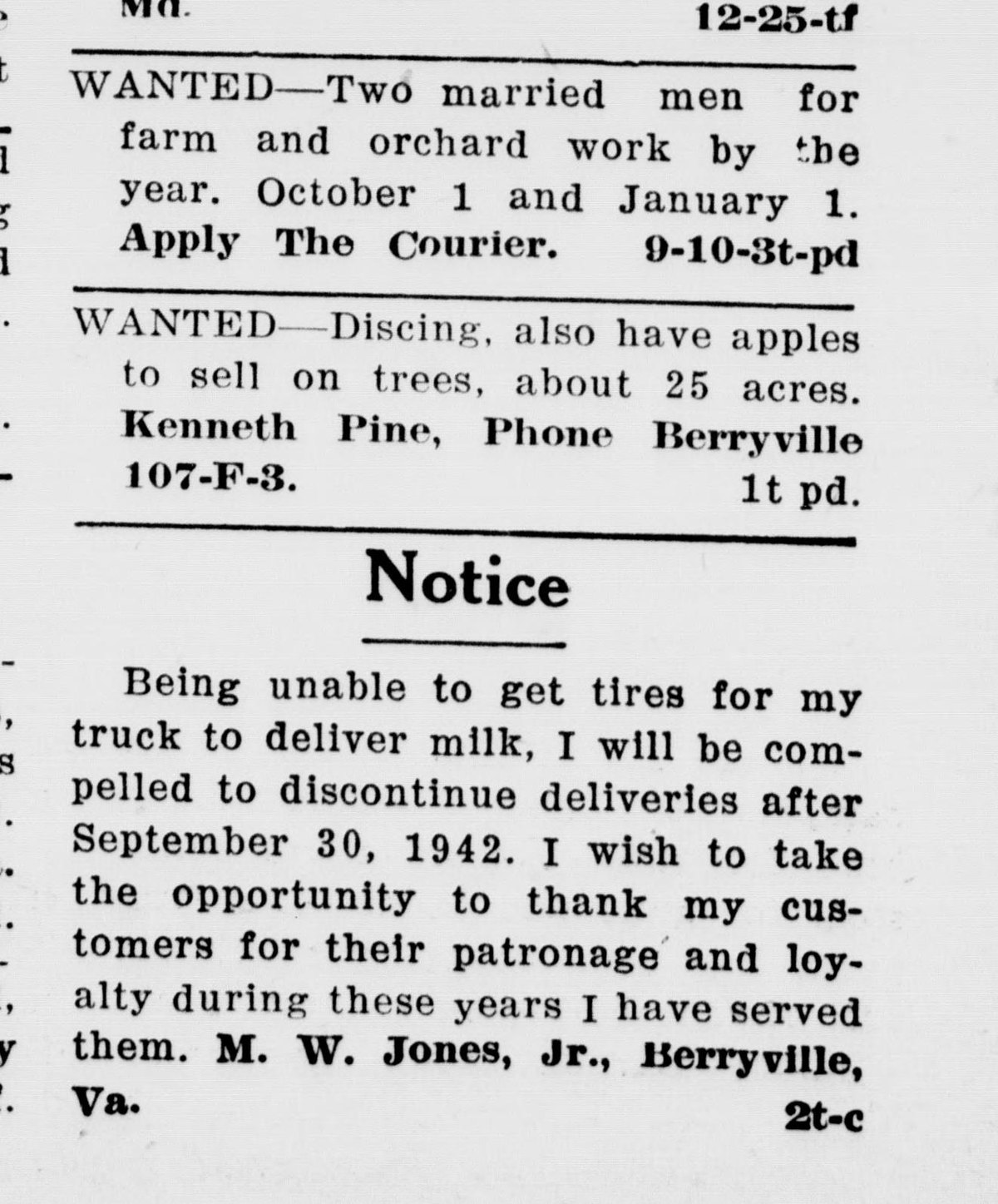
M. W. Jones, Jr., of Berryville gives notice that, unable to get tires for his truck, he will stop delivering milk after September 30, 1942.
Clarke Courier (Berryville, Va.), September 24, 1942, page 12. Library of Congress, Chronicling America. Rights Changes: The retained JPEG image of 1322 by 1594 pixels, scaled to 1200 by 1447 and re-encoded as JPEG for the web. Nothing retouched or added.
Source: Clarke Courier, Berryville, Va., September 24, 1942, page 12: "Berryville Post Changes To 3 Hour Shifts" and a notice by M. W. Jones, Jr. Open the full image
The schools become ration offices
In May the schools took on a new job. Registration for sugar ration books opened at the schools on Monday, May 4, 1942, and closed that Thursday. By Tuesday, 3,726 people had registered: 1,428 on the first day and 2,308 on the second, as the paper printed the figures. Those two days actually add up to ten more than the printed total. The official who compiled the count expected 6,800 or 6,900 people to register in the county. At Berryville, the principal, D. G. Cooley, announced an extra evening session for the last day. The next week it was gasoline. Hundreds of motorists came to the schoolhouses, where teachers questioned them before issuing cards. The schools were Berryville High School, Boyce High School, Providence Chapel, White Post, Gaylord and the Millwood Colored School. Of the 1,255 car owners who signed up, 431 received the basic A card, and 49 received the X card, which allowed unlimited fuel. The first weekend under rationing changed little. The paper reported that Clarke's motorists kept up their custom of a Sunday afternoon drive, and that the swollen Shenandoah River drew sightseers. The next week was different. Main Street in Berryville was almost empty of cars for three days, and the Courier passed along one resident's remark that rationing had solved the town's parking problem. By early August, the same column that told the "Red Flash" story reported, the local board had handled about 250 applications for supplementary gasoline coupons. Rationing reached ceremonies too. In late May the W. T. B. Williams Training School, as the paper named it, announced that there would be no baccalaureate sermon that year, because of gasoline rationing and the need to save rubber. Commencement was instead to include the unveiling of a photograph of Dr. W. T. B. Williams, with his sister drawing the veil.
Source note: Clarke Courier, Berryville, Va., 1942
The Clarke Courier of May 7, 1942, the day sugar registration was to end at the schools, reported that 3,726 persons in Clarke county had registered for sugar rationing books through Tuesday, according to a survey by the official in charge; that the total for Monday, the first day, was 1,428 and for Tuesday 2,308; that he expected about 6,800 or 6,900 people to register in the county; and that D. G. Cooley, principal, said registration at Berryville would be held that evening from 7:30 to 9 o'clock.
What the source supports
How many people registered for sugar ration books in the first two days, as the paper printed the figures, and where registration was held.
Uncertainty
The figures are kept as printed: the two day counts add to 3,736, ten more than the printed total of 3,726, and neither is corrected here. The final county count was not checked. The expected total is an estimate. D. G. Cooley is named as printed and not joined to any other record of that name.
Source
Evidence role: supports. The registration figures, the estimate and the Berryville session.
Clarke Courier, Berryville, Va., May 7, 1942, page 1: "Sugar Rationing Ends Today In County"
Clarke Courier, Berryville, Va. · 1942-05-07 (publication)
Locator: Page 1, report of the sugar registration, headline to the gasoline paragraph
Checked: Original inspected. A digital reproduction was inspected; no original has been handled.
Open sourceSource family: clarke-courier. Multiple passages from one source are not independent witnesses.
AI-assisted source check (Claude Opus 5.5) · 2026-09-26. How this project checks its sources
Source note: Clarke Courier, Berryville, Va., 1942
The Clarke Courier of May 14, 1942 reported that hundreds of motorists had come to the school houses that week to register for gasoline rationing cards, where they were questioned by school teachers; that the cards were being issued at Berryville High School, Boyce High School, Providence Chapel School, White Post School, Gaylord School and the Millwood Colored School; and that the X card entitled its holder to unlimited quantities of fuel.
What the source supports
That the county's schools served as gasoline registration offices, with teachers questioning motorists, and which schools did so.
Uncertainty
The schools are named as printed and are not joined to school records elsewhere in this project. The paper adds that many sought the X card but only a few were issued.
Source
Evidence role: supports. The report of the registration.
Clarke Courier, Berryville, Va., May 14, 1942, page 1: "Hundreds Issued Gas Rationing Cards Here"
Clarke Courier, Berryville, Va. · 1942-05-14 (publication)
Locator: Page 1, report of the gasoline card registration at the schools
Checked: Original inspected. A digital reproduction was inspected; no original has been handled.
Open sourceSource family: clarke-courier. Multiple passages from one source are not independent witnesses.
AI-assisted source check (Claude Opus 5.5) · 2026-09-26. How this project checks its sources
Source note: Clarke Courier, Berryville, Va., 1942
The Clarke Courier of May 21, 1942 reported that in the first weekend under gasoline rationing the county's motorists kept up their custom of a Sunday afternoon drive and the swollen Shenandoah River drew much travel; that Main Street in Berryville had been almost empty of cars on the Monday, Tuesday and Wednesday of that week, and that, as someone pointed out, rationing had solved the parking problem in Berryville; and that 1,255 car owners had signed up for ration cards at the schools, 431 of them for A cards and, as the article's continuation on page 4 and its subhead give it, 49 for X cards.
What the source supports
How the first days of gasoline rationing looked in Berryville, and how many car owners received the basic and unlimited cards.
Uncertainty
The paper's own observations and counts. The parking remark is an unnamed person's, as the paper reports it. The page image reads 431 where the machine-read text is garbled; the X figure is on the page 4 continuation and in the page 1 subhead.
Source
Evidence role: supports. The first weekend, Main Street, the total and the A count.
Clarke Courier, Berryville, Va., May 21, 1942, page 1: "1,255 Register For Gas Rationing Cards In County"
Clarke Courier, Berryville, Va. · 1942-05-21 (publication)
Locator: Page 1, report of the first weekend of gasoline rationing and the card counts, headline to the continuation line
Checked: Original inspected. A digital reproduction was inspected; no original has been handled.
Open sourceSource family: clarke-courier. Multiple passages from one source are not independent witnesses.
Evidence role: supports. The X card count on the continuation.
Clarke Courier, Berryville, Va., May 21, 1942, page 4: "Gas Rationing Cards", continued from page 1
Clarke Courier, Berryville, Va. · 1942-05-21 (publication)
Locator: Page 4, continuation of the gasoline card report, the B-3 and X card counts
Checked: Original inspected. A digital reproduction was inspected; no original has been handled.
Open sourceSource family: clarke-courier. Multiple passages from one source are not independent witnesses.
AI-assisted source check (Claude Opus 5.5) · 2026-09-26. How this project checks its sources
Source note: Clarke Courier, Berryville, Va., 1942
The same column reported that approximately 250 applications for supplementary gasoline ration coupons had been handled by the local board through Saturday.
What the source supports
The paper's count of supplementary gasoline applications by early August 1942.
Uncertainty
An approximate figure from the paper; the board's records were not seen. The page image reads 250 where the machine-read text is garbled.
Source
Evidence role: supports. The Notes paragraph.
Clarke Courier, Berryville, Va., August 6, 1942, page 17: "Courier Chatter" column
Clarke Courier, Berryville, Va. · 1942-08-06 (publication)
Locator: Page 17, same column, "Notes" paragraph on supplementary gasoline coupon applications
Checked: Original inspected. A digital reproduction was inspected; no original has been handled.
Open sourceSource family: clarke-courier. Multiple passages from one source are not independent witnesses.
AI-assisted source check (Claude Opus 5.5) · 2026-09-26. How this project checks its sources
Source note: Clarke Courier, Berryville, Va., 1942
The Clarke Courier of May 28, 1942 reported that, on account of gasoline rationing and the conservation of rubber, there would be no baccalaureate sermon that year at the W. T. B. Williams Training School, and that at commencement a photograph of Dr. W. T. B. Williams would be unveiled, his sister drawing the veil.
What the source supports
That rationing changed the school's 1942 commencement plans, as the paper announced them.
Uncertainty
An announcement before commencement, not a report of it. The school's name is as printed; it is not joined here to the Clarke County Training School record.
Source
Evidence role: supports. The report of the cancelled baccalaureate.
Clarke Courier, Berryville, Va., May 28, 1942, page 19: "Training School Cancels Baccalaureate"
Clarke Courier, Berryville, Va. · 1942-05-28 (publication)
Locator: Page 19, report of the Training School's cancelled baccalaureate
Checked: Original inspected. A digital reproduction was inspected; no original has been handled.
Open sourceSource family: clarke-courier. Multiple passages from one source are not independent witnesses.
AI-assisted source check (Claude Opus 5.5) · 2026-09-26. How this project checks its sources
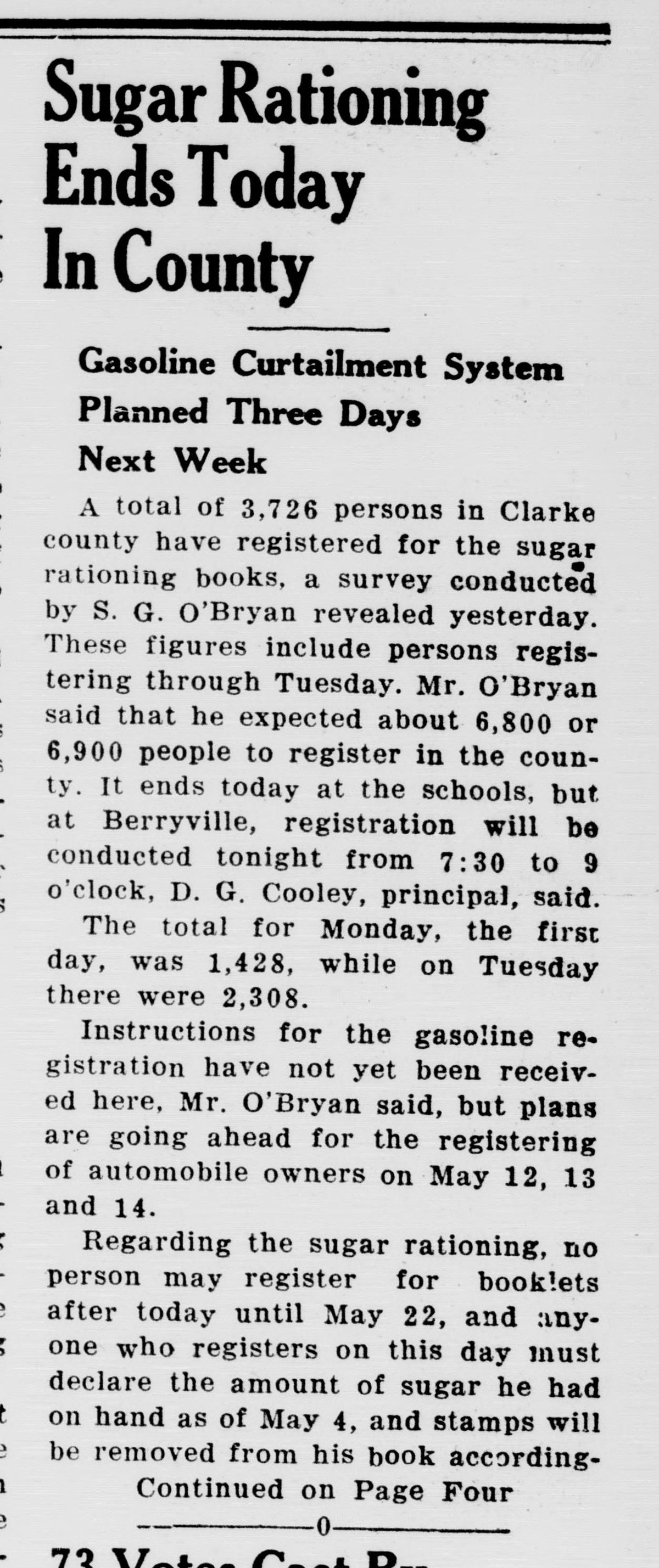
Sugar registration at the schools: 3,726 registered through Tuesday, with the day counts as printed and an extra evening session at Berryville.
Clarke Courier (Berryville, Va.), May 7, 1942, page 1. Library of Congress, Chronicling America. Rights Changes: The retained JPEG image of 1253 by 2983 pixels, scaled to 1200 by 2857 and re-encoded as JPEG for the web. Nothing retouched or added.
Source: Clarke Courier, Berryville, Va., May 7, 1942, page 1: "Sugar Rationing Ends Today In County" Open the full image
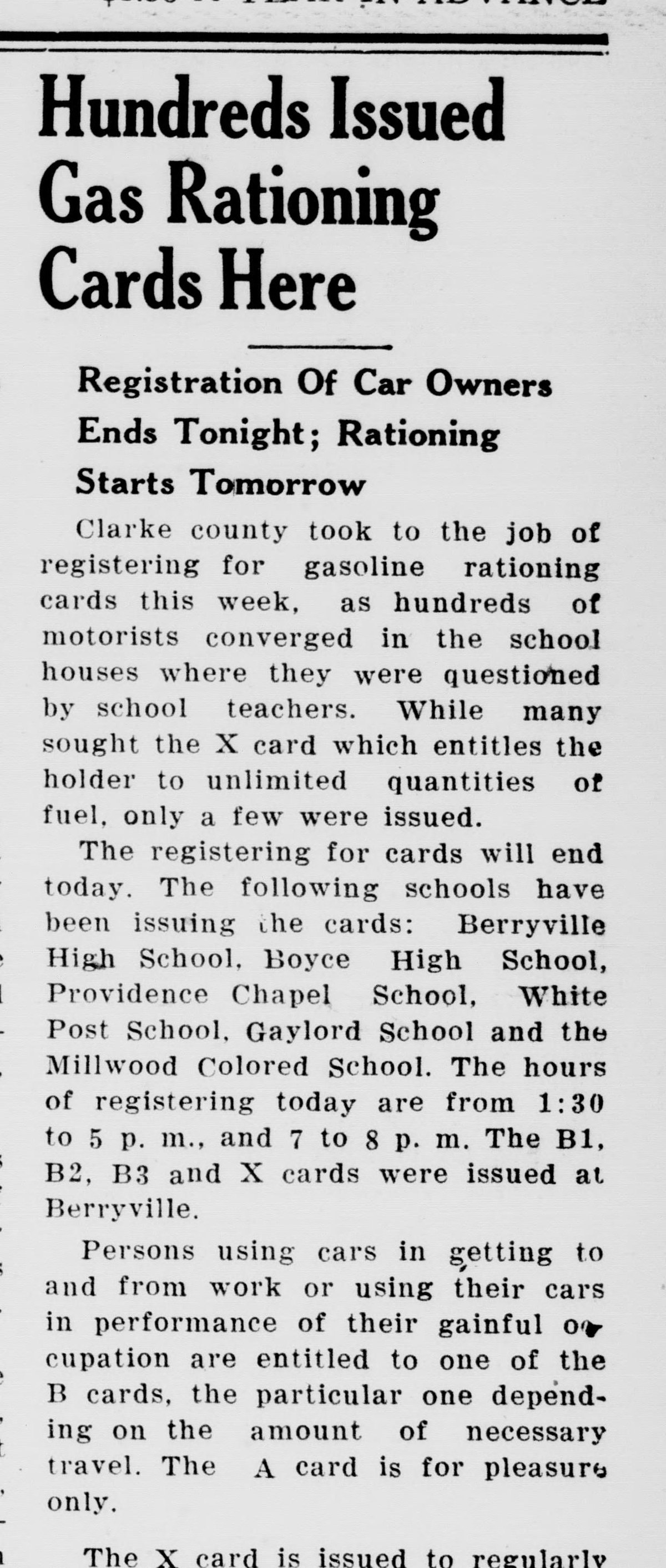
Gasoline registration at six schoolhouses, where teachers questioned motorists; the X card entitled its holder to unlimited fuel.
Clarke Courier (Berryville, Va.), May 14, 1942, page 1. Library of Congress, Chronicling America. Rights Changes: The retained JPEG image of 1240 by 2921 pixels, scaled to 1200 by 2827 and re-encoded as JPEG for the web. Nothing retouched or added.
Source: Clarke Courier, Berryville, Va., May 14, 1942, page 1: "Hundreds Issued Gas Rationing Cards Here" Open the full image
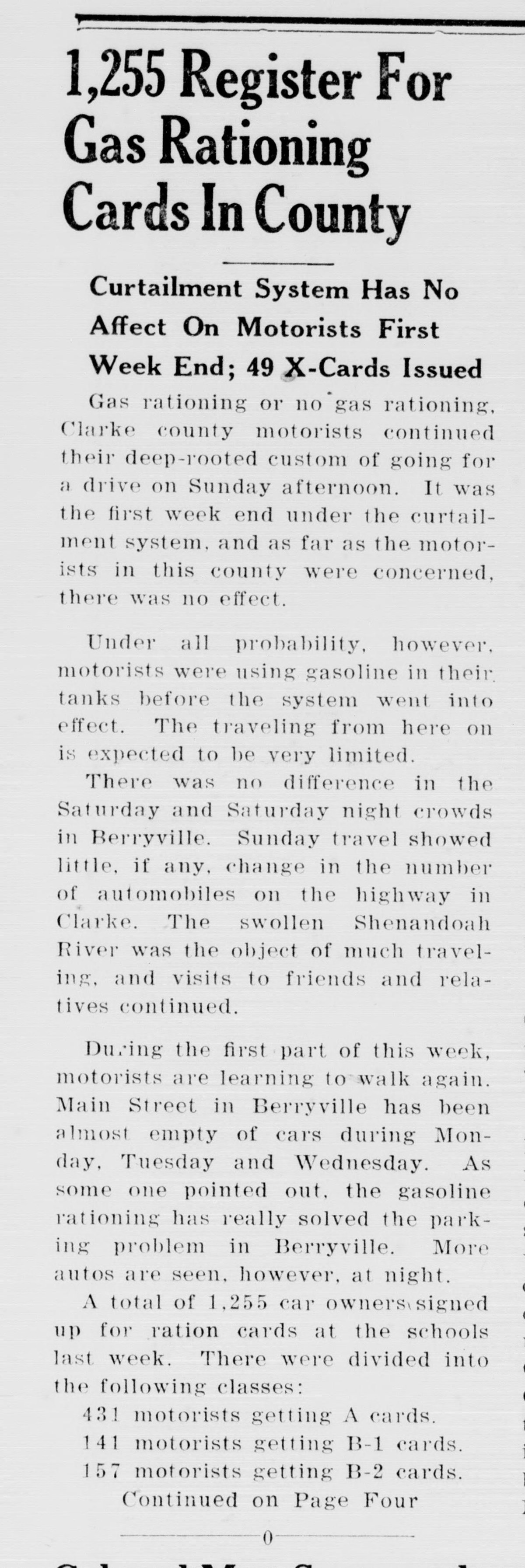
The first weekend of gasoline rationing, Main Street almost empty, and 1,255 car owners signed up, with the A, B-1 and B-2 counts (continued on page 4).
Clarke Courier (Berryville, Va.), May 21, 1942, page 1. Library of Congress, Chronicling America. Rights Changes: The retained JPEG image of 1264 by 3777 pixels, scaled to 1200 by 3586 and re-encoded as JPEG for the web. Nothing retouched or added.
Source: Clarke Courier, Berryville, Va., May 21, 1942, page 1: "1,255 Register For Gas Rationing Cards In County" Open the full image
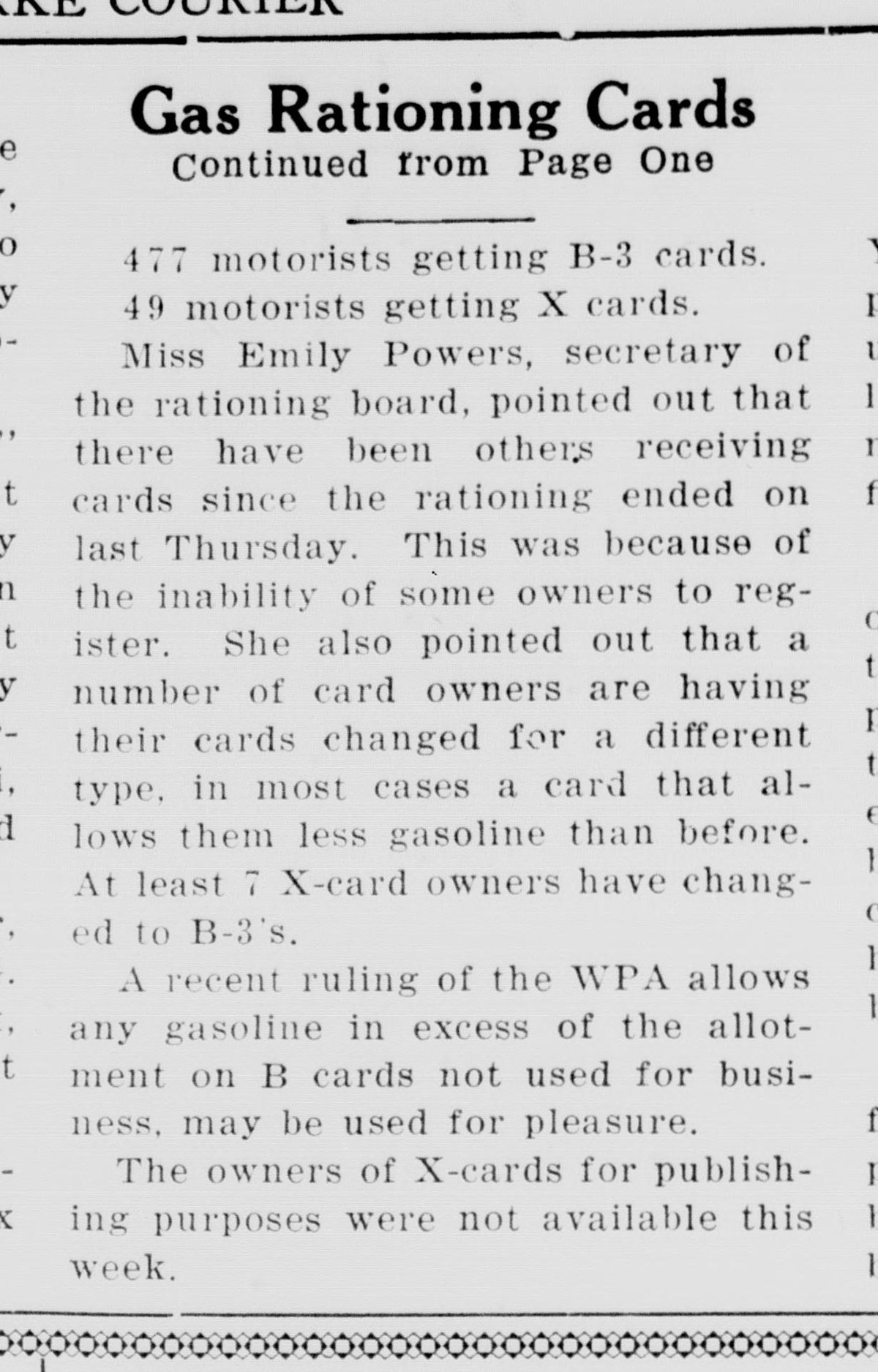
Continuation from page 1: the B-3 and X card counts, including 49 X cards.
Clarke Courier (Berryville, Va.), May 21, 1942, page 4. Library of Congress, Chronicling America. Rights Changes: The retained JPEG image of 1232 by 1926 pixels, scaled to 1200 by 1876 and re-encoded as JPEG for the web. Nothing retouched or added.
Source: Clarke Courier, Berryville, Va., May 21, 1942, page 4: "Gas Rationing Cards", continued from page 1 Open the full image
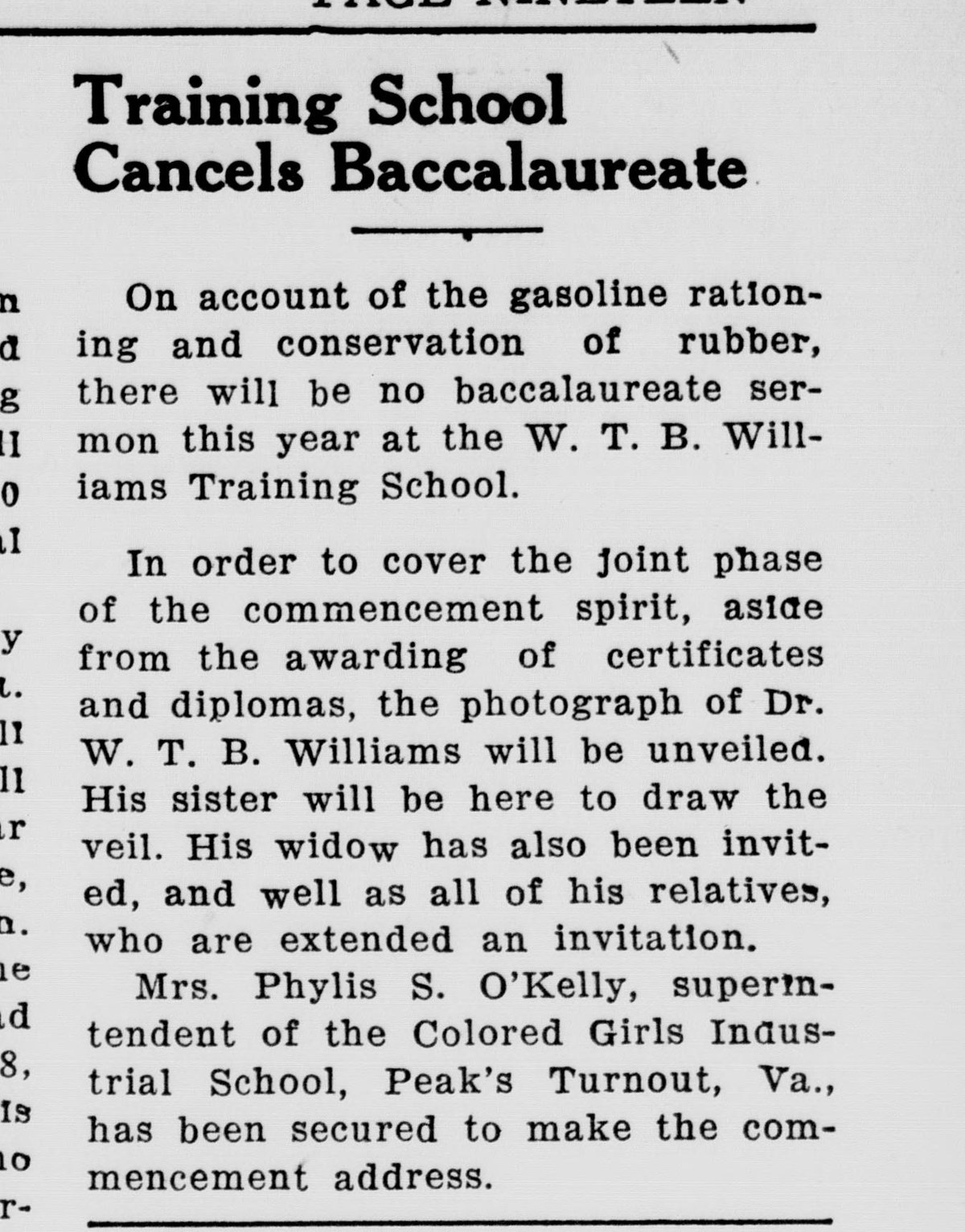
The W. T. B. Williams Training School, as the paper names it, drops its baccalaureate sermon because of gasoline rationing and plans to unveil a photograph of Dr. W. T. B. Williams.
Clarke Courier (Berryville, Va.), May 28, 1942, page 19. Library of Congress, Chronicling America. Rights Changes: A detail of the retained region crop of the Library of Congress page image (1347 by 2343 pixels): the rectangle from x 0 to 1347 and y 0 to 1720, which leaves out the unrelated items around it, scaled to 1200 by 1532, and re-encoded as JPEG. The whole page is at the source link. Nothing retouched or added.
Source: Clarke Courier, Berryville, Va., May 28, 1942, page 19: "Training School Cancels Baccalaureate" Open the full image
Around the clock
Keeping a post manned day and night took a steady supply of volunteers. In late September 1942 the Berryville post announced that from October 1 it would move from four-hour watches to three-hour watches. The change needed 28 more observers, and 21 more were wanted for hours that were already vacant or would be once school began: about 50 in all. The paper described how the new schedule would work. The shifts would start at 8 in the morning and run around the clock. Women would take the daylight watches and men the night hours, with two observers on duty at once and an assistant chief observer in charge of each day of the week. Volunteers were asked to give three hours a week and to call the chief observer, E. D. Vaughan, or the assistant for the day they wanted. Every observer would get an identification card; an arm band came after 25 hours of service.
Source note: Clarke Courier, Berryville, Va., 1942
The Clarke Courier of September 24, 1942 reported that the Berryville Aircraft Warning Post planned to change from four-hour to three-hour watches beginning October 1, which would require 28 more observers for the added shifts, besides 21 more spotters for hours vacant then or when school began, approximately 50 in all; that the new shifts would begin at 8 a.m. and run around the clock, the daylight shifts manned by the ladies and the night hours given to the men, with an assistant chief observer in charge of each day's group and two observers on duty at the same period; that those willing to give three hours a week were asked to call the chief observer, E. D. Vaughan, or the assistant chief observer for the day they wished to serve; and that identification cards would be issued to all observers and arm bands to those with 25 hours of service.
What the source supports
How the Berryville post planned to keep watch around the clock from October 1942, and what it asked of volunteers.
Uncertainty
A plan and an appeal, not a record of how the shifts were filled. The daily assistant chief observers are printed but not listed here; the Rev. H. G. Lane among them is not joined to the Rev. Henry G. Lane named in 1943. A printed "three-four periods" is probably a typesetting slip and is not relied on.
Source
Evidence role: supports. The shift article across both columns.
Clarke Courier, Berryville, Va., September 24, 1942, page 12: "Berryville Post Changes To 3 Hour Shifts" and a notice by M. W. Jones, Jr.
Clarke Courier, Berryville, Va. · 1942-09-24 (publication)
Locator: Page 12, report of the Berryville post's change to three-hour shifts, across two columns
Checked: Original inspected. A digital reproduction was inspected; no original has been handled.
Open sourceSource family: clarke-courier. Multiple passages from one source are not independent witnesses.
AI-assisted source check (Claude Opus 5.5) · 2026-09-26. How this project checks its sources
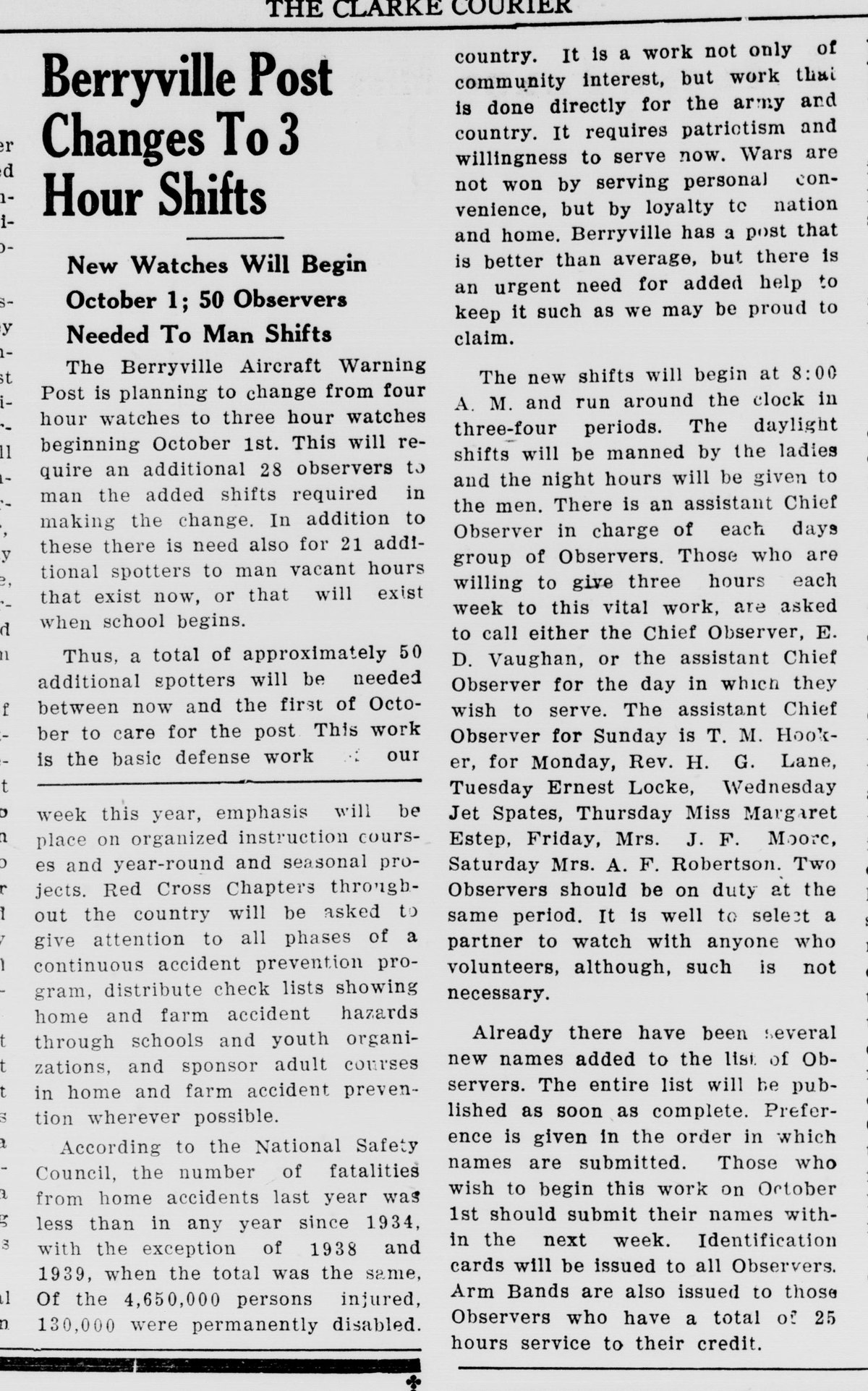
The Berryville post moves to three-hour watches from October 1 and asks for about 50 more observers. The article jumps from the left column to the right; the lower left column is an unrelated Red Cross item.
Clarke Courier (Berryville, Va.), September 24, 1942, page 12. Library of Congress, Chronicling America. Rights Changes: The retained JPEG image of 2344 by 3756 pixels, scaled to 1200 by 1923 and re-encoded as JPEG for the web. Nothing retouched or added.
Source: Clarke Courier, Berryville, Va., September 24, 1942, page 12: "Berryville Post Changes To 3 Hour Shifts" and a notice by M. W. Jones, Jr. Open the full image
Posts that neighbors built
Concentrating the watch also meant building for it. In late August 1942, White Post's spotters voted to put up a post of their own. Their model was the post at Brucetown: an elevated building about sixteen feet in the air, topped by an eight-foot room enclosed in glass with a walkway around it. The chief observer, A. Mackay Smith, hoped to raise $140 for the materials and furnishings. The land was donated, and the labor was to be donated too. At Boyce, the post was dedicated on a Sunday in late November 1942 at the Parish House. George H. Burwell called it "the material expression of a watchful public spirited community." John Zombro, the post's chief air spotter, thanked the contributors and said their work was only beginning. Women's clubs did the same kind of work for war bonds. Through November 1942 the Junior Woman's Club ran bond-selling booths in Berryville stores every Saturday. The paper credited the club with $6,000 or more of the county's $26,000 monthly bond quota.
Source note: Clarke Courier, Berryville, Va., 1942
The Clarke Courier of September 3, 1942 reported that the erection of a spotters' post in White Post was voted on the Thursday night of the previous week at a meeting called by A. Mackay Smith, chief observer; that the spotters voted to copy the post at Brucetown, an elevated building about 16 feet in the air, with a post on top 8 feet, enclosed by glass, and a walkway around it; that Smith hoped to raise $140 to pay for the materials and furnish it; and that it would be erected on donated land, with the labor donated.
What the source supports
The White Post spotters' decision to build a post of their own, its model and its funding plan.
Uncertainty
A vote and a plan. Whether the post was built is not shown by any page read for this story. The building committee and the landowner are named in the report and not here.
Source
Evidence role: supports. The report of the vote.
Clarke Courier, Berryville, Va., September 3, 1942, page 15: report of the White Post spotters' vote to build a post
Clarke Courier, Berryville, Va. · 1942-09-03 (publication)
Locator: Page 15, report of the White Post spotters' vote
Checked: Original inspected. A digital reproduction was inspected; no original has been handled.
Open sourceSource family: clarke-courier. Multiple passages from one source are not independent witnesses.
AI-assisted source check (Claude Opus 5.5) · 2026-09-26. How this project checks its sources
Source note: Clarke Courier, Berryville, Va., 1942
The Clarke Courier of December 3, 1942 reported that the spotter post at Boyce was dedicated on the Sunday by George H. Burwell in the Parish House as "the material expression of a watchful public spirited community," and that John Zombro, chief air spotter of the post, who presided, thanked those present for their contributions and said he was sure they considered their work just beginning.
What the source supports
That the Boyce post was dedicated in late November 1942, by whom, and what was said.
Uncertainty
The paper's report of the ceremony. John Zombro is not joined to the John E. Zombro named in 1943 and 1944, nor George H. Burwell to Townsend Burwell. The quotation is as printed, with a line-end hyphen closed up.
Source
Evidence role: supports. The dedication paragraph and Zombro's opening remarks.
Clarke Courier, Berryville, Va., December 3, 1942, page 16: "Air Spotter Post Dedicated At Boyce Sunday"
Clarke Courier, Berryville, Va. · 1942-12-03 (publication)
Locator: Page 16, report of the Boyce post's dedication, the dedication paragraph and John Zombro's opening remarks
Relevant passagethe material expression of a watchful public spirited community.
Checked: Original inspected. A digital reproduction was inspected; no original has been handled.
Open sourceSource family: clarke-courier. Multiple passages from one source are not independent witnesses.
AI-assisted source check (Claude Opus 5.5) · 2026-09-26. How this project checks its sources
Source note: Clarke Courier, Berryville, Va., 1942
The Clarke Courier of December 3, 1942 reported that of Clarke County's monthly war bond quota of $26,000, $6,000 or more was credited to the Junior Woman's Club of Clarke County in the last week of the campaign, and that every Saturday during November the club's president arranged bond-selling booths in the Berryville stores.
What the source supports
The Junior Woman's Club's part in the county's November 1942 war bond sales, as the paper credited it.
Uncertainty
The figures are the paper's; no bond or club records were seen.
Source
Evidence role: supports. The first paragraph of the report.
Clarke Courier, Berryville, Va., December 3, 1942, page 1: "Junior Woman's Club Active In Sale Of Bonds"
Clarke Courier, Berryville, Va. · 1942-12-03 (publication)
Locator: Page 1, report of the Junior Woman's Club's bond sales, first paragraph
Checked: Original inspected. A digital reproduction was inspected; no original has been handled.
Open sourceSource family: clarke-courier. Multiple passages from one source are not independent witnesses.
AI-assisted source check (Claude Opus 5.5) · 2026-09-26. How this project checks its sources
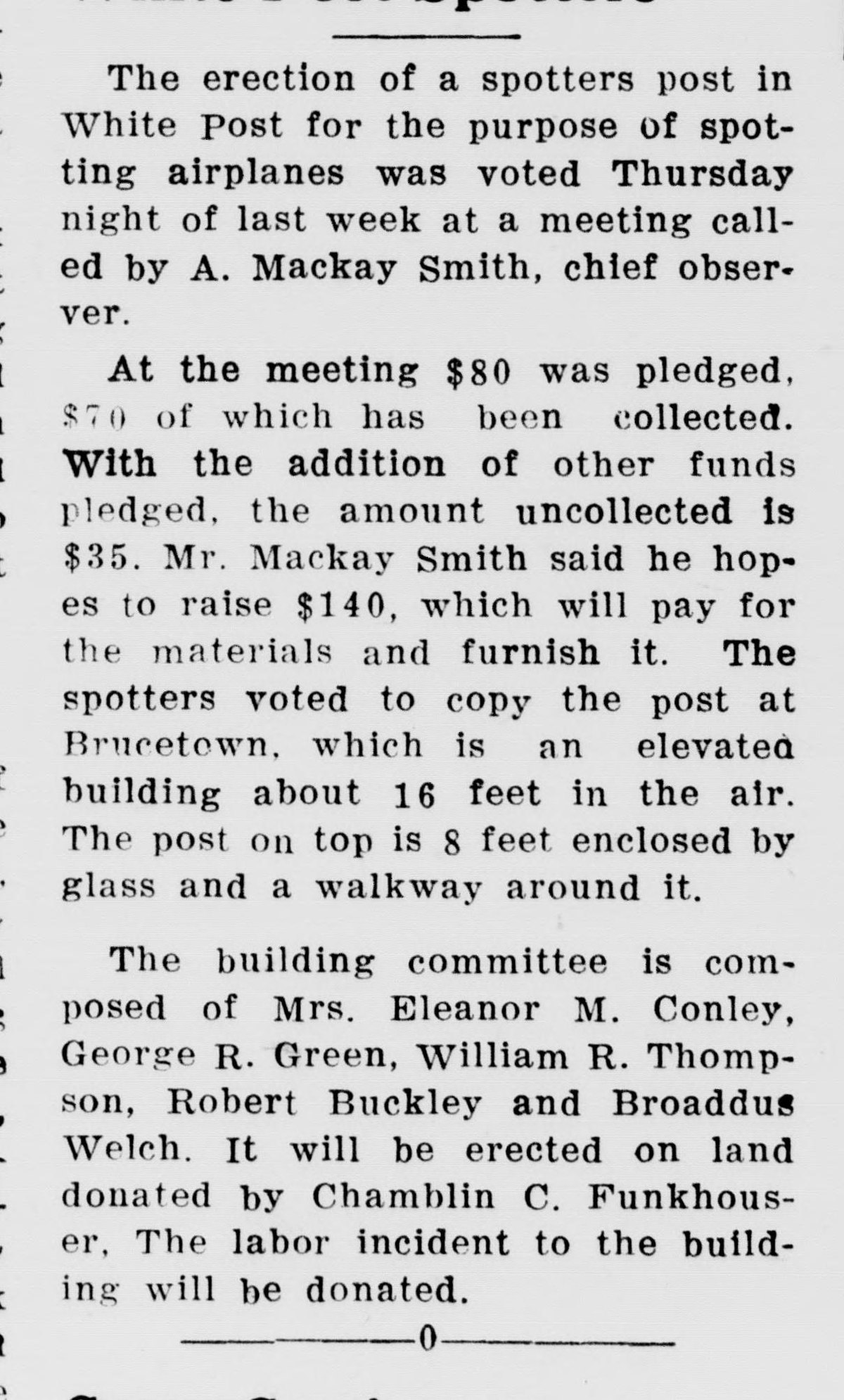
White Post spotters vote to build an elevated post modeled on the one at Brucetown.
Clarke Courier (Berryville, Va.), September 3, 1942, page 15. Library of Congress, Chronicling America. Rights Changes: The retained JPEG image of 1208 by 2004 pixels, scaled to 1200 by 1991 and re-encoded as JPEG for the web. Nothing retouched or added.
Source: Clarke Courier, Berryville, Va., September 3, 1942, page 15: report of the White Post spotters' vote to build a post Open the full image
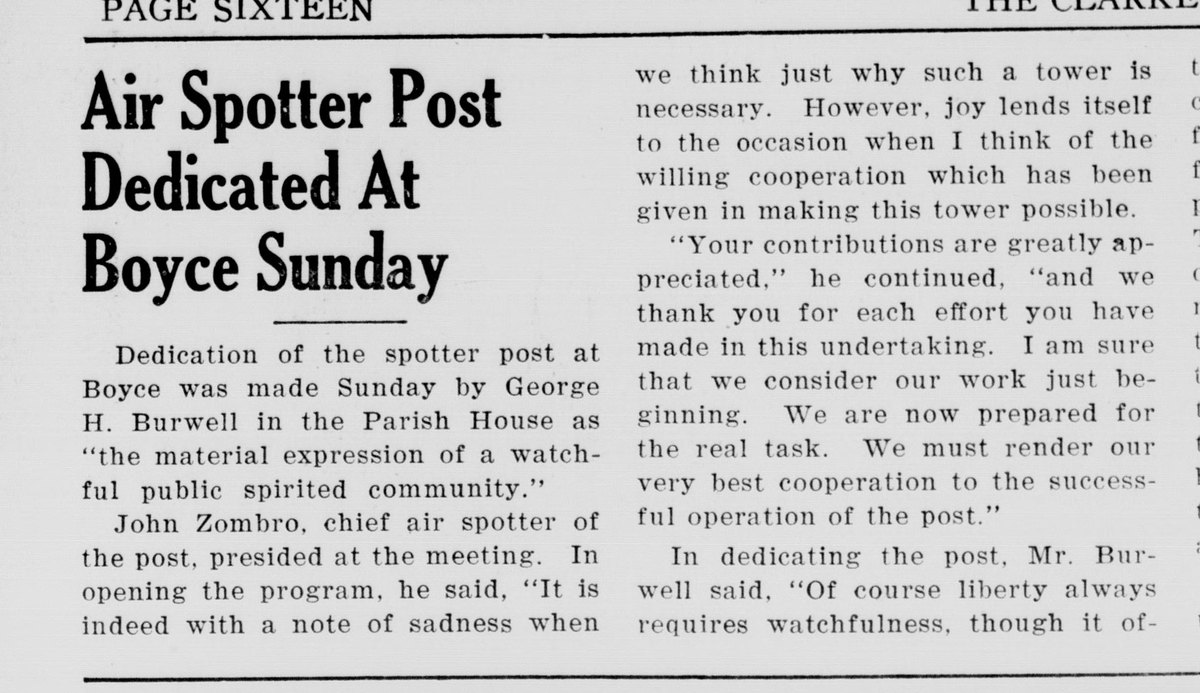
The Boyce air spotter post is dedicated at the Parish House; George H. Burwell's words and John Zombro's thanks.
Clarke Courier (Berryville, Va.), December 3, 1942, page 16. Library of Congress, Chronicling America. Rights Changes: The retained JPEG image of 2412 by 1393 pixels, scaled to 1200 by 693 and re-encoded as JPEG for the web. Nothing retouched or added.
Source: Clarke Courier, Berryville, Va., December 3, 1942, page 16: "Air Spotter Post Dedicated At Boyce Sunday" Open the full image
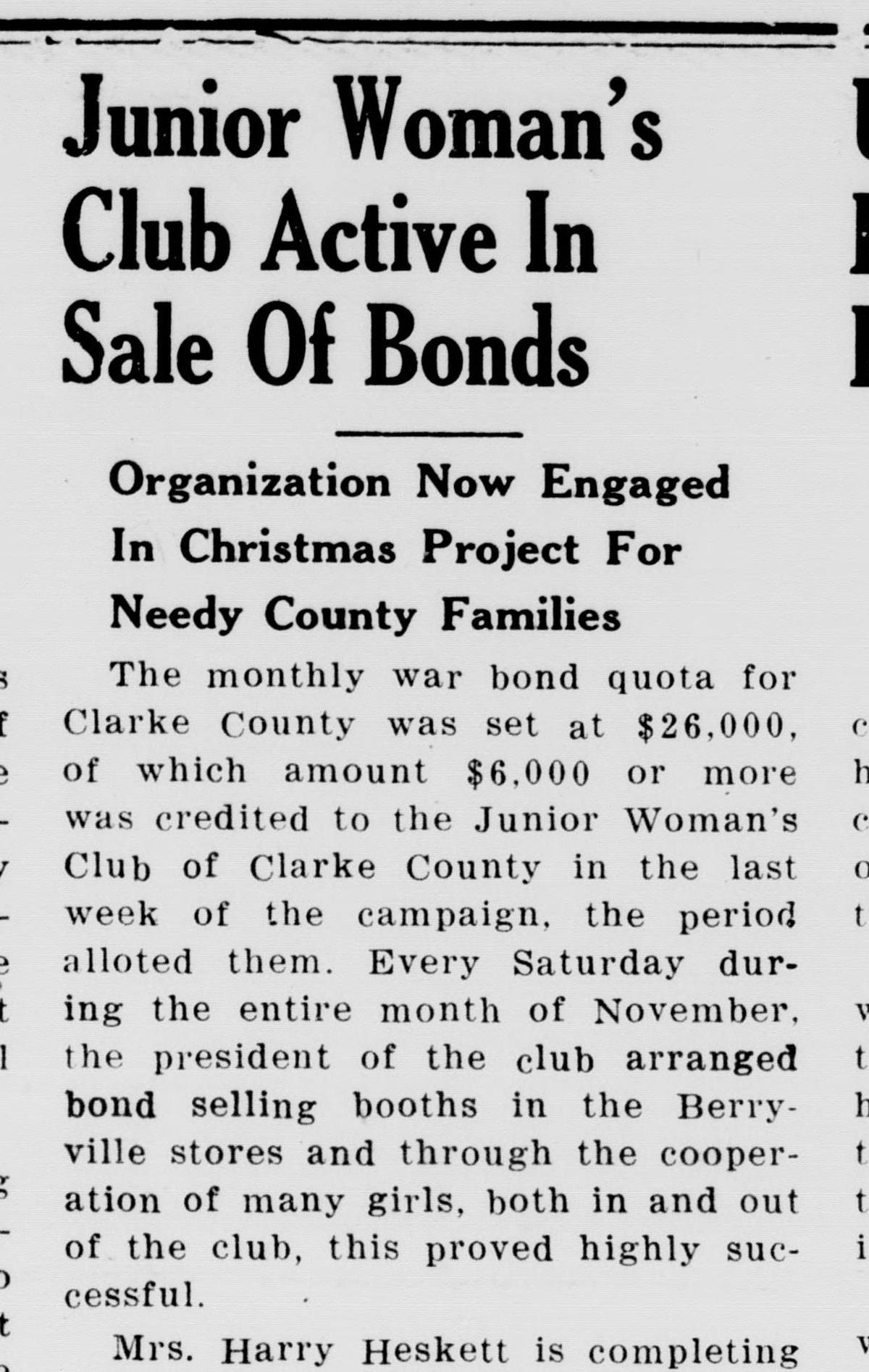
The Junior Woman's Club's Saturday war bond booths in Berryville stores.
Clarke Courier (Berryville, Va.), December 3, 1942, page 1. Library of Congress, Chronicling America. Rights Changes: The retained JPEG image of 1238 by 1954 pixels, scaled to 1200 by 1894 and re-encoded as JPEG for the web. Nothing retouched or added.
Source: Clarke Courier, Berryville, Va., December 3, 1942, page 1: "Junior Woman's Club Active In Sale Of Bonds" Open the full image
Stood down
In July 1943 the War Department closed Clarke's three posts at midnight. It announced that "the danger of a large scale sustained attack from the air in this section has passed." The Courier reported the closing on July 22 and named the three chief observers: A. Mackay Smith at White Post, John E. Zombro at Boyce and the Rev. Henry G. Lane at Berryville. The posts were told to keep their organizations ready to return on short notice. Observers were asked to report their hours so the War Department could send them souvenirs. The Boyce station outlived its watch. By November 1944 it was advertised for sale at auction, for cash, in a notice signed by John E. Zombro as chief observer. It was a building about twelve feet square, with much good timber and window sash, and an automatic oil stove that had served well in all kinds of weather. The observers were invited to say how the money from the sale should be spent. Nine months later, in its August 2, 1945 report on the sale of the White Post observation post, the Courier noted in passing that a similar building at Boyce had "sold for $71 at public auction." That is the paper's report of the outcome, not a record of the sale itself: it does not say when the auction was held, who bought the building or what became of it.
Source note: Clarke Courier, Berryville, Va., 1943
The Clarke Courier of July 22, 1943 reported that the three observation posts in Clarke county had been closed at midnight the night before on an order from the War Department, which announced that in its opinion "the danger of a large scale sustained attack from the air in this section has passed"; that the posts were to maintain their organizations and be ready to spring back into action on short notice; that their chief observers had been A. Mackay Smith at White Post, John E. Zombro at Boyce and the Rev. Henry G. Lane at Berryville; and that observers were asked to report the hours they had served so that the War Department could present souvenirs.
What the source supports
That the county's posts were closed by War Department order in July 1943, the reason given, and who had led them.
Uncertainty
The paper's report of the order; the order itself was not seen. The Rev. Henry G. Lane is not joined to the Rev. H. G. Lane named in 1942.
Source
Evidence role: supports. The closing, the War Department's statement and the order to stay ready.
Clarke Courier, Berryville, Va., July 22, 1943, page 1: "3 Aircraft Posts Closed By War Department"
Clarke Courier, Berryville, Va. · 1943-07-22 (publication)
Locator: Page 1, report of the posts' closing, headline, subhead, the War Department's statement and the order to stay ready
Relevant passagethe danger of a large scale sustained attack from the air in this section has passed.
Checked: Original inspected. A digital reproduction was inspected; no original has been handled.
Open sourceSource family: clarke-courier. Multiple passages from one source are not independent witnesses.
Evidence role: supports. The chief observers and the request for hours served.
Clarke Courier, Berryville, Va., July 22, 1943, page 1: "3 Aircraft Posts Closed By War Department"
Clarke Courier, Berryville, Va. · 1943-07-22 (publication)
Locator: Page 1, same report, the three chief observers, the service's beginning and the request for hours served
Checked: Original inspected. A digital reproduction was inspected; no original has been handled.
Open sourceSource family: clarke-courier. Multiple passages from one source are not independent witnesses.
AI-assisted source check (Claude Opus 5.5) · 2026-09-26. How this project checks its sources
Source note: Clarke Courier, Berryville, Va., 1944
A notice in the Clarke Courier of November 9, 1944 offered for sale the air spotter station at Boyce on Friday, November 10, 1944, at 4 p.m.: a building about 12 by 12 feet, containing much good timber and window sash, with an automatic oil heating stove that had proved an excellent heater in all kinds of weather. It invited all observers to state how they wished the proceeds of the sale used, gave the terms as cash, and was signed by John E. Zombro, chief observer, with an auctioneer and a clerk.
What the source supports
That the Boyce station was advertised for sale at auction in November 1944.
Uncertainty
An advertisement of a sale to come. It does not show that the sale took place, who bought the building or what became of it; that outcome was not checked. The auctioneer and clerk are named in the notice and not here.
Source
Evidence role: supports. The notice.
Clarke Courier, Berryville, Va., November 9, 1944, page 14: "For Sale" notice of the air spotter station at Boyce
Clarke Courier, Berryville, Va. · 1944-11-09 (publication)
Locator: Page 14, "For Sale" notice of the air spotter station at Boyce
Checked: Original inspected. A digital reproduction was inspected; no original has been handled.
Open sourceSource family: clarke-courier. Multiple passages from one source are not independent witnesses.
AI-assisted source check (Claude Opus 5.5) · 2026-09-26. How this project checks its sources
Source note: Clarke Courier, Berryville, Va., 1945, and one more
In its report of the White Post sale, the Clarke Courier of August 2, 1945 stated that a similar building at Boyce "sold for $71 at public auction."
What the source supports
That the Courier reported the Boyce spotter building sold at public auction for $71.
Uncertainty
A reported outcome in an item about another post, not an inspected sale record; no report of the Boyce auction itself was found. The item does not date the auction or name the buyer, and says nothing of what became of the building. It calls it "a similar building at Boyce"; reading it as the station advertised in November 1944 follows the two reports, not a separate record.
Source
Evidence role: supports. The sentence on the Boyce building.
Clarke Courier, Berryville, Va., August 2, 1945, page 15: "Observation Post At White Post Sold"
Clarke Courier, Berryville, Va. · 1945-08-02 (publication)
Locator: Page 15, "Observation Post At White Post Sold," the sale to W. R. Thompson, the price, the Boyce comparison and the proceeds
Relevant passagea similar building at Boyce sold for $71 at public auction.
Checked: Original inspected. A digital reproduction was inspected; no original has been handled.
Open sourceSource family: clarke-courier. Multiple passages from one source are not independent witnesses.
Evidence role: contextualizes. The November 1944 notice that advertised the Boyce station for sale at auction.
Clarke Courier, Berryville, Va., November 9, 1944, page 14: "For Sale" notice of the air spotter station at Boyce
Clarke Courier, Berryville, Va. · 1944-11-09 (publication)
Locator: Page 14, "For Sale" notice of the air spotter station at Boyce
Checked: Original inspected. A digital reproduction was inspected; no original has been handled.
Open sourceSource family: clarke-courier. Multiple passages from one source are not independent witnesses.
AI-assisted source check (Claude Opus 5.5) · 2026-09-26. How this project checks its sources
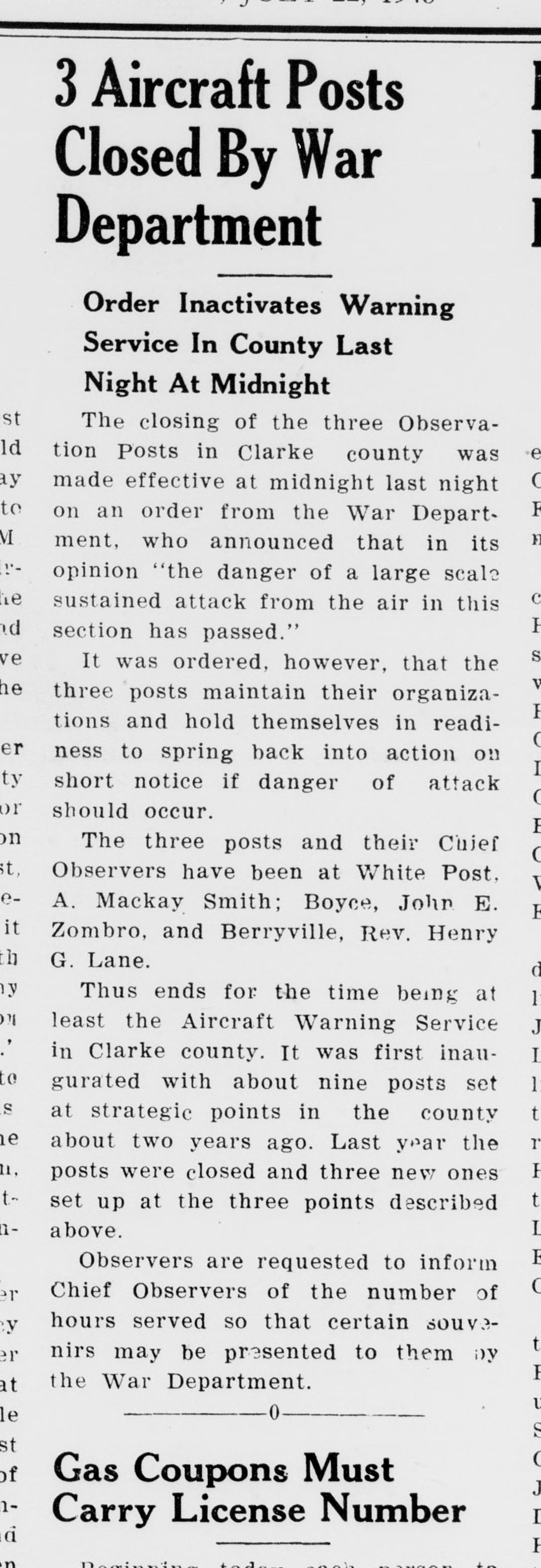
The War Department closes the county's three aircraft warning posts; the paper recalls that the service began with about nine posts and names the three chief observers.
Clarke Courier (Berryville, Va.), July 22, 1943, page 1. Library of Congress, Chronicling America. Rights Changes: The retained file itself, shown at its own 1086 by 3147 pixels: not scaled, not re-encoded. Nothing retouched or added.
Source: Clarke Courier, Berryville, Va., July 22, 1943, page 1: "3 Aircraft Posts Closed By War Department" Open the full image
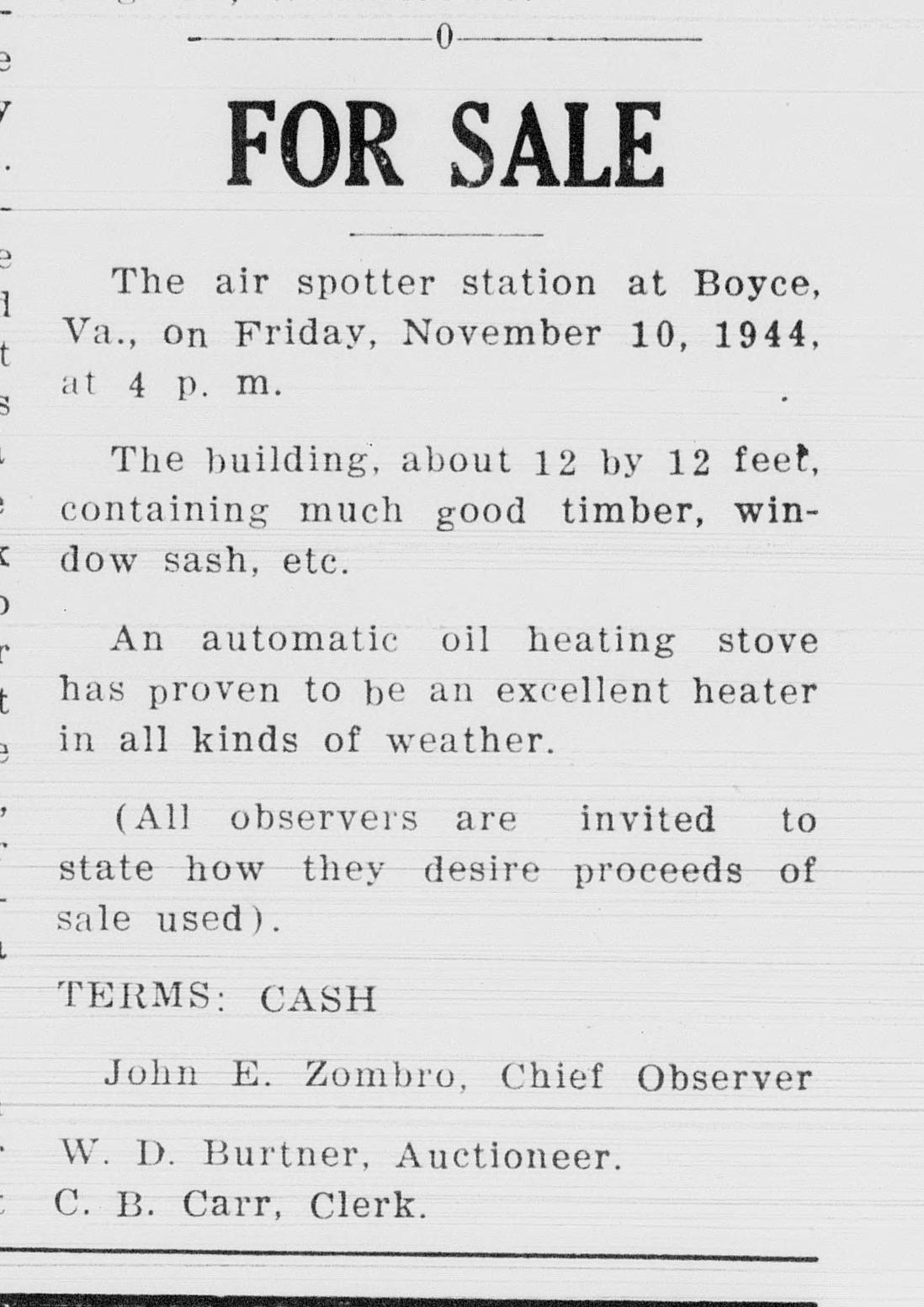
The Boyce air spotter station is advertised for sale at auction, signed by John E. Zombro as chief observer.
Clarke Courier (Berryville, Va.), November 9, 1944, page 14. Library of Congress, Chronicling America. Rights Changes: The retained file itself, shown at its own 1098 by 1553 pixels: not scaled, not re-encoded. Nothing retouched or added.
Source: Clarke Courier, Berryville, Va., November 9, 1944, page 14: "For Sale" notice of the air spotter station at Boyce Open the full image
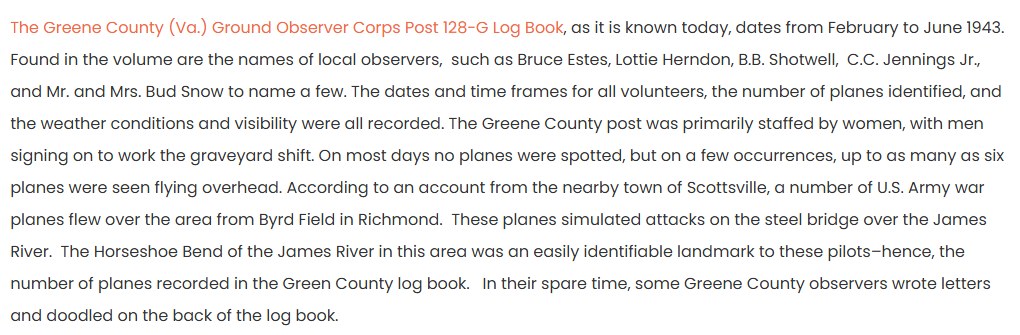
A later account, not a Clarke record: the Library of Virginia's 2013 post describes the log book of the Greene County post, February to June 1943. No Clarke post's log was found.
Callie Lou Freed, "Keep Your Eyes Aloft," The UncommonWealth: Voices from the Library of Virginia, November 6, 2013. Rights Changes: A detail of the retained full-page screenshot of the Library of Virginia post (1280 by 3200 pixels): the rectangle from x 130 to 1150 and y 1840 to 2175, which leaves out the post's photographs, its other paragraphs and the site's navigation, not scaled, and re-encoded as JPEG. The whole page is at the source link. Nothing retouched or added.
Source: Callie Lou Freed, "Keep Your Eyes Aloft," The UncommonWealth: Voices from the Library of Virginia, November 6, 2013 Open the full image
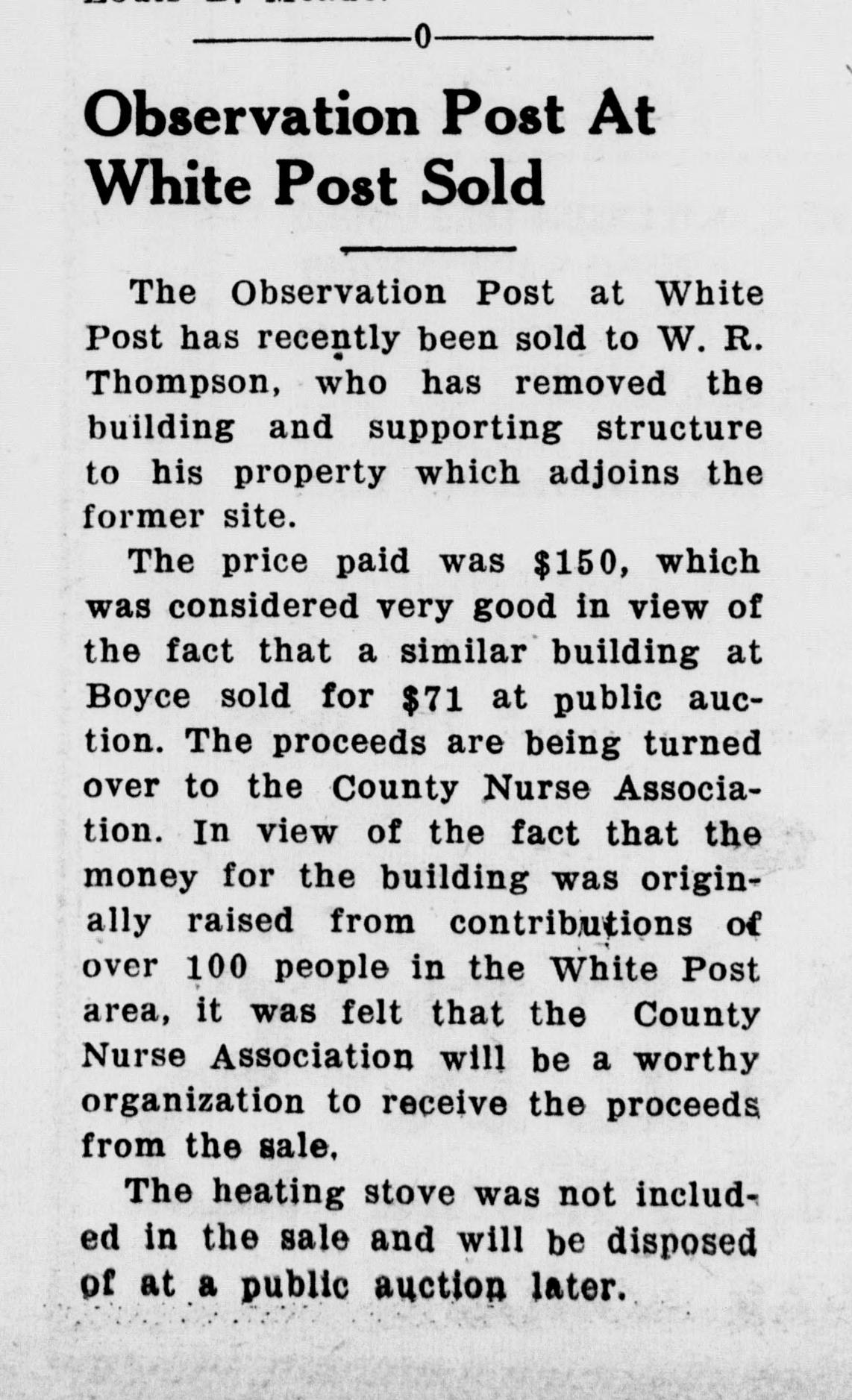
The White Post observation post is sold for $150 and moved next door; the item notes that a similar building at Boyce sold for $71 at public auction.
Clarke Courier (Berryville, Va.), August 2, 1945, page 15. Library of Congress, Chronicling America. Rights Changes: The retained file itself, shown at its own 1142 by 1877 pixels: not scaled, not re-encoded. Nothing retouched or added.
Source: Clarke Courier, Berryville, Va., August 2, 1945, page 15: "Observation Post At White Post Sold" Open the full image
About the accountsWhat the evidence says
Courier reports and notices from June 1941 to August 1945, each read on a Library of Congress page image, document the county's aircraft warning posts, the tire board, the sugar and gasoline registrations, the posts' closing and the Boyce station's sale. They do not corroborate the column's "Red Flash" story, give a final sugar count or show who bought the Boyce station.
Every item is the paper's own report or a signed notice. The "Red Flash" episode is a humorous column's account with no second source. The sugar day counts are kept as printed, though they add to ten more than the printed total. The White Post vote, the Berryville shift plan and the 1944 sale notice are plans and announcements, not outcomes. The Boyce station's $71 sale is known only from a passing mention in the paper's August 1945 report on the White Post post, not from a report or record of the auction.
- An account exists✓ Supported by a source
The "Courier Chatter" column of the Clarke Courier of August 6, 1942 reported that Mrs. Eddy Joyce and Mrs. Gordon Levi, spotting for the first time at the post on Rosemont Circle on the Monday morning, had been told to call "Red Flash" into the telephone on sighting an airplane, a signal that in the Army's usage meant bombs were falling or parachute troops were landing; that they called it in for one plane and again for another a few minutes later; that the Interceptor Command in Baltimore called back to ask whether Berryville was being bombed; and that, put straight about the signals, the two women now said "Army Flash."
See the evidence
✓ Supported by a sourceAn account existsThe "Courier Chatter" column of the Clarke Courier of August 6, 1942 reported that Mrs. Eddy Joyce and Mrs. Gordon Levi, spotting for the first time at the post on Rosemont Circle on the Monday morning, had been told to call "Red Flash" into the telephone on sighting an airplane, a signal that in the Army's usage meant bombs were falling or parachute troops were landing; that they called it in for one plane and again for another a few minutes later; that the Interceptor Command in Baltimore called back to ask whether Berryville was being bombed; and that, put straight about the signals, the two women now said "Army Flash."
What the source supports
How the Courier's column told the "Red Flash" mix-up at the Berryville post.
Uncertainty
A humorous column's account; no second source for the episode was found, and it is presented as the column's story. The two women are named as the column prints them. Rosemont Circle is the post's printed location in 1942, not a present-day address.
Source
Reporting Evidence role: supports. The "Red Flash" paragraph.
Clarke Courier, Berryville, Va., August 6, 1942, page 17: "Courier Chatter" column
Clarke Courier, Berryville, Va. · 1942-08-06 (publication)
Locator: Page 17, "Courier Chatter" column, paragraph on the "Red Flash" mix-up at the Rosemont Circle post
Checked: Original inspected. A digital reproduction was inspected; no original has been handled.
Open sourceSource family: clarke-courier. Multiple passages from one source are not independent witnesses.
AI-assisted source check (Claude Opus 5.5) · 2026-09-26. How this project checks its sources
- An account exists✓ Supported by a source
The Clarke Courier of May 7, 1942, the day sugar registration was to end at the schools, reported that 3,726 persons in Clarke county had registered for sugar rationing books through Tuesday, according to a survey by the official in charge; that the total for Monday, the first day, was 1,428 and for Tuesday 2,308; that he expected about 6,800 or 6,900 people to register in the county; and that D. G. Cooley, principal, said registration at Berryville would be held that evening from 7:30 to 9 o'clock.
See the evidence
✓ Supported by a sourceAn account existsThe Clarke Courier of May 7, 1942, the day sugar registration was to end at the schools, reported that 3,726 persons in Clarke county had registered for sugar rationing books through Tuesday, according to a survey by the official in charge; that the total for Monday, the first day, was 1,428 and for Tuesday 2,308; that he expected about 6,800 or 6,900 people to register in the county; and that D. G. Cooley, principal, said registration at Berryville would be held that evening from 7:30 to 9 o'clock.
What the source supports
How many people registered for sugar ration books in the first two days, as the paper printed the figures, and where registration was held.
Uncertainty
The figures are kept as printed: the two day counts add to 3,736, ten more than the printed total of 3,726, and neither is corrected here. The final county count was not checked. The expected total is an estimate. D. G. Cooley is named as printed and not joined to any other record of that name.
Source
Reporting Evidence role: supports. The registration figures, the estimate and the Berryville session.
Clarke Courier, Berryville, Va., May 7, 1942, page 1: "Sugar Rationing Ends Today In County"
Clarke Courier, Berryville, Va. · 1942-05-07 (publication)
Locator: Page 1, report of the sugar registration, headline to the gasoline paragraph
Checked: Original inspected. A digital reproduction was inspected; no original has been handled.
Open sourceSource family: clarke-courier. Multiple passages from one source are not independent witnesses.
AI-assisted source check (Claude Opus 5.5) · 2026-09-26. How this project checks its sources
- An account exists✓ Supported by a source
The Clarke Courier of July 22, 1943 reported that the three observation posts in Clarke county had been closed at midnight the night before on an order from the War Department, which announced that in its opinion "the danger of a large scale sustained attack from the air in this section has passed"; that the posts were to maintain their organizations and be ready to spring back into action on short notice; that their chief observers had been A. Mackay Smith at White Post, John E. Zombro at Boyce and the Rev. Henry G. Lane at Berryville; and that observers were asked to report the hours they had served so that the War Department could present souvenirs.
See the evidence
✓ Supported by a sourceAn account existsThe Clarke Courier of July 22, 1943 reported that the three observation posts in Clarke county had been closed at midnight the night before on an order from the War Department, which announced that in its opinion "the danger of a large scale sustained attack from the air in this section has passed"; that the posts were to maintain their organizations and be ready to spring back into action on short notice; that their chief observers had been A. Mackay Smith at White Post, John E. Zombro at Boyce and the Rev. Henry G. Lane at Berryville; and that observers were asked to report the hours they had served so that the War Department could present souvenirs.
What the source supports
That the county's posts were closed by War Department order in July 1943, the reason given, and who had led them.
Uncertainty
The paper's report of the order; the order itself was not seen. The Rev. Henry G. Lane is not joined to the Rev. H. G. Lane named in 1942.
Source
Reporting Evidence role: supports. The closing, the War Department's statement and the order to stay ready.
Clarke Courier, Berryville, Va., July 22, 1943, page 1: "3 Aircraft Posts Closed By War Department"
Clarke Courier, Berryville, Va. · 1943-07-22 (publication)
Locator: Page 1, report of the posts' closing, headline, subhead, the War Department's statement and the order to stay ready
Relevant passagethe danger of a large scale sustained attack from the air in this section has passed.
Checked: Original inspected. A digital reproduction was inspected; no original has been handled.
Open sourceSource family: clarke-courier. Multiple passages from one source are not independent witnesses.
Reporting Evidence role: supports. The chief observers and the request for hours served.
Clarke Courier, Berryville, Va., July 22, 1943, page 1: "3 Aircraft Posts Closed By War Department"
Clarke Courier, Berryville, Va. · 1943-07-22 (publication)
Locator: Page 1, same report, the three chief observers, the service's beginning and the request for hours served
Checked: Original inspected. A digital reproduction was inspected; no original has been handled.
Open sourceSource family: clarke-courier. Multiple passages from one source are not independent witnesses.
AI-assisted source check (Claude Opus 5.5) · 2026-09-26. How this project checks its sources
- An account exists✓ Supported by a source
A notice in the Clarke Courier of November 9, 1944 offered for sale the air spotter station at Boyce on Friday, November 10, 1944, at 4 p.m.: a building about 12 by 12 feet, containing much good timber and window sash, with an automatic oil heating stove that had proved an excellent heater in all kinds of weather. It invited all observers to state how they wished the proceeds of the sale used, gave the terms as cash, and was signed by John E. Zombro, chief observer, with an auctioneer and a clerk.
See the evidence
✓ Supported by a sourceAn account existsA notice in the Clarke Courier of November 9, 1944 offered for sale the air spotter station at Boyce on Friday, November 10, 1944, at 4 p.m.: a building about 12 by 12 feet, containing much good timber and window sash, with an automatic oil heating stove that had proved an excellent heater in all kinds of weather. It invited all observers to state how they wished the proceeds of the sale used, gave the terms as cash, and was signed by John E. Zombro, chief observer, with an auctioneer and a clerk.
What the source supports
That the Boyce station was advertised for sale at auction in November 1944.
Uncertainty
An advertisement of a sale to come. It does not show that the sale took place, who bought the building or what became of it; that outcome was not checked. The auctioneer and clerk are named in the notice and not here.
Source
Contemporary report Evidence role: supports. The notice.
Clarke Courier, Berryville, Va., November 9, 1944, page 14: "For Sale" notice of the air spotter station at Boyce
Clarke Courier, Berryville, Va. · 1944-11-09 (publication)
Locator: Page 14, "For Sale" notice of the air spotter station at Boyce
Checked: Original inspected. A digital reproduction was inspected; no original has been handled.
Open sourceSource family: clarke-courier. Multiple passages from one source are not independent witnesses.
AI-assisted source check (Claude Opus 5.5) · 2026-09-26. How this project checks its sources
- An account exists✓ Supported by a source
In its report of the White Post sale, the Clarke Courier of August 2, 1945 stated that a similar building at Boyce "sold for $71 at public auction."
See the evidence
✓ Supported by a sourceAn account existsIn its report of the White Post sale, the Clarke Courier of August 2, 1945 stated that a similar building at Boyce "sold for $71 at public auction."
What the source supports
That the Courier reported the Boyce spotter building sold at public auction for $71.
Uncertainty
A reported outcome in an item about another post, not an inspected sale record; no report of the Boyce auction itself was found. The item does not date the auction or name the buyer, and says nothing of what became of the building. It calls it "a similar building at Boyce"; reading it as the station advertised in November 1944 follows the two reports, not a separate record.
Source
Reporting Evidence role: supports. The sentence on the Boyce building.
Clarke Courier, Berryville, Va., August 2, 1945, page 15: "Observation Post At White Post Sold"
Clarke Courier, Berryville, Va. · 1945-08-02 (publication)
Locator: Page 15, "Observation Post At White Post Sold," the sale to W. R. Thompson, the price, the Boyce comparison and the proceeds
Relevant passagea similar building at Boyce sold for $71 at public auction.
Checked: Original inspected. A digital reproduction was inspected; no original has been handled.
Open sourceSource family: clarke-courier. Multiple passages from one source are not independent witnesses.
Contemporary report Evidence role: contextualizes. The November 1944 notice that advertised the Boyce station for sale at auction.
Clarke Courier, Berryville, Va., November 9, 1944, page 14: "For Sale" notice of the air spotter station at Boyce
Clarke Courier, Berryville, Va. · 1944-11-09 (publication)
Locator: Page 14, "For Sale" notice of the air spotter station at Boyce
Checked: Original inspected. A digital reproduction was inspected; no original has been handled.
Open sourceSource family: clarke-courier. Multiple passages from one source are not independent witnesses.
AI-assisted source check (Claude Opus 5.5) · 2026-09-26. How this project checks its sources
Each statement above is assessed on its own evidence. Nothing here is averaged, scored or voted on, and a well-attributed account can be documented while what it describes stays unconfirmed.
Source note
The story rests on the Clarke Courier (Berryville), 1941–1944, read on Library of Congress page images (Chronicling America), which are digital reproductions. Every figure, name and quotation above was read on the page image. The "Red Flash" episode is the Courier column's own account; this research found no second source for it. The sugar figures are given as printed, including the ten-person difference between the two daily counts and the total; the final county count was not checked. The paper's December 18, 1941 report on the first posts and its October 1, 1942 report on the Berryville post's upkeep were not retrieved for this story, so the story gives the paper's 1943 summary of the early posts and leaves the upkeep report out. The Library of Virginia holds at least one Virginia county's observation-post log book, Greene County's of 1943; no Clarke log was found in the searched material, which does not show that none survives. National and state wire copy is not used as evidence of what happened in Clarke. Individual tire grants are summarized rather than listed by name.
Source note: Callie Lou Freed, 2013
The Library of Virginia's blog post "Keep Your Eyes Aloft" (November 6, 2013), by its local records archivist Callie Lou Freed, describes the Greene County (Va.) Ground Observer Corps Post 128-G log book, dated February to June 1943, which came from the Greene County Courthouse into the Library of Virginia's collections and is open to researchers.
What the source supports
That at least one Virginia county's observation-post log book survives at the Library of Virginia.
Uncertainty
A later interpretive post about one county's log book; it does not mention Clarke County. No Clarke log was found in the searched material, which does not show that none survives.
Source
Evidence role: supports. The paragraphs on the Greene County log book.
Callie Lou Freed, "Keep Your Eyes Aloft," The UncommonWealth: Voices from the Library of Virginia, November 6, 2013
Library of Virginia (Callie Lou Freed, Local Records Archivist) · 2013-11-06 (publication)
Locator: Blog post, opening paragraph and the paragraphs on the Greene County log book and its availability to researchers
Checked: Page text reviewed. Original image not independently inspected.
Open sourceSource family: lva-uncommonwealth-2013-keep-your-eyes-aloft. Multiple passages from one source are not independent witnesses.
AI-assisted source check (Claude Opus 5.5) · 2026-09-26. How this project checks its sources
Who bought the Boyce air spotter station, which the Courier reported in August 1945 had sold for $71 at public auction, and does any log book from a Clarke observation post survive?
Know more about this story, or see something to correct? Help fill a gap. It stays private until it is reviewed.
Remember this place or someone in this story? Share a memory, even if you do not know the date. It stays private until it is reviewed.
Go deeper: every source under this story Follow another threadDear Dan: Clarke's home front, 1943–1945
The same county's home front from 1943 to the war's end, told through the Courier's weekly "Dear Dan" letter, the 1944 harvest and one family's four sons.