
What was taken
Between August and December 1864, according to her later claim, Union forces under Gen. Philip Sheridan took supplies and livestock from Mary F. Lewis's farm near Boyce. Her list named a saddle horse and a work horse, fourteen hogs, fifteen sheep, more than 750 bushels of corn, fifty bushels of wheat, eighty-five turkeys, seventy-five chickens and three barrels of family flour. She put the total at $1,925.
Source note: H. Misc. Doc. No. 44, 1892
Mary F. Lewis's petition, as the Court of Claims summarized it, said she lived near Boyce and that United States forces under Gen. P. H. Sheridan took quartermaster stores and commissary supplies from her Clarke County farm in 1864 worth $1,925.
What the source supports
What she claimed, and how much.
Uncertainty
These are her allegations, not the court's findings. The court found a different value.
Source
Evidence role: supports. The allegation and its total.
H. Misc. Doc. No. 44, 52d Cong., 1st Sess. (Serial Set 2959): Court of Claims findings, Congressional Case No. 5328, Mary F. (Francis) Lewis v. The United States (1892)
United States Court of Claims, transmitted to the House of Representatives · 1892-01-19 (publication)
Locator: Page 2, allegations of the petition
Relevant passageThat she is a citizen of the United States, residing near Boyce, Clarke County, State of Virginia, where she resided during the late war of the rebellion; that at different times during said period the United States forces, by proper authority, took from your petitioner quartermaster stores and commissary supplies of the value of $1,925
Checked: Original inspected. A digital reproduction was inspected; no original has been handled.
Open sourceSource family: court-of-claims-5328-lewis. Multiple passages from one source are not independent witnesses.
Evidence role: supports. Sheridan's forces and her farm.
H. Misc. Doc. No. 44, 52d Cong., 1st Sess. (Serial Set 2959): Court of Claims findings, Congressional Case No. 5328, Mary F. (Francis) Lewis v. The United States (1892)
United States Court of Claims, transmitted to the House of Representatives · 1892-01-19 (publication)
Locator: Page 2, after the schedule
Relevant passageAll of the above property was taken by and for the use of the United States armies, commanded by Gen. P. H. Sheridan, from claimant's farm, in Clarke County, Va.
Checked: Original inspected. A digital reproduction was inspected; no original has been handled.
Open sourceSource family: court-of-claims-5328-lewis. Multiple passages from one source are not independent witnesses.
AI-assisted source check (Claude Opus 5.5) · 2026-09-23. How this project checks its sources
Source note: H. Misc. Doc. No. 44, 1892
Her claim listed a saddle and harness horse, a work horse, fourteen hogs, fifteen sheep, 755 bushels of corn in two entries, fifty bushels of wheat, eighty-five turkeys, seventy-five chickens and other fowls, and three barrels of family flour, with dated entries from August to December 1864.
What the source supports
The itemized losses she claimed.
Uncertainty
A list of what was claimed, not of what the court allowed; the court valued the whole at a single lower sum.
Source
Evidence role: supports. The itemized schedule, read from the page image.
H. Misc. Doc. No. 44, 52d Cong., 1st Sess. (Serial Set 2959): Court of Claims findings, Congressional Case No. 5328, Mary F. (Francis) Lewis v. The United States (1892)
United States Court of Claims, transmitted to the House of Representatives · 1892-01-19 (publication)
Locator: Page 2, itemized schedule, 1864
Relevant passageAug. 11. One saddle and harness horse ... One strong work horse ... Aug. 14. Fourteen hogs ... Nov. 15. Fifteen sheep ... Seven hundred and twenty bushels corn ... Aug. 10, 11. Fifty bushels wheat ... Eighty-five turkeys ... Seventy-five chickens and other fowls ... Dec. 10. Three barrels family flour ... Thirty-five bushels corn ... 1,925.00
Checked: Original inspected. A digital reproduction was inspected; no original has been handled.
Open sourceSource family: court-of-claims-5328-lewis. Multiple passages from one source are not independent witnesses.
AI-assisted source check (Claude Opus 5.5) · 2026-09-23. How this project checks its sources
The family's telling
Her descendant Barry H. Lewis tells the same season from inside the house. Writing in Clarke Monthly in 2026, he passes on a family account in which Mary Frances stood on a rug at the doorway while soldiers searched the house, her nephews hidden beneath the floor. No record examined for this story confirms that scene. It survives as the family has handed it down.
Source note: Barry H. Lewis, in Clarke Monthly, 2026
In a 2026 guest essay, her descendant Barry H. Lewis writes that Mary Frances hid her nephews, who rode with John Mosby, beneath the floor of the log part of the house and stood on a rug at the doorway while Union soldiers searched it.
What the source supports
That the family tells this story.
Uncertainty
An inherited family account written about 160 years after the events it describes. No record examined confirms it, and the nephews are not named.
Source
Evidence role: supports. The essay's account, read from the page image of printed p. 4.
Barry H. Lewis, "A Legacy Imperiled", guest essay, Clarke Monthly, September 2026, pages 4-5
Barry H. Lewis, in Clarke Monthly · 2026-09 (publication)
Locator: Page 4, "The Civil War"
Relevant passageMary Frances hid her nephews beneath the floor in the log part of the house here. She stood on a rug at the doorway as the soldiers searched the house as her nephews hid below.
Checked: Original inspected. A digital reproduction was inspected; no original has been handled.
Open sourceSource family: lewis-family-account-2026. Multiple passages from one source are not independent witnesses.
AI-assisted source check (Claude Opus 5.5) · 2026-09-23. How this project checks its sources
To Congress and the court
The paper trail begins more than twenty years later. In the summer of 1888, Representative O'Ferrall presented her petition to the House, asking that her claim be referred to the Court of Claims. The House Committee on War Claims sent it there on July 10, 1888, under a law of 1883 that let Congress ask the court to find the facts of old war claims.
Source note: United States Congress, 1888
In the summer of 1888 Representative O'Ferrall presented to the House a petition of Mary F. Lewis, of Clarke County, Virginia, asking that her claim be referred to the Court of Claims; it went to the Committee on War Claims.
What the source supports
That her claim reached Congress in 1888 as a petition for referral.
Uncertainty
The Record reproduces only the entry, not the petition. The exact legislative day is the one printed before July 3, 1888.
Source
Evidence role: supports. The petition entry as printed.
Congressional Record, 50th Cong., 1st Sess., vol. 19, part 6 (1888), House, page 5859: petitions
United States Congress · 1888-07 (publication)
Locator: Page 5859, House petitions, O'Ferrall entry
Relevant passageBy Mr. O'FERRALL: Petition of Mary F. Lewis, of Clarke County, Virginia, for reference of her claim to the Court of Claims—to the Committee on War Claims.
Checked: Original inspected. A digital reproduction was inspected; no original has been handled.
Open sourceSource family: congressional-record-1888-lewis-petition. Multiple passages from one source are not independent witnesses.
AI-assisted source check (Claude Opus 5.5) · 2026-09-23. How this project checks its sources
Source note: H. Misc. Doc. No. 44, 1892
The House Committee on War Claims sent Mary F. Lewis's claim to the Court of Claims on July 10, 1888, under the act of March 3, 1883.
What the source supports
The date and route of the referral.
Uncertainty
The act of March 3, 1883, commonly called the Bowman Act, let Congress ask the court to find the facts of such claims; the court's findings went back to Congress rather than producing a payment.
Source
Evidence role: supports. The court's statement of how the case reached it.
H. Misc. Doc. No. 44, 52d Cong., 1st Sess. (Serial Set 2959): Court of Claims findings, Congressional Case No. 5328, Mary F. (Francis) Lewis v. The United States (1892)
United States Court of Claims, transmitted to the House of Representatives · 1892-01-19 (publication)
Locator: Page 1, statement of case
Relevant passageThe claim in the above-entitled case for supplies or stores alleged to have been taken by or furnished to the military forces of the United States for their use during the late war for the suppression of the rebellion was transmitted to the court by the Committee on War Claims of the House of Representatives on the 10th day of July, 1888.
Checked: Original inspected. A digital reproduction was inspected; no original has been handled.
Open sourceSource family: court-of-claims-5328-lewis. Multiple passages from one source are not independent witnesses.
AI-assisted source check (Claude Opus 5.5) · 2026-09-23. How this project checks its sources
Loyal, and valued lower
In November 1890, the court found that she "was loyal to the Government of the United States throughout said war." A year later it turned to the value. In December 1891 it found that stores and supplies had been taken from her Clarke County farm in 1864 for the use of the Army, and set their reasonable value at $1,002, a little over half what she had claimed.
Source note: H. Misc. Doc. No. 44, 1892
On November 24, 1890, the Court of Claims found that Mary F. Lewis "was loyal to the Government of the United States throughout said war."
What the source supports
The court's loyalty finding.
Uncertainty
A preliminary finding the court made before hearing the merits.
Source
Evidence role: supports. The loyalty finding and its filing date.
H. Misc. Doc. No. 44, 52d Cong., 1st Sess. (Serial Set 2959): Court of Claims findings, Congressional Case No. 5328, Mary F. (Francis) Lewis v. The United States (1892)
United States Court of Claims, transmitted to the House of Representatives · 1892-01-19 (publication)
Locator: Pages 1-2, loyalty finding
Relevant passagefinds that Mary F. Lewis, the person alleged to have furnished such supplies or stores, or from whom the same are alleged to have been taken, was loyal to the Government of the United States throughout said war. ... Filed November 24, 1890.
Checked: Original inspected. A digital reproduction was inspected; no original has been handled.
Open sourceSource family: court-of-claims-5328-lewis. Multiple passages from one source are not independent witnesses.
AI-assisted source check (Claude Opus 5.5) · 2026-09-23. How this project checks its sources
Source note: H. Misc. Doc. No. 44, 1892
On December 7, 1891, the Court of Claims found that stores and supplies had been taken from the claimant's farm in Clarke County in 1864 for the use of the Army, and that their reasonable value was $1,002.
What the source supports
The court valuation, distinct from both the claim and any payment.
Uncertainty
A finding of value reported to Congress. It is not an award paid and not a payment.
Source
Evidence role: supports. The finding of fact and its filing date.
H. Misc. Doc. No. 44, 52d Cong., 1st Sess. (Serial Set 2959): Court of Claims findings, Congressional Case No. 5328, Mary F. (Francis) Lewis v. The United States (1892)
United States Court of Claims, transmitted to the House of Representatives · 1892-01-19 (publication)
Locator: Page 2, findings of fact
Relevant passageThere was taken from the claimant's farm in Clark County, Va., in 1864, stores and supplies, as above set forth, for the use of the Army, the reasonable value of which was $1,002. ... Filed December 7, 1891.
Checked: Original inspected. A digital reproduction was inspected; no original has been handled.
Open sourceSource family: court-of-claims-5328-lewis. Multiple passages from one source are not independent witnesses.
AI-assisted source check (Claude Opus 5.5) · 2026-09-23. How this project checks its sources
In August, November, and December, ... supplies, grain, and livestock were taken. Two horses were taken. Seven hundred fifty-five bushels of corn, 50 bushels of wheat, and three barrels of flour were taken. Fourteen hogs, 15 sheep, 85 turkeys, and 75 chickens were confiscated.
What Congress allowed
A finding was not a payment. The court reported to Congress, and Congress had to vote the money. On March 3, 1899, it passed an act allowing a long list of claims from across the South and border states. Midway down the Virginia list, between two claimants from Rockingham County, is one line: "To Mary F. Lewis, of Clarke County, one thousand and two dollars." Accepting it would end her claim for good.
Source note: United States Congress, 1899
The act of March 3, 1899, chapter 426, directed the Secretary of the Treasury to pay "Mary F. Lewis, of Clarke County, one thousand and two dollars," in full and final release of her claim.
What the source supports
That $1,002 was appropriated to her.
Uncertainty
An appropriation authorizes and directs payment; it does not show that money was paid, when, to whom, or net of any attorney's fee. No Treasury payment record has been examined.
Source
Evidence role: supports. Her entry in the Virginia list, read from the page image.
Act of March 3, 1899, ch. 426, 30 Stat. 1161: "An Act For the allowance of certain claims for stores and supplies reported by the Court of Claims under ... the Bowman Act"
United States Congress · 1899-03-03 (creation)
Locator: Page 1185, Virginia list
Relevant passageTo Mary F. Lewis, of Clarke County, one thousand and two dollars.
Checked: Original inspected. A digital reproduction was inspected; no original has been handled.
Open sourceSource family: statutes-at-large-30-ch426. Multiple passages from one source are not independent witnesses.
Evidence role: supports. The direction to pay and the full-and-final-release terms.
Act of March 3, 1899, ch. 426, 30 Stat. 1161: "An Act For the allowance of certain claims for stores and supplies reported by the Court of Claims under ... the Bowman Act"
United States Congress · 1899-03-03 (creation)
Locator: Page 1161, enacting clause
Relevant passageThat the Secretary of the Treasury be, and he is hereby, authorized and directed to pay, out of any money in the Treasury not otherwise appropriated, to claimants in this Act named the several sums appropriated herein, the same being in full for, and the receipt of the same to be taken and accepted in each case as a full and final release and discharge of their respective claims
Checked: Original inspected. A digital reproduction was inspected; no original has been handled.
Open sourceSource family: statutes-at-large-30-ch426. Multiple passages from one source are not independent witnesses.
Evidence role: contextualizes. Where payment was to go if a claimant had died.
Act of March 3, 1899, ch. 426, 30 Stat. 1161: "An Act For the allowance of certain claims for stores and supplies reported by the Court of Claims under ... the Bowman Act"
United States Congress · 1899-03-03 (creation)
Locator: Pages 1213-1214, closing provisions
Relevant passageIn case of the death of any claimant, or death or discharge of any executor or administrator of any claimant herein named, then payment of such claim as herein provided shall be made to the legal representatives
Checked: Original inspected. A digital reproduction was inspected; no original has been handled.
Open sourceSource family: statutes-at-large-30-ch426. Multiple passages from one source are not independent witnesses.
AI-assisted source check (Claude Opus 5.5) · 2026-09-23. How this project checks its sources
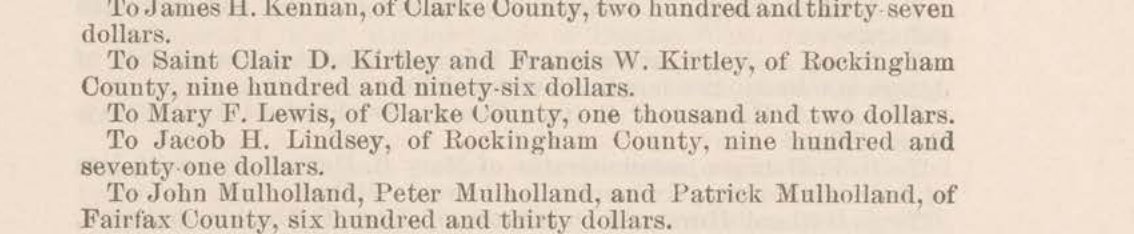
Detail of the 1899 act's entry for Mary F. Lewis of Clarke County: "one thousand and two dollars." This records an appropriation, not evidence that the Treasury paid it.
What this image does and does not showA detail of the printed appropriations list, not the whole page. The complete line for Mary F. Lewis is shown, along with four neighboring lines; the entries immediately before and after this group are excluded. The full printed page (Statutes at Large, p. 1185) is reproduced whole in this story's downloadable evidence packet (PDF page 6) and at the source link (PDF page 25).
United States Congress, Act of March 3, 1899, ch. 426, 30 Stat. 1185. Digital reproduction via govinfo, U.S. Government Publishing Office. Rights Changes: Extracted losslessly (its own embedded PNG image, byte for byte) from packet page 7 of the accepted Locust Grove evidence packet, itself a 200 dpi render of the rectangle (60,238) to (468,322) in PDF points on the source PDF's page 25 (packet page 6 reproduces that full source page). Not scaled, cropped again, sharpened, recolored or reconstructed; re-encoded as JPEG for the web derivative only.
Source: Act of March 3, 1899, ch. 426, 30 Stat. 1161: "An Act For the allowance of certain claims for stores and supplies reported by the Court of Claims under ... the Bowman Act" Open the full image
An open ending
The name, county, amount and route leave little doubt that this is the same claim. By then almost thirty-five years had passed since the horses were led away. Whether the Treasury paid the money, and to whom, has not been found.
Source note: United States Congress, 1899, and two more
The Mary F. Lewis of Clarke County in the 1899 act and the claimant in Court of Claims Congressional Case No. 5328 are very probably the same person and claim: the name, county and the exact $1,002 match, and the act lists her among claims allowed under the Bowman Act by the Court of Claims.
What the source supports
The join between the court case and the appropriation.
Uncertainty
The act cites no case number for any claimant, so the join rests on converging details rather than a shared identifier. No other Mary F. Lewis appears in the act.
Source
Evidence role: supports. Name, county and amount in the act.
Act of March 3, 1899, ch. 426, 30 Stat. 1161: "An Act For the allowance of certain claims for stores and supplies reported by the Court of Claims under ... the Bowman Act"
United States Congress · 1899-03-03 (creation)
Locator: Page 1185, Virginia list
Relevant passageTo Mary F. Lewis, of Clarke County, one thousand and two dollars.
Checked: Original inspected. A digital reproduction was inspected; no original has been handled.
Open sourceSource family: statutes-at-large-30-ch426. Multiple passages from one source are not independent witnesses.
Evidence role: supports. The $1,002 valuation in the case.
H. Misc. Doc. No. 44, 52d Cong., 1st Sess. (Serial Set 2959): Court of Claims findings, Congressional Case No. 5328, Mary F. (Francis) Lewis v. The United States (1892)
United States Court of Claims, transmitted to the House of Representatives · 1892-01-19 (publication)
Locator: Page 2, findings of fact
Relevant passageThere was taken from the claimant's farm in Clark County, Va., in 1864, stores and supplies, as above set forth, for the use of the Army, the reasonable value of which was $1,002. ... Filed December 7, 1891.
Checked: Original inspected. A digital reproduction was inspected; no original has been handled.
Open sourceSource family: court-of-claims-5328-lewis. Multiple passages from one source are not independent witnesses.
Evidence role: supports. The same name and county in the 1888 petition.
Congressional Record, 50th Cong., 1st Sess., vol. 19, part 6 (1888), House, page 5859: petitions
United States Congress · 1888-07 (publication)
Locator: Page 5859, House petitions, O'Ferrall entry
Relevant passageBy Mr. O'FERRALL: Petition of Mary F. Lewis, of Clarke County, Virginia, for reference of her claim to the Court of Claims—to the Committee on War Claims.
Checked: Original inspected. A digital reproduction was inspected; no original has been handled.
Open sourceSource family: congressional-record-1888-lewis-petition. Multiple passages from one source are not independent witnesses.
AI-assisted source check (Claude Opus 5.5) · 2026-09-23. How this project checks its sources
Two endings
The family remembers the ending differently. In Barry Lewis's telling, compensation of $1,925 was paid, and the family account connects it with a staircase and two bedrooms at Locust Grove, the stone and log house on Old Winchester Road that is now a contributing building in the Chapel Rural Historic District. The 1899 act appropriated $1,002. The federal records examined document that appropriation, but not its disbursement or its use for building work.
Source note: Barry H. Lewis, in Clarke Monthly, 2026, and two more
Barry H. Lewis’s 2026 family essay says Mary Frances filed a petition on September 20, 1888, that compensation of $1,925.00 was paid, and that she used the money to build an addition to the log part of the house: a staircase and two bedrooms.
What the source supports
That the family connects compensation with the staircase and bedrooms.
Uncertainty
The petition date and the $1,925 payment are the essay's statements and are not independently verified. The federal records examined document a $1,925 claim, a $1,002 valuation and a $1,002 appropriation, but no disbursement and no building work.
Source
Evidence role: supports. The essay's closing Civil War paragraph, read from the page image of printed p. 4.
Barry H. Lewis, "A Legacy Imperiled", guest essay, Clarke Monthly, September 2026, pages 4-5
Barry H. Lewis, in Clarke Monthly · 2026-09 (publication)
Locator: Page 4, "The Civil War", closing paragraph
Relevant passageMary Frances filed a petition on September 20, 1888, ... Her case was finally recognized and compensation of $1,925.00 was paid. It is with that money that Mary Frances built an addition to the log portion of the house. The addition consisted of a staircase and two bedrooms.
Checked: Original inspected. A digital reproduction was inspected; no original has been handled.
Open sourceSource family: lewis-family-account-2026. Multiple passages from one source are not independent witnesses.
Evidence role: complicates. The 1899 act appropriated $1,002, not $1,925.
Act of March 3, 1899, ch. 426, 30 Stat. 1161: "An Act For the allowance of certain claims for stores and supplies reported by the Court of Claims under ... the Bowman Act"
United States Congress · 1899-03-03 (creation)
Locator: Page 1185, Virginia list
Relevant passageTo Mary F. Lewis, of Clarke County, one thousand and two dollars.
Checked: Original inspected. A digital reproduction was inspected; no original has been handled.
Open sourceSource family: statutes-at-large-30-ch426. Multiple passages from one source are not independent witnesses.
Evidence role: complicates. The court valued the claim at $1,002; $1,925 is the total she claimed.
H. Misc. Doc. No. 44, 52d Cong., 1st Sess. (Serial Set 2959): Court of Claims findings, Congressional Case No. 5328, Mary F. (Francis) Lewis v. The United States (1892)
United States Court of Claims, transmitted to the House of Representatives · 1892-01-19 (publication)
Locator: Page 2, findings of fact
Relevant passageThere was taken from the claimant's farm in Clark County, Va., in 1864, stores and supplies, as above set forth, for the use of the Army, the reasonable value of which was $1,002. ... Filed December 7, 1891.
Checked: Original inspected. A digital reproduction was inspected; no original has been handled.
Open sourceSource family: court-of-claims-5328-lewis. Multiple passages from one source are not independent witnesses.
AI-assisted source check (Claude Opus 5.5) · 2026-09-23. How this project checks its sources
Source note: Barry H. Lewis, in Clarke Monthly, 2026, and one more
The essay identifies the claimant as Mary Frances (Bell) Lewis of Locust Grove, and the losses it lists match the court's summary of Mary F. Lewis's claim: two horses, 755 bushels of corn, 50 of wheat, three barrels of flour, 14 hogs, 15 sheep, 85 turkeys and 75 chickens, in August, November and December.
What the source supports
Why the court claimant and the woman of Locust Grove are taken to be the same.
Uncertainty
The connection to the house comes from the family account. The federal records do not name Locust Grove, Westbrook or her maiden name.
Source
Evidence role: supports. The essay's line of descent to Locust Grove.
Barry H. Lewis, "A Legacy Imperiled", guest essay, Clarke Monthly, September 2026, pages 4-5
Barry H. Lewis, in Clarke Monthly · 2026-09 (publication)
Locator: Page 4, family history and "The Civil War"
Relevant passageTheir daughter Mary Frances Bell married Thomas D. Lewis, and Locust Grove came into the Lewis family. ... My great-great grandmother, Mary Frances (Bell) Lewis, Thomas having died in 1862, had regular encounters with Union soldiers.
Checked: Original inspected. A digital reproduction was inspected; no original has been handled.
Open sourceSource family: lewis-family-account-2026. Multiple passages from one source are not independent witnesses.
Evidence role: supports. The essay's list of losses.
Barry H. Lewis, "A Legacy Imperiled", guest essay, Clarke Monthly, September 2026, pages 4-5
Barry H. Lewis, in Clarke Monthly · 2026-09 (publication)
Locator: Page 4, "The Civil War"
Relevant passageIn August, November, and December, ... supplies, grain, and livestock were taken. Two horses were taken. Seven hundred fifty-five bushels of corn, 50 bushels of wheat, and three barrels of flour were taken. Fourteen hogs, 15 sheep, 85 turkeys, and 75 chickens were confiscated.
Checked: Original inspected. A digital reproduction was inspected; no original has been handled.
Open sourceSource family: lewis-family-account-2026. Multiple passages from one source are not independent witnesses.
Evidence role: supports. The court's summary of the claimed items.
H. Misc. Doc. No. 44, 52d Cong., 1st Sess. (Serial Set 2959): Court of Claims findings, Congressional Case No. 5328, Mary F. (Francis) Lewis v. The United States (1892)
United States Court of Claims, transmitted to the House of Representatives · 1892-01-19 (publication)
Locator: Page 2, itemized schedule, 1864
Relevant passageAug. 11. One saddle and harness horse ... One strong work horse ... Aug. 14. Fourteen hogs ... Nov. 15. Fifteen sheep ... Seven hundred and twenty bushels corn ... Aug. 10, 11. Fifty bushels wheat ... Eighty-five turkeys ... Seventy-five chickens and other fowls ... Dec. 10. Three barrels family flour ... Thirty-five bushels corn ... 1,925.00
Checked: Original inspected. A digital reproduction was inspected; no original has been handled.
Open sourceSource family: court-of-claims-5328-lewis. Multiple passages from one source are not independent witnesses.
Evidence role: supports. Near Boyce, Clarke County.
H. Misc. Doc. No. 44, 52d Cong., 1st Sess. (Serial Set 2959): Court of Claims findings, Congressional Case No. 5328, Mary F. (Francis) Lewis v. The United States (1892)
United States Court of Claims, transmitted to the House of Representatives · 1892-01-19 (publication)
Locator: Page 2, allegations of the petition
Relevant passageThat she is a citizen of the United States, residing near Boyce, Clarke County, State of Virginia, where she resided during the late war of the rebellion; that at different times during said period the United States forces, by proper authority, took from your petitioner quartermaster stores and commissary supplies of the value of $1,925
Checked: Original inspected. A digital reproduction was inspected; no original has been handled.
Open sourceSource family: court-of-claims-5328-lewis. Multiple passages from one source are not independent witnesses.
AI-assisted source check (Claude Opus 5.5) · 2026-09-23. How this project checks its sources
Source note: Virginia Department of Historic Resources, 2013
The 2013 National Register nomination for the Chapel Rural Historic District records Locust Grove, 537 Old Winchester Road (DHR 021-0194), as a contributing vernacular dwelling that combines stone and log construction.
What the source supports
The house's recorded status in the historic district.
Uncertainty
District membership as a contributing resource, not an individual listing. The survey's 1810 date is an attribution, and the nomination says nothing about who paid for any part of the house.
Source
Evidence role: supports. The inventory entry.
Chapel Rural Historic District, National Register of Historic Places nomination, VDHR 021-5025 (2013)
Virginia Department of Historic Resources · 2013 (creation)
Locator: Section 7, pages 58-59, inventory
Relevant passage537 Old Winchester Road 021-0194 Other DHR Id #: 021-5025-0020 Primary Resource Information: Single Dwelling, Stories 2.00, Style: Vernacular, 1810 ... Individual Resource Status: Single Dwelling Contributing
Checked: Page text reviewed. Original image not independently inspected.
Open sourceSource family: dhr-021-5025-chapel-rural. Multiple passages from one source are not independent witnesses.
Evidence role: supports. The narrative's identification of Locust Grove and its construction.
Chapel Rural Historic District, National Register of Historic Places nomination, VDHR 021-5025 (2013)
Virginia Department of Historic Resources · 2013 (creation)
Locator: Section 7, page 9
Relevant passageThe J.B Lindsay House at New Market Farm (021-0043, 021-5025-1026) and Locust Grove (021-194; 021-5025-0020) also date from this era and combine stone and log construction.
Checked: Page text reviewed. Original image not independently inspected.
Open sourceSource family: dhr-021-5025-chapel-rural. Multiple passages from one source are not independent witnesses.
AI-assisted source check (Claude Opus 5.5) · 2026-09-23. How this project checks its sources
About the accountsWhat the evidence says
Three federal records for the claim, the valuation and the appropriation; a family essay for the rest. No payment record.
The claim, the court's loyalty finding and its $1,002 valuation come from the Court of Claims findings printed for the House in 1892, and the 1888 petition from the Congressional Record, all read from page images. The $1,002 appropriation comes from the act of March 3, 1899, whose entry for her was read from the page image. An appropriation is not a payment, and no payment record has been examined. The scene at the doorway, the September 20, 1888 petition date, the $1,925 payment and the staircase and bedrooms are Barry H. Lewis's family account, printed in 2026. The federal records do not name Locust Grove.
- An account exists✓ Supported by a source
Mary F. Lewis's petition, as the Court of Claims summarized it, said she lived near Boyce and that United States forces under Gen. P. H. Sheridan took quartermaster stores and commissary supplies from her Clarke County farm in 1864 worth $1,925.
See the evidence
✓ Supported by a sourceAn account existsMary F. Lewis's petition, as the Court of Claims summarized it, said she lived near Boyce and that United States forces under Gen. P. H. Sheridan took quartermaster stores and commissary supplies from her Clarke County farm in 1864 worth $1,925.
What the source supports
What she claimed, and how much.
Uncertainty
These are her allegations, not the court's findings. The court found a different value.
Source
Contemporary document Evidence role: supports. The allegation and its total.
H. Misc. Doc. No. 44, 52d Cong., 1st Sess. (Serial Set 2959): Court of Claims findings, Congressional Case No. 5328, Mary F. (Francis) Lewis v. The United States (1892)
United States Court of Claims, transmitted to the House of Representatives · 1892-01-19 (publication)
Locator: Page 2, allegations of the petition
Relevant passageThat she is a citizen of the United States, residing near Boyce, Clarke County, State of Virginia, where she resided during the late war of the rebellion; that at different times during said period the United States forces, by proper authority, took from your petitioner quartermaster stores and commissary supplies of the value of $1,925
Checked: Original inspected. A digital reproduction was inspected; no original has been handled.
Open sourceSource family: court-of-claims-5328-lewis. Multiple passages from one source are not independent witnesses.
Contemporary document Evidence role: supports. Sheridan's forces and her farm.
H. Misc. Doc. No. 44, 52d Cong., 1st Sess. (Serial Set 2959): Court of Claims findings, Congressional Case No. 5328, Mary F. (Francis) Lewis v. The United States (1892)
United States Court of Claims, transmitted to the House of Representatives · 1892-01-19 (publication)
Locator: Page 2, after the schedule
Relevant passageAll of the above property was taken by and for the use of the United States armies, commanded by Gen. P. H. Sheridan, from claimant's farm, in Clarke County, Va.
Checked: Original inspected. A digital reproduction was inspected; no original has been handled.
Open sourceSource family: court-of-claims-5328-lewis. Multiple passages from one source are not independent witnesses.
AI-assisted source check (Claude Opus 5.5) · 2026-09-23. How this project checks its sources
- That it was so✓ Documented
On December 7, 1891, the Court of Claims found that stores and supplies had been taken from the claimant's farm in Clarke County in 1864 for the use of the Army, and that their reasonable value was $1,002.
See the evidence
✓ DocumentedThat it was soOn December 7, 1891, the Court of Claims found that stores and supplies had been taken from the claimant's farm in Clarke County in 1864 for the use of the Army, and that their reasonable value was $1,002.
What the source supports
The court valuation, distinct from both the claim and any payment.
Uncertainty
A finding of value reported to Congress. It is not an award paid and not a payment.
Source
Contemporary document Evidence role: supports. The finding of fact and its filing date.
H. Misc. Doc. No. 44, 52d Cong., 1st Sess. (Serial Set 2959): Court of Claims findings, Congressional Case No. 5328, Mary F. (Francis) Lewis v. The United States (1892)
United States Court of Claims, transmitted to the House of Representatives · 1892-01-19 (publication)
Locator: Page 2, findings of fact
Relevant passageThere was taken from the claimant's farm in Clark County, Va., in 1864, stores and supplies, as above set forth, for the use of the Army, the reasonable value of which was $1,002. ... Filed December 7, 1891.
Checked: Original inspected. A digital reproduction was inspected; no original has been handled.
Open sourceSource family: court-of-claims-5328-lewis. Multiple passages from one source are not independent witnesses.
AI-assisted source check (Claude Opus 5.5) · 2026-09-23. How this project checks its sources
- That it was so✓ Documented
The act of March 3, 1899, chapter 426, directed the Secretary of the Treasury to pay "Mary F. Lewis, of Clarke County, one thousand and two dollars," in full and final release of her claim.
See the evidence
✓ DocumentedThat it was soThe act of March 3, 1899, chapter 426, directed the Secretary of the Treasury to pay "Mary F. Lewis, of Clarke County, one thousand and two dollars," in full and final release of her claim.
What the source supports
That $1,002 was appropriated to her.
Uncertainty
An appropriation authorizes and directs payment; it does not show that money was paid, when, to whom, or net of any attorney's fee. No Treasury payment record has been examined.
Source
Contemporary document Evidence role: supports. Her entry in the Virginia list, read from the page image.
Act of March 3, 1899, ch. 426, 30 Stat. 1161: "An Act For the allowance of certain claims for stores and supplies reported by the Court of Claims under ... the Bowman Act"
United States Congress · 1899-03-03 (creation)
Locator: Page 1185, Virginia list
Relevant passageTo Mary F. Lewis, of Clarke County, one thousand and two dollars.
Checked: Original inspected. A digital reproduction was inspected; no original has been handled.
Open sourceSource family: statutes-at-large-30-ch426. Multiple passages from one source are not independent witnesses.
Contemporary document Evidence role: supports. The direction to pay and the full-and-final-release terms.
Act of March 3, 1899, ch. 426, 30 Stat. 1161: "An Act For the allowance of certain claims for stores and supplies reported by the Court of Claims under ... the Bowman Act"
United States Congress · 1899-03-03 (creation)
Locator: Page 1161, enacting clause
Relevant passageThat the Secretary of the Treasury be, and he is hereby, authorized and directed to pay, out of any money in the Treasury not otherwise appropriated, to claimants in this Act named the several sums appropriated herein, the same being in full for, and the receipt of the same to be taken and accepted in each case as a full and final release and discharge of their respective claims
Checked: Original inspected. A digital reproduction was inspected; no original has been handled.
Open sourceSource family: statutes-at-large-30-ch426. Multiple passages from one source are not independent witnesses.
Contemporary document Evidence role: contextualizes. Where payment was to go if a claimant had died.
Act of March 3, 1899, ch. 426, 30 Stat. 1161: "An Act For the allowance of certain claims for stores and supplies reported by the Court of Claims under ... the Bowman Act"
United States Congress · 1899-03-03 (creation)
Locator: Pages 1213-1214, closing provisions
Relevant passageIn case of the death of any claimant, or death or discharge of any executor or administrator of any claimant herein named, then payment of such claim as herein provided shall be made to the legal representatives
Checked: Original inspected. A digital reproduction was inspected; no original has been handled.
Open sourceSource family: statutes-at-large-30-ch426. Multiple passages from one source are not independent witnesses.
AI-assisted source check (Claude Opus 5.5) · 2026-09-23. How this project checks its sources
- An account exists✓ Supported by a source
Barry H. Lewis’s 2026 family essay says Mary Frances filed a petition on September 20, 1888, that compensation of $1,925.00 was paid, and that she used the money to build an addition to the log part of the house: a staircase and two bedrooms.
See the evidence
✓ Supported by a sourceAn account existsBarry H. Lewis’s 2026 family essay says Mary Frances filed a petition on September 20, 1888, that compensation of $1,925.00 was paid, and that she used the money to build an addition to the log part of the house: a staircase and two bedrooms.
What the source supports
That the family connects compensation with the staircase and bedrooms.
Uncertainty
The petition date and the $1,925 payment are the essay's statements and are not independently verified. The federal records examined document a $1,925 claim, a $1,002 valuation and a $1,002 appropriation, but no disbursement and no building work.
Source
Later historical account Evidence role: supports. The essay's closing Civil War paragraph, read from the page image of printed p. 4.
Barry H. Lewis, "A Legacy Imperiled", guest essay, Clarke Monthly, September 2026, pages 4-5
Barry H. Lewis, in Clarke Monthly · 2026-09 (publication)
Locator: Page 4, "The Civil War", closing paragraph
Relevant passageMary Frances filed a petition on September 20, 1888, ... Her case was finally recognized and compensation of $1,925.00 was paid. It is with that money that Mary Frances built an addition to the log portion of the house. The addition consisted of a staircase and two bedrooms.
Checked: Original inspected. A digital reproduction was inspected; no original has been handled.
Open sourceSource family: lewis-family-account-2026. Multiple passages from one source are not independent witnesses.
Contemporary document Evidence role: complicates. The 1899 act appropriated $1,002, not $1,925.
Act of March 3, 1899, ch. 426, 30 Stat. 1161: "An Act For the allowance of certain claims for stores and supplies reported by the Court of Claims under ... the Bowman Act"
United States Congress · 1899-03-03 (creation)
Locator: Page 1185, Virginia list
Relevant passageTo Mary F. Lewis, of Clarke County, one thousand and two dollars.
Checked: Original inspected. A digital reproduction was inspected; no original has been handled.
Open sourceSource family: statutes-at-large-30-ch426. Multiple passages from one source are not independent witnesses.
Contemporary document Evidence role: complicates. The court valued the claim at $1,002; $1,925 is the total she claimed.
H. Misc. Doc. No. 44, 52d Cong., 1st Sess. (Serial Set 2959): Court of Claims findings, Congressional Case No. 5328, Mary F. (Francis) Lewis v. The United States (1892)
United States Court of Claims, transmitted to the House of Representatives · 1892-01-19 (publication)
Locator: Page 2, findings of fact
Relevant passageThere was taken from the claimant's farm in Clark County, Va., in 1864, stores and supplies, as above set forth, for the use of the Army, the reasonable value of which was $1,002. ... Filed December 7, 1891.
Checked: Original inspected. A digital reproduction was inspected; no original has been handled.
Open sourceSource family: court-of-claims-5328-lewis. Multiple passages from one source are not independent witnesses.
AI-assisted source check (Claude Opus 5.5) · 2026-09-23. How this project checks its sources
Each statement above is assessed on its own evidence. Nothing here is averaged, scored or voted on, and a well-attributed account can be documented while what it describes stays unconfirmed.
What this story does not say
It does not say the Treasury paid Mary F. Lewis: the 1899 act appropriated $1,002, and no payment record has been examined. It does not treat the family's $1,925 as the sum paid, or the appropriation as the source of the staircase and bedrooms. It does not treat September 20, 1888 as a verified filing date; that date is the family essay's. And the federal records do not name Locust Grove. The connection to the house rests on the family account, together with a matching name, place, total and list of losses.
Did the Treasury pay the $1,002, and to whom?
Know more about this story, or see something to correct? Help fill a gap. It stays private until it is reviewed.
Remember this place or someone in this story? Share a memory, even if you do not know the date. It stays private until it is reviewed.
Go deeper: every source under this story Follow another threadAlec Cary: a killing on the turnpike
Another Clarke County story from the 1860s, told from what its record does and does not say. An editorial connection, not a personal one.