
The companies
The roll of Clarke's veterans on this site lists 943 people who served in the Civil War. The Clarke Courier printed their reunions and, into the 1920s, their death notices.
Berryville's company was organized in October 1859 as the Clarke Guards and helped guard the Charles Town prison until John Brown and his men were executed, a 1948 column by Everard Kidder Meade says. Reorganized as the Clarke Rifles, it served the four years of the war in the Stonewall Brigade as Co. I, 2nd Virginia Infantry. The county's horsemen rode as the Clarke Cavalry in the 6th Virginia. Isaac Bonham "went out at the age of 16 with the first volunteers," a private in that company, his death notice said in 1883.
Source note: Everard Kidder Meade, 1958
The Clarke County Historical Association's Proceedings (1958), reprinting a 1948 column by Everard Kidder Meade, say the Berryville company was organized in October 1859 as the Clarke Guards, helped guard the Charles Town prison until John Brown and his men were executed, and was reorganized as the Clarke Rifles, which served the four years of the war in the Stonewall Brigade as Co. I, 2nd Virginia Infantry.
What the source supports
A local historian's account of how the Clarke Rifles began.
Uncertainty
Written in 1948 and printed in 1958; it cites no record of the Clarke Guards. Its claim that the company "prevented the escape of two of Brown's men" is not checked here.
Source
Evidence role: supports. The Clarke Guards of 1859.
Everard Kidder Meade, "Notes on the History of the Lower Shenandoah Valley," Proceedings of the Clarke County Historical Association, vol. XIV (1956-1957), pp. 70 and 72
Everard Kidder Meade; Clarke County Historical Association · 1958 (publication)
Locator: Page 70, "Berryville Company"
Relevant passageUntil the execution of John Brown and his captured associates, this company, organized in October 1859 as Clarke Guards, took part in guarding Charles Town prison and prevented the escape of two of Brown's men.
Checked: Original inspected. A digital reproduction was inspected; no original has been handled.
Open sourceSource family: ccha-proceedings. Multiple passages from one source are not independent witnesses.
Evidence role: supports. Reorganized as the Clarke Rifles, Co. I.
Everard Kidder Meade, "Notes on the History of the Lower Shenandoah Valley," Proceedings of the Clarke County Historical Association, vol. XIV (1956-1957), pp. 70 and 72
Everard Kidder Meade; Clarke County Historical Association · 1958 (publication)
Locator: Page 70, "Berryville Company"
Relevant passageReorganized later as Clarke Rifles, It went through four years of war in the Stonewall Brigade as Co. I, 2nd Va. Inf., C.S.A.
Checked: Original inspected. A digital reproduction was inspected; no original has been handled.
Open sourceSource family: ccha-proceedings. Multiple passages from one source are not independent witnesses.
AI-assisted source check (Claude Opus 5.5) · 2026-10-12. How this project checks its sources
Source note: Clarke Courier, Berryville, Va., 1883
Isaac Bonham's death notice, which the Clarke Courier reprinted from the Vicksburg Herald in 1883, says he "went out at the age of 16 with the first volunteers," a private in the Clarke Cavalry, 6th Virginia; that he served as "special courier to Stonewall Jackson"; and that he was captured and "for a long time lingered in prison."
What the source supports
What the notice says of his service.
Uncertainty
The age and the courier service are the notice's, written about twenty years after the war.
Source
Evidence role: contextualizes. The Courier's reprint of the Herald.
Clarke Courier, Berryville, Va., September 6, 1883, page 3: "Death of Mr. Isaac Bonham," reprinting the Vicksburg Herald of August 14
Clarke Courier, Berryville, Va. · 1883-09-06 (publication)
Locator: Page 3, "Death of Mr. Isaac Bonham"
Relevant passageWe take the following account of the death of Isaac Bonham from the Vicksburg Herald of August 14th:
Checked: Original inspected. A digital reproduction was inspected; no original has been handled.
Open sourceSource family: clarke-courier. Multiple passages from one source are not independent witnesses.
Evidence role: supports. Sixteen, with the first volunteers.
Clarke Courier, Berryville, Va., September 6, 1883, page 3: "Death of Mr. Isaac Bonham," reprinting the Vicksburg Herald of August 14
Clarke Courier, Berryville, Va. · 1883-09-06 (publication)
Locator: Page 3, "Death of Mr. Isaac Bonham"
Relevant passageHe went out at the age of 16 with the first volunteers that enlisted for the war from his native State, and entered the army as a private in the celebrated Clarke Cavalry, 6th Virginia, and served with distinction during the entire continuance of the hostilities.
Checked: Original inspected. A digital reproduction was inspected; no original has been handled.
Open sourceSource family: clarke-courier. Multiple passages from one source are not independent witnesses.
Evidence role: supports. Courier to Jackson; prison.
Clarke Courier, Berryville, Va., September 6, 1883, page 3: "Death of Mr. Isaac Bonham," reprinting the Vicksburg Herald of August 14
Clarke Courier, Berryville, Va. · 1883-09-06 (publication)
Locator: Page 3, "Death of Mr. Isaac Bonham"
Relevant passageHe was for a long time during that period engaged as special courier to Stonewall Jackson, a trying and dangerous post, which called for the exercises of the highest qualities of coolness, daring and bravery. He was captured and for a long time lingered in prison
Checked: Original inspected. A digital reproduction was inspected; no original has been handled.
Open sourceSource family: clarke-courier. Multiple passages from one source are not independent witnesses.
AI-assisted source check (Claude Opus 5.5) · 2026-10-12. How this project checks its sources
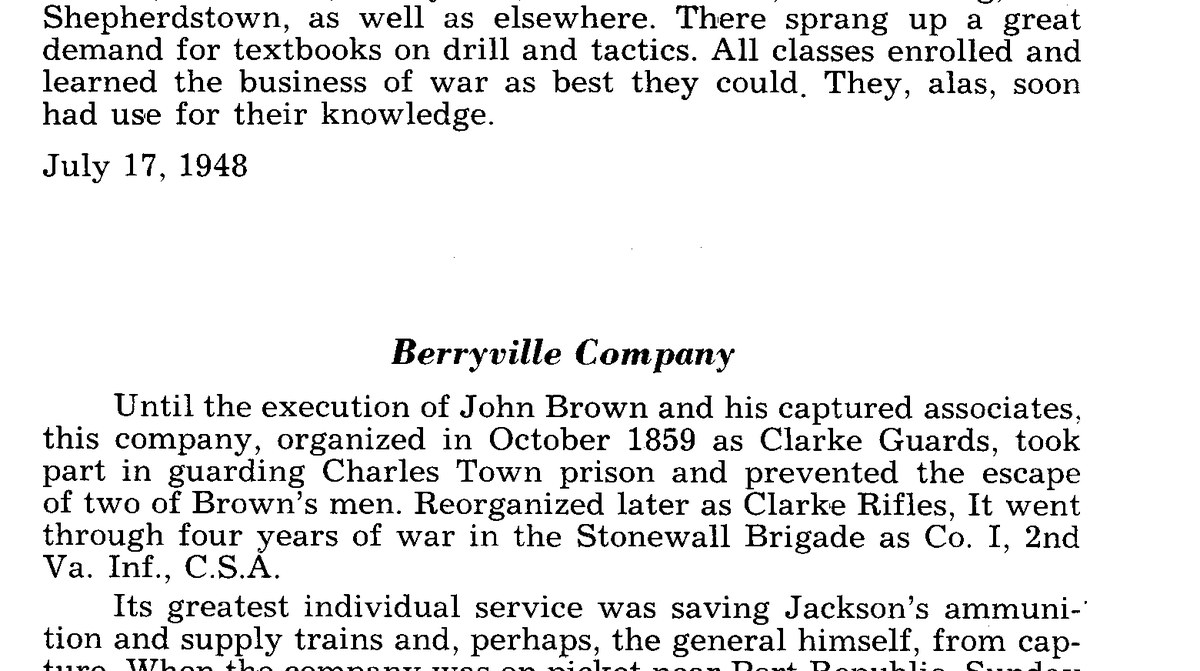
"Berryville Company": Everard Kidder Meade's 1948 column on the Clarke Guards of 1859 and the Clarke Rifles at Port Republic, as the Clarke County Historical Association reprinted it in 1958.
What this image does and does not showA crop of part of one page; the rest of the page is not shown.
Proceedings of the Clarke County Historical Association, vol. XIV (1956-1957), p. 70. Wayback Machine copy of the Association's scan. Rights Changes: Rendered from PDF page 81 of the scan at 1725 pixels wide, cropped to the article (1560 by 872 pixels) and scaled to 1200 by 671; re-encoded as JPEG. Nothing retouched or added.
Source: Everard Kidder Meade, "Notes on the History of the Lower Shenandoah Valley," Proceedings of the Clarke County Historical Association, vol. XIV (1956-1957), pp. 70 and 72 Open the full image
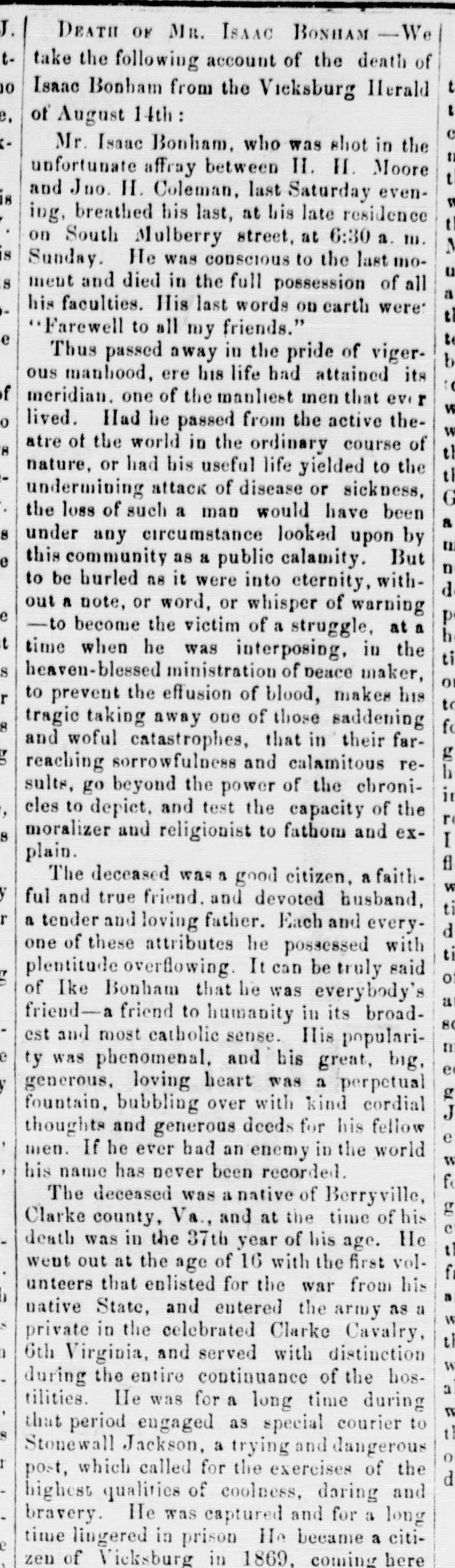
The Courier reprints the Vicksburg Herald: Isaac Bonham, who "went out at the age of 16 with the first volunteers."
What this image does and does not showA crop of part of one page; the rest of the page is not shown.
Clarke Courier (Berryville, Va.), September 6, 1883, page 3. Library of Congress, Chronicling America. Rights Changes: Cropped from the Library of Congress page image to the region of this item: 851 by 2935 pixels, shown at its own 851 by 2935 pixels; re-encoded as JPEG. Nothing retouched or added.
Source: Clarke Courier, Berryville, Va., September 6, 1883, page 3: "Death of Mr. Isaac Bonham," reprinting the Vicksburg Herald of August 14 Open the full image
In battle
On picket near Port Republic on June 8, 1862, Capt. S. J. C. Moore of the Clarke Rifles was warned by Henry Kerfoot of the Clarke Cavalry that Union cavalry was coming. Moore sent Kerfoot on to warn Jackson and placed the company so that it held the enemy until help came, Meade's column says.
At Brandy Station on June 9, 1863, Lieut. R. O. Allen of the Clarke Cavalry, with one load left in his pistol, came up behind Col. B. F. Davis of the 8th New York Cavalry. Davis "made a vicious stroke at Lieutenant Allen with his sword"; Allen fired, and Davis "fell dead from his horse," Gold's 1914 history of Clarke County says. Nicholas Moore, in the woods with Allen, was badly wounded by a pistol shot but kept his seat and was brought off the field. Allen was wounded that day too; his service record, for September and October 1864, carries him "Absent sick wounded in action June 9, 1863 Brandy Station." Thomas H. Shearer of the Nelson Rifles was severely wounded at Gettysburg, his 1899 notice says.
Source note: Everard Kidder Meade, 1958
Meade's column says that on picket near Port Republic on Sunday morning, June 8, 1862, the company's Capt. S. J. C. Moore, warned by Henry Kerfoot of the Clarke Cavalry that Union cavalry was coming, sent Kerfoot on to warn Jackson and placed Co. I so that it held the enemy until help came.
What the source supports
The column's account of the company at Port Republic.
Uncertainty
A 1948 account; the column calls this the company's greatest service and says it may have saved Jackson himself, which is its judgment.
Source
Evidence role: supports. Kerfoot's warning.
Everard Kidder Meade, "Notes on the History of the Lower Shenandoah Valley," Proceedings of the Clarke County Historical Association, vol. XIV (1956-1957), pp. 70 and 72
Everard Kidder Meade; Clarke County Historical Association · 1958 (publication)
Locator: Page 70, "Berryville Company"
Relevant passageWhen the company was on picket near Port Republic, Sunday morning, June 8, 1862, Henry Kerfoot of the Clarke Cavalry dashed up to Capt. S. J. C. Moore with the news that Union cavalry with fieldpieces was approaching at full gallop.
Checked: Original inspected. A digital reproduction was inspected; no original has been handled.
Open sourceSource family: ccha-proceedings. Multiple passages from one source are not independent witnesses.
Evidence role: supports. Moore's orders.
Everard Kidder Meade, "Notes on the History of the Lower Shenandoah Valley," Proceedings of the Clarke County Historical Association, vol. XIV (1956-1957), pp. 70 and 72
Everard Kidder Meade; Clarke County Historical Association · 1958 (publication)
Locator: Page 70, "Berryville Company"
Relevant passageMoore, later promoted to lieutenant colonel, instantly ordered Kerfoot to warn Jackson, then disposed Co. I so advantageously that it was able to check the enemy until help came.
Checked: Original inspected. A digital reproduction was inspected; no original has been handled.
Open sourceSource family: ccha-proceedings. Multiple passages from one source are not independent witnesses.
AI-assisted source check (Claude Opus 5.5) · 2026-10-12. How this project checks its sources
Source note: Compiled service record of Robert O. Allen
A muster-roll card in the same record for Sept and Oct 1864 reads "R. O. Allen, 2 Lieut, Co. D, 6 Reg't Virginia Cavalry" and carries him absent: "Absent sick wounded in action June 9, 1863 Brandy Station."
What the source supports
That the company still carried 2nd Lieut. R. O. Allen absent in the autumn of 1864, wounded at Brandy Station on June 9, 1863.
Uncertainty
The cards are the War Department’s later abstracts, not the original records. No card read here says that the man on it is the Robert O. Allen of Gold’s Clarke Cavalry roll: the link rests on the name, rank and Company D of the 6th Virginia Cavalry. The passage was read on the saved file and twice on the crop, the second time independently. Nothing beyond the quoted passage was read from the card. No human historian has reviewed this claim.
Source
Evidence role: supports. Supports what the cited card says (RECORD label); it does not by itself establish that the man is the Robert O. Allen of Gold’s roll. See limits.
Compiled service record of Robert O. Allen, Co. D, 6th Virginia Cavalry (Confederate), NARA M324, roll 62, as viewed on Fold3
U.S. War Department (compiled service records of Confederate soldiers), National Archives microfilm publication M324
Locator: NARA M324 roll 62, Robert O. Allen, Co. D, 6th Virginia Cavalry, image 11 of 34 (Fold3 image id 7947463), muster-roll card for Sept and Oct 1864
Relevant passageR. O. Allen, 2 Lieut, Co. D, 6 Reg't Virginia Cavalry. Appears on Company Muster Roll of the organization named above, for Sept & Oct, 1864. Present or absent: Absent. Remarks: Absent sick wounded in action June 9, 1863 Brandy Station.
Checked: Original inspected. A digital reproduction was inspected; no original has been handled.
Open sourceSource family: nara-m324-allen-robert-owen-co-d-6th-va-cav. Multiple passages from one source are not independent witnesses.
AI-assisted source check (Claude Opus 5.5) · 2026-10-13. How this project checks its sources
Source note: Thomas D. Gold, 1914
Gold’s 1914 history of Clarke County, in its account of the fighting on the road from Beverly’s Ford by St. James church to Brandy Station (printed pp. 267-269), says that Lieut. R. O. Allen of the Clarke Cavalry, with one load left in his pistol, came up behind Col. B. F. Davis of the 8th New York Cavalry; that Davis "made a vicious stroke at Lieutenant Allen with his sword"; and that Allen, throwing himself on the side of his horse, "fired his remaining shot at Davis with an aim so true that he fell dead from his horse and Allen galloped off unharmed."
What the source supports
What Gold’s history says of Lieut. R. O. Allen and Col. B. F. Davis at Brandy Station.
Uncertainty
Gold wrote in 1914, about fifty years after the battle; this is his account, and no record read here describes the encounter otherwise. The passage was read on the page image of the hosted digital reproduction. No human historian has reviewed this claim.
Source
Evidence role: supports. Names Lieut. R. O. Allen of the Clarke Cavalry and Col. B. F. Davis.
History of Clarke County, Virginia and its connection with the war between the states
Thomas D. Gold · 1914 (publication)
Locator: Printed p. 268, PDF p. 298 of the hosted copy, battle narrative naming Lieut. R. O. Allen
Relevant passageamong them Lieut. R. O. Allen, of the Clarke Cavalry, whose attention was attracted to Col. B. F. Davis, of the 8th New York Cavalry, that day in command of the brigade
Checked: This passage was read on a digital reproduction of the page; no original has been handled. The source's other readings: existing OCR reviewed, original image not independently inspected.
Open sourceSource family: gold-1914. Multiple passages from one source are not independent witnesses.
Evidence role: supports. The last load and Davis’ sword stroke.
History of Clarke County, Virginia and its connection with the war between the states
Thomas D. Gold · 1914 (publication)
Locator: Printed p. 268, PDF p. 298 of the hosted copy, Lieut. R. O. Allen and Col. B. F. Davis
Relevant passageLieutenant Allen had shot from his pistol all but one load. [...] Colonel Davis, perceiving his danger, made a vicious stroke at Lieutenant Allen with his sword.
Checked: This passage was read on a digital reproduction of the page; no original has been handled. The source's other readings: existing OCR reviewed, original image not independently inspected.
Open sourceSource family: gold-1914. Multiple passages from one source are not independent witnesses.
Evidence role: supports. The last shot, as Gold tells it.
History of Clarke County, Virginia and its connection with the war between the states
Thomas D. Gold · 1914 (publication)
Locator: Printed p. 269, PDF p. 301 of the hosted copy, Allen’s last shot
Relevant passageThrowing himself quickly on the side of his horse, the sweep of Davis’ sword passed over him and in an instant Allen fired his remaining shot at Davis with an aim so true that he fell dead from his horse and Allen galloped off unharmed.
Checked: This passage was read on a digital reproduction of the page; no original has been handled. The source's other readings: existing OCR reviewed, original image not independently inspected.
Open sourceSource family: gold-1914. Multiple passages from one source are not independent witnesses.
Evidence role: supports. Places the fight on the road from Beverly’s Ford by St. James church to Brandy Station.
History of Clarke County, Virginia and its connection with the war between the states
Thomas D. Gold · 1914 (publication)
Locator: Printed p. 267, PDF p. 297 of the hosted copy, the road from Beverly’s Ford to Brandy Station
Relevant passagesuddenly, a little before daybreak, began the fording of the Rappahannock at Beverly’s Ford [...] the road, a narrow one, led through the hills overlooking the river, and thence on by way of St. James church to Brandy Station.
Checked: This passage was read on a digital reproduction of the page; no original has been handled. The source's other readings: existing OCR reviewed, original image not independently inspected.
Open sourceSource family: gold-1914. Multiple passages from one source are not independent witnesses.
AI-assisted source check (Claude Opus 5.5) · 2026-10-13. How this project checks its sources
Source note: Thomas D. Gold, 1914
Gold’s account of Brandy Station (printed p. 269) says that "One of the men in the woods with Lieutenant Allen was Nicholas Moore, of the Clarke Cavalry, who received a very severe wound from a pistol shot," fell forward on his horse, kept his seat, and was brought off the field.
What the source supports
That Gold’s history names Nicholas Moore of the Clarke Cavalry as severely wounded at Brandy Station.
Uncertainty
Gold wrote in 1914, about fifty years after the battle; this is his account, and no record read here describes the encounter otherwise. The passage was read on the page image of the hosted digital reproduction. No human historian has reviewed this claim.
Source
Evidence role: supports. Nicholas Moore wounded, as Gold tells it.
History of Clarke County, Virginia and its connection with the war between the states
Thomas D. Gold · 1914 (publication)
Locator: Printed p. 269, PDF p. 301 of the hosted copy, Nicholas Moore wounded
Relevant passageOne of the men in the woods with Lieutenant Allen was Nicholas Moore, of the Clarke Cavalry, who received a very severe wound from a pistol shot which caused him to fall forward on his horse and to loose control of it.
Checked: This passage was read on a digital reproduction of the page; no original has been handled. The source's other readings: existing OCR reviewed, original image not independently inspected.
Open sourceSource family: gold-1914. Multiple passages from one source are not independent witnesses.
AI-assisted source check (Claude Opus 5.5) · 2026-10-13. How this project checks its sources
Source note: Clarke Courier, Berryville, Va., 1899
Thomas H. Shearer served in the Nelson Rifles, Second Virginia Regiment, Stonewall Brigade, and was severely wounded at the battle of Gettysburg, his 1899 death notice says.
What the source supports
Shearer's company and his wound at Gettysburg.
Uncertainty
The notice names the battle, not its date. Read on the page image of the Library of Congress digital reproduction. No human historian has reviewed this claim.
Source
Evidence role: supports. Page 3, "Death of T. H. Shearer".
Clarke Courier, Berryville, Va., June 28, 1899, page 3: "Death of T. H. Shearer"
Clarke Courier, Berryville, Va. · 1899-06-28 (publication)
Locator: Page 3, "Death of T. H. Shearer"
Relevant passageDuring the civil war he served in the Confederate army as a member of Nelson Rifles, Second Virginia Regiment, Stonewall Brigade. Mr. Shearer was severely wounded at the battle of Gettysburg.
Checked: Original inspected. A digital reproduction was inspected; no original has been handled.
Open sourceSource family: clarke-courier. Multiple passages from one source are not independent witnesses.
AI-assisted source check (Claude Opus 5.5) · 2026-10-14. How this project checks its sources
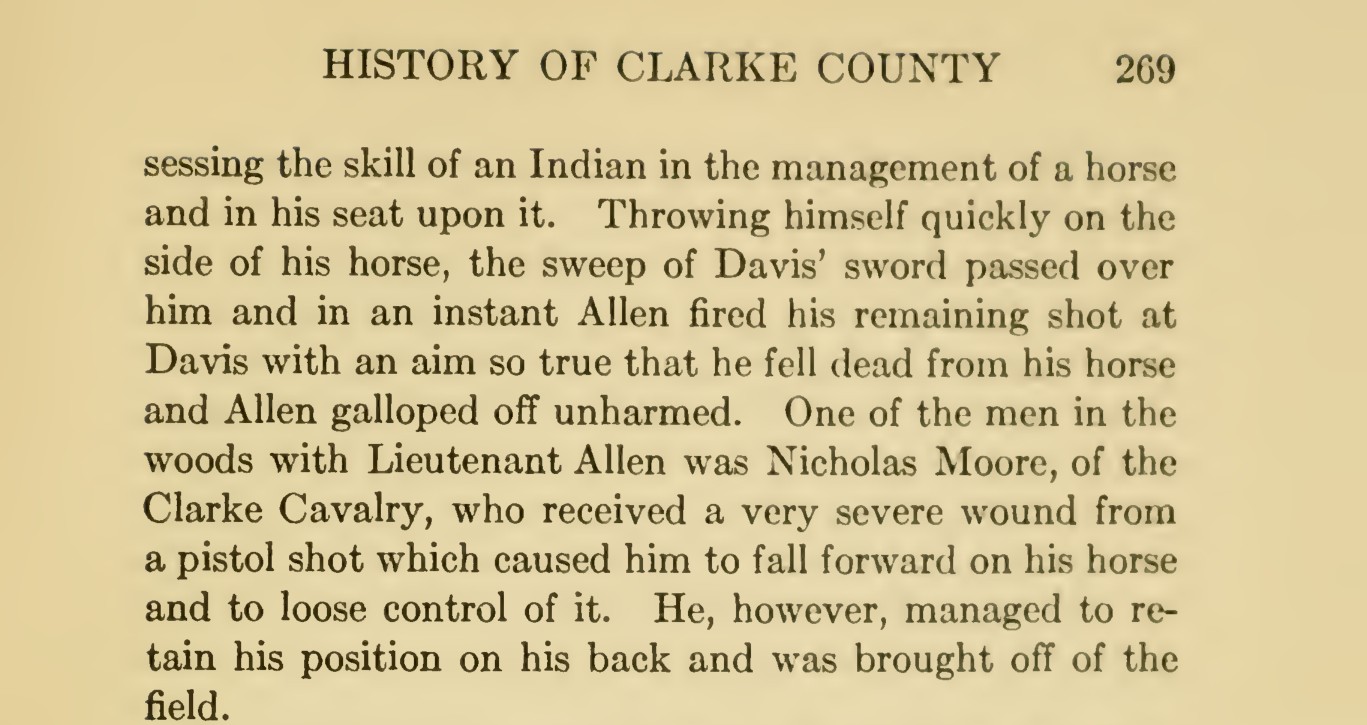
Gold’s account goes on: Allen’s last shot, and Nicholas Moore of the Clarke Cavalry wounded beside him.
What this image does and does not showA crop of part of one printed page; the rest of the page and the book is not shown.
Thomas D. Gold, History of Clarke County, Virginia (1914), p. 269. Rights Changes: Cropped to the running head and the first paragraph (box 0,170 1367x725 pixels) from a 300 dpi render of PDF p. 301 of the hosted copy; re-encoded as JPEG. Not retouched or enhanced.
Source: History of Clarke County, Virginia and its connection with the war between the states Open the full image
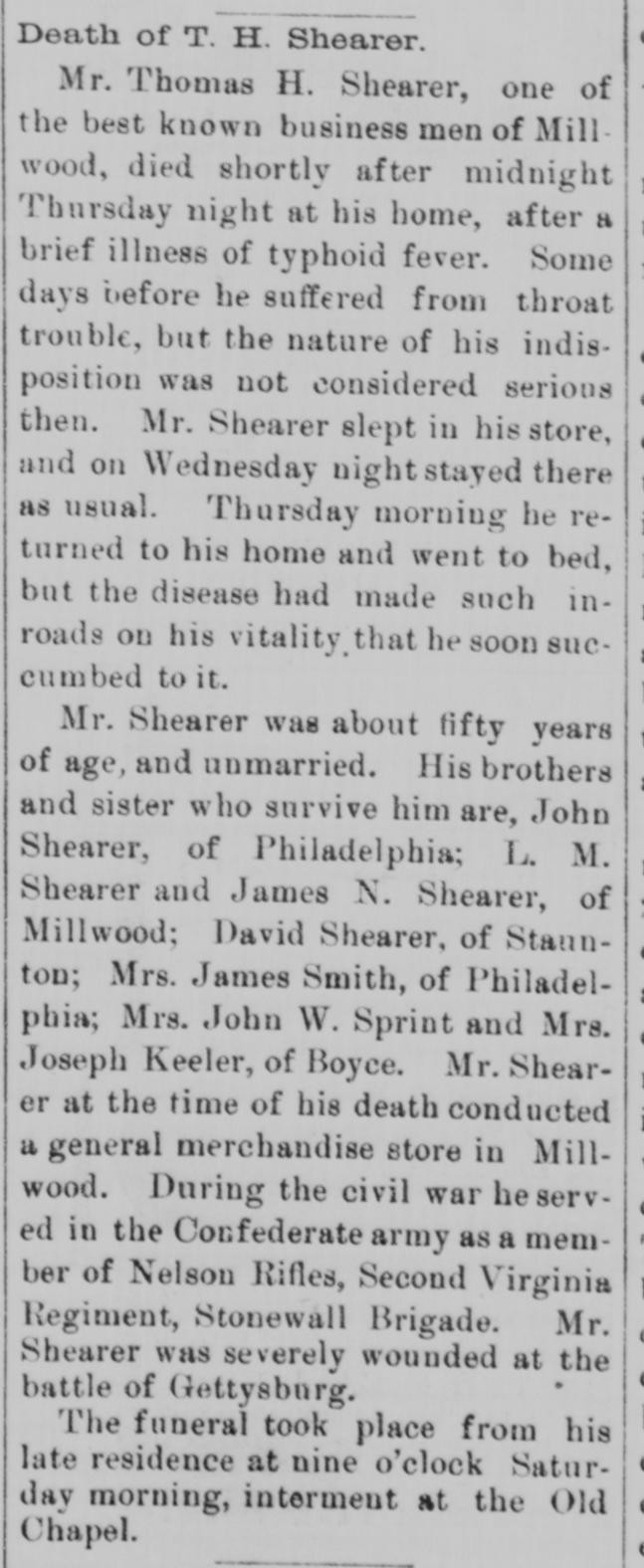
"Death of T. H. Shearer": a Millwood merchant who "was severely wounded at the battle of Gettysburg."
What this image does and does not showA crop of part of one page; the rest of the page is not shown.
Clarke Courier (Berryville, Va.), June 28, 1899, page 3. Library of Congress, Chronicling America. Rights Changes: Cropped from the Library of Congress page image (a region fetched at 60 percent scale) to the notice "Death of T. H. Shearer": 647 by 1576 pixels, shown at its own 647 by 1576 pixels; re-encoded as JPEG. Nothing retouched or added.
Source: Clarke Courier, Berryville, Va., June 28, 1899, page 3: "Death of T. H. Shearer" Open the full image
In prison
Clarke men who were captured were held in Northern prisons. John C. Rutherford, color-bearer of Co. F, 52nd Virginia, was taken at Cold Harbor and held at Elmira, New York; his 1923 tribute retells his stories of bunking with a smallpox patient and of holding his washing while it dried so no one would steal it. Dilmon Estep, captured at Spotsylvania Court House, worked as a carpenter around the prison at Fort Delaware; in 1867 he came to Clarke, where he built barns and houses and the old white schoolhouse at Millwood.
John O. Crown, editor of the Courier, had been a prisoner at Point Lookout. His pamphlet, "A Chapter of Prison Life in a Northern Prison," was praised by a correspondent in 1900.
Source note: Clarke Courier, 1923
John C. Rutherford, color-bearer of Co. F, 52nd Virginia, was captured at Cold Harbor and held at Elmira, New York, until the war ended; his 1923 tribute retells his stories of bunking with a smallpox patient, holding his washing while it dried so no one would steal it, and trading the whiskey ration for ditch-digging for bread and meat.
What the source supports
Rutherford's prison stories, as he told them.
Uncertainty
His own stories, retold in a tribute after his death; the unit is from the same tribute.
Source
Evidence role: supports. Color-bearer, Co. F, 52nd Va.
Clarke Courier, Berryville, Va., March 1, 1923
Clarke Courier · 1923-03-01 (publication)
Locator: Page 4, the tribute to John C. Rutherford
Relevant passageAt the outbreak of the civil war Mr. Rutherford joined Capt. James Bumgardner's Company (F) in the 52nd Regt. Virginia Volunteers, and was later made color bearer and a corporal.
Checked: This passage was read on a digital reproduction of the page; no original has been handled. The source's other readings: existing OCR reviewed, original image not independently inspected.
Open sourceSource family: clarke-courier. Multiple passages from one source are not independent witnesses.
Evidence role: supports. Captured and held at Elmira.
Clarke Courier, Berryville, Va., March 1, 1923
Clarke Courier · 1923-03-01 (publication)
Locator: Page 4, the tribute to John C. Rutherford
Relevant passageMr. Rutherford was captured at the Battle of Cold Harbor on May 30th and taken to Elmire [sic], N. Y., whene [sic] he was held a prisoner of war until the war was over.
Checked: This passage was read on a digital reproduction of the page; no original has been handled. The source's other readings: existing OCR reviewed, original image not independently inspected.
Open sourceSource family: clarke-courier. Multiple passages from one source are not independent witnesses.
Evidence role: supports. The smallpox bunkmate.
Clarke Courier, Berryville, Va., March 1, 1923
Clarke Courier · 1923-03-01 (publication)
Locator: Page 4, the tribute to John C. Rutherford
Relevant passageOn one occasion he was made to bunk with a comrade who had smallpox and slept with him. He never contracted the disease.
Checked: This passage was read on a digital reproduction of the page; no original has been handled. The source's other readings: existing OCR reviewed, original image not independently inspected.
Open sourceSource family: clarke-courier. Multiple passages from one source are not independent witnesses.
Evidence role: supports. The washing.
Clarke Courier, Berryville, Va., March 1, 1923
Clarke Courier · 1923-03-01 (publication)
Locator: Page 4, the tribute to John C. Rutherford
Relevant passageIn prison his clothes were ragged and few. He often said that when he washed his underwear he had to hold it while it dried lest some one would steal it.
Checked: This passage was read on a digital reproduction of the page; no original has been handled. The source's other readings: existing OCR reviewed, original image not independently inspected.
Open sourceSource family: clarke-courier. Multiple passages from one source are not independent witnesses.
Evidence role: supports. The whiskey traded for food.
Clarke Courier, Berryville, Va., March 1, 1923
Clarke Courier · 1923-03-01 (publication)
Locator: Page 4, the tribute to John C. Rutherford
Relevant passageWhen in prison he was compelled to do work, for which the prison authorties [sic] always gave the Soldiers a ration of whiskey. This work was often digging ditches in water over the shoe tops. Mr. Rutherford would take the whiskey and trade it for bread and meat. He never drank.
Checked: This passage was read on a digital reproduction of the page; no original has been handled. The source's other readings: existing OCR reviewed, original image not independently inspected.
Open sourceSource family: clarke-courier. Multiple passages from one source are not independent witnesses.
AI-assisted source check (Claude Opus 5.5) · 2026-10-12. How this project checks its sources
Source note: Clarke Courier, Berryville, Va., 1918
Dilmon Estep, captured at Spotsylvania Court House and held to the end of the war, worked as a carpenter around the prison at Fort Delaware; in 1867 he came to Clarke, where he built barns and houses and the old white schoolhouse and hall at Millwood, his 1918 notice says.
What the source supports
Estep's prison work and his building in Clarke.
Uncertainty
A death notice; the buildings were not identified on the ground for this story.
Source
Evidence role: supports. Carpenter at Fort Delaware.
Clarke Courier, Berryville, Va., June 13, 1918, page 1: the death notice of Dilmon Estep
Clarke Courier, Berryville, Va. · 1918-06-13 (publication)
Locator: Page 1, the death notice of Dilmon Estep
Relevant passageWas taken prisoner at Spottsylvania Court House and held as such until the end of the war, but not having the spirit of idleness, he was busily engaged as a carpenter around the old prison at Fort Delaware.
Checked: Original inspected. A digital reproduction was inspected; no original has been handled.
Open sourceSource family: clarke-courier. Multiple passages from one source are not independent witnesses.
Evidence role: supports. Came to Clarke and built.
Clarke Courier, Berryville, Va., June 13, 1918, page 1: the death notice of Dilmon Estep
Clarke Courier, Berryville, Va. · 1918-06-13 (publication)
Locator: Page 1, the death notice of Dilmon Estep
Relevant passageIn 1867 he came to Clarke county, and built several barns and houses, some of which are still standing,
Checked: Original inspected. A digital reproduction was inspected; no original has been handled.
Open sourceSource family: clarke-courier. Multiple passages from one source are not independent witnesses.
Evidence role: supports. The Millwood schoolhouse and hall.
Clarke Courier, Berryville, Va., June 13, 1918, page 1: the death notice of Dilmon Estep
Clarke Courier, Berryville, Va. · 1918-06-13 (publication)
Locator: Page 1, the death notice of Dilmon Estep
Relevant passageand the old white school house and hall at Millwood.
Checked: Original inspected. A digital reproduction was inspected; no original has been handled.
Open sourceSource family: clarke-courier. Multiple passages from one source are not independent witnesses.
AI-assisted source check (Claude Opus 5.5) · 2026-10-12. How this project checks its sources
Source note: Clarke Courier, Berryville, Va., 1900
John O. Crown, editor of the Clarke Courier, had been a prisoner at Point Lookout, and after his death his pamphlet "A Chapter of Prison Life in a Northern Prison," dedicated to the J. E. B. Stuart Camp, was praised by a correspondent in 1900.
What the source supports
That the Courier's own editor had been a prisoner and wrote about it.
Uncertainty
The pamphlet itself was not found or read for this story.
Source
Evidence role: supports. The pamphlet.
Clarke Courier, Berryville, Va., October 10, 1900, page 4: a correspondent's letter signed "G. M. C.," on John O. Crown's prison pamphlet
Clarke Courier, Berryville, Va. · 1900-10-10 (publication)
Locator: Page 4, the letter signed "G. M. C."
Relevant passageWe have read with much pleasure and interest a neat little pamphlet entitled "A Chapter of Prison Life in a Northern Prison," by the late Mr. John O. Crown, editor of the Clarke Courier, and dedicated to his comrades of the J. E. B. Stuart Camp of Confederate Veterans, of this place.
Checked: Original inspected. A digital reproduction was inspected; no original has been handled.
Open sourceSource family: clarke-courier. Multiple passages from one source are not independent witnesses.
Evidence role: supports. Point Lookout.
Clarke Courier, Berryville, Va., October 10, 1900, page 4: a correspondent's letter signed "G. M. C.," on John O. Crown's prison pamphlet
Clarke Courier, Berryville, Va. · 1900-10-10 (publication)
Locator: Page 4, the letter signed "G. M. C."
Relevant passageMr. Crown was a prisoner at Point Lookout.
Checked: Original inspected. A digital reproduction was inspected; no original has been handled.
Open sourceSource family: clarke-courier. Multiple passages from one source are not independent witnesses.
AI-assisted source check (Claude Opus 5.5) · 2026-10-12. How this project checks its sources
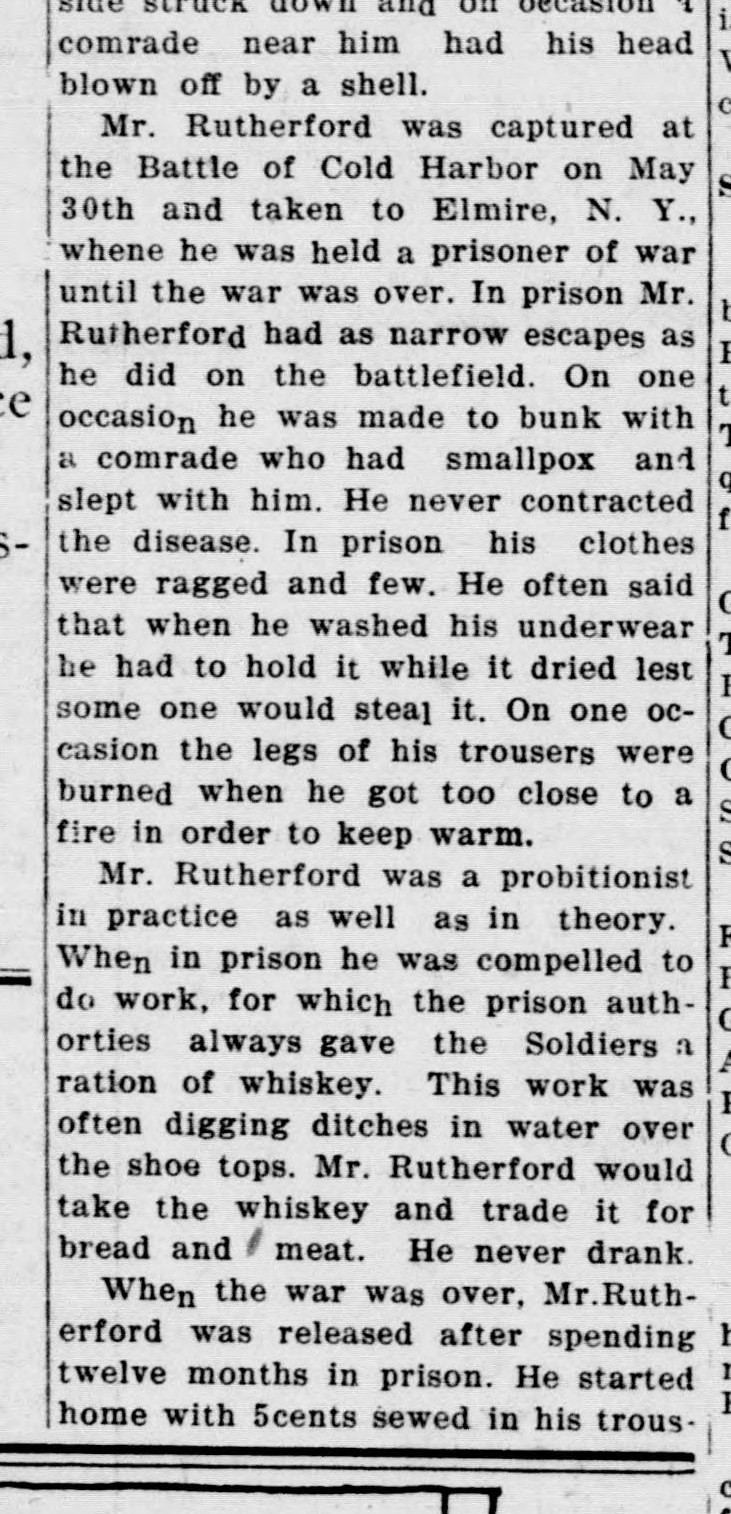
From the tribute to John C. Rutherford: captured at Cold Harbor and held at Elmira, where he traded the whiskey ration for bread and meat.
What this image does and does not showA crop of part of one page; the rest of the page is not shown.
Clarke Courier (Berryville, Va.), March 1, 1923, page 4. Library of Congress, Chronicling America. Rights Changes: Cropped from the Library of Congress page image to the region of this item, then cropped again to the opening of the report: 731 by 1514 pixels, shown at its own 731 by 1514 pixels; re-encoded as JPEG. Nothing retouched or added.
Source: Clarke Courier, Berryville, Va., March 1, 1923 Open the full image
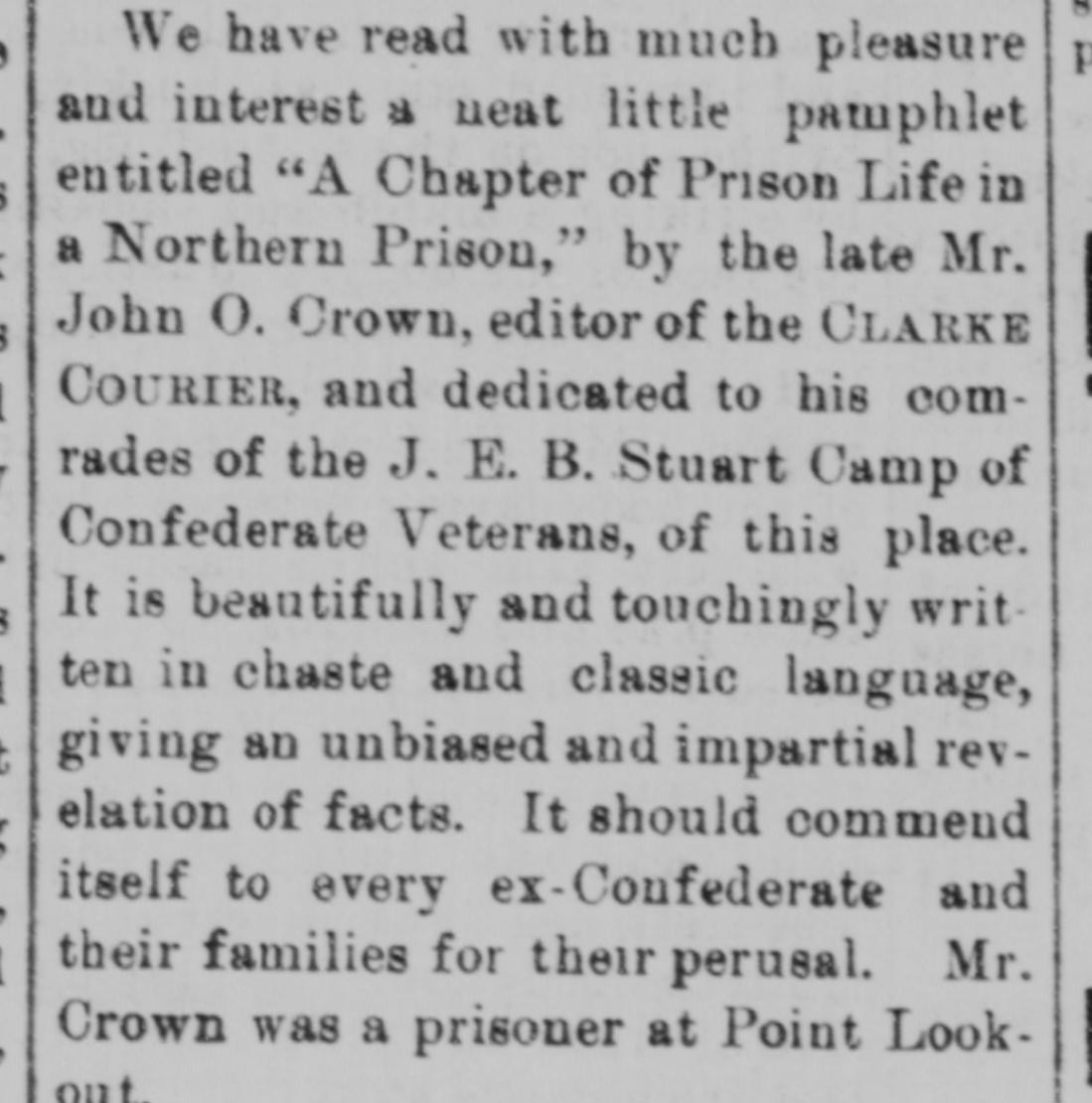
A correspondent on "A Chapter of Prison Life in a Northern Prison," by the Courier's late editor, John O. Crown, once a prisoner at Point Lookout.
What this image does and does not showA crop of part of one page; the rest of the page is not shown.
Clarke Courier (Berryville, Va.), October 10, 1900, page 4. Library of Congress, Chronicling America. Rights Changes: Cropped from the Library of Congress page image to the region of this item, then cropped again to the opening of the report: 1099 by 1110 pixels, shown at its own 1099 by 1110 pixels; re-encoded as JPEG. Nothing retouched or added.
Source: Clarke Courier, Berryville, Va., October 10, 1900, page 4: a correspondent's letter signed "G. M. C.," on John O. Crown's prison pamphlet Open the full image
The survivors
In September 1884 the survivors of the Clarke Cavalry met under the trees in front of Lieut. Allen's house and formed an association; 32 answered the roll. The next June a committee of them, with A. Moore, Jr. as chairman, appealed in the Courier for help to build a monument to the Clarke men "who were slain in battle, or died from wounds received, or sickness contracted" in the war. The monument to the Confederate dead of Clarke County was unveiled on July 21, 1900.
Of the Clarke Rifles, a 1920 tribute said John R. Shipe and Abner Jones "were the only ones of Co. I" at Lee's surrender; Meade's column says four. At the cavalry's 34th reunion, in August 1918, four members answered the roll: J. S. Ware, Nicholas Moore, Jos. N. Wheat and A. Moore, Jr.
Source note: Clarke Courier, Berryville, Va., 1884
The Clarke Courier of September 4, 1884 reported that the survivors of Co. D, the Clarke Cavalry, met under the trees in front of Lieut. R. O. Allen's house and formed the "Association of the survivors of the Clarke Cavalry"; 32 answered the roll.
What the source supports
The founding of the survivors' association.
Uncertainty
The report gives "last Friday" for the meeting, not a date.
Source
Evidence role: supports. The meeting and the society's name.
Clarke Courier, Berryville, Va., September 4, 1884, page 3: "Clarke Cavalry—Its Re-organization"
Clarke Courier, Berryville, Va. · 1884-09-04 (publication)
Locator: Page 3, "Clarke Cavalry—Its Re-organization"
Relevant passageUnder the shade of the trees that ornament the grounds in front of Lieut. R. O. Allen's residence the survivors of Co. D, Clarke Cavalry, assembled last Friday, and there formed a society to be known as the "Association of the survivors of the Clarke Cavalry,"
Checked: Original inspected. A digital reproduction was inspected; no original has been handled.
Open sourceSource family: clarke-courier. Multiple passages from one source are not independent witnesses.
Evidence role: supports. The constitution, presented by A. Moore, Jr.
Clarke Courier, Berryville, Va., September 4, 1884, page 3: "Clarke Cavalry—Its Re-organization"
Clarke Courier, Berryville, Va. · 1884-09-04 (publication)
Locator: Page 3, "Clarke Cavalry—Its Re-organization"
Relevant passageMr. A. Moore jr. from the committee appointed to draft and report a constitution and rules presented the same and they were unanimously adopted.
Checked: Original inspected. A digital reproduction was inspected; no original has been handled.
Open sourceSource family: clarke-courier. Multiple passages from one source are not independent witnesses.
Evidence role: supports. The 32 at the roll call.
Clarke Courier, Berryville, Va., September 4, 1884, page 3: "Clarke Cavalry—Its Re-organization"
Clarke Courier, Berryville, Va. · 1884-09-04 (publication)
Locator: Page 3, "Clarke Cavalry—Its Re-organization"
Relevant passageAt the calling of the roll 32 responded to their names
Checked: Original inspected. A digital reproduction was inspected; no original has been handled.
Open sourceSource family: clarke-courier. Multiple passages from one source are not independent witnesses.
AI-assisted source check (Claude Opus 5.5) · 2026-10-12. How this project checks its sources
Source note: Clarke Courier, Berryville, Va., 1885
In June 1885 a committee of the survivors, with A. Moore, Jr. as chairman, appealed in the Courier for help to build a monument to the Clarke men "who were slain in battle, or died from wounds received, or sickness contracted" in the war.
What the source supports
The survivors' plan for a monument and who led it.
Uncertainty
An appeal in the committee's own words; it did not yet say where the monument would stand.
Source
Evidence role: supports. The decision to build.
Clarke Courier, Berryville, Va., June 18, 1885, page 4: "Confederate Monument. To our Fellow Citizens of Clarke County," an appeal signed by the survivors' committee
Clarke Courier, Berryville, Va. · 1885-06-18 (publication)
Locator: Page 4, "Confederate Monument"
Relevant passageAt the late meeting of the survivors of the Clarke Cavalry, it was determined to erect a suitable monument to the memory of our county men, and others members of military organizations from this county, who were slain in battle, or died from wounds received, or sickness contracted in the military service of their country during the late war.
Checked: Original inspected. A digital reproduction was inspected; no original has been handled.
Open sourceSource family: clarke-courier. Multiple passages from one source are not independent witnesses.
Evidence role: supports. The chairman.
Clarke Courier, Berryville, Va., June 18, 1885, page 4: "Confederate Monument. To our Fellow Citizens of Clarke County," an appeal signed by the survivors' committee
Clarke Courier, Berryville, Va. · 1885-06-18 (publication)
Locator: Page 4, "Confederate Monument," the signature
Relevant passageA. Moore, Jr., Ch'n.
Checked: Original inspected. A digital reproduction was inspected; no original has been handled.
Open sourceSource family: clarke-courier. Multiple passages from one source are not independent witnesses.
AI-assisted source check (Claude Opus 5.5) · 2026-10-12. How this project checks its sources
Source note: Clarke Courier, Berryville, Va., 1900
The monument to the Confederate dead of Clarke County was unveiled on Saturday, July 21, 1900, the Courier reported.
What the source supports
The date of the unveiling.
Uncertainty
The report is written in the language of the day; only the date is taken from it here.
Source
Evidence role: supports. The unveiling.
Clarke Courier, Berryville, Va., July 25, 1900, page 3: "Good Speeches, Fine Music," on the unveiling of the Confederate monument
Clarke Courier, Berryville, Va. · 1900-07-25 (publication)
Locator: Page 3, "Good Speeches, Fine Music"
Relevant passageThis imperishable tribute to the Confederate dead of Clarke county was unveiled Saturday last, the 21st day of July,
Checked: Original inspected. A digital reproduction was inspected; no original has been handled.
Open sourceSource family: clarke-courier. Multiple passages from one source are not independent witnesses.
AI-assisted source check (Claude Opus 5.5) · 2026-10-12. How this project checks its sources
Source note: Clarke Courier, Berryville, Va., 1920, and one more
The 1920 tribute says Shipe and Abner Jones "were the only ones of Co. I" at Lee's surrender; Meade's 1948 column says "Four survivors surrendered at Appomattox."
What the source supports
That the accounts disagree on how many of the company were at Appomattox.
Uncertainty
Neither account names a record; the Appomattox parole lists were not checked for this story.
Source
Evidence role: supports. Two men, as the tribute gives it.
Clarke Courier, Berryville, Va., February 12, 1920, page 4: "Old Veteran Pays Tribute to Late John R. Shipe," signed "B."
Clarke Courier, Berryville, Va. · 1920-02-12 (publication)
Locator: Page 4, the tribute to John R. Shipe
Relevant passageHe and Abner Jones were the only ones of Co. I, Stonewall Brigade, 2nd Virginia Regiment, at Gen. Lee's surrender.
Checked: Original inspected. A digital reproduction was inspected; no original has been handled.
Open sourceSource family: clarke-courier. Multiple passages from one source are not independent witnesses.
Evidence role: complicates. Four, as the column gives it.
Everard Kidder Meade, "Notes on the History of the Lower Shenandoah Valley," Proceedings of the Clarke County Historical Association, vol. XIV (1956-1957), pp. 70 and 72
Everard Kidder Meade; Clarke County Historical Association · 1958 (publication)
Locator: Page 72, "Clarke Companies C.S.A."
Relevant passageFour survivors surrendered at Appomattox.
Checked: Original inspected. A digital reproduction was inspected; no original has been handled.
Open sourceSource family: ccha-proceedings. Multiple passages from one source are not independent witnesses.
AI-assisted source check (Claude Opus 5.5) · 2026-10-12. How this project checks its sources
Source note: Clarke Courier, Berryville, Va., 1918
At the 34th reunion, in August 1918, four members answered the roll: J. S. Ware, Nicholas Moore, Jos. N. Wheat and A. Moore, Jr.
What the source supports
The last roll call this story found.
Uncertainty
The report names the four who answered; others living may not have attended.
Source
Evidence role: supports. The four.
Clarke Courier, Berryville, Va., September 5, 1918, page 1: "Clarke Cavalry Reunion," the report of the 34th reunion
Clarke Courier, Berryville, Va. · 1918-09-05 (publication)
Locator: Page 1, "Clarke Cavalry Reunion"
Relevant passagethe following members on the call of the roll answered to their name: J. S. Ware, Nicholas Moore, Jos. N. Wheat and A. Moore, Jr.
Checked: Original inspected. A digital reproduction was inspected; no original has been handled.
Open sourceSource family: clarke-courier. Multiple passages from one source are not independent witnesses.
AI-assisted source check (Claude Opus 5.5) · 2026-10-12. How this project checks its sources
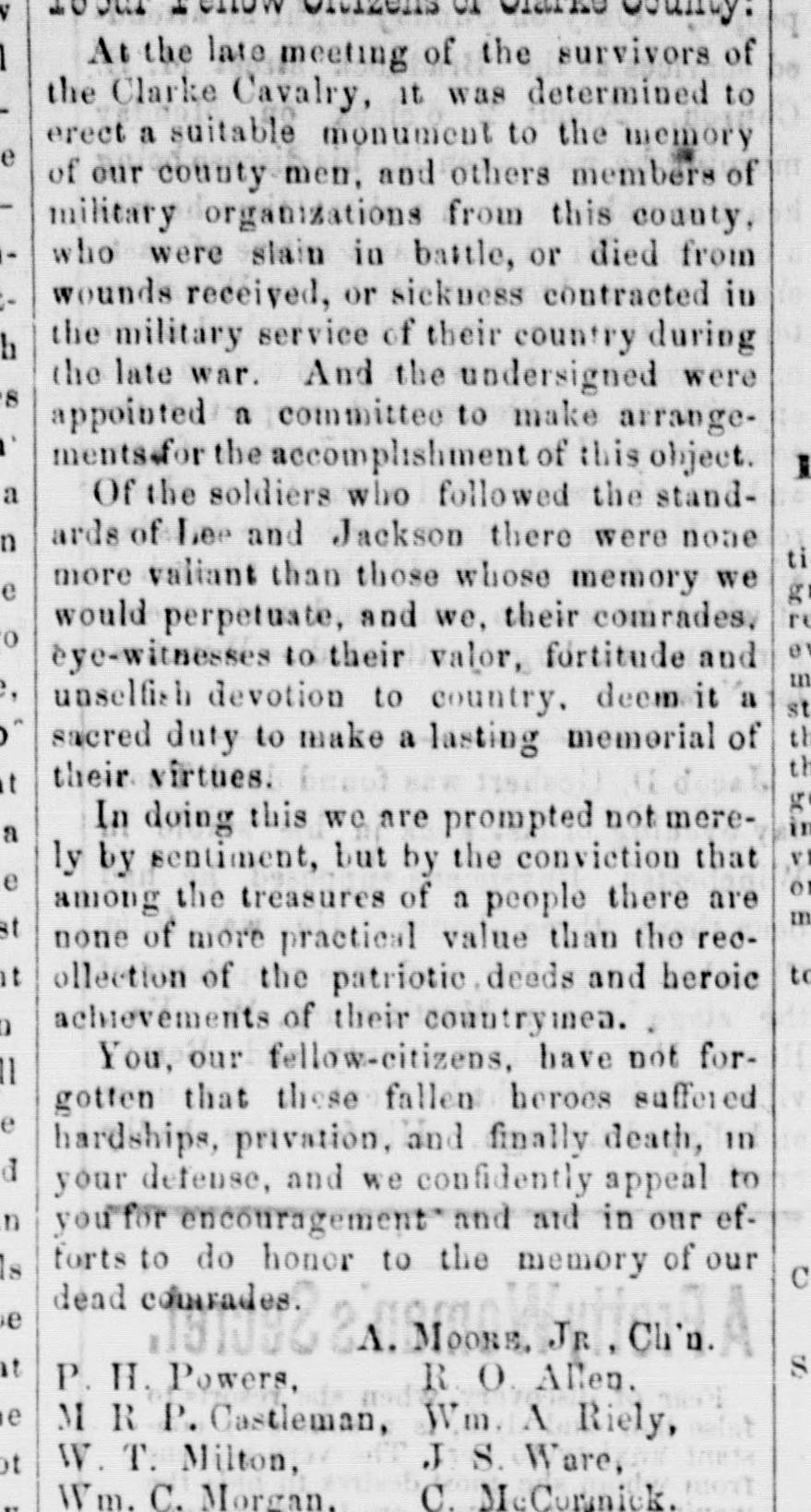
The survivors' committee, A. Moore, Jr., chairman, asks the county's help with a monument to its dead.
What this image does and does not showA crop of part of one page; the rest of the page is not shown.
Clarke Courier (Berryville, Va.), June 18, 1885, page 4. Library of Congress, Chronicling America. Rights Changes: Cropped from the Library of Congress page image to the region of this item: 879 by 1638 pixels, shown at its own 879 by 1638 pixels; re-encoded as JPEG. Nothing retouched or added.
Source: Clarke Courier, Berryville, Va., June 18, 1885, page 4: "Confederate Monument. To our Fellow Citizens of Clarke County," an appeal signed by the survivors' committee Open the full image
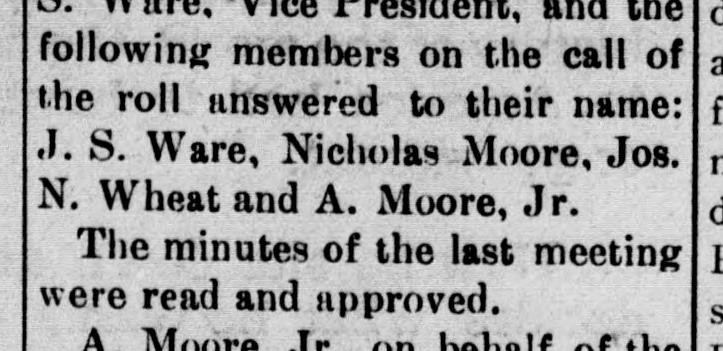
The 34th reunion, August 1918: four members answer the roll.
What this image does and does not showA crop of part of one page; the rest of the page is not shown.
Clarke Courier (Berryville, Va.), September 5, 1918, page 1. Library of Congress, Chronicling America. Rights Changes: Cropped from the Library of Congress page image to the region of this item: 723 by 351 pixels, shown at its own 723 by 351 pixels; re-encoded as JPEG. Nothing retouched or added.
Source: Clarke Courier, Berryville, Va., September 5, 1918, page 1: "Clarke Cavalry Reunion," the report of the 34th reunion Open the full image
About the sourcesWhat the evidence says
Clarke Courier items of 1883 to 1923, Gold's 1914 history, Meade's 1948 column and a compiled service record, already published on this site, and the roll of veterans.
The roll's count is of people this site has found on a record of service; it is not an official enlistment count, and it changes as names are added.
- An account exists✓ Supported by a source
The Clarke County Historical Association's Proceedings (1958), reprinting a 1948 column by Everard Kidder Meade, say the Berryville company was organized in October 1859 as the Clarke Guards, helped guard the Charles Town prison until John Brown and his men were executed, and was reorganized as the Clarke Rifles, which served the four years of the war in the Stonewall Brigade as Co. I, 2nd Virginia Infantry.
See the evidence
✓ Supported by a sourceAn account existsThe Clarke County Historical Association's Proceedings (1958), reprinting a 1948 column by Everard Kidder Meade, say the Berryville company was organized in October 1859 as the Clarke Guards, helped guard the Charles Town prison until John Brown and his men were executed, and was reorganized as the Clarke Rifles, which served the four years of the war in the Stonewall Brigade as Co. I, 2nd Virginia Infantry.
What the source supports
A local historian's account of how the Clarke Rifles began.
Uncertainty
Written in 1948 and printed in 1958; it cites no record of the Clarke Guards. Its claim that the company "prevented the escape of two of Brown's men" is not checked here.
Source
Later historical account Evidence role: supports. The Clarke Guards of 1859.
Everard Kidder Meade, "Notes on the History of the Lower Shenandoah Valley," Proceedings of the Clarke County Historical Association, vol. XIV (1956-1957), pp. 70 and 72
Everard Kidder Meade; Clarke County Historical Association · 1958 (publication)
Locator: Page 70, "Berryville Company"
Relevant passageUntil the execution of John Brown and his captured associates, this company, organized in October 1859 as Clarke Guards, took part in guarding Charles Town prison and prevented the escape of two of Brown's men.
Checked: Original inspected. A digital reproduction was inspected; no original has been handled.
Open sourceSource family: ccha-proceedings. Multiple passages from one source are not independent witnesses.
Later historical account Evidence role: supports. Reorganized as the Clarke Rifles, Co. I.
Everard Kidder Meade, "Notes on the History of the Lower Shenandoah Valley," Proceedings of the Clarke County Historical Association, vol. XIV (1956-1957), pp. 70 and 72
Everard Kidder Meade; Clarke County Historical Association · 1958 (publication)
Locator: Page 70, "Berryville Company"
Relevant passageReorganized later as Clarke Rifles, It went through four years of war in the Stonewall Brigade as Co. I, 2nd Va. Inf., C.S.A.
Checked: Original inspected. A digital reproduction was inspected; no original has been handled.
Open sourceSource family: ccha-proceedings. Multiple passages from one source are not independent witnesses.
AI-assisted source check (Claude Opus 5.5) · 2026-10-12. How this project checks its sources
- An account exists✓ Supported by a source
Gold’s 1914 history of Clarke County, in its account of the fighting on the road from Beverly’s Ford by St. James church to Brandy Station (printed pp. 267-269), says that Lieut. R. O. Allen of the Clarke Cavalry, with one load left in his pistol, came up behind Col. B. F. Davis of the 8th New York Cavalry; that Davis "made a vicious stroke at Lieutenant Allen with his sword"; and that Allen, throwing himself on the side of his horse, "fired his remaining shot at Davis with an aim so true that he fell dead from his horse and Allen galloped off unharmed."
See the evidence
✓ Supported by a sourceAn account existsGold’s 1914 history of Clarke County, in its account of the fighting on the road from Beverly’s Ford by St. James church to Brandy Station (printed pp. 267-269), says that Lieut. R. O. Allen of the Clarke Cavalry, with one load left in his pistol, came up behind Col. B. F. Davis of the 8th New York Cavalry; that Davis "made a vicious stroke at Lieutenant Allen with his sword"; and that Allen, throwing himself on the side of his horse, "fired his remaining shot at Davis with an aim so true that he fell dead from his horse and Allen galloped off unharmed."
What the source supports
What Gold’s history says of Lieut. R. O. Allen and Col. B. F. Davis at Brandy Station.
Uncertainty
Gold wrote in 1914, about fifty years after the battle; this is his account, and no record read here describes the encounter otherwise. The passage was read on the page image of the hosted digital reproduction. No human historian has reviewed this claim.
Source
Later historical account Evidence role: supports. Names Lieut. R. O. Allen of the Clarke Cavalry and Col. B. F. Davis.
History of Clarke County, Virginia and its connection with the war between the states
Thomas D. Gold · 1914 (publication)
Locator: Printed p. 268, PDF p. 298 of the hosted copy, battle narrative naming Lieut. R. O. Allen
Relevant passageamong them Lieut. R. O. Allen, of the Clarke Cavalry, whose attention was attracted to Col. B. F. Davis, of the 8th New York Cavalry, that day in command of the brigade
Checked: This passage was read on a digital reproduction of the page; no original has been handled. The source's other readings: existing OCR reviewed, original image not independently inspected.
Open sourceSource family: gold-1914. Multiple passages from one source are not independent witnesses.
Later historical account Evidence role: supports. The last load and Davis’ sword stroke.
History of Clarke County, Virginia and its connection with the war between the states
Thomas D. Gold · 1914 (publication)
Locator: Printed p. 268, PDF p. 298 of the hosted copy, Lieut. R. O. Allen and Col. B. F. Davis
Relevant passageLieutenant Allen had shot from his pistol all but one load. [...] Colonel Davis, perceiving his danger, made a vicious stroke at Lieutenant Allen with his sword.
Checked: This passage was read on a digital reproduction of the page; no original has been handled. The source's other readings: existing OCR reviewed, original image not independently inspected.
Open sourceSource family: gold-1914. Multiple passages from one source are not independent witnesses.
Later historical account Evidence role: supports. The last shot, as Gold tells it.
History of Clarke County, Virginia and its connection with the war between the states
Thomas D. Gold · 1914 (publication)
Locator: Printed p. 269, PDF p. 301 of the hosted copy, Allen’s last shot
Relevant passageThrowing himself quickly on the side of his horse, the sweep of Davis’ sword passed over him and in an instant Allen fired his remaining shot at Davis with an aim so true that he fell dead from his horse and Allen galloped off unharmed.
Checked: This passage was read on a digital reproduction of the page; no original has been handled. The source's other readings: existing OCR reviewed, original image not independently inspected.
Open sourceSource family: gold-1914. Multiple passages from one source are not independent witnesses.
Later historical account Evidence role: supports. Places the fight on the road from Beverly’s Ford by St. James church to Brandy Station.
History of Clarke County, Virginia and its connection with the war between the states
Thomas D. Gold · 1914 (publication)
Locator: Printed p. 267, PDF p. 297 of the hosted copy, the road from Beverly’s Ford to Brandy Station
Relevant passagesuddenly, a little before daybreak, began the fording of the Rappahannock at Beverly’s Ford [...] the road, a narrow one, led through the hills overlooking the river, and thence on by way of St. James church to Brandy Station.
Checked: This passage was read on a digital reproduction of the page; no original has been handled. The source's other readings: existing OCR reviewed, original image not independently inspected.
Open sourceSource family: gold-1914. Multiple passages from one source are not independent witnesses.
AI-assisted source check (Claude Opus 5.5) · 2026-10-13. How this project checks its sources
- An account exists✓ Supported by a source
In June 1885 a committee of the survivors, with A. Moore, Jr. as chairman, appealed in the Courier for help to build a monument to the Clarke men "who were slain in battle, or died from wounds received, or sickness contracted" in the war.
See the evidence
✓ Supported by a sourceAn account existsIn June 1885 a committee of the survivors, with A. Moore, Jr. as chairman, appealed in the Courier for help to build a monument to the Clarke men "who were slain in battle, or died from wounds received, or sickness contracted" in the war.
What the source supports
The survivors' plan for a monument and who led it.
Uncertainty
An appeal in the committee's own words; it did not yet say where the monument would stand.
Source
Reporting Evidence role: supports. The decision to build.
Clarke Courier, Berryville, Va., June 18, 1885, page 4: "Confederate Monument. To our Fellow Citizens of Clarke County," an appeal signed by the survivors' committee
Clarke Courier, Berryville, Va. · 1885-06-18 (publication)
Locator: Page 4, "Confederate Monument"
Relevant passageAt the late meeting of the survivors of the Clarke Cavalry, it was determined to erect a suitable monument to the memory of our county men, and others members of military organizations from this county, who were slain in battle, or died from wounds received, or sickness contracted in the military service of their country during the late war.
Checked: Original inspected. A digital reproduction was inspected; no original has been handled.
Open sourceSource family: clarke-courier. Multiple passages from one source are not independent witnesses.
Reporting Evidence role: supports. The chairman.
Clarke Courier, Berryville, Va., June 18, 1885, page 4: "Confederate Monument. To our Fellow Citizens of Clarke County," an appeal signed by the survivors' committee
Clarke Courier, Berryville, Va. · 1885-06-18 (publication)
Locator: Page 4, "Confederate Monument," the signature
Relevant passageA. Moore, Jr., Ch'n.
Checked: Original inspected. A digital reproduction was inspected; no original has been handled.
Open sourceSource family: clarke-courier. Multiple passages from one source are not independent witnesses.
AI-assisted source check (Claude Opus 5.5) · 2026-10-12. How this project checks its sources
Each statement above is assessed on its own evidence. Nothing here is averaged, scored or voted on, and a well-attributed account can be documented while what it describes stays unconfirmed.
Source note
This overview rests on records already published on this site: Clarke Courier items of 1883 to 1923, each read on the page image; Gold's 1914 history of Clarke County; Meade's 1948 column, reprinted in the Clarke County Historical Association's Proceedings; a compiled service record; and the roll of veterans, whose count grows as names are added. It follows the county's Confederate companies. The roll also lists Clarke men who served in Union regiments. The men and companies it names have fuller stories of their own.
How many of the 940 people on the roll served in the two Clarke companies, and how many in other commands?
Know more about this story, or see something to correct? Help fill a gap. It stays private until it is reviewed.
Remember this place or someone in this story? Share a memory, even if you do not know the date. It stays private until it is reviewed.
Go deeper: every source under this story Follow another threadThe last roll call: the Clarke Cavalry, 1884 to 1918
The Clarke Cavalry's survivors, from their first meeting in 1884 to the four who answered the roll in 1918.