
Fort Delaware
Thomas Wyndham was "only 15 years old" when the war began, his 1921 notice says. He joined the Clarke Cavalry in 1862, was twice captured, and was once held five months at Fort Delaware.
Dilmon Estep, captured at Spotsylvania Court House, was held a prisoner to the end of the war. "Not having the spirit of idleness," his notice says, he worked as a carpenter around the prison at Fort Delaware. In 1867 he came to Clarke and built barns and houses, among them "the old white school house and hall at Millwood."
Source note: Clarke Courier, 1921
Thomas Wyndham, who joined the Clarke Cavalry in 1862 though only fifteen when the war began, was twice captured and once held five months at Fort Delaware, his 1921 notice says.
What the source supports
Wyndham's captures and prison.
Uncertainty
A death notice; the dates of capture are not given.
Source
Evidence role: supports. Fifteen when the war began.
Clarke Courier, Berryville, Va., June 9, 1921
Clarke Courier · 1921-06-09 (publication)
Locator: Page 1, "Another Brave Old Confederate Passes Away"
Relevant passageWhen the war between the states broke out, although only 15 years old, his courage and love of his mother state impelled him to enlist under the Stars and Bars.
Checked: This passage was read on a digital reproduction of the page; no original has been handled. The source's other readings: existing OCR reviewed, original image not independently inspected.
Open sourceSource family: clarke-courier. Multiple passages from one source are not independent witnesses.
Evidence role: supports. Twice captured; five months at Fort Delaware.
Clarke Courier, Berryville, Va., June 9, 1921
Clarke Courier · 1921-06-09 (publication)
Locator: Page 1, "Another Brave Old Confederate Passes Away"
Relevant passageHe joined Maj. Calmes' Clarke Cavalry in 1862 and served through the war. He was twice captured, and at one time was confined for five months in Fort Delaware.
Checked: This passage was read on a digital reproduction of the page; no original has been handled. The source's other readings: existing OCR reviewed, original image not independently inspected.
Open sourceSource family: clarke-courier. Multiple passages from one source are not independent witnesses.
AI-assisted source check (Claude Opus 5.5) · 2026-10-12. How this project checks its sources
Source note: Clarke Courier, Berryville, Va., 1918
Dilmon Estep, captured at Spotsylvania Court House and held to the end of the war, worked as a carpenter around the prison at Fort Delaware; in 1867 he came to Clarke, where he built barns and houses and the old white schoolhouse and hall at Millwood, his 1918 notice says.
What the source supports
Estep's prison work and his building in Clarke.
Uncertainty
A death notice; the buildings were not identified on the ground for this story.
Source
Evidence role: supports. Carpenter at Fort Delaware.
Clarke Courier, Berryville, Va., June 13, 1918, page 1: the death notice of Dilmon Estep
Clarke Courier, Berryville, Va. · 1918-06-13 (publication)
Locator: Page 1, the death notice of Dilmon Estep
Relevant passageWas taken prisoner at Spottsylvania Court House and held as such until the end of the war, but not having the spirit of idleness, he was busily engaged as a carpenter around the old prison at Fort Delaware.
Checked: Original inspected. A digital reproduction was inspected; no original has been handled.
Open sourceSource family: clarke-courier. Multiple passages from one source are not independent witnesses.
Evidence role: supports. Came to Clarke and built.
Clarke Courier, Berryville, Va., June 13, 1918, page 1: the death notice of Dilmon Estep
Clarke Courier, Berryville, Va. · 1918-06-13 (publication)
Locator: Page 1, the death notice of Dilmon Estep
Relevant passageIn 1867 he came to Clarke county, and built several barns and houses, some of which are still standing,
Checked: Original inspected. A digital reproduction was inspected; no original has been handled.
Open sourceSource family: clarke-courier. Multiple passages from one source are not independent witnesses.
Evidence role: supports. The Millwood schoolhouse and hall.
Clarke Courier, Berryville, Va., June 13, 1918, page 1: the death notice of Dilmon Estep
Clarke Courier, Berryville, Va. · 1918-06-13 (publication)
Locator: Page 1, the death notice of Dilmon Estep
Relevant passageand the old white school house and hall at Millwood.
Checked: Original inspected. A digital reproduction was inspected; no original has been handled.
Open sourceSource family: clarke-courier. Multiple passages from one source are not independent witnesses.
AI-assisted source check (Claude Opus 5.5) · 2026-10-12. How this project checks its sources
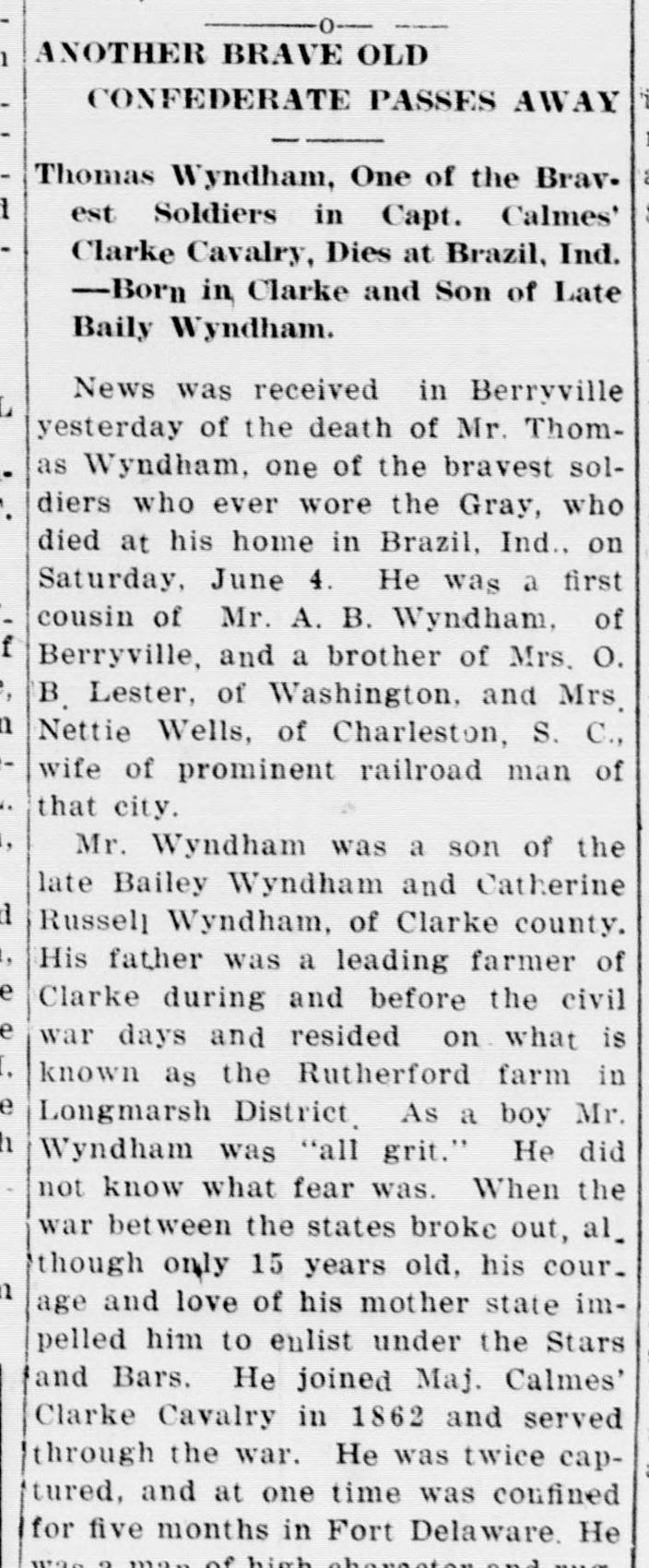
"Another Brave Old Confederate Passes Away": Thomas Wyndham, fifteen when the war began, twice captured.
What this image does and does not showA crop of part of one page; the rest of the page is not shown.
Clarke Courier (Berryville, Va.), June 9, 1921, page 1. Library of Congress, Chronicling America. Rights Changes: Cropped from the Library of Congress page image to the region of this item, then cropped again to the opening of the report: 704 by 1700 pixels, shown at its own 704 by 1700 pixels; re-encoded as JPEG. Nothing retouched or added.
Source: Clarke Courier, Berryville, Va., June 9, 1921 Open the full image
Mrs. Van Meter's soldier
James L. E. Van Meter, a Clarke farmer, served in a Virginia cavalry company of Rosser's Brigade and was captured and sent to Fort Delaware. His release, his 1920 notice says, came from home.
In 1864 a Union soldier named Bedell was wounded in a skirmish on the Opequon. His leg was amputated, and he was left in a house near the Van Meter farm, where a Black man, whom the notice does not name, was caring for him. Mrs. Van Meter found him there "in almost dying condition." She drove to Harpers Ferry to tell the Union general of Bedell's condition, and then took him into the garret of her own house, where she nursed him back to health.
As a reward, the notice says, the general had the War Department release her husband from prison. The Van Meters and the Bedells stayed friends and visited each other for years.
Source note: Clarke Courier, Berryville, Va., 1920
James L. E. Van Meter, a Clarke farmer who served in Co. C of a Virginia cavalry regiment in Rosser's Brigade, was captured and sent to Fort Delaware, his 1920 death notice says.
What the source supports
Van Meter's capture and prison.
Uncertainty
The notice names the company but not the regiment.
Source
Evidence role: supports. A Clarke farmer.
Clarke Courier, Berryville, Va., August 19, 1920, page 1: "J. L. E. Van Meter, Aged Farmer, Dies"
Clarke Courier, Berryville, Va. · 1920-08-19 (publication)
Locator: Page 1, "J. L. E. Van Meter, Aged Farmer, Dies"
Relevant passageMr. James L. E. Van Meter, aged 89 years, a Confederate soldier and for years a leading farmer of Clarke county,
Checked: Original inspected. A digital reproduction was inspected; no original has been handled.
Open sourceSource family: clarke-courier. Multiple passages from one source are not independent witnesses.
Evidence role: supports. His service and his prison.
Clarke Courier, Berryville, Va., August 19, 1920, page 1: "J. L. E. Van Meter, Aged Farmer, Dies"
Clarke Courier, Berryville, Va. · 1920-08-19 (publication)
Locator: Page 1, "J. L. E. Van Meter, Aged Farmer, Dies"
Relevant passageHe was a Cofederate [sic] soldier, having served in Co. C, Virginia Cavalry, Gen. Rosser's Brigade. He was captured and sent to Fort Delaware.
Checked: Original inspected. A digital reproduction was inspected; no original has been handled.
Open sourceSource family: clarke-courier. Multiple passages from one source are not independent witnesses.
AI-assisted source check (Claude Opus 5.5) · 2026-10-12. How this project checks its sources
Source note: Clarke Courier, Berryville, Va., 1920
His notice tells how in 1864 Mrs. Van Meter found Bedell, a Union soldier who had lost a leg after a skirmish on the Opequon, near death in a house near their farm, where a Black man was caring for him; she told the Union general at Harpers Ferry, took Bedell into her own garret and nursed him back to health.
What the source supports
Mrs. Van Meter's care of a wounded Union soldier, as her husband's notice told it.
Uncertainty
Told fifty-six years later; the man who first cared for Bedell is not named, and Bedell's first name and unit are not given.
Source
Evidence role: supports. Bedell wounded and cared for.
Clarke Courier, Berryville, Va., August 19, 1920, page 1: "J. L. E. Van Meter, Aged Farmer, Dies"
Clarke Courier, Berryville, Va. · 1920-08-19 (publication)
Locator: Page 1, "J. L. E. Van Meter, Aged Farmer, Dies"
Relevant passageA Mr. Bedell, a Union soldier, was wounded in a skirmish in Clarke county on the Opequon in 1864. Bedell's leg was amputated and he was taken to a house near the Van Meter farm and cared for by a colored man.
Checked: Original inspected. A digital reproduction was inspected; no original has been handled.
Open sourceSource family: clarke-courier. Multiple passages from one source are not independent witnesses.
Evidence role: supports. Mrs. Van Meter finds him.
Clarke Courier, Berryville, Va., August 19, 1920, page 1: "J. L. E. Van Meter, Aged Farmer, Dies"
Clarke Courier, Berryville, Va. · 1920-08-19 (publication)
Locator: Page 1, "J. L. E. Van Meter, Aged Farmer, Dies"
Relevant passageMrs. Van Meter discovered Bedell in the delapidated house, who then was in almost dying condition.
Checked: Original inspected. A digital reproduction was inspected; no original has been handled.
Open sourceSource family: clarke-courier. Multiple passages from one source are not independent witnesses.
Evidence role: supports. Harpers Ferry and the garret.
Clarke Courier, Berryville, Va., August 19, 1920, page 1: "J. L. E. Van Meter, Aged Farmer, Dies"
Clarke Courier, Berryville, Va. · 1920-08-19 (publication)
Locator: Page 1, "J. L. E. Van Meter, Aged Farmer, Dies"
Relevant passageMrs. Van Meter then drove to Harpers Ferry and told Gen. Stephenson of Bedell's condition. She returned and later removed Bedell to the garret of her own home, where she kept him protected and nursed him back to health.
Checked: Original inspected. A digital reproduction was inspected; no original has been handled.
Open sourceSource family: clarke-courier. Multiple passages from one source are not independent witnesses.
AI-assisted source check (Claude Opus 5.5) · 2026-10-12. How this project checks its sources
Source note: Clarke Courier, Berryville, Va., 1920
As a reward, the notice says, the general had the War Department release Van Meter from prison, and the Van Meters and the Bedells visited each other for years afterward.
What the source supports
The release, as the family's story gave it.
Uncertainty
No release record was read for this story.
Source
Evidence role: supports. The release and the friendship.
Clarke Courier, Berryville, Va., August 19, 1920, page 1: "J. L. E. Van Meter, Aged Farmer, Dies"
Clarke Courier, Berryville, Va. · 1920-08-19 (publication)
Locator: Page 1, "J. L. E. Van Meter, Aged Farmer, Dies"
Relevant passageAs a reward for what she had done, Gen. Stephenson had the War Department to release Mr. Van Meter from prison. A lasting friendship sprung up between the Van Meters and the Bedells and the two families exchanged visits for years.
Checked: Original inspected. A digital reproduction was inspected; no original has been handled.
Open sourceSource family: clarke-courier. Multiple passages from one source are not independent witnesses.
AI-assisted source check (Claude Opus 5.5) · 2026-10-12. How this project checks its sources
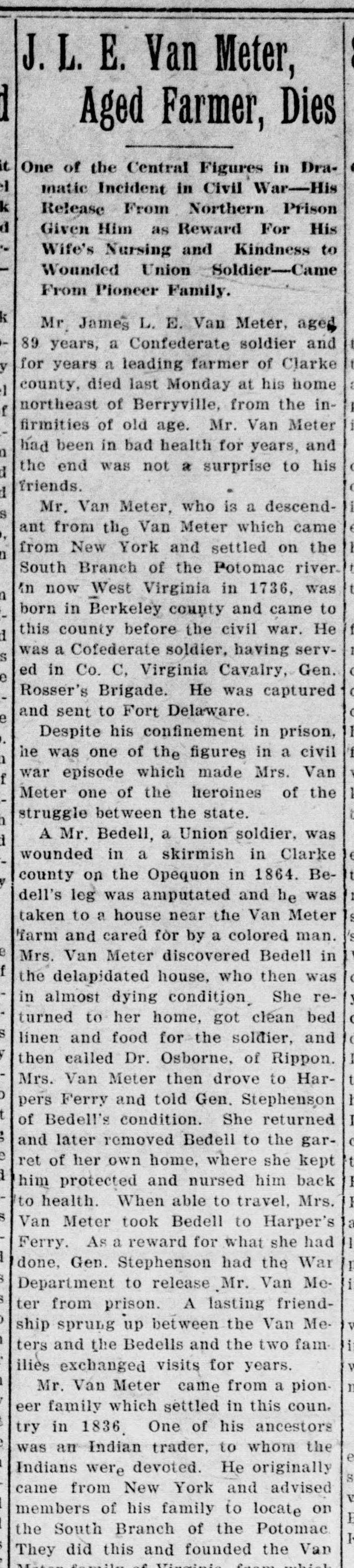
"J. L. E. Van Meter, Aged Farmer, Dies": his release from a Northern prison "Given Him as Reward For His Wife's Nursing and Kindness to Wounded Union Soldier."
What this image does and does not showA crop of part of one page; the rest of the page is not shown.
Clarke Courier (Berryville, Va.), August 19, 1920, page 1. Library of Congress, Chronicling America. Rights Changes: Cropped from the Library of Congress page image to the region of this item, then cropped again to the opening of the report: 712 by 3150 pixels, shown at its own 712 by 3150 pixels; re-encoded as JPEG. Nothing retouched or added.
Source: Clarke Courier, Berryville, Va., August 19, 1920, page 1: "J. L. E. Van Meter, Aged Farmer, Dies" Open the full image
Elmira
John C. Rutherford, color-bearer of Co. F, 52nd Virginia, was captured at Cold Harbor and held at Elmira, New York, until the war was over. He often told his stories, and his 1923 tribute kept them. He was made to bunk with a comrade who had smallpox, and never caught it. In prison his clothes were "ragged and few," and when he washed his underwear he held it while it dried, "lest some one would steal it." The prisoners who dug ditches in water over their shoe tops were given a ration of whiskey; Rutherford never drank, and traded his for bread and meat.
Released after twelve months, he made his way home. Near Staunton a boatman wanted pay to carry him across a swollen river. Rutherford waded and swam across instead, reached Staunton that night, and walked thirteen miles to his father's house before morning.
A. J. Berlin of White Post, of the Nelson Rifles, was taken prisoner at the Bloody Angle at Spotsylvania and also held at Elmira. A comrade wrote in 1907 that he endured it "in the same quiet, uncomplaining way that characterized his life in all things."
Source note: Clarke Courier, 1923
John C. Rutherford, color-bearer of Co. F, 52nd Virginia, was captured at Cold Harbor and held at Elmira, New York, until the war ended; his 1923 tribute retells his stories of bunking with a smallpox patient, holding his washing while it dried so no one would steal it, and trading the whiskey ration for ditch-digging for bread and meat.
What the source supports
Rutherford's prison stories, as he told them.
Uncertainty
His own stories, retold in a tribute after his death; the unit is from the same tribute.
Source
Evidence role: supports. Color-bearer, Co. F, 52nd Va.
Clarke Courier, Berryville, Va., March 1, 1923
Clarke Courier · 1923-03-01 (publication)
Locator: Page 4, the tribute to John C. Rutherford
Relevant passageAt the outbreak of the civil war Mr. Rutherford joined Capt. James Bumgardner's Company (F) in the 52nd Regt. Virginia Volunteers, and was later made color bearer and a corporal.
Checked: This passage was read on a digital reproduction of the page; no original has been handled. The source's other readings: existing OCR reviewed, original image not independently inspected.
Open sourceSource family: clarke-courier. Multiple passages from one source are not independent witnesses.
Evidence role: supports. Captured and held at Elmira.
Clarke Courier, Berryville, Va., March 1, 1923
Clarke Courier · 1923-03-01 (publication)
Locator: Page 4, the tribute to John C. Rutherford
Relevant passageMr. Rutherford was captured at the Battle of Cold Harbor on May 30th and taken to Elmire [sic], N. Y., whene [sic] he was held a prisoner of war until the war was over.
Checked: This passage was read on a digital reproduction of the page; no original has been handled. The source's other readings: existing OCR reviewed, original image not independently inspected.
Open sourceSource family: clarke-courier. Multiple passages from one source are not independent witnesses.
Evidence role: supports. The smallpox bunkmate.
Clarke Courier, Berryville, Va., March 1, 1923
Clarke Courier · 1923-03-01 (publication)
Locator: Page 4, the tribute to John C. Rutherford
Relevant passageOn one occasion he was made to bunk with a comrade who had smallpox and slept with him. He never contracted the disease.
Checked: This passage was read on a digital reproduction of the page; no original has been handled. The source's other readings: existing OCR reviewed, original image not independently inspected.
Open sourceSource family: clarke-courier. Multiple passages from one source are not independent witnesses.
Evidence role: supports. The washing.
Clarke Courier, Berryville, Va., March 1, 1923
Clarke Courier · 1923-03-01 (publication)
Locator: Page 4, the tribute to John C. Rutherford
Relevant passageIn prison his clothes were ragged and few. He often said that when he washed his underwear he had to hold it while it dried lest some one would steal it.
Checked: This passage was read on a digital reproduction of the page; no original has been handled. The source's other readings: existing OCR reviewed, original image not independently inspected.
Open sourceSource family: clarke-courier. Multiple passages from one source are not independent witnesses.
Evidence role: supports. The whiskey traded for food.
Clarke Courier, Berryville, Va., March 1, 1923
Clarke Courier · 1923-03-01 (publication)
Locator: Page 4, the tribute to John C. Rutherford
Relevant passageWhen in prison he was compelled to do work, for which the prison authorties [sic] always gave the Soldiers a ration of whiskey. This work was often digging ditches in water over the shoe tops. Mr. Rutherford would take the whiskey and trade it for bread and meat. He never drank.
Checked: This passage was read on a digital reproduction of the page; no original has been handled. The source's other readings: existing OCR reviewed, original image not independently inspected.
Open sourceSource family: clarke-courier. Multiple passages from one source are not independent witnesses.
AI-assisted source check (Claude Opus 5.5) · 2026-10-12. How this project checks its sources
Source note: Clarke Courier, 1923
Released after twelve months, the tribute says, Rutherford made his way home; near Staunton a boatman wanted pay to carry him across a swollen river, so he waded and swam across and walked thirteen miles to his father's house before morning.
What the source supports
Rutherford's journey home, as he told it.
Uncertainty
His own story, retold after his death.
Source
Evidence role: supports. Released after twelve months.
Clarke Courier, Berryville, Va., March 1, 1923
Clarke Courier · 1923-03-01 (publication)
Locator: Page 4, the tribute to John C. Rutherford
Relevant passageWhen the war was over, Mr. Rutherford was released after spending twelve months in prison.
Checked: This passage was read on a digital reproduction of the page; no original has been handled. The source's other readings: existing OCR reviewed, original image not independently inspected.
Open sourceSource family: clarke-courier. Multiple passages from one source are not independent witnesses.
Evidence role: supports. The river and the walk home.
Clarke Courier, Berryville, Va., March 1, 1923
Clarke Courier · 1923-03-01 (publication)
Locator: Page 4, the tribute to John C. Rutherford, continued
Relevant passageAs he neared Staunton, he encountered a swollen river. A boatman demanded pay for carrying him across. Not having the money Mr. Rutherford jumped into the river and waded and swam to the other side, reaching Staunton at night and then walking 13 miles to his father's house before morning.
Checked: This passage was read on a digital reproduction of the page; no original has been handled. The source's other readings: existing OCR reviewed, original image not independently inspected.
Open sourceSource family: clarke-courier. Multiple passages from one source are not independent witnesses.
AI-assisted source check (Claude Opus 5.5) · 2026-10-12. How this project checks its sources
Source note: Clarke Courier, Berryville, Va., 1907
A. J. Berlin of White Post, of the Nelson Rifles, was taken prisoner at the Bloody Angle at Spotsylvania and held at Elmira, a comrade wrote in 1907, and endured it "in the same quiet, uncomplaining way" as the rest of his life.
What the source supports
Berlin's capture and prison.
Uncertainty
A comrade's letter, written from memory.
Source
Evidence role: supports. Of White Post.
Clarke Courier, Berryville, Va., February 27, 1907, page 1: a letter on A. J. Berlin of White Post, signed "A Comrade"
Clarke Courier, Berryville, Va. · 1907-02-27 (publication)
Locator: Page 1, the letter signed "A Comrade"
Relevant passageMr. Berlin was born, lived and died at or near White Post.
Checked: Original inspected. A digital reproduction was inspected; no original has been handled.
Open sourceSource family: clarke-courier. Multiple passages from one source are not independent witnesses.
Evidence role: supports. The Nelson Rifles.
Clarke Courier, Berryville, Va., February 27, 1907, page 1: a letter on A. J. Berlin of White Post, signed "A Comrade"
Clarke Courier, Berryville, Va. · 1907-02-27 (publication)
Locator: Page 1, the letter signed "A Comrade"
Relevant passageAs a member of the "Nelson Rifles," Company C, 2d Virginia Infantry,
Checked: Original inspected. A digital reproduction was inspected; no original has been handled.
Open sourceSource family: clarke-courier. Multiple passages from one source are not independent witnesses.
Evidence role: supports. Captured and taken to Elmira.
Clarke Courier, Berryville, Va., February 27, 1907, page 1: a letter on A. J. Berlin of White Post, signed "A Comrade"
Clarke Courier, Berryville, Va. · 1907-02-27 (publication)
Locator: Page 1, the letter signed "A Comrade"
Relevant passageAt the "Bloody Angle," at Spottsylvania, he was taken prisoner, and was taken to Elmira, New York, and kept in prison there.
Checked: Original inspected. A digital reproduction was inspected; no original has been handled.
Open sourceSource family: clarke-courier. Multiple passages from one source are not independent witnesses.
Evidence role: supports. How he bore it.
Clarke Courier, Berryville, Va., February 27, 1907, page 1: a letter on A. J. Berlin of White Post, signed "A Comrade"
Clarke Courier, Berryville, Va. · 1907-02-27 (publication)
Locator: Page 1, the letter signed "A Comrade"
Relevant passageHe endured the sufferings of that trying time in the same quiet, uncomplaining way that characterized his life in all things.
Checked: Original inspected. A digital reproduction was inspected; no original has been handled.
Open sourceSource family: clarke-courier. Multiple passages from one source are not independent witnesses.
AI-assisted source check (Claude Opus 5.5) · 2026-10-12. How this project checks its sources
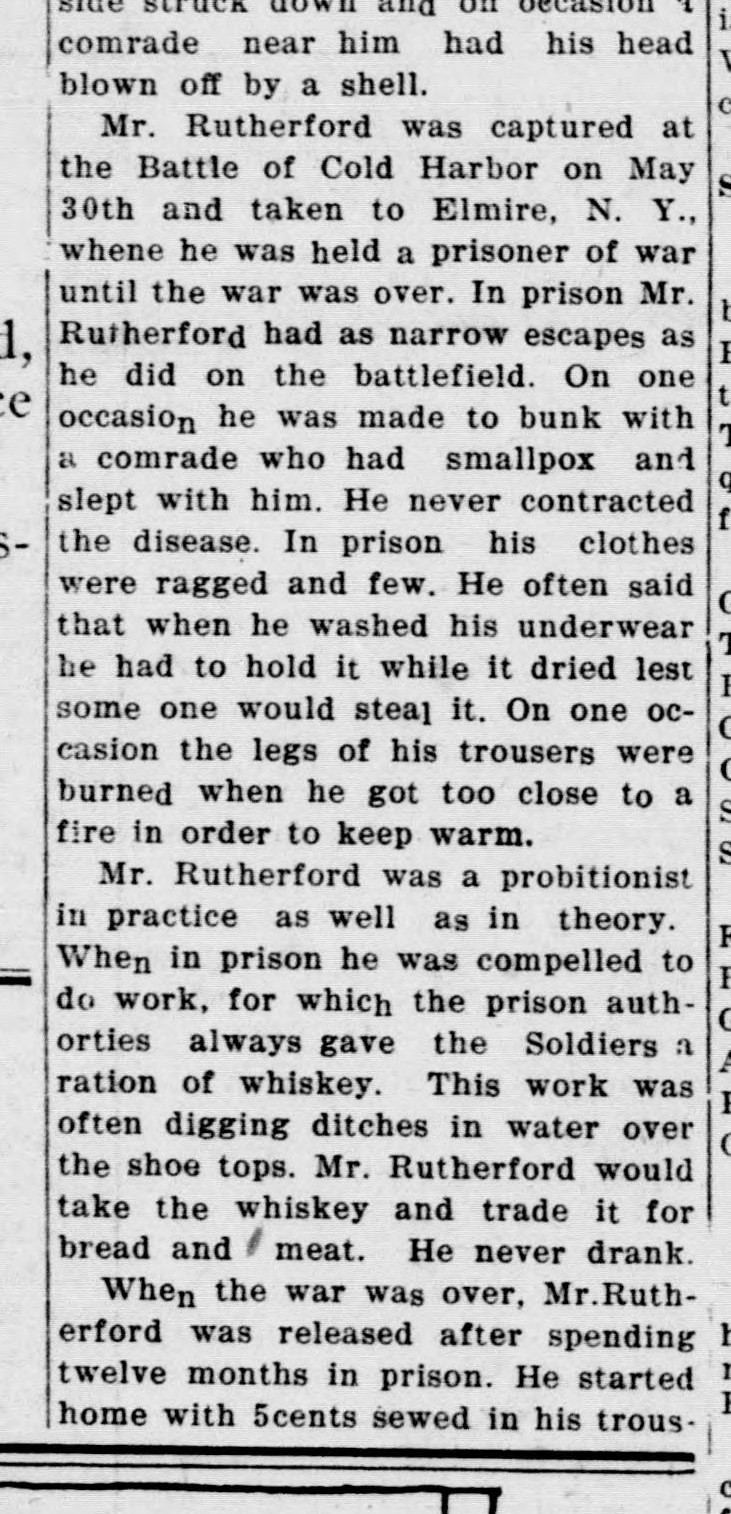
From the tribute to John C. Rutherford: captured at Cold Harbor and held at Elmira, where he traded the whiskey ration for bread and meat.
What this image does and does not showA crop of part of one page; the rest of the page is not shown.
Clarke Courier (Berryville, Va.), March 1, 1923, page 4. Library of Congress, Chronicling America. Rights Changes: Cropped from the Library of Congress page image to the region of this item, then cropped again to the opening of the report: 731 by 1514 pixels, shown at its own 731 by 1514 pixels; re-encoded as JPEG. Nothing retouched or added.
Source: Clarke Courier, Berryville, Va., March 1, 1923 Open the full image
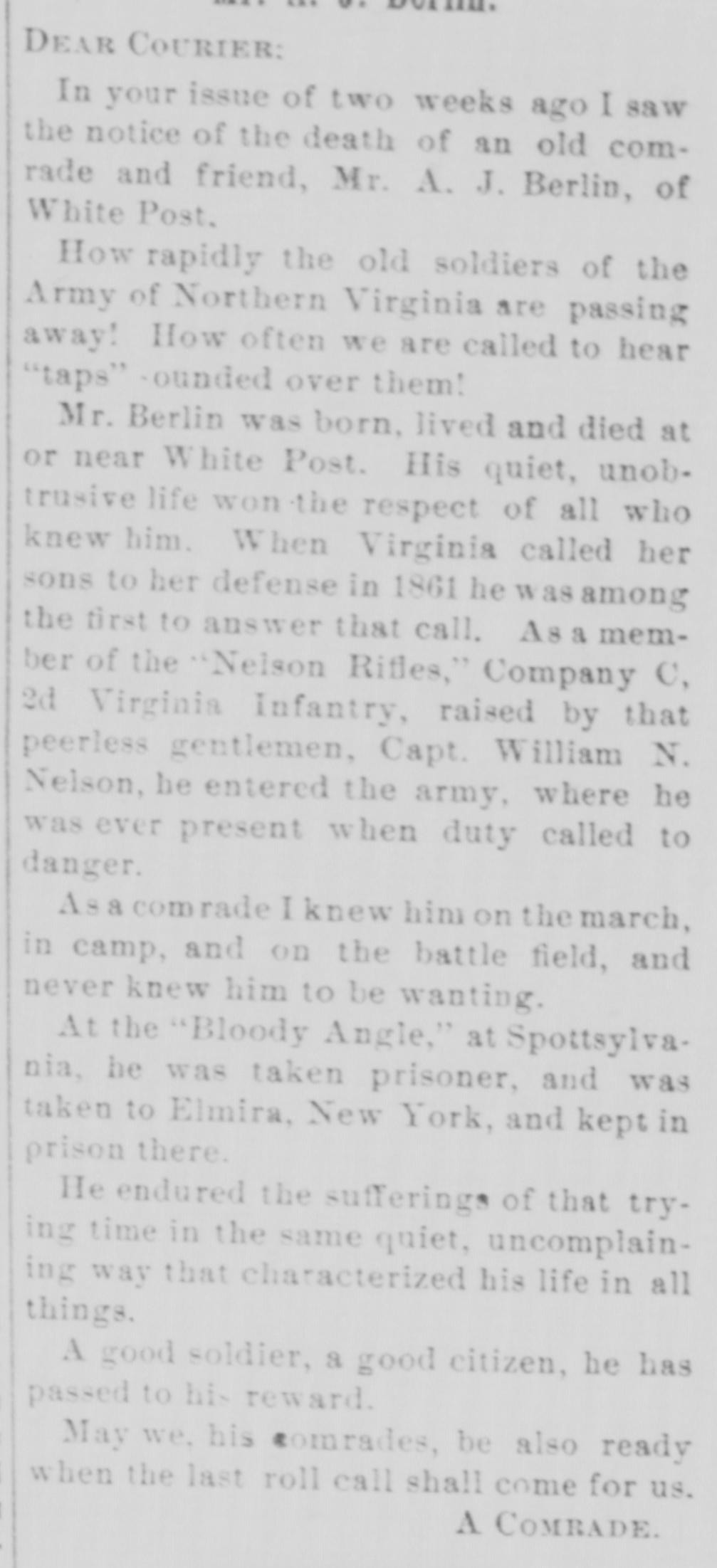
A comrade's letter on A. J. Berlin of White Post, taken prisoner at the Bloody Angle and held at Elmira.
What this image does and does not showA crop of part of one page; the rest of the page is not shown.
Clarke Courier (Berryville, Va.), February 27, 1907, page 1. Library of Congress, Chronicling America. Rights Changes: Cropped from the Library of Congress page image to the region of this item: 1007 by 2203 pixels, shown at its own 1007 by 2203 pixels; re-encoded as JPEG. Nothing retouched or added.
Source: Clarke Courier, Berryville, Va., February 27, 1907, page 1: a letter on A. J. Berlin of White Post, signed "A Comrade" Open the full image
Other prisons
William A. Riely of the Clarke Cavalry "languished in a Federal prison for 15 months." James W. Doran of Millwood, of the same company, was held in prison at Washington. And the Courier's own editor, John O. Crown, had been a prisoner at Point Lookout. After his death his pamphlet, "A Chapter of Prison Life in a Northern Prison," dedicated to the J. E. B. Stuart Camp, was praised by a correspondent in 1900.
Source note: Clarke Courier, Berryville, Va., 1905
William A. Riely of the Clarke Cavalry "languished in a Federal prison for 15 months," his 1905 notice says.
What the source supports
Riely's prison term.
Uncertainty
The notice does not name the prison.
Source
Evidence role: supports. Clarke Cavalry.
Clarke Courier, Berryville, Va., August 16, 1905, page 1: the death notice of William A. Riley (Riely)
Clarke Courier, Berryville, Va. · 1905-08-16 (publication)
Locator: Page 1, the death notice of William A. Riley
Relevant passageIn the Civil War he served with distinction as a member of the Clarke Cavalry.
Checked: Original inspected. A digital reproduction was inspected; no original has been handled.
Open sourceSource family: clarke-courier. Multiple passages from one source are not independent witnesses.
Evidence role: supports. Fifteen months.
Clarke Courier, Berryville, Va., August 16, 1905, page 1: the death notice of William A. Riley (Riely)
Clarke Courier, Berryville, Va. · 1905-08-16 (publication)
Locator: Page 1, the death notice of William A. Riley
Relevant passageHe was captured and languished in a Federal prison for 15 months.
Checked: Original inspected. A digital reproduction was inspected; no original has been handled.
Open sourceSource family: clarke-courier. Multiple passages from one source are not independent witnesses.
AI-assisted source check (Claude Opus 5.5) · 2026-10-12. How this project checks its sources
Source note: Clarke Courier, Berryville, Va., 1903
James W. Doran of Millwood, of the Clarke Cavalry, was captured and held in prison at Washington, D.C., his 1903 notice says.
What the source supports
Doran's prison.
Uncertainty
The notice does not date it.
Source
Evidence role: supports. Of Millwood.
Clarke Courier, Berryville, Va., July 15, 1903, page 4: the notice of the funeral of James W. Doran
Clarke Courier, Berryville, Va. · 1903-07-15 (publication)
Locator: Page 4, the notice of James W. Doran
Relevant passageMr. Doran was born in Millwood, Va., 65 years ago and had lived near the scene of his birth all of his life.
Checked: Original inspected. A digital reproduction was inspected; no original has been handled.
Open sourceSource family: clarke-courier. Multiple passages from one source are not independent witnesses.
Evidence role: supports. Captured; prison at Washington.
Clarke Courier, Berryville, Va., July 15, 1903, page 4: the notice of the funeral of James W. Doran
Clarke Courier, Berryville, Va. · 1903-07-15 (publication)
Locator: Page 4, the notice of James W. Doran
Relevant passageDuring the Civil War he served in the Confederate army as a member of the Clarke Cavalry and was captured and confined in prison at Washington, D. C.
Checked: Original inspected. A digital reproduction was inspected; no original has been handled.
Open sourceSource family: clarke-courier. Multiple passages from one source are not independent witnesses.
AI-assisted source check (Claude Opus 5.5) · 2026-10-12. How this project checks its sources
Source note: Clarke Courier, Berryville, Va., 1900
John O. Crown, editor of the Clarke Courier, had been a prisoner at Point Lookout, and after his death his pamphlet "A Chapter of Prison Life in a Northern Prison," dedicated to the J. E. B. Stuart Camp, was praised by a correspondent in 1900.
What the source supports
That the Courier's own editor had been a prisoner and wrote about it.
Uncertainty
The pamphlet itself was not found or read for this story.
Source
Evidence role: supports. The pamphlet.
Clarke Courier, Berryville, Va., October 10, 1900, page 4: a correspondent's letter signed "G. M. C.," on John O. Crown's prison pamphlet
Clarke Courier, Berryville, Va. · 1900-10-10 (publication)
Locator: Page 4, the letter signed "G. M. C."
Relevant passageWe have read with much pleasure and interest a neat little pamphlet entitled "A Chapter of Prison Life in a Northern Prison," by the late Mr. John O. Crown, editor of the Clarke Courier, and dedicated to his comrades of the J. E. B. Stuart Camp of Confederate Veterans, of this place.
Checked: Original inspected. A digital reproduction was inspected; no original has been handled.
Open sourceSource family: clarke-courier. Multiple passages from one source are not independent witnesses.
Evidence role: supports. Point Lookout.
Clarke Courier, Berryville, Va., October 10, 1900, page 4: a correspondent's letter signed "G. M. C.," on John O. Crown's prison pamphlet
Clarke Courier, Berryville, Va. · 1900-10-10 (publication)
Locator: Page 4, the letter signed "G. M. C."
Relevant passageMr. Crown was a prisoner at Point Lookout.
Checked: Original inspected. A digital reproduction was inspected; no original has been handled.
Open sourceSource family: clarke-courier. Multiple passages from one source are not independent witnesses.
AI-assisted source check (Claude Opus 5.5) · 2026-10-12. How this project checks its sources
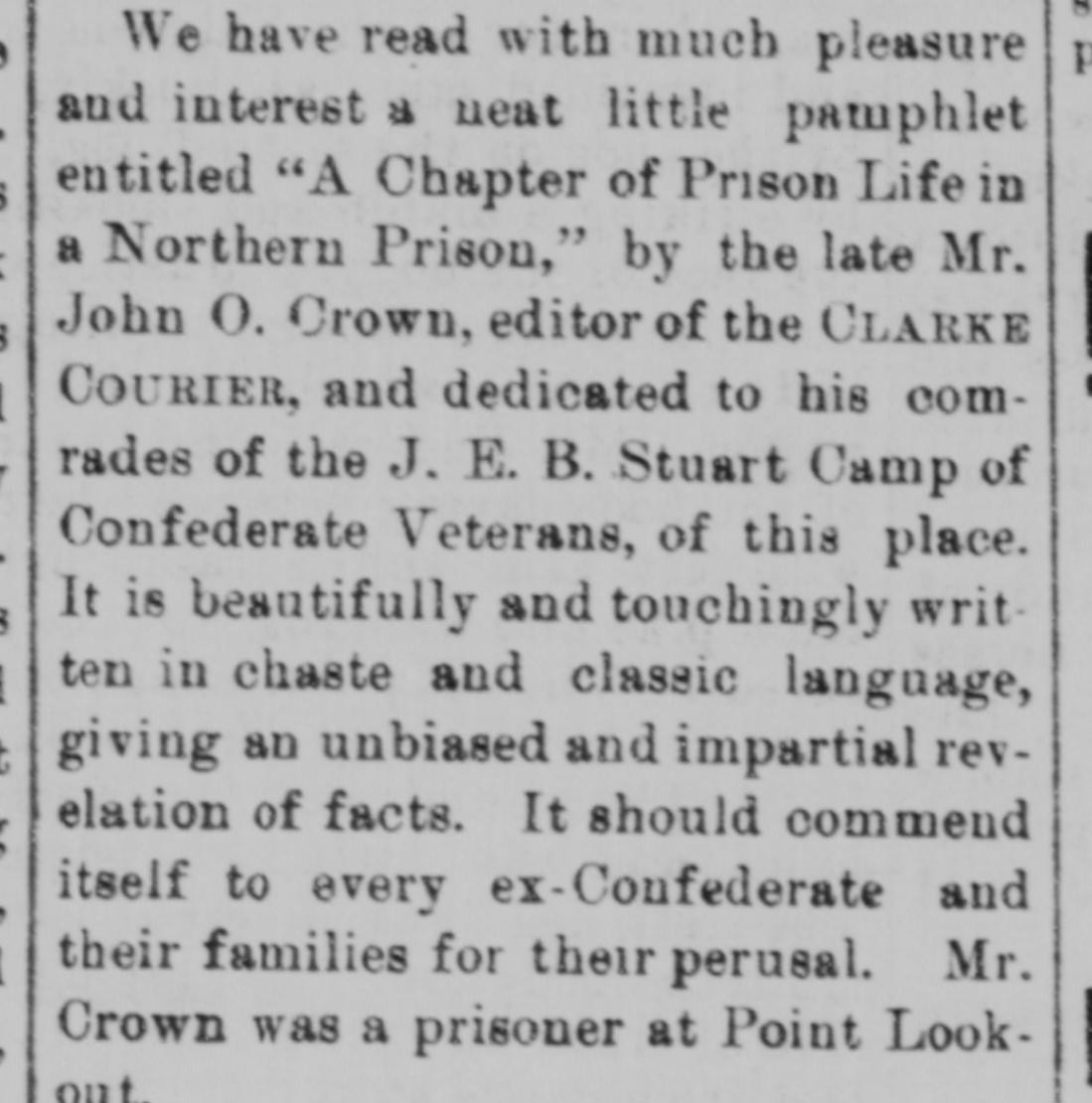
A correspondent on "A Chapter of Prison Life in a Northern Prison," by the Courier's late editor, John O. Crown, once a prisoner at Point Lookout.
What this image does and does not showA crop of part of one page; the rest of the page is not shown.
Clarke Courier (Berryville, Va.), October 10, 1900, page 4. Library of Congress, Chronicling America. Rights Changes: Cropped from the Library of Congress page image to the region of this item, then cropped again to the opening of the report: 1099 by 1110 pixels, shown at its own 1099 by 1110 pixels; re-encoded as JPEG. Nothing retouched or added.
Source: Clarke Courier, Berryville, Va., October 10, 1900, page 4: a correspondent's letter signed "G. M. C.," on John O. Crown's prison pamphlet Open the full image
About the noticesWhat the evidence says
Eight Clarke Courier notices and letters of 1900 to 1923, read on the Library of Congress page images, tell what the county remembered of its Confederate soldiers held in Northern prisons.
Every account was written long after the war, mostly from the men's own stories, and none is checked here against a prison or pension record. The Van Meter release is the family's story as the notice gave it.
- An account exists✓ Supported by a source
His notice tells how in 1864 Mrs. Van Meter found Bedell, a Union soldier who had lost a leg after a skirmish on the Opequon, near death in a house near their farm, where a Black man was caring for him; she told the Union general at Harpers Ferry, took Bedell into her own garret and nursed him back to health.
See the evidence
✓ Supported by a sourceAn account existsHis notice tells how in 1864 Mrs. Van Meter found Bedell, a Union soldier who had lost a leg after a skirmish on the Opequon, near death in a house near their farm, where a Black man was caring for him; she told the Union general at Harpers Ferry, took Bedell into her own garret and nursed him back to health.
What the source supports
Mrs. Van Meter's care of a wounded Union soldier, as her husband's notice told it.
Uncertainty
Told fifty-six years later; the man who first cared for Bedell is not named, and Bedell's first name and unit are not given.
Source
Reporting Evidence role: supports. Bedell wounded and cared for.
Clarke Courier, Berryville, Va., August 19, 1920, page 1: "J. L. E. Van Meter, Aged Farmer, Dies"
Clarke Courier, Berryville, Va. · 1920-08-19 (publication)
Locator: Page 1, "J. L. E. Van Meter, Aged Farmer, Dies"
Relevant passageA Mr. Bedell, a Union soldier, was wounded in a skirmish in Clarke county on the Opequon in 1864. Bedell's leg was amputated and he was taken to a house near the Van Meter farm and cared for by a colored man.
Checked: Original inspected. A digital reproduction was inspected; no original has been handled.
Open sourceSource family: clarke-courier. Multiple passages from one source are not independent witnesses.
Reporting Evidence role: supports. Mrs. Van Meter finds him.
Clarke Courier, Berryville, Va., August 19, 1920, page 1: "J. L. E. Van Meter, Aged Farmer, Dies"
Clarke Courier, Berryville, Va. · 1920-08-19 (publication)
Locator: Page 1, "J. L. E. Van Meter, Aged Farmer, Dies"
Relevant passageMrs. Van Meter discovered Bedell in the delapidated house, who then was in almost dying condition.
Checked: Original inspected. A digital reproduction was inspected; no original has been handled.
Open sourceSource family: clarke-courier. Multiple passages from one source are not independent witnesses.
Reporting Evidence role: supports. Harpers Ferry and the garret.
Clarke Courier, Berryville, Va., August 19, 1920, page 1: "J. L. E. Van Meter, Aged Farmer, Dies"
Clarke Courier, Berryville, Va. · 1920-08-19 (publication)
Locator: Page 1, "J. L. E. Van Meter, Aged Farmer, Dies"
Relevant passageMrs. Van Meter then drove to Harpers Ferry and told Gen. Stephenson of Bedell's condition. She returned and later removed Bedell to the garret of her own home, where she kept him protected and nursed him back to health.
Checked: Original inspected. A digital reproduction was inspected; no original has been handled.
Open sourceSource family: clarke-courier. Multiple passages from one source are not independent witnesses.
AI-assisted source check (Claude Opus 5.5) · 2026-10-12. How this project checks its sources
- An account exists✓ Supported by a source
As a reward, the notice says, the general had the War Department release Van Meter from prison, and the Van Meters and the Bedells visited each other for years afterward.
See the evidence
✓ Supported by a sourceAn account existsAs a reward, the notice says, the general had the War Department release Van Meter from prison, and the Van Meters and the Bedells visited each other for years afterward.
What the source supports
The release, as the family's story gave it.
Uncertainty
No release record was read for this story.
Source
Reporting Evidence role: supports. The release and the friendship.
Clarke Courier, Berryville, Va., August 19, 1920, page 1: "J. L. E. Van Meter, Aged Farmer, Dies"
Clarke Courier, Berryville, Va. · 1920-08-19 (publication)
Locator: Page 1, "J. L. E. Van Meter, Aged Farmer, Dies"
Relevant passageAs a reward for what she had done, Gen. Stephenson had the War Department to release Mr. Van Meter from prison. A lasting friendship sprung up between the Van Meters and the Bedells and the two families exchanged visits for years.
Checked: Original inspected. A digital reproduction was inspected; no original has been handled.
Open sourceSource family: clarke-courier. Multiple passages from one source are not independent witnesses.
AI-assisted source check (Claude Opus 5.5) · 2026-10-12. How this project checks its sources
- An account exists✓ Supported by a source
John C. Rutherford, color-bearer of Co. F, 52nd Virginia, was captured at Cold Harbor and held at Elmira, New York, until the war ended; his 1923 tribute retells his stories of bunking with a smallpox patient, holding his washing while it dried so no one would steal it, and trading the whiskey ration for ditch-digging for bread and meat.
See the evidence
✓ Supported by a sourceAn account existsJohn C. Rutherford, color-bearer of Co. F, 52nd Virginia, was captured at Cold Harbor and held at Elmira, New York, until the war ended; his 1923 tribute retells his stories of bunking with a smallpox patient, holding his washing while it dried so no one would steal it, and trading the whiskey ration for ditch-digging for bread and meat.
What the source supports
Rutherford's prison stories, as he told them.
Uncertainty
His own stories, retold in a tribute after his death; the unit is from the same tribute.
Source
Reporting Evidence role: supports. Color-bearer, Co. F, 52nd Va.
Clarke Courier, Berryville, Va., March 1, 1923
Clarke Courier · 1923-03-01 (publication)
Locator: Page 4, the tribute to John C. Rutherford
Relevant passageAt the outbreak of the civil war Mr. Rutherford joined Capt. James Bumgardner's Company (F) in the 52nd Regt. Virginia Volunteers, and was later made color bearer and a corporal.
Checked: This passage was read on a digital reproduction of the page; no original has been handled. The source's other readings: existing OCR reviewed, original image not independently inspected.
Open sourceSource family: clarke-courier. Multiple passages from one source are not independent witnesses.
Reporting Evidence role: supports. Captured and held at Elmira.
Clarke Courier, Berryville, Va., March 1, 1923
Clarke Courier · 1923-03-01 (publication)
Locator: Page 4, the tribute to John C. Rutherford
Relevant passageMr. Rutherford was captured at the Battle of Cold Harbor on May 30th and taken to Elmire [sic], N. Y., whene [sic] he was held a prisoner of war until the war was over.
Checked: This passage was read on a digital reproduction of the page; no original has been handled. The source's other readings: existing OCR reviewed, original image not independently inspected.
Open sourceSource family: clarke-courier. Multiple passages from one source are not independent witnesses.
Reporting Evidence role: supports. The smallpox bunkmate.
Clarke Courier, Berryville, Va., March 1, 1923
Clarke Courier · 1923-03-01 (publication)
Locator: Page 4, the tribute to John C. Rutherford
Relevant passageOn one occasion he was made to bunk with a comrade who had smallpox and slept with him. He never contracted the disease.
Checked: This passage was read on a digital reproduction of the page; no original has been handled. The source's other readings: existing OCR reviewed, original image not independently inspected.
Open sourceSource family: clarke-courier. Multiple passages from one source are not independent witnesses.
Reporting Evidence role: supports. The washing.
Clarke Courier, Berryville, Va., March 1, 1923
Clarke Courier · 1923-03-01 (publication)
Locator: Page 4, the tribute to John C. Rutherford
Relevant passageIn prison his clothes were ragged and few. He often said that when he washed his underwear he had to hold it while it dried lest some one would steal it.
Checked: This passage was read on a digital reproduction of the page; no original has been handled. The source's other readings: existing OCR reviewed, original image not independently inspected.
Open sourceSource family: clarke-courier. Multiple passages from one source are not independent witnesses.
Reporting Evidence role: supports. The whiskey traded for food.
Clarke Courier, Berryville, Va., March 1, 1923
Clarke Courier · 1923-03-01 (publication)
Locator: Page 4, the tribute to John C. Rutherford
Relevant passageWhen in prison he was compelled to do work, for which the prison authorties [sic] always gave the Soldiers a ration of whiskey. This work was often digging ditches in water over the shoe tops. Mr. Rutherford would take the whiskey and trade it for bread and meat. He never drank.
Checked: This passage was read on a digital reproduction of the page; no original has been handled. The source's other readings: existing OCR reviewed, original image not independently inspected.
Open sourceSource family: clarke-courier. Multiple passages from one source are not independent witnesses.
AI-assisted source check (Claude Opus 5.5) · 2026-10-12. How this project checks its sources
- An account exists✓ Supported by a source
Dilmon Estep, captured at Spotsylvania Court House and held to the end of the war, worked as a carpenter around the prison at Fort Delaware; in 1867 he came to Clarke, where he built barns and houses and the old white schoolhouse and hall at Millwood, his 1918 notice says.
See the evidence
✓ Supported by a sourceAn account existsDilmon Estep, captured at Spotsylvania Court House and held to the end of the war, worked as a carpenter around the prison at Fort Delaware; in 1867 he came to Clarke, where he built barns and houses and the old white schoolhouse and hall at Millwood, his 1918 notice says.
What the source supports
Estep's prison work and his building in Clarke.
Uncertainty
A death notice; the buildings were not identified on the ground for this story.
Source
Reporting Evidence role: supports. Carpenter at Fort Delaware.
Clarke Courier, Berryville, Va., June 13, 1918, page 1: the death notice of Dilmon Estep
Clarke Courier, Berryville, Va. · 1918-06-13 (publication)
Locator: Page 1, the death notice of Dilmon Estep
Relevant passageWas taken prisoner at Spottsylvania Court House and held as such until the end of the war, but not having the spirit of idleness, he was busily engaged as a carpenter around the old prison at Fort Delaware.
Checked: Original inspected. A digital reproduction was inspected; no original has been handled.
Open sourceSource family: clarke-courier. Multiple passages from one source are not independent witnesses.
Reporting Evidence role: supports. Came to Clarke and built.
Clarke Courier, Berryville, Va., June 13, 1918, page 1: the death notice of Dilmon Estep
Clarke Courier, Berryville, Va. · 1918-06-13 (publication)
Locator: Page 1, the death notice of Dilmon Estep
Relevant passageIn 1867 he came to Clarke county, and built several barns and houses, some of which are still standing,
Checked: Original inspected. A digital reproduction was inspected; no original has been handled.
Open sourceSource family: clarke-courier. Multiple passages from one source are not independent witnesses.
Reporting Evidence role: supports. The Millwood schoolhouse and hall.
Clarke Courier, Berryville, Va., June 13, 1918, page 1: the death notice of Dilmon Estep
Clarke Courier, Berryville, Va. · 1918-06-13 (publication)
Locator: Page 1, the death notice of Dilmon Estep
Relevant passageand the old white school house and hall at Millwood.
Checked: Original inspected. A digital reproduction was inspected; no original has been handled.
Open sourceSource family: clarke-courier. Multiple passages from one source are not independent witnesses.
AI-assisted source check (Claude Opus 5.5) · 2026-10-12. How this project checks its sources
Each statement above is assessed on its own evidence. Nothing here is averaged, scored or voted on, and a well-attributed account can be documented while what it describes stays unconfirmed.
Source note
This story rests on Clarke Courier notices of 1900 to 1923, read on the Library of Congress page images. They were written decades after the war, mostly from what the men themselves had told, and are retold here as the notices give them; no prison record was read. The notices' language ("the Stars and Bars") is theirs; this site does not adopt it. The Van Meter notice prints the general's name "Stephenson" and calls the man who first cared for Bedell only "a colored man"; his name is not known. John O. Crown's pamphlet was not found. The men named are on this site's roll of Clarke's veterans.
Who was Bedell, the Union soldier Mrs. Van Meter nursed in 1864, and do the prison and pension records bear out her husband's release?
Know more about this story, or see something to correct? Help fill a gap. It stays private until it is reviewed.
Remember this place or someone in this story? Share a memory, even if you do not know the date. It stays private until it is reviewed.
Go deeper: every source under this story Follow another threadThe last roll call: the Clarke Cavalry, 1884 to 1918
How the Clarke Cavalry's survivors kept their company together after the war.